
INTRODUCTION OF THE CENTRAL NERVOUS SYSTEM CNS By
INTRODUCTION OF THE CENTRAL NERVOUS SYSTEM (CNS) By ADEDAYO, Lawrence D. Department of Physiology Bowen University Iwo, Nigeria Lecture 1
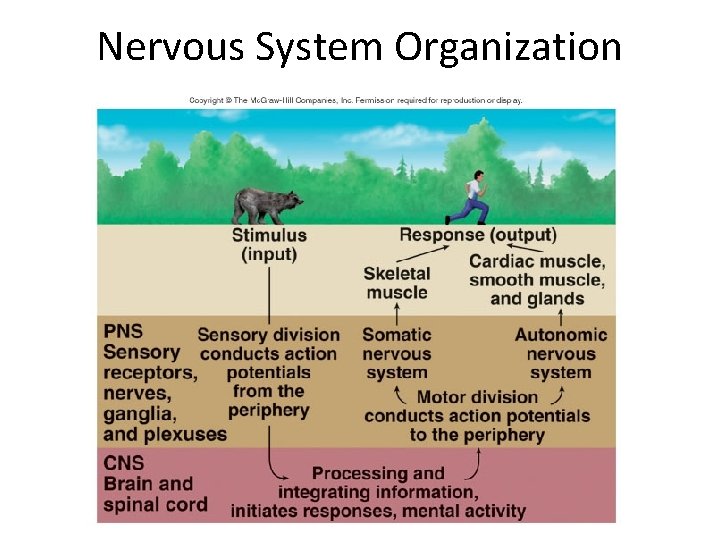
What is CNS? v. The nervous system like a sentry, it uses its millions of sensory receptors to monitor changes occurring both inside and outside the body. v. These changes are called stimuli, and the gathered information is called sensory input. v It processes and interprets the sensory input and makes decisions about what should be done at each moment – a process called integration. v. It then effects a response by activating muscles or glands (effectors) via motor output.
Nervous System Organization
Cont’d v The two principle divisions of the nervous system are the central and peripheral. v The former consists of the brain and spinal cord, while the latter is the rest of the nervous system. The brain and spinal cord carry out the bulk of the complex processing, v while the peripheral acts as a sort of buffer between the central nervous system and the outside world. v The peripheral system can be further subdivided into the somatic and automatic v The former is responsible for somatosensation and conscious/purposeful action, while the latter is responsible for "vegetative"processes. v The autonomic division can also be divided into two systems, the sympathetic and parasympathetic, which carry out the opposing processes of arousal and relaxation.
CHARACTERISTICS OF THE CNS v. The most fundamental way of categorizing groups of neurons that makes up the central nervous system is as nuclei and tracts. v. The nuclei are collections of cell bodies and tracts are pathways consisting of large groups of axons. v Due to their myelin the axons often appear white and the cell bodies appear gray, thus creating what is often referred to as gray and white matter in the brain.
Cont’d v The brain occupies the cranial cavity and is composed of one hundred billion neurons and innumerable nerve fibers, by which the neurons communicate with one another and with neurons in other parts of the system. v It can also be refer to a big collection of nuclei and groups of nuclei where processing occurs, and tracts which carry the messages from one group of nuclei to another.
Cont’d v. The brain is not neatly divided into sections, rather the "structures" refer to areas where clumps of nuclei occur, these areas are not neatly partitioned off from other areas, rather all the structures are interconnected in a myriad of complex patterns.

THE PROTECTIVE STRUCTURES OF THE CNS v The importance of the central nervous system is reflected in the way in which it is protected. v They are protected in the following ways: v The brain sits inside the skull and the spinal cord is surrounded by a series of vertebrae. v Inside these bony structures lie a series of layers of tissue referred to as meninges.
Cont’d v These meninges surround the brain and spinal cord, and act as a protective lining additional layers of protection. Within the layers of the meninges is a channel referred to as the subarachnoid space and, within this space the cerebral spinal fluid (CSF) runs. v The blood-brain barrier also offers protection to the brain by preventing hazardous substances from entering the brain.
Structures at the Base of the Brain (rhombencephalon) v At the very base of the brain is a structure referred to as the medulla. v The medulla is responsible for basic survival and, thus controls heart rate and respiration. In this sense the medulla is the least important structure for complex processing, and the most important for survival. v As we move up the brain stem we encounter the cerebellum, which is a large structure in the back of the brain, that looks like a miniature version of the brain. The cerebellum is important for smooth/coordinated movements, and for the integration of different sensory information for the purpose of controlling movement.
Cont’d v. The reticular activating system (RAS). The RAS sends out tracts that affect many other structures of the brain, and, as a result, the activity of the RAS has a diffuse effect on the brain as a whole. It is primarily important in attention and wakefulness. v. At this moment the amount of attention that you are paying to this lesson, is to some extent, a function of RAS activity.
Structures in the Middle of the Brain v In the middle brain we contact a number of small structures which play large roles. v Among these is the thalamus. Most of the sensory information that comes from the various senses is funneled through the thalamus. v There the information passes through one of many specialized nuclei and is directed toward the appropriate site. For example, visual information passes from the eye, down the optic nerve to the thalamus and then to the visual cortex.
Cont’d v. Also in the middle of the brain is a set of interconnected structures which play an important role in emotion, and memory. v. These structures are referred to as the limbic system. Three of the most important structures in the limbic system are the amygdala, the hypothalamus, and the hippocampus.
The Cerebral Cortex v Surely one of the most interesting brain structures is the very thin outer coating of the brain which is referred to as the cerebral cortex. v The outer covering is very wrinkled, which acts to greatly increase the cortex surface area, so that it's thin width is somewhat misleading with regard to its size. v The cortex is the most uniquely "human" part of our brain. This structure is responsible for the highest level types of human function (e. g. , speech processing). v Each half/hemisphere of the cortex can be considered as four lobes, the frontal, parietal, occipital, and temporal. Within each of these lobes is a relatively small area of cortex that's responsible for a specific motor or sensory function.
THE BRAINSTEM • Is the region between the diencephalons and the spinal cord. It consists of three parts: midbrain, pons, and medulla oblongata. • The midbrain is the most superior portion of the brain stem. The pons is the bulging middle portion of the brain stem. • This region primarily consists of nerve fibers that form conduction tracts between the higher brain centers and spinal cord. The medulla oblongata, or simply medulla, extends inferiorly from the pons. • It is continuous with the spinal cord at the foramen magnum. All the ascending (sensory) and descending (motor) nerve fibers connecting the brain and spinal cord pass through the medulla. • Each part of brain stem is connected to cerebellum by cerebellar peduncles (superior, middle & inferior).
Cont’d General functions of the brainstem • Pathway of tracts between cerebral cortex & spinal cord. • Site of origin of nuclei of cranial nerves (from 3 rd to 12 th). • Site of emergence of cranial nerves (from 3 rd to 12 th). • Contains groups of nuclei & related fibers known as reticular formation responsible for: control of level of consciousness, perception of pain, cardiovascular & respiratory systems regulation of
BASAL GANGLIA § The basal ganglia and the lateral portions of the cerebellum (neocerebellum) are part of a feedback circuit to the premotor and motor cortex that is concerned with planning and organizing voluntary movement. § The basal ganglia convert thoughts into a motor plan, and put the program of the performance especially of slow movements, then discharge to the cortical motor areas which also share in planning and programming processes especially the supplementary and premotor areas.
The spinal cord v The spinal cord conducts sensory information from the peripheral nervous system (both somatic and autonomic) to the brain. It conducts motor information from the brain to various effectors namely: § skeletal muscles § cardiac muscle § smooth muscle § glands
The main functions of the spinal cord 1. It connects a large part of the peripheral nervous system to the brain. § The tracts conducting impulses from body parts and carrying sensory information to the brain are called ascending tracts § Those conducting motor impulses from the brain to muscles and glands are called descending tracts. 2. The spinal cord also acts as a minor coordinating center responsible for some simple reflexes like the withdrawal reflex.

Thanks for listening
- Slides: 20