
Introduction of System Dynamics Chapter One Historical Overview
- Slides: 20
Introduction of System Dynamics Chapter One
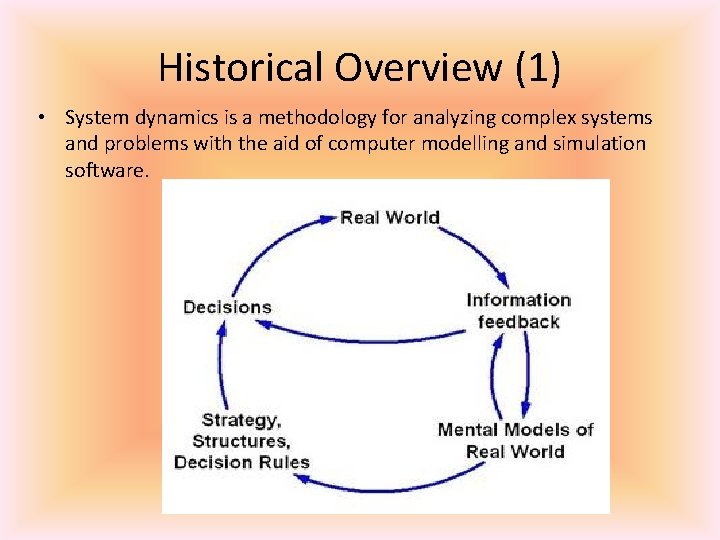
Historical Overview (1) • System dynamics is a methodology for analyzing complex systems and problems with the aid of computer modelling and simulation software.
Historical Overview (2) • Originated from the research of Professor Jay W. Forrester at Massachusetts Institute of Technology in the late 1950 s. • Initial goal was to determine how his background in science and engineering could be brought to bear, in some useful way • Involve d with managers at General Electric (GE) during the mid -1950 s. The business cycle was judged to be an insufficient explanation for the employment instability • From hand simulations (or calculations) of the stock-flowfeedback structure of the GE plants, which included the existing corporate decision-making structure for hiring and layoffs proves - instability in GE employment was due to the internal structure of the firm.
Historical Overview (3) • Late 1950 s and early 1960 s - Forrester and a team of graduate students developed formal computer modelling stage. • SIMPLE (Simulation of Industrial Management Problems with Lots of Equations) by Richard Bennett – first SD computer modeling language. • Phyllis Fox and Alexander Pugh wrote the first version of DYNAMO (DYNAmic MOdels), an improved version of SIMPLE • From the late 1950 s to the late 1960 s, system dynamics was applied almost exclusively to corporate/managerial problems. • The second major noncorporate application of system dynamics - Jay Forrester was invited by the Club of Rome (organization devoted to solving what its members describe as the "predicament of mankind“) —that is, the global crisis that may appear sometime in the future, due to the demands being placed on the Earth's carrying capacity (its sources of renewable and nonrenewable resources and its sinks for the disposal of pollutants) by the world's exponentially growing population.
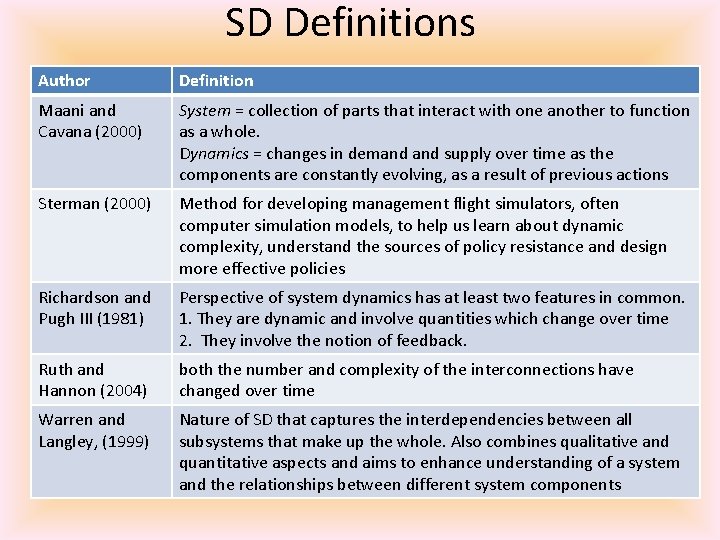
SD Definitions Author Definition Maani and Cavana (2000) System = collection of parts that interact with one another to function as a whole. Dynamics = changes in demand supply over time as the components are constantly evolving, as a result of previous actions Sterman (2000) Method for developing management flight simulators, often computer simulation models, to help us learn about dynamic complexity, understand the sources of policy resistance and design more effective policies Richardson and Pugh III (1981) Perspective of system dynamics has at least two features in common. 1. They are dynamic and involve quantities which change over time 2. They involve the notion of feedback. Ruth and Hannon (2004) both the number and complexity of the interconnections have changed over time Warren and Langley, (1999) Nature of SD that captures the interdependencies between all subsystems that make up the whole. Also combines qualitative and quantitative aspects and aims to enhance understanding of a system and the relationships between different system components
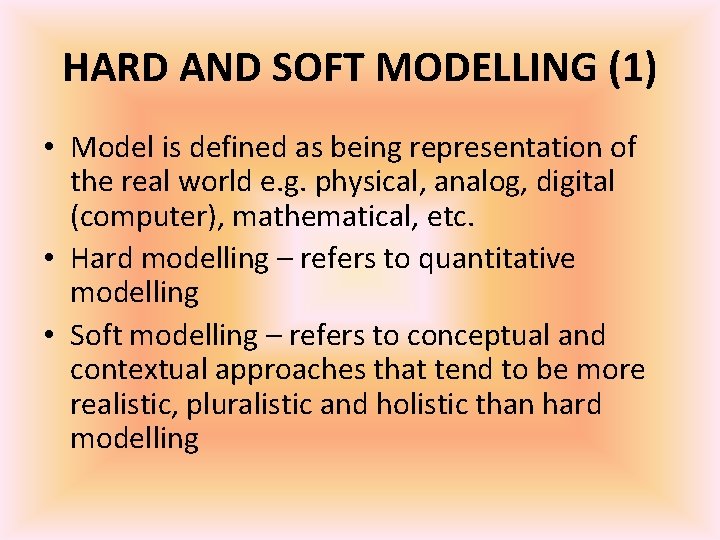
HARD AND SOFT MODELLING (1) • Model is defined as being representation of the real world e. g. physical, analog, digital (computer), mathematical, etc. • Hard modelling – refers to quantitative modelling • Soft modelling – refers to conceptual and contextual approaches that tend to be more realistic, pluralistic and holistic than hard modelling
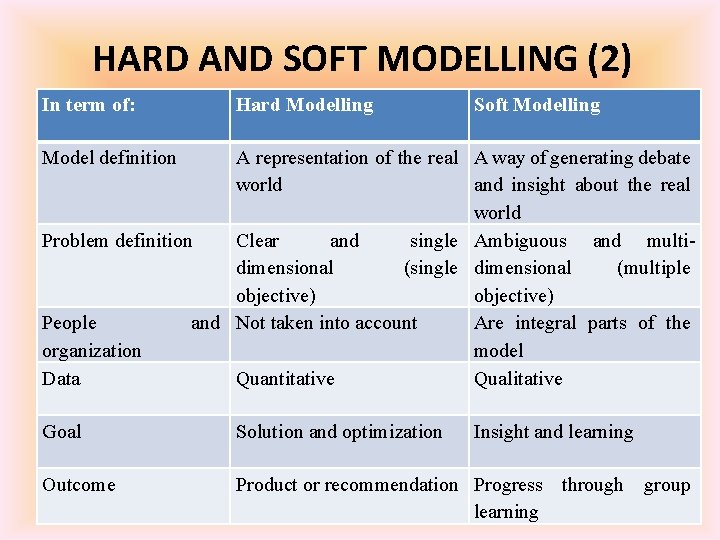
HARD AND SOFT MODELLING (2) In term of: Hard Modelling Soft Modelling Model definition A representation of the real A way of generating debate world and insight about the real world Problem definition Clear and single Ambiguous and multidimensional (single dimensional (multiple objective) People and Not taken into account Are integral parts of the organization model Data Quantitative Qualitative Goal Solution and optimization Insight and learning Outcome Product or recommendation Progress through group learning
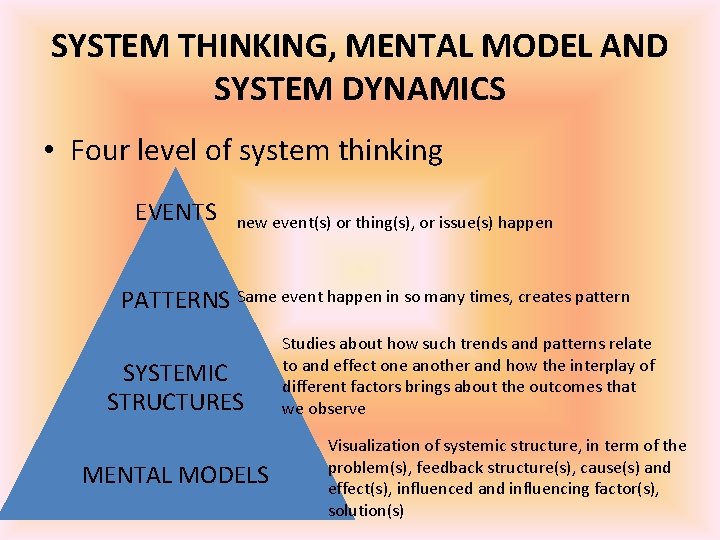
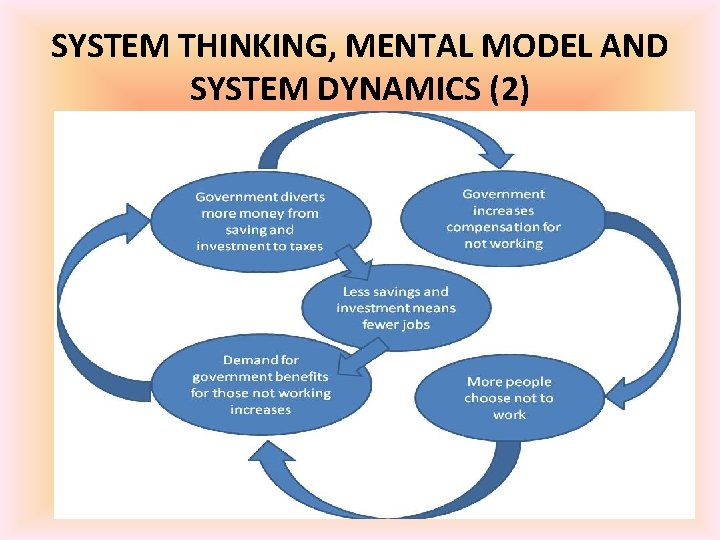
SYSTEM THINKING, MENTAL MODEL AND SYSTEM DYNAMICS • Four level of system thinking EVENTS new event(s) or thing(s), or issue(s) happen PATTERNS Same event happen in so many times, creates pattern SYSTEMIC STRUCTURES MENTAL MODELS Studies about how such trends and patterns relate to and effect one another and how the interplay of different factors brings about the outcomes that we observe Visualization of systemic structure, in term of the problem(s), feedback structure(s), cause(s) and effect(s), influenced and influencing factor(s), solution(s)
SYSTEM THINKING, MENTAL MODEL AND SYSTEM DYNAMICS (2)
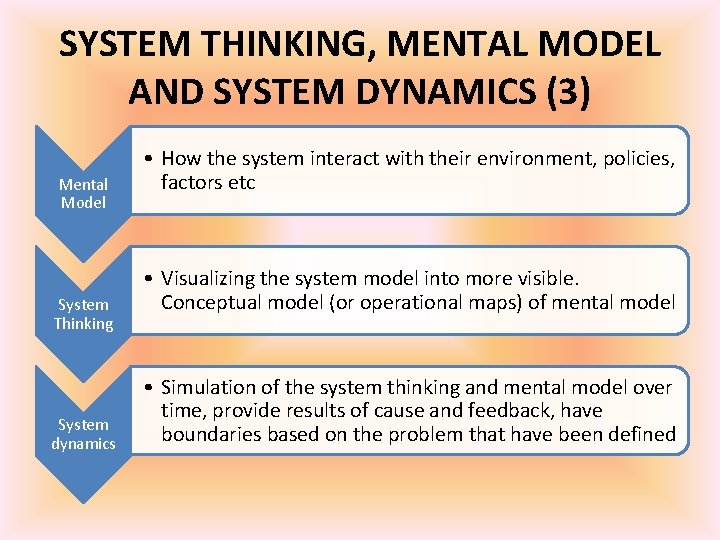
SYSTEM THINKING, MENTAL MODEL AND SYSTEM DYNAMICS (3) Mental Model System Thinking System dynamics • How the system interact with their environment, policies, factors etc • Visualizing the system model into more visible. Conceptual model (or operational maps) of mental model • Simulation of the system thinking and mental model over time, provide results of cause and feedback, have boundaries based on the problem that have been defined
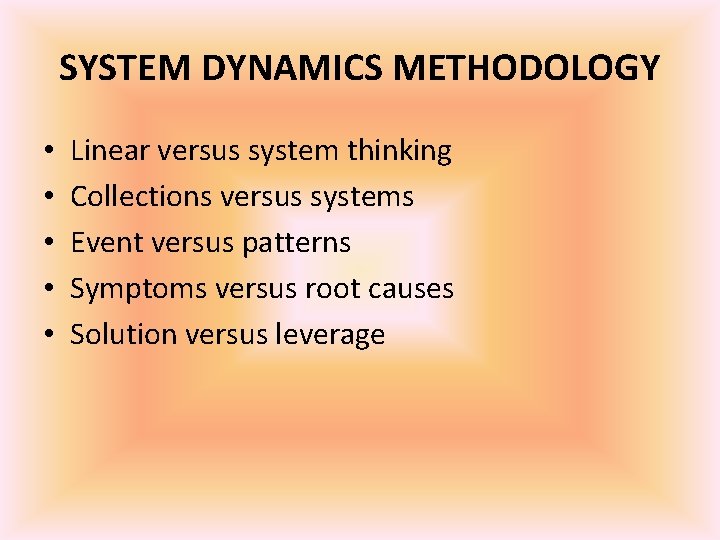
SYSTEM DYNAMICS METHODOLOGY • • • Linear versus system thinking Collections versus systems Event versus patterns Symptoms versus root causes Solution versus leverage
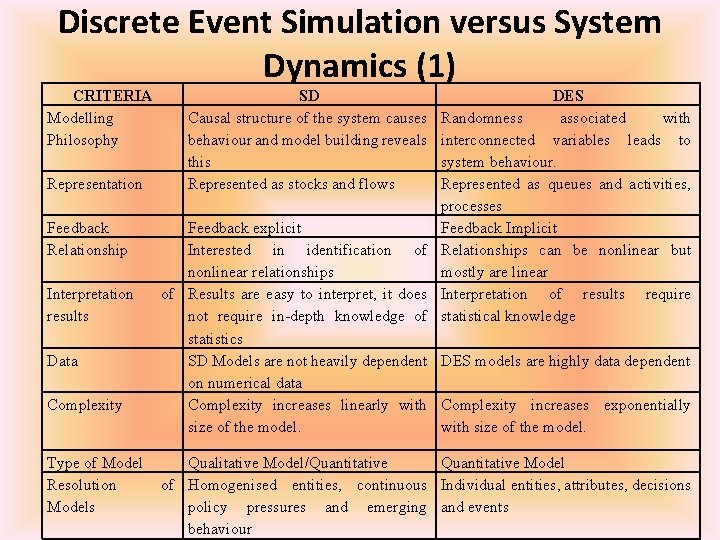
Discrete Event Simulation versus System Dynamics (1) CRITERIA Modelling Philosophy Representation Feedback Relationship Interpretation results Data Complexity Type of Model Resolution Models SD Causal structure of the system causes behaviour and model building reveals this Represented as stocks and flows DES Randomness associated with interconnected variables leads to system behaviour. Represented as queues and activities, processes Feedback explicit Feedback Implicit Interested in identification of Relationships can be nonlinear but nonlinear relationships mostly are linear of Results are easy to interpret, it does Interpretation of results require not require in-depth knowledge of statistical knowledge statistics SD Models are not heavily dependent DES models are highly data dependent on numerical data Complexity increases linearly with Complexity increases exponentially size of the model. with size of the model. Qualitative Model/Quantitative Model of Homogenised entities, continuous Individual entities, attributes, decisions policy pressures and emerging and events behaviour
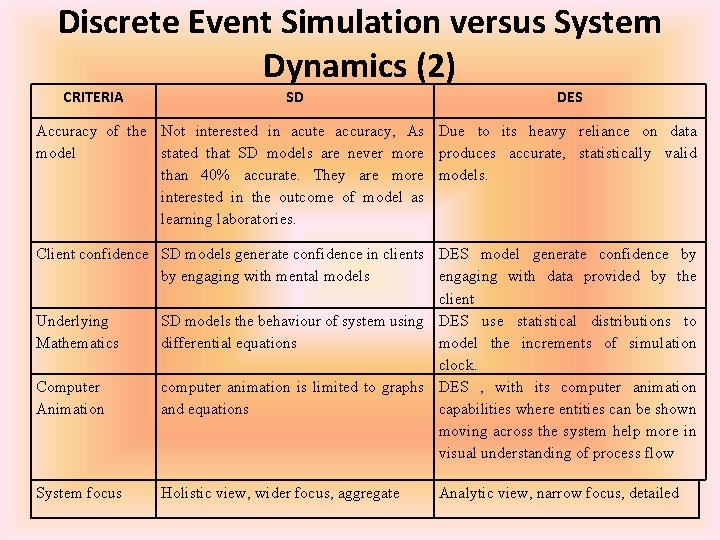
Discrete Event Simulation versus System Dynamics (2) CRITERIA SD DES Accuracy of the Not interested in acute accuracy, As Due to its heavy reliance on data model stated that SD models are never more produces accurate, statistically valid than 40% accurate. They are models. interested in the outcome of model as learning laboratories. Client confidence SD models generate confidence in clients DES model generate confidence by by engaging with mental models engaging with data provided by the client Underlying SD models the behaviour of system using DES use statistical distributions to Mathematics differential equations model the increments of simulation clock. Computer computer animation is limited to graphs DES , with its computer animation Animation and equations capabilities where entities can be shown moving across the system help more in visual understanding of process flow System focus Holistic view, wider focus, aggregate Analytic view, narrow focus, detailed
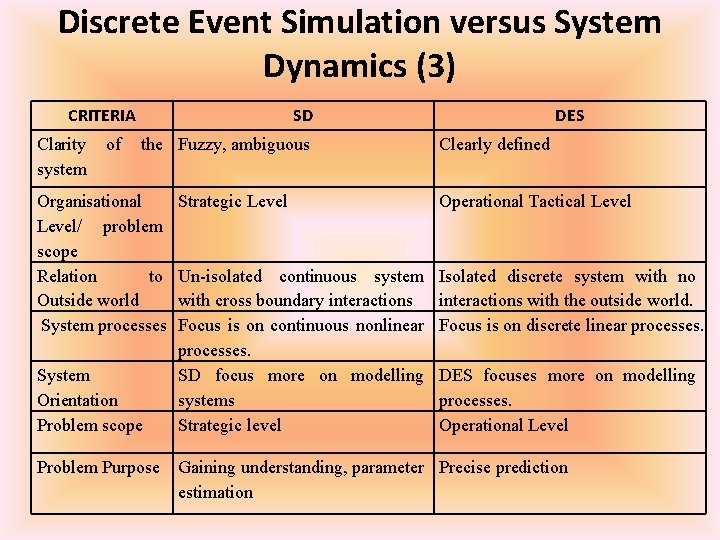
Discrete Event Simulation versus System Dynamics (3) CRITERIA Clarity system of SD the Fuzzy, ambiguous Organisational Level/ problem scope Relation to Outside world System processes System Orientation Problem scope Problem Purpose DES Clearly defined Strategic Level Operational Tactical Level Un-isolated continuous system with cross boundary interactions Focus is on continuous nonlinear processes. SD focus more on modelling systems Strategic level Isolated discrete system with no interactions with the outside world. Focus is on discrete linear processes. DES focuses more on modelling processes. Operational Level Gaining understanding, parameter Precise prediction estimation
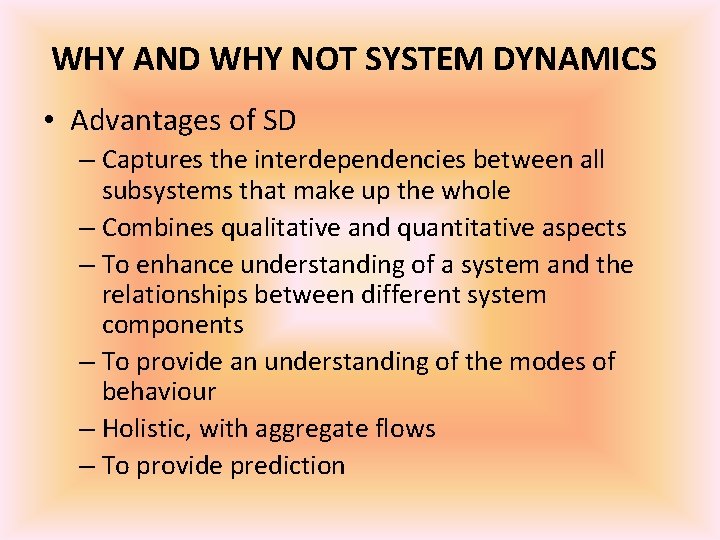
WHY AND WHY NOT SYSTEM DYNAMICS • Advantages of SD – Captures the interdependencies between all subsystems that make up the whole – Combines qualitative and quantitative aspects – To enhance understanding of a system and the relationships between different system components – To provide an understanding of the modes of behaviour – Holistic, with aggregate flows – To provide prediction
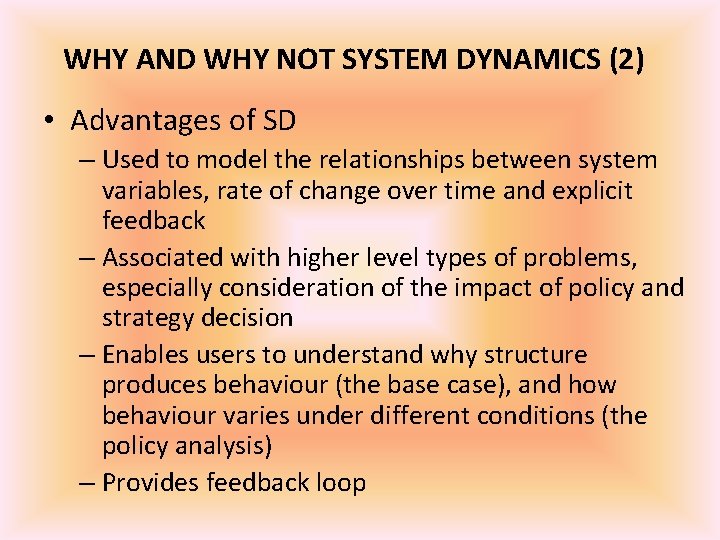
WHY AND WHY NOT SYSTEM DYNAMICS (2) • Advantages of SD – Used to model the relationships between system variables, rate of change over time and explicit feedback – Associated with higher level types of problems, especially consideration of the impact of policy and strategy decision – Enables users to understand why structure produces behaviour (the base case), and how behaviour varies under different conditions (the policy analysis) – Provides feedback loop
WHY AND WHY NOT SYSTEM DYNAMICS (3) • Disadvantages of SD – Cannot provide individual analysis – Not suitable for assessing hard/discrete/tangible factors – Not suitable to provides micro perspectives – Not suitable to assess short term effect
Hybrid Simulation (1) • Combining the DES and SD – will be beneficial when the detail, stochastic and individual analysis (provided by DES) and whole system approach (by SD) is combined. • Hybrid technique will work sort of information sharing, where DES and SD will consider taking and giving one to another • It will help the decision maker to consider a more reliable model prior to the implementation of any decision, as they can see from detail perspective to the whole picture
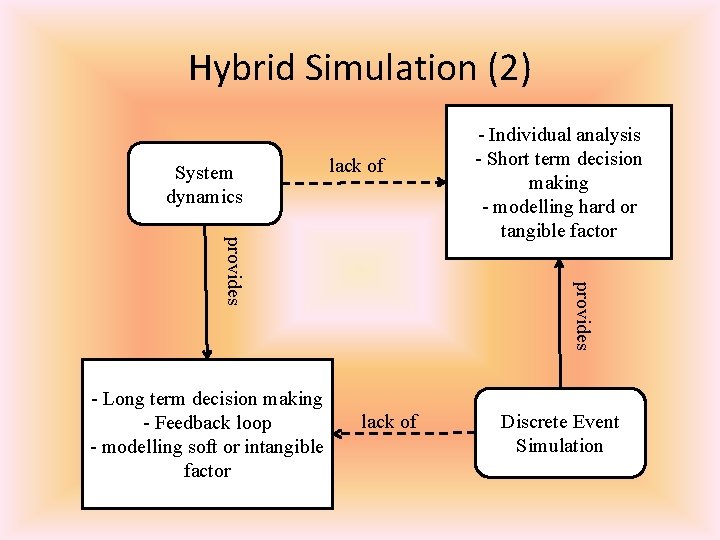
Hybrid Simulation (2) System dynamics lack of provides - Long term decision making - Feedback loop - modelling soft or intangible factor - Individual analysis - Short term decision making - modelling hard or tangible factor lack of Discrete Event Simulation
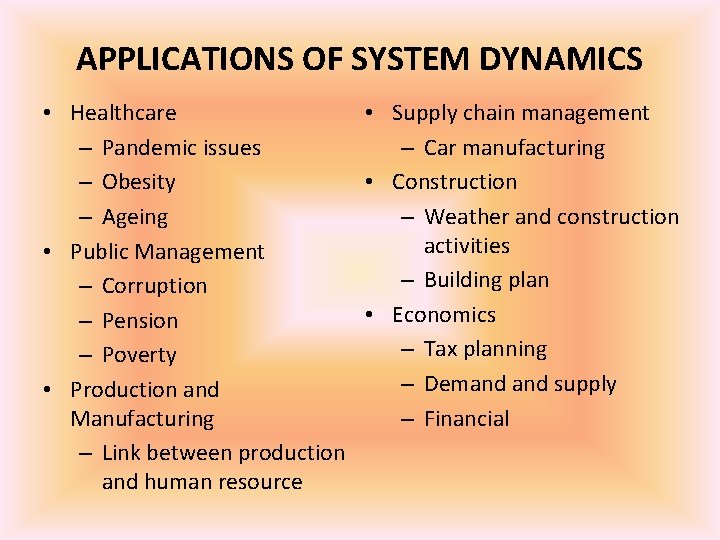
APPLICATIONS OF SYSTEM DYNAMICS • Supply chain management • Healthcare – Car manufacturing – Pandemic issues • Construction – Obesity – Ageing – Weather and construction activities • Public Management – Building plan – Corruption • Economics – Pension – Tax planning – Poverty – Demand supply • Production and Manufacturing – Financial – Link between production and human resource