
Introduction of Roles LITERATURE CIRCLES Student Jobs or
Introduction of Roles LITERATURE CIRCLES
Student Jobs or Roles in the Circle � Questioner/Discussion Leader/Summarizer � Researcher � Characterization � Figurative Language � Conflict & Theme � Illustrator
Here’s how it works � Each member of the circle will have a different job each week. � Points will be earned based on �Completing the assigned reading �Completing the assigned job and worksheet �Participating in the circle’s discussion � Students will not have the same job more than once during the novel.
Questioner/Discussion Leader/Summarizer � Questioner/Discussion Director/Summarizer: Your job is to develop a list of questions that your group might want to discuss about this part of the book. Don’t worry about the small details; your task is to help people talk over the big ideas in the reading and share their reactions. Usually the best discussion questions come from your own thoughts, feelings, and concerns as you read. You can list them during or after your reading. You will also need to summarizer the high points in that section of the novel.
Questioner/Discussion Leader/Summarizer You will list 5 topics/questions for discussion. You will keep track of any discussion topics or questions that need to be carried on to the next week’s discussion. � Consider the following: � A discussion of a work’s characters: are they realistic, symbolic, historically-based? � What motivates the characters or leads them to make the choices they do? � An in-depth discussion of the work’s events � A discussion of any confusing passage or event � The historical context and/or events that occurred in a particular work � Commentary on the social, political, or economic context in which a work was written –- how does the context influence the work? � An analysis of a specific image, passage, phrase, etc. � An analysis of a recurring image, phrase, event, etc. � �
Questioner/Discussion Leader/Summarizer � Example
A Bad Case of the Stripes by David Shannon
Questioner/Discussion Leader/Summarizer Example
Characterization: author’s development of characters. � You will choose 1 character and fill out a graphic organizer. � �You will write the character’s name in the center of the organizer. Then choose 3 adjectives that describe him/her. Write supporting quotes/textual evidence in the appropriate outer boxes. Be sure to include page numbers for any quotes or details from the text. Be prepared to explain your chart to your circle.
Characterization � You will find details and quotes from the novel about the character you chose for each of the following: �Other characters’ reactions �Phrases the author uses to describe the character �The character’s actions �The character’s physical appearance �The character’s dialogue
Characterization � Example
Characterization Example
Figurative Language � Figurative Language: Your job is to find examples in the reading of figurative language. You will fill out a chart with your examples. Be prepared to discuss with your circle why you chose these examples and what they add to the reading. You must find 4 examples of figurative language.
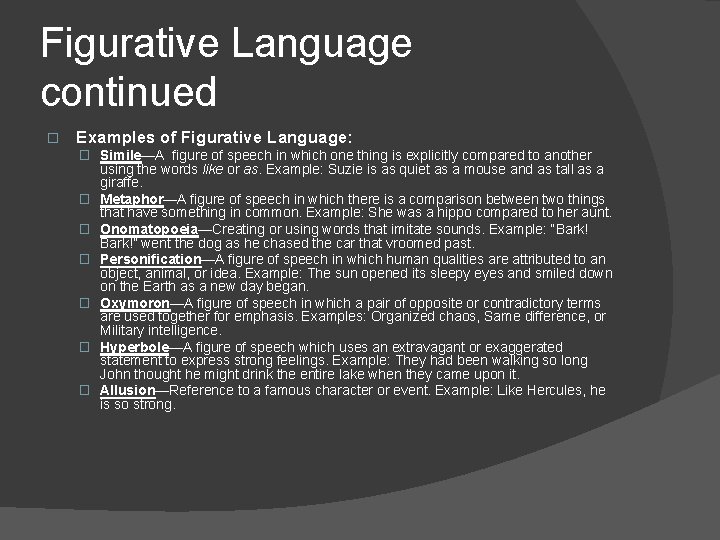
Figurative Language continued � Examples of Figurative Language: � Simile—A figure of speech in which one thing is explicitly compared to another � � � using the words like or as. Example: Suzie is as quiet as a mouse and as tall as a giraffe. Metaphor—A figure of speech in which there is a comparison between two things that have something in common. Example: She was a hippo compared to her aunt. Onomatopoeia—Creating or using words that imitate sounds. Example: “Bark!” went the dog as he chased the car that vroomed past. Personification—A figure of speech in which human qualities are attributed to an object, animal, or idea. Example: The sun opened its sleepy eyes and smiled down on the Earth as a new day began. Oxymoron—A figure of speech in which a pair of opposite or contradictory terms are used together for emphasis. Examples: Organized chaos, Same difference, or Military intelligence. Hyperbole—A figure of speech which uses an extravagant or exaggerated statement to express strong feelings. Example: They had been walking so long John thought he might drink the entire lake when they came upon it. Allusion—Reference to a famous character or event. Example: Like Hercules, he is so strong.
Figurative Language � Example
Figurative Language Example
Conflict & Theme � Conflict & Theme: Your job is to identify important conflicts within the book as well as finding the details that help to give us theme of the book. Be prepared to discuss both with your circle. �You will be expected to explain what type of conflict and how the conflict was resolved. �You will be expected to give 2 details or quotes that support your theme.
Conflict & Theme � Conflict—the struggle between opposing forces. � External Conflict—a character is pitted against an outside force, such as another character, a physical obstacle, or an aspect of nature or society. � Internal Conflict—the struggle takes place within a character. � Theme—the central idea or message. Theme is a perception about life or human nature shared with the reader. One way to discover theme is to think about what happens to the central characters. The importance of those events, stated in terms that apply to all human beings, is often theme.
Conflict and Theme � Example
Conflict & Theme Example
Illustrator � Illustrator: Good readers make pictures in their minds as they read. This is a chance to share some of your own images and visions. Your role will be to draw what you read. This might mean drawing a scene as a cartoon-like sequence or an important scene so readers can better understand the section. You can draw maps or organizational trees to show one person, place, or event relates to others. � You will explain how your drawing relates to the text. Label your drawing so your group will know who the characters are. Your drawing should also be colorful.
Illustrator � In writing you will �Describe the scene �Explain who the characters are in the scene �Explain the importance of the scene to the novel
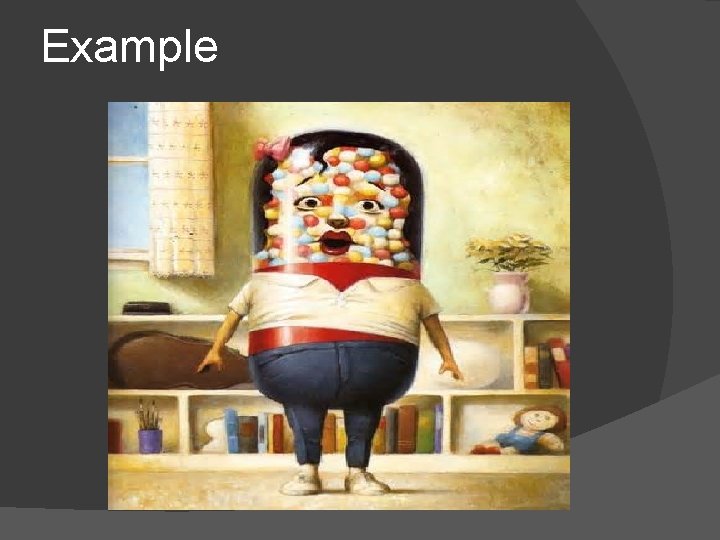
Illustrator � Example
Example
Illustrator Example
Researcher Your job is to find a relevant article that deals with the main theme of your book thus far. You will need to use the reliable source- www. sweetsearch 4 me. com � You will also need to print enough copies for yourself and your group. If you can’t print the articles you will need to e-mail it to me in enough time that I can print for you and your entire group. � This article will then need to be annotated and a summary and reaction written. �
Researcher � Example

Researcher � Example Article
Researcher � Example
- Slides: 29