
Introduction of phage DNA into bacterial cells Two
Introduction of phage DNA into bacterial cells
§ Two different methods: Transfection in vitro packaging § Transfection: �Equivalent to transformation, the only difference being that phage DNA rather than a plasmid is involved. �The purified phage DNA, or recombinant phage molecule, is mixed with competent E. coli cells and DNA uptake induced by heat shock. �Transfection is the standard method for introducing the double stranded RF form of an M 13 cloning vector into E. coli.
In vitro packaging of λ cloning vectors � Packaging requires a number of different proteins coded by the λ genome, but these can be prepared at a high concentration from cells infected with defective λ phage strains. � single strain system, the defective λ phage carries a mutation in the cos sites, so that these are not recognized by the endonuclease that normally cleaves the e catenanes during phage replication. � This means that the defective phage cannot replicate, though it does direct synthesis of all the proteins needed for packaging. � The proteins accumulate in the bacterium and can be purified from cultures of E. coli infected with the mutated λ. � The protein preparation is then used for in vitro packaging of recombinant λ molecules
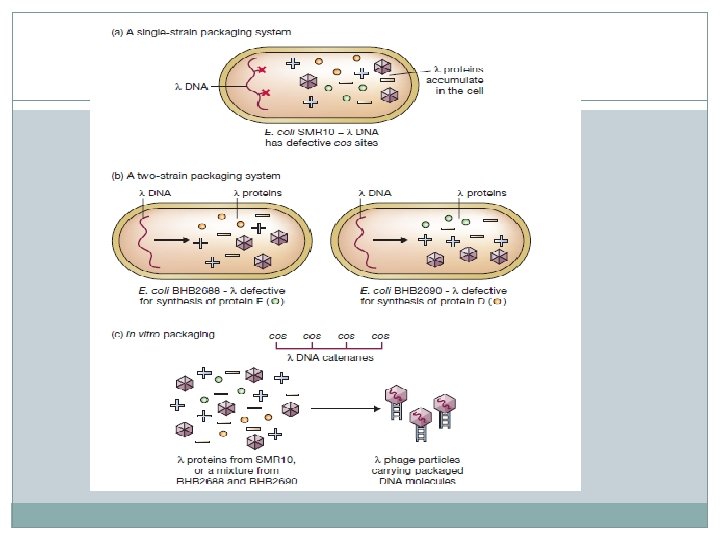
� With the second system two defective e strains are needed. � Both of these strains carry a mutation in a gene for one of the components of the phage protein coat: with one strain the mutation is in gene D, and with the second strain it is in gene E. � Neither strain is able to complete an infection cycle in E. coli because in the absence of the product of the mutated gene the complete capsid structure cannot be made. � Instead the products of all the other coat protein genes accumulate � An in vitro packaging mix can therefore be prepared by combining lysates of two cultures of cells, one infected with the e D− strain, the other infected with the E− strain. � The mixture now contains all the necessary components for in vitro packaging.

� With both systems, formation of phage particles is achieved simply by mixing the packaging proteins with λ DNA— assembly of the particles occurs automatically in the test tube. � The packaged λ DNA is then introduced into E. coli cells simply by adding the assembled phages to the bacterial culture and allowing the normal λ infective process to take place.
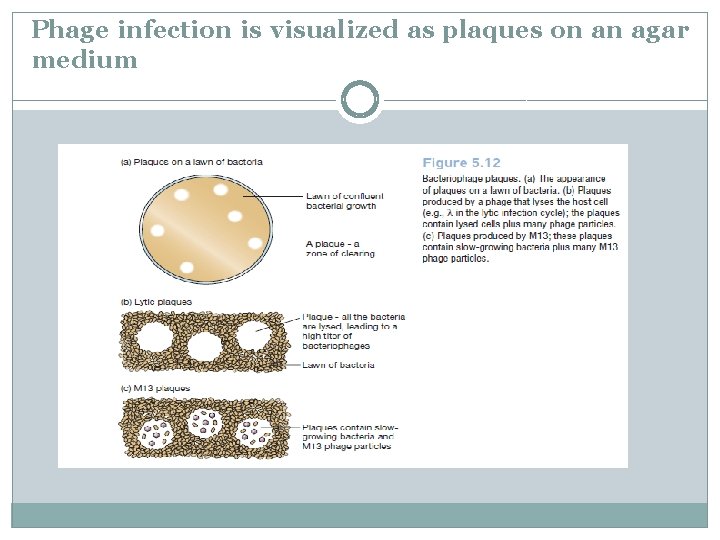
Phage infection is visualized as plaques on an agar medium

Insertional inactivation of a lac. Z′ gene carried by the phage vector � All M 13 cloning vectors, as well as several λ vectors, carry a copy of the lac. Z′ gene. � Insertion of new DNA into this gene inactivates b-galactosidase synthesis, just as with the plasmid vector p. UC 8. � Recombinants are distinguished by plating cells onto X-gal agar: plaques comprising normal phages are blue; recombinant plaques are clear
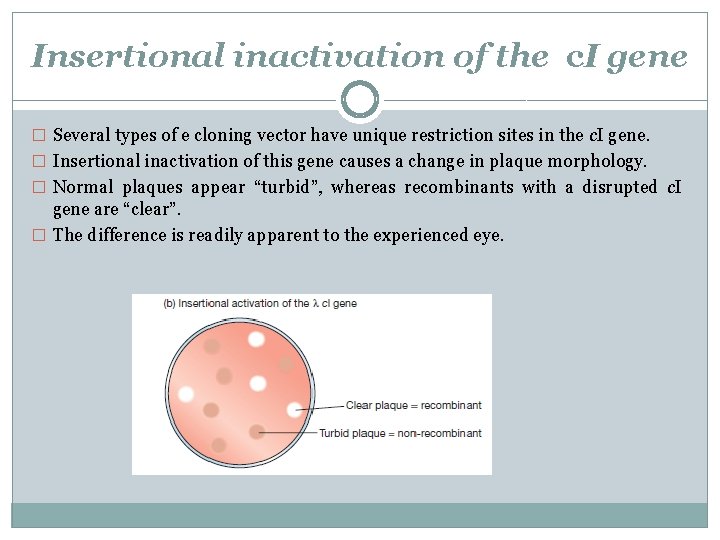
Insertional inactivation of the c. I gene � Several types of e cloning vector have unique restriction sites in the c. I gene. � Insertional inactivation of this gene causes a change in plaque morphology. � Normal plaques appear “turbid”, whereas recombinants with a disrupted c. I gene are “clear”. � The difference is readily apparent to the experienced eye.
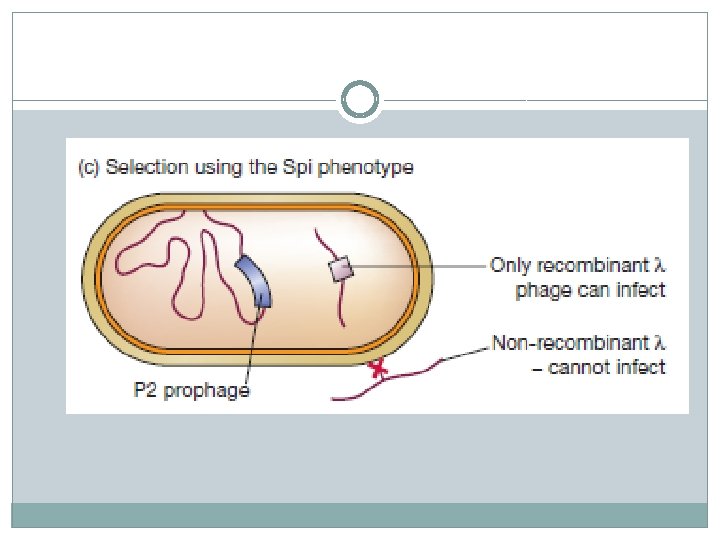
Selection using the Spi phenotype �λ phages cannot normally infect E. coli cells that already possess an integrated form of a related phage called P 2. �λ is therefore said to be Spi+ (sensitive to P 2 prophage inhibition). �Some λ cloning vectors are designed so that insertion of new DNA causes a change from Spi+ to Spi−, enabling the recombinants to infect cells that carry P 2 prophages. �Such cells are used as the host for cloning experiments with these vectors; only recombinants are Spi− so only recombinants form plaques
Selection on the basis of λ genome size � The λ packaging system, which assembles the mature phage particles, can only insert DNA molecules of between 37 and 52 kb into the head structure. � Anything less than 37 kb is not packaged. � Many λ vectors have been constructed by deleting large segments of the λ DNA molecule and so are less than 37 kb in length. � These can only be packaged into mature phage particles after extra DNA has been inserted, bringing the total genome size up to 37 kb or more. � Therefore, with these vectors only recombinant phages are able to replicate.
- Slides: 13