
Introduction of ISO 7700 1 2008 Food products


- Slides: 18
Introduction of ISO 7700 -1 (2008) Food products - Checking the performance of moisture meters in use Part 1: Moisture meters for cereals Dr. Tsuyoshi Matsumoto Chair of APLMF WG on Quality Measurements of Agricultural Products (QMAP) National Metrology Institute of Japan (NMIJ) National Institute of Advanced Industrial Science and Technology (AIST) at APLMF Training Course on Traceability in Rice Moisture Measurement 25 - 29 November, 2013 Imperial Mae Ping Hotel, Chiang Mai, Thailand 1
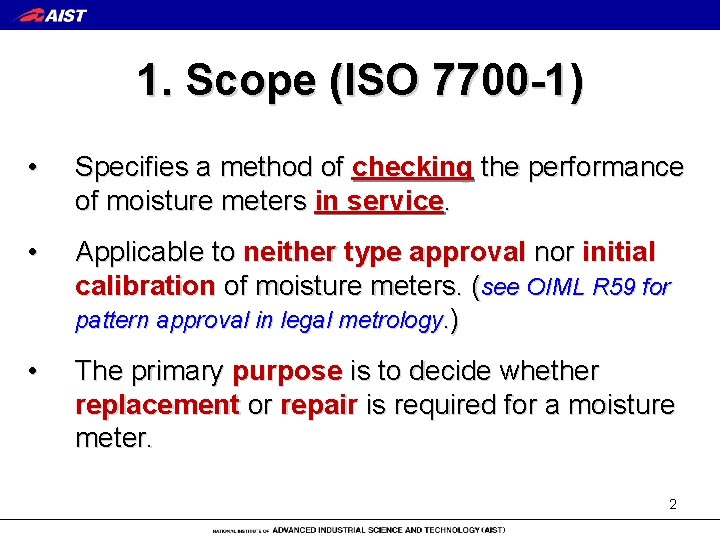
1. Scope (ISO 7700 -1) • Specifies a method of checking the performance of moisture meters in service. • Applicable to neither type approval nor initial calibration of moisture meters. (see OIML R 59 for pattern approval in legal metrology. ) • The primary purpose is to decide whether replacement or repair is required for a moisture meter. 2
3. Terms and Definitions “Moisture content (MC) / Moisture mass fraction” ü Loss in mass undergone by the product under the experimental conditions specified in either ISO 712* or ISO 6540* Note: MC is expressed as a percentage mass fraction [the format “%” is deprecated. ] * ISO 712: Cereals and cereal products -- Determination of moisture content -- Reference method * ISO 6540: Maize -- Determination of moisture content (on milled grains and on whole grains) 3
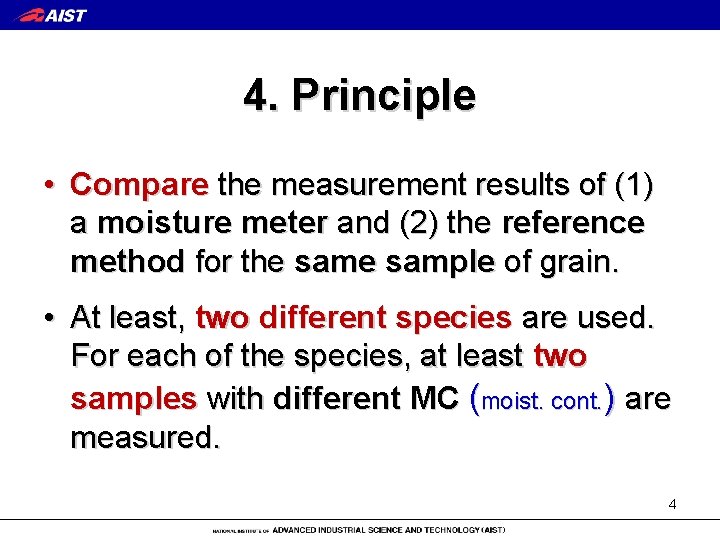
4. Principle • Compare the measurement results of (1) a moisture meter and (2) the reference method for the sample of grain. • At least, two different species are used. For each of the species, at least two samples with different MC (moist. cont. ) are measured. 4
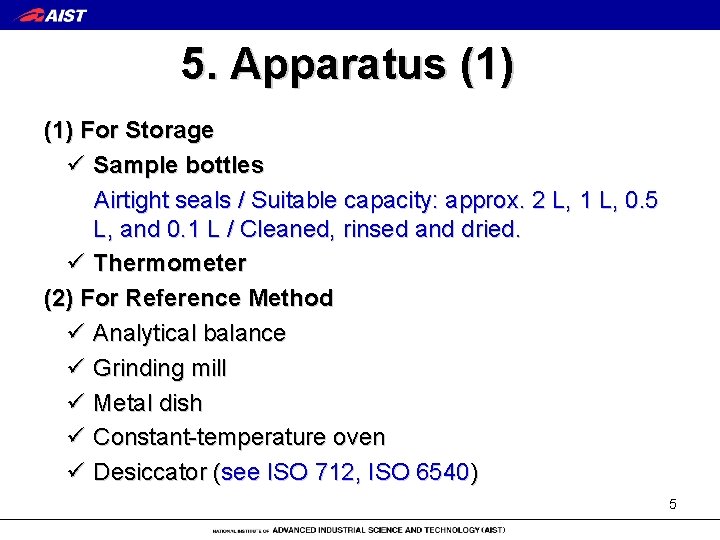
5. Apparatus (1) For Storage ü Sample bottles Airtight seals / Suitable capacity: approx. 2 L, 1 L, 0. 5 L, and 0. 1 L / Cleaned, rinsed and dried. ü Thermometer (2) For Reference Method ü Analytical balance ü Grinding mill ü Metal dish ü Constant-temperature oven ü Desiccator (see ISO 712, ISO 6540) 5
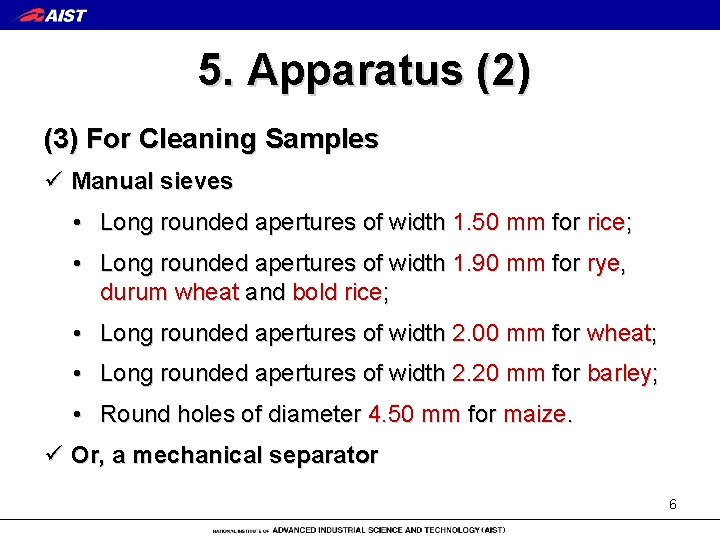
5. Apparatus (2) (3) For Cleaning Samples ü Manual sieves • Long rounded apertures of width 1. 50 mm for rice; • Long rounded apertures of width 1. 90 mm for rye, durum wheat and bold rice; • Long rounded apertures of width 2. 00 mm for wheat; • Long rounded apertures of width 2. 20 mm for barley; • Round holes of diameter 4. 50 mm for maize. ü Or, a mechanical separator 6
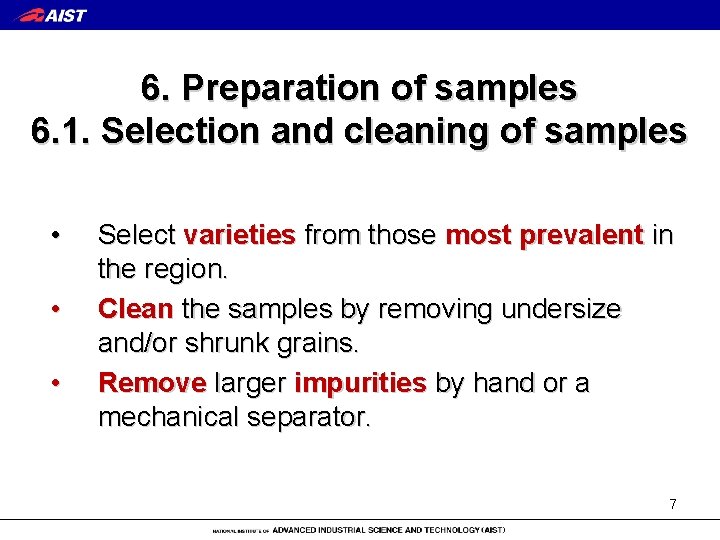
6. Preparation of samples 6. 1. Selection and cleaning of samples • • • Select varieties from those most prevalent in the region. Clean the samples by removing undersize and/or shrunk grains. Remove larger impurities by hand or a mechanical separator. 7
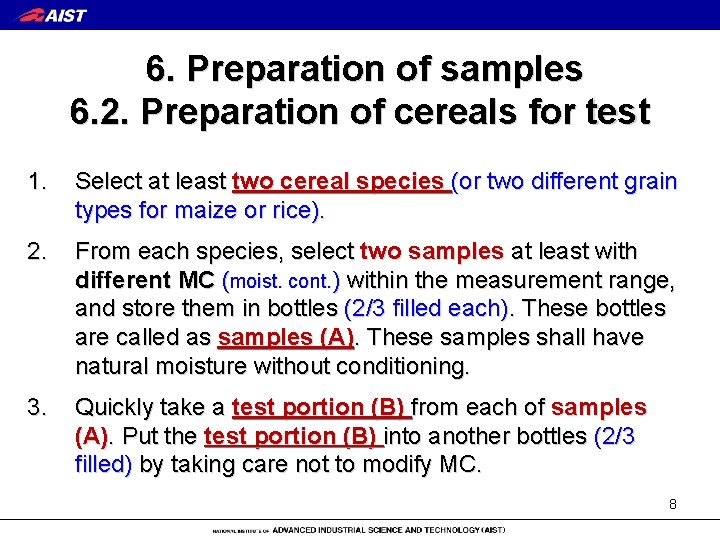
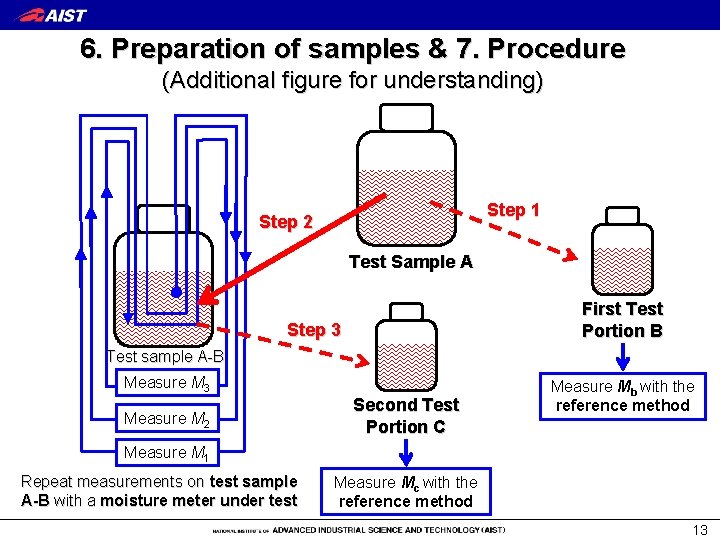
6. Preparation of samples 6. 2. Preparation of cereals for test 1. Select at least two cereal species (or two different grain types for maize or rice). 2. From each species, select two samples at least with different MC (moist. cont. ) within the measurement range, and store them in bottles (2/3 filled each). These bottles are called as samples (A). These samples shall have natural moisture without conditioning. 3. Quickly take a test portion (B) from each of samples (A). Put the test portion (B) into another bottles (2/3 filled) by taking care not to modify MC. 8
7. Procedure 7. 1 Initial reference moisture content determination 7. 2 Stabilization of sample temperature 1. Determine the MC of the test portion (B) using a reference method (oven method) in accordance with ISO 712 or ISO 6540. 2. Stabilize the temperatures of test sample (A-B*) and moisture meter until an equilibrium is established. A temperature difference between the meter and the test portions may influence the measurement result. 3. Measure and record the room temperature with a thermometer. Recommended room temperature is in the range of 15 to 25 ºC. * A-B: Sample left in the bottle of sample (A) after taking the portion (B). 9
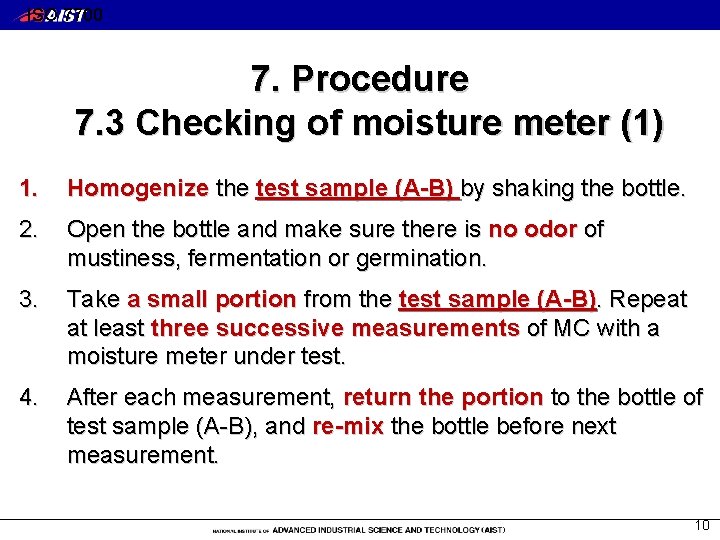
ISO 7700 7. Procedure 7. 3 Checking of moisture meter (1) 1. Homogenize the test sample (A-B) by shaking the bottle. 2. Open the bottle and make sure there is no odor of mustiness, fermentation or germination. 3. Take a small portion from the test sample (A-B). Repeat at least three successive measurements of MC with a moisture meter under test. 4. After each measurement, return the portion to the bottle of test sample (A-B), and re-mix the bottle before next measurement. 10
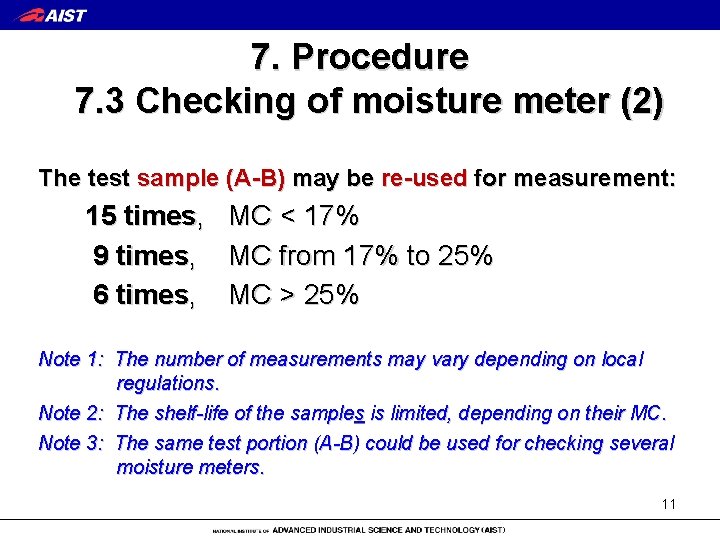
7. Procedure 7. 3 Checking of moisture meter (2) The test sample (A-B) may be re-used for measurement: 15 times, MC < 17% 9 times, MC from 17% to 25% 6 times, MC > 25% Note 1: The number of measurements may vary depending on local regulations. Note 2: The shelf-life of the samples is limited, depending on their MC. Note 3: The same test portion (A-B) could be used for checking several moisture meters. 11
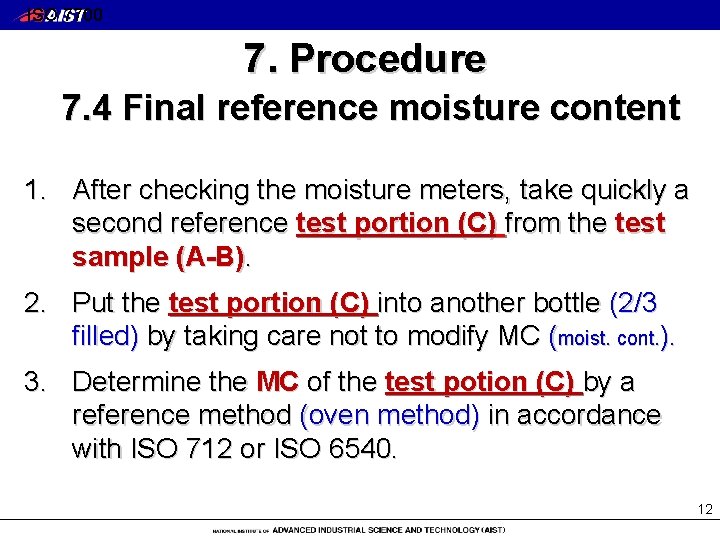
ISO 7700 7. Procedure 7. 4 Final reference moisture content 1. After checking the moisture meters, take quickly a second reference test portion (C) from the test sample (A-B). 2. Put the test portion (C) into another bottle (2/3 filled) by taking care not to modify MC (moist. cont. ). 3. Determine the MC of the test potion (C) by a reference method (oven method) in accordance with ISO 712 or ISO 6540. 12
6. Preparation of samples & 7. Procedure (Additional figure for understanding) Step 1 Step 2 Test Sample A First Test Portion B Step 3 Test sample A-B Measure M 3 Measure M 2 Second Test Portion C Measure Mb with the reference method Measure M 1 Repeat measurements on test sample A-B with a moisture meter under test Measure Mc with the reference method 13
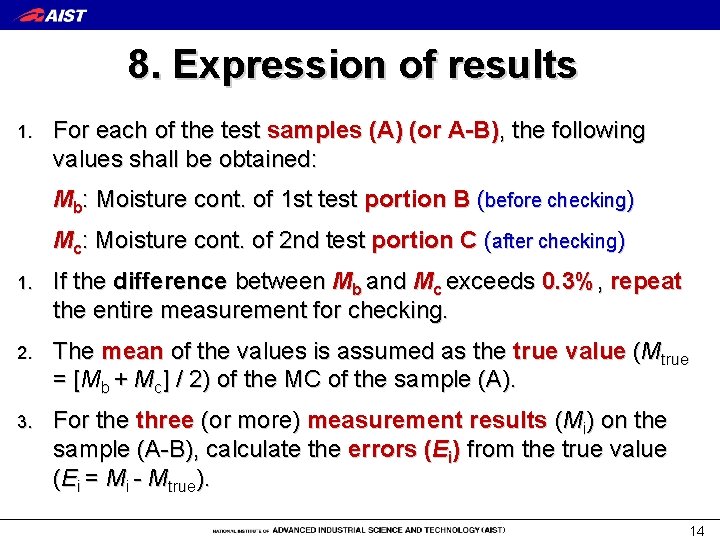
8. Expression of results 1. For each of the test samples (A) (or A-B), the following values shall be obtained: Mb: Moisture cont. of 1 st test portion B (before checking) Mc: Moisture cont. of 2 nd test portion C (after checking) 1. If the difference between Mb and Mc exceeds 0. 3%, repeat the entire measurement for checking. 2. The mean of the values is assumed as the true value (Mtrue = [Mb + Mc] / 2) of the MC of the sample (A). 3. For the three (or more) measurement results (Mi) on the sample (A-B), calculate the errors (Ei) from the true value (Ei = Mi - Mtrue). 14
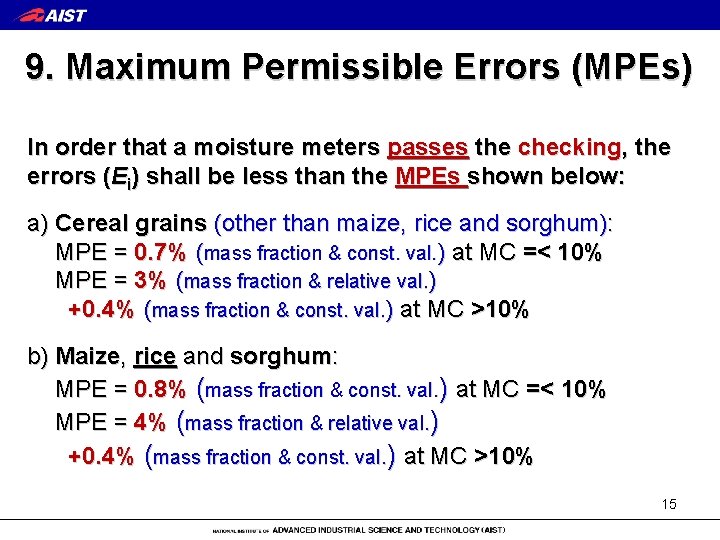
9. Maximum Permissible Errors (MPEs) In order that a moisture meters passes the checking, the errors (Ei) shall be less than the MPEs shown below: a) Cereal grains (other than maize, rice and sorghum): MPE = 0. 7% (mass fraction & const. val. ) at MC =< 10% MPE = 3% (mass fraction & relative val. ) +0. 4% (mass fraction & const. val. ) at MC >10% b) Maize, rice and sorghum: MPE = 0. 8% (mass fraction & const. val. ) at MC =< 10% MPE = 4% (mass fraction & relative val. ) +0. 4% (mass fraction & const. val. ) at MC >10% 15
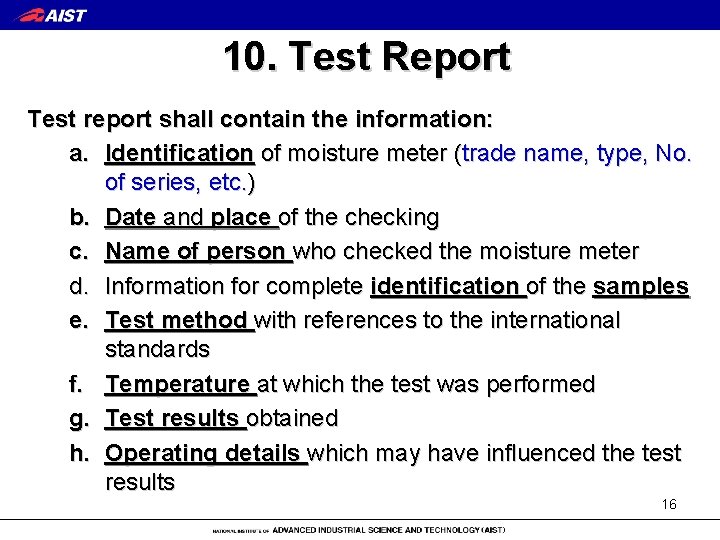
10. Test Report Test report shall contain the information: a. Identification of moisture meter (trade name, type, No. of series, etc. ) b. Date and place of the checking c. Name of person who checked the moisture meter d. Information for complete identification of the samples e. Test method with references to the international standards f. Temperature at which the test was performed g. Test results obtained h. Operating details which may have influenced the test results 16
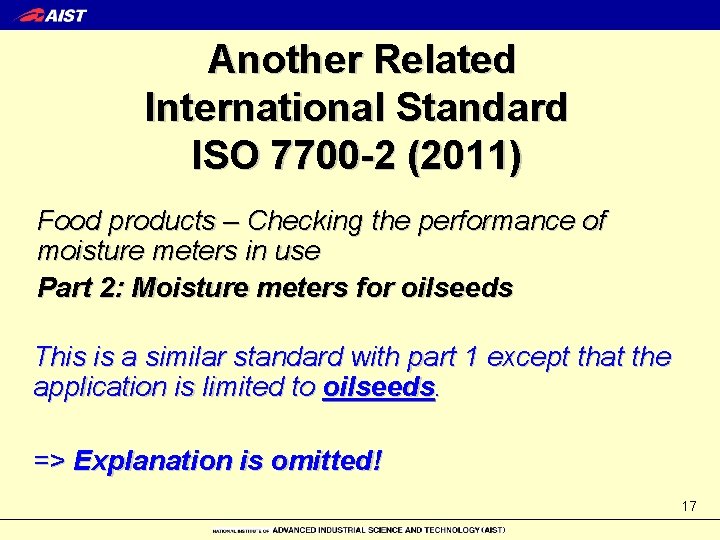
Another Related International Standard ISO 7700 -2 (2011) Food products – Checking the performance of moisture meters in use Part 2: Moisture meters for oilseeds This is a similar standard with part 1 except that the application is limited to oilseeds. => Explanation is omitted! 17
This presentation material is based on the ISO 7700 -1 (2008). A part of the material was provided by the Kett Electric Laboratory. Thank you for your kind attention! 18