
Introduction of Hospital Pharmacy By Ashish Singh Parihar

Introduction of Hospital Pharmacy By: Ashish Singh Parihar KLE College of Pharmacy, Belagavi A constituent Unit of KLE Academy of Higher Education and Research Nehru Nagar, Belagavi – 590 010, Karnataka, India Phone: 0831 -2471399; Fax: 0831 -2472387; Web: http: //www. klepharm. edu. E-mail: principal@klepharm. edu
Hospital • Institution of community health or an organization, which makes use of healthcare team and also provide healthcare facility.
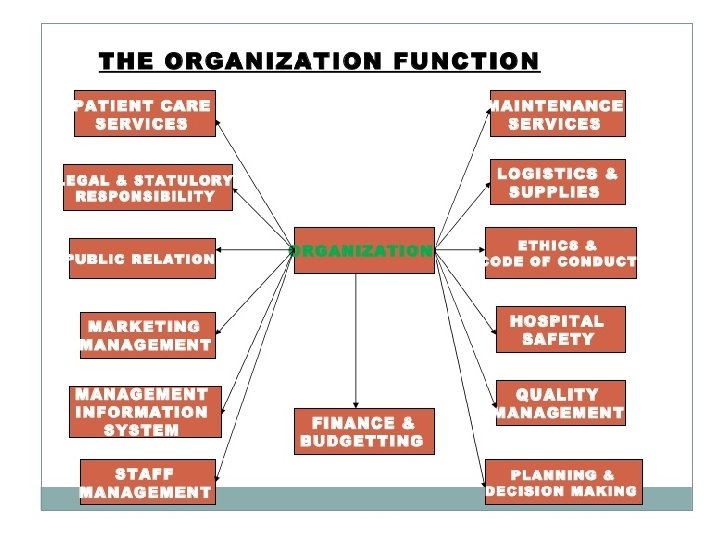
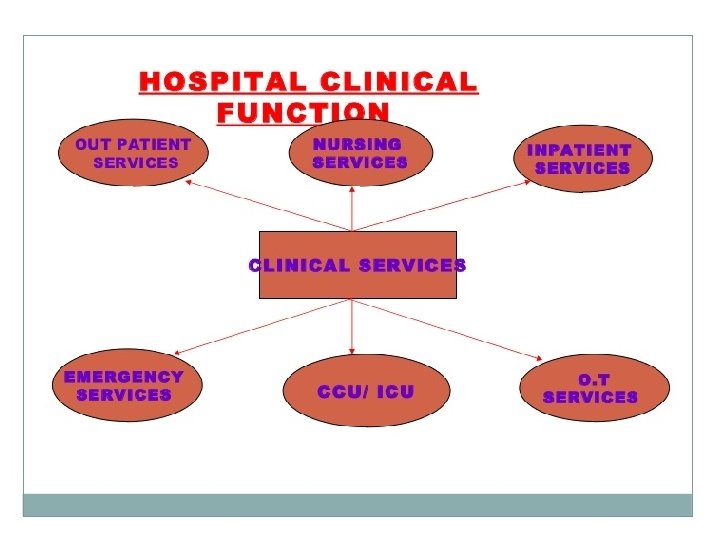
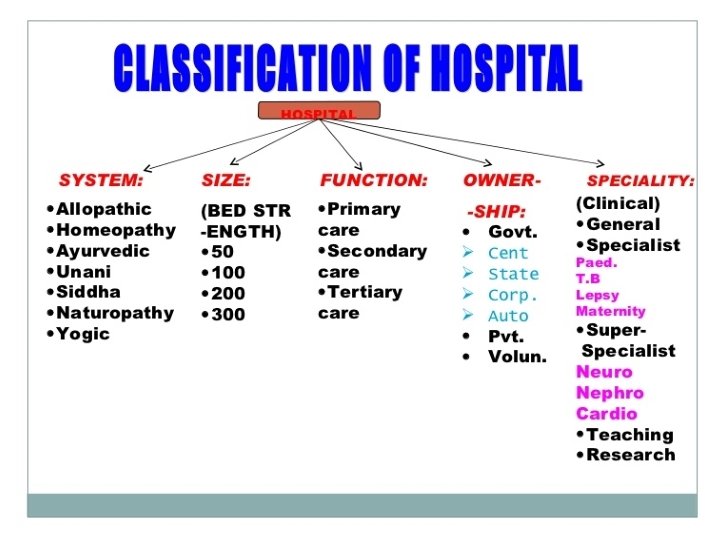
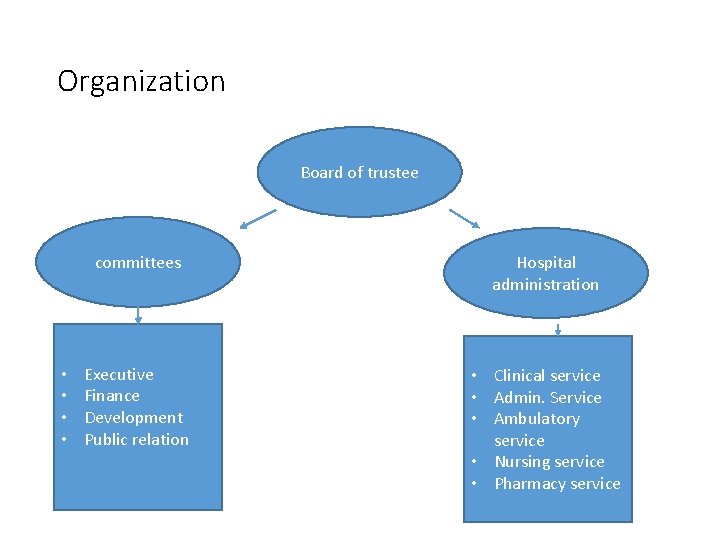
Organization Board of trustee • • committees Hospital administration Executive Finance Development Public relation • Clinical service • Admin. Service • Ambulatory service • Nursing service • Pharmacy service
Introduction • Hospital pharmacy is the health care service, which comprises the art, practice, and profession of choosing, preparing, storing, compounding, and dispensing medicines and medical devices, advising healthcare professionals and patients on their safe, effective and efficient use. • Hospital pharmacy is managed under the direction of a professionally competent and legally qualified pharmacist. • Hospital pharmacy is a specialised field of pharmacy which forms an integrated part of patient health care in a health facility. • Hospital pharmacy is the profession that strives to continuously maintain and improve the medication management and pharmaceutical care of patients to the highest standards in a hospital setting.
Introduction • The missions of the hospital pharmacist Øto be part of the medication management in hospitals, which encompasses the entire way in which medicines are selected, procured, delivered, prescribed, administered and reviewed to optimise the contribution that medicines make to producing informed and desired outcomes Øto enhance the safety and quality of all medicine related processes affecting patients of the hospital Øto ensure the 7 “rights” are respected: right patient, right dose, right route, right time, right drug with the right information and documentation
Pharmaceutical services 1. Dispensing of drugs and other pharmaceuticals as per the prescriptions of the medical staff of the hospital for inpatients and as well as for out patients. 1. a) b) c) Management of the stores: Purchase of drugs and medicines Storage Maintenance of proper records 3. Manufacturing and distribution of medicaments and products such as transfusion fluids and other parenteral products, tablets, ointments, stock mixtures etc…
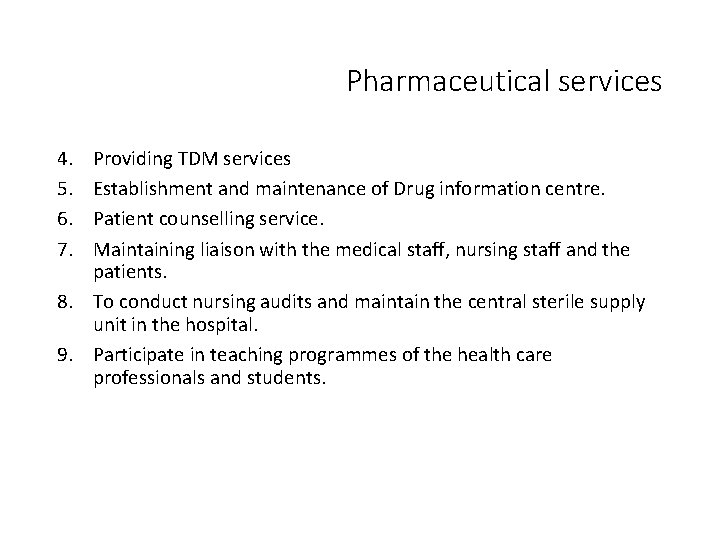
Pharmaceutical services 4. 5. 6. 7. Providing TDM services Establishment and maintenance of Drug information centre. Patient counselling service. Maintaining liaison with the medical staff, nursing staff and the patients. 8. To conduct nursing audits and maintain the central sterile supply unit in the hospital. 9. Participate in teaching programmes of the health care professionals and students.
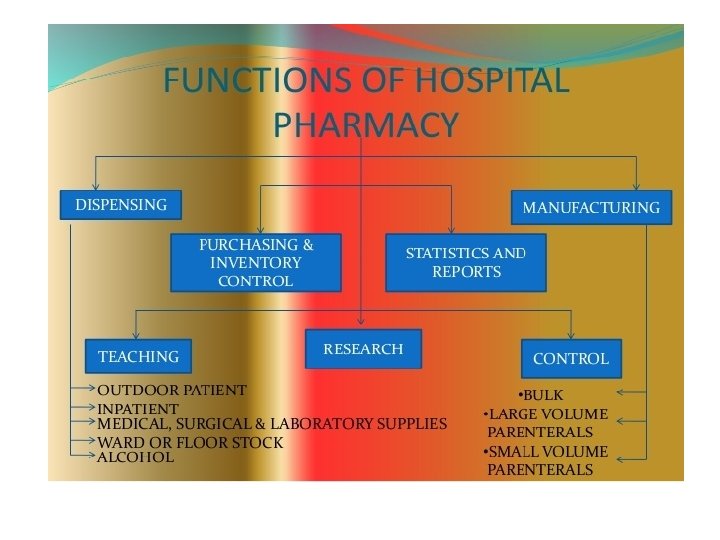
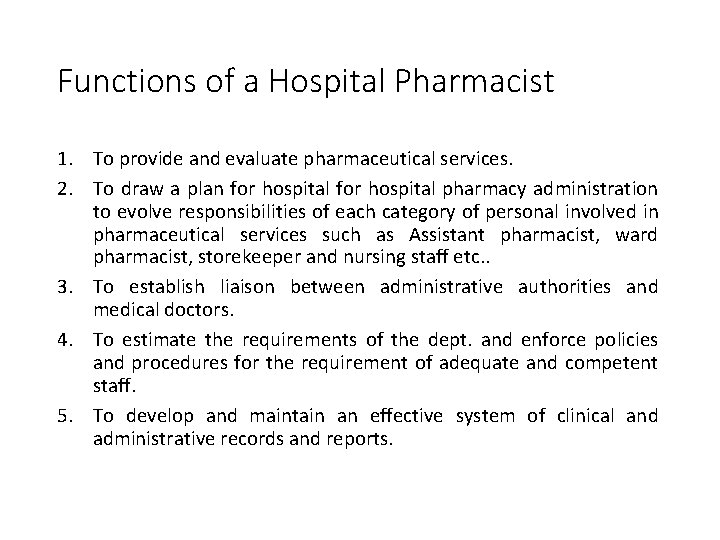
Functions of a Hospital Pharmacist 1. To provide and evaluate pharmaceutical services. 2. To draw a plan for hospital pharmacy administration to evolve responsibilities of each category of personal involved in pharmaceutical services such as Assistant pharmacist, ward pharmacist, storekeeper and nursing staff etc. . 3. To establish liaison between administrative authorities and medical doctors. 4. To estimate the requirements of the dept. and enforce policies and procedures for the requirement of adequate and competent staff. 5. To develop and maintain an effective system of clinical and administrative records and reports.
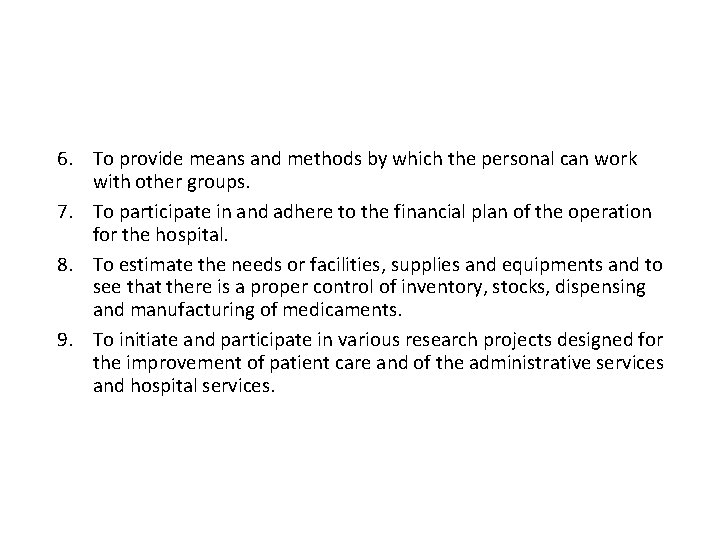
6. To provide means and methods by which the personal can work with other groups. 7. To participate in and adhere to the financial plan of the operation for the hospital. 8. To estimate the needs or facilities, supplies and equipments and to see that there is a proper control of inventory, stocks, dispensing and manufacturing of medicaments. 9. To initiate and participate in various research projects designed for the improvement of patient care and of the administrative services and hospital services.
10. Continuing education (CPE or CME). 11. To participate and adhere to the safety programmes of the hospital.
Relationship of hospital pharmacy with other department and staff q. Hospital’s clinical staff q. Hospital's nursing staff q. Hospital Administration q. Hospitals committee q. Patients q. Hospital’s other department
Responsibility of the HOD of pharmacy and his staff I. Inpatients or indoor pharmacists responsibilities: A) Central dispensing area B) Patient care areas (wards, operation theatres, and other departments of the hospital) C) Direct patient care areas D) General departments
II. Outpatient or outdoor pharmacists responsibilities: A. The central dispensing area B. Patient care area C. General responsibilities
Reference • https: //www. vub. ac. be/MICH/eafp_pages/archive/pdfpres/osl o_pdf/Antonio%20 Melo%20 Gouveia. pdf Access on 6/7/2017 • Nand P, Khar RK, A text book of hospital and clinical pharmacy, Birla publication. Page No. 3 -27.

Thank you…. .
- Slides: 19