
Introduction Methods Results Discussion An Analysis of the







- Slides: 38
Introduction Methods Results Discussion An Analysis of the Iowa Child Passenger Safety Survey Based on Generalized Linear Mixed Models Joseph Cavanaugh and Eric Chen Department of Biostatistics The University of Iowa New York State Psychiatric Institute Columbia University February 26, 2009
Introduction Methods Results Discussion Background Restraints Study Design Children and Motor Vehicle Accidents • According to the National Safe Kids Coalition, motor vehicle accidents are the leading cause of death in the United States among children from 3 to 14 years of age. • In Iowa, approximately 40 children each year are killed in motor vehicle accidents, one every 9 days. (Iowa Department of Public Safety, 2004)
Introduction Methods Results Discussion Background Restraints Study Design Children and Motor Vehicle Accidents • Child safety seats reduce the risk of death by 71% for infants, and by 54% for children aged 1 to 4 years. (National Highway Traffic Safety Administration, 2005) • For children aged 4 to 7 years, booster seats reduce injury risk by 59% compared to seat belts alone. (Durbin et al. , 2003) • The proper use of child safety seats, booster seats, and seat belts is the best protection available to keep children safe in motor vehicles.
Introduction Methods Results Discussion Background Restraints Study Design Iowa History • In 2001, the National Safe Kids Coalition graded each state’s child restraint law. Iowa received an "F", ranking 46 out of 51 (50 states and the District of Columbia). • In July of 2004, Iowa’s Child Restraint Law was strengthened based on recommendations from the National Highway Traffic Safety Administration and the American Academy of Pediatrics. • The revised law included an 18 -month education phase prior to full enforcement of the new requirements.
Introduction Methods Results Discussion Background Restraints Study Design Iowa History • To measure compliance with the law and to direct educational efforts, observational restraint usage surveys have been conducted annually since 1988. • These child passenger safety surveys are funded by the Governor’s Traffic Safety Bureau (GTSB). • The GTSB has contracted with the University of Iowa Injury Prevention Research Center (IPRC) to conduct the surveys since 1996.
Introduction Methods Results Discussion Background Restraints Study Design IRPC Child Passenger Safety Survey • In 2004, the IPRC redesigned the survey in conjunction with the implementation of the new law. • The sampled communities, and targeted sample sizes within these communities, were selected so that the sample would resemble the state population in terms of its rural and urban composition. • The annual targeted sample size was set at 3, 000. • The data is collected by three trained surveyors.
Introduction Methods Results Discussion Background Restraints Study Design IPRC Child Passenger Safety Survey • The new data collection protocol requires the surveyor to approach the driver in the parking lot of a convenience store and to ask for his/her participation. § § A card is given to the driver explaining the study. The driver is asked the age of each child. The restraint status of each child is directly observed. The restraint status of the driver (belted / not belted) and the vehicle type (truck, car, van, SUV) are also recorded. § No identifying information (e. g. , names, license plate numbers) is collected. • An annual report summarizing the survey results is presented to the Iowa state legislature.
Introduction Methods Results Discussion Background Restraints Study Design Iowa Law Requirements of the current Iowa law: § Children must ride in an appropriate rearfacing child safety seat until one year of age and at least 20 pounds. § Children must ride in a child safety seat or a booster seat through the age of 5 years. § Children ages 6 through 10 must ride in a booster seat or use a seat belt.
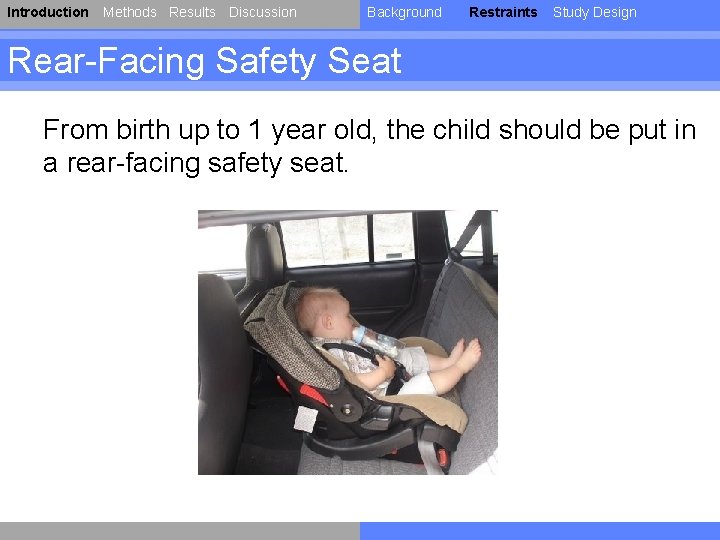
Introduction Methods Results Discussion Background Restraints Study Design Rear-Facing Safety Seat From birth up to 1 year old, the child should be put in a rear-facing safety seat.
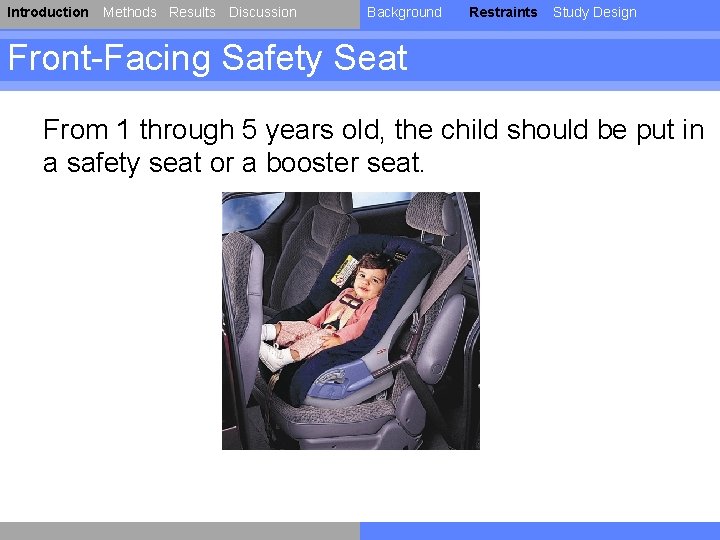
Introduction Methods Results Discussion Background Restraints Study Design Front-Facing Safety Seat From 1 through 5 years old, the child should be put in a safety seat or a booster seat.
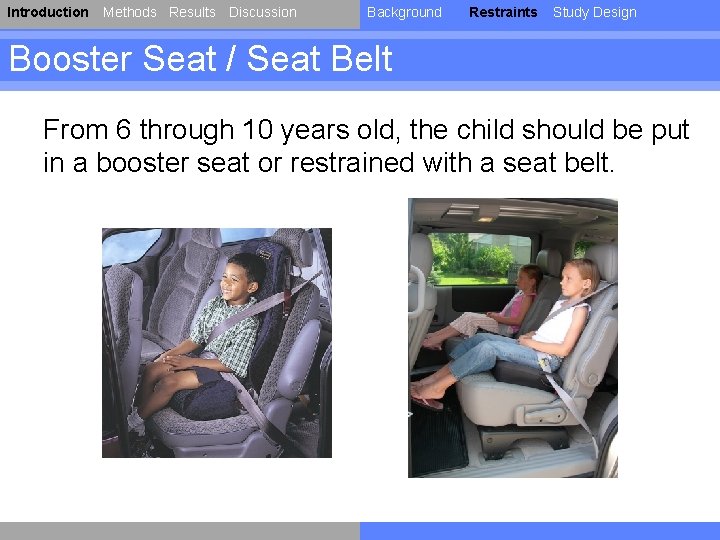
Introduction Methods Results Discussion Background Restraints Study Design Booster Seat / Seat Belt From 6 through 10 years old, the child should be put in a booster seat or restrained with a seat belt.
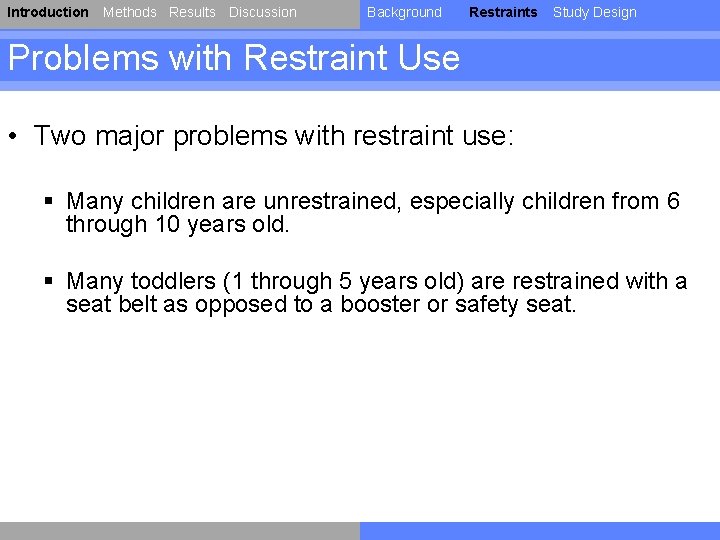
Introduction Methods Results Discussion Background Restraints Study Design Problems with Restraint Use • Two major problems with restraint use: § Many children are unrestrained, especially children from 6 through 10 years old. § Many toddlers (1 through 5 years old) are restrained with a seat belt as opposed to a booster or safety seat.
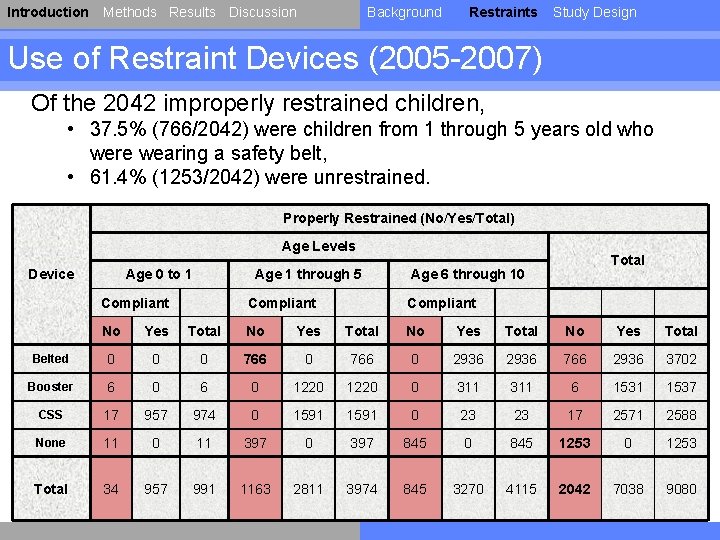
Introduction Methods Results Discussion Background Restraints Study Design Use of Restraint Devices (2005 -2007) Of the 2042 improperly restrained children, • 37. 5% (766/2042) were children from 1 through 5 years old who were wearing a safety belt, • 61. 4% (1253/2042) were unrestrained. Properly Restrained (No/Yes/Total) Age Levels Age 0 to 1 Device Age 1 through 5 Compliant Total Age 6 through 10 Compliant No Yes Total Belted 0 0 0 766 0 2936 766 2936 3702 Booster 6 0 1220 0 311 6 1531 1537 CSS 17 957 974 0 1591 0 23 23 17 2571 2588 None 11 0 11 397 0 397 845 0 845 1253 0 1253 Total 34 957 991 1163 2811 3974 845 3270 4115 2042 7038 9080
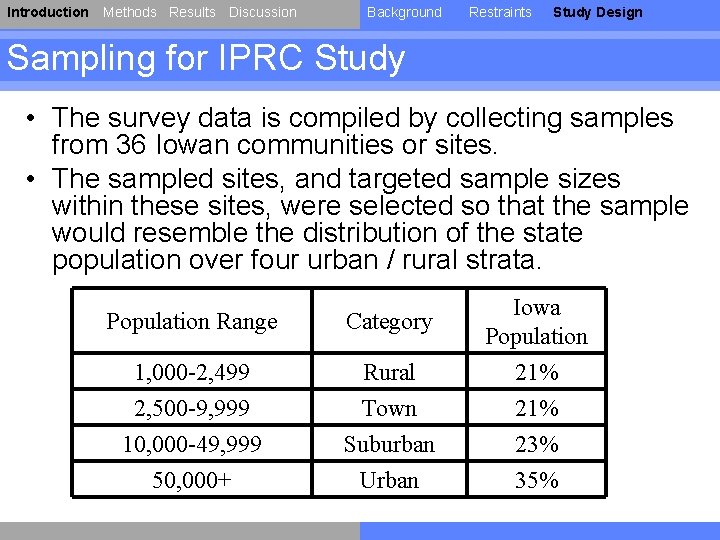
Introduction Methods Results Discussion Background Restraints Study Design Sampling for IPRC Study • The survey data is compiled by collecting samples from 36 Iowan communities or sites. • The sampled sites, and targeted sample sizes within these sites, were selected so that the sample would resemble the distribution of the state population over four urban / rural strata. Population Range Category Iowa Population 1, 000 -2, 499 2, 500 -9, 999 10, 000 -49, 999 50, 000+ Rural Town Suburban Urban 21% 23% 35%
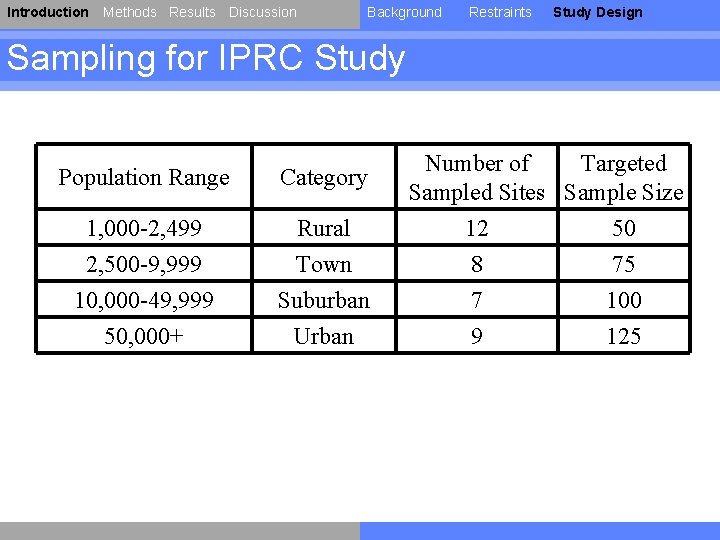
Introduction Methods Results Discussion Background Restraints Study Design Sampling for IPRC Study Population Range Category 1, 000 -2, 499 2, 500 -9, 999 10, 000 -49, 999 50, 000+ Rural Town Suburban Urban Number of Targeted Sampled Sites Sample Size 12 8 7 9 50 75 100 125
Introduction Methods Results Discussion Background Restraints IPRC Study Sites Map of Study Sites Study Design
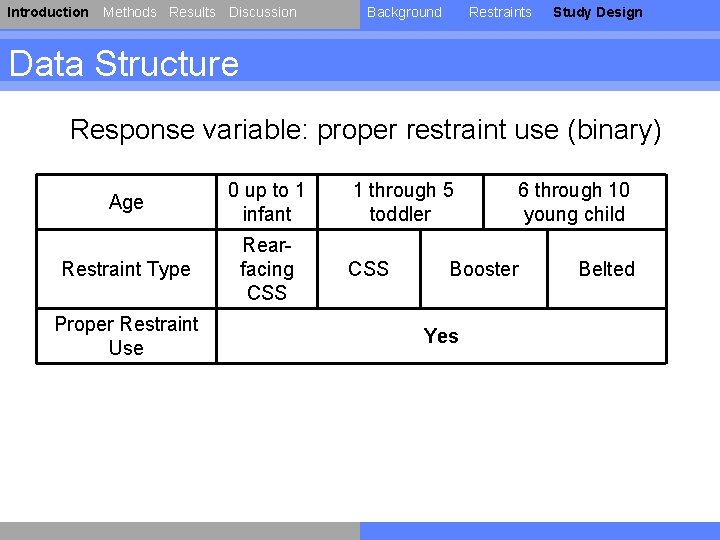
Introduction Methods Results Discussion Background Restraints Study Design Data Structure Response variable: proper restraint use (binary) Age 0 up to 1 infant Restraint Type Rearfacing CSS Proper Restraint Use 1 through 5 toddler CSS Booster Yes 6 through 10 young child Belted
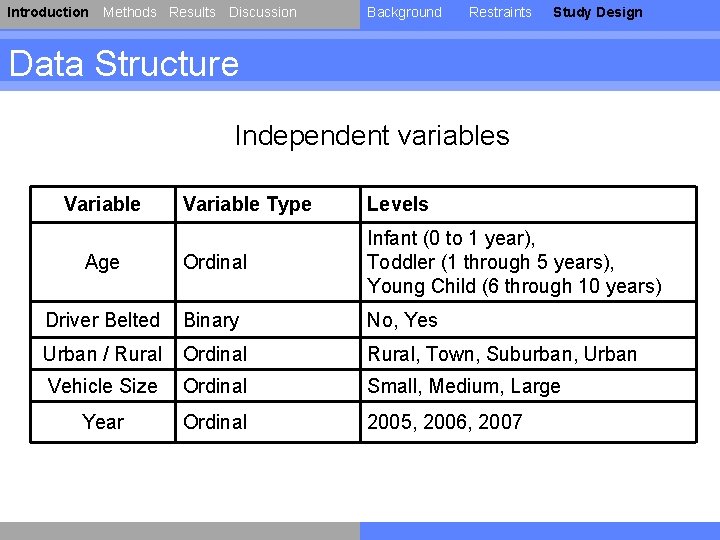
Introduction Methods Results Discussion Background Restraints Study Design Data Structure Independent variables Variable Type Levels Age Ordinal Infant (0 to 1 year), Toddler (1 through 5 years), Young Child (6 through 10 years) Driver Belted Binary No, Yes Urban / Rural Ordinal Rural, Town, Suburban, Urban Vehicle Size Ordinal Small, Medium, Large Year Ordinal 2005, 2006, 2007
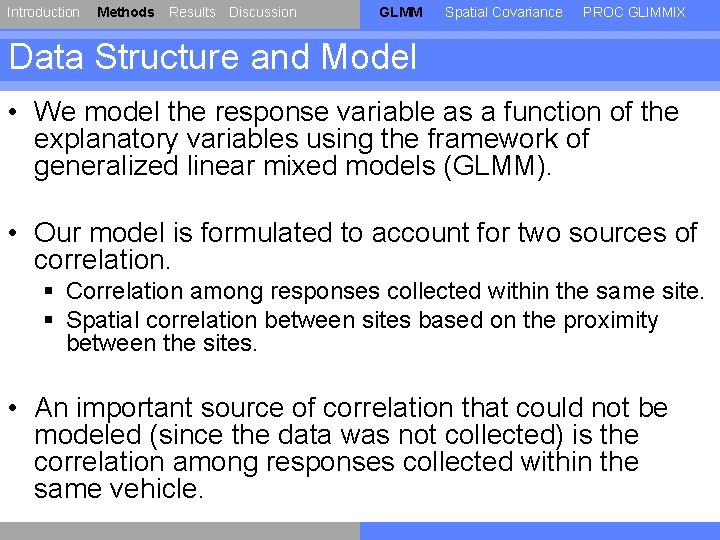
Introduction Methods Results Discussion GLMM Spatial Covariance PROC GLIMMIX Data Structure and Model • We model the response variable as a function of the explanatory variables using the framework of generalized linear mixed models (GLMM). • Our model is formulated to account for two sources of correlation. § Correlation among responses collected within the same site. § Spatial correlation between sites based on the proximity between the sites. • An important source of correlation that could not be modeled (since the data was not collected) is the correlation among responses collected within the same vehicle.
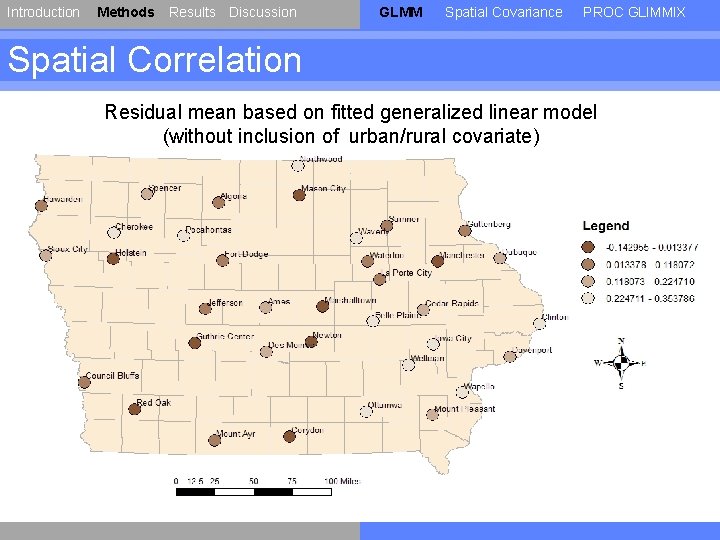
Introduction Methods Results Discussion GLMM Spatial Covariance PROC GLIMMIX Spatial Correlation Residual mean based on fitted generalized linear model (without inclusion of urban/rural covariate)
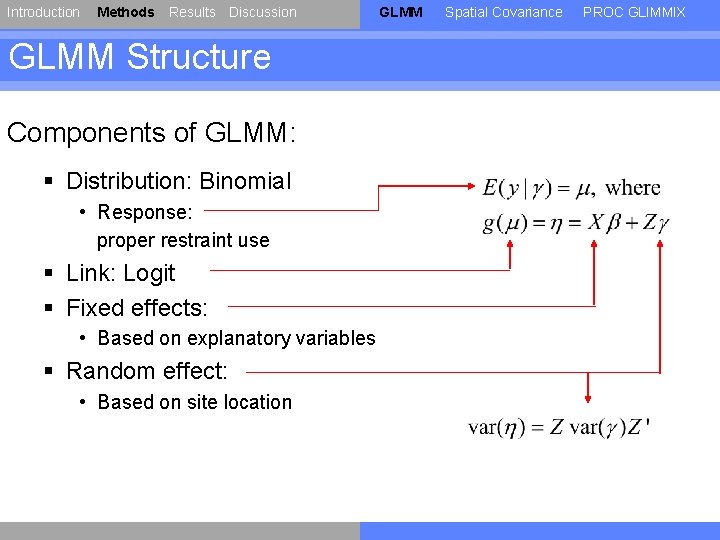
Introduction Methods Results Discussion GLMM Structure Components of GLMM: § Distribution: Binomial • Response: proper restraint use § Link: Logit § Fixed effects: • Based on explanatory variables § Random effect: • Based on site location GLMM Spatial Covariance PROC GLIMMIX
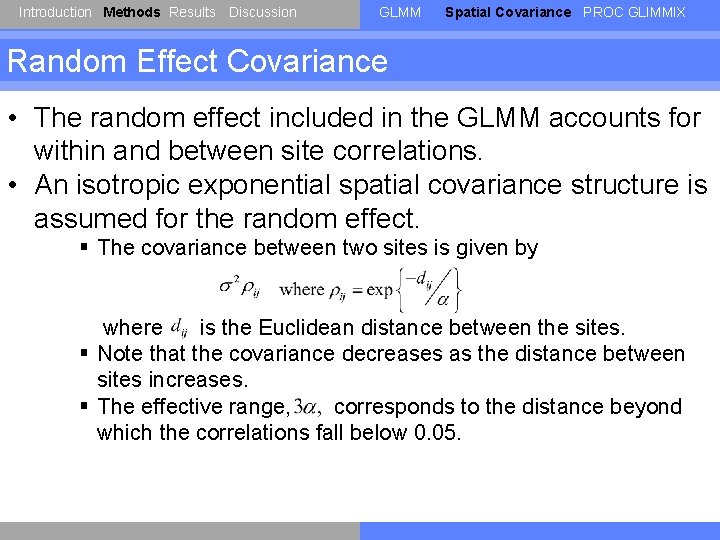
Introduction Methods Results Discussion GLMM Spatial Covariance PROC GLIMMIX Random Effect Covariance • The random effect included in the GLMM accounts for within and between site correlations. • An isotropic exponential spatial covariance structure is assumed for the random effect. § The covariance between two sites is given by where is the Euclidean distance between the sites. § Note that the covariance decreases as the distance between sites increases. § The effective range, corresponds to the distance beyond which the correlations fall below 0. 05.
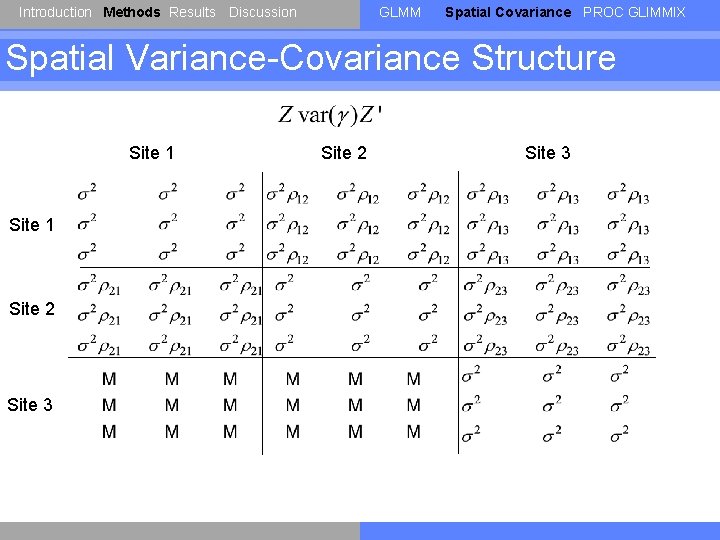
Introduction Methods Results Discussion GLMM Spatial Covariance PROC GLIMMIX Spatial Variance-Covariance Structure Site 1 Site 2 Site 3
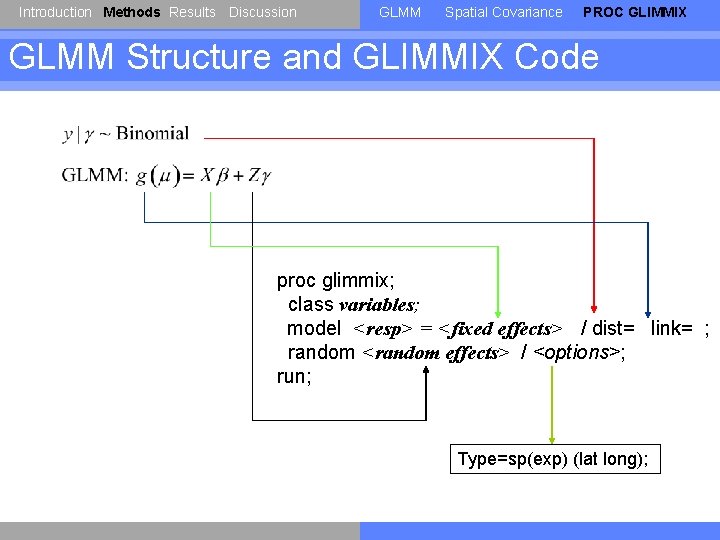
Introduction Methods Results Discussion GLMM Spatial Covariance PROC GLIMMIX GLMM Structure and GLIMMIX Code proc glimmix; class variables; model <resp> = <fixed effects> / dist= link= ; random <random effects> / <options>; run; Type=sp(exp) (lat long);
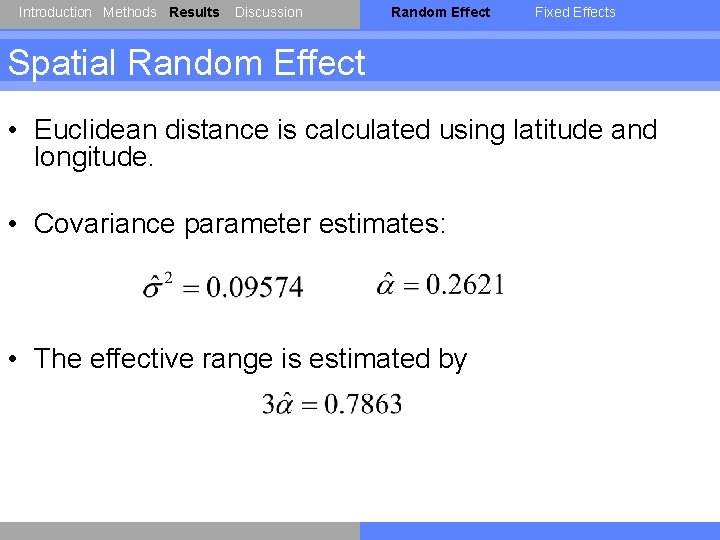
Introduction Methods Results Discussion Random Effect Fixed Effects Spatial Random Effect • Euclidean distance is calculated using latitude and longitude. • Covariance parameter estimates: • The effective range is estimated by
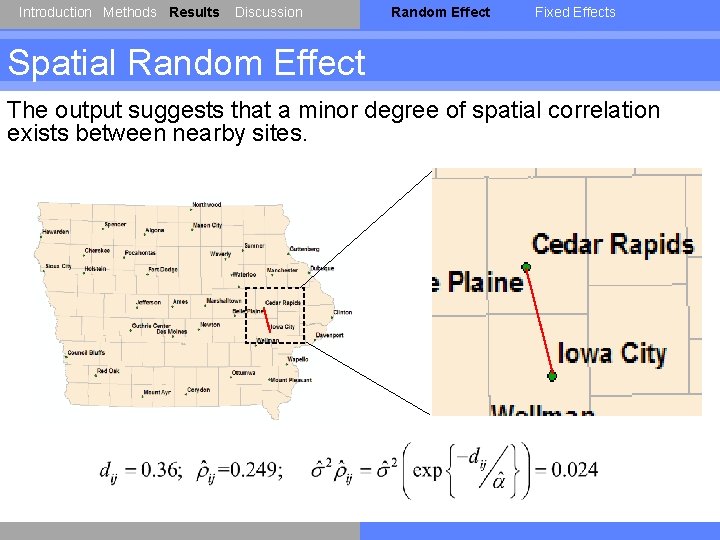
Introduction Methods Results Discussion Random Effect Fixed Effects Spatial Random Effect The output suggests that a minor degree of spatial correlation exists between nearby sites.
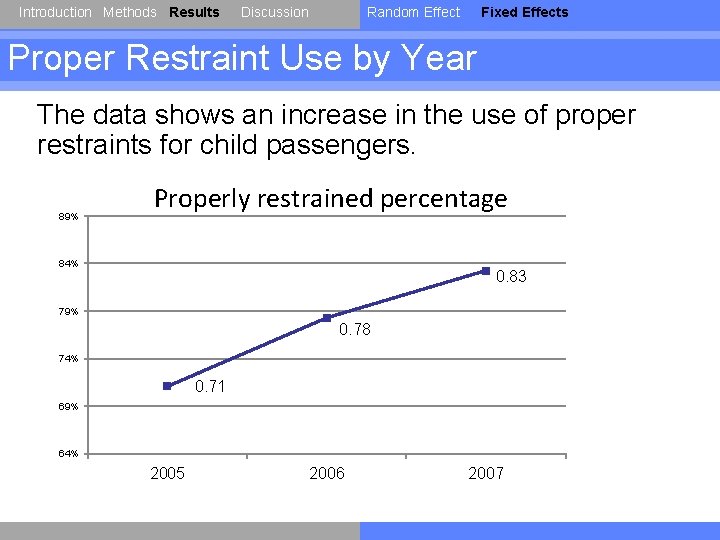
Introduction Methods Results Discussion Random Effect Fixed Effects Proper Restraint Use by Year The data shows an increase in the use of proper restraints for child passengers. 89% Properly restrained percentage 84% 0. 83 79% 0. 78 74% 0. 71 69% 64% 2005 2006 2007
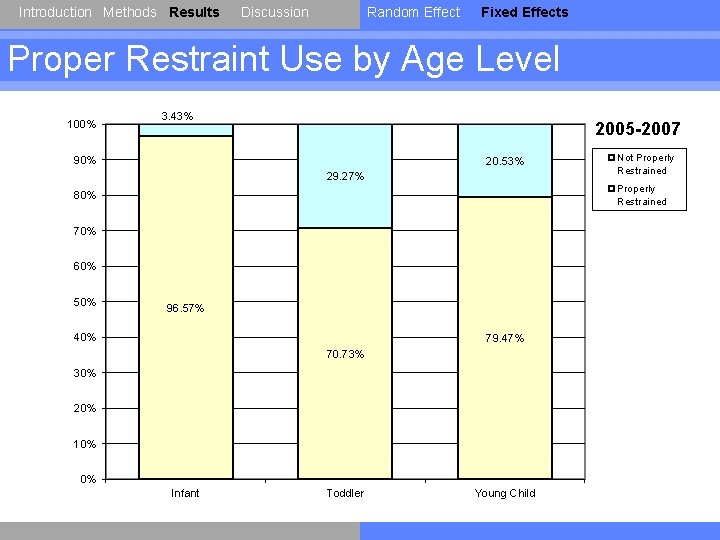
Introduction Methods Results Discussion Random Effect Fixed Effects Proper Restraint Use by Age Level 100% 3. 43% 2005 -2007 90% 20. 53% 29. 27% Properly Restrained 80% 70% 60% 50% Not Properly Restrained 96. 57% 40% 79. 47% 70. 73% 30% 20% 10% 0% Infant Toddler Young Child
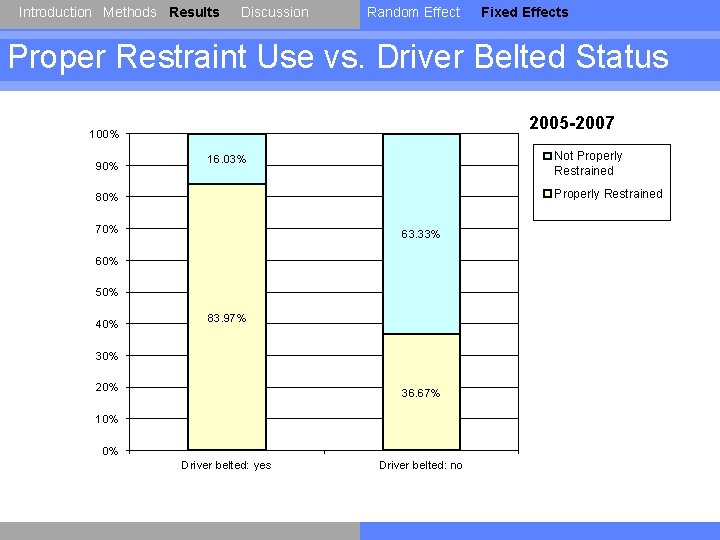
Introduction Methods Results Discussion Random Effect Fixed Effects Proper Restraint Use vs. Driver Belted Status 2005 -2007 100% 90% Not Properly Restrained 16. 03% Properly Restrained 80% 70% 63. 33% 60% 50% 40% 83. 97% 30% 20% 36. 67% 10% 0% Driver belted: yes Driver belted: no
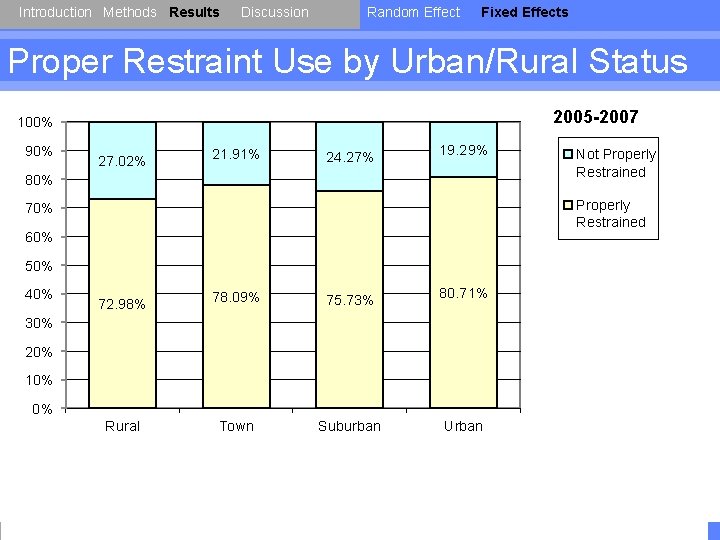
Introduction Methods Results Discussion Random Effect Fixed Effects Proper Restraint Use by Urban/Rural Status 2005 -2007 100% 90% 27. 02% 21. 91% 24. 27% 19. 29% 80% Properly Restrained 70% 60% 50% 40% Not Properly Restrained 72. 98% 78. 09% 75. 73% 80. 71% Town Suburban Urban 30% 20% 10% 0% Rural
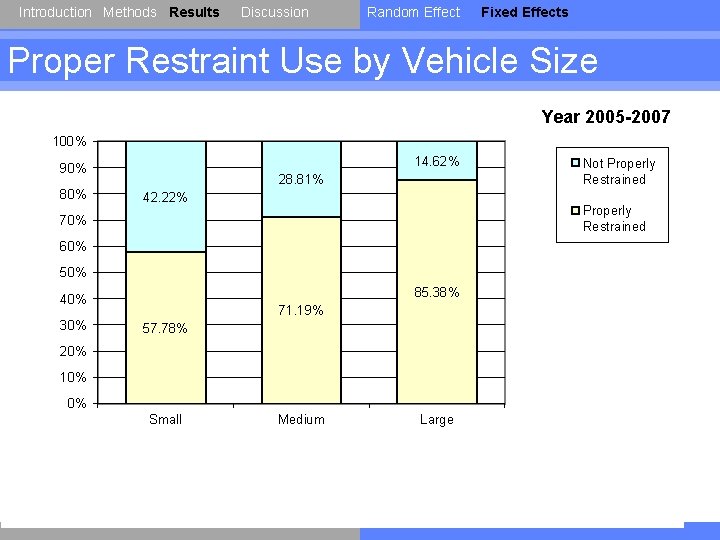
Introduction Methods Results Discussion Random Effect Fixed Effects Proper Restraint Use by Vehicle Size Year 2005 -2007 100% 14. 62% 90% 80% 28. 81% 42. 22% Properly Restrained 70% 60% 50% 85. 38% 40% 30% 71. 19% 57. 78% 20% 10% 0% Small Not Properly Restrained Medium Large
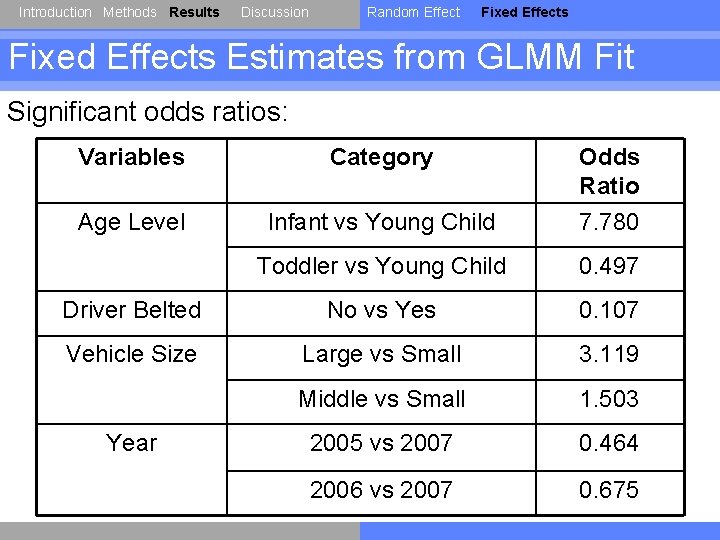
Introduction Methods Results Discussion Random Effect Fixed Effects Estimates from GLMM Fit Significant odds ratios: Variables Category Odds Ratio Age Level Infant vs Young Child 7. 780 Toddler vs Young Child 0. 497 Driver Belted No vs Yes 0. 107 Vehicle Size Large vs Small 3. 119 Middle vs Small 1. 503 2005 vs 2007 0. 464 2006 vs 2007 0. 675 Year
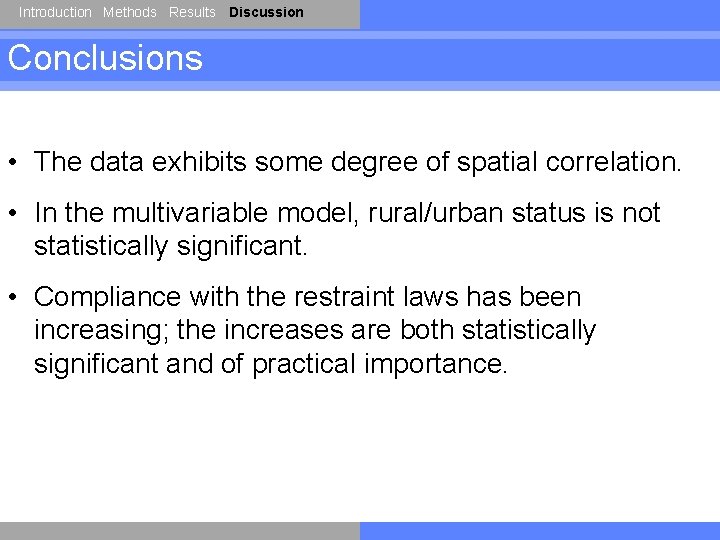
Introduction Methods Results Discussion Conclusions • The data exhibits some degree of spatial correlation. • In the multivariable model, rural/urban status is not statistically significant. • Compliance with the restraint laws has been increasing; the increases are both statistically significant and of practical importance.
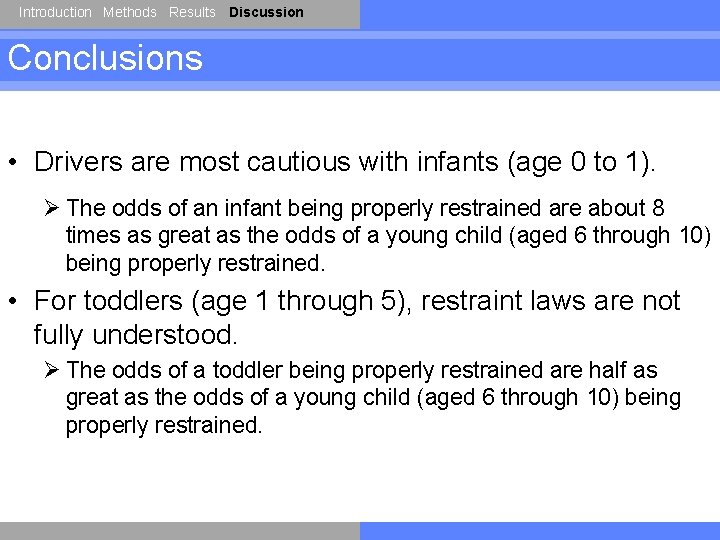
Introduction Methods Results Discussion Conclusions • Drivers are most cautious with infants (age 0 to 1). Ø The odds of an infant being properly restrained are about 8 times as great as the odds of a young child (aged 6 through 10) being properly restrained. • For toddlers (age 1 through 5), restraint laws are not fully understood. Ø The odds of a toddler being properly restrained are half as great as the odds of a young child (aged 6 through 10) being properly restrained.
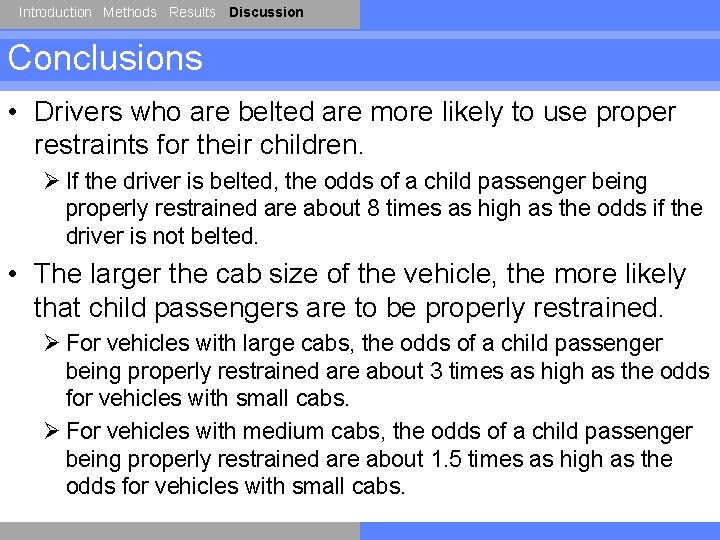
Introduction Methods Results Discussion Conclusions • Drivers who are belted are more likely to use proper restraints for their children. Ø If the driver is belted, the odds of a child passenger being properly restrained are about 8 times as high as the odds if the driver is not belted. • The larger the cab size of the vehicle, the more likely that child passengers are to be properly restrained. Ø For vehicles with large cabs, the odds of a child passenger being properly restrained are about 3 times as high as the odds for vehicles with small cabs. Ø For vehicles with medium cabs, the odds of a child passenger being properly restrained are about 1. 5 times as high as the odds for vehicles with small cabs.
Introduction Methods Results Discussion Limitations • Within-vehicle correlations, which could not be modeled due to the limitations of the data, may be important. • For the surveyors, no data has been collected which would allow an assessment of validity or inter-rater reliability.
Introduction Methods Results Discussion Acknowledgements • John Lundell • Eric Chen • Jing Xu
Introduction Methods Results Discussion Thank you!