
Introduction Mathematical expressions are commonly used to represent
- Slides: 12
Introduction Mathematical expressions are commonly used to represent real-world scenarios that involve a changing variable. For example, an expression can be written to show the total number of miles run in a week, the total cost of clothes bought at a sale, the profit of a business, and how to evenly divide cookies amongst friends. There are many key parts of an expression, including terms, constants, and coefficients. 1 1. 1 Skill 3: Identifying Parts of an Expression
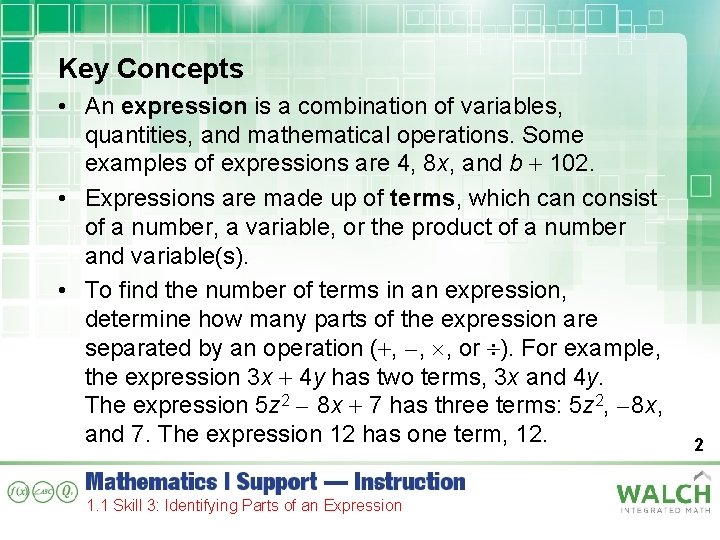
Key Concepts • An expression is a combination of variables, quantities, and mathematical operations. Some examples of expressions are 4, 8 x, and b + 102. • Expressions are made up of terms, which can consist of a number, a variable, or the product of a number and variable(s). • To find the number of terms in an expression, determine how many parts of the expression are separated by an operation (+, – , , or ). For example, the expression 3 x + 4 y has two terms, 3 x and 4 y. The expression 5 z 2 – 8 x + 7 has three terms: 5 z 2, – 8 x, and 7. The expression 12 has one term, 12. 1. 1 Skill 3: Identifying Parts of an Expression 2
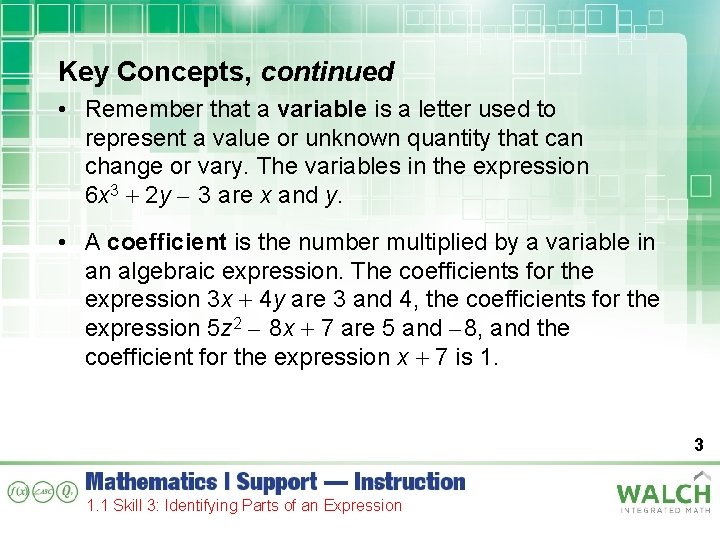
Key Concepts, continued • Remember that a variable is a letter used to represent a value or unknown quantity that can change or vary. The variables in the expression 6 x 3 + 2 y – 3 are x and y. • A coefficient is the number multiplied by a variable in an algebraic expression. The coefficients for the expression 3 x + 4 y are 3 and 4, the coefficients for the expression 5 z 2 – 8 x + 7 are 5 and – 8, and the coefficient for the expression x + 7 is 1. 3 1. 1 Skill 3: Identifying Parts of an Expression
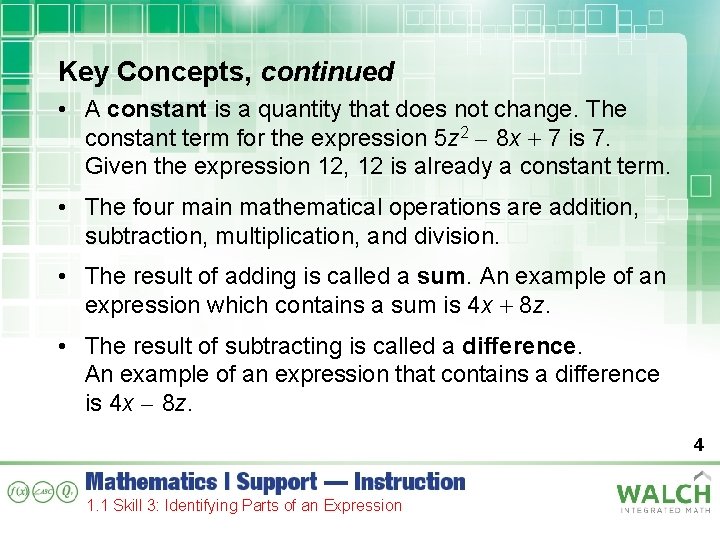
Key Concepts, continued • A constant is a quantity that does not change. The constant term for the expression 5 z 2 – 8 x + 7 is 7. Given the expression 12, 12 is already a constant term. • The four main mathematical operations are addition, subtraction, multiplication, and division. • The result of adding is called a sum. An example of an expression which contains a sum is 4 x + 8 z. • The result of subtracting is called a difference. An example of an expression that contains a difference is 4 x – 8 z. 4 1. 1 Skill 3: Identifying Parts of an Expression
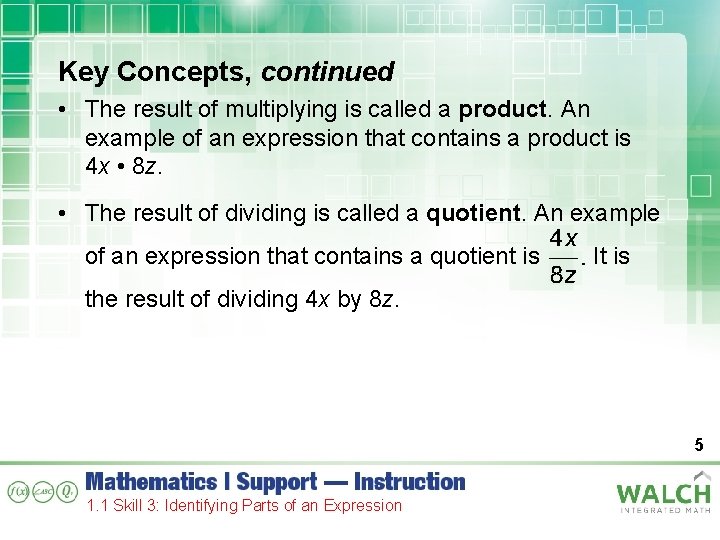
Key Concepts, continued • The result of multiplying is called a product. An example of an expression that contains a product is 4 x • 8 z. • The result of dividing is called a quotient. An example of an expression that contains a quotient is It is the result of dividing 4 x by 8 z. 5 1. 1 Skill 3: Identifying Parts of an Expression
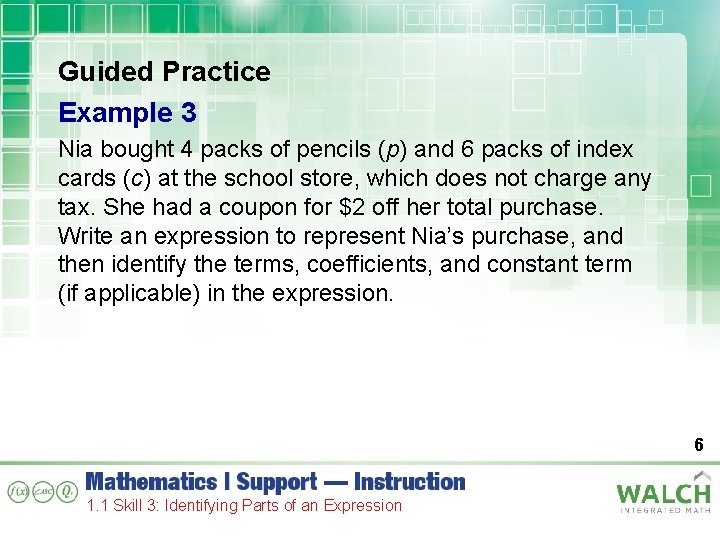
Guided Practice Example 3 Nia bought 4 packs of pencils (p) and 6 packs of index cards (c) at the school store, which does not charge any tax. She had a coupon for $2 off her total purchase. Write an expression to represent Nia’s purchase, and then identify the terms, coefficients, and constant term (if applicable) in the expression. 6 1. 1 Skill 3: Identifying Parts of an Expression
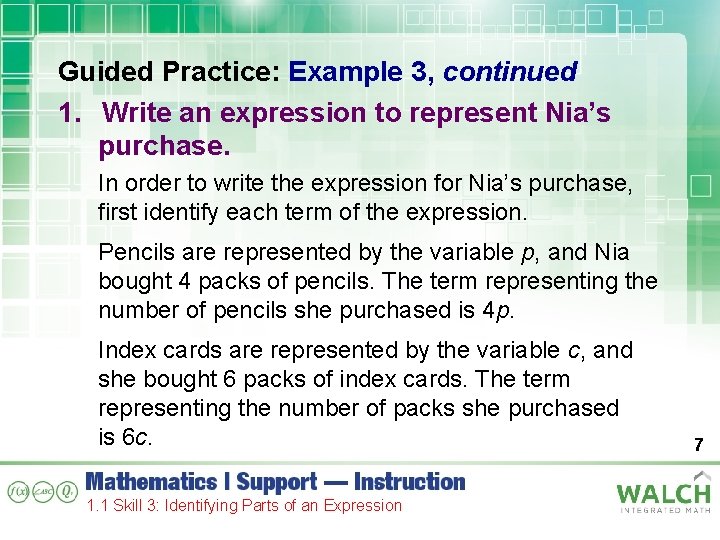
Guided Practice: Example 3, continued 1. Write an expression to represent Nia’s purchase. In order to write the expression for Nia’s purchase, first identify each term of the expression. Pencils are represented by the variable p, and Nia bought 4 packs of pencils. The term representing the number of pencils she purchased is 4 p. Index cards are represented by the variable c, and she bought 6 packs of index cards. The term representing the number of packs she purchased is 6 c. 1. 1 Skill 3: Identifying Parts of an Expression 7
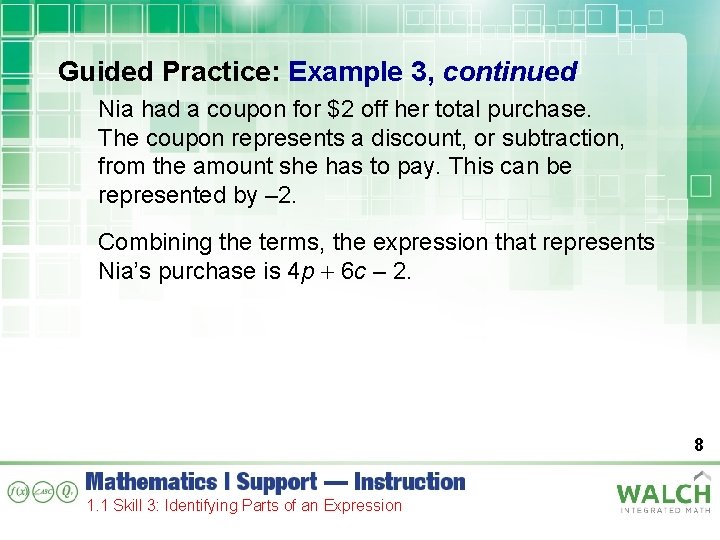
Guided Practice: Example 3, continued Nia had a coupon for $2 off her total purchase. The coupon represents a discount, or subtraction, from the amount she has to pay. This can be represented by – 2. Combining the terms, the expression that represents Nia’s purchase is 4 p + 6 c – 2. 8 1. 1 Skill 3: Identifying Parts of an Expression
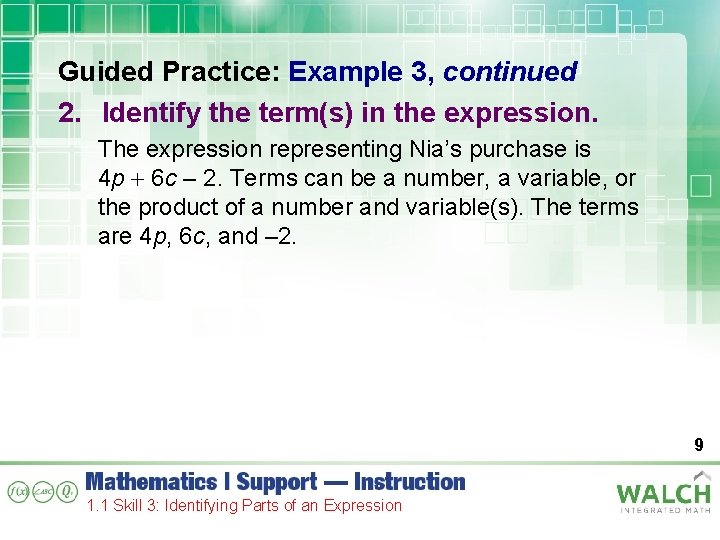
Guided Practice: Example 3, continued 2. Identify the term(s) in the expression. The expression representing Nia’s purchase is 4 p + 6 c – 2. Terms can be a number, a variable, or the product of a number and variable(s). The terms are 4 p, 6 c, and – 2. 9 1. 1 Skill 3: Identifying Parts of an Expression
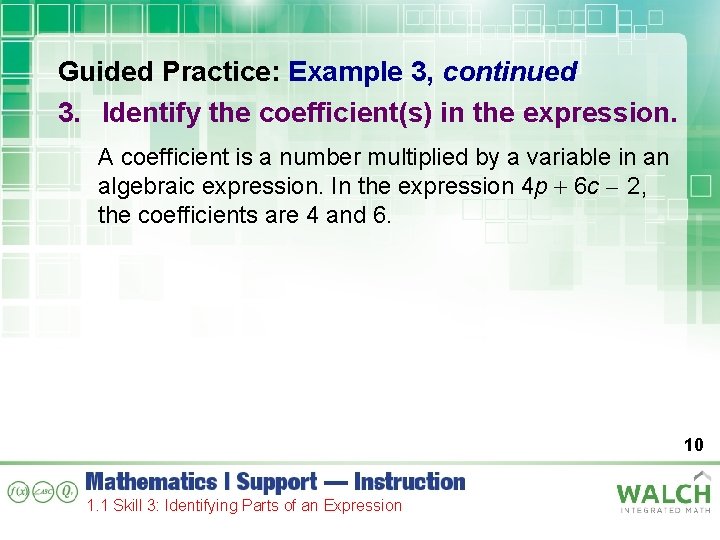
Guided Practice: Example 3, continued 3. Identify the coefficient(s) in the expression. A coefficient is a number multiplied by a variable in an algebraic expression. In the expression 4 p + 6 c – 2, the coefficients are 4 and 6. 10 1. 1 Skill 3: Identifying Parts of an Expression
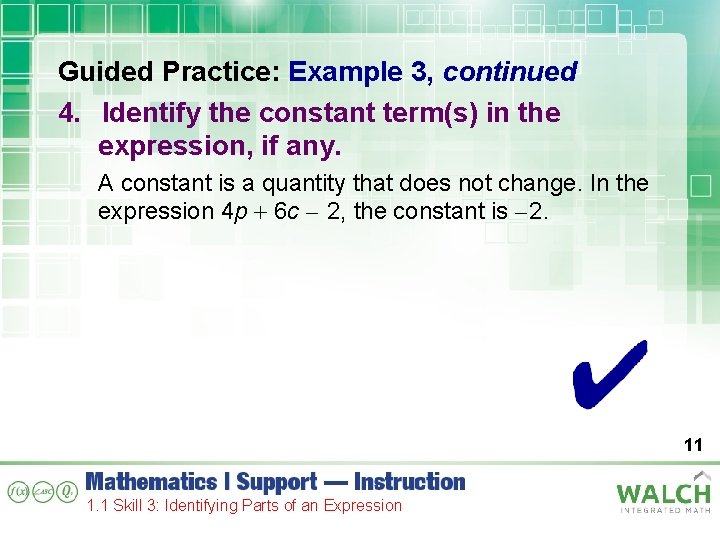
Guided Practice: Example 3, continued 4. Identify the constant term(s) in the expression, if any. A constant is a quantity that does not change. In the expression 4 p + 6 c – 2, the constant is – 2. 11 1. 1 Skill 3: Identifying Parts of an Expression
Guided Practice: Example 3, continued 12 1. 1 Skill 3: Identifying Parts of an Expression