
Introduction Look at Mprocessors internal programming model and
- Slides: 56
Introduction Look at • Mprocessor’s internal programming model and then how its memory space is addressed. • Addressing modes for this powerful family of microprocessors – the real, – protected, and – flat modes of operation. The Intel Microprocessors: 8086/8088, 80186/80188, 80286, 80386, 80486 Pentium, Pentium Processor, Pentium II, Pentium, 4, and Core 2 with 64 -bit Extensions Architecture, Programming, and Interfacing, Eighth Edition Barry B. Brey Copyright © 2009 by Pearson Education, Inc. Upper Saddle River, New Jersey 07458 • All rights reserved.
2– 1 INTERNAL MICROPROCESSOR ARCHITECTURE • Before a program is written or instruction investigated, internal configuration of the microprocessor must be known. • In a multiple core microprocessor each core contains the same programming model. • Each core runs a separate task or thread simultaneously. The Intel Microprocessors: 8086/8088, 80186/80188, 80286, 80386, 80486 Pentium, Pentium Processor, Pentium II, Pentium, 4, and Core 2 with 64 -bit Extensions Architecture, Programming, and Interfacing, Eighth Edition Barry B. Brey Copyright © 2009 by Pearson Education, Inc. Upper Saddle River, New Jersey 07458 • All rights reserved.
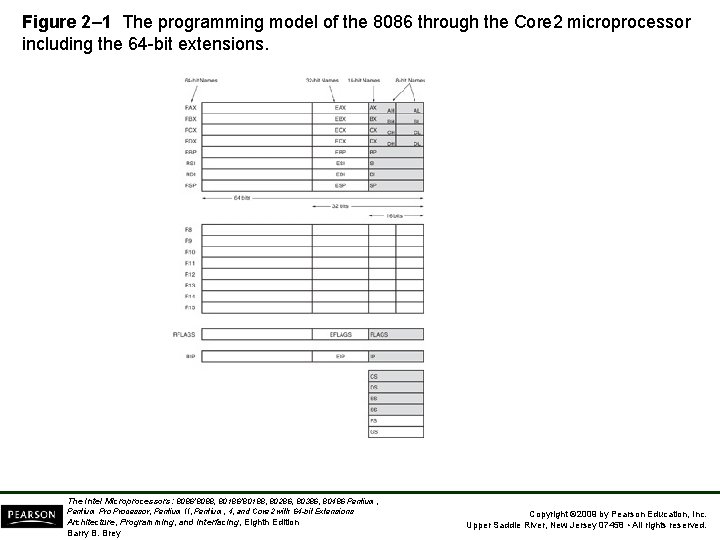
The Programming Model • 8086 through Core 2 considered program visible registers. – registers are used during programming and are specified by the instructions • Other registers considered to be program invisible. – not addressable directly during applications programming The Intel Microprocessors: 8086/8088, 80186/80188, 80286, 80386, 80486 Pentium, Pentium Processor, Pentium II, Pentium, 4, and Core 2 with 64 -bit Extensions Architecture, Programming, and Interfacing, Eighth Edition Barry B. Brey Copyright © 2009 by Pearson Education, Inc. Upper Saddle River, New Jersey 07458 • All rights reserved.
• 80286 and above contain program-invisible registers to control and operate protected memory. – and other features of the microprocessor • 80386 through Core 2 microprocessors contain full 32 -bit internal architectures. • 8086 through the 80286 are fully upwardcompatible to the 80386 through Core 2. The Intel Microprocessors: 8086/8088, 80186/80188, 80286, 80386, 80486 Pentium, Pentium Processor, Pentium II, Pentium, 4, and Core 2 with 64 -bit Extensions Architecture, Programming, and Interfacing, Eighth Edition Barry B. Brey Copyright © 2009 by Pearson Education, Inc. Upper Saddle River, New Jersey 07458 • All rights reserved.
Figure 2– 1 The programming model of the 8086 through the Core 2 microprocessor including the 64 -bit extensions. The Intel Microprocessors: 8086/8088, 80186/80188, 80286, 80386, 80486 Pentium, Pentium Processor, Pentium II, Pentium, 4, and Core 2 with 64 -bit Extensions Architecture, Programming, and Interfacing, Eighth Edition Barry B. Brey Copyright © 2009 by Pearson Education, Inc. Upper Saddle River, New Jersey 07458 • All rights reserved.
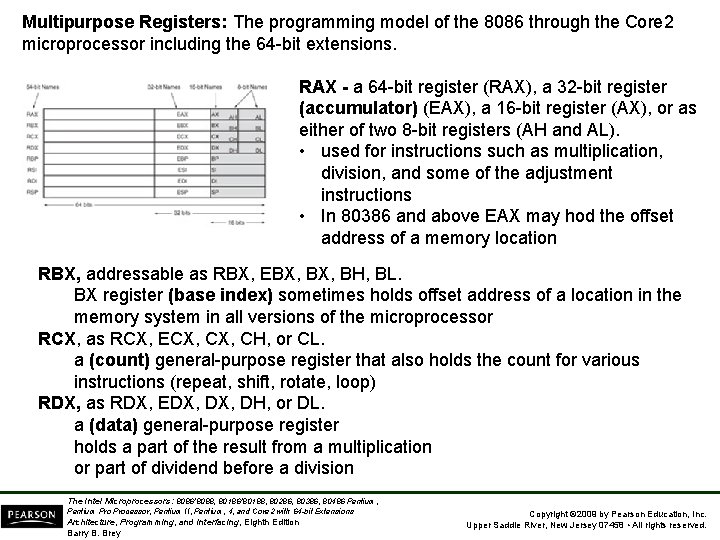
Multipurpose Registers: The programming model of the 8086 through the Core 2 microprocessor including the 64 -bit extensions. RAX - a 64 -bit register (RAX), a 32 -bit register (accumulator) (EAX), a 16 -bit register (AX), or as either of two 8 -bit registers (AH and AL). • used for instructions such as multiplication, division, and some of the adjustment instructions • In 80386 and above EAX may hod the offset address of a memory location RBX, addressable as RBX, EBX, BH, BL. BX register (base index) sometimes holds offset address of a location in the memory system in all versions of the microprocessor RCX, as RCX, ECX, CH, or CL. a (count) general-purpose register that also holds the count for various instructions (repeat, shift, rotate, loop) RDX, as RDX, EDX, DH, or DL. a (data) general-purpose register holds a part of the result from a multiplication or part of dividend before a division The Intel Microprocessors: 8086/8088, 80186/80188, 80286, 80386, 80486 Pentium, Pentium Processor, Pentium II, Pentium, 4, and Core 2 with 64 -bit Extensions Architecture, Programming, and Interfacing, Eighth Edition Barry B. Brey Copyright © 2009 by Pearson Education, Inc. Upper Saddle River, New Jersey 07458 • All rights reserved.
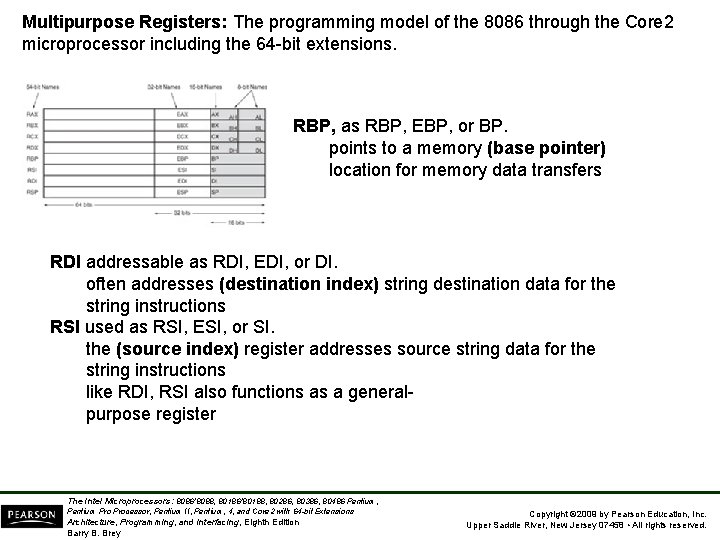
Multipurpose Registers: The programming model of the 8086 through the Core 2 microprocessor including the 64 -bit extensions. RBP, as RBP, EBP, or BP. points to a memory (base pointer) location for memory data transfers RDI addressable as RDI, EDI, or DI. often addresses (destination index) string destination data for the string instructions RSI used as RSI, ESI, or SI. the (source index) register addresses source string data for the string instructions like RDI, RSI also functions as a generalpurpose register The Intel Microprocessors: 8086/8088, 80186/80188, 80286, 80386, 80486 Pentium, Pentium Processor, Pentium II, Pentium, 4, and Core 2 with 64 -bit Extensions Architecture, Programming, and Interfacing, Eighth Edition Barry B. Brey Copyright © 2009 by Pearson Education, Inc. Upper Saddle River, New Jersey 07458 • All rights reserved.
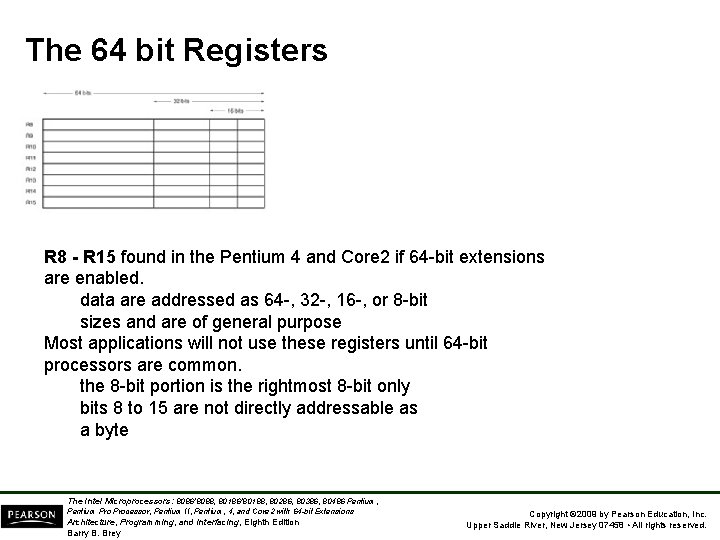
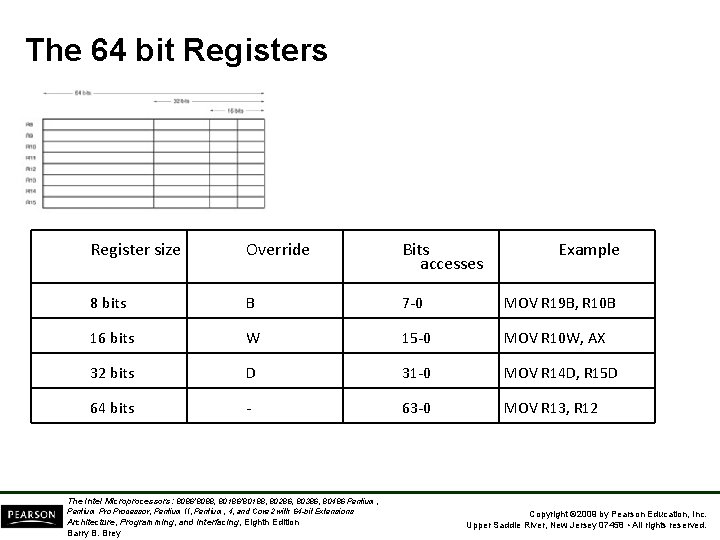
The 64 bit Registers R 8 - R 15 found in the Pentium 4 and Core 2 if 64 -bit extensions are enabled. data are addressed as 64 -, 32 -, 16 -, or 8 -bit sizes and are of general purpose Most applications will not use these registers until 64 -bit processors are common. the 8 -bit portion is the rightmost 8 -bit only bits 8 to 15 are not directly addressable as a byte The Intel Microprocessors: 8086/8088, 80186/80188, 80286, 80386, 80486 Pentium, Pentium Processor, Pentium II, Pentium, 4, and Core 2 with 64 -bit Extensions Architecture, Programming, and Interfacing, Eighth Edition Barry B. Brey Copyright © 2009 by Pearson Education, Inc. Upper Saddle River, New Jersey 07458 • All rights reserved.
The 64 bit Registers Register size Override Bits accesses Example 8 bits B 7 -0 MOV R 19 B, R 10 B 16 bits W 15 -0 MOV R 10 W, AX 32 bits D 31 -0 MOV R 14 D, R 15 D 64 bits - 63 -0 MOV R 13, R 12 The Intel Microprocessors: 8086/8088, 80186/80188, 80286, 80386, 80486 Pentium, Pentium Processor, Pentium II, Pentium, 4, and Core 2 with 64 -bit Extensions Architecture, Programming, and Interfacing, Eighth Edition Barry B. Brey Copyright © 2009 by Pearson Education, Inc. Upper Saddle River, New Jersey 07458 • All rights reserved.
Special-Purpose Registers • Include RIP, RSP, and RFLAGS – segment registers include CS, DS, ES, SS, FS, and GS • RIP - instruction pointer – addresses the next instruction in code section • RSP - stack pointer – addresses an area of memory called the stack. The Intel Microprocessors: 8086/8088, 80186/80188, 80286, 80386, 80486 Pentium, Pentium Processor, Pentium II, Pentium, 4, and Core 2 with 64 -bit Extensions Architecture, Programming, and Interfacing, Eighth Edition Barry B. Brey Copyright © 2009 by Pearson Education, Inc. Upper Saddle River, New Jersey 07458 • All rights reserved.
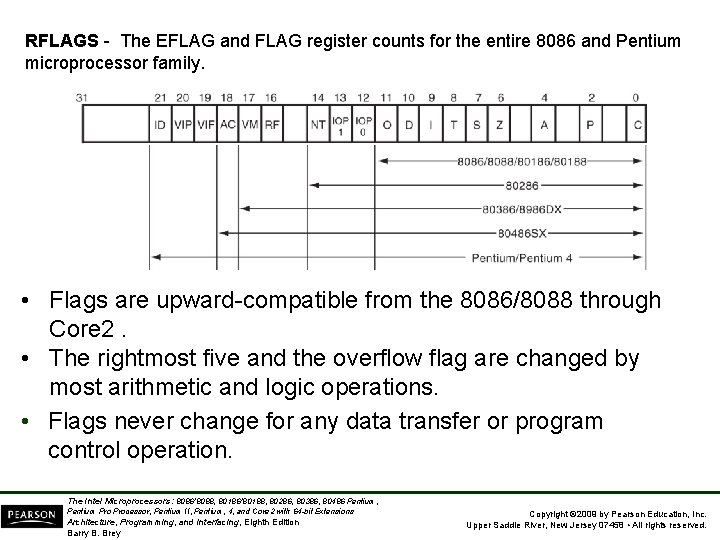
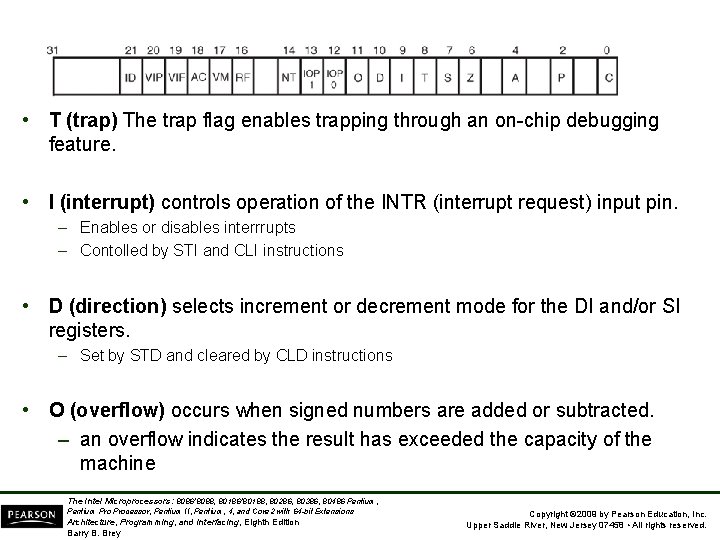
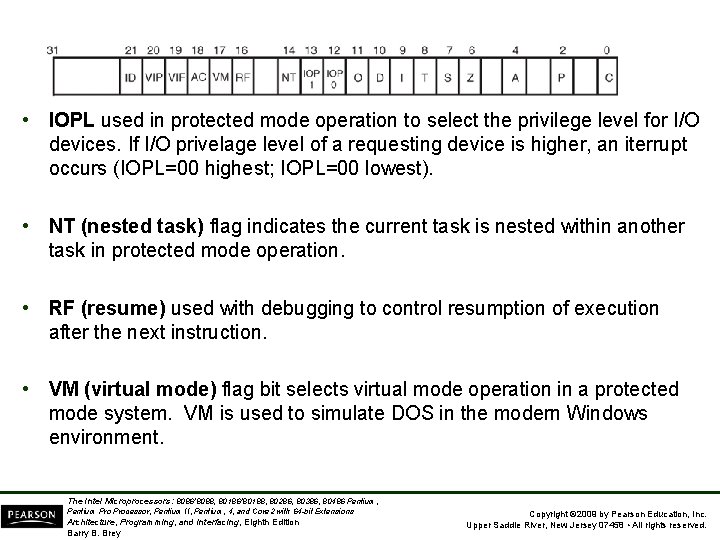
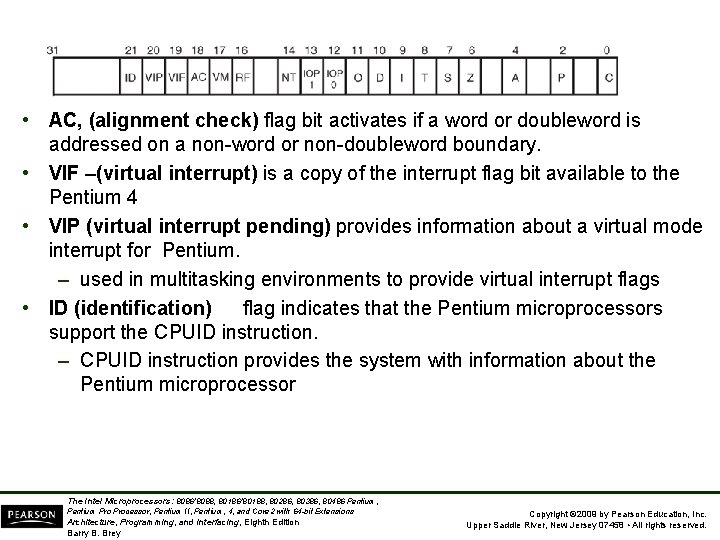
RFLAGS - The EFLAG and FLAG register counts for the entire 8086 and Pentium microprocessor family. • Flags are upward-compatible from the 8086/8088 through Core 2. • The rightmost five and the overflow flag are changed by most arithmetic and logic operations. • Flags never change for any data transfer or program control operation. The Intel Microprocessors: 8086/8088, 80186/80188, 80286, 80386, 80486 Pentium, Pentium Processor, Pentium II, Pentium, 4, and Core 2 with 64 -bit Extensions Architecture, Programming, and Interfacing, Eighth Edition Barry B. Brey Copyright © 2009 by Pearson Education, Inc. Upper Saddle River, New Jersey 07458 • All rights reserved.
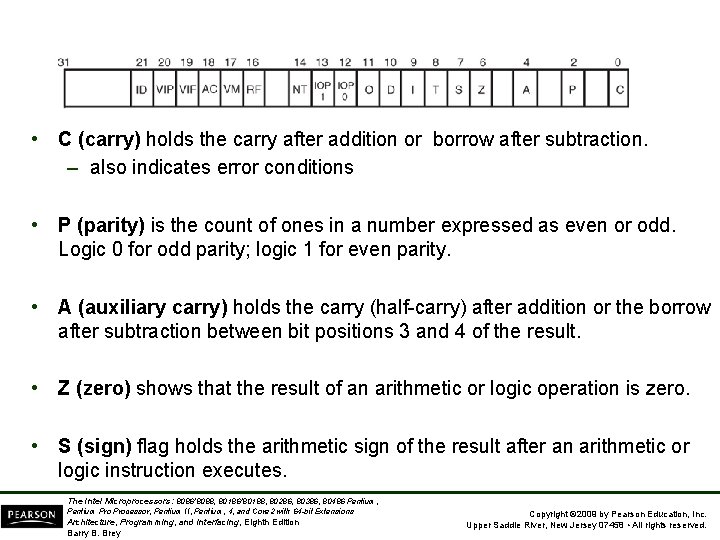
• C (carry) holds the carry after addition or borrow after subtraction. – also indicates error conditions • P (parity) is the count of ones in a number expressed as even or odd. Logic 0 for odd parity; logic 1 for even parity. • A (auxiliary carry) holds the carry (half-carry) after addition or the borrow after subtraction between bit positions 3 and 4 of the result. • Z (zero) shows that the result of an arithmetic or logic operation is zero. • S (sign) flag holds the arithmetic sign of the result after an arithmetic or logic instruction executes. The Intel Microprocessors: 8086/8088, 80186/80188, 80286, 80386, 80486 Pentium, Pentium Processor, Pentium II, Pentium, 4, and Core 2 with 64 -bit Extensions Architecture, Programming, and Interfacing, Eighth Edition Barry B. Brey Copyright © 2009 by Pearson Education, Inc. Upper Saddle River, New Jersey 07458 • All rights reserved.
• T (trap) The trap flag enables trapping through an on-chip debugging feature. • I (interrupt) controls operation of the INTR (interrupt request) input pin. – Enables or disables interrrupts – Contolled by STI and CLI instructions • D (direction) selects increment or decrement mode for the DI and/or SI registers. – Set by STD and cleared by CLD instructions • O (overflow) occurs when signed numbers are added or subtracted. – an overflow indicates the result has exceeded the capacity of the machine The Intel Microprocessors: 8086/8088, 80186/80188, 80286, 80386, 80486 Pentium, Pentium Processor, Pentium II, Pentium, 4, and Core 2 with 64 -bit Extensions Architecture, Programming, and Interfacing, Eighth Edition Barry B. Brey Copyright © 2009 by Pearson Education, Inc. Upper Saddle River, New Jersey 07458 • All rights reserved.
• IOPL used in protected mode operation to select the privilege level for I/O devices. If I/O privelage level of a requesting device is higher, an iterrupt occurs (IOPL=00 highest; IOPL=00 lowest). • NT (nested task) flag indicates the current task is nested within another task in protected mode operation. • RF (resume) used with debugging to control resumption of execution after the next instruction. • VM (virtual mode) flag bit selects virtual mode operation in a protected mode system. VM is used to simulate DOS in the modern Windows environment. The Intel Microprocessors: 8086/8088, 80186/80188, 80286, 80386, 80486 Pentium, Pentium Processor, Pentium II, Pentium, 4, and Core 2 with 64 -bit Extensions Architecture, Programming, and Interfacing, Eighth Edition Barry B. Brey Copyright © 2009 by Pearson Education, Inc. Upper Saddle River, New Jersey 07458 • All rights reserved.
• AC, (alignment check) flag bit activates if a word or doubleword is addressed on a non-word or non-doubleword boundary. • VIF –(virtual interrupt) is a copy of the interrupt flag bit available to the Pentium 4 • VIP (virtual interrupt pending) provides information about a virtual mode interrupt for Pentium. – used in multitasking environments to provide virtual interrupt flags • ID (identification) flag indicates that the Pentium microprocessors support the CPUID instruction. – CPUID instruction provides the system with information about the Pentium microprocessor The Intel Microprocessors: 8086/8088, 80186/80188, 80286, 80386, 80486 Pentium, Pentium Processor, Pentium II, Pentium, 4, and Core 2 with 64 -bit Extensions Architecture, Programming, and Interfacing, Eighth Edition Barry B. Brey Copyright © 2009 by Pearson Education, Inc. Upper Saddle River, New Jersey 07458 • All rights reserved.
Segment Registers • Generate memory addresses when combined with other registers in the microprocessor. • Four or six segment registers in various versions of the microprocessor. • A segment register functions differently in real mode than in protected mode. • Following is a list of each segment register, along with its function in the system. The Intel Microprocessors: 8086/8088, 80186/80188, 80286, 80386, 80486 Pentium, Pentium Processor, Pentium II, Pentium, 4, and Core 2 with 64 -bit Extensions Architecture, Programming, and Interfacing, Eighth Edition Barry B. Brey Copyright © 2009 by Pearson Education, Inc. Upper Saddle River, New Jersey 07458 • All rights reserved.
• CS (code) segment holds code (programs and procedures) used by the microprocessor. • DS (data) contains most data used by a program. – Data are accessed by an offset address or contents of other registers that hold the offset address • ES (extra) an additional data segment used by some instructions to hold destination data. The Intel Microprocessors: 8086/8088, 80186/80188, 80286, 80386, 80486 Pentium, Pentium Processor, Pentium II, Pentium, 4, and Core 2 with 64 -bit Extensions Architecture, Programming, and Interfacing, Eighth Edition Barry B. Brey Copyright © 2009 by Pearson Education, Inc. Upper Saddle River, New Jersey 07458 • All rights reserved.
• SS (stack) defines the area of memory used for the stack. – stack entry point is determined by the stack segment and stack pointer registers – the BP register also addresses data within the stack segment The Intel Microprocessors: 8086/8088, 80186/80188, 80286, 80386, 80486 Pentium, Pentium Processor, Pentium II, Pentium, 4, and Core 2 with 64 -bit Extensions Architecture, Programming, and Interfacing, Eighth Edition Barry B. Brey Copyright © 2009 by Pearson Education, Inc. Upper Saddle River, New Jersey 07458 • All rights reserved.
• FS and GS segments are supplemental segment registers available in 80386–Core 2 microprocessors. – allow two additional memory segments for access by programs • Windows uses these segments for internal operations, but no definition of their usage is available. The Intel Microprocessors: 8086/8088, 80186/80188, 80286, 80386, 80486 Pentium, Pentium Processor, Pentium II, Pentium, 4, and Core 2 with 64 -bit Extensions Architecture, Programming, and Interfacing, Eighth Edition Barry B. Brey Copyright © 2009 by Pearson Education, Inc. Upper Saddle River, New Jersey 07458 • All rights reserved.
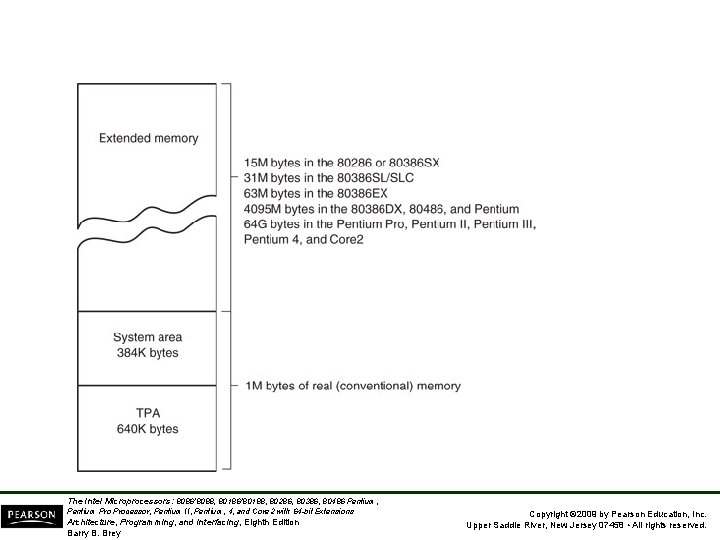
2– 2 REAL MODE MEMORY ADDRESSING • 80286 and above operate in either the real or protected mode. • Real mode operation allows addressing of only the first 1 M byte of memory space—even in Pentium 4 or Core 2 microprocessor. – the first 1 M byte of memory is called the real memory, conventional memory, or DOS memory system The Intel Microprocessors: 8086/8088, 80186/80188, 80286, 80386, 80486 Pentium, Pentium Processor, Pentium II, Pentium, 4, and Core 2 with 64 -bit Extensions Architecture, Programming, and Interfacing, Eighth Edition Barry B. Brey Copyright © 2009 by Pearson Education, Inc. Upper Saddle River, New Jersey 07458 • All rights reserved.
The Intel Microprocessors: 8086/8088, 80186/80188, 80286, 80386, 80486 Pentium, Pentium Processor, Pentium II, Pentium, 4, and Core 2 with 64 -bit Extensions Architecture, Programming, and Interfacing, Eighth Edition Barry B. Brey Copyright © 2009 by Pearson Education, Inc. Upper Saddle River, New Jersey 07458 • All rights reserved.
Segments and Offsets • All real mode memory addresses must consist of a segment address plus an offset address. – segment address defines the beginning address of any 64 K-byte memory segment – offset address selects any location within the 64 K byte memory segment • Figure 2– 3 shows how the segment plus offset addressing scheme selects a memory location. The Intel Microprocessors: 8086/8088, 80186/80188, 80286, 80386, 80486 Pentium, Pentium Processor, Pentium II, Pentium, 4, and Core 2 with 64 -bit Extensions Architecture, Programming, and Interfacing, Eighth Edition Barry B. Brey Copyright © 2009 by Pearson Education, Inc. Upper Saddle River, New Jersey 07458 • All rights reserved.
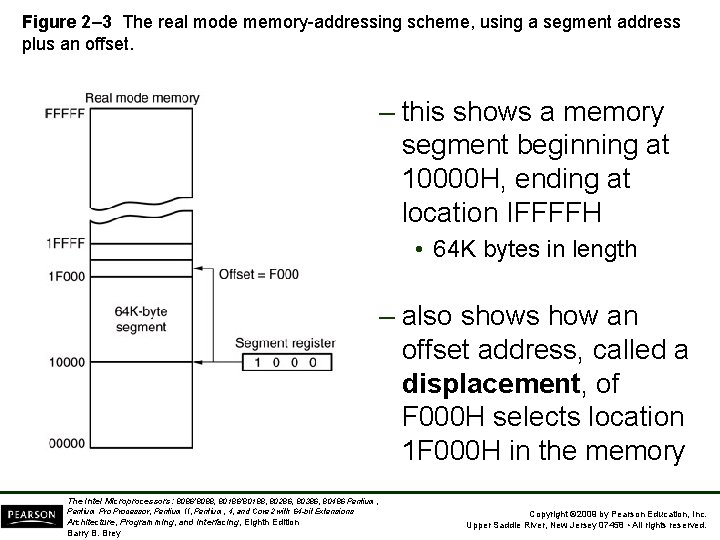
Figure 2– 3 The real mode memory-addressing scheme, using a segment address plus an offset. – this shows a memory segment beginning at 10000 H, ending at location IFFFFH • 64 K bytes in length – also shows how an offset address, called a displacement, of F 000 H selects location 1 F 000 H in the memory The Intel Microprocessors: 8086/8088, 80186/80188, 80286, 80386, 80486 Pentium, Pentium Processor, Pentium II, Pentium, 4, and Core 2 with 64 -bit Extensions Architecture, Programming, and Interfacing, Eighth Edition Barry B. Brey Copyright © 2009 by Pearson Education, Inc. Upper Saddle River, New Jersey 07458 • All rights reserved.
• Once the beginning address is known, the ending address is found by adding FFFFH. – because a real mode segment of memory is 64 K in length • The offset address is always added to the segment starting address to locate the data. • Segment and offset address is sometimes written as 1000: 2000. – a segment address of 1000 H; an offset of 2000 H – Memory address is 10000 + 2000 = 12000 H The Intel Microprocessors: 8086/8088, 80186/80188, 80286, 80386, 80486 Pentium, Pentium Processor, Pentium II, Pentium, 4, and Core 2 with 64 -bit Extensions Architecture, Programming, and Interfacing, Eighth Edition Barry B. Brey Copyright © 2009 by Pearson Education, Inc. Upper Saddle River, New Jersey 07458 • All rights reserved.
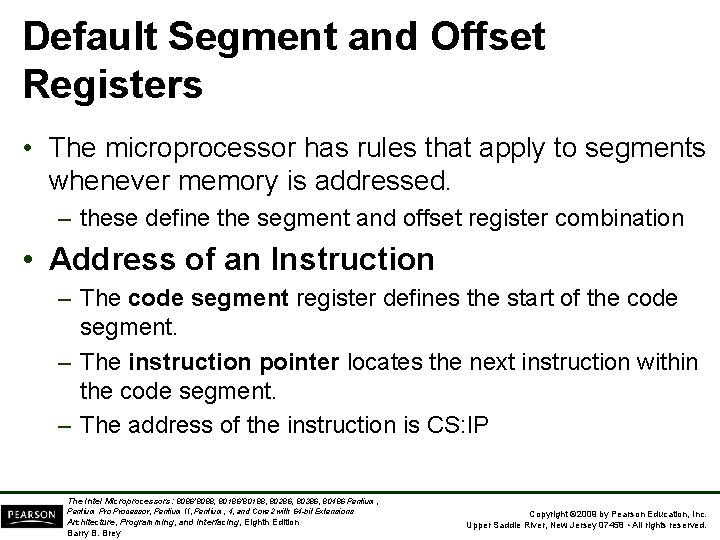
Default Segment and Offset Registers • The microprocessor has rules that apply to segments whenever memory is addressed. – these define the segment and offset register combination • Address of an Instruction – The code segment register defines the start of the code segment. – The instruction pointer locates the next instruction within the code segment. – The address of the instruction is CS: IP The Intel Microprocessors: 8086/8088, 80186/80188, 80286, 80386, 80486 Pentium, Pentium Processor, Pentium II, Pentium, 4, and Core 2 with 64 -bit Extensions Architecture, Programming, and Interfacing, Eighth Edition Barry B. Brey Copyright © 2009 by Pearson Education, Inc. Upper Saddle River, New Jersey 07458 • All rights reserved.
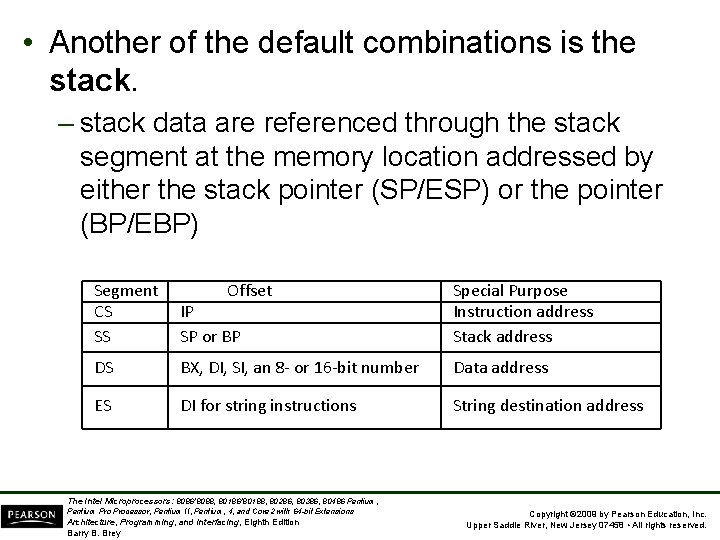
• Another of the default combinations is the stack. – stack data are referenced through the stack segment at the memory location addressed by either the stack pointer (SP/ESP) or the pointer (BP/EBP) Segment CS SS Offset IP SP or BP Special Purpose Instruction address Stack address DS BX, DI, SI, an 8 - or 16 -bit number Data address ES DI for string instructions String destination address The Intel Microprocessors: 8086/8088, 80186/80188, 80286, 80386, 80486 Pentium, Pentium Processor, Pentium II, Pentium, 4, and Core 2 with 64 -bit Extensions Architecture, Programming, and Interfacing, Eighth Edition Barry B. Brey Copyright © 2009 by Pearson Education, Inc. Upper Saddle River, New Jersey 07458 • All rights reserved.
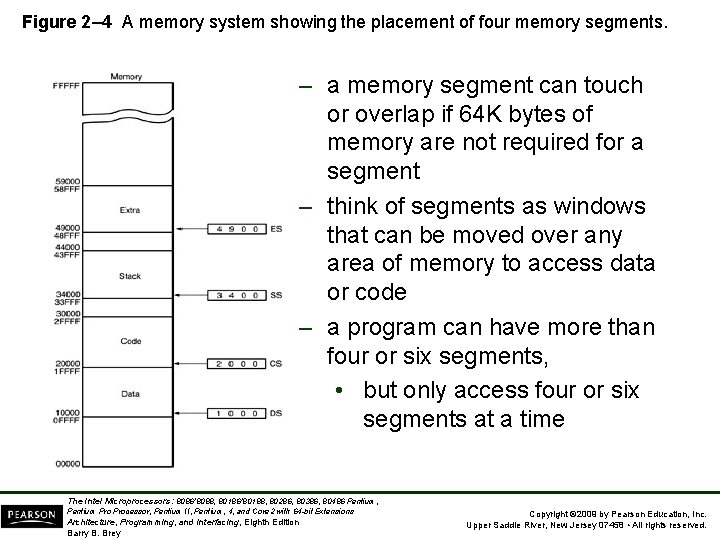
Figure 2– 4 A memory system showing the placement of four memory segments. – a memory segment can touch or overlap if 64 K bytes of memory are not required for a segment – think of segments as windows that can be moved over any area of memory to access data or code – a program can have more than four or six segments, • but only access four or six segments at a time The Intel Microprocessors: 8086/8088, 80186/80188, 80286, 80386, 80486 Pentium, Pentium Processor, Pentium II, Pentium, 4, and Core 2 with 64 -bit Extensions Architecture, Programming, and Interfacing, Eighth Edition Barry B. Brey Copyright © 2009 by Pearson Education, Inc. Upper Saddle River, New Jersey 07458 • All rights reserved.
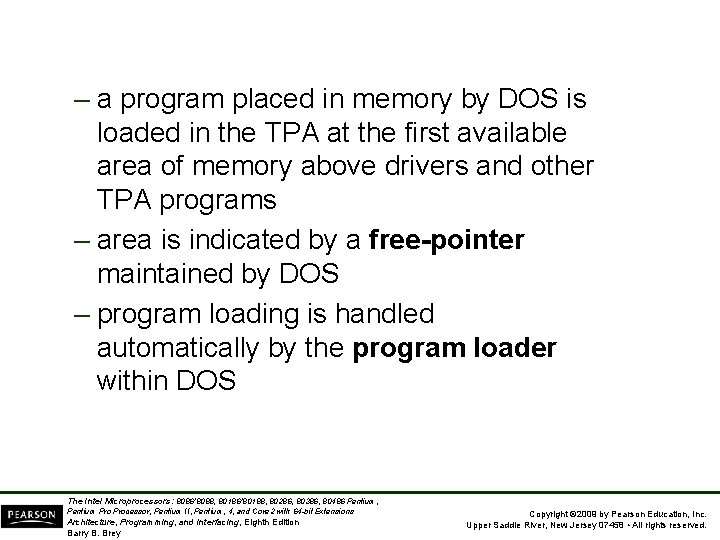
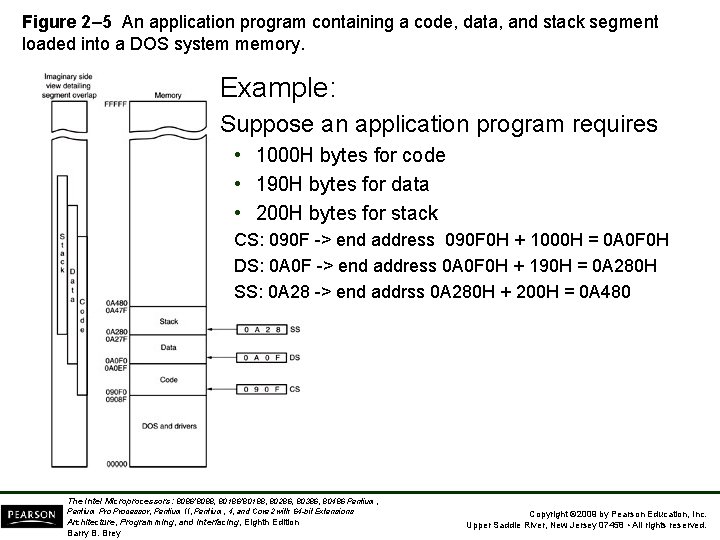
– a program placed in memory by DOS is loaded in the TPA at the first available area of memory above drivers and other TPA programs – area is indicated by a free-pointer maintained by DOS – program loading is handled automatically by the program loader within DOS The Intel Microprocessors: 8086/8088, 80186/80188, 80286, 80386, 80486 Pentium, Pentium Processor, Pentium II, Pentium, 4, and Core 2 with 64 -bit Extensions Architecture, Programming, and Interfacing, Eighth Edition Barry B. Brey Copyright © 2009 by Pearson Education, Inc. Upper Saddle River, New Jersey 07458 • All rights reserved.
Figure 2– 5 An application program containing a code, data, and stack segment loaded into a DOS system memory. Example: Suppose an application program requires • 1000 H bytes for code • 190 H bytes for data • 200 H bytes for stack CS: 090 F -> end address 090 F 0 H + 1000 H = 0 A 0 F 0 H DS: 0 A 0 F -> end address 0 A 0 F 0 H + 190 H = 0 A 280 H SS: 0 A 28 -> end addrss 0 A 280 H + 200 H = 0 A 480 The Intel Microprocessors: 8086/8088, 80186/80188, 80286, 80386, 80486 Pentium, Pentium Processor, Pentium II, Pentium, 4, and Core 2 with 64 -bit Extensions Architecture, Programming, and Interfacing, Eighth Edition Barry B. Brey Copyright © 2009 by Pearson Education, Inc. Upper Saddle River, New Jersey 07458 • All rights reserved.
Segment and Offset Addressing Scheme Allows Relocation • Segment plus offset addressing allows DOS programs to be relocated in memory. • A relocatable program is one that can be placed into any area of memory and executed without change. • Relocatable data are data that can be placed in any area of memory and used without any change to the program. The Intel Microprocessors: 8086/8088, 80186/80188, 80286, 80386, 80486 Pentium, Pentium Processor, Pentium II, Pentium, 4, and Core 2 with 64 -bit Extensions Architecture, Programming, and Interfacing, Eighth Edition Barry B. Brey Copyright © 2009 by Pearson Education, Inc. Upper Saddle River, New Jersey 07458 • All rights reserved.
• Because memory is addressed within a segment by an offset address, the memory segment can be moved to any place in the memory system without changing any of the offset addresses. • Only the contents of the segment register must be changed to address the program in the new area of memory. • Windows programs are written assuming that the first 2 G of memory are available for code and data. The Intel Microprocessors: 8086/8088, 80186/80188, 80286, 80386, 80486 Pentium, Pentium Processor, Pentium II, Pentium, 4, and Core 2 with 64 -bit Extensions Architecture, Programming, and Interfacing, Eighth Edition Barry B. Brey Copyright © 2009 by Pearson Education, Inc. Upper Saddle River, New Jersey 07458 • All rights reserved.
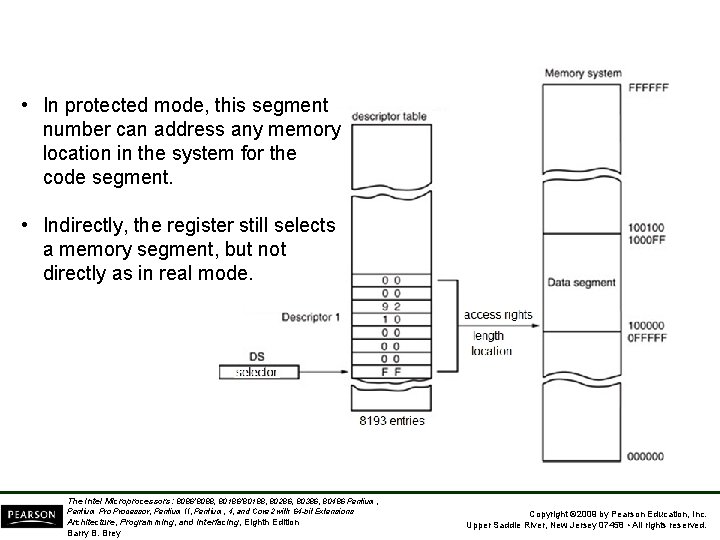
2– 3 INTRO TO PROTECTED MODE MEMORY ADDRESSING • Allows access to data and programs located within & above the first 1 M byte of memory. • Protected mode is where Windows operates. • In place of a segment address, the segment register contains a selector that selects a descriptor from a descriptor table. • The descriptor describes the memory segment’s location, length, and access rights. The Intel Microprocessors: 8086/8088, 80186/80188, 80286, 80386, 80486 Pentium, Pentium Processor, Pentium II, Pentium, 4, and Core 2 with 64 -bit Extensions Architecture, Programming, and Interfacing, Eighth Edition Barry B. Brey Copyright © 2009 by Pearson Education, Inc. Upper Saddle River, New Jersey 07458 • All rights reserved.
• In protected mode, this segment number can address any memory location in the system for the code segment. • Indirectly, the register still selects a memory segment, but not directly as in real mode. The Intel Microprocessors: 8086/8088, 80186/80188, 80286, 80386, 80486 Pentium, Pentium Processor, Pentium II, Pentium, 4, and Core 2 with 64 -bit Extensions Architecture, Programming, and Interfacing, Eighth Edition Barry B. Brey Copyright © 2009 by Pearson Education, Inc. Upper Saddle River, New Jersey 07458 • All rights reserved.
• Global descriptors contain segment definitions that apply to all programs. • Local descriptors are usually unique to an application. – a global descriptor might be called a system descriptor, and local descriptor an application descriptor – each descriptor is 8 bytes in length – global and local descriptor tables are a maximum of 64 K (8 x 8193) bytes in length The Intel Microprocessors: 8086/8088, 80186/80188, 80286, 80386, 80486 Pentium, Pentium Processor, Pentium II, Pentium, 4, and Core 2 with 64 -bit Extensions Architecture, Programming, and Interfacing, Eighth Edition Barry B. Brey Copyright © 2009 by Pearson Education, Inc. Upper Saddle River, New Jersey 07458 • All rights reserved.
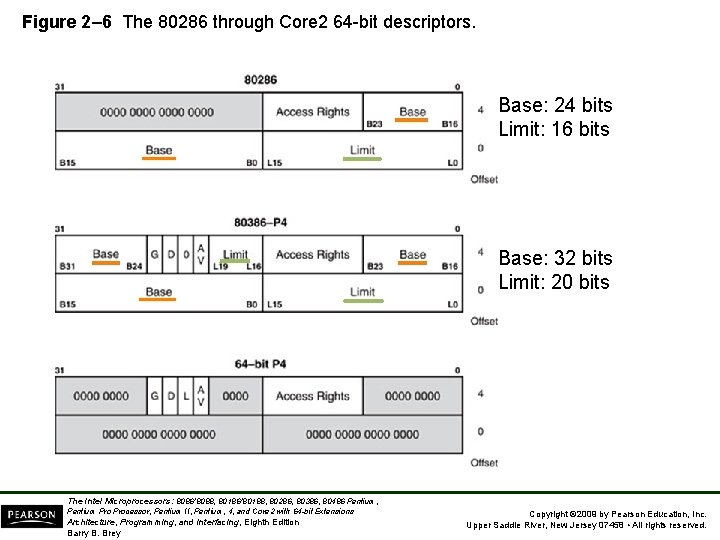
Figure 2– 6 The 80286 through Core 2 64 -bit descriptors. Base: 24 bits Limit: 16 bits Base: 32 bits Limit: 20 bits The Intel Microprocessors: 8086/8088, 80186/80188, 80286, 80386, 80486 Pentium, Pentium Processor, Pentium II, Pentium, 4, and Core 2 with 64 -bit Extensions Architecture, Programming, and Interfacing, Eighth Edition Barry B. Brey Copyright © 2009 by Pearson Education, Inc. Upper Saddle River, New Jersey 07458 • All rights reserved.
• The base address of the descriptor indicates the starting location of the memory segment. – the paragraph boundary limitation is removed in protected mode – segments may begin at any address • The G, or granularity bit allows a segment length of 4 K to 4 G bytes in steps of 4 K bytes. – 32 -bit offset address allows segment lengths of 4 G bytes – 16 -bit offset address allows segment lengths of 64 K bytes. The Intel Microprocessors: 8086/8088, 80186/80188, 80286, 80386, 80486 Pentium, Pentium Processor, Pentium II, Pentium, 4, and Core 2 with 64 -bit Extensions Architecture, Programming, and Interfacing, Eighth Edition Barry B. Brey Copyright © 2009 by Pearson Education, Inc. Upper Saddle River, New Jersey 07458 • All rights reserved.
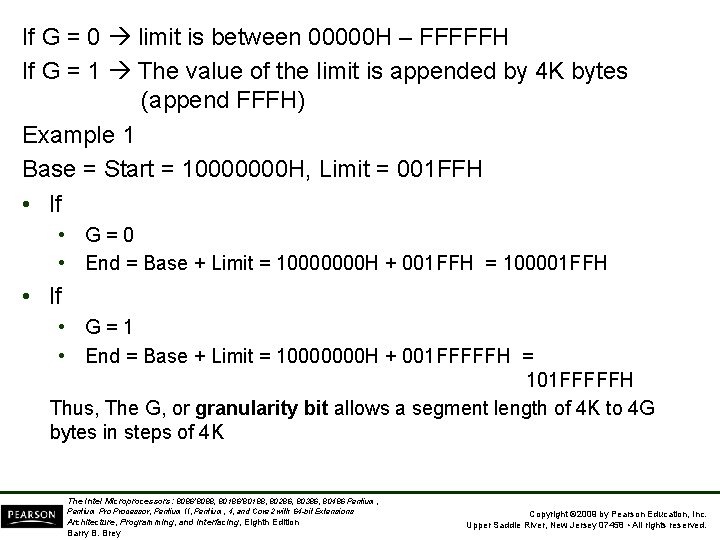
If G = 0 limit is between 00000 H – FFFFFH If G = 1 The value of the limit is appended by 4 K bytes (append FFFH) Example 1 Base = Start = 10000000 H, Limit = 001 FFH • If • G=0 • End = Base + Limit = 10000000 H + 001 FFH = 100001 FFH • If • G=1 • End = Base + Limit = 10000000 H + 001 FFFFFH = 101 FFFFFH Thus, The G, or granularity bit allows a segment length of 4 K to 4 G bytes in steps of 4 K The Intel Microprocessors: 8086/8088, 80186/80188, 80286, 80386, 80486 Pentium, Pentium Processor, Pentium II, Pentium, 4, and Core 2 with 64 -bit Extensions Architecture, Programming, and Interfacing, Eighth Edition Barry B. Brey Copyright © 2009 by Pearson Education, Inc. Upper Saddle River, New Jersey 07458 • All rights reserved.
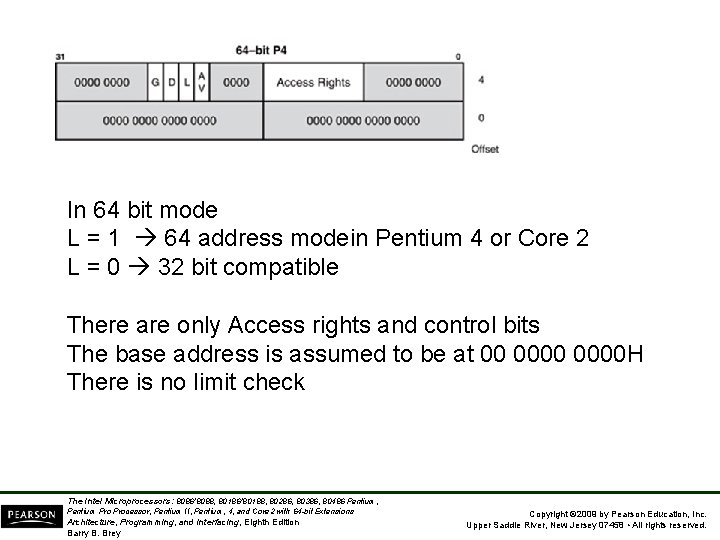
In 64 bit mode L = 1 64 address modein Pentium 4 or Core 2 L = 0 32 bit compatible There are only Access rights and control bits The base address is assumed to be at 00 0000 H There is no limit check The Intel Microprocessors: 8086/8088, 80186/80188, 80286, 80386, 80486 Pentium, Pentium Processor, Pentium II, Pentium, 4, and Core 2 with 64 -bit Extensions Architecture, Programming, and Interfacing, Eighth Edition Barry B. Brey Copyright © 2009 by Pearson Education, Inc. Upper Saddle River, New Jersey 07458 • All rights reserved.
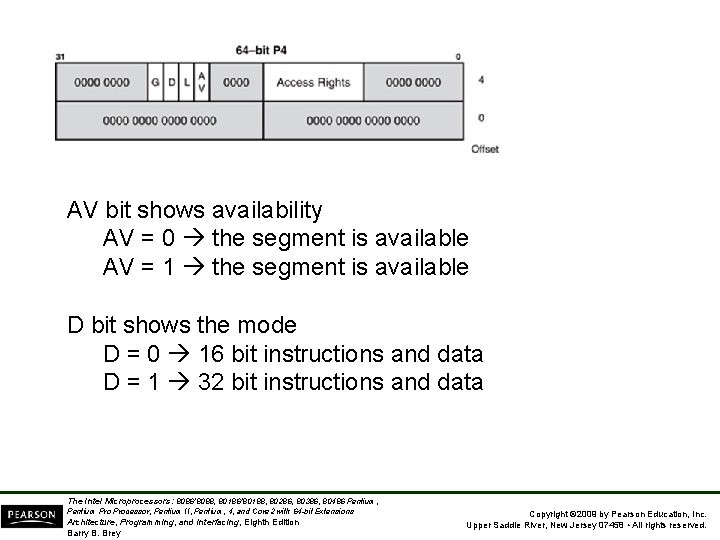
AV bit shows availability AV = 0 the segment is available AV = 1 the segment is available D bit shows the mode D = 0 16 bit instructions and data D = 1 32 bit instructions and data The Intel Microprocessors: 8086/8088, 80186/80188, 80286, 80386, 80486 Pentium, Pentium Processor, Pentium II, Pentium, 4, and Core 2 with 64 -bit Extensions Architecture, Programming, and Interfacing, Eighth Edition Barry B. Brey Copyright © 2009 by Pearson Education, Inc. Upper Saddle River, New Jersey 07458 • All rights reserved.
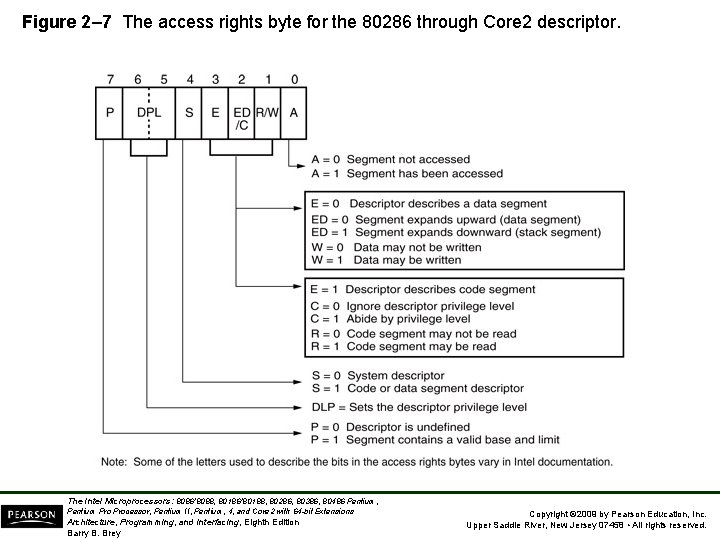
• The access rights byte controls access to the protected mode segment. – describes segment function in the system and allows complete control over the segment – if the segment is a data segment, the direction of growth is specified • If the segment grows beyond its limit, the operating system is interrupted, indicating a general protection fault. • You can specify whether a data segment can be written or is write-protected. The Intel Microprocessors: 8086/8088, 80186/80188, 80286, 80386, 80486 Pentium, Pentium Processor, Pentium II, Pentium, 4, and Core 2 with 64 -bit Extensions Architecture, Programming, and Interfacing, Eighth Edition Barry B. Brey Copyright © 2009 by Pearson Education, Inc. Upper Saddle River, New Jersey 07458 • All rights reserved.
Figure 2– 7 The access rights byte for the 80286 through Core 2 descriptor. The Intel Microprocessors: 8086/8088, 80186/80188, 80286, 80386, 80486 Pentium, Pentium Processor, Pentium II, Pentium, 4, and Core 2 with 64 -bit Extensions Architecture, Programming, and Interfacing, Eighth Edition Barry B. Brey Copyright © 2009 by Pearson Education, Inc. Upper Saddle River, New Jersey 07458 • All rights reserved.
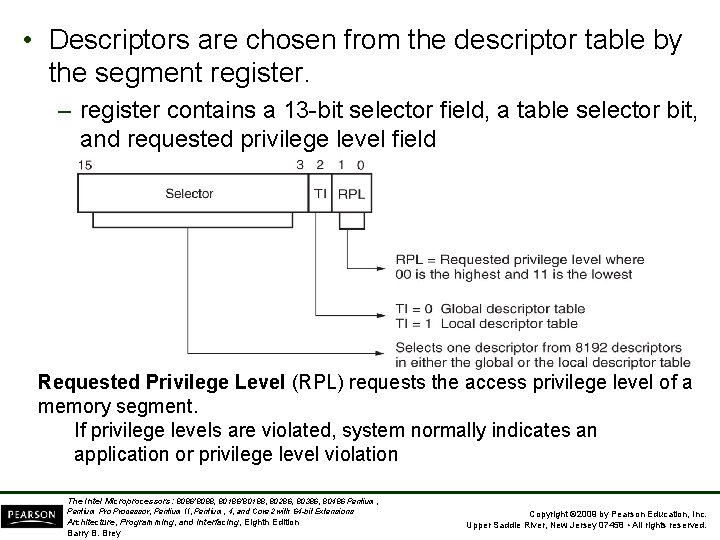
• Descriptors are chosen from the descriptor table by the segment register. – register contains a 13 -bit selector field, a table selector bit, and requested privilege level field Requested Privilege Level (RPL) requests the access privilege level of a memory segment. If privilege levels are violated, system normally indicates an application or privilege level violation The Intel Microprocessors: 8086/8088, 80186/80188, 80286, 80386, 80486 Pentium, Pentium Processor, Pentium II, Pentium, 4, and Core 2 with 64 -bit Extensions Architecture, Programming, and Interfacing, Eighth Edition Barry B. Brey Copyright © 2009 by Pearson Education, Inc. Upper Saddle River, New Jersey 07458 • All rights reserved.
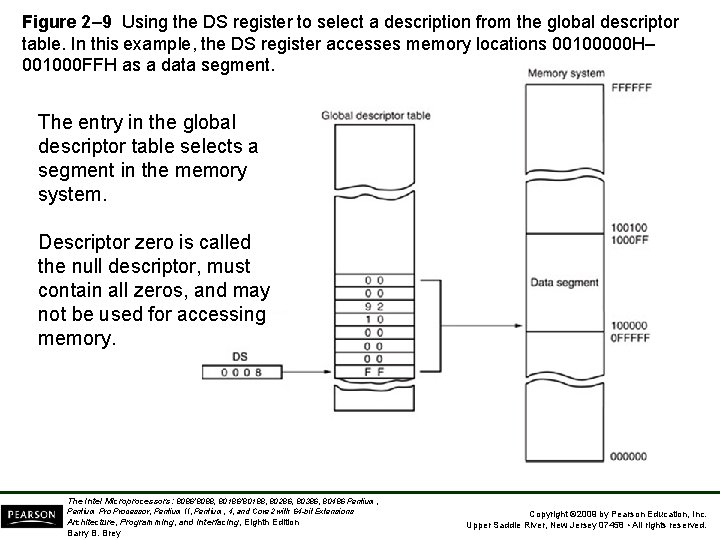
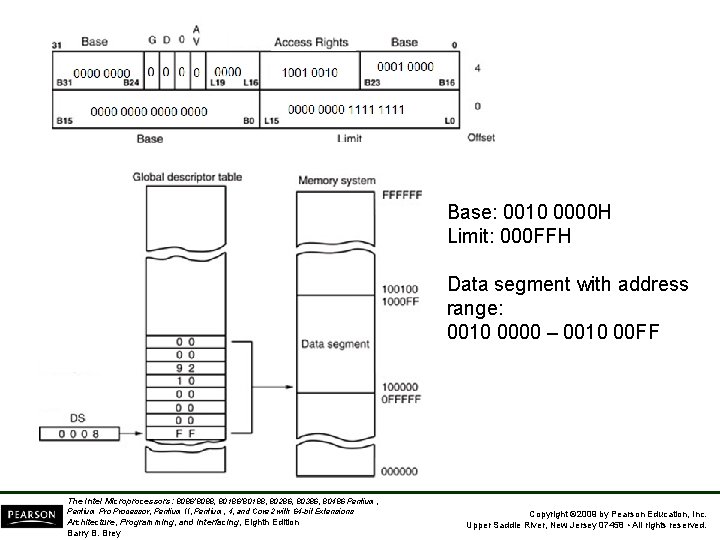
Figure 2– 9 Using the DS register to select a description from the global descriptor table. In this example, the DS register accesses memory locations 00100000 H– 001000 FFH as a data segment. The entry in the global descriptor table selects a segment in the memory system. Descriptor zero is called the null descriptor, must contain all zeros, and may not be used for accessing memory. The Intel Microprocessors: 8086/8088, 80186/80188, 80286, 80386, 80486 Pentium, Pentium Processor, Pentium II, Pentium, 4, and Core 2 with 64 -bit Extensions Architecture, Programming, and Interfacing, Eighth Edition Barry B. Brey Copyright © 2009 by Pearson Education, Inc. Upper Saddle River, New Jersey 07458 • All rights reserved.
Base: 0010 0000 H Limit: 000 FFH Data segment with address range: 0010 0000 – 0010 00 FF The Intel Microprocessors: 8086/8088, 80186/80188, 80286, 80386, 80486 Pentium, Pentium Processor, Pentium II, Pentium, 4, and Core 2 with 64 -bit Extensions Architecture, Programming, and Interfacing, Eighth Edition Barry B. Brey Copyright © 2009 by Pearson Education, Inc. Upper Saddle River, New Jersey 07458 • All rights reserved.
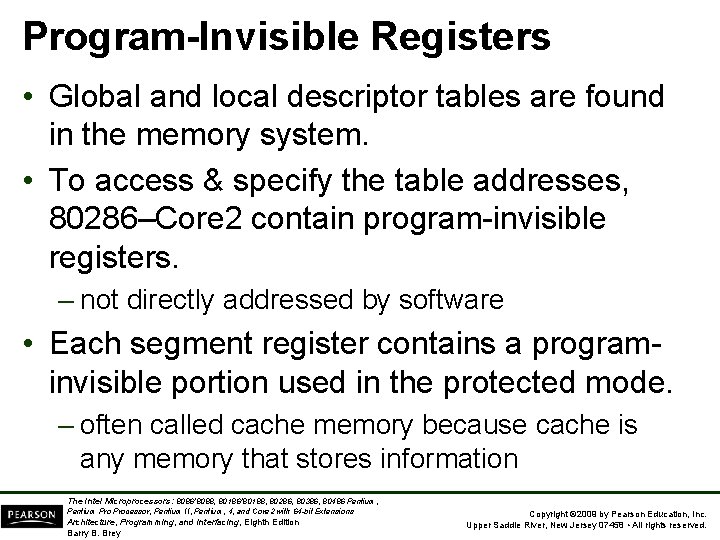
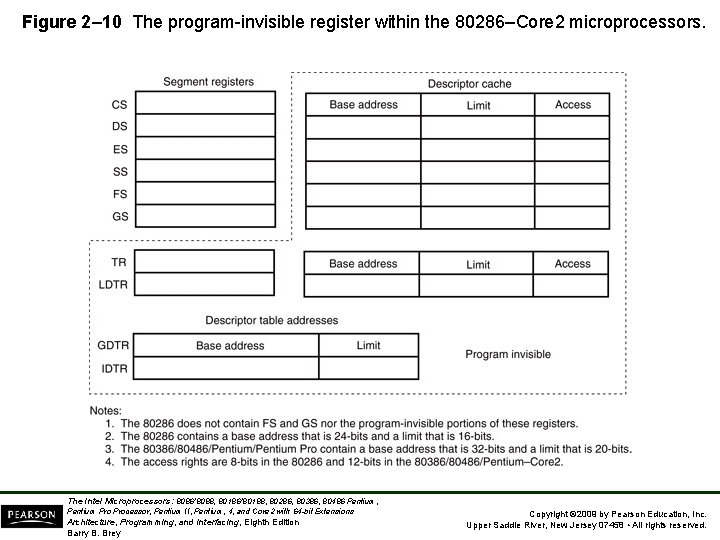
Program-Invisible Registers • Global and local descriptor tables are found in the memory system. • To access & specify the table addresses, 80286–Core 2 contain program-invisible registers. – not directly addressed by software • Each segment register contains a programinvisible portion used in the protected mode. – often called cache memory because cache is any memory that stores information The Intel Microprocessors: 8086/8088, 80186/80188, 80286, 80386, 80486 Pentium, Pentium Processor, Pentium II, Pentium, 4, and Core 2 with 64 -bit Extensions Architecture, Programming, and Interfacing, Eighth Edition Barry B. Brey Copyright © 2009 by Pearson Education, Inc. Upper Saddle River, New Jersey 07458 • All rights reserved.
Figure 2– 10 The program-invisible register within the 80286–Core 2 microprocessors. The Intel Microprocessors: 8086/8088, 80186/80188, 80286, 80386, 80486 Pentium, Pentium Processor, Pentium II, Pentium, 4, and Core 2 with 64 -bit Extensions Architecture, Programming, and Interfacing, Eighth Edition Barry B. Brey Copyright © 2009 by Pearson Education, Inc. Upper Saddle River, New Jersey 07458 • All rights reserved.
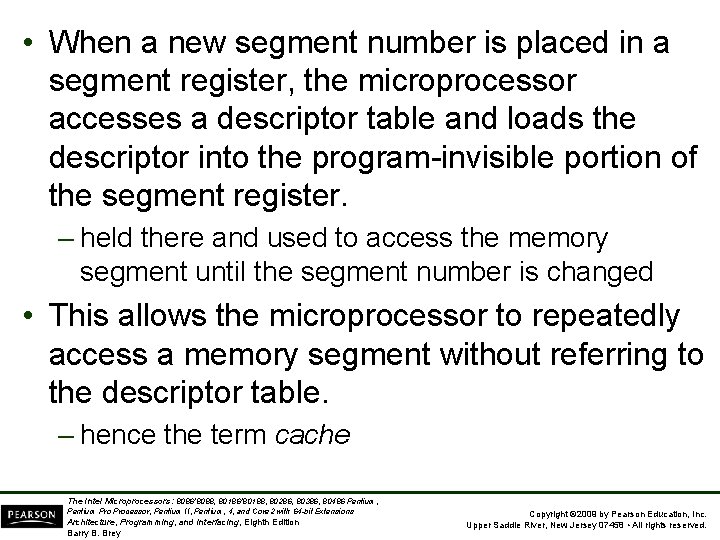
• When a new segment number is placed in a segment register, the microprocessor accesses a descriptor table and loads the descriptor into the program-invisible portion of the segment register. – held there and used to access the memory segment until the segment number is changed • This allows the microprocessor to repeatedly access a memory segment without referring to the descriptor table. – hence the term cache The Intel Microprocessors: 8086/8088, 80186/80188, 80286, 80386, 80486 Pentium, Pentium Processor, Pentium II, Pentium, 4, and Core 2 with 64 -bit Extensions Architecture, Programming, and Interfacing, Eighth Edition Barry B. Brey Copyright © 2009 by Pearson Education, Inc. Upper Saddle River, New Jersey 07458 • All rights reserved.
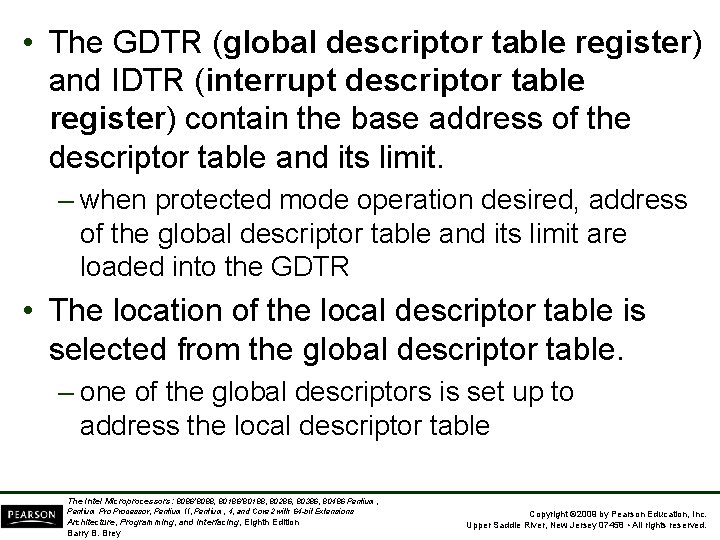
• The GDTR (global descriptor table register) and IDTR (interrupt descriptor table register) contain the base address of the descriptor table and its limit. – when protected mode operation desired, address of the global descriptor table and its limit are loaded into the GDTR • The location of the local descriptor table is selected from the global descriptor table. – one of the global descriptors is set up to address the local descriptor table The Intel Microprocessors: 8086/8088, 80186/80188, 80286, 80386, 80486 Pentium, Pentium Processor, Pentium II, Pentium, 4, and Core 2 with 64 -bit Extensions Architecture, Programming, and Interfacing, Eighth Edition Barry B. Brey Copyright © 2009 by Pearson Education, Inc. Upper Saddle River, New Jersey 07458 • All rights reserved.
• To access the local descriptor table, the LDTR (local descriptor table register) is loaded with a selector. – selector accesses global descriptor table, & loads local descriptor table address, limit, & access rights into the cache portion of the LDTR • The TR (task register) holds a selector, which accesses a descriptor that defines a task. – a task is most often a procedure or application • Allows multitasking systems to switch tasks to another in a simple and orderly fashion. The Intel Microprocessors: 8086/8088, 80186/80188, 80286, 80386, 80486 Pentium, Pentium Processor, Pentium II, Pentium, 4, and Core 2 with 64 -bit Extensions Architecture, Programming, and Interfacing, Eighth Edition Barry B. Brey Copyright © 2009 by Pearson Education, Inc. Upper Saddle River, New Jersey 07458 • All rights reserved.
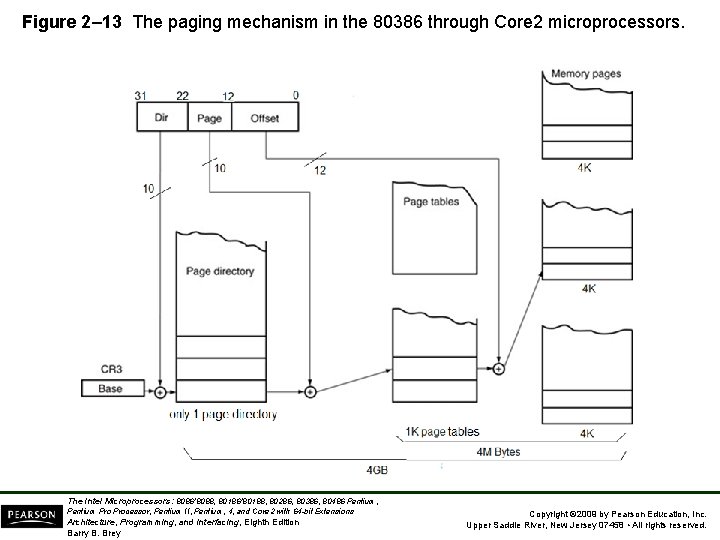
2– 4 MEMORY PAGING • The memory paging mechanism allows any physical memory location to be assigned to any linear address. – Iinear address is defined as the address generated by a program. – Physical address is the actual memory location accessed by a program. • With memory paging, the linear address is invisibly translated to any physical address. The Intel Microprocessors: 8086/8088, 80186/80188, 80286, 80386, 80486 Pentium, Pentium Processor, Pentium II, Pentium, 4, and Core 2 with 64 -bit Extensions Architecture, Programming, and Interfacing, Eighth Edition Barry B. Brey Copyright © 2009 by Pearson Education, Inc. Upper Saddle River, New Jersey 07458 • All rights reserved.
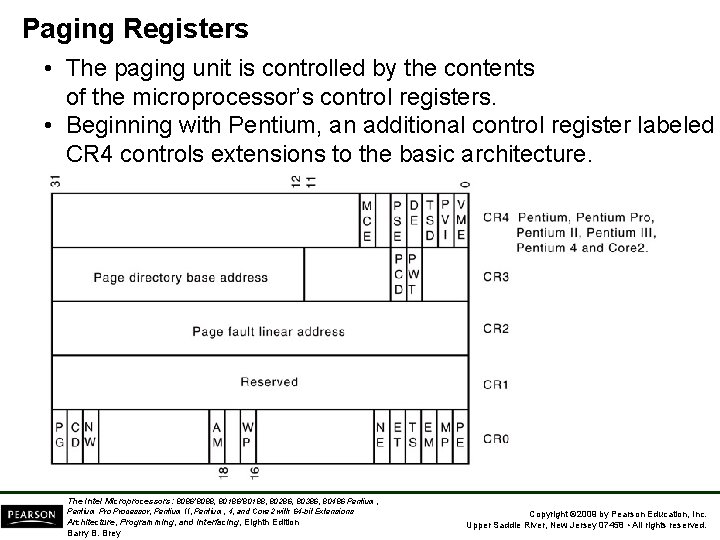
Paging Registers • The paging unit is controlled by the contents of the microprocessor’s control registers. • Beginning with Pentium, an additional control register labeled CR 4 controls extensions to the basic architecture. The Intel Microprocessors: 8086/8088, 80186/80188, 80286, 80386, 80486 Pentium, Pentium Processor, Pentium II, Pentium, 4, and Core 2 with 64 -bit Extensions Architecture, Programming, and Interfacing, Eighth Edition Barry B. Brey Copyright © 2009 by Pearson Education, Inc. Upper Saddle River, New Jersey 07458 • All rights reserved.
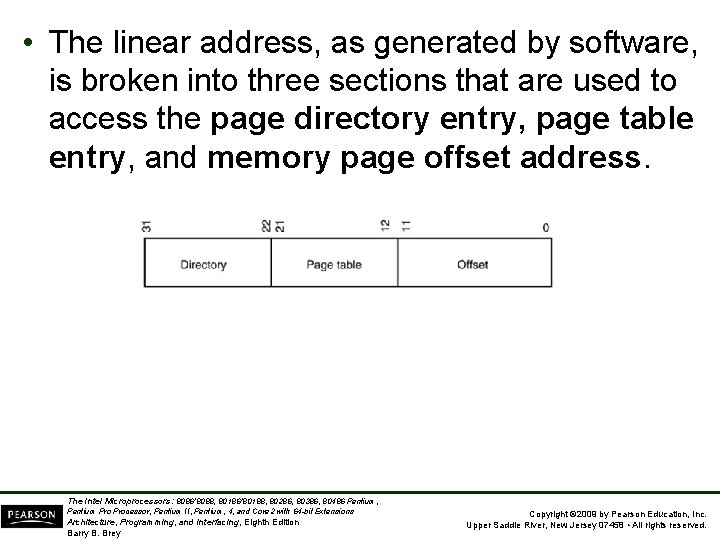
• The linear address, as generated by software, is broken into three sections that are used to access the page directory entry, page table entry, and memory page offset address. The Intel Microprocessors: 8086/8088, 80186/80188, 80286, 80386, 80486 Pentium, Pentium Processor, Pentium II, Pentium, 4, and Core 2 with 64 -bit Extensions Architecture, Programming, and Interfacing, Eighth Edition Barry B. Brey Copyright © 2009 by Pearson Education, Inc. Upper Saddle River, New Jersey 07458 • All rights reserved.
Figure 2– 13 The paging mechanism in the 80386 through Core 2 microprocessors. The Intel Microprocessors: 8086/8088, 80186/80188, 80286, 80386, 80486 Pentium, Pentium Processor, Pentium II, Pentium, 4, and Core 2 with 64 -bit Extensions Architecture, Programming, and Interfacing, Eighth Edition Barry B. Brey Copyright © 2009 by Pearson Education, Inc. Upper Saddle River, New Jersey 07458 • All rights reserved.
• Intel has incorporated a special type of cache called TLB (translation look-aside buffer). – because repaging a 4 K-byte section of memory requires access to the page directory and a page table, both located in memory • The 80486 cache holds the 32 most recent page translation addresses. – if the same area of memory is accessed, the address is already present in the TLB – This speeds program execution • Pentium contains separate TLBs for each of their instruction and data caches. The Intel Microprocessors: 8086/8088, 80186/80188, 80286, 80386, 80486 Pentium, Pentium Processor, Pentium II, Pentium, 4, and Core 2 with 64 -bit Extensions Architecture, Programming, and Interfacing, Eighth Edition Barry B. Brey Copyright © 2009 by Pearson Education, Inc. Upper Saddle River, New Jersey 07458 • All rights reserved.
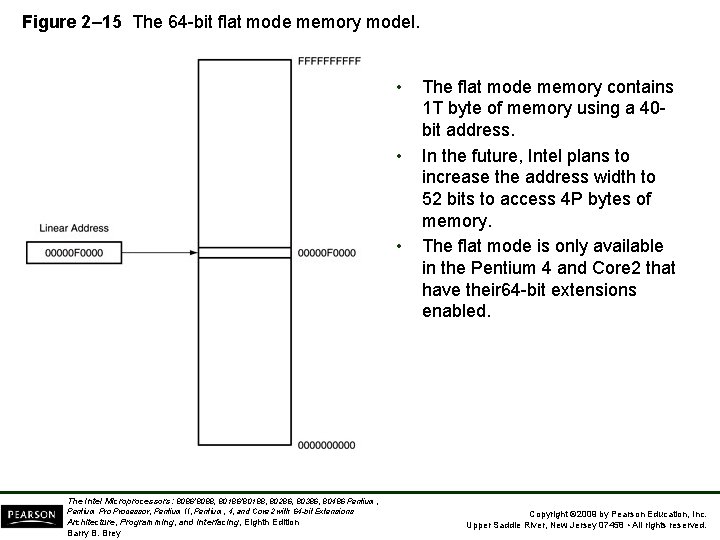
2– 5 Flat Mode Memory • A flat mode memory system is one in which there is no segmentation. – does not use a segment register to address a location in the memory • First byte address is at 00 0000 H; the last location is at FF FFFFH. – address is 40 -bits • The segment register still selects the privilege level of the software. The Intel Microprocessors: 8086/8088, 80186/80188, 80286, 80386, 80486 Pentium, Pentium Processor, Pentium II, Pentium, 4, and Core 2 with 64 -bit Extensions Architecture, Programming, and Interfacing, Eighth Edition Barry B. Brey Copyright © 2009 by Pearson Education, Inc. Upper Saddle River, New Jersey 07458 • All rights reserved.
Figure 2– 15 The 64 -bit flat mode memory model. • • • The flat mode memory contains 1 T byte of memory using a 40 bit address. In the future, Intel plans to increase the address width to 52 bits to access 4 P bytes of memory. The flat mode is only available in the Pentium 4 and Core 2 that have their 64 -bit extensions enabled. The Intel Microprocessors: 8086/8088, 80186/80188, 80286, 80386, 80486 Pentium, Pentium Processor, Pentium II, Pentium, 4, and Core 2 with 64 -bit Extensions Architecture, Programming, and Interfacing, Eighth Edition Barry B. Brey Copyright © 2009 by Pearson Education, Inc. Upper Saddle River, New Jersey 07458 • All rights reserved.