
Introduction Logic Gates Boolean Algebra Map Specification Combinational
Introduction Logic Gates Boolean Algebra Map Specification Combinational Circuits
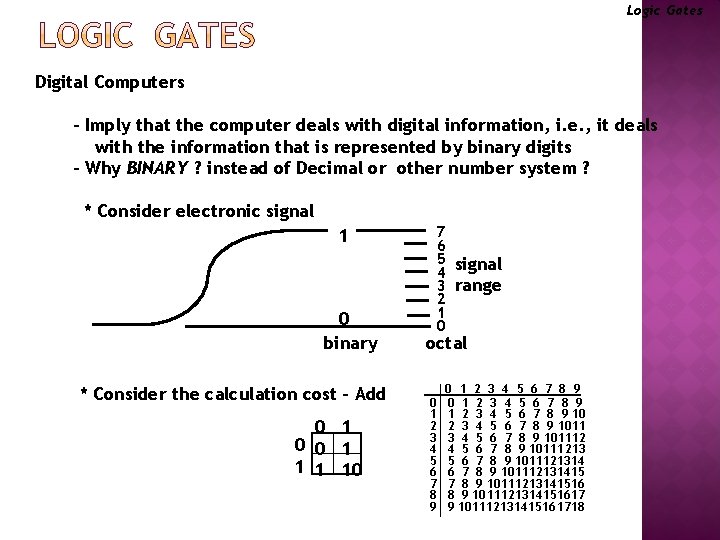
Logic Gates Digital Computers - Imply that the computer deals with digital information, i. e. , it deals with the information that is represented by binary digits - Why BINARY ? instead of Decimal or other number system ? * Consider electronic signal 1 0 binary * Consider the calculation cost - Add 0 1 0 0 1 10 7 6 5 signal 4 3 range 2 1 0 octal 0 1 2 3 4 5 6 7 8 9 0 0 1 2 3 4 5 6 7 8 9 10 3 4 5 6 7 8 9 1011121314 7 8 9 101112131415161718
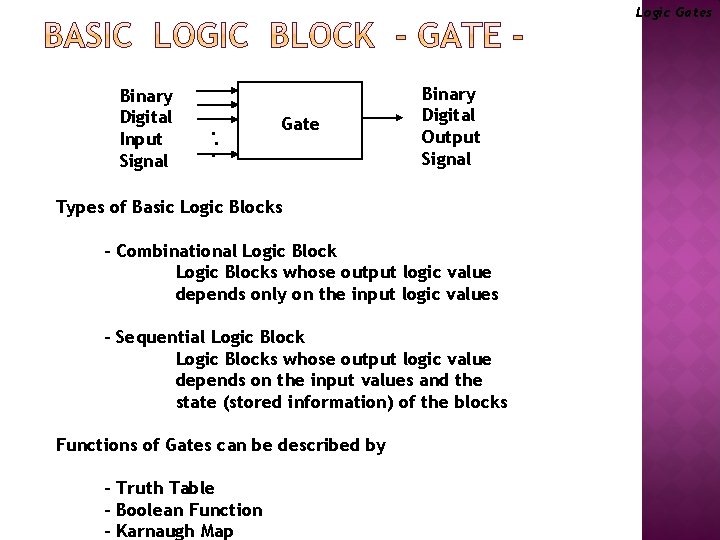
Logic Gates Binary Digital Input Signal . . . Gate Binary Digital Output Signal Types of Basic Logic Blocks - Combinational Logic Blocks whose output logic value depends only on the input logic values - Sequential Logic Blocks whose output logic value depends on the input values and the state (stored information) of the blocks Functions of Gates can be described by - Truth Table - Boolean Function - Karnaugh Map
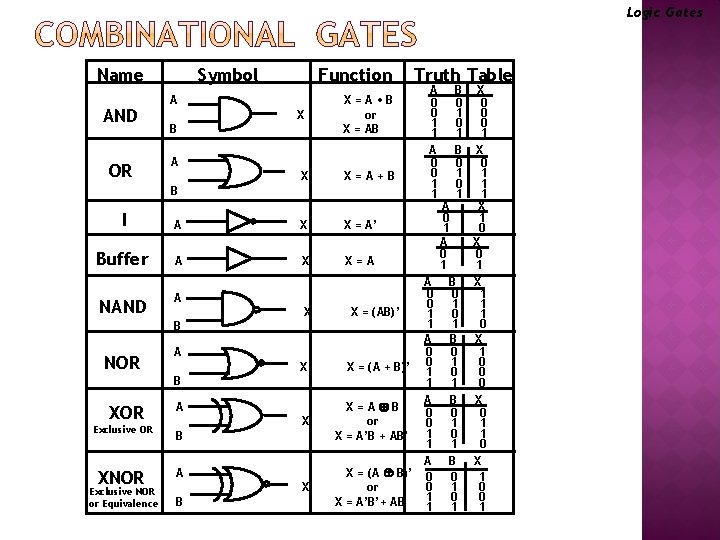
Logic Gates Name AND OR Symbol Function A X=A • B or X = AB X B A X X=A+B B I A X X = A’ Buffer A X X=A NAND A X B NOR A X B XOR Exclusive OR XNOR Exclusive NOR or Equivalence A X B Truth Table A 0 0 1 1 A 0 0 X = (AB)’ 1 1 A 0 X = (A + B)’ 0 1 1 A X=A B 0 or 0 X = A’B + AB’ 1 1 A X = (A B)’ 0 0 or 1 X = A’B’+ AB 1 B 0 1 0 1 A 0 1 B 0 1 0 1 X 0 0 0 1 X 0 1 1 1 X 1 0 X 0 1 X 1 1 1 0 X 1 0 0 0 X 0 1 1 0 X 1 0 0 1
Boolean Algebra * Algebra with Binary(Boolean) Variable and Logic Operations * Boolean Algebra is useful in Analysis and Synthesis of Digital Logic Circuits - Input and Output signals can be represented by Boolean Variables, and - Function of the Digital Logic Circuits can be represented by Logic Operations, i. e. , Boolean Function(s) - From a Boolean function, a logic diagram can be constructed using AND, OR, and I Truth Table * The most elementary specification of the function of a Digital Logic Circuit is the Truth Table - Table that describes the Output Values for all the combinations of the Input Values, called MINTERMS - n input variables → 2 n minterms
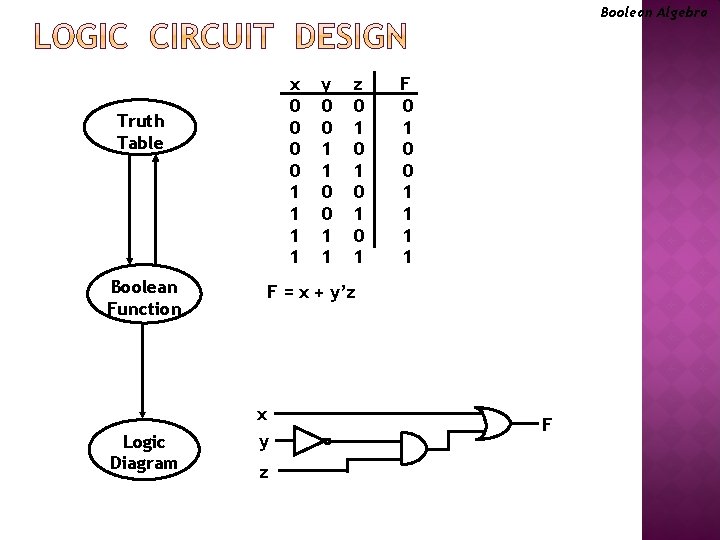
Boolean Algebra x 0 0 1 1 Truth Table Boolean Function Logic Diagram y 0 0 1 1 z 0 1 0 1 F 0 1 0 0 1 1 F = x + y’z x y z F
![Boolean Algebra [1] [3] [5] [7] [9] [11] [13] [15] [17] x+0=x [2] x](http://slidetodoc.com/presentation_image_h2/938a4ac30b164c5bb166c9d4ec6eb389/image-7.jpg "Boolean Algebra [1] [3] [5] [7] [9] [11] [13] [15] [17] x+0=x [2] x")
Boolean Algebra [1] [3] [5] [7] [9] [11] [13] [15] [17] x+0=x [2] x • 0 = 0 x+1=1 [4] x • 1 = x x+x=x [6] x • x = x x + x’ = 1 [8] x • X’ = 0 x+y=y+x [10] xy = yx x + (y + z) = (x + y) + z [12] x(yz) = (xy)z x(y + z) = xy +xz [14] x + yz = (x + y)(x + z) (x + y)’ = x’y’ [16] (xy)’ = x’ + y’ (x’)’ = x [15] and [16] : De Morgan’s Theorem Usefulness of this Table - Simplification of the Boolean function - Derivation of equivalent Boolean functions to obtain logic diagrams utilizing different logic gates -- Ordinarily ANDs, ORs, and Inverters -- But a certain different form of Boolean function may be convenient to obtain circuits with NANDs or NORs → Applications of De Morgans Theorem x’y’ = (x + y)’ I, AND → NOR x’+ y’= (xy)’ I, OR → NAND
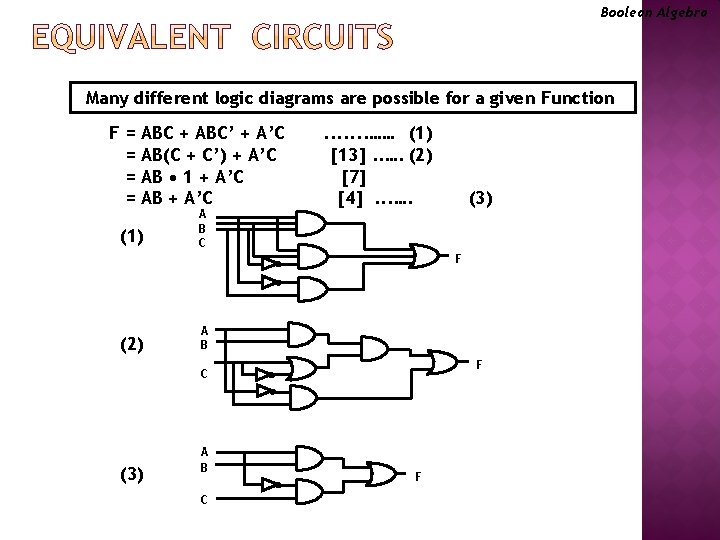
Boolean Algebra Many different logic diagrams are possible for a given Function F = ABC + ABC’ + A’C = AB(C + C’) + A’C = AB • 1 + A’C = AB + A’C (1) A B C . . . . …… (1) [13]. . …. (2) [7] [4]. . . …. (3) F (2) A B F C (3) A B C F
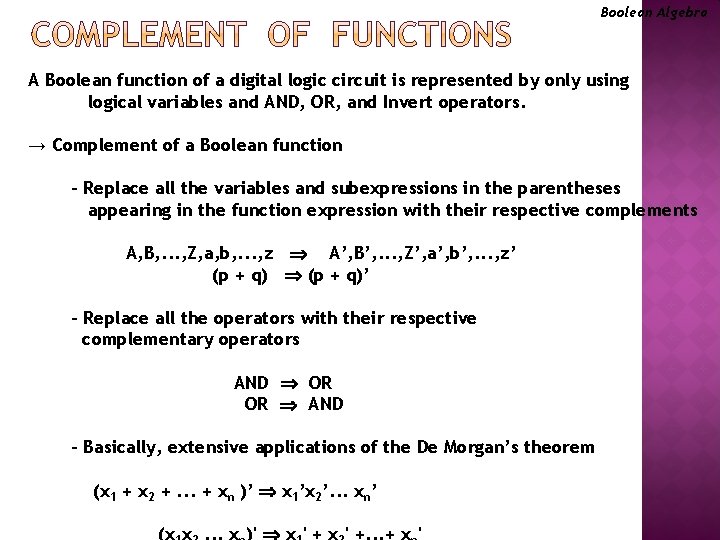
Boolean Algebra A Boolean function of a digital logic circuit is represented by only using logical variables and AND, OR, and Invert operators. → Complement of a Boolean function - Replace all the variables and subexpressions in the parentheses appearing in the function expression with their respective complements A, B, . . . , Z, a, b, . . . , z A’, B’, . . . , Z’, a’, b’, . . . , z’ (p + q)’ - Replace all the operators with their respective complementary operators AND OR OR AND - Basically, extensive applications of the De Morgan’s theorem (x 1 + x 2 +. . . + xn )’ x 1’x 2’. . . xn’ (x x. . . x )' x ' +. . . + x '

Map Simplification Boolean Function Truth Table Many different expressions exist Unique Simplification from Boolean function - Finding an equivalent expression that is least expensive to implement - For a simple function, it is possible to obtain a simple expression for low cost implementation - But, with complex functions, it is a very difficult task Karnaugh Map (K-map) is a simple procedure for simplifying Boolean expressions. Truth Table Boolean function Karnaugh Map Simplified Boolean Function
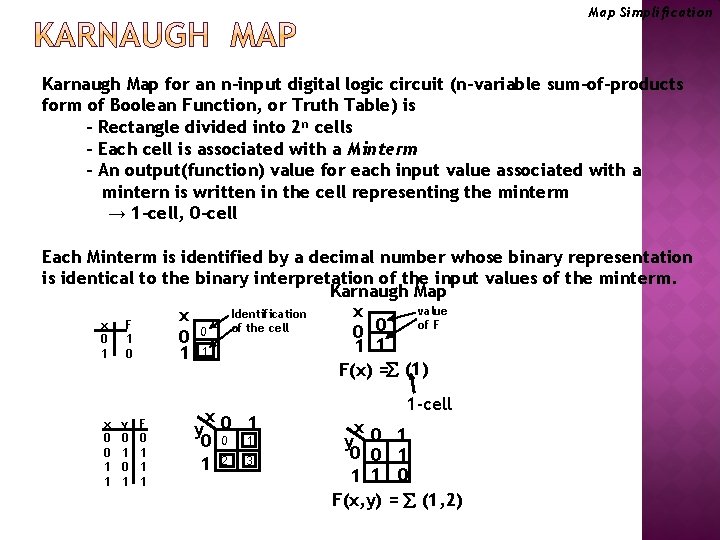
Map Simplification Karnaugh Map for an n-input digital logic circuit (n-variable sum-of-products form of Boolean Function, or Truth Table) is - Rectangle divided into 2 n cells - Each cell is associated with a Minterm - An output(function) value for each input value associated with a mintern is written in the cell representing the minterm → 1 -cell, 0 -cell Each Minterm is identified by a decimal number whose binary representation is identical to the binary interpretation of the input values of the minterm. Karnaugh Map value x Identification x x F of the cell 0 0 0 1 1 F(x) = (1) x 0 0 1 1 y 0 1 F 0 1 1 1 x y 0 1 0 0 1 1 2 3 1 -cell x y 0 0 0 1 1 F(x, y) 1 1 0 = (1, 2)
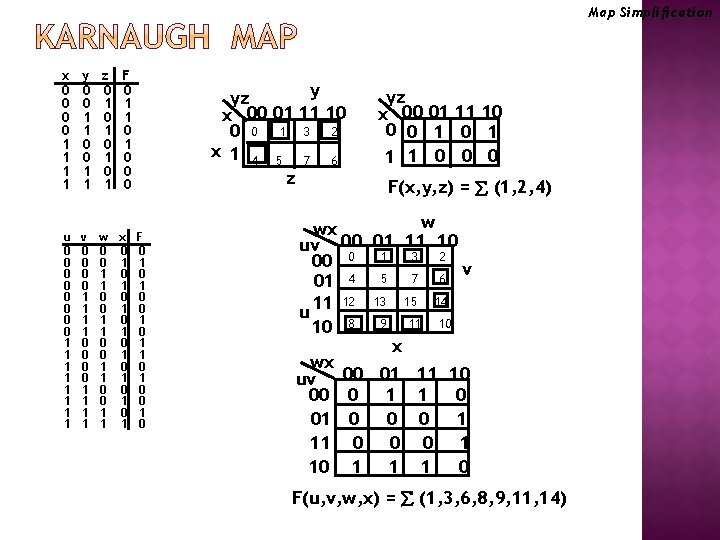
Map Simplification x 0 0 1 1 y 0 0 1 1 z 0 1 0 1 F 0 1 1 0 0 0 u 0 0 0 0 1 1 1 1 v 0 0 0 0 1 1 1 1 w x 0 0 0 1 1 0 1 1 y yz x 00 01 11 10 0 0 1 3 2 x 1 4 5 7 6 z F 0 1 0 0 1 0 yz x 00 01 11 10 0 0 1 1 1 0 0 0 F(x, y, z) = (1, 2, 4) w wx uv 00 01 11 10 00 0 1 3 2 v 01 4 5 7 6 12 13 15 14 u 11 10 8 9 11 10 x wx uv 00 01 11 10 00 0 1 1 0 0 0 1 11 0 0 0 1 1 1 0 F(u, v, w, x) = (1, 3, 6, 8, 9, 11, 14)
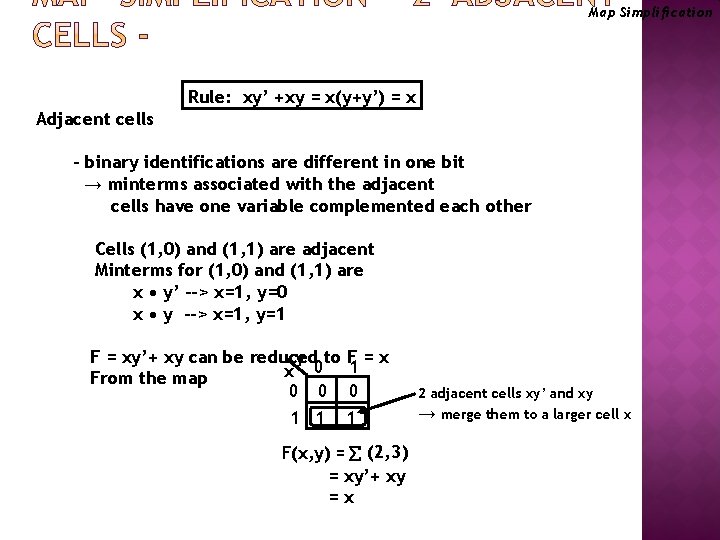
Map Simplification Rule: xy’ +xy = x(y+y’) = x Adjacent cells - binary identifications are different in one bit → minterms associated with the adjacent cells have one variable complemented each other Cells (1, 0) and (1, 1) are adjacent Minterms for (1, 0) and (1, 1) are x • y’ --> x=1, y=0 x • y --> x=1, y=1 F = xy’+ xy can be reduced y to F = x 1 x 0 From the map 0 0 0 1 1 1 F(x, y) = (2, 3) = xy’+ xy =x 2 adjacent cells xy’ and xy → merge them to a larger cell x
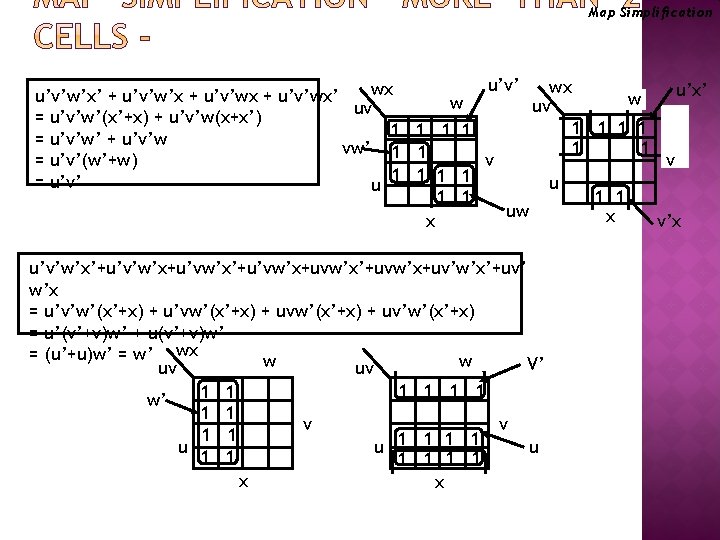
Map Simplification u’v’ wx wx u’x’ u’v’w’x’ + u’v’w’x + u’v’wx’ w w uv uv = u’v’w’(x’+x) + u’v’w(x+x’) 1 1 1 1 = u’v’w’ + u’v’w vw’ 1 1 v v = u’v’(w’+w) 1 1 = u’v’ u u 1 1 uw x x v’x u’v’w’x’+u’v’w’x+u’vw’x’+u’vw’x+uvw’x’+uvw’x+uv’w’x’+uv’ w’x = u’v’w’(x’+x) + u’vw’(x’+x) + uv’w’(x’+x) = u’(v’+v)w’ + u(v’+v)w’ = (u’+u)w’ = w’ wx w w V’ uv uv 1 1 1 w’ 1 1 v v 1 1 u u 1 1 1 x x
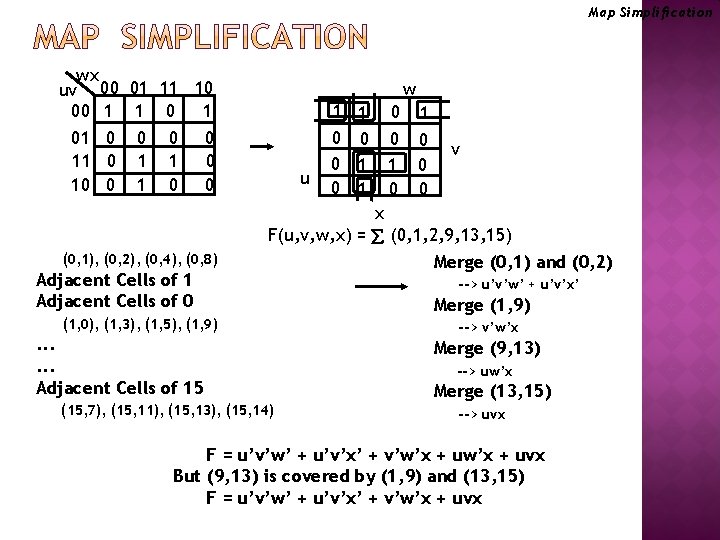
Map Simplification wx uv 00 01 11 10 00 1 1 01 0 0 11 0 10 0 1 0 0 (0, 1), (0, 2), (0, 4), (0, 8) Adjacent Cells of 1 Adjacent Cells of 0 w u 1 0 0 0 1 1 0 0 0 v x F(u, v, w, x) = (0, 1, 2, 9, 13, 15) Merge (0, 1) and (0, 2) (1, 0), (1, 3), (1, 5), (1, 9) . . . Adjacent Cells of 15 (15, 7), (15, 11), (15, 13), (15, 14) --> u’v’w’ + u’v’x’ Merge (1, 9) --> v’w’x Merge (9, 13) --> uw’x Merge (13, 15) --> uvx F = u’v’w’ + u’v’x’ + v’w’x + uvx But (9, 13) is covered by (1, 9) and (13, 15) F = u’v’w’ + u’v’x’ + v’w’x + uvx
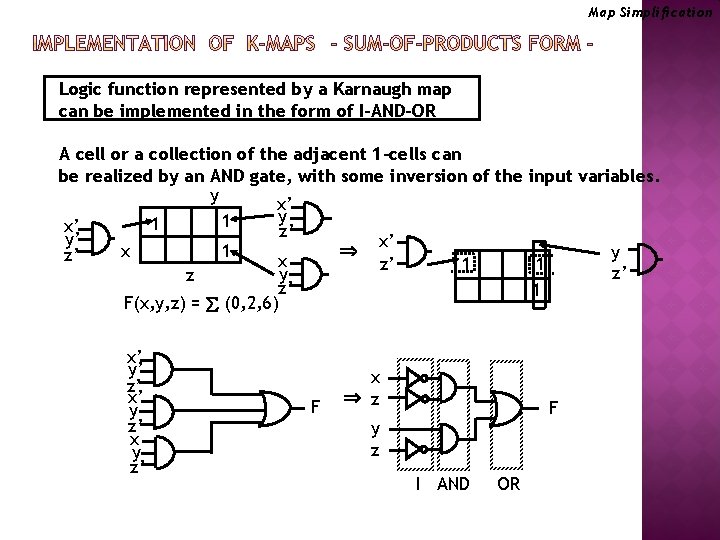
Map Simplification Logic function represented by a Karnaugh map can be implemented in the form of I-AND-OR A cell or a collection of the adjacent 1 -cells can be realized by an AND gate, with some inversion of the input variables. y x’ y 1 1 x’ z’ y’ x’ x 1 y z’ x 1 1 z’ z’ y z z’ 1 F(x, y, z) = (0, 2, 6) x’ y’ z’ x’ y z’ x y z’ F x z F y z I AND OR
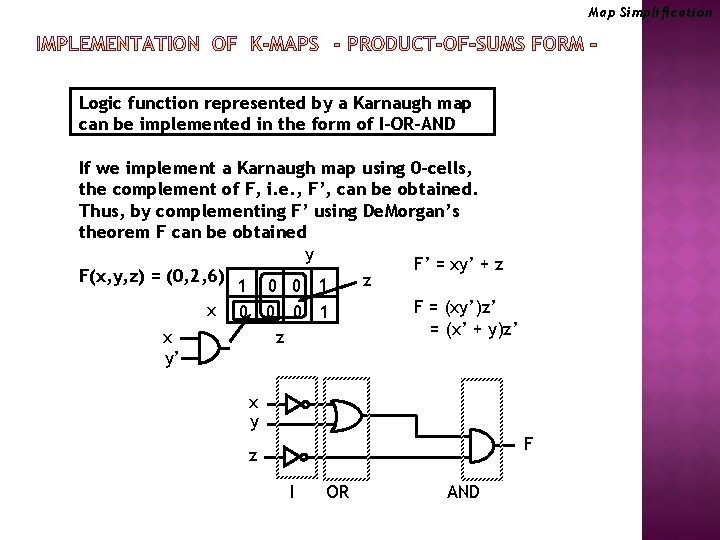
Map Simplification Logic function represented by a Karnaugh map can be implemented in the form of I-OR-AND If we implement a Karnaugh map using 0 -cells, the complement of F, i. e. , F’, can be obtained. Thus, by complementing F’ using De. Morgan’s theorem F can be obtained y F’ = xy’ + z F(x, y, z) = (0, 2, 6) z 1 0 0 1 x x y’ 0 0 0 1 z F = (xy’)z’ = (x’ + y)z’ x y F z I OR AND
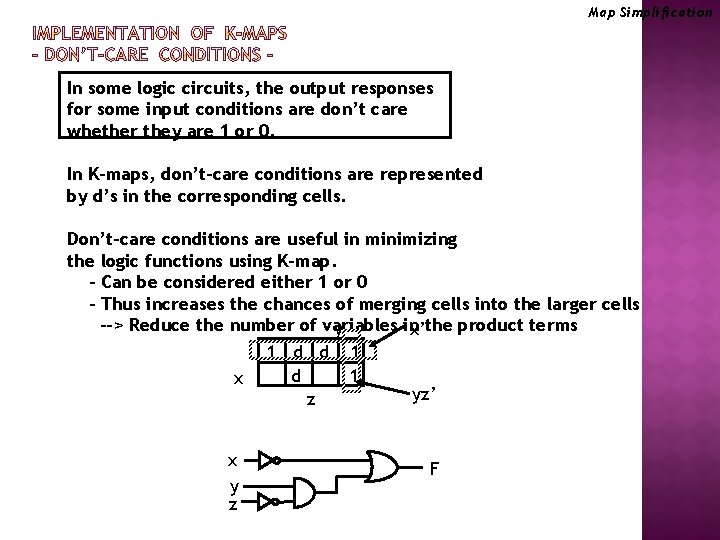
Map Simplification In some logic circuits, the output responses for some input conditions are don’t care whether they are 1 or 0. In K-maps, don’t-care conditions are represented by d’s in the corresponding cells. Don’t-care conditions are useful in minimizing the logic functions using K-map. - Can be considered either 1 or 0 - Thus increases the chances of merging cells into the larger cells --> Reduce the number of variables in y x’the product terms 1 d d 1 x yz’ z x y z F
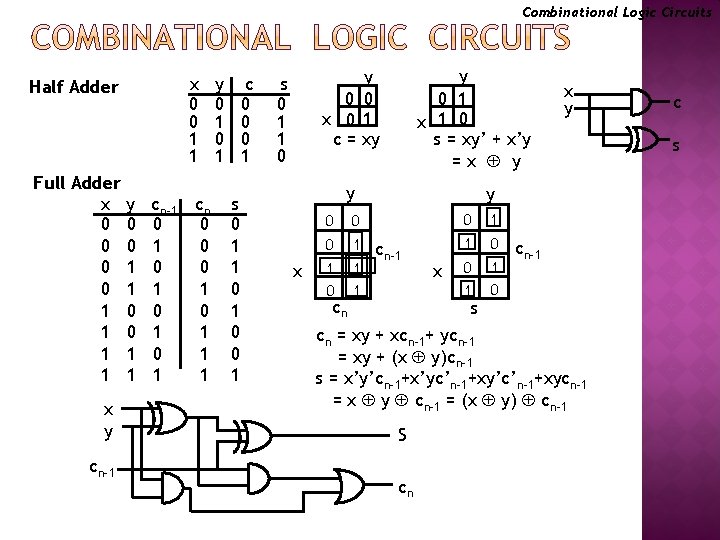
Combinational Logic Circuits x 0 0 1 1 Half Adder Full Adder x y 0 0 0 1 0 1 1 1 1 x y cn-1 0 1 0 1 cn 0 0 0 1 1 1 y 0 1 c 0 0 0 1 s 0 1 1 0 0 1 y 0 1 x 1 0 s = xy’ + x’y =x y y 0 0 x 0 1 c = xy s 0 1 1 0 y x 0 0 1 0 cn x y y 0 1 c n-1 1 1 x 0 1 s 1 0 c n-1 1 0 cn = xy + xcn-1+ ycn-1 = xy + (x y)cn-1 s = x’y’cn-1+x’yc’n-1+xy’c’n-1+xycn-1 = x y cn-1 = (x y) cn-1 S cn c s
Combinational Logic Circuits Other Combinational Circuits Multiplexer Encoder Decoder Parity Checker Parity Generator etc
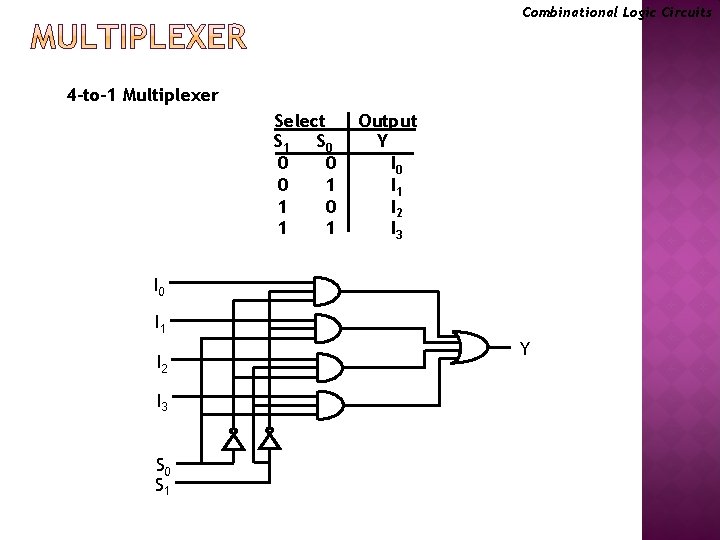
Combinational Logic Circuits 4 -to-1 Multiplexer Select S 1 S 0 0 1 1 Output Y I 0 I 1 I 2 I 3 S 0 S 1 Y
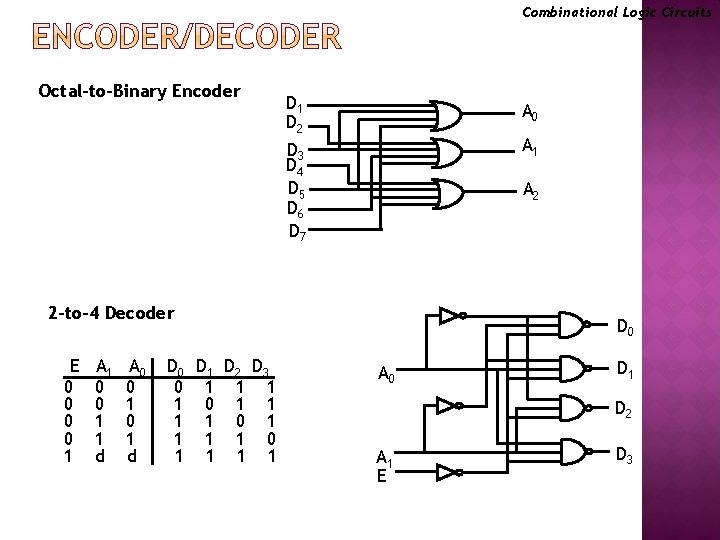
Combinational Logic Circuits Octal-to-Binary Encoder D 1 D 2 A 0 D 3 D 4 D 5 D 6 D 7 A 2 A 1 2 -to-4 Decoder E 0 0 1 A 1 0 0 1 1 d A 0 0 1 d D 0 D 1 D 2 D 3 0 1 1 1 1 D 0 A 0 D 1 D 2 A 1 E D 3
- Slides: 22