
INTRODUCTION LIGHT A BEGINNING DEFINITION All objects are

INTRODUCTION - LIGHT

A BEGINNING DEFINITION All objects are emitting and absorbing EM radiation. Consider a poker placed in a fire. As heating occurs, the emitted EM waves have higher energy and eventually become visible. First red. . . then white. 1 2 3 4 Light may be defined as electromagnetic radiation that is capable of affecting the sense of sight.
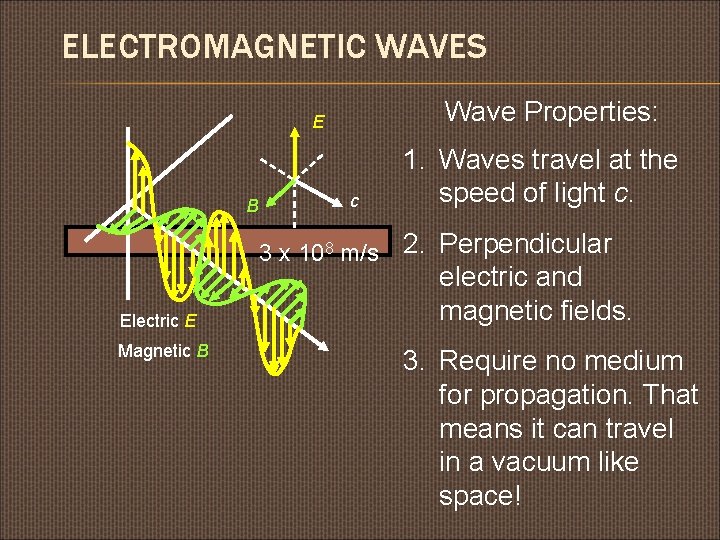
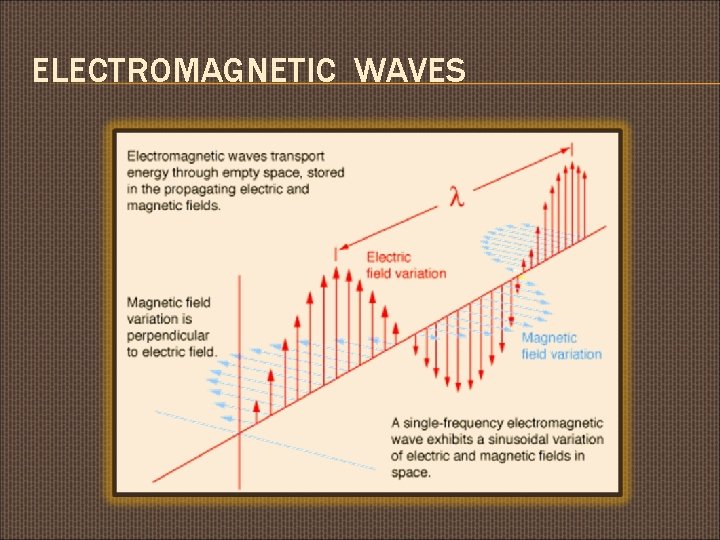
ELECTROMAGNETIC WAVES Wave Properties: E B c 1. Waves travel at the speed of light c. 3 x 10⁸ m/s 2. Perpendicular Electric E Magnetic B electric and magnetic fields. 3. Require no medium for propagation. That means it can travel in a vacuum like space!
ELECTROMAGNETIC WAVES
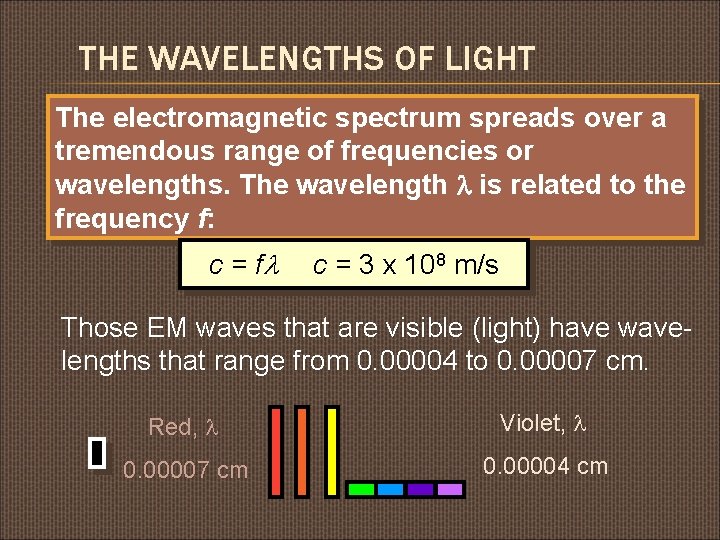
THE WAVELENGTHS OF LIGHT The electromagnetic spectrum spreads over a tremendous range of frequencies or wavelengths. The wavelength l is related to the frequency f: c = fl c = 3 x 10⁸ m/s Those EM waves that are visible (light) have wavelengths that range from 0. 00004 to 0. 00007 cm. Red, l Violet, l 0. 00007 cm 0. 00004 cm

WILL CONTINUE TOMORROW!!!

CONTINUE FROM YESTERDAY
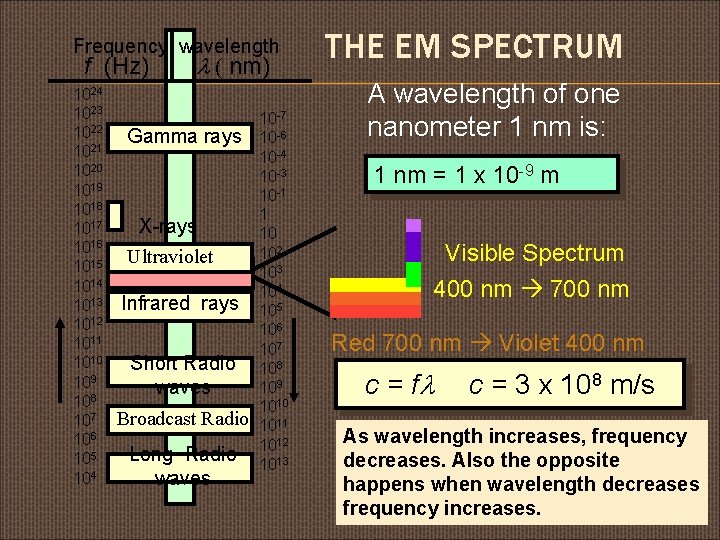
Frequency wavelength f (Hz) 1024 1023 1022 1021 1020 1019 1018 1017 1016 1015 1014 1013 1012 1011 1010 109 108 107 106 105 104 l ( nm) Gamma rays X-rays Ultraviolet Infrared rays Short Radio waves Broadcast Radio Long Radio waves 10 -7 10 -6 10 -4 10 -3 10 -1 1 10 102 103 104 105 106 107 108 109 1010 1011 1012 1013 THE EM SPECTRUM A wavelength of one nanometer 1 nm is: 1 nm = 1 x 10 -9 m Visible Spectrum 400 nm 700 nm Red 700 nm Violet 400 nm c = fl c = 3 x 10⁸ m/s As wavelength increases, frequency decreases. Also the opposite happens when wavelength decreases frequency increases.
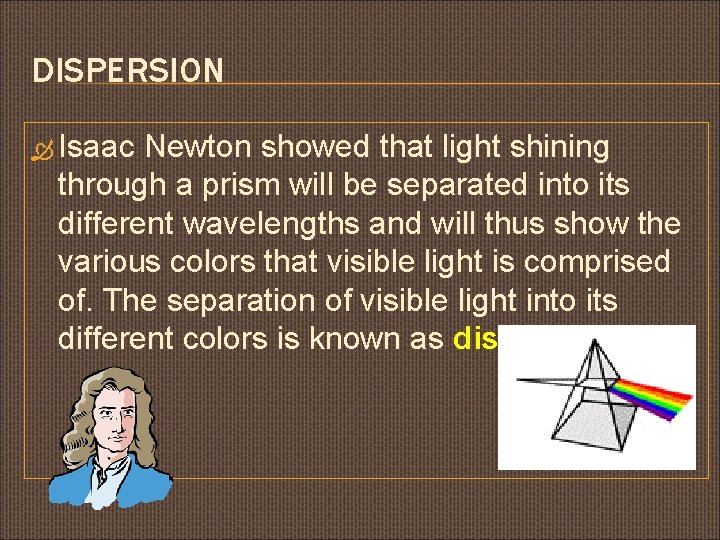
DISPERSION Isaac Newton showed that light shining through a prism will be separated into its different wavelengths and will thus show the various colors that visible light is comprised of. The separation of visible light into its different colors is known as dispersion.
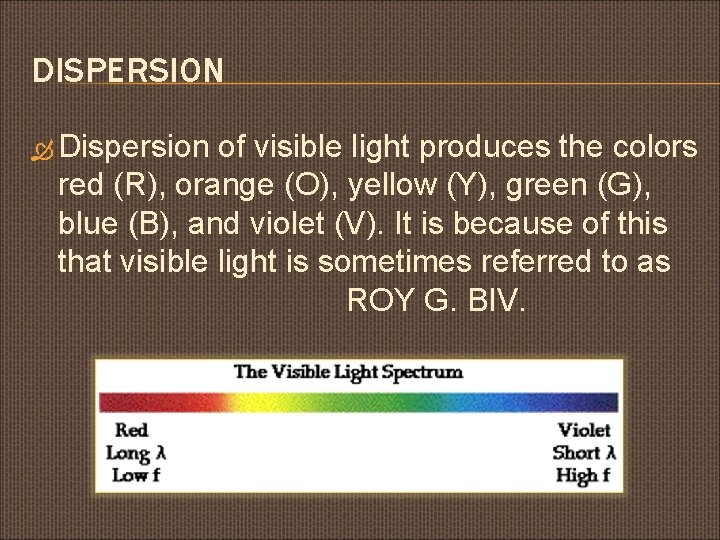
DISPERSION Dispersion of visible light produces the colors red (R), orange (O), yellow (Y), green (G), blue (B), and violet (V). It is because of this that visible light is sometimes referred to as ROY G. BIV.
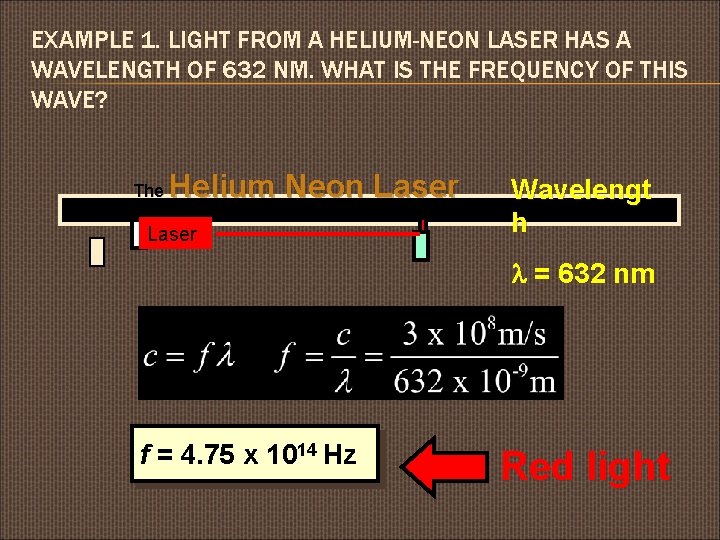
EXAMPLE 1. LIGHT FROM A HELIUM-NEON LASER HAS A WAVELENGTH OF 632 NM. WHAT IS THE FREQUENCY OF THIS WAVE? The Helium Neon Laser Wavelengt h l = 632 nm f = 4. 75 x 1014 Hz Red light
PROPERTIES OF LIGHT Any study of the nature of light must explain the following observed properties: • Rectilinear propagation: Light travels in straight lines. • Reflection: Light striking a smooth surface turns back into the original medium. • Refraction: Light bends when entering a transparent medium.
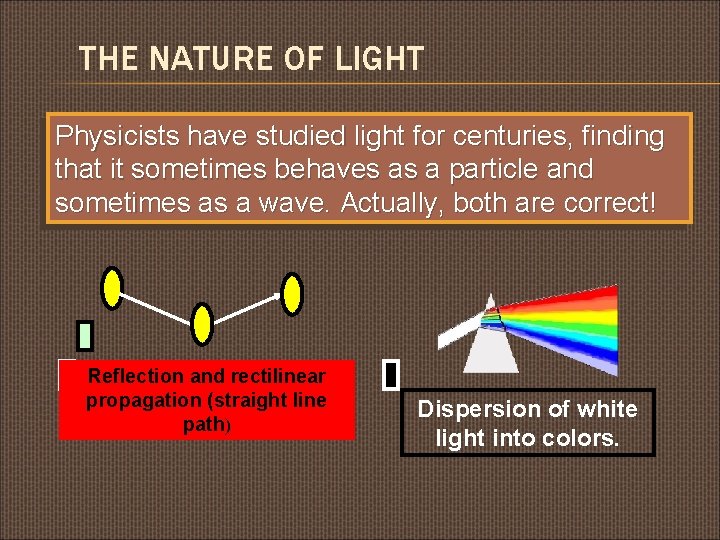
THE NATURE OF LIGHT Physicists have studied light for centuries, finding that it sometimes behaves as a particle and sometimes as a wave. Actually, both are correct! Reflection and rectilinear propagation (straight line path) Dispersion of white light into colors.
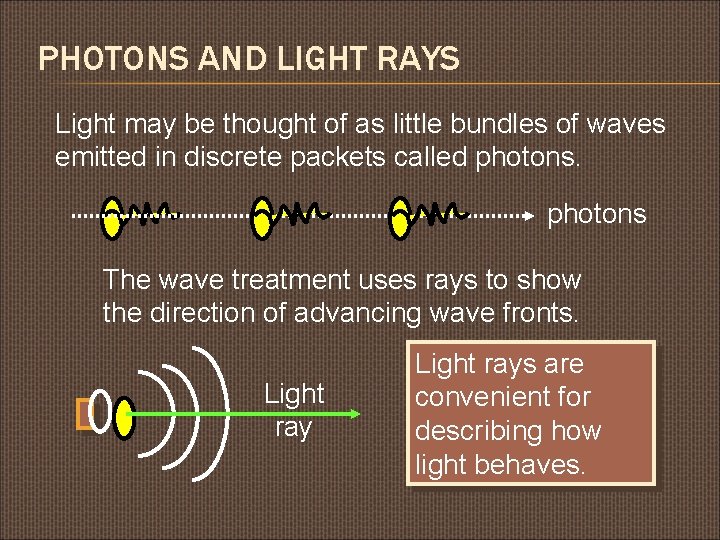
PHOTONS AND LIGHT RAYS Light may be thought of as little bundles of waves emitted in discrete packets called photons The wave treatment uses rays to show the direction of advancing wave fronts. Light rays are convenient for describing how light behaves.
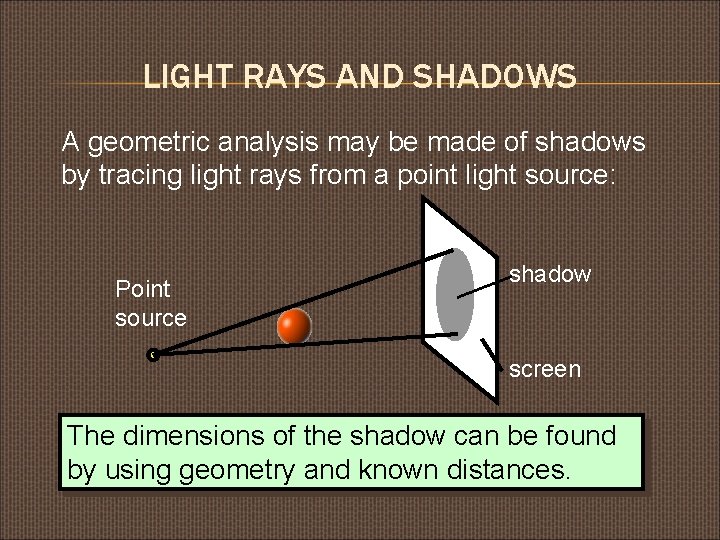
LIGHT RAYS AND SHADOWS A geometric analysis may be made of shadows by tracing light rays from a point light source: Point source shadow screen The dimensions of the shadow can be found by using geometry and known distances.
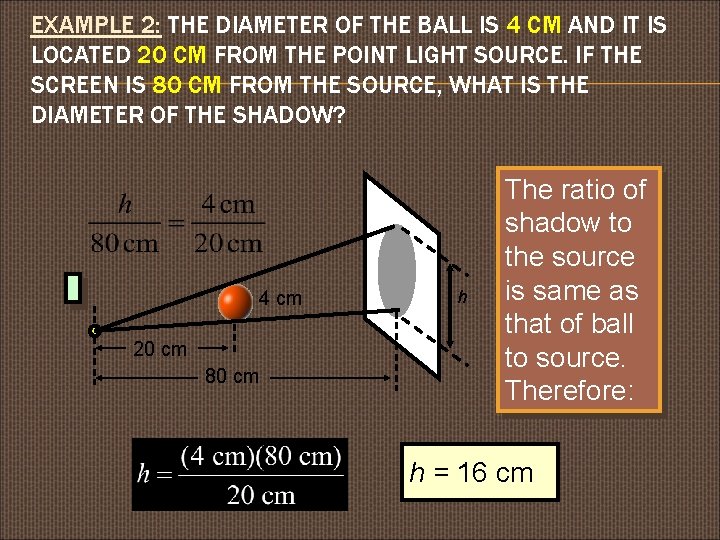
EXAMPLE 2: THE DIAMETER OF THE BALL IS 4 CM AND IT IS LOCATED 20 CM FROM THE POINT LIGHT SOURCE. IF THE SCREEN IS 80 CM FROM THE SOURCE, WHAT IS THE DIAMETER OF THE SHADOW? 4 cm 20 cm 80 cm h The ratio of shadow to the source is same as that of ball to source. Therefore: h = 16 cm
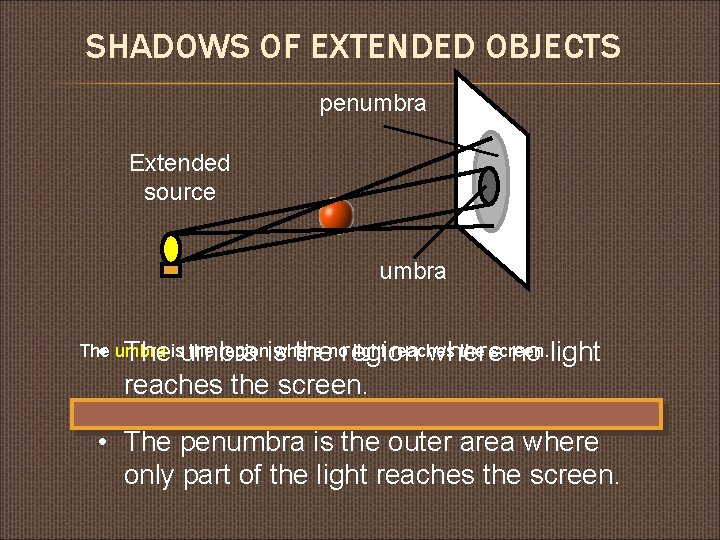
SHADOWS OF EXTENDED OBJECTS penumbra Extended source umbra The the regionis where light reaches the screen. • umbra Theisumbra thenoregion where no light reaches the screen. • The penumbra is the outer area where only part of the light reaches the screen.
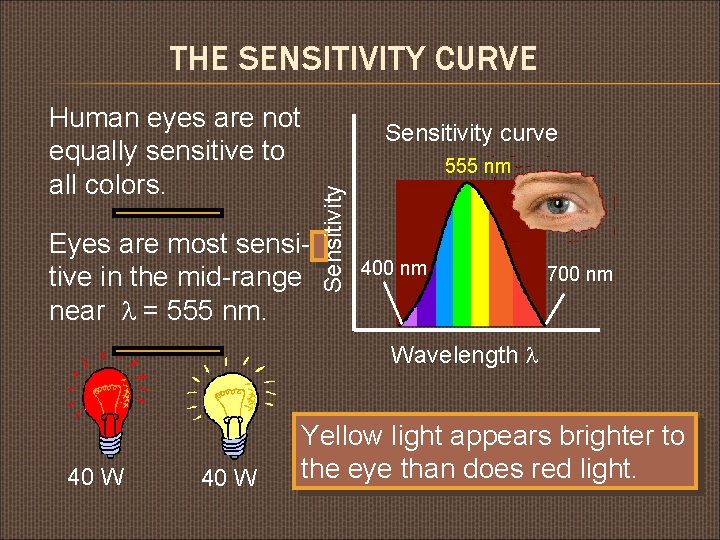
THE SENSITIVITY CURVE Human eyes are not equally sensitive to all colors. Sensitivity curve Eyes are most sensitive in the mid-range near l = 555 nm. Sensitivity 555 nm 400 nm 700 nm Wavelength l 40 W Yellow light appears brighter to the eye than does red light.
WHAT DO YOU KNOW? Consider the electromagnetic spectrum as you answer these three questions. 1. Which region of the electromagnetic spectrum has the highest frequency? Gamma Rays 2. Which region of the electromagnetic spectrum has the longest wavelength? Radio Waves 3. Which region of the electromagnetic spectrum will travel with the fastest speed? All regions have the same speed
WHAT DO YOU KNOW? Consider the visible light spectrum as you answer these two questions. 1. Which color of the visible light spectrum has the greatest frequency? Violet 2. Which color of the visible light spectrum has the greatest wavelength? RED
- Slides: 20