
Introduction Law and Economic Development Y S Lee
- Slides: 26
Introduction: Law and Economic Development Y. S. Lee, The Law and Development Program Introduction Copyright Law and Development Institute
I. Introduction 1. Law and economic development - Interrelationship between law and economic development: why economic development? - The impact of law on economic development e. g. , example - Studies the role of law for economic and social progress: dates back to the works of Max Weber and Friedrich Hayek on the role of law in economy and society - The rule of law being adopted in the Sustainable Development Goals (SDGs) promoted by the United Nation - Law means to achieve economic growth and industrialization: “developmental state” - Law means to protect the market and prevent state interference - Law as a development goal itself Copyright Law and Development Institute
I. Introduction (cont. ) 2. Law and development initiatives / movements - - 50 s and 60 s by a group of lawyers and scholars from the United States to “transplant” U. S. legal practices and methods of legal education at U. S. law schools in the developing world with hopes to facilitate development through effective legal apparatus: considered failure by the 70 s 80 s and 90 s rule of law projects in the neoliberal contexts focusing on deregulation and privatization: mixed results: did not lead to economic improvement for most countries. Causes of failure: failure to understand the local context and local needs; lack of due institutional capacities (legislature, judiciary, administration) Revision of the past approaches: “Development as Freedom” (Amartya Sen), rejection of neo-liberal approach, importance of “institutions” (referring to a wide range of organizations, norms, and practices related to the adoption, implementation, and enforcement of law). Copyright Law and Development Institute
II. Need for a New Analytical Framework 1. Stagnant development of the field and as a method to effect economic development - Concept of “development” in the context of law and development Lack of methodology No analytical frameworks to explain the impact of law on economic development General theory of law and development (2017) Law reform projects with mixed results: “good governance” requirements by the IFIs Failure to bring about economic development, failure to create effective legal apparatus Confusion, cost, counter-productive outcomes Emergence of Asian Infrastructure Investment Bank Copyright Law and Development Institute
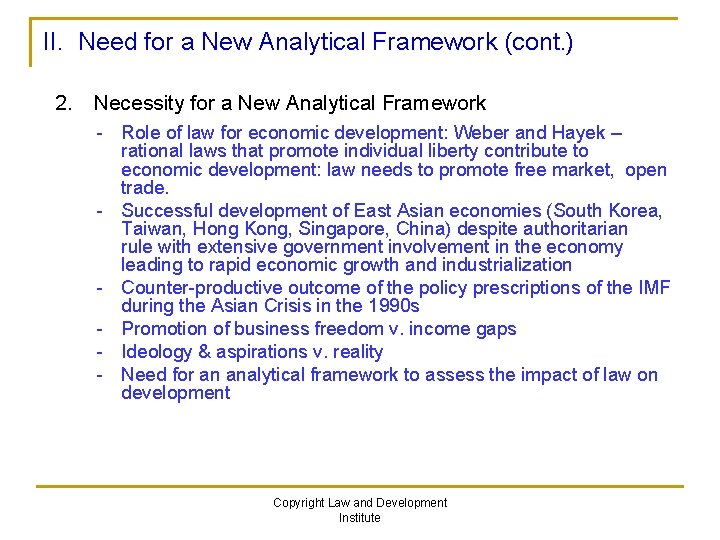
II. Need for a New Analytical Framework (cont. ) 2. Necessity for a New Analytical Framework - Role of law for economic development: Weber and Hayek – rational laws that promote individual liberty contribute to economic development: law needs to promote free market, open trade. - Successful development of East Asian economies (South Korea, Taiwan, Hong Kong, Singapore, China) despite authoritarian rule with extensive government involvement in the economy leading to rapid economic growth and industrialization - Counter-productive outcome of the policy prescriptions of the IMF during the Asian Crisis in the 1990 s - Promotion of business freedom v. income gaps - Ideology & aspirations v. reality - Need for an analytical framework to assess the impact of law on development Copyright Law and Development Institute
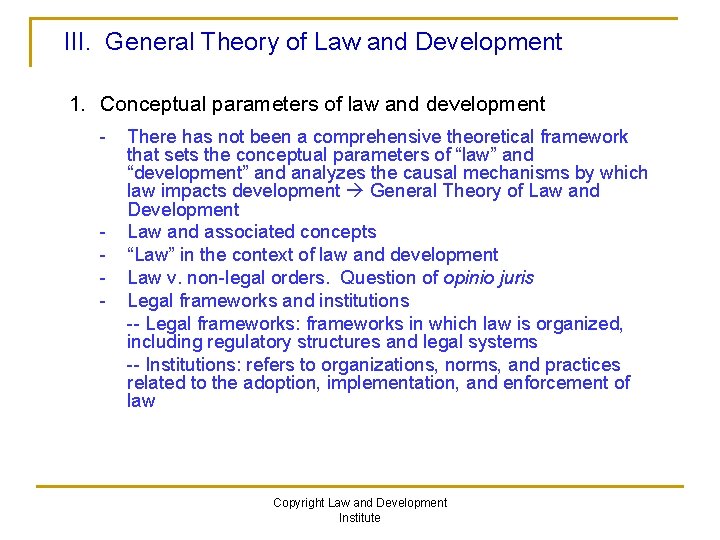
III. General Theory of Law and Development 1. Conceptual parameters of law and development - - There has not been a comprehensive theoretical framework that sets the conceptual parameters of “law” and “development” and analyzes the causal mechanisms by which law impacts development General Theory of Law and Development Law and associated concepts “Law” in the context of law and development Law v. non-legal orders. Question of opinio juris Legal frameworks and institutions -- Legal frameworks: frameworks in which law is organized, including regulatory structures and legal systems -- Institutions: refers to organizations, norms, and practices related to the adoption, implementation, and enforcement of law Copyright Law and Development Institute
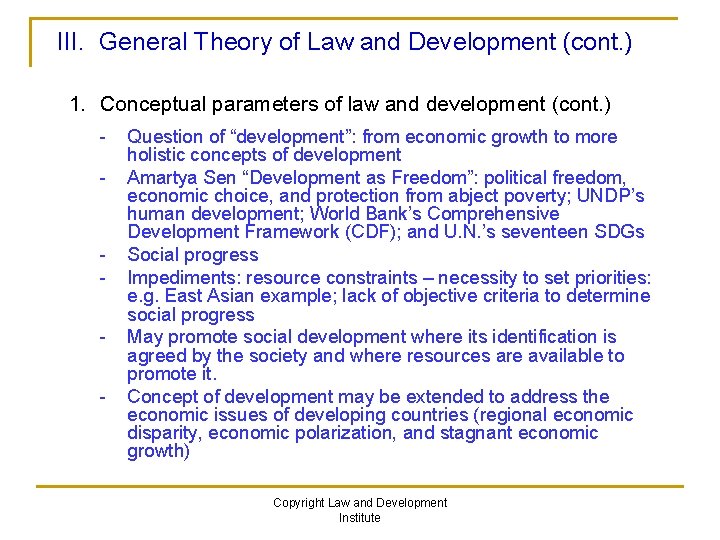
III. General Theory of Law and Development (cont. ) 1. Conceptual parameters of law and development (cont. ) - - Question of “development”: from economic growth to more holistic concepts of development Amartya Sen “Development as Freedom”: political freedom, economic choice, and protection from abject poverty; UNDP’s human development; World Bank’s Comprehensive Development Framework (CDF); and U. N. ’s seventeen SDGs Social progress Impediments: resource constraints – necessity to set priorities: e. g. East Asian example; lack of objective criteria to determine social progress May promote social development where its identification is agreed by the society and where resources are available to promote it. Concept of development may be extended to address the economic issues of developing countries (regional economic disparity, economic polarization, and stagnant economic growth) Copyright Law and Development Institute
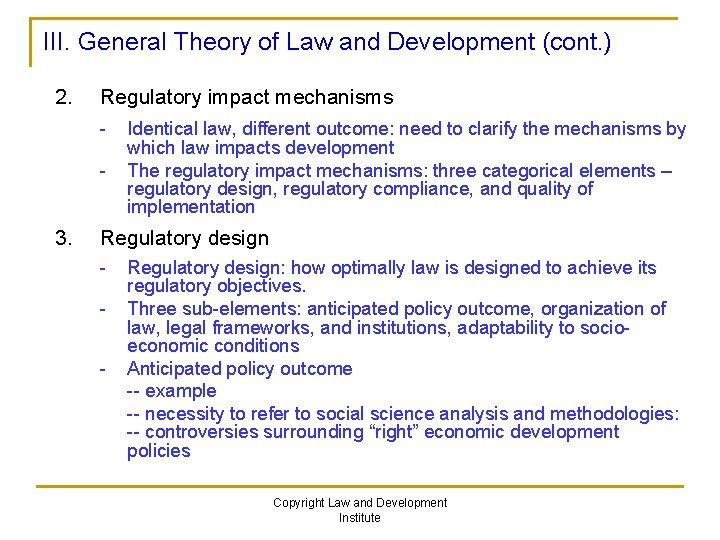
III. General Theory of Law and Development (cont. ) 2. Regulatory impact mechanisms - 3. Identical law, different outcome: need to clarify the mechanisms by which law impacts development The regulatory impact mechanisms: three categorical elements – regulatory design, regulatory compliance, and quality of implementation Regulatory design - Regulatory design: how optimally law is designed to achieve its regulatory objectives. Three sub-elements: anticipated policy outcome, organization of law, legal frameworks, and institutions, adaptability to socioeconomic conditions Anticipated policy outcome -- example -- necessity to refer to social science analysis and methodologies: -- controversies surrounding “right” economic development policies Copyright Law and Development Institute
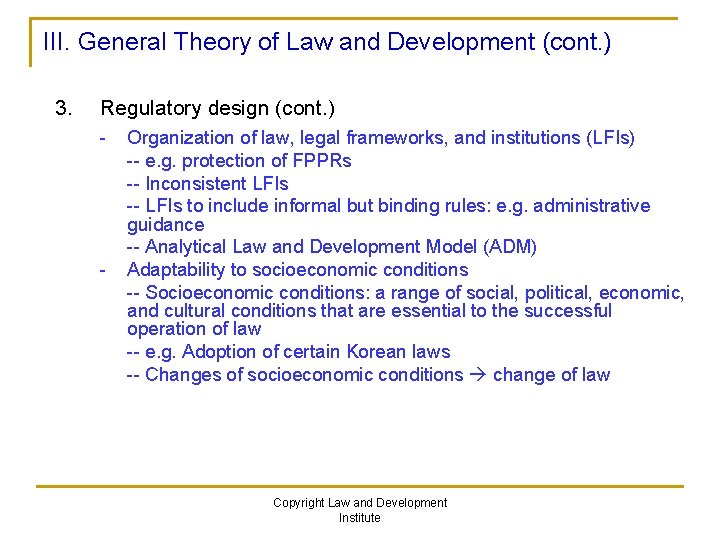
III. General Theory of Law and Development (cont. ) 3. Regulatory design (cont. ) - - Organization of law, legal frameworks, and institutions (LFIs) -- e. g. protection of FPPRs -- Inconsistent LFIs -- LFIs to include informal but binding rules: e. g. administrative guidance -- Analytical Law and Development Model (ADM) Adaptability to socioeconomic conditions -- Socioeconomic conditions: a range of social, political, economic, and cultural conditions that are essential to the successful operation of law -- e. g. Adoption of certain Korean laws -- Changes of socioeconomic conditions change of law Copyright Law and Development Institute
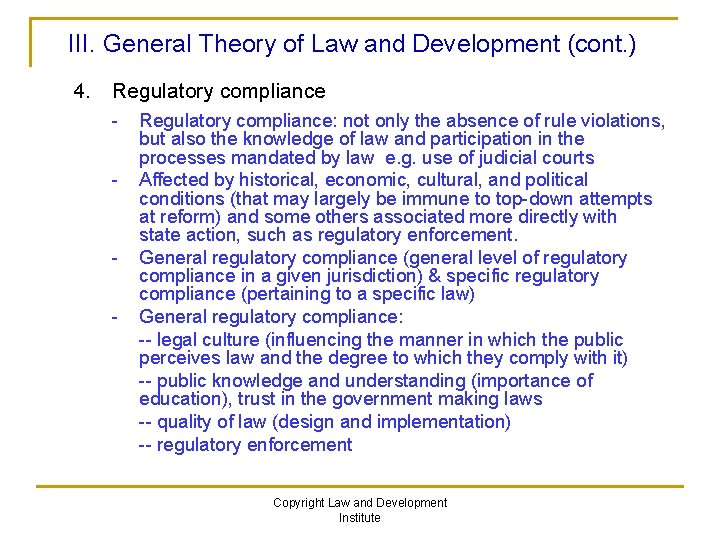
III. General Theory of Law and Development (cont. ) 4. Regulatory compliance - - Regulatory compliance: not only the absence of rule violations, but also the knowledge of law and participation in the processes mandated by law e. g. use of judicial courts Affected by historical, economic, cultural, and political conditions (that may largely be immune to top-down attempts at reform) and some others associated more directly with state action, such as regulatory enforcement. General regulatory compliance (general level of regulatory compliance in a given jurisdiction) & specific regulatory compliance (pertaining to a specific law) General regulatory compliance: -- legal culture (influencing the manner in which the public perceives law and the degree to which they comply with it) -- public knowledge and understanding (importance of education), trust in the government making laws -- quality of law (design and implementation) -- regulatory enforcement Copyright Law and Development Institute
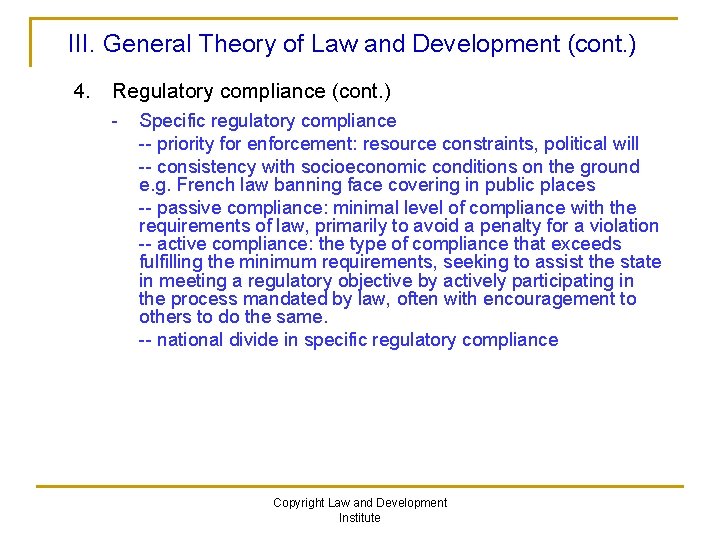
III. General Theory of Law and Development (cont. ) 4. Regulatory compliance (cont. ) - Specific regulatory compliance -- priority for enforcement: resource constraints, political will -- consistency with socioeconomic conditions on the ground e. g. French law banning face covering in public places -- passive compliance: minimal level of compliance with the requirements of law, primarily to avoid a penalty for a violation -- active compliance: the type of compliance that exceeds fulfilling the minimum requirements, seeking to assist the state in meeting a regulatory objective by actively participating in the process mandated by law, often with encouragement to others to do the same. -- national divide in specific regulatory compliance Copyright Law and Development Institute
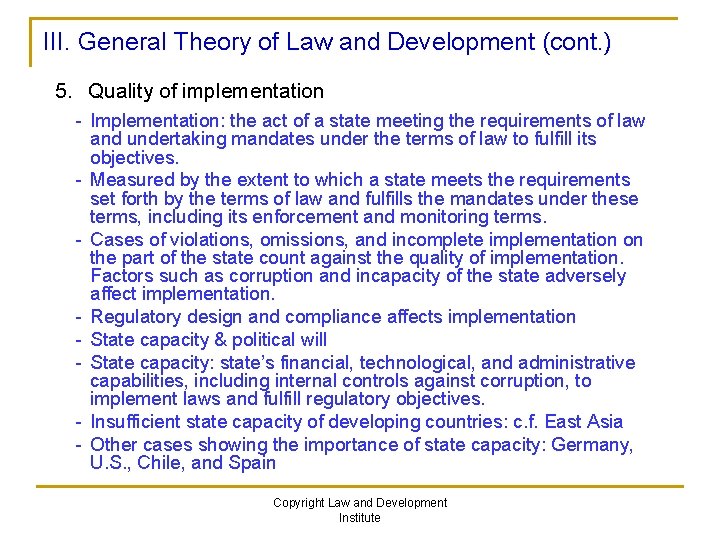
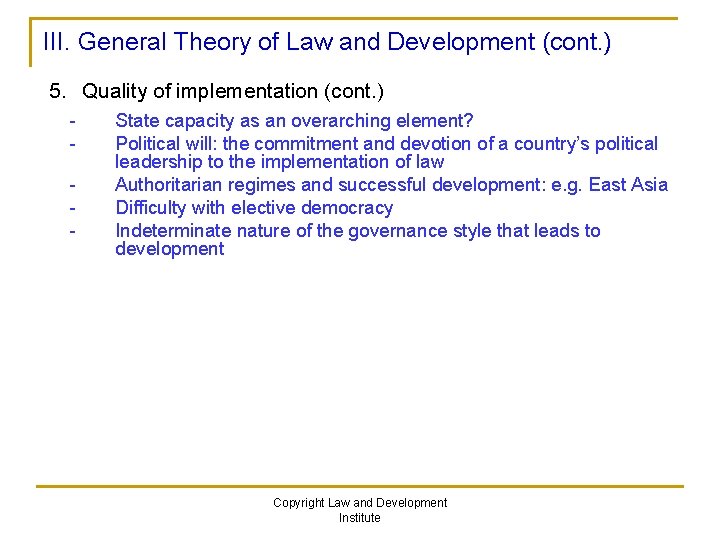
III. General Theory of Law and Development (cont. ) 5. Quality of implementation - Implementation: the act of a state meeting the requirements of law and undertaking mandates under the terms of law to fulfill its objectives. - Measured by the extent to which a state meets the requirements set forth by the terms of law and fulfills the mandates under these terms, including its enforcement and monitoring terms. - Cases of violations, omissions, and incomplete implementation on the part of the state count against the quality of implementation. Factors such as corruption and incapacity of the state adversely affect implementation. - Regulatory design and compliance affects implementation - State capacity & political will - State capacity: state’s financial, technological, and administrative capabilities, including internal controls against corruption, to implement laws and fulfill regulatory objectives. - Insufficient state capacity of developing countries: c. f. East Asia - Other cases showing the importance of state capacity: Germany, U. S. , Chile, and Spain Copyright Law and Development Institute
III. General Theory of Law and Development (cont. ) 5. Quality of implementation (cont. ) - State capacity as an overarching element? Political will: the commitment and devotion of a country’s political leadership to the implementation of law Authoritarian regimes and successful development: e. g. East Asia Difficulty with elective democracy Indeterminate nature of the governance style that leads to development Copyright Law and Development Institute
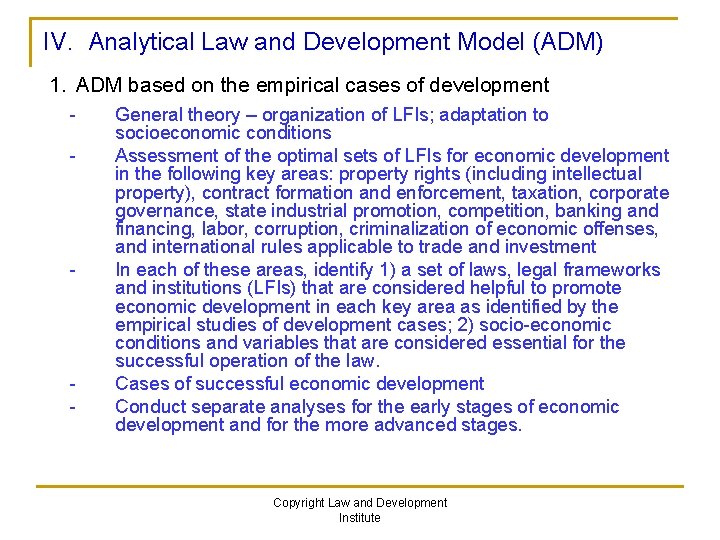
IV. Analytical Law and Development Model (ADM) 1. ADM based on the empirical cases of development - - - General theory – organization of LFIs; adaptation to socioeconomic conditions Assessment of the optimal sets of LFIs for economic development in the following key areas: property rights (including intellectual property), contract formation and enforcement, taxation, corporate governance, state industrial promotion, competition, banking and financing, labor, corruption, criminalization of economic offenses, and international rules applicable to trade and investment In each of these areas, identify 1) a set of laws, legal frameworks and institutions (LFIs) that are considered helpful to promote economic development in each key area as identified by the empirical studies of development cases; 2) socio-economic conditions and variables that are considered essential for the successful operation of the law. Cases of successful economic development Conduct separate analyses for the early stages of economic development and for the more advanced stages. Copyright Law and Development Institute
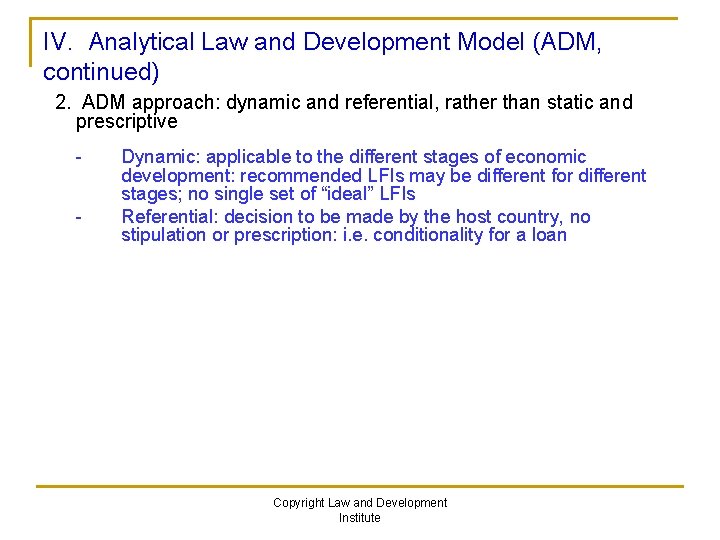
IV. Analytical Law and Development Model (ADM, continued) 2. ADM approach: dynamic and referential, rather than static and prescriptive - Dynamic: applicable to the different stages of economic development: recommended LFIs may be different for different stages; no single set of “ideal” LFIs Referential: decision to be made by the host country, no stipulation or prescription: i. e. conditionality for a loan Copyright Law and Development Institute
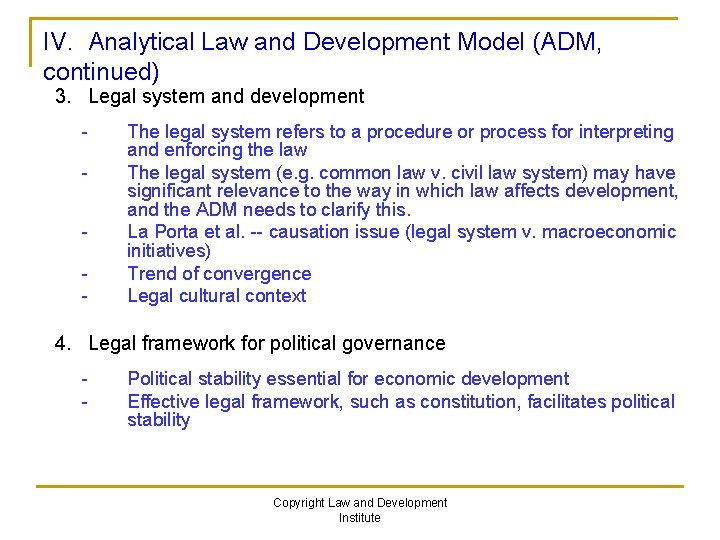
IV. Analytical Law and Development Model (ADM, continued) 3. Legal system and development - The legal system refers to a procedure or process for interpreting and enforcing the law The legal system (e. g. common law v. civil law system) may have significant relevance to the way in which law affects development, and the ADM needs to clarify this. La Porta et al. -- causation issue (legal system v. macroeconomic initiatives) Trend of convergence Legal cultural context 4. Legal framework for political governance - Political stability essential for economic development Effective legal framework, such as constitution, facilitates political stability Copyright Law and Development Institute
IV. Analytical Law and Development Model (ADM, continued) 5. Legal framework for political governance (cont. ) - - Political stability & democracy: effective governance system promoting political stability: different by the socio-economic circumstances (political needs, cultural priority, historical context, and popular aspirations) of the host country Necessity for civil representation in governance may increase when economic development progresses 6. Public healthcare and environment - Inadequate public healthcare and unhealthy environment for labor: may decrease productivity Providing public healthcare, such as public healthcare coverage, and protecting environment: costly, particularly to developing countries with limited resources Finding an adequate balance between the cost and the necessity LFIs that secure such a balance important Copyright Law and Development Institute
IV. Analytical Law and Development Model (ADM, continued) 7. Taxation - - Taxation: considerable impacts on economic activities: e. g. consumption tax on specific products; higher indirect tax on consumption; tax on property transactions Regulatory frameworks in tax that support economic activities considered to promote economic development: authorizing tax exemption or tax reduction on the profits of export industries and heavier taxes on importation Necessity of flexible regulatory regime to meet changing economic needs in different stages of economic development 8. Corporate governance - Effective corporation: essential for economic development Corporate governance determines the functional effectiveness of corporations Copyright Law and Development Institute
IV. Analytical Law and Development Model (ADM, continued) 8. Corporate governance (cont. ) - - Corporate governance securing the effective control by corporate head useful in the early stages of economic development Later stages: corporate governance that promotes transparency and social responsibility might be necessary: LFIs that respond to the different governance needs in different stages of economic development important Problems associated with the concentration of corporate power in the hands of a few among a small number of mega-corporate groups (e. g. problems of “Chaebol” in South Korea)- 9. Competition law - Competition law regulates anti-competitive behavior in market which reduces market efficiency, such as price fixing, division of sales territories, and tying Copyright Law and Development Institute
IV. Analytical Law and Development Model (ADM, continued) 9. Competition law (cont. ) - - In the early stages of economic development: strong competition law may inhibit accumulation of economic resources for efficient entrepreneurs to achieve economies of scale for economic development Regulatory balance necessary: some competition should be instilled so that the market is not dominated by a single supplier Protection of consumers by consumer law 10. Protection of intellectual property rights - International protection of intellectual property rights driven by developed countries in the recent decades IPRs: double-edged sword for economic development – encouragement of innovation and invention v. increase cost of accessing new technology for development Copyright Law and Development Institute
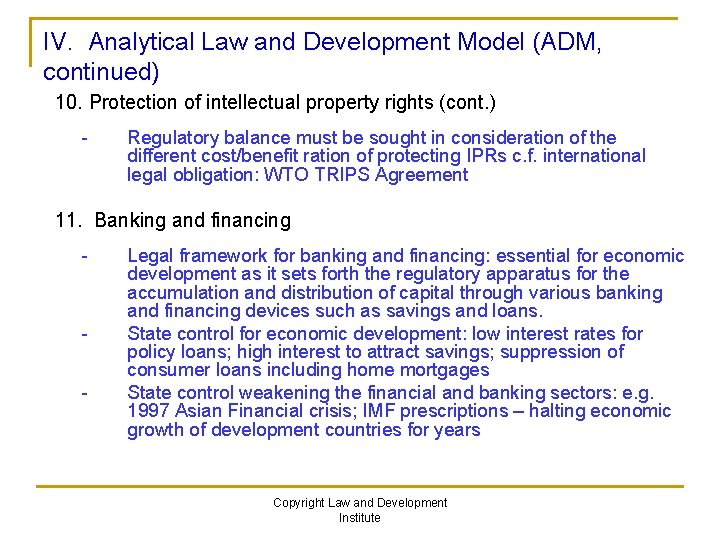
IV. Analytical Law and Development Model (ADM, continued) 10. Protection of intellectual property rights (cont. ) - Regulatory balance must be sought in consideration of the different cost/benefit ration of protecting IPRs c. f. international legal obligation: WTO TRIPS Agreement 11. Banking and financing - - Legal framework for banking and financing: essential for economic development as it sets forth the regulatory apparatus for the accumulation and distribution of capital through various banking and financing devices such as savings and loans. State control for economic development: low interest rates for policy loans; high interest to attract savings; suppression of consumer loans including home mortgages State control weakening the financial and banking sectors: e. g. 1997 Asian Financial crisis; IMF prescriptions – halting economic growth of development countries for years Copyright Law and Development Institute
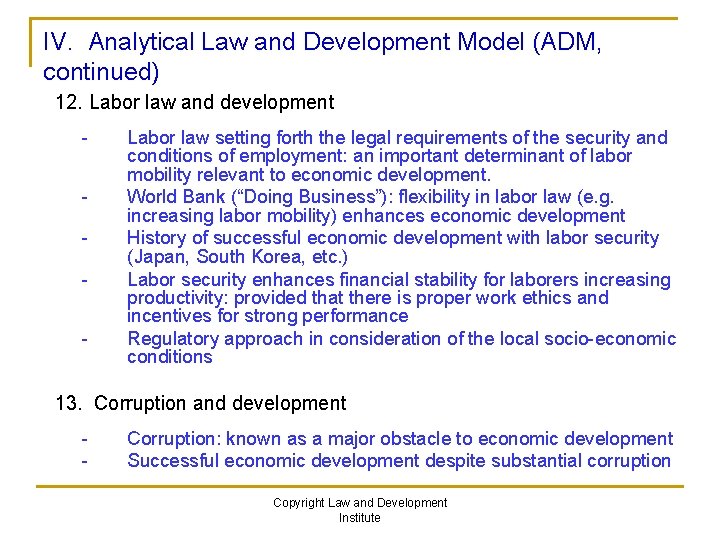
IV. Analytical Law and Development Model (ADM, continued) 12. Labor law and development - Labor law setting forth the legal requirements of the security and conditions of employment: an important determinant of labor mobility relevant to economic development. World Bank (“Doing Business”): flexibility in labor law (e. g. increasing labor mobility) enhances economic development History of successful economic development with labor security (Japan, South Korea, etc. ) Labor security enhances financial stability for laborers increasing productivity: provided that there is proper work ethics and incentives for strong performance Regulatory approach in consideration of the local socio-economic conditions 13. Corruption and development - Corruption: known as a major obstacle to economic development Successful economic development despite substantial corruption Copyright Law and Development Institute
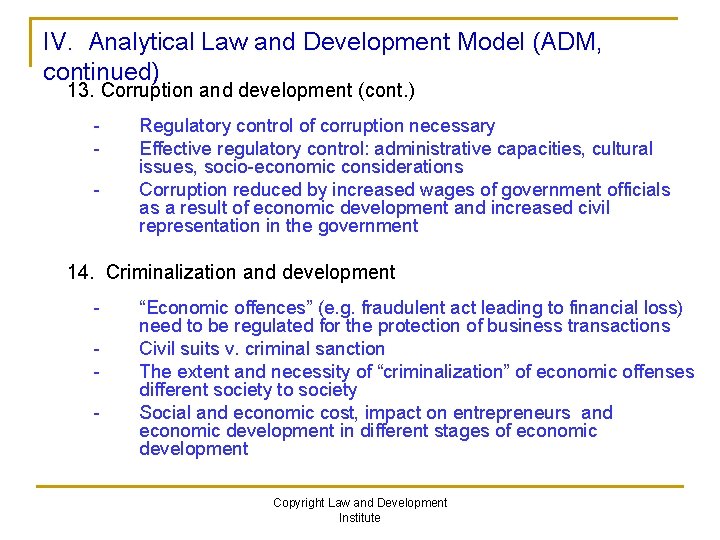
IV. Analytical Law and Development Model (ADM, continued) 13. Corruption and development (cont. ) - Regulatory control of corruption necessary Effective regulatory control: administrative capacities, cultural issues, socio-economic considerations Corruption reduced by increased wages of government officials as a result of economic development and increased civil representation in the government 14. Criminalization and development - “Economic offences” (e. g. fraudulent act leading to financial loss) need to be regulated for the protection of business transactions Civil suits v. criminal sanction The extent and necessity of “criminalization” of economic offenses different society to society Social and economic cost, impact on entrepreneurs and economic development in different stages of economic development Copyright Law and Development Institute
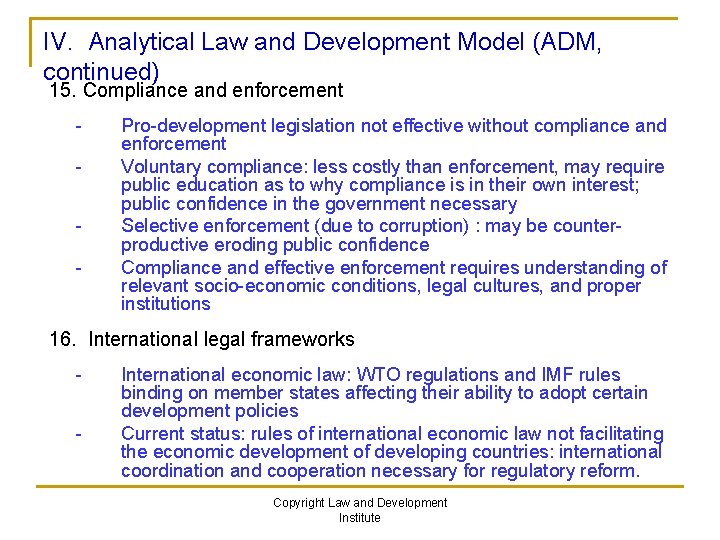
IV. Analytical Law and Development Model (ADM, continued) 15. Compliance and enforcement - Pro-development legislation not effective without compliance and enforcement Voluntary compliance: less costly than enforcement, may require public education as to why compliance is in their own interest; public confidence in the government necessary Selective enforcement (due to corruption) : may be counterproductive eroding public confidence Compliance and effective enforcement requires understanding of relevant socio-economic conditions, legal cultures, and proper institutions 16. International legal frameworks - International economic law: WTO regulations and IMF rules binding on member states affecting their ability to adopt certain development policies Current status: rules of international economic law not facilitating the economic development of developing countries: international coordination and cooperation necessary for regulatory reform. Copyright Law and Development Institute
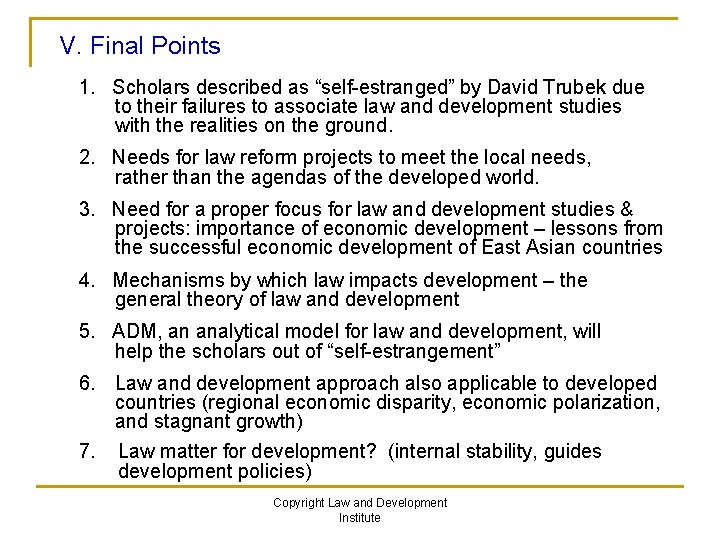
V. Final Points 1. Scholars described as “self-estranged” by David Trubek due to their failures to associate law and development studies with the realities on the ground. 2. Needs for law reform projects to meet the local needs, rather than the agendas of the developed world. 3. Need for a proper focus for law and development studies & projects: importance of economic development – lessons from the successful economic development of East Asian countries 4. Mechanisms by which law impacts development – the general theory of law and development 5. ADM, an analytical model for law and development, will help the scholars out of “self-estrangement” 6. Law and development approach also applicable to developed countries (regional economic disparity, economic polarization, and stagnant growth) 7. Law matter for development? (internal stability, guides development policies) Copyright Law and Development Institute
For articles: www. lawanddevelopment. net/dld/r. pdf Law and Development Program www. lawanddevelopment. net/dld. pdf 2018 Law and Development Conference (Berlin) www. ldiconference. net/ Copyright Law and Development Institute