
Introduction Kinematics and Dynamics Introduction Outline of this
- Slides: 44
Introduction Kinematics and Dynamics
Introduction • Outline of this lecture packet… • • • Overview of ATMS courses Dimensions, units, scales of motion Fundamental forces Newton and your sick stomach Vertical aspects of the atmosphere
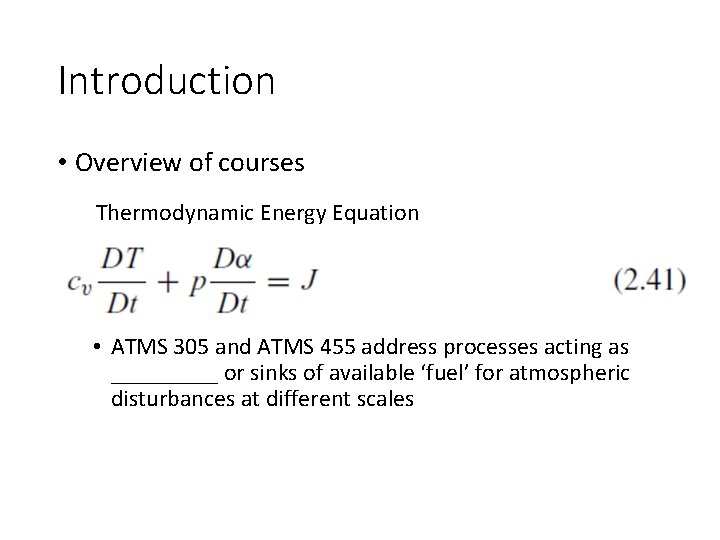
Introduction • Overview of courses Thermodynamic Energy Equation • ATMS 305 and ATMS 455 address processes acting as _____ or sinks of available ‘fuel’ for atmospheric disturbances at different scales
Introduction • Overview of courses Momentum Equations • This course (ATMS 310) addresses processes, through the movement of mass, momentum, energy, and moisture, creating the right conditions (‘ingredients’) to produce an atmospheric disturbance, if a ‘trigger’ is present
Introduction • Overview of this course (ATMS 310) • On occasion, we will apply principles and concepts learned in this course to considerations of _____ weather models (numerical weather prediction, NWP) https: //www. nbcnews. com/mach/science/5 -ways-world-s-fastest-supercomputer-could-change-world-ncna 883766
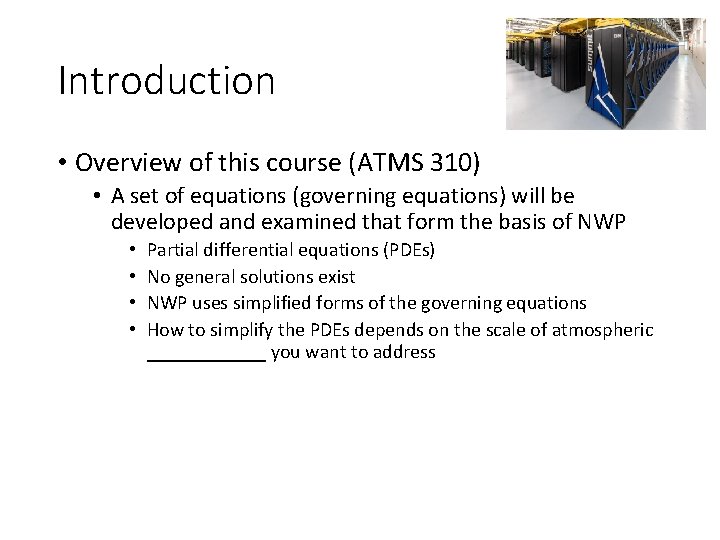
Introduction • Overview of this course (ATMS 310) • A set of equations (governing equations) will be developed and examined that form the basis of NWP • • Partial differential equations (PDEs) No general solutions exist NWP uses simplified forms of the governing equations How to simplify the PDEs depends on the scale of atmospheric ______ you want to address
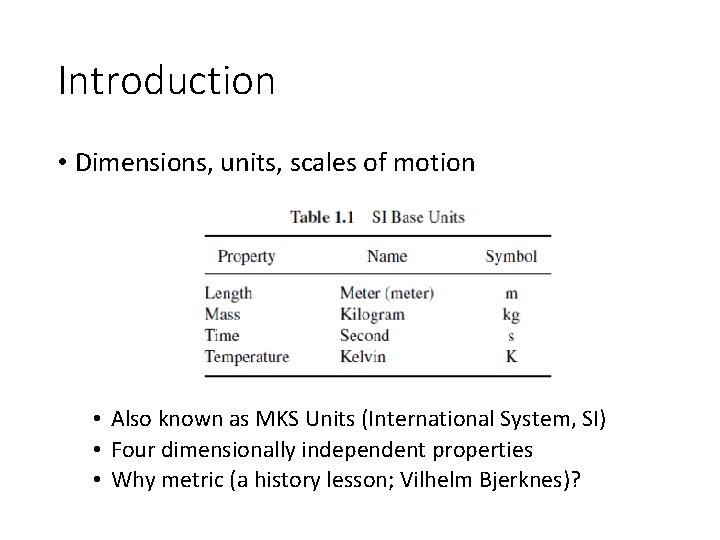
Introduction • Dimensions, units, scales of motion • Also known as MKS Units (International System, SI) • Four dimensionally independent properties • Why metric (a history lesson; Vilhelm Bjerknes)?
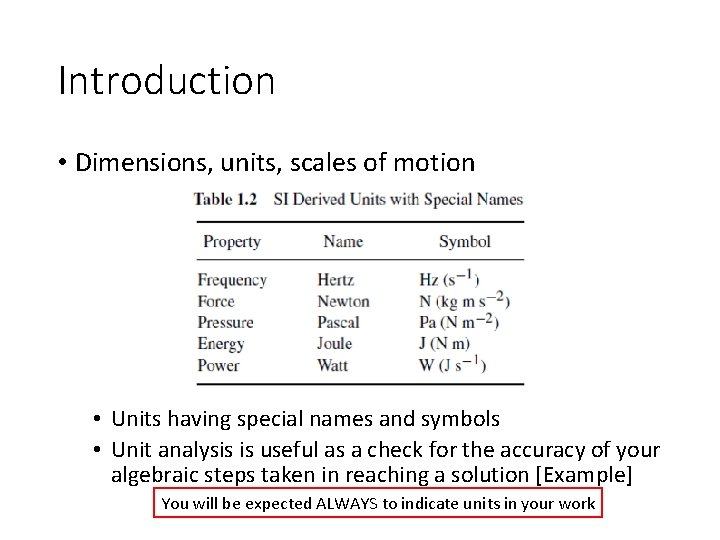
Introduction • Dimensions, units, scales of motion • Units having special names and symbols • Unit analysis is useful as a check for the accuracy of your algebraic steps taken in reaching a solution [Example] You will be expected ALWAYS to indicate units in your work
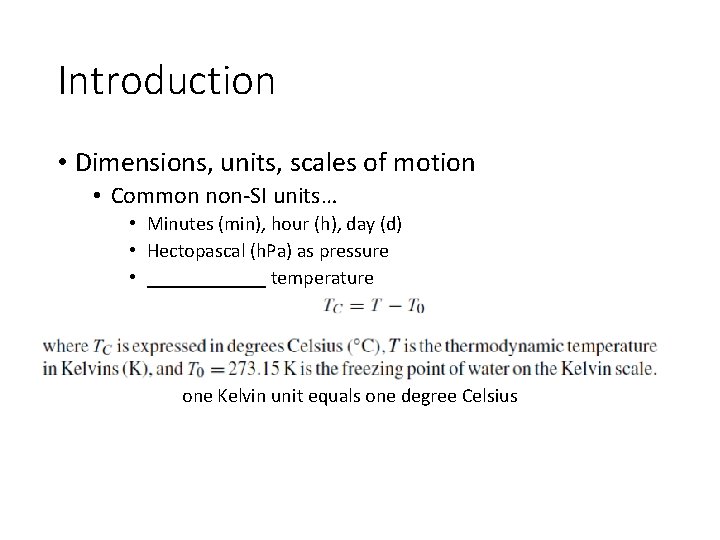
Introduction • Dimensions, units, scales of motion • Common non-SI units… • Minutes (min), hour (h), day (d) • Hectopascal (h. Pa) as pressure • ______ temperature one Kelvin unit equals one degree Celsius
Introduction • Dimensions, units, scales of motion • Common prefixes in science
Introduction • Dimensions, units, scales of motion • Scaling depends on the expected… • magnitude, perturbation (fluctuation), and length/ depth/ time scale on which the ______ occurs
Introduction • Dimensions, units, scales of motion • Scaling allows the simplification of the complicated governing equations to forcings relevant to the atmospheric ‘animal of interest’ (phenomenon) in our computer weather model • Dominant terms in the governing equations depends on the horizontal scale of motions For purposes of operational forecasting, there’s not much practical justification for simulating atmospheric phenomena smaller than the mesoscale, however, … for purposes of research, there’s always justification for simulating smaller atmospheric phenomena (e. g. , large eddy simulations).
Introduction • Fundamental forces • The movement of Polly Parcel is determined by laws prescribing the ______ of mass, momentum, and energy • Conservation of momentum depends on the nature of forces influencing atmospheric motions • Body forces- act on the center of mass of an air parcel; magnitude is proportional to the mass of the parcel (e. g. , gravity) • Surface forces- act across the boundary surface separating the air parcel from its surroundings; magnitude is independent of the air parcel mass (e. g. , PGF)
Introduction • Fundamental forces • Newton’s 2 nd law of motion… rate of change of momentum (a. k. a. acceleration) of an object, as measured in a fixed coordinate system, is the sum of all forces acting on the object • Fundamental forces • pressure gradient force, gravitational force, friction • Apparent forces (coordinate system that rotates with earth) • centrifugal force, Coriolis force
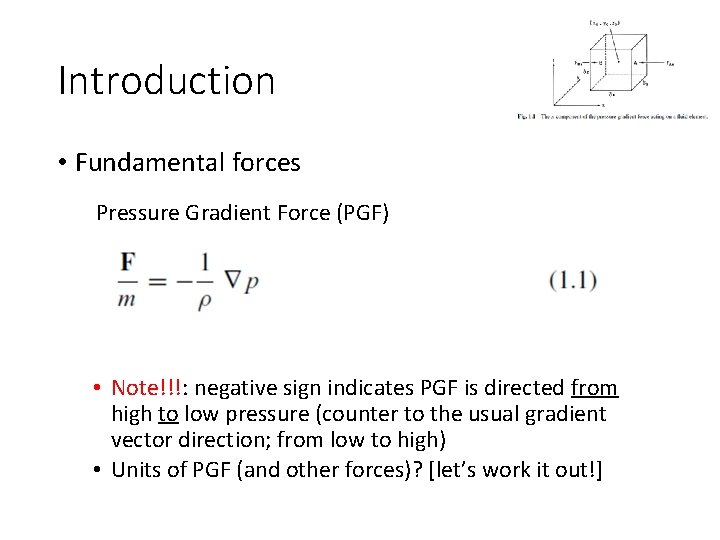
Introduction • Fundamental forces Pressure Gradient Force
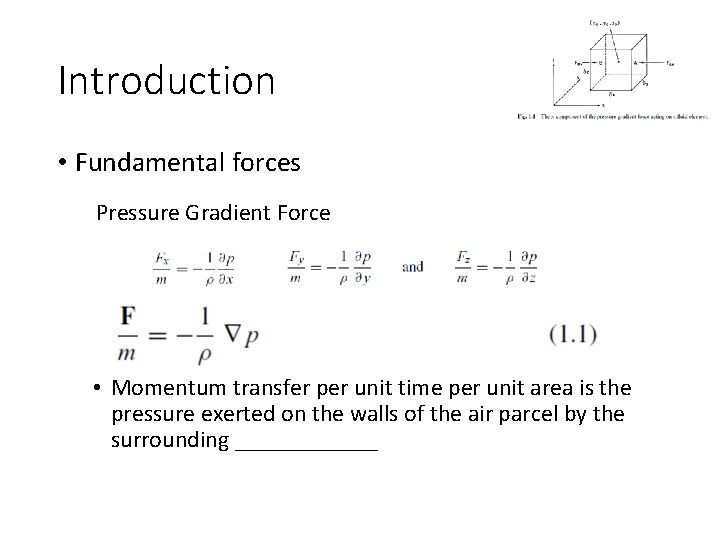
Introduction • Fundamental forces Pressure Gradient Force • Momentum transfer per unit time per unit area is the pressure exerted on the walls of the air parcel by the surrounding ______
Introduction • Fundamental forces Pressure Gradient Force (PGF) • Note!!!: negative sign indicates PGF is directed from high to low pressure (counter to the usual gradient vector direction; from low to high) • Units of PGF (and other forces)? [let’s work it out!]
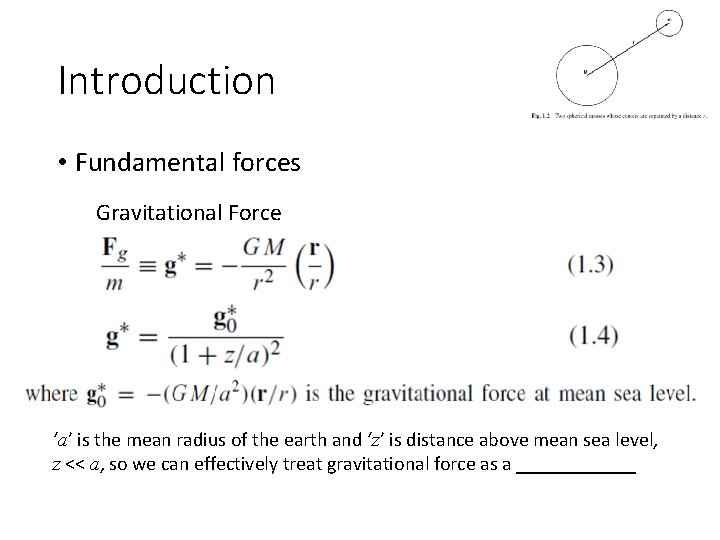
Introduction • Fundamental forces Gravitational Force
Introduction • Fundamental forces Gravitational Force ‘a’ is the mean radius of the earth and ‘z’ is distance above mean sea level, z << a, so we can effectively treat gravitational force as a ______
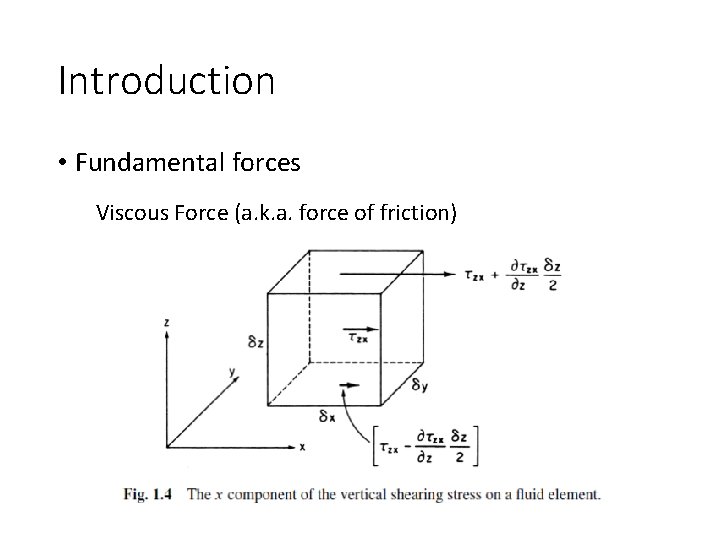
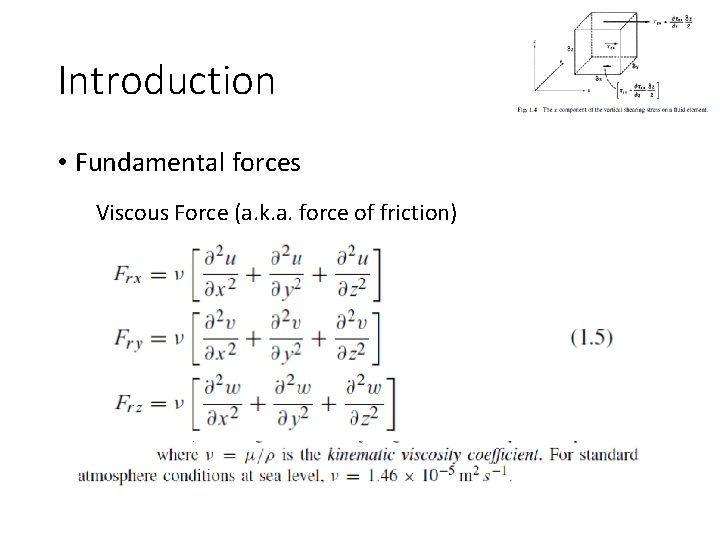
Introduction • Fundamental forces Viscous Force (a. k. a. force of friction)
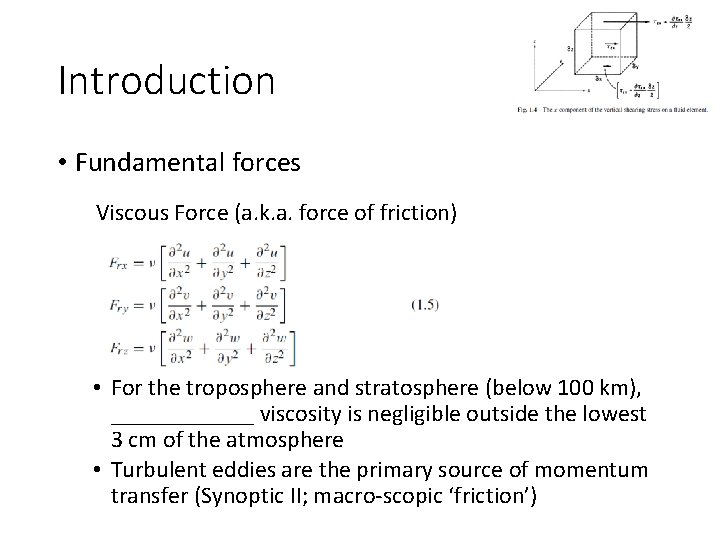
Introduction • Fundamental forces Viscous Force (a. k. a. force of friction)
Introduction • Fundamental forces Viscous Force (a. k. a. force of friction) • For the troposphere and stratosphere (below 100 km), ______ viscosity is negligible outside the lowest 3 cm of the atmosphere • Turbulent eddies are the primary source of momentum transfer (Synoptic II; macro-scopic ‘friction’)
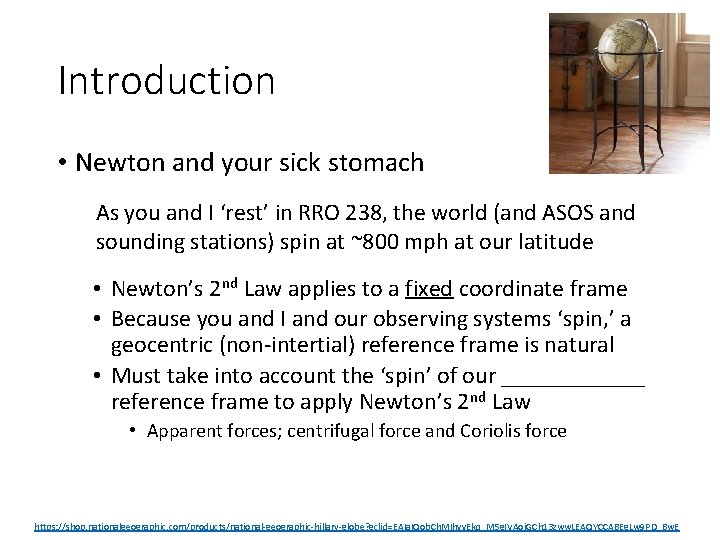
Introduction • Newton and your sick stomach As you and I ‘rest’ in RRO 238, the world (and ASOS and sounding stations) spin at ~800 mph at our latitude • Newton’s 2 nd Law applies to a fixed coordinate frame • Because you and I and our observing systems ‘spin, ’ a geocentric (non-intertial) reference frame is natural • Must take into account the ‘spin’ of our ______ reference frame to apply Newton’s 2 nd Law • Apparent forces; centrifugal force and Coriolis force https: //shop. nationalgeographic. com/products/national-geographic-hillary-globe? gclid=EAIa. IQob. Ch. MIhvv. Ekq_M 5 g. IVAoi. GCh 13 zww. LEAQYCCABEg. Lw 9 PD_Bw. E
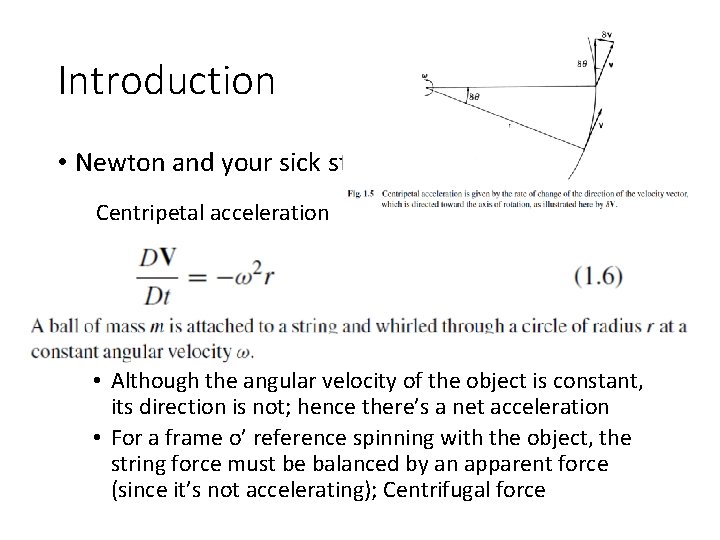
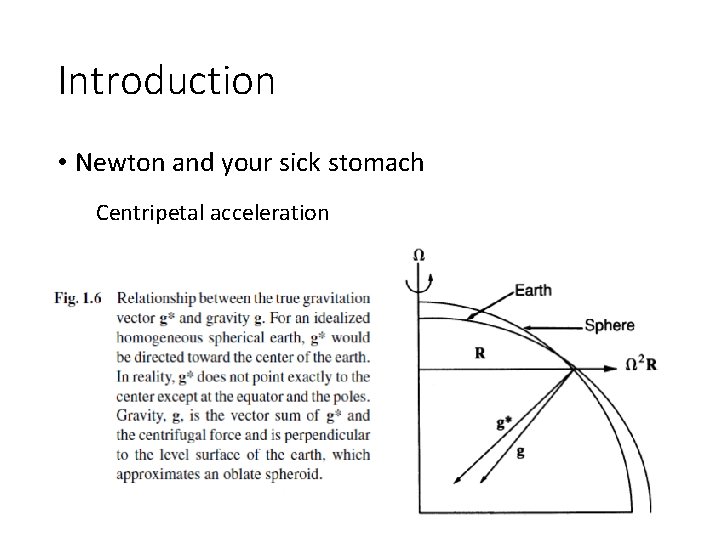
Introduction • Newton and your sick stomach Centripetal acceleration • Although the angular velocity of the object is constant, its direction is not; hence there’s a net acceleration • For a frame o’ reference spinning with the object, the string force must be balanced by an apparent force (since it’s not accelerating); Centrifugal force
Introduction • Newton and your sick stomach Centripetal acceleration • For a frame o’ reference spinning with the object, the string force must be balanced by an apparent force (since it’s not accelerating); Centrifugal force
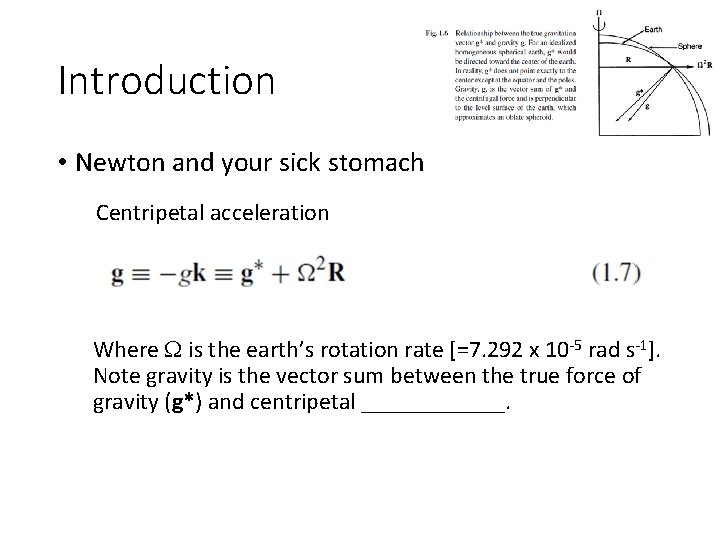
Introduction • Newton and your sick stomach Centripetal acceleration Where is the earth’s rotation rate [=7. 292 x 10 -5 rad s-1]. Note gravity is the vector sum between the true force of gravity (g*) and centripetal ______.
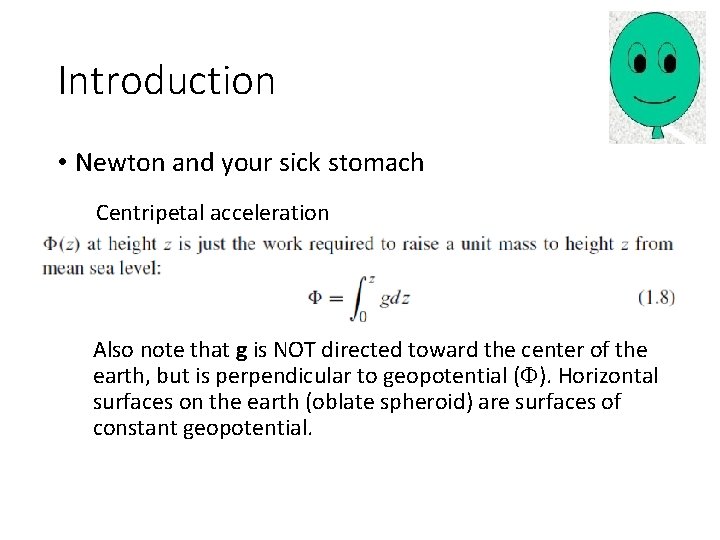
Introduction • Newton and your sick stomach Centripetal acceleration Also note that g is NOT directed toward the center of the earth, but is perpendicular to geopotential ( ). Horizontal surfaces on the earth (oblate spheroid) are surfaces of constant geopotential.
Introduction • Newton and your sick stomach Coriolis force… …required to apply Newton’s 2 nd Law if an object is changing its ______ on the earth’s surface.
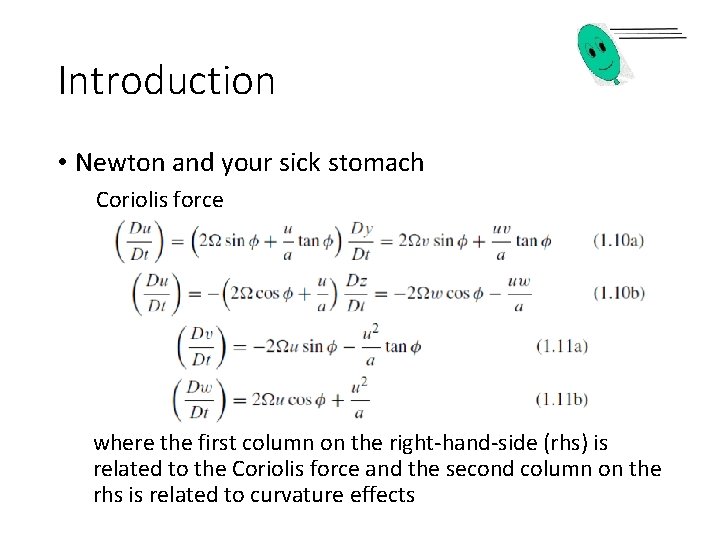
Introduction • Newton and your sick stomach Coriolis force where the first column on the right-hand-side (rhs) is related to the Coriolis force and the second column on the rhs is related to curvature effects
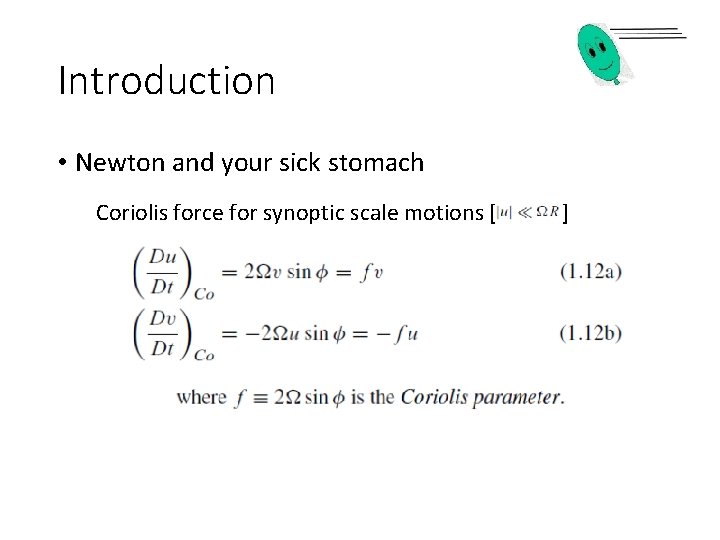
Introduction • Newton and your sick stomach Coriolis force for synoptic scale motions [ ]
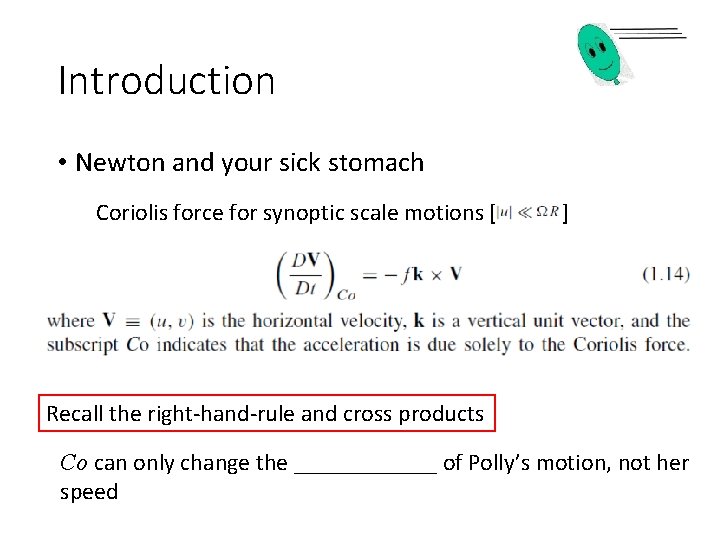
Introduction • Newton and your sick stomach Coriolis force for synoptic scale motions [ ] Recall the right-hand-rule and cross products Co can only change the ______ of Polly’s motion, not her speed
Introduction • Newton and your sick stomach Coriolis force • deflection is to the right (left) in the Northern (Southern) Hemisphere • ‘strength’ of Co depends on [1] speed of horizontal wind (u=dx/dt, v=dy/dt) [2] latitude of object [3] ______ rate of earth • is negligible for motions with time scales that are very short compared to the period of earth’s rotation (such as draining toilets after having been flushed)
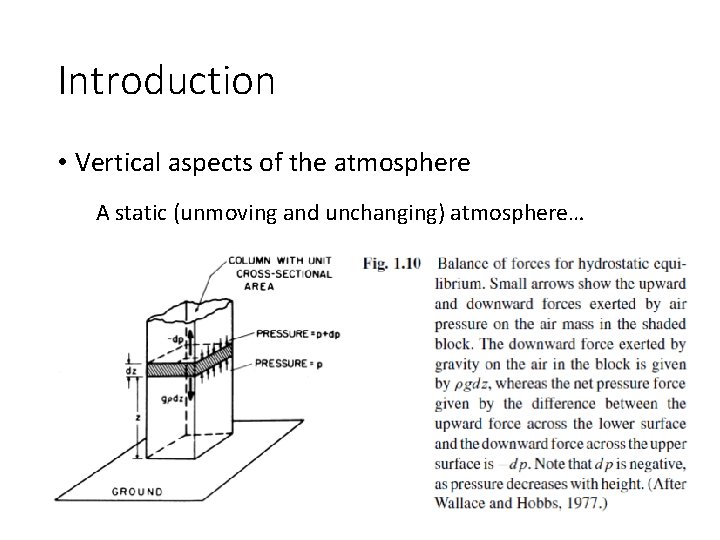
Introduction • Vertical aspects of the atmosphere A static (unmoving and unchanging) atmosphere… • ATMS 305 and ATMS 455 address processes responsible for changing the available ‘fuel’ for atmospheric disturbances at different scales
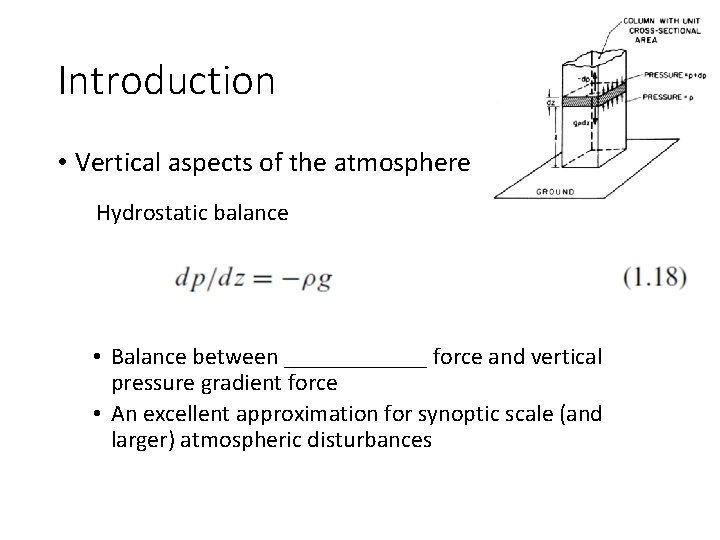
Introduction • Vertical aspects of the atmosphere Hydrostatic balance • Balance between ______ force and vertical pressure gradient force • An excellent approximation for synoptic scale (and larger) atmospheric disturbances
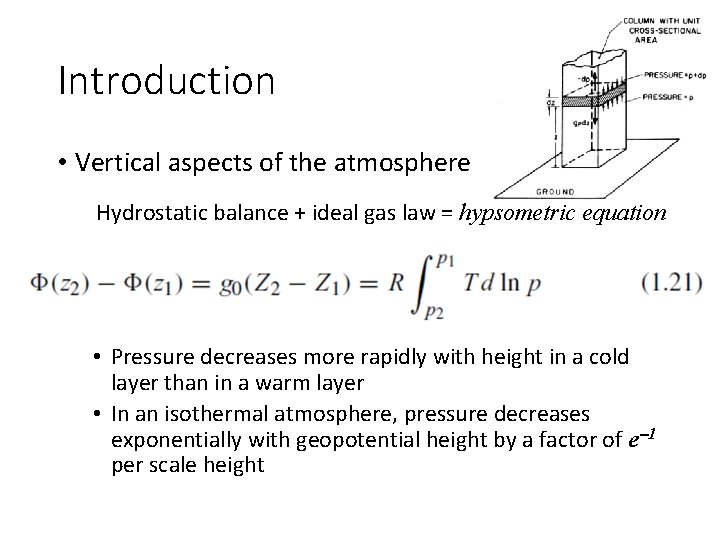
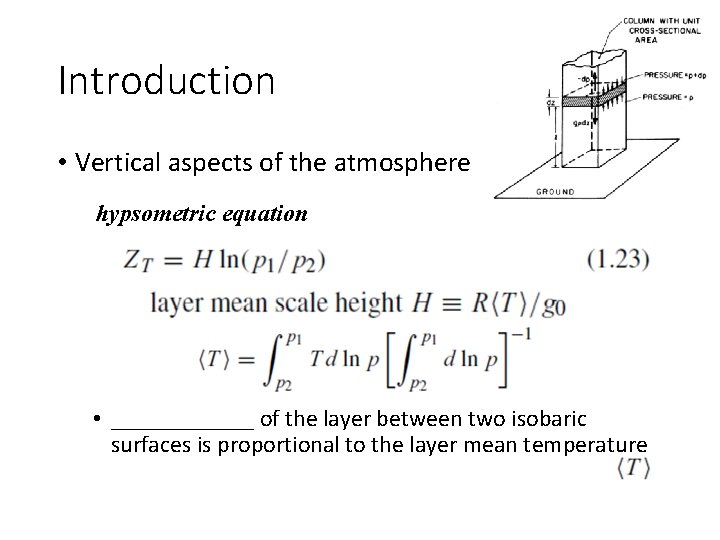
Introduction • Vertical aspects of the atmosphere Hydrostatic balance + ideal gas law = hypsometric equation • Pressure decreases more rapidly with height in a cold layer than in a warm layer • In an isothermal atmosphere, pressure decreases exponentially with geopotential height by a factor of e-1 per scale height
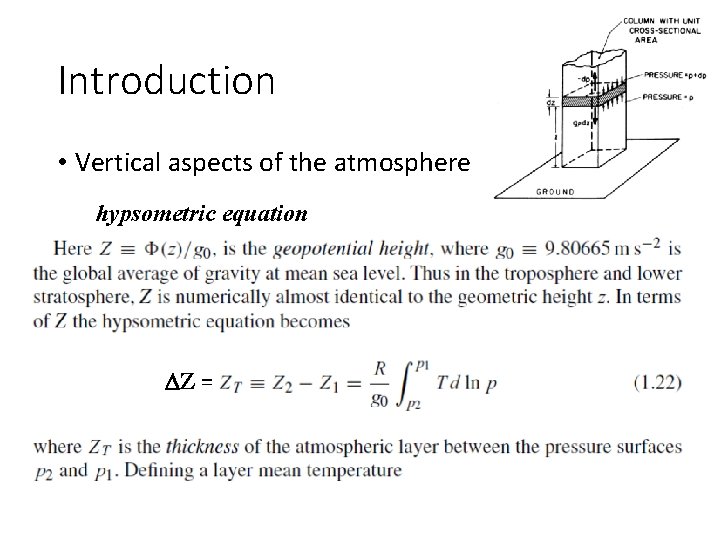
Introduction • Vertical aspects of the atmosphere hypsometric equation DZ =
Introduction • Vertical aspects of the atmosphere hypsometric equation • ______ of the layer between two isobaric surfaces is proportional to the layer mean temperature
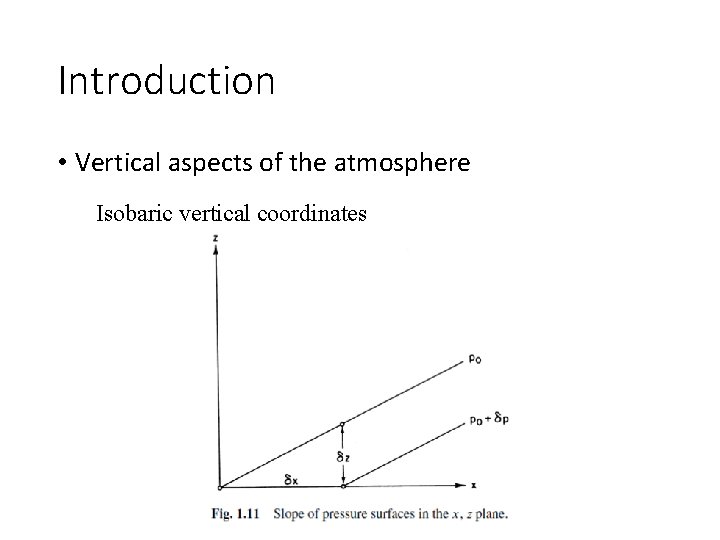
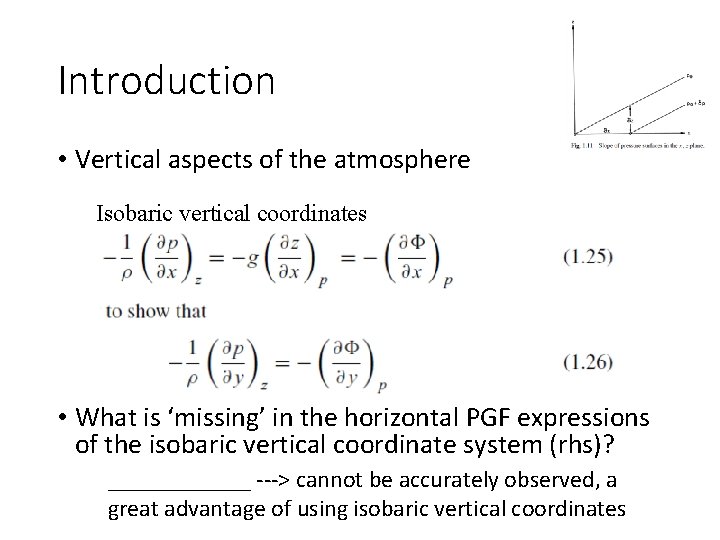
Introduction • Vertical aspects of the atmosphere Isobaric vertical coordinates
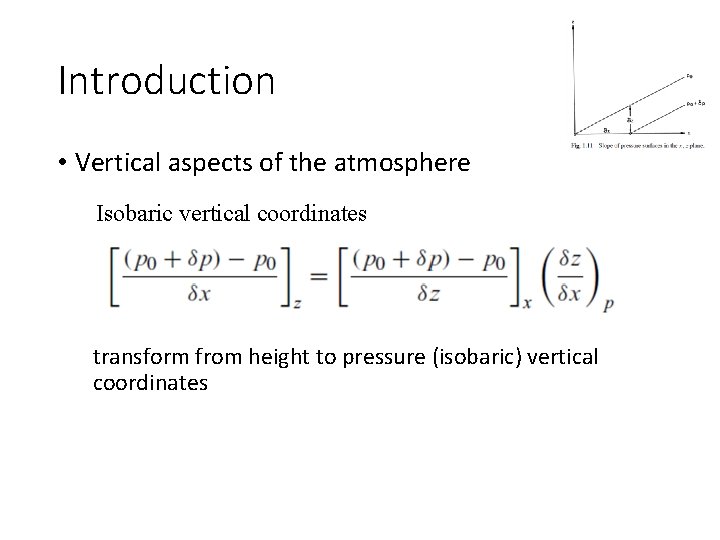
Introduction • Vertical aspects of the atmosphere Isobaric vertical coordinates transform from height to pressure (isobaric) vertical coordinates
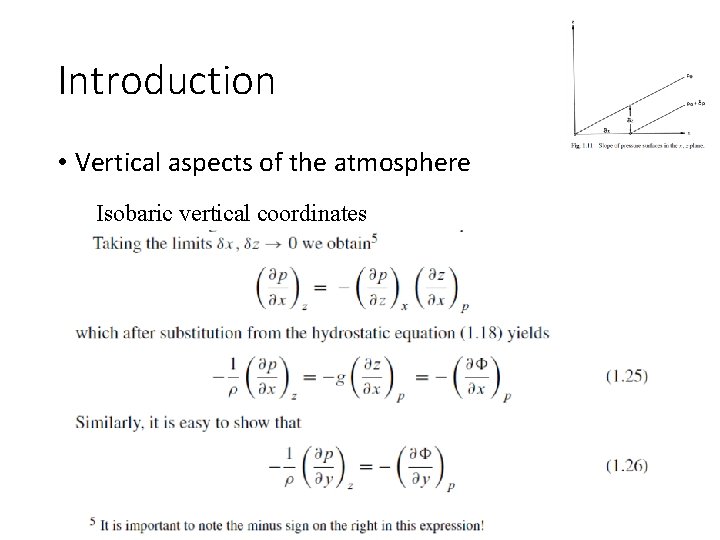
Introduction • Vertical aspects of the atmosphere Isobaric vertical coordinates
Introduction • Vertical aspects of the atmosphere Isobaric vertical coordinates • What is ‘missing’ in the horizontal PGF expressions of the isobaric vertical coordinate system (rhs)? ______ ---> cannot be accurately observed, a great advantage of using isobaric vertical coordinates
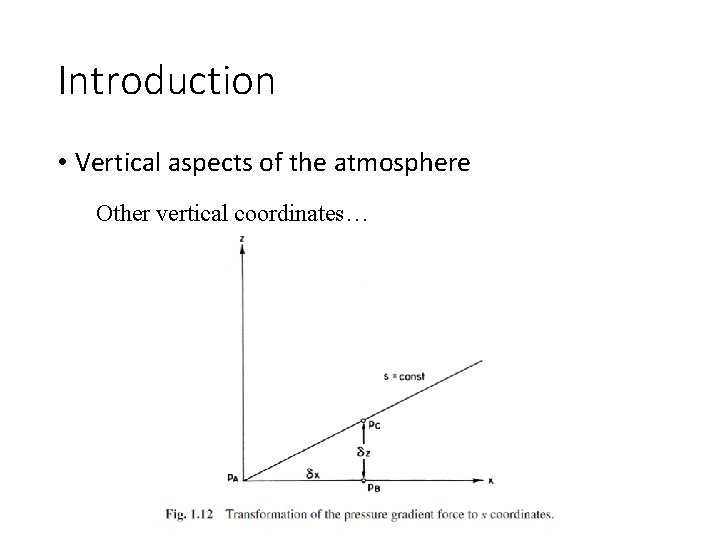
Introduction • Vertical aspects of the atmosphere Other vertical coordinates…
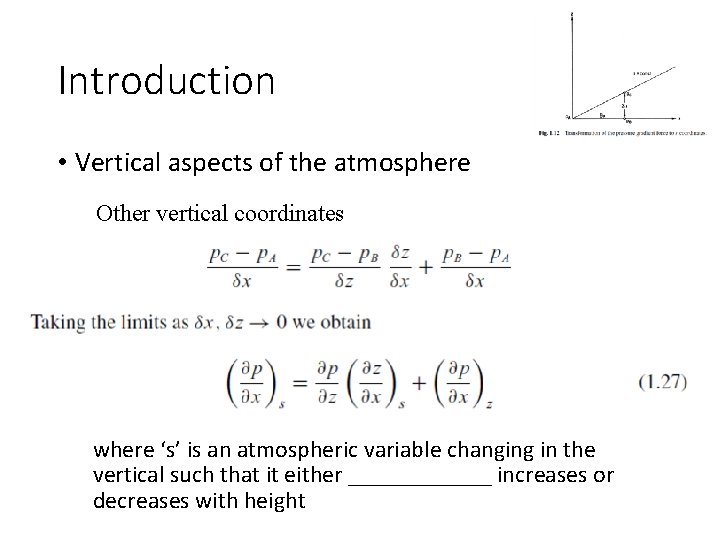
Introduction • Vertical aspects of the atmosphere Other vertical coordinates where ‘s’ is an atmospheric variable changing in the vertical such that it either ______ increases or decreases with height
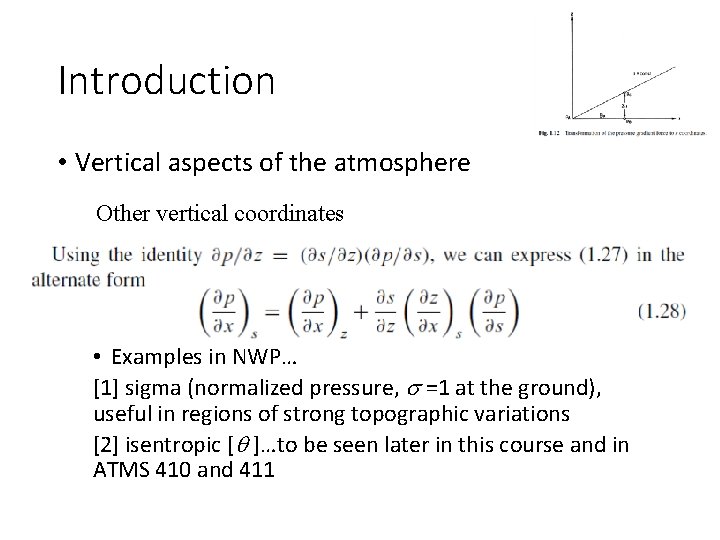
Introduction • Vertical aspects of the atmosphere Other vertical coordinates • Examples in NWP… [1] sigma (normalized pressure, s =1 at the ground), useful in regions of strong topographic variations [2] isentropic [q ]…to be seen later in this course and in ATMS 410 and 411