
INTRODUCTION Key Concepts in Ethics Reference ETHICS PRINCIPLES
- Slides: 17
INTRODUCTION: Key Concepts in Ethics Reference: ETHICS: PRINCIPLES OF ETHICAL BEHAVIOR IN MODERN SOCIETY (Mutya, 2018) by Jens Micah De Guzman, et al.
Ethics and Morality Ethics: branch of philosophy that studies morality or the rightness or wrongness of human conduct. - stands to queries about what there is reason to do; deals with human actions and reasons for action; concerned with character (from the Greek ‘ethos, ’ which means ‘character’, or ‘manners’. ) - also called ‘moral philosophy’; a normative study of human actions Morality: speaks of a code or system of behavior in regards to standards of right or wrong behavior Ethics and Morality: oftentimes used interchangeably; both carry the concept of moral standards or rules
1. The Importance of Rules to Social Beings Rules: regulations or principles governing conduct within a specific activity or sphere a. Protect social beings by regulating behavior -usually coupled w/ means to impose consequences on those who violate them b. Help to guarantee people certain rights and freedom -laws/rules are outlined in what is called constitution w/c protects human rights c. Produce a sense of justice among social beings -prevent exploitation and domination d. Essential for a healthy economic system -e. g. ensure product safety, employee safety, and product quality
2. Moral vs. Non-moral Standards Moral standards: those relating to human behavior, especially the distinction between good and bad behavior -involve rules about actions which are morally right and wrong, and values on objects which are morally good and bad Non-moral standards: rules unrelated to moral or ethical considerations; either not necessarily linked to morality or by nature lack ethical sense Examples: rules of etiquette, fashion standards, rules in games, and various house rules Note: Technically, religious rules, some traditions, and legal statutes (i. e. laws and ordinances) are non-moral principles, though they can be ethically relevant depending on some factors and contexts.
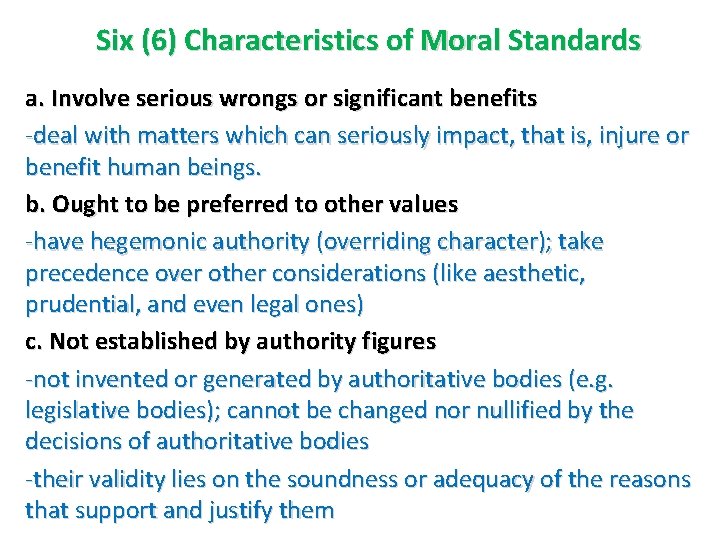
Six (6) Characteristics of Moral Standards a. Involve serious wrongs or significant benefits -deal with matters which can seriously impact, that is, injure or benefit human beings. b. Ought to be preferred to other values -have hegemonic authority (overriding character); take precedence over other considerations (like aesthetic, prudential, and even legal ones) c. Not established by authority figures -not invented or generated by authoritative bodies (e. g. legislative bodies); cannot be changed nor nullified by the decisions of authoritative bodies -their validity lies on the soundness or adequacy of the reasons that support and justify them
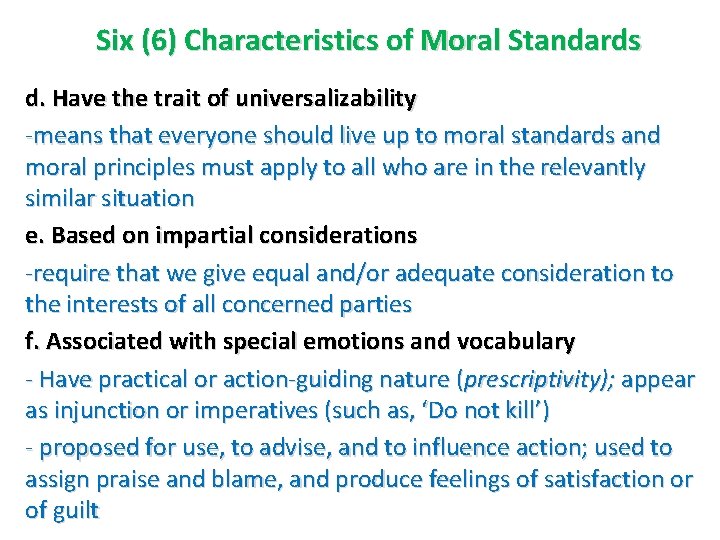
Six (6) Characteristics of Moral Standards d. Have the trait of universalizability -means that everyone should live up to moral standards and moral principles must apply to all who are in the relevantly similar situation e. Based on impartial considerations -require that we give equal and/or adequate consideration to the interests of all concerned parties f. Associated with special emotions and vocabulary - Have practical or action-guiding nature (prescriptivity); appear as injunction or imperatives (such as, ‘Do not kill’) - proposed for use, to advise, and to influence action; used to assign praise and blame, and produce feelings of satisfaction or of guilt
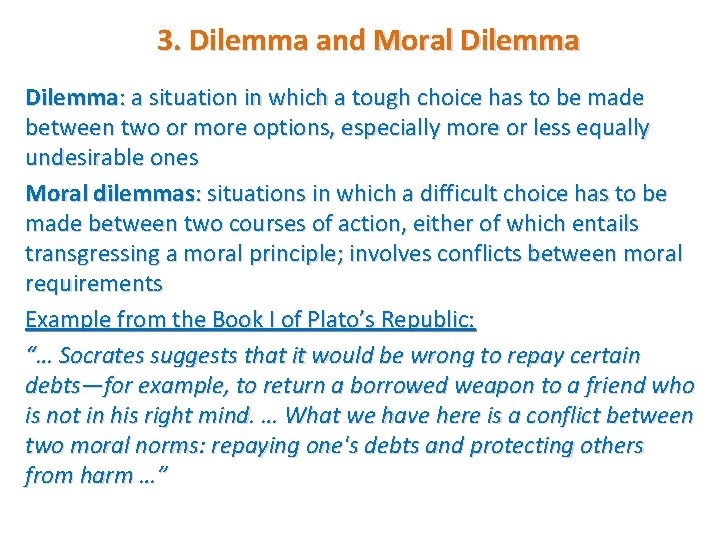
3. Dilemma and Moral Dilemma: a situation in which a tough choice has to be made between two or more options, especially more or less equally undesirable ones Moral dilemmas: situations in which a difficult choice has to be made between two courses of action, either of which entails transgressing a moral principle; involves conflicts between moral requirements Example from the Book I of Plato’s Republic: “… Socrates suggests that it would be wrong to repay certain debts—for example, to return a borrowed weapon to a friend who is not in his right mind. … What we have here is a conflict between two moral norms: repaying one's debts and protecting others from harm …”
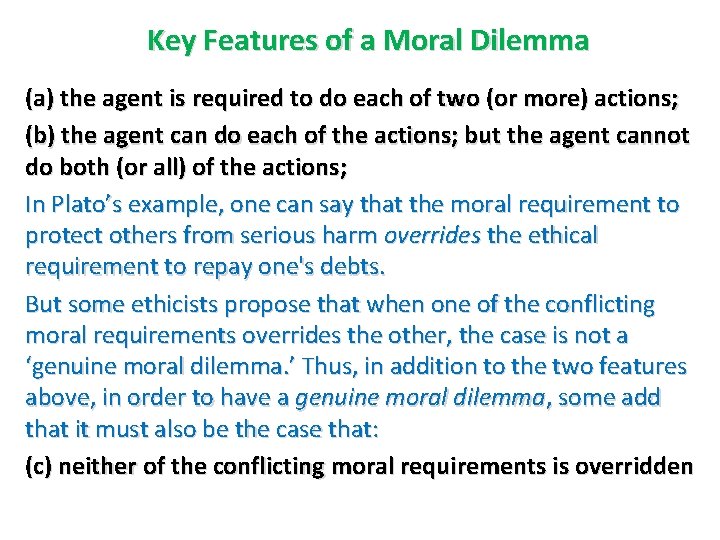
Key Features of a Moral Dilemma (a) the agent is required to do each of two (or more) actions; (b) the agent can do each of the actions; but the agent cannot do both (or all) of the actions; In Plato’s example, one can say that the moral requirement to protect others from serious harm overrides the ethical requirement to repay one's debts. But some ethicists propose that when one of the conflicting moral requirements overrides the other, the case is not a ‘genuine moral dilemma. ’ Thus, in addition to the two features above, in order to have a genuine moral dilemma, some add that it must also be the case that: (c) neither of the conflicting moral requirements is overridden
4. Three Levels of Moral Dilemmas a. Personal Dilemmas -those experienced and resolved on the personal level. Jean-Paul Sartre’s example: “… a student whose brother had been killed in the German offensive of 1940. The student wanted to avenge his brother and to fight forces that he regarded as evil. But the student's mother was living with him, and he was her one consolation in life … Sartre describes him as being torn between two kinds of morality: … personal devotion to his mother [and] … attempting to contribute to the defeat of an unjust aggressor. ” Other examples: making conflicting promises; choosing between the life of a child who is about to be delivered and the child’s mother
4. Three Levels of Moral Dilemmas b. Organizational Dilemmas - ethical cases encountered and resolved by social organizations; include moral dilemmas in business, medical field, and public sector Examples: - withdrawing life support from a dying patient (human life should not be deliberately shortened vs. unpreventable pain should not be tolerated) - whether or not to favor family, friends, or campaign contributors over other constituents; favoring the agenda of one’s political party over a policy one believes to be good for the community; accepting gifts if it is legally permitted but creates the appearance of impropriety
4. Three Levels of Moral Dilemmas c. Structural Dilemmas - cases involving network of institutions and operative theoretical paradigms; encompass multi-sectoral institutions and organizations; may be larger in scope and extent than organizational ones Case: relatively higher prices of medicines in the Philippines Factors: the cost of research, presence of competition in the market, government regulations, and patent protection Lowering the costs of medicine: (+) benefits the Filipino public (-) ruins the interests or legal rights of the involved researchers, inventors or discoverers, and pharmaceutical companies
5. ‘Only human beings can be ethical’ Some human beings’ traits that make it possible for them to be moral: a. Only human beings are rational, autonomous, and selfconscious. -We can achieve certain values and goods that outweigh those that non-rational, non-autonomous, and non-self-conscious beings are capable of realizing. -For instance, in order to attain the kind of dignity and selfrespect that we have, a being must be able to conceive of itself as one among many, and must be able to consciously select his actions rather than be led by blind instinct.
5. ‘Only human beings can be ethical’ Some human beings’ traits that make it possible for them to be moral: b. Only human beings can act morally or immorally. - Strictly speaking, an animal which devours another animal cannot be said to be immoral. And no matter how ‘good’ an animal’s action seems to be, it cannot be technically said to be moral. - Only beings that can act morally can be required to sacrifice their interests for the sake of others. Animals could not really sacrifice their own good for the sake of others, but would even pursue their good at the expense of others.
5. ‘Only human beings can be ethical’ Some human beings’ traits that make it possible for them to be moral: c. Only human beings are part of the moral community. -Moral community is defined in terms of the essential social relations that exist between or among beings. - In truly meaningful ways, only human beings can communicate with each other, engage in economic, political, and familial relationships, form deep personal relationships, and extend real concern to other members of the moral community. -Only human beings can possess or practice values such as love, honor, social relationships, forgiveness, compassion, and altruism; and participate in a collective cognition.
6. Freedom as a Foundation of Morality - Morality is a question of choice and is about choosing ethical codes, values, or standards to guide us in our daily lives. Philosophically, choosing is impossible without freedom. - Animals cannot be truly ethical for they are not really autonomous or free. Likewise, a beneficial robot cannot be said to be moral, for it has no freedom or choice but to work according to its built-in program. - Morality requires and allows choice. In daily lives, people make the choice to give to charities, donate time and money to schools, mentor children, open businesses, or protest against animal cruelty. - Practically, the sum of our choices defines our specific ‘morality. ’
7. Minimum Requirement for Morality: Reason and Impartiality James Rachels (1941 -2003) holds that moral judgments must be backed by sound reasoning and that morality requires the impartial consideration of all parties involved. Reason entails that human feelings may be important in ethical decisions, but they ought to be guided by sound reasoning. It helps us to evaluate whether our feelings and intuitions about moral cases are correct and defensible. Impartiality involves the idea that each individual’s interests and point of view are equally important. Also called evenhandedness or fair-mindedness, it is a principle of justice stating that decisions ought to be based on objective criteria, rather than on the basis of bias, prejudice, or preferring the benefit to one person over another for improper reasons.
ASSIGNMENT Accomplish the “E-Learning Assignment: Preparation for the Next Lesson” written on page 12 of the book. Submit the output next meeting. Have fun!