
Introduction Junhui Qian Intermediate Macroeconomics 1 Content What
- Slides: 38
Introduction Junhui Qian Intermediate Macroeconomics 1
Content • • • What macroeconomics is about How the economy works Macroeconomic modeling History of macroeconomic thought Concluding remarks Intermediate Macroeconomics 2
Macroeconomics • With microeconomics, macroeconomics (macro) is one of the two pillars of economics. • Macroeconomics studies the performance, structure, behavior, and policy-making of an economy as a whole. Intermediate Macroeconomics 3
Objectives of Macroeconomics • To understand causes and consequences of “business cycles”. • To understand why some countries achieve long-term economic growth while others do not. • Macroeconomic policy making – Fiscal policy – Monetary policy • Macroeconomic forecasting Intermediate Macroeconomics 4
Why Macroeconomics Is Important • With a better understanding of why economy grows and why recessions occur, better policy making is possible. • A stably growing economy leads not only to a better living for millions of people, but also to a better society. • Paul Samuelson: “It is not too much to say that the widespread creation of dictatorships and the resulting World War II stemmed in no small measure from the world's failure to meet this basic economic problem [the Great Depression] adequately. ” Intermediate Macroeconomics 5
Content • What macroeconomics is about • How the economy works – Market economy – Planned economy – Mixed economy • Macroeconomic modeling • History of macroeconomic thought • Concluding remarks Intermediate Macroeconomics 6
Problems An Economy Must Solve • What goods and services should be produced, and in what quantity? • How should resources, which are scarce and have alternative uses, be used in producing these goods and services? • For whom are they to be produced? Intermediate Macroeconomics 7
Some Stylized Forms of Economy • • The economy of instinct (e. g. , bees) The tribal economy The market economy The planned economy Intermediate Macroeconomics 8
Market Economy • A market economy relies on the market to solve these problems. • As demand for some goods and services increases, consumers bid up their prices, which induce suppliers to produce more. • To produce more of the demanded goods and services, suppliers bid up prices of required inputs (labor, capital, land, energy, metals, etc. ). The increased prices then lead to re-allocation of these resources for production. • Workers receive their compensation for the supply of labor; Owners of capital get paid for the supply of capital; And owners of the firms claim the residual profit. All of them are consumers of goods and services in the economy. Intermediate Macroeconomics 9
Price: the “Invisible Hand” • In a market economy, price plays a crucial role. • For the first problem an economy must solve, prices signal the supply and demand condition in the market of consumer goods and services. • For the second problem, prices signal the relative scarcity of resources and the reward for being used. • Invisibly and without any coercion, prices direct resources to be used in producing millions of goods and services demanded by millions of consumers with different tastes and preferences. Intermediate Macroeconomics 10
Limitations of Market Economy • The market alone would under-supply public goods and over-supply public bads (pollution). • Monopolies may lead to under-supply of goods and services with distortionary prices. • Without proper regulation of the financial industry, the market may experience violent boom-bust cycles. • Distribution of income and wealth in a pure market economy may be dangerously unequal. – Recommended reading: Capital in the 21 st Century, by T. Piketty Intermediate Macroeconomics 11
Moral Limits of Market • There are things money should not buy (e. g. , human being, political rights). • Market value of labor can be unfair. – Salary of “super-managers” v. s. nurses – Professor of finance v. s. mathematics • Recommend reading: What Money Can’t Buy: The Moral Limits of Markets, by M. J. Sandel Intermediate Macroeconomics 12
Planned Economy • From 1953 to 1978, China experimented planned economy similar with the former Soviet Union. • The planned economy relies on the government to determine what and how much goods and services to be produced, how resources are used in production, and how to distribute final goods and services among peasants, workers and cadres in every ranks. • Without markets and prices, the economic planning turned out to be a disaster resulting in huge waste in the use of labor and capital, extreme scarcity of consumer goods, stagnation of living standards. Intermediate Macroeconomics 13
Mixed Economy • Since 1978, China started reforming its economy. The spirit of the reform was to let market play a more and more important role in the economy. • What we have now is a mixed economy, where both the market and the government play important roles in the economy. Intermediate Macroeconomics 14
The Roles of Government in Mixed Economy • Provide public goods (defense, public security, protection of environment, etc. ) • Conduct public investment (infrastructure, education, basic research, etc. ) • Make transfer payments (less developed areas; the retired, the unemployed, etc. ) • Financial regulation (banks, securities, insurance) • Conduct monetary and fiscal policy • Directly manage state-owned enterprises Intermediate Macroeconomics 15
Content • • • What macroeconomics is about How the economy works Macroeconomic modeling History of macroeconomic thought Concluding remarks Intermediate Macroeconomics 16
Macroeconomic Variables • We “know” the economy, in an objective way, through macroeconomic variables (e. g. , GDP, inflation, etc. ), which are measurements of the economy from different perspectives. • We “understand” the economy using models that characterize causal relationships among macroeconomic variables. • Key macroeconomic variables: GDP, (un)employment, inflation, interest rates, exchange rates, etc. Intermediate Macroeconomics 17
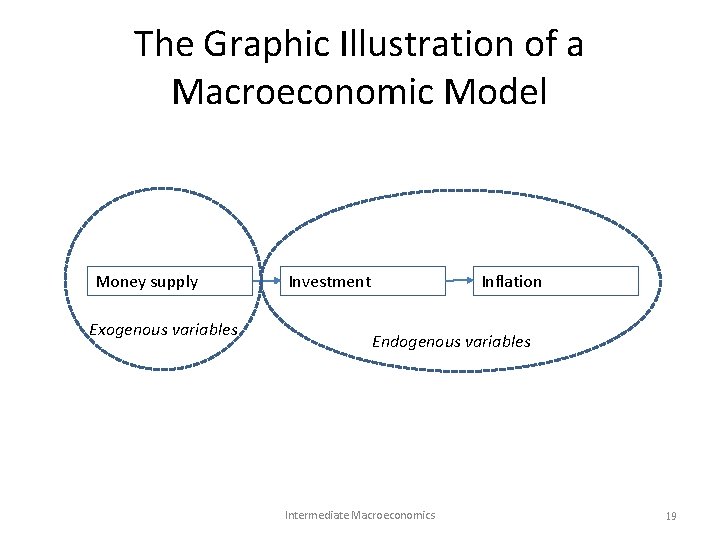
Endogenous vs. Exogenous Variables • In economic models, we must have both endogenous variables and exogenous variables. – Endogenous variable: also called “dependent variable”, a variable whose value is determined by the solution of a model. – Exogenous variable: also called “independent variable”, a variable whose value is determined outside the model. • What is economic explanation? Associate variations in endogenous variables with variations in some exogenous variables. Intermediate Macroeconomics 18
The Graphic Illustration of a Macroeconomic Model Money supply Exogenous variables Investment Inflation Endogenous variables Intermediate Macroeconomics 19
Macroeconomic Modeling • Professional economists approach economic problems by scientific modeling. • From data we summarize empirical facts (phenomenon) to be explained. These empirical facts are usually some statistics of some endogenous variables. For example, the average growth rate of real income. • To explain, we conjecture a model (that is, a toy economy) that has – Endogenous variables, exogenous variables – A functional relationship • A successful model explains the empirical facts about the endogenous variable using the exogenous variables, under some reasonable assumptions. • However, a successful model in one setting will probably fail in another setting, where the assumptions of the model no longer hold. • Then new models, with modified assumptions, are proposed to explain new phenomena in the new setting. • This dynamic process goes on. Intermediate Macroeconomics 20
The Art of Using Models • It takes science to propose and evaluate models. But it takes art to choose an appropriate model in a particular setting. • Keynes: Economics is a science of thinking in terms of models joined to the art of choosing models which are relevant to the contemporary world. Intermediate Macroeconomics 21
It Depends! • The default answer to an economic question should be: it depends. – There’s no definite answer, since the setting where an economic question arises is almost always complex, so that there is uncertainty on whether a model’s assumptions actually hold. – It’s important to have observations that are as accurate and complete as possible. – It’s important to be humble. Intermediate Macroeconomics 22
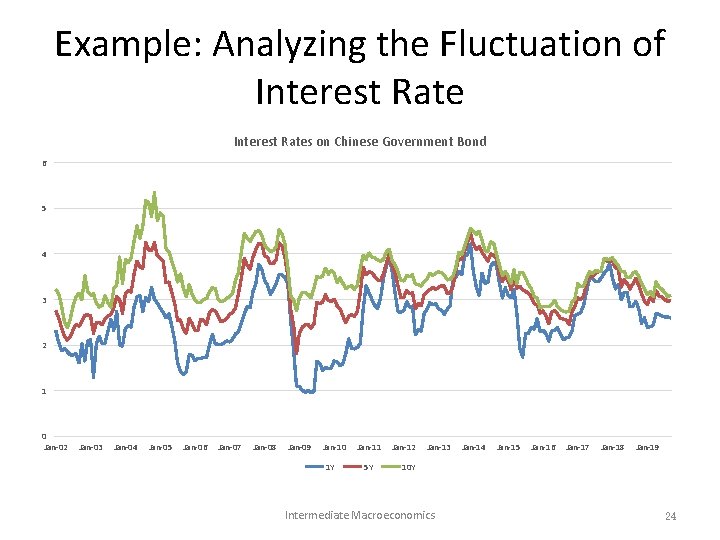
Example: Analyzing the Fluctuation of Interest Rate • Consider the Chinese government bond market, where a term structure of interest rate is determined. • In this question, the government bond price (or equivalently, the risk-free interest rate) is the endogenous variable. • The empirical fact is that the bond price exhibits rises and falls over time. • An obvious model is the model of supply and demand in the bond market, with exogenous variables shifting the supply and demand curves. • The exogenous variables may include – On the demand side: the monetary policy of the US Fed, domestic inflation expectation, etc. – On the supply side: bond issuance, which is related to government deficit. Intermediate Macroeconomics 23
Example: Analyzing the Fluctuation of Interest Rates on Chinese Government Bond 6 5 4 3 2 1 0 Jan-02 Jan-03 Jan-04 Jan-05 Jan-06 Jan-07 Jan-08 Jan-09 Jan-10 1 Y Jan-11 5 Y Jan-12 Jan-13 Jan-14 Jan-15 Jan-16 Jan-17 Jan-18 Jan-19 10 Y Intermediate Macroeconomics 24
The Application of Macro Models • To explain macroeconomic phenomena • To make forecasts on trends in the economy and the financial markets • To analyze policies, old or new – Treatment-effect analysis – Counter-factual analysis Intermediate Macroeconomics 25
Structural Model v. s. Reduced Model • In the previous example, the simple model of supply and demand is an example of structural model. • We are essentially explaining the variation in endogenous variable (government bond price) using the variation in the exogenous variables (e. g. , inflation expectation) via the working of a model. • If without a structural model, we may still make forecasts based on the correlations between endogenous and exogenous variables. The set of correlations constitutes a reduced model. • The reduced model is nothing but statistical associations, which do not explain anything. • As time goes by, the reduced statistical model may change. This point is known as the “Lucas Critique”, which was raised by Robert Lucas, the winner of 1995 Nobel Prize in economics. Intermediate Macroeconomics 26
Content • • • What macroeconomics is about How the economy works Macroeconomic modeling History of macroeconomic thought Concluding remarks Intermediate Macroeconomics 27
History of Macroeconomic Thought • • Classical Keynesian (Neoclassical synthesis) Monetarism New classical New Keynesian Other schools Intermediate Macroeconomics 28
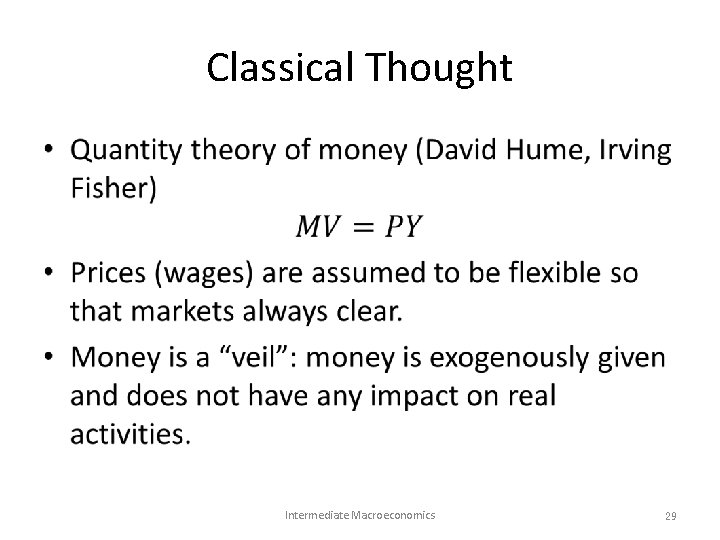
Classical Thought • Intermediate Macroeconomics 29
Keynesian Revolution • Macroeconomics began with the publication of John Maynard Keynes's General Theory of Employment, Interest and Money, in the depth of the Great Depression. • Keynes offers a theory that explains why the Great Depression can occur and what governments can do. • Keynesian theory does not assume imperfect markets and rationality of individuals. – “Sticky price” (wage) – “Animal spirits” – “Beauty contest” Intermediate Macroeconomics 30
Neoclassical Synthesis • The neo-Keynesians, notably Paul Samuelson (1915– 2009), combine Keynes's macroeconomics with neoclassical microeconomics (general equilibrium analysis). • Samuelson establishes a new pattern for economic teaching and research: economic theories expressed in formal, mathematical models. • Large-scale econometric models are developed for macroeconomic forecasts and policy evaluation (e. g. , Jan Tinbergen (1903 – 1994), Lawrence Klein (19202013)). Intermediate Macroeconomics 31
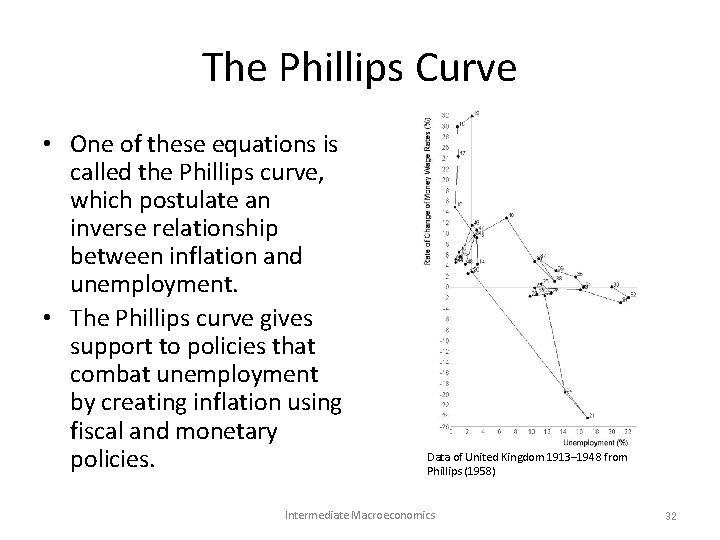
The Phillips Curve • One of these equations is called the Phillips curve, which postulate an inverse relationship between inflation and unemployment. • The Phillips curve gives support to policies that combat unemployment by creating inflation using fiscal and monetary policies. Data of United Kingdom 1913– 1948 from Phillips (1958) Intermediate Macroeconomics 32
Monetarism • Monetarism is championed by Milton Friedman (1921 -2006). • Friedman (and Phelps) argues that there is no long-run trade-off between inflation and unemployment, because people can form expectations of future inflation. • In contradiction to his contemporary Keynesians, Friedman argues that monetary policy matters and that fiscal policy may fail. Intermediate Macroeconomics 33
New Classical Macroeconomics • New classical economists, notably Robert Lucas, further challenged the Keynesians. • The new classical macroeconomics assumes rational expectation of individuals, instead of adaptive expectation. • Large-scale econometric models were discredited, since the empirical relationship (reduced model) may break down when the underlying structural model changes. This was called the Lucas's critique. • Edward C. Prescott and Finn E. Kydland created real business cycle (RBC) models, which postulate that business cycles are efficient responses to exogenous shocks. Intermediate Macroeconomics 34
New Keynesianism • The Keynesian economics suffers from a lack of “microeconomic foundation” that justifies market imperfection. • New Keynesians investigate how market imperfections occur, e. g. , monopolistic competition, sticky price, asymmetric information, etc. Intermediate Macroeconomics 35
Other Schools • Knut Wicksell (1851 -1926, forerunner of the Stockholm School) • Michał Kalecki (1899 -1970) • Stockholm school (Gunnar Myrdal (1898 -1987), Bertil Ohlin (1899 -1979), etc. ) • Austrian business cycle theory (Carl Menger, Ludwig von Mises (1881 - 1973), Friedrich Hayek (1899 -1992), etc. ) • Post Keynesian economics (Hyman Minsky (19191996), Modern Monetary Theory, etc. ) Intermediate Macroeconomics 36
What Do We Believe? • We should not religiously believe in any school of thought. • A model is in a sense always wrong, since it is a theoretical abstraction. It is valuable as long as it sheds light on some question in some particular setting. • It’s dangerous to be captivated by a single big idea (e. g. , free market, or omnipotent government) and try to use it in every problem. Intermediate Macroeconomics 37
Concluding Remarks • Macroeconomics is the study of the economy as a whole. • Our economy can be characterized as a mixed economy, where both market and government play important roles. • To explain, evaluate, or/and predict, professional economists rely on models. • It takes science to propose and evaluate models. But it takes art to choose an appropriate model in a particular setting. • Intermediate Macroeconomics 38