
Introduction ITER 1 Under construction DEMO 2 Commercial

![Introduction ITER [1] Under construction DEMO [2] Commercial [2] Construction of control system is](https://slidetodoc.com/presentation_image_h/aa486db2504d9846e2a11f6f7d4a5c53/image-2.jpg "Introduction ITER [1] Under construction DEMO [2] Commercial [2] Construction of control system is")
![Fusion power control simulation Gas-puff [10^19/sec] Target value Fusion power Gas-puff Current profile movie](https://slidetodoc.com/presentation_image_h/aa486db2504d9846e2a11f6f7d4a5c53/image-8.jpg "Fusion power control simulation Gas-puff [10^19/sec] Target value Fusion power Gas-puff Current profile movie")
![Energy [MW] r/a (qmin) qmin q-minimum control simulation Current profile](https://slidetodoc.com/presentation_image_h/aa486db2504d9846e2a11f6f7d4a5c53/image-9.jpg "Energy [MW] r/a (qmin) qmin q-minimum control simulation Current profile")
![r/a (qmin) qmin Gas-puff [10^19/sec] Energy [MW] Simultaneous control simulation](https://slidetodoc.com/presentation_image_h/aa486db2504d9846e2a11f6f7d4a5c53/image-10.jpg "r/a (qmin) qmin Gas-puff [10^19/sec] Energy [MW] Simultaneous control simulation")
![Reference [1] http: //www. naka. jaea. go. jp/ITER/iter/index. html [2] http: //www. asahi-net. or.](https://slidetodoc.com/presentation_image_h/aa486db2504d9846e2a11f6f7d4a5c53/image-22.jpg "Reference [1] http: //www. naka. jaea. go. jp/ITER/iter/index. html [2] http: //www. asahi-net. or.")
- Slides: 25
Introduction ITER [1] Under construction DEMO [2] Commercial [2] Construction of control system is needed. Construction of control system for high performance plasma with limited actuators or
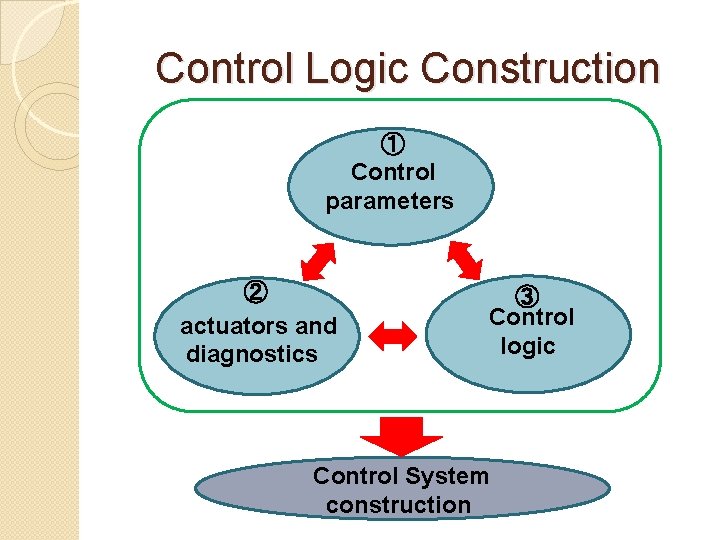
Control Logic Construction ① Control parameters ② actuators and diagnostics ③ Control logic Control System construction
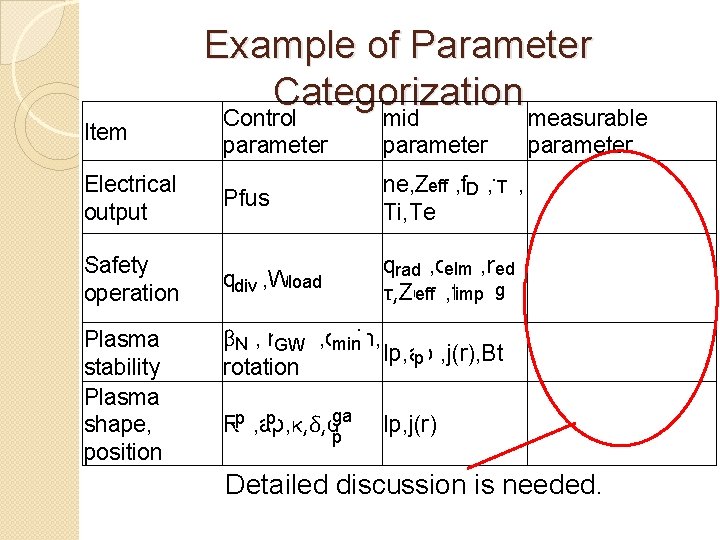
Example of Parameter Categorization Item Control parameter mid parameter Electrical output Pfus ne, Zeff , f. D , f. T , Ti, Te Safety operation qdiv , Wload qra rad , qelm , ned eff , fimp g τ, Zeff Plasma stability Plasma shape, position measurable parameter βN , n. GW , qmin, min Ip, ap p , j(r), Bt rotation ga p Rp , ap, κ, δ, d p Ip, j(r) Detailed discussion is needed.
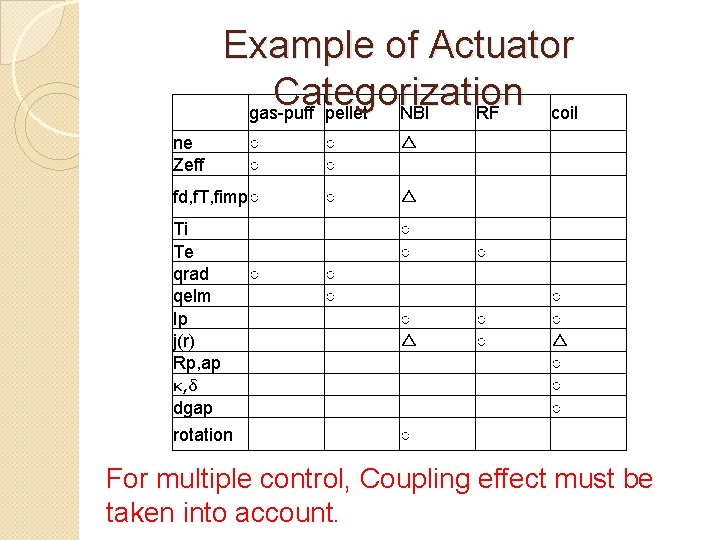
ne Zeff Example of Actuator Categorization gas-puff pellet NBI RF coil ○ ○ △ fd, f. T, fimp○ ○ △ Ti Te qrad qelm Ip j(r) Rp, ap κ, δ dgap ○ ○ ○ ○ △ ○ ○ ○ ○ △ ○ ○ ○ rotation ○ For multiple control, Coupling effect must be taken into account.
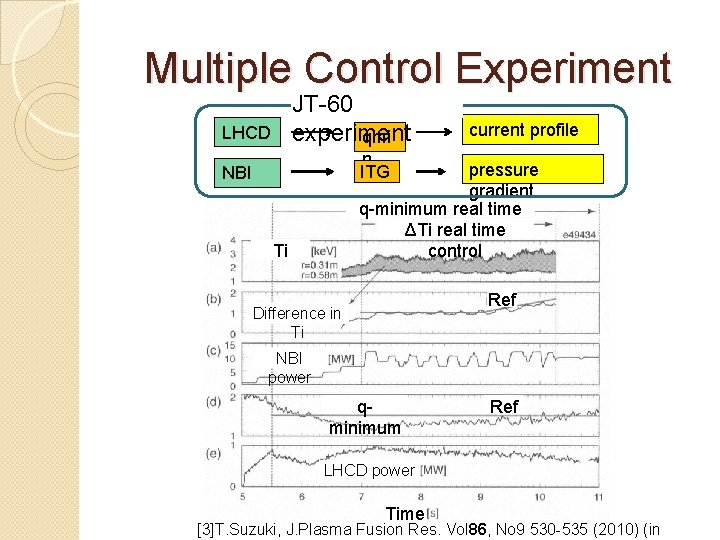
Multiple Control Experiment JT-60 experiment qmi LHCD current profile n ITG pressure gradient q-minimum real time ΔTi real time control NBI Ti Ref Difference in Ti NBI power qminimum Ref LHCD power Time [3]T. Suzuki, J. Plasma Fusion Res. Vol 86, No 9 530 -535 (2010) (in
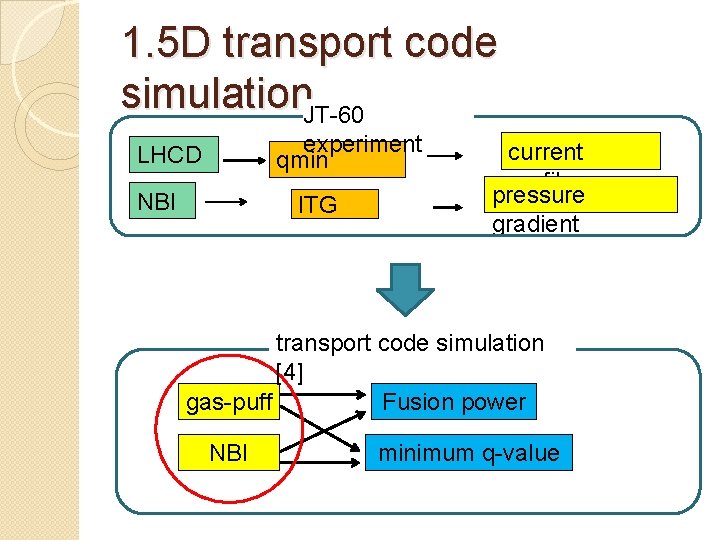
1. 5 D transport code simulation. JT-60 experiment qmin LHCD NBI ITG current profile pressure gradient transport code simulation [4] gas-puff Fusion power NBI minimum q-value
Fusion power control simulation Gas-puff [10^19/sec] Target value Fusion power Gas-puff Current profile movie Density profile movie
Energy [MW] r/a (qmin) qmin q-minimum control simulation Current profile
r/a (qmin) qmin Gas-puff [10^19/sec] Energy [MW] Simultaneous control simulation
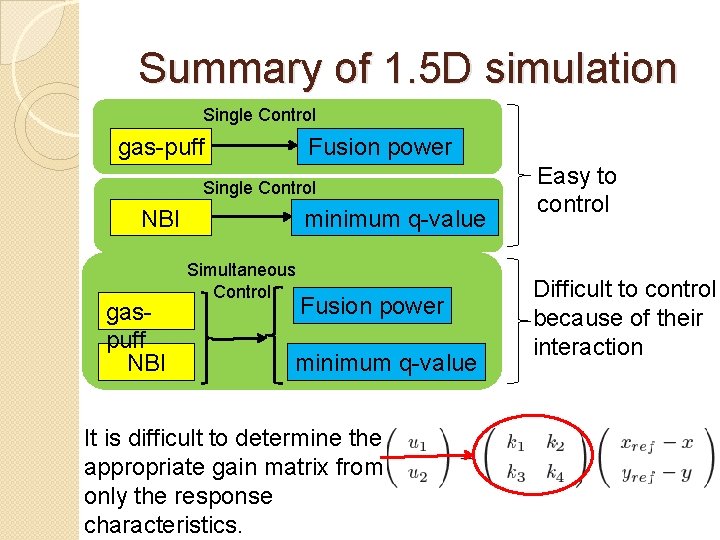
Summary of 1. 5 D simulation Single Control gas-puff Fusion power Single Control NBI gaspuff NBI minimum q-value Simultaneous Control Fusion power minimum q-value It is difficult to determine the appropriate gain matrix from only the response characteristics. Easy to control Difficult to control because of their interaction
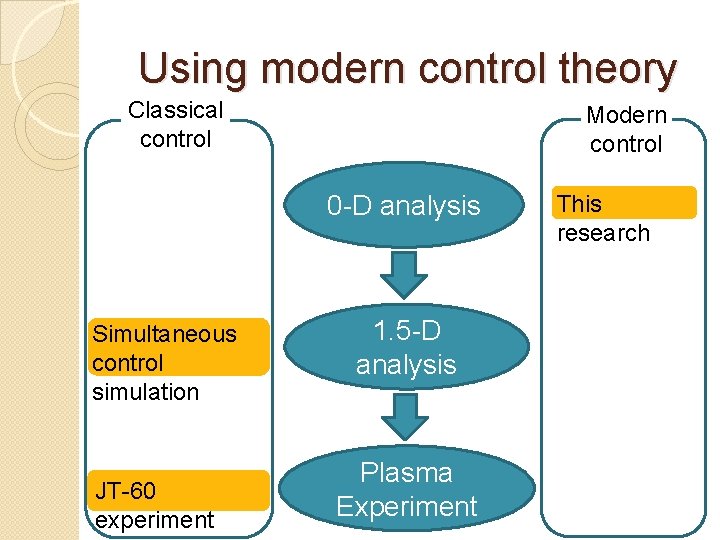
Using modern control theory Classical control Modern control 0 -D analysis Simultaneous control simulation JT-60 experiment 1. 5 -D analysis Plasma Experiment This research
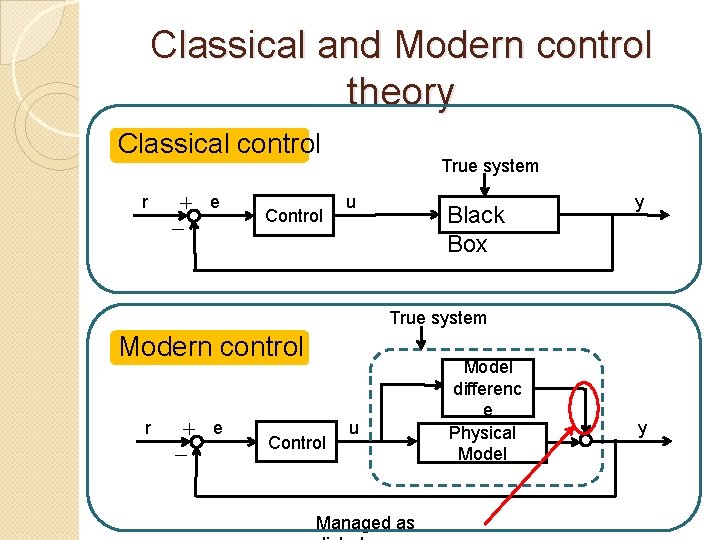
Classical and Modern control theory Classical control r + e - Control True system u Black Box y True system Modern control r + e - Control u Managed as Model differenc e Physical Model y
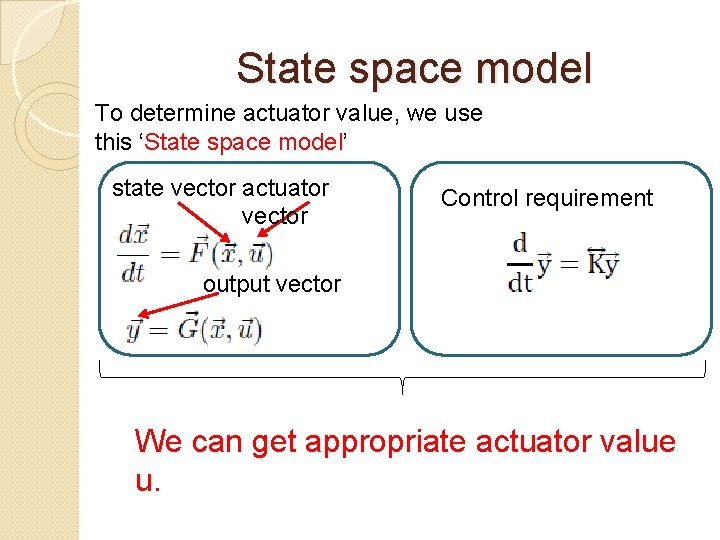
State space model To determine actuator value, we use this ‘State space model’ state vector actuator vector Control requirement output vector We can get appropriate actuator value u.
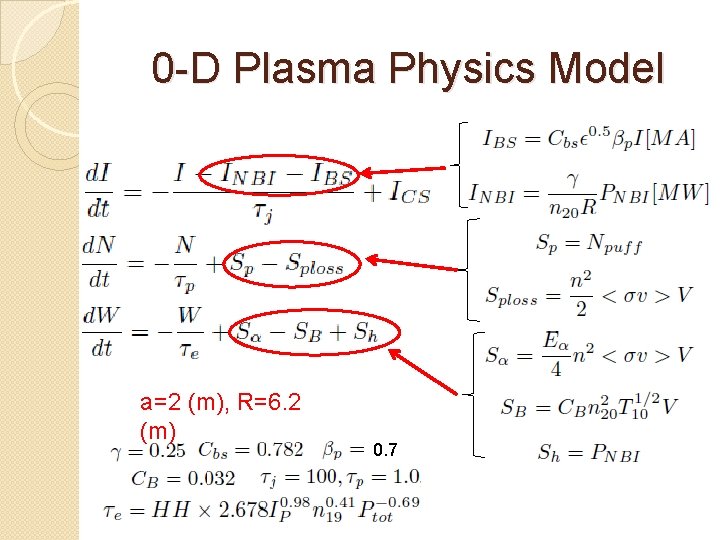
0 -D Plasma Physics Model a=2 (m), R=6. 2 (m) 0. 7
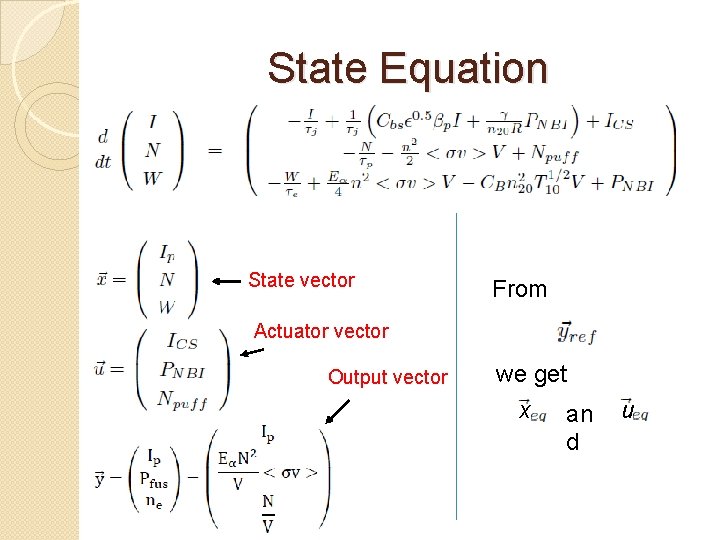
State Equation State vector From Actuator vector Output vector we get x an d u
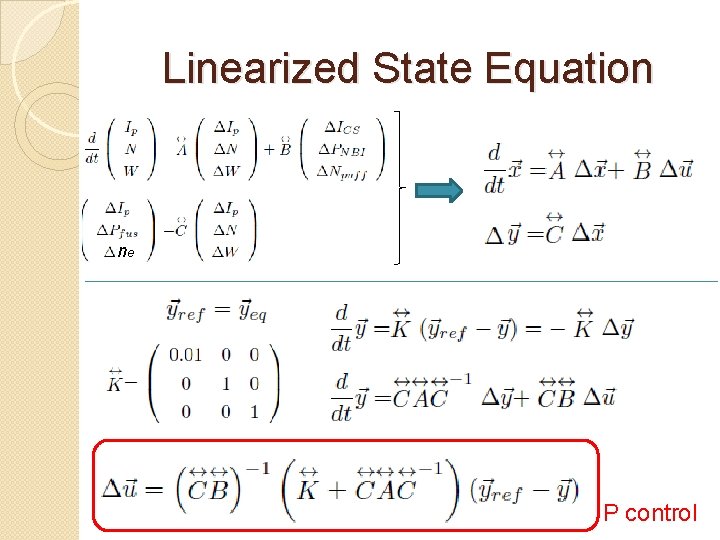
Linearized State Equation ne P control
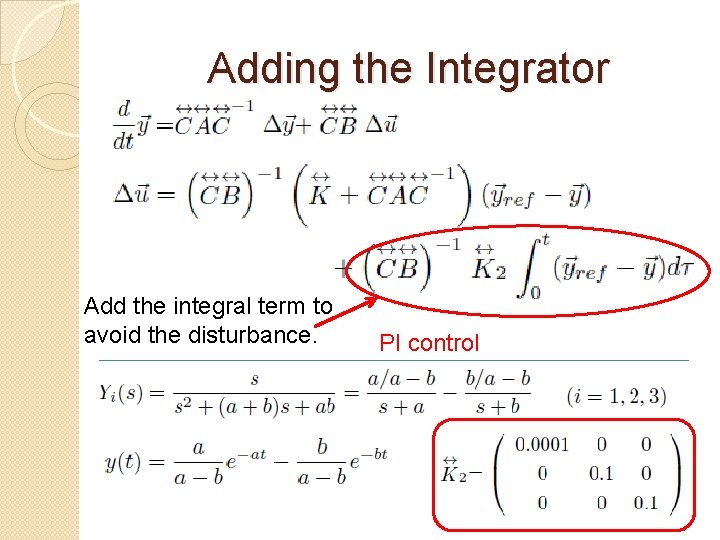
Adding the Integrator Add the integral term to avoid the disturbance. PI control
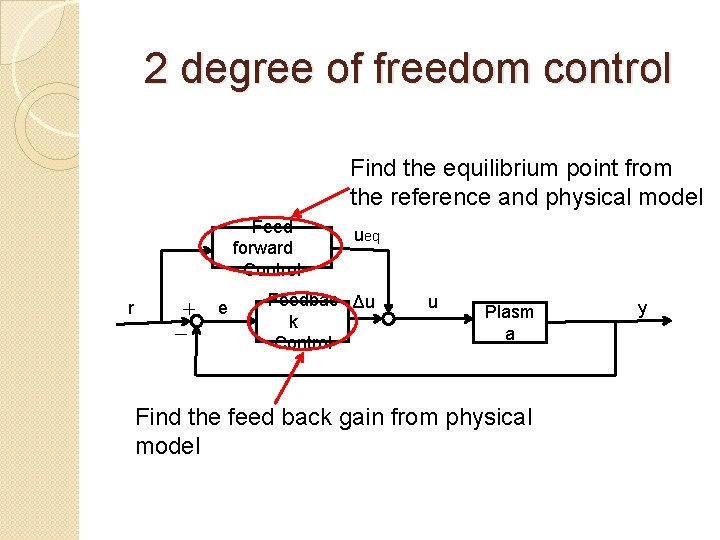
2 degree of freedom control Find the equilibrium point from the reference and physical model Feed forward Control r + - e ueq Feedbac Δu k Control u Plasm a Find the feed back gain from physical model y
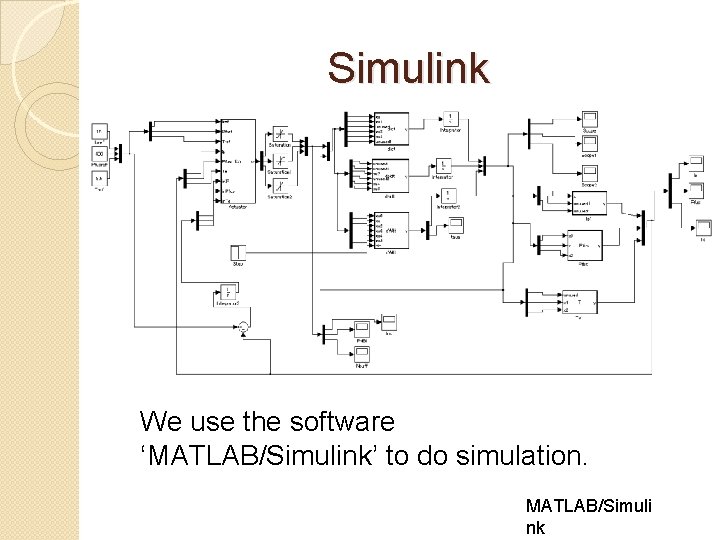
Simulink We use the software ‘MATLAB/Simulink’ to do simulation. MATLAB/Simuli nk
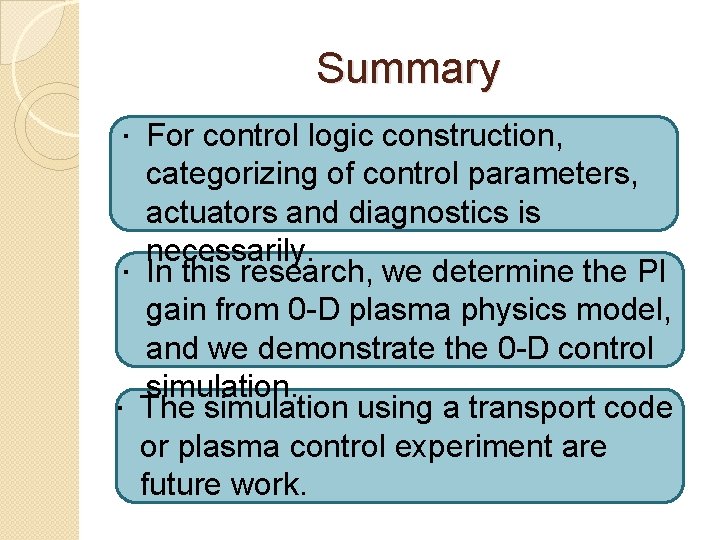
Summary ・ For control logic construction, categorizing of control parameters, actuators and diagnostics is necessarily. ・ In this research, we determine the PI gain from 0 -D plasma physics model, and we demonstrate the 0 -D control simulation. ・ The simulation using a transport code or plasma control experiment are future work.
Reference [1] http: //www. naka. jaea. go. jp/ITER/iter/index. html [2] http: //www. asahi-net. or. jp/~rt 6 k-okn/subject. htm [3] 3]T. Suzuki, J. Plasma Fusion Res. Vol 86, No 9 530 -535 (2010) (in Japanese) [4] Y. Miyoshi et. al PFR Vol. 7 2405135 (2012) [5] Control system design (G. C. Goodwin et. al)
Appendix
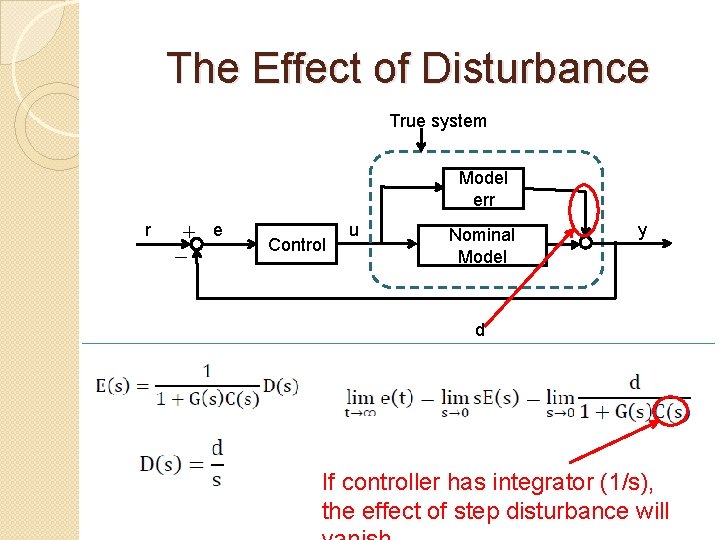
The Effect of Disturbance True system Model err r + e - Control u Nominal Model y d If controller has integrator (1/s), the effect of step disturbance will
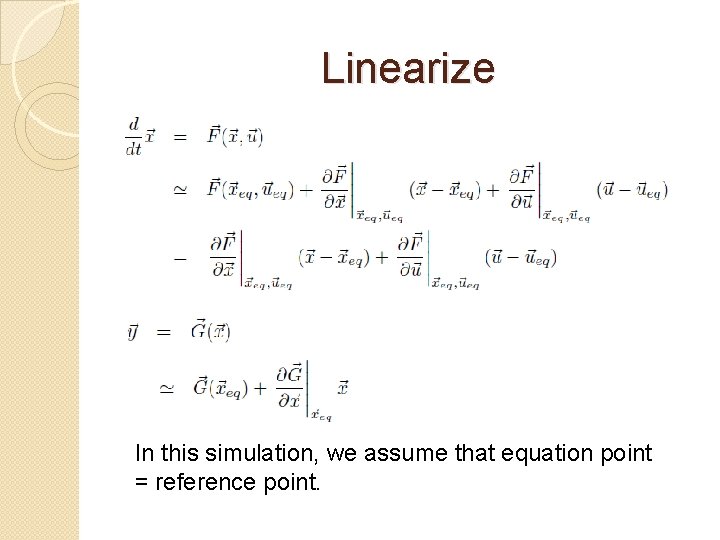
Linearize In this simulation, we assume that equation point = reference point.