
Introduction INFORMATION SYSTEM AUDIT Book Reference Auditors Guide
Introduction INFORMATION SYSTEM AUDIT
Book Reference �Auditor's Guide to Information Systems Auditing by Richard E. Cascarino �Information System Audit and Assurance, Dube – Gulati, 2005 �CISA �COBIT �Information system Control and Audit, Ron Weber, 1999
Introduction Information ? ? ? System ? ? ? Information System? ? Information Technology? ? ? Information System Audit ? ? ? Why IS need to Audit? ?
Introduction (2) �Information Strategic Resources organization vision and mission. to reach �Information Organization Asset �Information System Sub system of Organization to process information �Information Technology Information System Component
Methodologies in Developing System
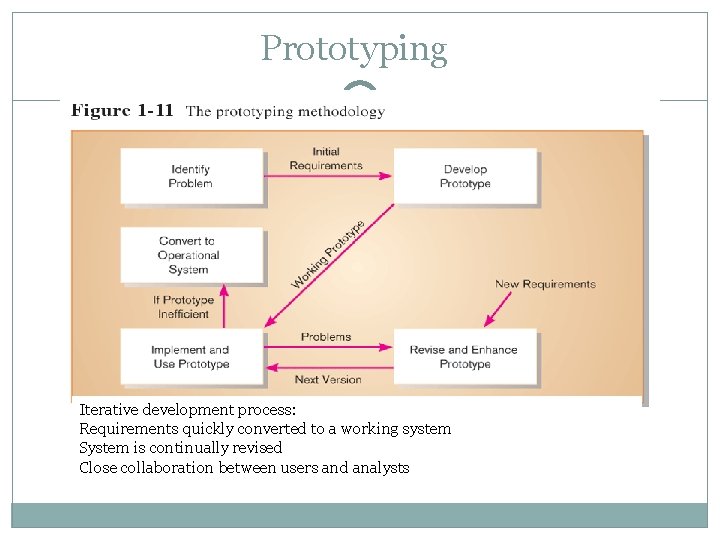
Prototyping Iterative development process: Requirements quickly converted to a working system System is continually revised Close collaboration between users and analysts
CASE Tools �Computer-Aided Software Engineering �Software tools providing automated support for systems development �Project dictionary/workbook: system description and specifications �Diagramming tools �Example products: Oracle Designer, Rational Rose
Joint Application Development/Design (JAD) �Structured process involving users, analysts, and managers �Several-day intensive workgroup sessions �Purpose: to specify or review system requirements
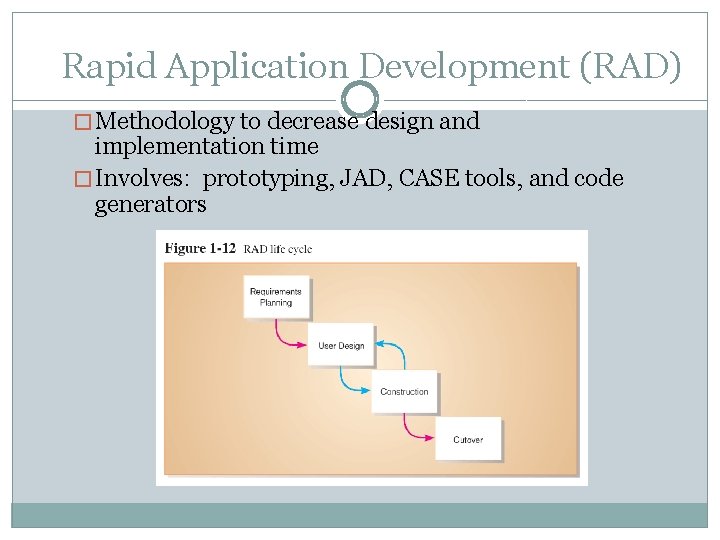
Rapid Application Development (RAD) � Methodology to decrease design and implementation time � Involves: prototyping, JAD, CASE tools, and code generators
Agile Methodologies �Motivated by recognition of software development as fluid, unpredictable, and dynamic �Three key principles Adaptive rather than predictive Emphasize people rather than roles Self-adaptive processes
e. Xtreme Programming �Short, incremental development cycles �Automated tests �Two-person programming teams �Coding and testing operate together �Advantages: Communication between developers High level of productivity High-quality code
Object-Oriented Analysis and Design �Based on objects rather than data or processes �Object: a structure encapsulating attributes and behaviors of a real-world entity �Object class: a logical grouping of objects sharing the same attributes and behaviors �Inheritance: hierarchical arrangement of classes enable subclasses to inherit properties of superclasses
Audit : a planned and documented activity performed by qualified personnel to determine by investigation, examination, or evaluation of objective evidence, the adequacy and compliance with established procedures, or applicable documents, and the effectiveness of implementation
Information Systems Auditing is the process of collecting and evaluating evidence to determine whether a computer system safeguards assets, maintains data integrity, allows organizational goals to be achieved effectively, and users resources efficiently (Weber, 2000)
Audit Function �Go Public Corporate Go public Good corporate governance? Audit for technique faculty? �A company support by operational system and conceptional system (information system) Need to get feed back Information with Value added
Audit Function To ascertain whether the information system has been designed and implemented in accordance with the procedures and standards that have been set Auditing is important for information system
Audit Category �Application Control To ensure the data is correctly input into application, processed correctly, and there is adequate control over the output produced �General Control To ensure data integrity in the computer system and at the same time assuring the program or application integrity that used to performed the data processing
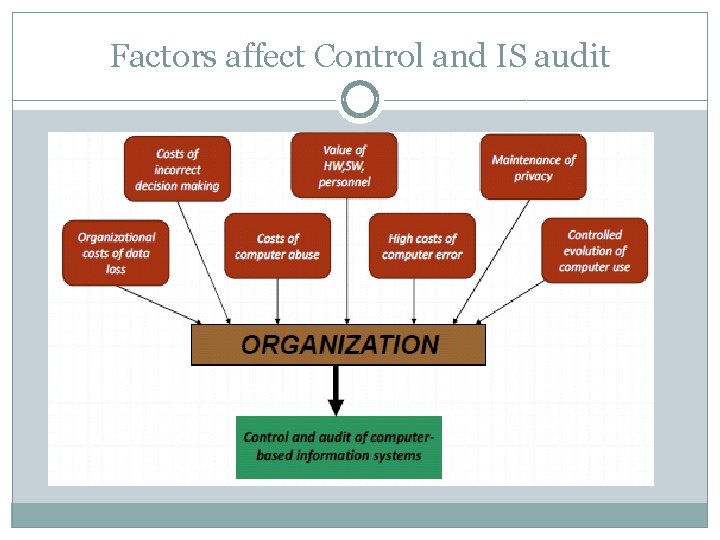
Factors affect Control and IS audit
Factors affect Control and IS audit �Organization Cost of Data Loss Ex : �Incorrect Decision Making Incorrect Data cause incorrect decision making and causing organization Data lost Ex : �Cost of Computer Abuse Ex :
Factors affect Control and IS audit �Value of Hardware, Software and Personnel Ex : �High Cost of Computer Error Ex : �Maintenance of Privacy Computer ability to process data causing changes to individuals privacy and organization Ex : �Controlled Evaluation of Computer use Ex :
Professional Standards & Operational Procedures �Professional Standards Knowledge, skill and professional attitude must have to conduct the profession �Operational Procedures Standardized Instructions for completing a certain routine work procedures
Auditor Organization �IIA – institute of Internal Auditors �AAA – American Accounting Association �ISACA – Information System Audit and Control Association The only association for information system auditor profession Issued CISA certification
Who is doing the Audit �General activities of the audit / financial statements take place by accountants �non general audit is not to be done by the accountants Especially for operation and management audit �Information Technology development forcing auditor to have skills related with IT This point accommodated by information system field and accounting computer It is expected that the two departments must competence in the field of information technology and accounting � Technical Skill/hard skill & soft skill
Audit types base on field �Finance Audit �Operational Audit (management audit) �compliance audit �Information System Audit �E-Commerce Audit �Forensic Audit
Audit types – base on Auditor �External Independence Auditor �Internal Auditor �Government Auditor �Tax Auditor
Information System Audit �Include: IT Governance Information system Development Audit (SDLC), certain application
IS Audit– History �America Univac – computer used for census 1959 – computer used for bookkeeping IBM 360 – mainframe for accounting � Known term : audit around computer EEDPAA – electronic data processing auditors association founded on 1969 � issued control objective (since 1994 called Cob. IT) � As international set of generally accepted IT control objectives for day-to day use by business managers, users of it and IS auditors
IS Audit �As Special audit – need to check the level of maturity or readiness of an organization in managing IT �Level of maturity can be seen from awareness of stake holder That is why IT implementation must through a good planning
IS Audit needs �General Financial Audit objective in accordance with accounting standards Model reference is COSO (committee of sponsoring Organization) �IT Governance Operational Audit to information resource management Effectiveness aspects , efficiency of data , data integrity, save guarding asset, reliability, confidentiality, availability, security.
IS Audit– IT Governance �The audit not just for the whole system but can do for certain part such as: General information review � Audit to IS Quality Assurance � Auditor (not as developer team), helping to improve system quality. Auditor as project leader representative Postimplementation Audit � Does the system needed to be updated or corrected or discontinued � Term audit around audit through the computer doesn’t apply to this type audit
IS Audit �IT/IS Audit not a must This is a form of awareness from management because of IT activity
IS Audit - Factor �Detecting whether the computer is poorly organized Without vision, mission, IT planning, without training �Detecting data lost risk �Detecting risk of inaccurate information �Protecting asset �Detecting computer error
IS Audit - Factor(2) �Detecting risk of computer abuse �Protecting confidentiality �To improve control of the evolution for computer or development for the future
Questions Explain difference of each auditor base on auditor types 2. Find out standardization of IS auditor profession and which organization issued the standard 3. On your opinion how importance IT and IS audit for an organization 4. Explain about audit around the computer and audit through the computer 1.
- Slides: 34