
Introduction Index Decision Making Tools Materials for Orthotic



- Slides: 68
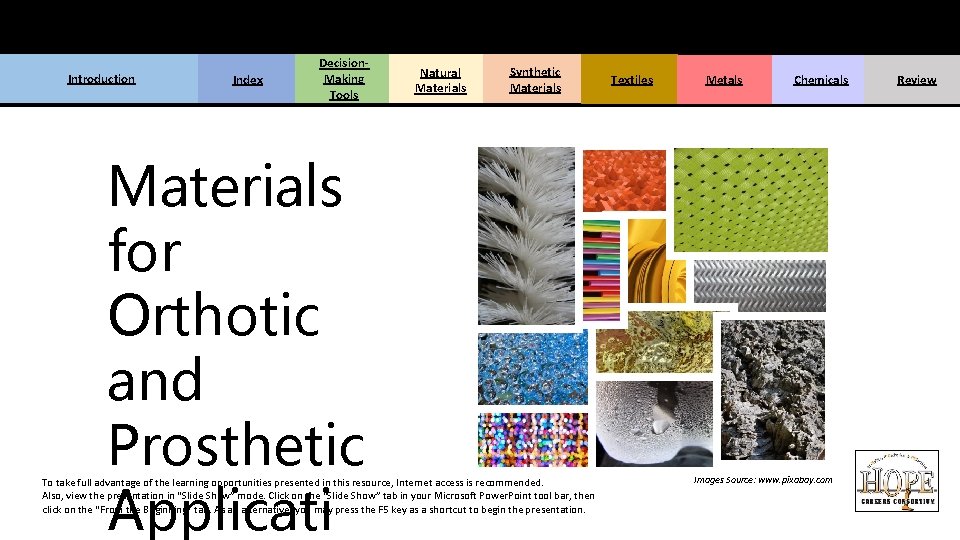
Introduction Index Decision. Making Tools Materials for Orthotic and Prosthetic Applicati Natural Materials Synthetic Materials To take full advantage of the learning opportunities presented in this resource, Internet access is recommended. Also, view the presentation in “Slide Show” mode. Click on the “Slide Show” tab in your Microsoft Power. Point tool bar, then click on the “From the Beginning” tab. As an alternative, you may press the F 5 key as a shortcut to begin the presentation. Textiles Metals Chemicals Images Source: www. pixabay. com Review
INTRODUCTION: HOPE Careers Consortium Introduction Index Decision. Making Tools Natural Materials Synthetic Materials Textiles Metals Chemicals HOPE Careers Consortium is a partnership of five institutions of higher education that is building exciting new programs that will provide valuable career education and training in the Orthotics, Prosthetics, and Pedorthics (O&P) sector. The five institutions are: Baker College – Flint, Michigan Century College – White Bear Lake, Minnesota Oklahoma State University Institute of Technology – Okmulgee, Oklahoma Spokane Falls Community College – Spokane, Washington St. Petersburg College – St. Petersburg, Florida This Open Educational Resource (OER) is provided with the goal of helping learners more fully understand the many types of materials that can be used when selecting, designing, adjusting, and fabricating orthotic and prosthetic devices. This workforce product was funded by a grant awarded by the U. S. Department of Labor’s Employment and Training Administration. The product was created by the grantee and does not necessarily reflect the official position of the U. S. Department of Labor. The U. S. Department of Labor makes no guarantees, warranties, or assurances of any kind, express or implied, with respect to such information, including any information on linked sites and including, but not limited to, accuracy of the information or its completeness, timeliness, usefulness, adequacy, continued availability, or ownership. Produced 2016. Review
INTRODUCTION: Objectives Introduction Index Decision. Making Tools Synthetic Materials Natural Materials Textiles Metals Chemicals OBJECTIVES Upon successful completion of this Open Educational Resource presentation, you will be able to: q Evaluate material variables to determine how best to meet a patient’s need. q Compare and contrast open-cell and closed-cell foam structures. q Describe the purpose of a durometer scale. q Describe the purpose of a Mohs scale. q Describe the properties and uses of leather in O&P devices. q Explain how leather is measured. q Describe the properties and uses of cork in O&P devices. q Describe the properties and uses of carbon composites. q Contrast and compare the key properties and uses of common thermoplastics in the O&P field. q Compare and contrast the differences between thermoplastic and thermoset. q Describe the properties and uses of foams and gels. q Describe the properties and uses of textiles. q Compare and contrast the differences between metals that are malleable and metals that are ductile. q Compare and contrast the attributes of polyester, vinyl ester, and epoxy resins. q List protective measures to take when working with chemicals and dust. NOTE: The length of time it will take a learner to complete this self-study resource depends greatly on the learner’s style and pace of learning as well as his / her current understanding of the subject matter. However, an estimate has been made that a learner could thoroughly read and review this material, as well as participate in all self-assessment opportunities, in approximately six hours. Review
INTRODUCTION: Course Management Introduction Index Decision. Making Tools Natural Materials MATERIALS for ORTHOTIC and PROSTHETIC APPLICATIONS There was a time when leather, wood, and steel were the primary materials used when designing and fabricating orthotic and prosthetic devices. Not anymore. In the O&P field, thermoplastics and other synthetic materials provide varying combinations of strength, weight, flexibility, and energy return, while composites and metal alloys facilitate lighter, stronger artificial limbs. So, what materials should be selected for any given patient? Factors to consider include the patient’s age, weight, general health, occupation, hobbies and aspirations, where they live (cold or warm climate), and insurance coverage. And because there are so many material choices available and each has its own advantages and disadvantages, decisions must be made to balance material qualities, such as firmness, flexibility, rigidity, adjustability, strength … and so on. Synthetic Materials Textiles Metals Chemicals Review This presentation helps to address some of these issues by providing: (a) information about the considerations to make when working with orthotic and prosthetic materials, (b) categories and descriptions of materials used in the O&P industry: natural, synthetic, textiles, and metals, (c) information about the chemicals used in O&P devices, and (d) Helpful, self-assessment sections. For ease in navigation, each tab above is a link to its respective section. Although you can review the material in any order you prefer, we recommend you review the “Decision-Making Tools” section prior to accessing the materials sections. Note: In addition to the review section at the end of the entire presentation, each materials section and the chemicals section includes a link to Quizlet, which enables further self-assessment. Quizlet is a fun and easy online learning resource featuring “STUDY” tools and “PLAY” tools. Visit the site to further your understanding of the information presented here.
INTRODUCTION: Orthotic and Prosthetic Terms Introduction Index Decision. Making Tools Synthetic Materials Natural Materials ORTHOTIC DEVICES Orthotic devices include: • • • • FO—Foot Orthosis AFO—Ankle Foot Orthosis KAFO—Knee Ankle Foot Orthosis HKAFO—Hip Knee Ankle Foot Orthosis KO—Knee Orthosis HO—Hip Orthosis WHO—Wrist Hand Orthosis EWHO—Elbow Wrist hand Orthosis SEWHO—Shoulder Elbow Wrist Hand Orthosis SO—Sacral Orthosis LSO—Lumbar Sacral Orthosis TLSO—Thoracolumbosacral Orthosis CTLSO—Cervical Thoraco Lumbar Sacral Orthosis Textiles Metals PROSTHESIS TYPES Types of prostheses include: • • • TM—Transmetatarsal Amputation AD—Ankle Disarticulation TT—Transtibial TF—Transfemoral HD—Hip Disarticulation HP—Hemipelvectomy WD—Wrist Disarticulation TR—Transradial ED—Elbow Disarticulation TH—Transhumeral SD—Shoulder Disarticulation IT—Interscapulo Thoracic Chemicals Review
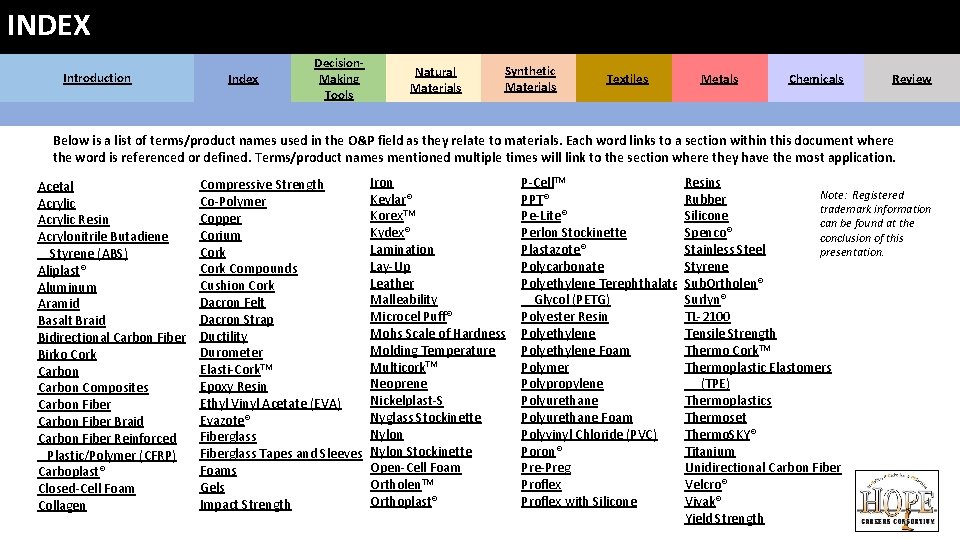
INDEX Introduction Index Decision. Making Tools Natural Materials Synthetic Materials Textiles Metals Chemicals Review Below is a list of terms/product names used in the O&P field as they relate to materials. Each word links to a section within this document where the word is referenced or defined. Terms/product names mentioned multiple times will link to the section where they have the most application. Acetal Acrylic Resin Acrylonitrile Butadiene Styrene (ABS) Aliplast® Aluminum Aramid Basalt Braid Bidirectional Carbon Fiber Birko Cork Carbon Composites Carbon Fiber Braid Carbon Fiber Reinforced Plastic/Polymer (CFRP) Carboplast® Closed-Cell Foam Collagen Compressive Strength Co-Polymer Copper Corium Cork Compounds Cushion Cork Dacron Felt Dacron Strap Ductility Durometer Elasti-Cork. TM Epoxy Resin Ethyl Vinyl Acetate (EVA) Evazote® Fiberglass Tapes and Sleeves Foams Gels Impact Strength Iron Kevlar® Korex. TM Kydex® Lamination Lay-Up Leather Malleability Microcel Puff® Mohs Scale of Hardness Molding Temperature Multicork. TM Neoprene Nickelplast-S Nyglass Stockinette Nylon Stockinette Open-Cell Foam Ortholen. TM Orthoplast® P-Cell. TM PPT® Pe-Lite® Perlon Stockinette Plastazote® Polycarbonate Polyethylene Terephthalate Glycol (PETG) Polyester Resin Polyethylene Foam Polymer Polypropylene Polyurethane Foam Polyvinyl Chloride (PVC) Poron® Pre-Preg Proflex with Silicone Resins Note: Registered Rubber trademark information Silicone can be found at the Spenco® conclusion of this Stainless Steel presentation. Styrene Sub. Ortholen® Surlyn® TL-2100 Tensile Strength Thermo Cork. TM Thermoplastic Elastomers (TPE) Thermoplastics Thermoset Thermo. SKY® Titanium Unidirectional Carbon Fiber Velcro® Vivak® Yield Strength
DECISION-MAKING TOOLS Introduction Index Decision. Making Tools Natural Materials Synthetic Materials Textiles Metals DECISION-MAKING TOOLS Chemicals Review
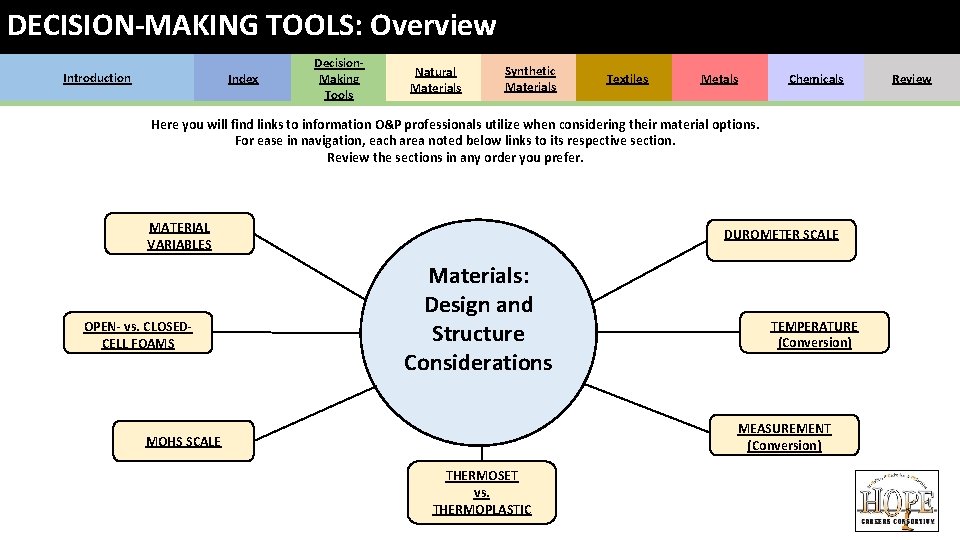
DECISION-MAKING TOOLS: Overview Introduction Index Decision. Making Tools Natural Materials Synthetic Materials Textiles Metals Chemicals Here you will find links to information O&P professionals utilize when considering their material options. For ease in navigation, each area noted below links to its respective section. Review the sections in any order you prefer. MATERIAL VARIABLES OPEN- vs. CLOSEDCELL FOAMS DUROMETER SCALE Materials: Design and Structure Considerations TEMPERATURE (Conversion) MEASUREMENT (Conversion) MOHS SCALE THERMOSET vs. THERMOPLASTIC Review
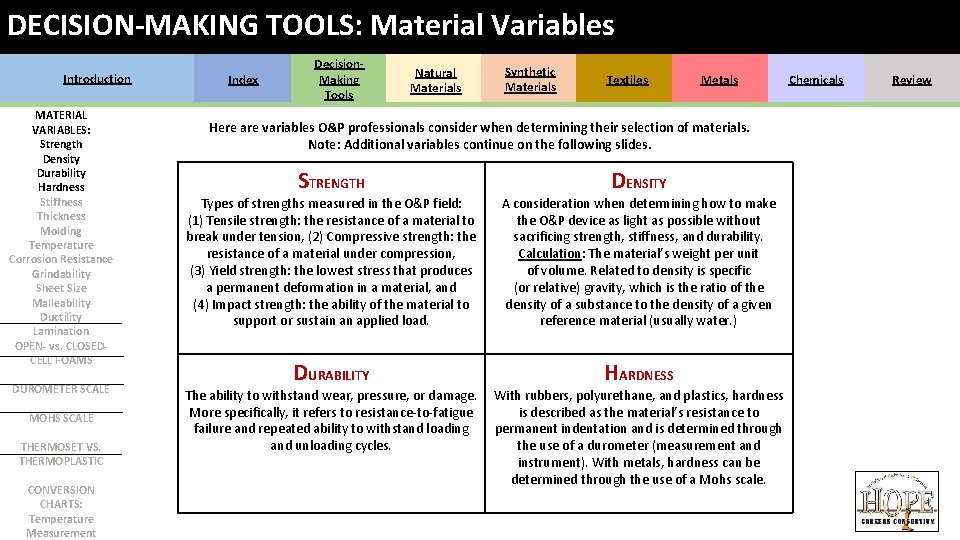
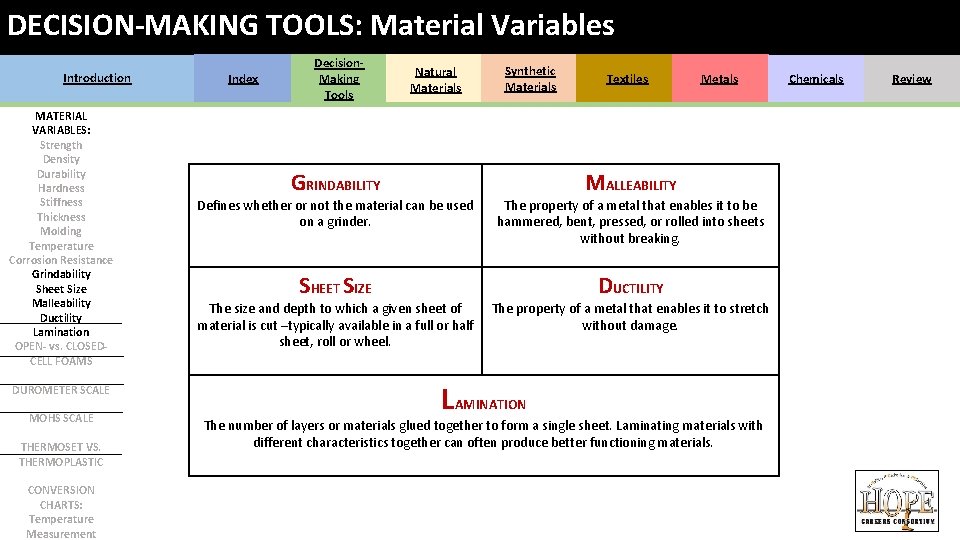
DECISION-MAKING TOOLS: Material Variables Introduction MATERIAL VARIABLES: Strength Density Durability Hardness Stiffness Thickness Molding Temperature Corrosion Resistance Grindability Sheet Size Malleability Ductility Lamination OPEN- vs. CLOSEDCELL FOAMS DUROMETER SCALE MOHS SCALE THERMOSET VS. THERMOPLASTIC CONVERSION CHARTS: Temperature Measurement Index Decision. Making Tools Natural Materials Synthetic Materials Textiles Metals Here are variables O&P professionals consider when determining their selection of materials. Note: Additional variables continue on the following slides. STRENGTH DENSITY Types of strengths measured in the O&P field: (1) Tensile strength: the resistance of a material to break under tension, (2) Compressive strength: the resistance of a material under compression, (3) Yield strength: the lowest stress that produces a permanent deformation in a material, and (4) Impact strength: the ability of the material to support or sustain an applied load. A consideration when determining how to make the O&P device as light as possible without sacrificing strength, stiffness, and durability. Calculation: The material’s weight per unit of volume. Related to density is specific (or relative) gravity, which is the ratio of the density of a substance to the density of a given reference material (usually water. ) DURABILITY HARDNESS The ability to withstand wear, pressure, or damage. More specifically, it refers to resistance-to-fatigue failure and repeated ability to withstand loading and unloading cycles. With rubbers, polyurethane, and plastics, hardness is described as the material’s resistance to permanent indentation and is determined through the use of a durometer (measurement and instrument). With metals, hardness can be determined through the use of a Mohs scale. Chemicals Review
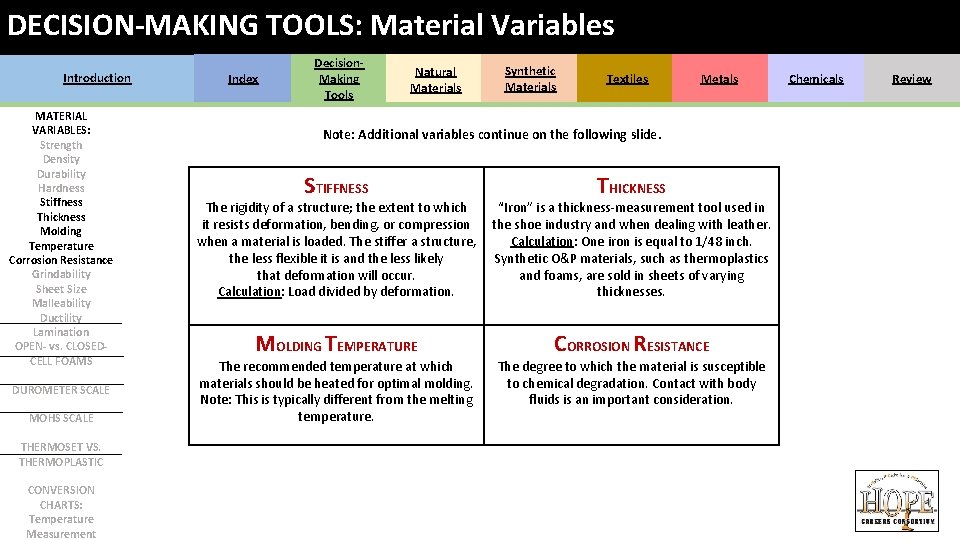
DECISION-MAKING TOOLS: Material Variables Introduction MATERIAL VARIABLES: Strength Density Durability Hardness Stiffness Thickness Molding Temperature Corrosion Resistance Grindability Sheet Size Malleability Ductility Lamination OPEN- vs. CLOSEDCELL FOAMS DUROMETER SCALE MOHS SCALE THERMOSET VS. THERMOPLASTIC CONVERSION CHARTS: Temperature Measurement Index Decision. Making Tools Natural Materials Synthetic Materials Textiles Metals Note: Additional variables continue on the following slide. STIFFNESS THICKNESS The rigidity of a structure; the extent to which it resists deformation, bending, or compression when a material is loaded. The stiffer a structure, the less flexible it is and the less likely that deformation will occur. Calculation: Load divided by deformation. “Iron” is a thickness-measurement tool used in the shoe industry and when dealing with leather. Calculation: One iron is equal to 1/48 inch. Synthetic O&P materials, such as thermoplastics and foams, are sold in sheets of varying thicknesses. MOLDING TEMPERATURE CORROSION RESISTANCE The recommended temperature at which materials should be heated for optimal molding. Note: This is typically different from the melting temperature. The degree to which the material is susceptible to chemical degradation. Contact with body fluids is an important consideration. Chemicals Review
DECISION-MAKING TOOLS: Material Variables Introduction MATERIAL VARIABLES: Strength Density Durability Hardness Stiffness Thickness Molding Temperature Corrosion Resistance Grindability Sheet Size Malleability Ductility Lamination OPEN- vs. CLOSEDCELL FOAMS DUROMETER SCALE MOHS SCALE THERMOSET VS. THERMOPLASTIC CONVERSION CHARTS: Temperature Measurement Index Decision. Making Tools Natural Materials GRINDABILITY Synthetic Materials Textiles Metals MALLEABILITY Defines whether or not the material can be used on a grinder. The property of a metal that enables it to be hammered, bent, pressed, or rolled into sheets without breaking. SHEET SIZE DUCTILITY The size and depth to which a given sheet of material is cut –typically available in a full or half sheet, roll or wheel. The property of a metal that enables it to stretch without damage. LAMINATION The number of layers or materials glued together to form a single sheet. Laminating materials with different characteristics together can often produce better functioning materials. Chemicals Review
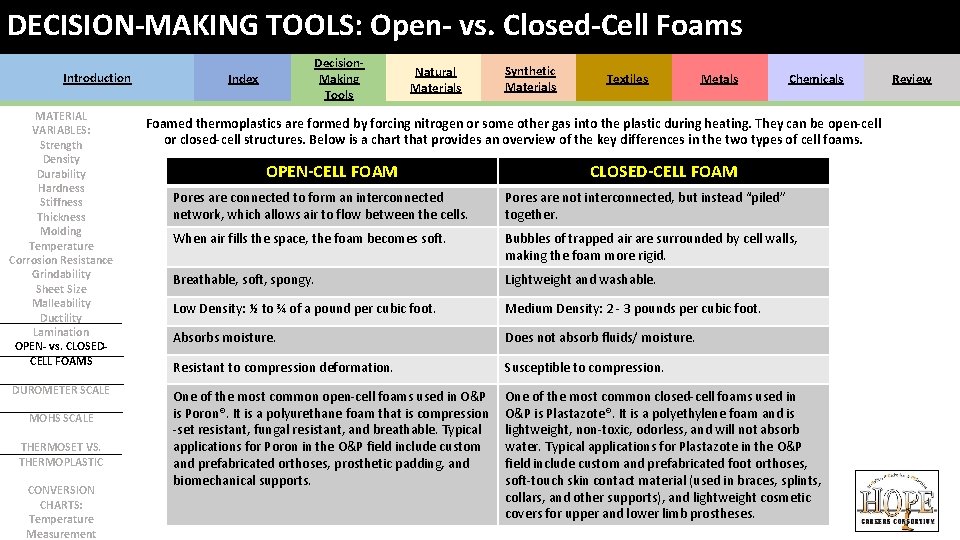
DECISION-MAKING TOOLS: Open- vs. Closed-Cell Foams Introduction MATERIAL VARIABLES: Strength Density Durability Hardness Stiffness Thickness Molding Temperature Corrosion Resistance Grindability Sheet Size Malleability Ductility Lamination OPEN- vs. CLOSEDCELL FOAMS DUROMETER SCALE MOHS SCALE THERMOSET VS. THERMOPLASTIC CONVERSION CHARTS: Temperature Measurement Decision. Making Tools Index Natural Materials Synthetic Materials Textiles Metals Chemicals Foamed thermoplastics are formed by forcing nitrogen or some other gas into the plastic during heating. They can be open-cell or closed-cell structures. Below is a chart that provides an overview of the key differences in the two types of cell foams. OPEN-CELL FOAM CLOSED-CELL FOAM Pores are connected to form an interconnected network, which allows air to flow between the cells. Pores are not interconnected, but instead “piled” together. When air fills the space, the foam becomes soft. Bubbles of trapped air are surrounded by cell walls, making the foam more rigid. Breathable, soft, spongy. Lightweight and washable. Low Density: ½ to ¾ of a pound per cubic foot. Medium Density: 2 - 3 pounds per cubic foot. Absorbs moisture. Does not absorb fluids/ moisture. Resistant to compression deformation. Susceptible to compression. One of the most common open-cell foams used in O&P is Poron®. It is a polyurethane foam that is compression -set resistant, fungal resistant, and breathable. Typical applications for Poron in the O&P field include custom and prefabricated orthoses, prosthetic padding, and biomechanical supports. One of the most common closed-cell foams used in O&P is Plastazote®. It is a polyethylene foam and is lightweight, non-toxic, odorless, and will not absorb water. Typical applications for Plastazote in the O&P field include custom and prefabricated foot orthoses, soft-touch skin contact material (used in braces, splints, collars, and other supports), and lightweight cosmetic covers for upper and lower limb prostheses. Review
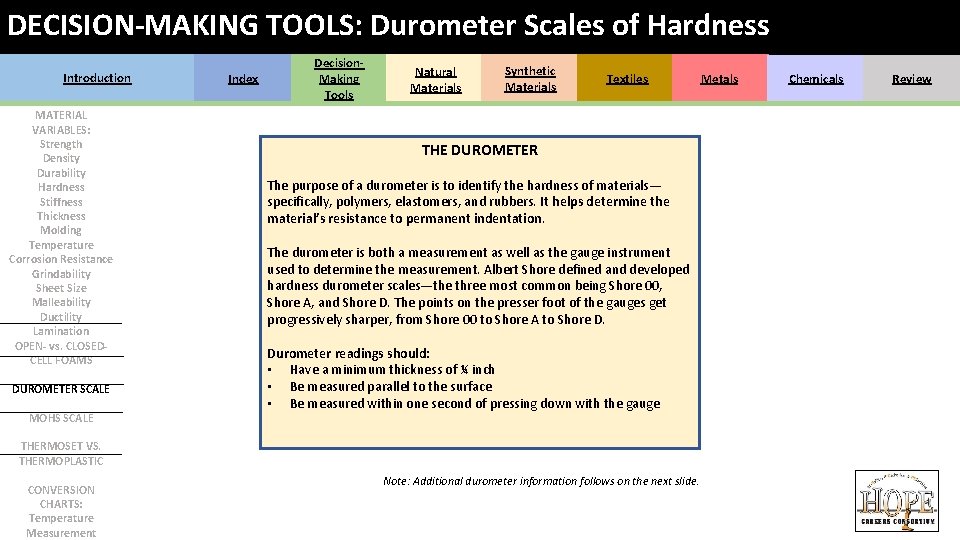
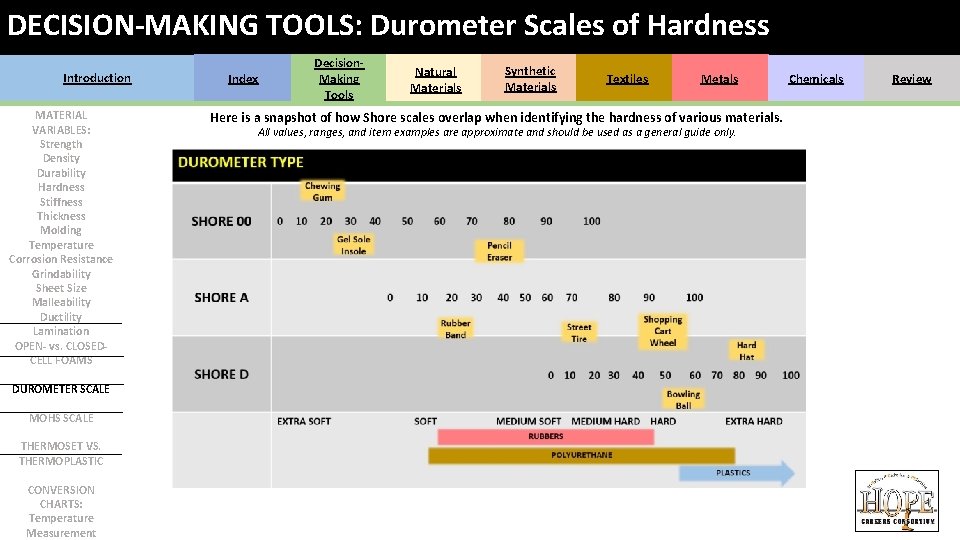
DECISION-MAKING TOOLS: Durometer Scales of Hardness Introduction MATERIAL VARIABLES: Strength Density Durability Hardness Stiffness Thickness Molding Temperature Corrosion Resistance Grindability Sheet Size Malleability Ductility Lamination OPEN- vs. CLOSEDCELL FOAMS DUROMETER SCALE MOHS SCALE Index Decision. Making Tools Natural Materials Synthetic Materials Textiles THE DUROMETER The purpose of a durometer is to identify the hardness of materials— specifically, polymers, elastomers, and rubbers. It helps determine the material’s resistance to permanent indentation. The durometer is both a measurement as well as the gauge instrument used to determine the measurement. Albert Shore defined and developed hardness durometer scales—the three most common being Shore 00, Shore A, and Shore D. The points on the presser foot of the gauges get progressively sharper, from Shore 00 to Shore A to Shore D. Durometer readings should: • Have a minimum thickness of ¼ inch • Be measured parallel to the surface • Be measured within one second of pressing down with the gauge THERMOSET VS. THERMOPLASTIC CONVERSION CHARTS: Temperature Measurement Note: Additional durometer information follows on the next slide. Metals Chemicals Review
DECISION-MAKING TOOLS: Durometer Scales of Hardness Introduction MATERIAL VARIABLES: Strength Density Durability Hardness Stiffness Thickness Molding Temperature Corrosion Resistance Grindability Sheet Size Malleability Ductility Lamination OPEN- vs. CLOSEDCELL FOAMS DUROMETER SCALE MOHS SCALE THERMOSET VS. THERMOPLASTIC CONVERSION CHARTS: Temperature Measurement Index Decision. Making Tools Natural Materials Synthetic Materials Textiles Metals Here is a snapshot of how Shore scales overlap when identifying the hardness of various materials. All values, ranges, and item examples are approximate and should be used as a general guide only. Chemicals Review
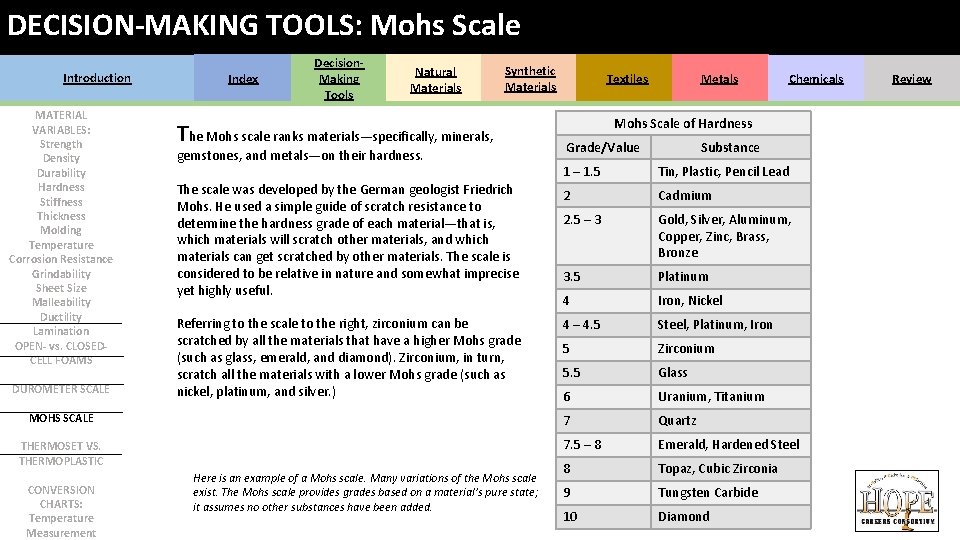
DECISION-MAKING TOOLS: Mohs Scale Introduction MATERIAL VARIABLES: Strength Density Durability Hardness Stiffness Thickness Molding Temperature Corrosion Resistance Grindability Sheet Size Malleability Ductility Lamination OPEN- vs. CLOSEDCELL FOAMS DUROMETER SCALE Index Decision. Making Tools Natural Materials Synthetic Materials The Mohs scale ranks materials—specifically, minerals, gemstones, and metals—on their hardness. Metals Chemicals Mohs Scale of Hardness Grade/Value Substance 1 – 1. 5 Tin, Plastic, Pencil Lead The scale was developed by the German geologist Friedrich Mohs. He used a simple guide of scratch resistance to determine the hardness grade of each material—that is, which materials will scratch other materials, and which materials can get scratched by other materials. The scale is considered to be relative in nature and somewhat imprecise yet highly useful. 2 Cadmium 2. 5 – 3 Gold, Silver, Aluminum, Copper, Zinc, Brass, Bronze 3. 5 Platinum 4 Iron, Nickel Referring to the scale to the right, zirconium can be scratched by all the materials that have a higher Mohs grade (such as glass, emerald, and diamond). Zirconium, in turn, scratch all the materials with a lower Mohs grade (such as nickel, platinum, and silver. ) 4 – 4. 5 Steel, Platinum, Iron 5 Zirconium 5. 5 Glass 6 Uranium, Titanium 7 Quartz 7. 5 – 8 Emerald, Hardened Steel 8 Topaz, Cubic Zirconia 9 Tungsten Carbide 10 Diamond MOHS SCALE THERMOSET VS. THERMOPLASTIC CONVERSION CHARTS: Temperature Measurement Textiles Here is an example of a Mohs scale. Many variations of the Mohs scale exist. The Mohs scale provides grades based on a material’s pure state; it assumes no other substances have been added. Review
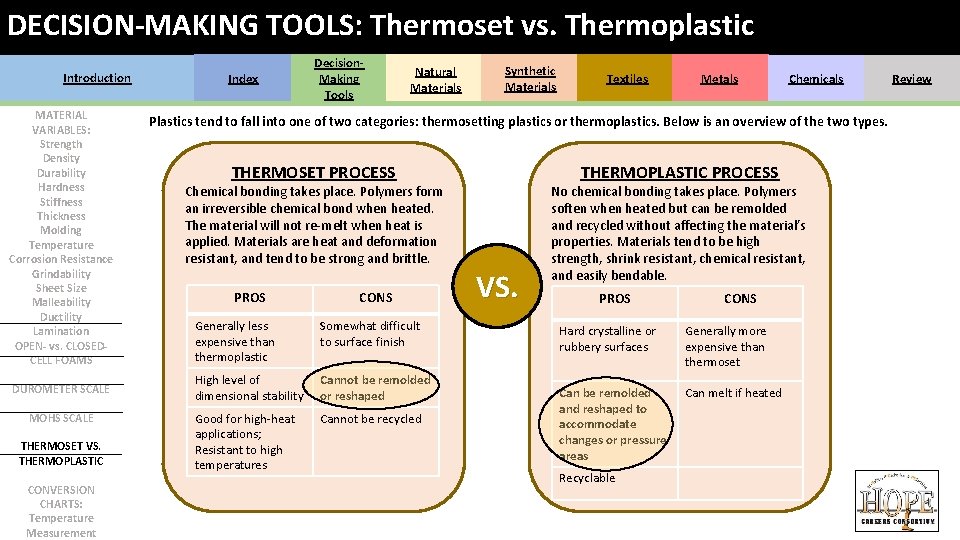
DECISION-MAKING TOOLS: Thermoset vs. Thermoplastic Introduction MATERIAL VARIABLES: Strength Density Durability Hardness Stiffness Thickness Molding Temperature Corrosion Resistance Grindability Sheet Size Malleability Ductility Lamination OPEN- vs. CLOSEDCELL FOAMS DUROMETER SCALE MOHS SCALE THERMOSET VS. THERMOPLASTIC CONVERSION CHARTS: Temperature Measurement Index Decision. Making Tools Natural Materials Synthetic Materials Textiles Metals Chemicals Plastics tend to fall into one of two categories: thermosetting plastics or thermoplastics. Below is an overview of the two types. THERMOSET PROCESS Chemical bonding takes place. Polymers form an irreversible chemical bond when heated. The material will not re-melt when heat is applied. Materials are heat and deformation resistant, and tend to be strong and brittle. PROS CONS Generally less expensive than thermoplastic Somewhat difficult to surface finish High level of dimensional stability Cannot be remolded or reshaped Good for high-heat applications; Resistant to high temperatures Cannot be recycled THERMOPLASTIC PROCESS VS. No chemical bonding takes place. Polymers soften when heated but can be remolded and recycled without affecting the material’s properties. Materials tend to be high strength, shrink resistant, chemical resistant, and easily bendable. PROS CONS Hard crystalline or rubbery surfaces Generally more expensive than thermoset Can be remolded and reshaped to accommodate changes or pressure areas Can melt if heated Recyclable Review
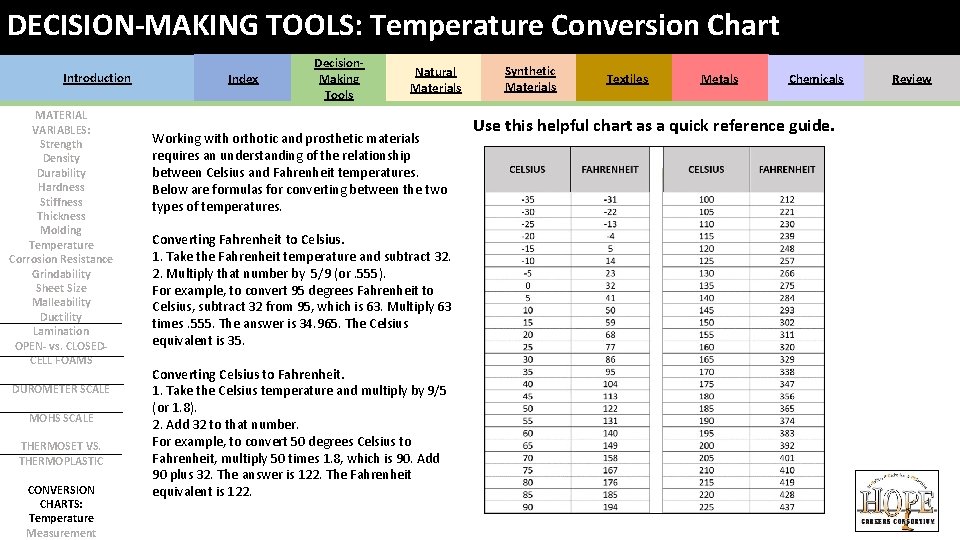
DECISION-MAKING TOOLS: Temperature Conversion Chart Introduction MATERIAL VARIABLES: Strength Density Durability Hardness Stiffness Thickness Molding Temperature Corrosion Resistance Grindability Sheet Size Malleability Ductility Lamination OPEN- vs. CLOSEDCELL FOAMS DUROMETER SCALE MOHS SCALE THERMOSET VS. THERMOPLASTIC CONVERSION CHARTS: Temperature Measurement Index Decision. Making Tools Natural Materials Working with orthotic and prosthetic materials requires an understanding of the relationship between Celsius and Fahrenheit temperatures. Below are formulas for converting between the two types of temperatures. Converting Fahrenheit to Celsius. 1. Take the Fahrenheit temperature and subtract 32. 2. Multiply that number by 5/9 (or. 555). For example, to convert 95 degrees Fahrenheit to Celsius, subtract 32 from 95, which is 63. Multiply 63 times. 555. The answer is 34. 965. The Celsius equivalent is 35. Converting Celsius to Fahrenheit. 1. Take the Celsius temperature and multiply by 9/5 (or 1. 8). 2. Add 32 to that number. For example, to convert 50 degrees Celsius to Fahrenheit, multiply 50 times 1. 8, which is 90. Add 90 plus 32. The answer is 122. The Fahrenheit equivalent is 122. Synthetic Materials Textiles Metals Chemicals Use this helpful chart as a quick reference guide. Review
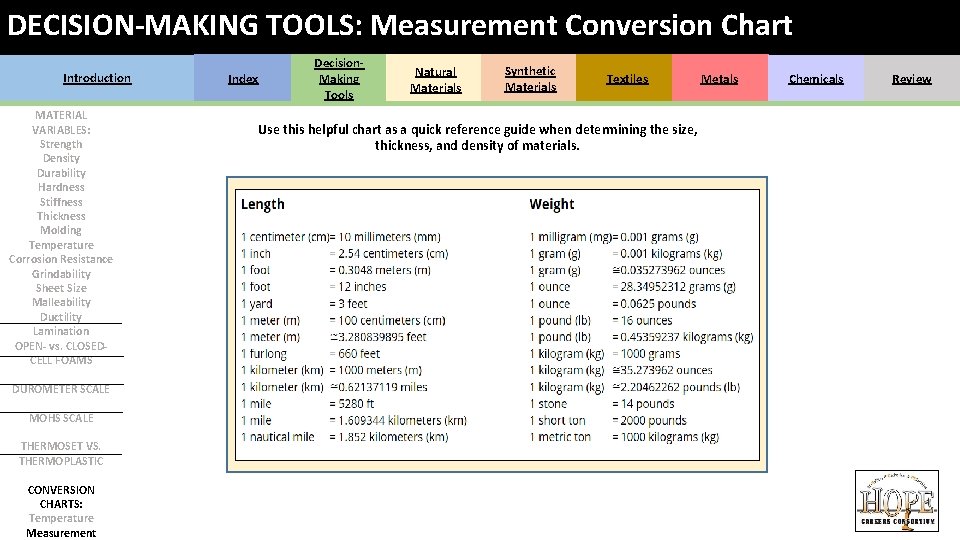
DECISION-MAKING TOOLS: Measurement Conversion Chart Introduction MATERIAL VARIABLES: Strength Density Durability Hardness Stiffness Thickness Molding Temperature Corrosion Resistance Grindability Sheet Size Malleability Ductility Lamination OPEN- vs. CLOSEDCELL FOAMS DUROMETER SCALE MOHS SCALE THERMOSET VS. THERMOPLASTIC CONVERSION CHARTS: Temperature Measurement Index Decision. Making Tools Natural Materials Synthetic Materials Textiles Use this helpful chart as a quick reference guide when determining the size, thickness, and density of materials. Metals Chemicals Review
NATURAL MATERIALS Introduction Index Decision. Making Tools Natural Materials Synthetic Materials Textiles NATURAL MATERIALS Metals Chemicals Review
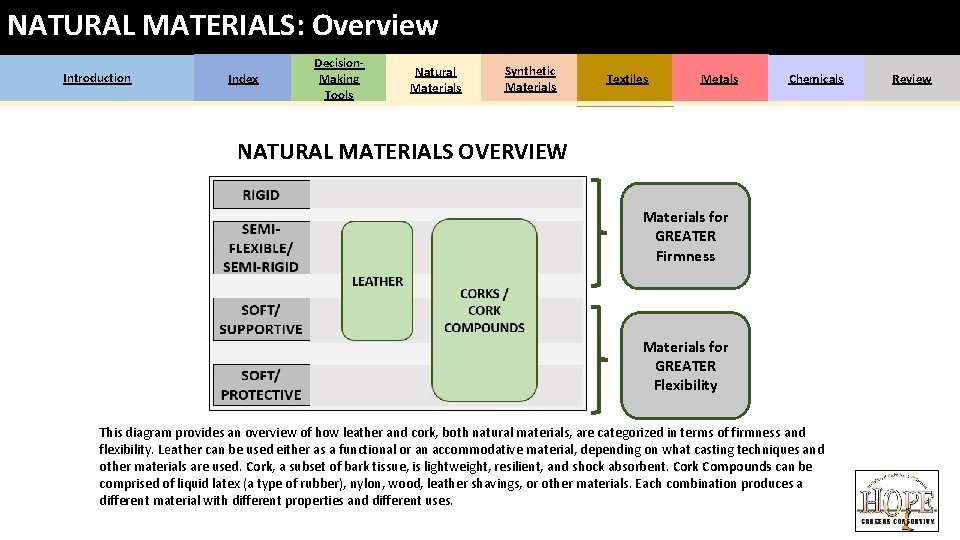
NATURAL MATERIALS: Overview Introduction Index Decision. Making Tools Natural Materials Synthetic Materials Textiles Metals Chemicals NATURAL MATERIALS OVERVIEW Materials for GREATER Firmness Materials for GREATER Flexibility This diagram provides an overview of how leather and cork, both natural materials, are categorized in terms of firmness and flexibility. Leather can be used either as a functional or an accommodative material, depending on what casting techniques and other materials are used. Cork, a subset of bark tissue, is lightweight, resilient, and shock absorbent. Cork Compounds can be comprised of liquid latex (a type of rubber), nylon, wood, leather shavings, or other materials. Each combination produces a different material with different properties and different uses. Review
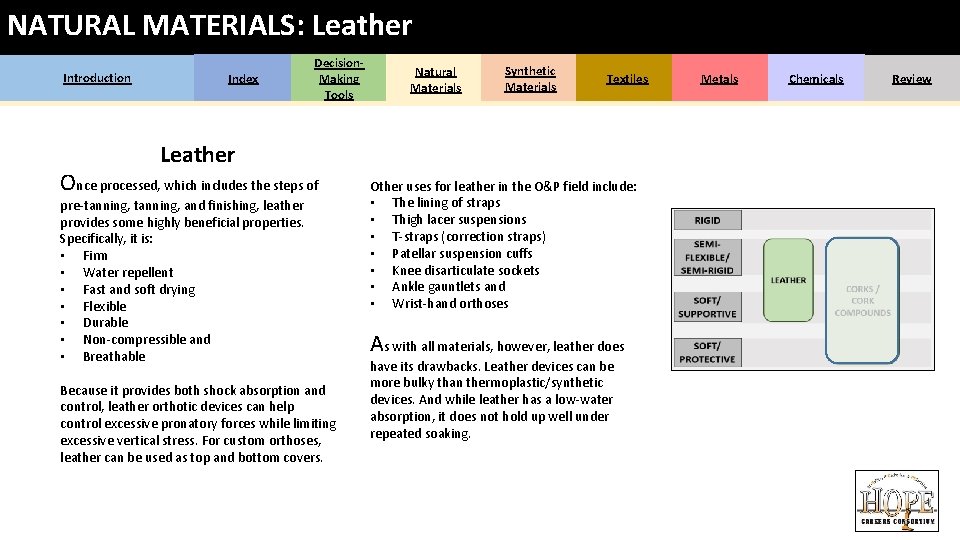
NATURAL MATERIALS: Leather Introduction Index Decision. Making Tools Natural Materials Synthetic Materials Textiles Leather Once processed, which includes the steps of pre-tanning, and finishing, leather provides some highly beneficial properties. Specifically, it is: • Firm • Water repellent • Fast and soft drying • Flexible • Durable • Non-compressible and • Breathable Because it provides both shock absorption and control, leather orthotic devices can help control excessive pronatory forces while limiting excessive vertical stress. For custom orthoses, leather can be used as top and bottom covers. Other uses for leather in the O&P field include: • The lining of straps • Thigh lacer suspensions • T-straps (correction straps) • Patellar suspension cuffs • Knee disarticulate sockets • Ankle gauntlets and • Wrist-hand orthoses As with all materials, however, leather does have its drawbacks. Leather devices can be more bulky than thermoplastic/synthetic devices. And while leather has a low-water absorption, it does not hold up well under repeated soaking. Metals Chemicals Review
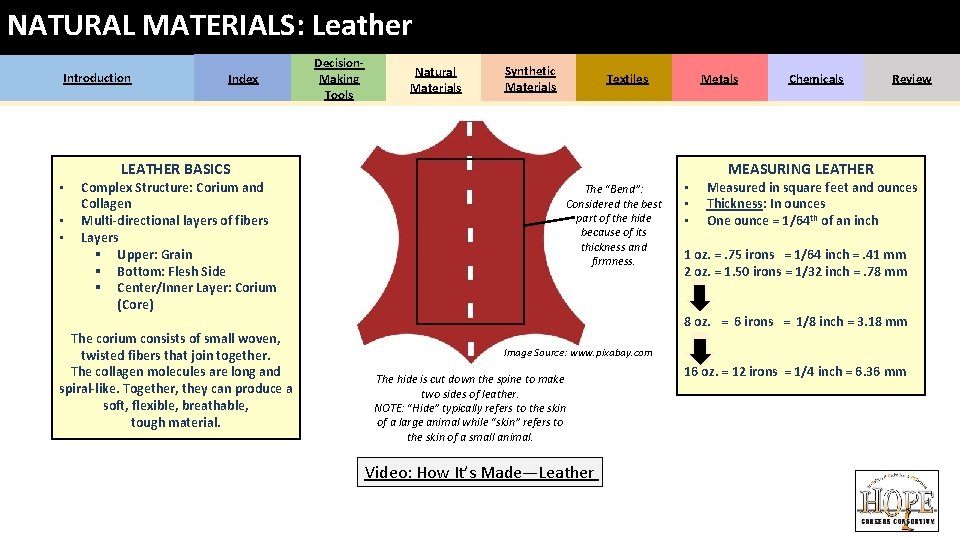
NATURAL MATERIALS: Leather Introduction • • • Index Decision. Making Tools Natural Materials Synthetic Materials Textiles LEATHER BASICS Complex Structure: Corium and Collagen Multi-directional layers of fibers Layers § Upper: Grain § Bottom: Flesh Side § Center/Inner Layer: Corium (Core) The corium consists of small woven, twisted fibers that join together. The collagen molecules are long and spiral-like. Together, they can produce a soft, flexible, breathable, tough material. The “Bend”: Considered the best part of the hide because of its thickness and firmness. Metals • • • Chemicals Review MEASURING LEATHER Measured in square feet and ounces Thickness: In ounces One ounce = 1/64 th of an inch 1 oz. =. 75 irons = 1/64 inch =. 41 mm 2 oz. = 1. 50 irons = 1/32 inch =. 78 mm 8 oz. = 6 irons = 1/8 inch = 3. 18 mm Image Source: www. pixabay. com The hide is cut down the spine to make two sides of leather. NOTE: “Hide” typically refers to the skin of a large animal while “skin” refers to the skin of a small animal. Video: How It’s Made—Leather 16 oz. = 12 irons = 1/4 inch = 6. 36 mm
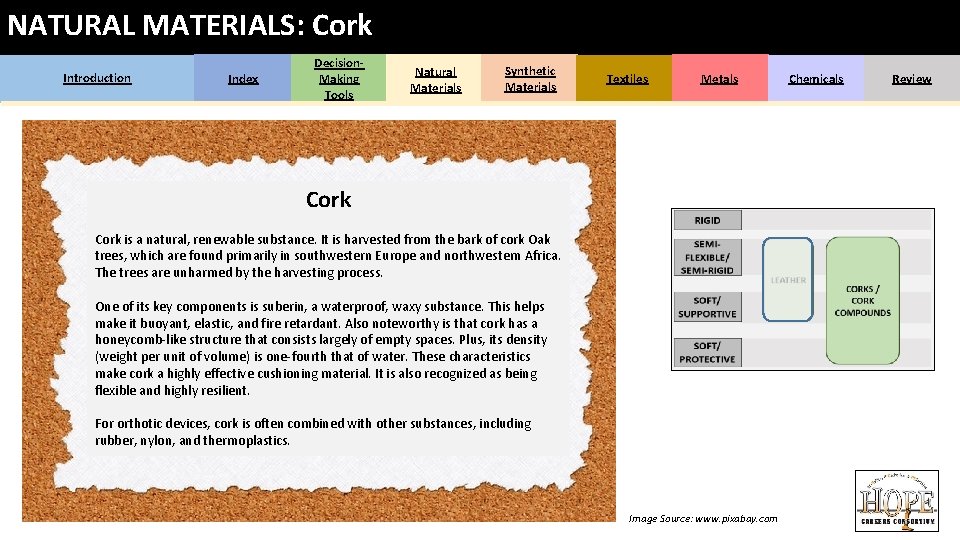
NATURAL MATERIALS: Cork Introduction Index Decision. Making Tools Natural Materials Synthetic Materials Textiles Metals Cork is a natural, renewable substance. It is harvested from the bark of cork Oak trees, which are found primarily in southwestern Europe and northwestern Africa. The trees are unharmed by the harvesting process. One of its key components is suberin, a waterproof, waxy substance. This helps make it buoyant, elastic, and fire retardant. Also noteworthy is that cork has a honeycomb-like structure that consists largely of empty spaces. Plus, its density (weight per unit of volume) is one-fourth that of water. These characteristics make cork a highly effective cushioning material. It is also recognized as being flexible and highly resilient. For orthotic devices, cork is often combined with other substances, including rubber, nylon, and thermoplastics. Image Source: www. pixabay. com Chemicals Review
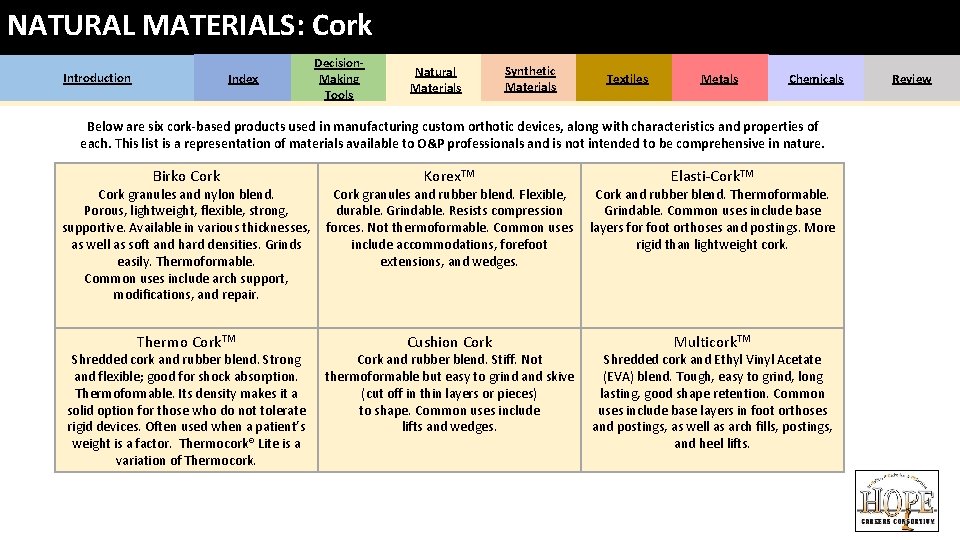
NATURAL MATERIALS: Cork Introduction Index Decision. Making Tools Natural Materials Synthetic Materials Textiles Metals Chemicals Below are six cork-based products used in manufacturing custom orthotic devices, along with characteristics and properties of each. This list is a representation of materials available to O&P professionals and is not intended to be comprehensive in nature. Birko Cork Korex. TM Elasti-Cork. TM Cork granules and nylon blend. Porous, lightweight, flexible, strong, supportive. Available in various thicknesses, as well as soft and hard densities. Grinds easily. Thermoformable. Common uses include arch support, modifications, and repair. Cork granules and rubber blend. Flexible, durable. Grindable. Resists compression forces. Not thermoformable. Common uses include accommodations, forefoot extensions, and wedges. Cork and rubber blend. Thermoformable. Grindable. Common uses include base layers for foot orthoses and postings. More rigid than lightweight cork. Thermo Cork. TM Cushion Cork Multicork. TM Shredded cork and rubber blend. Strong and flexible; good for shock absorption. Thermoformable. Its density makes it a solid option for those who do not tolerate rigid devices. Often used when a patient’s weight is a factor. Thermocork® Lite is a variation of Thermocork. Cork and rubber blend. Stiff. Not thermoformable but easy to grind and skive (cut off in thin layers or pieces) to shape. Common uses include lifts and wedges. Shredded cork and Ethyl Vinyl Acetate (EVA) blend. Tough, easy to grind, long lasting, good shape retention. Common uses include base layers in foot orthoses and postings, as well as arch fills, postings, and heel lifts. Review
NATURAL MATERIALS: Review Introduction Decision. Making Tools Index Natural Materials Synthetic Materials Textiles Visit Quizlet to test your knowledge of Natural Materials. Click on the link below. LINK to QUIZLET: NATURAL MATERIALS O&P Once on the site, click on “Test Your Knowledge: Natural Materials O&P. ” You will see a list of words/terms and their associated meanings. 1. 2. 3. 4. 5. Give the list a quick review. Choose any or all of the “Study” tools and “Play” tools listed at the top of the page. Test your knowledge in multiple ways, including flashcards, formal tests, spelling, and timed games. Note: With the test option, you can re-format in multiple ways and take as many times as you like. When finished, return to this presentation for more Materials information. Metals Chemicals Review
SYNTHETIC MATERIALS Introduction Index Decision. Making Tools Natural Materials Synthetic Materials Textiles Metals SYNTHETIC MATERIALS Chemicals Review
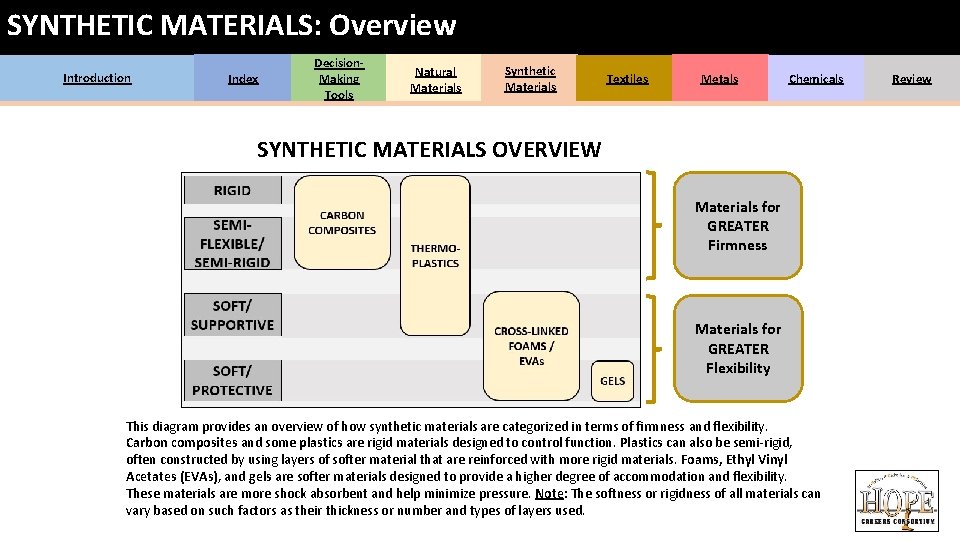
SYNTHETIC MATERIALS: Overview Introduction Index Decision. Making Tools Natural Materials Synthetic Materials Textiles Metals Chemicals SYNTHETIC MATERIALS OVERVIEW Materials for GREATER Firmness Materials for GREATER Flexibility This diagram provides an overview of how synthetic materials are categorized in terms of firmness and flexibility. Carbon composites and some plastics are rigid materials designed to control function. Plastics can also be semi-rigid, often constructed by using layers of softer material that are reinforced with more rigid materials. Foams, Ethyl Vinyl Acetates (EVAs), and gels are softer materials designed to provide a higher degree of accommodation and flexibility. These materials are more shock absorbent and help minimize pressure. Note: The softness or rigidness of all materials can vary based on such factors as their thickness or number and types of layers used. Review
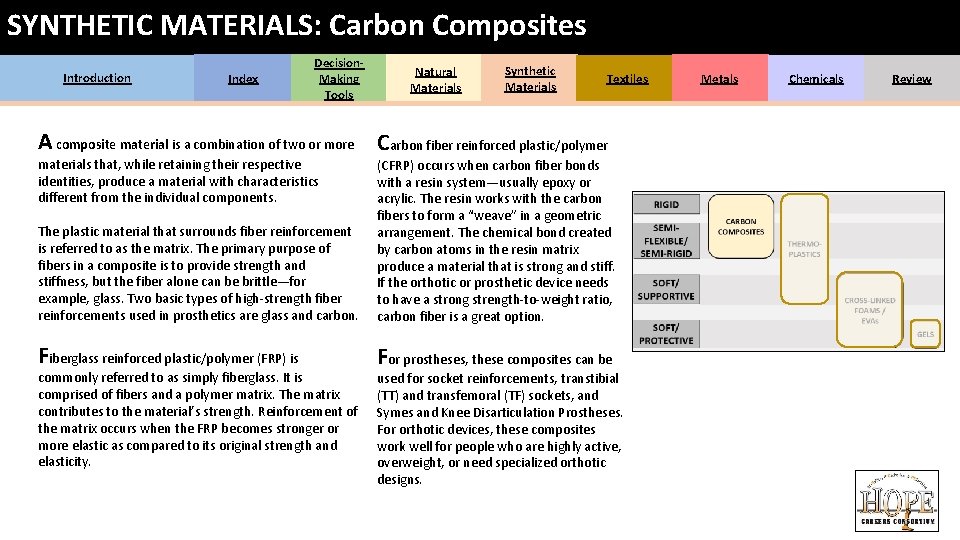
SYNTHETIC MATERIALS: Carbon Composites Introduction Index Decision. Making Tools Natural Materials Synthetic Materials Textiles A composite material is a combination of two or more Carbon fiber reinforced plastic/polymer materials that, while retaining their respective identities, produce a material with characteristics different from the individual components. The plastic material that surrounds fiber reinforcement is referred to as the matrix. The primary purpose of fibers in a composite is to provide strength and stiffness, but the fiber alone can be brittle—for example, glass. Two basic types of high-strength fiber reinforcements used in prosthetics are glass and carbon. (CFRP) occurs when carbon fiber bonds with a resin system—usually epoxy or acrylic. The resin works with the carbon fibers to form a “weave” in a geometric arrangement. The chemical bond created by carbon atoms in the resin matrix produce a material that is strong and stiff. If the orthotic or prosthetic device needs to have a strong strength-to-weight ratio, carbon fiber is a great option. Fiberglass reinforced plastic/polymer (FRP) is For prostheses, these composites can be commonly referred to as simply fiberglass. It is comprised of fibers and a polymer matrix. The matrix contributes to the material’s strength. Reinforcement of the matrix occurs when the FRP becomes stronger or more elastic as compared to its original strength and elasticity. used for socket reinforcements, transtibial (TT) and transfemoral (TF) sockets, and Symes and Knee Disarticulation Prostheses. For orthotic devices, these composites work well for people who are highly active, overweight, or need specialized orthotic designs. Metals Chemicals Review
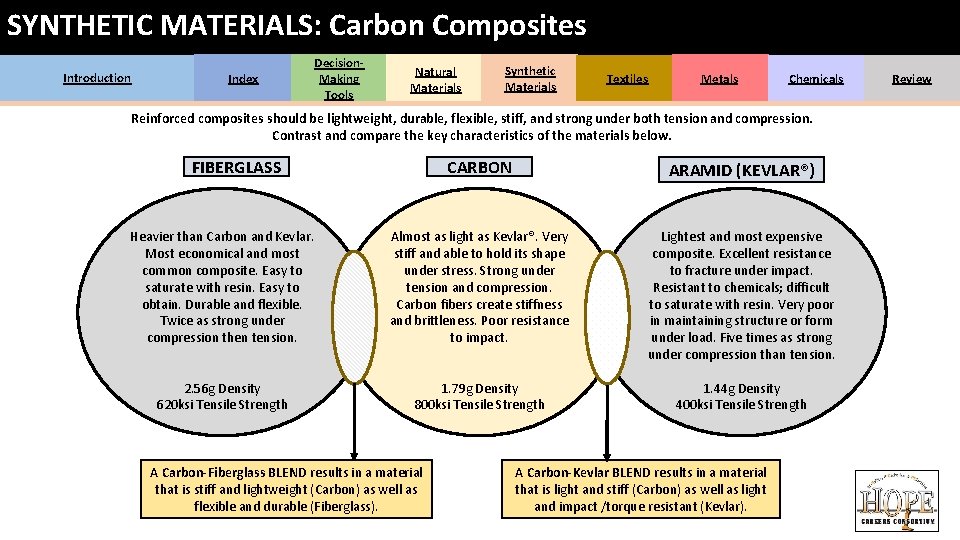
SYNTHETIC MATERIALS: Carbon Composites Introduction Index Decision. Making Tools Natural Materials Synthetic Materials Textiles Metals Chemicals Reinforced composites should be lightweight, durable, flexible, stiff, and strong under both tension and compression. Contrast and compare the key characteristics of the materials below. FIBERGLASS CARBON ARAMID (KEVLAR®) Heavier than Carbon and Kevlar. Most economical and most common composite. Easy to saturate with resin. Easy to obtain. Durable and flexible. Twice as strong under compression then tension. Almost as light as Kevlar®. Very stiff and able to hold its shape under stress. Strong under tension and compression. Carbon fibers create stiffness and brittleness. Poor resistance to impact. Lightest and most expensive composite. Excellent resistance to fracture under impact. Resistant to chemicals; difficult to saturate with resin. Very poor in maintaining structure or form under load. Five times as strong under compression than tension. 2. 56 g Density 620 ksi Tensile Strength 1. 79 g Density 800 ksi Tensile Strength 1. 44 g Density 400 ksi Tensile Strength A Carbon-Fiberglass BLEND results in a material that is stiff and lightweight (Carbon) as well as flexible and durable (Fiberglass). A Carbon-Kevlar BLEND results in a material that is light and stiff (Carbon) as well as light and impact /torque resistant (Kevlar). Review
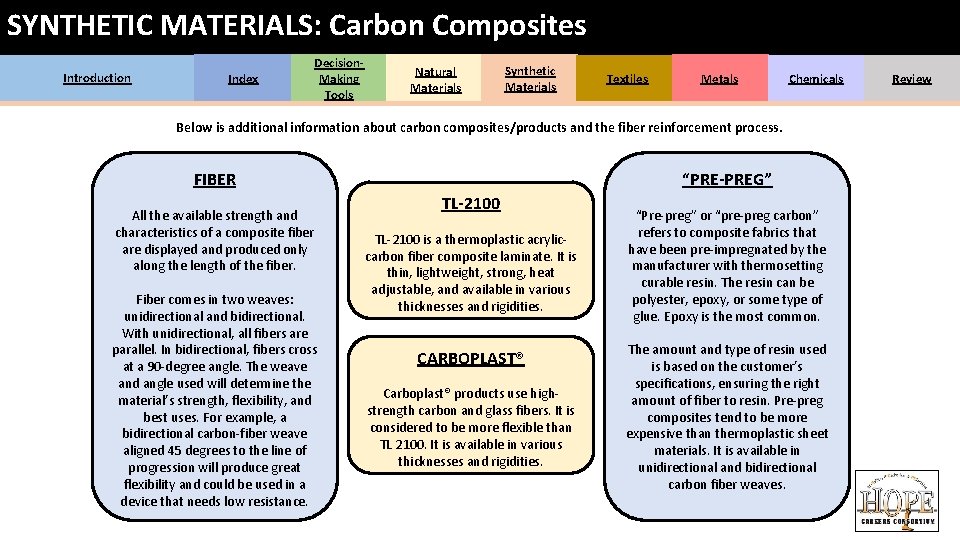
SYNTHETIC MATERIALS: Carbon Composites Introduction Index Decision. Making Tools Natural Materials Synthetic Materials Textiles Metals Chemicals Below is additional information about carbon composites/products and the fiber reinforcement process. FIBER All the available strength and characteristics of a composite fiber are displayed and produced only along the length of the fiber. Fiber comes in two weaves: unidirectional and bidirectional. With unidirectional, all fibers are parallel. In bidirectional, fibers cross at a 90 -degree angle. The weave and angle used will determine the material’s strength, flexibility, and best uses. For example, a bidirectional carbon-fiber weave aligned 45 degrees to the line of progression will produce great flexibility and could be used in a device that needs low resistance. “PRE-PREG” TL-2100 is a thermoplastic acryliccarbon fiber composite laminate. It is thin, lightweight, strong, heat adjustable, and available in various thicknesses and rigidities. CARBOPLAST® Carboplast® products use highstrength carbon and glass fibers. It is considered to be more flexible than TL 2100. It is available in various thicknesses and rigidities. “Pre-preg” or “pre-preg carbon” refers to composite fabrics that have been pre-impregnated by the manufacturer with thermosetting curable resin. The resin can be polyester, epoxy, or some type of glue. Epoxy is the most common. The amount and type of resin used is based on the customer’s specifications, ensuring the right amount of fiber to resin. Pre-preg composites tend to be more expensive than thermoplastic sheet materials. It is available in unidirectional and bidirectional carbon fiber weaves. Review
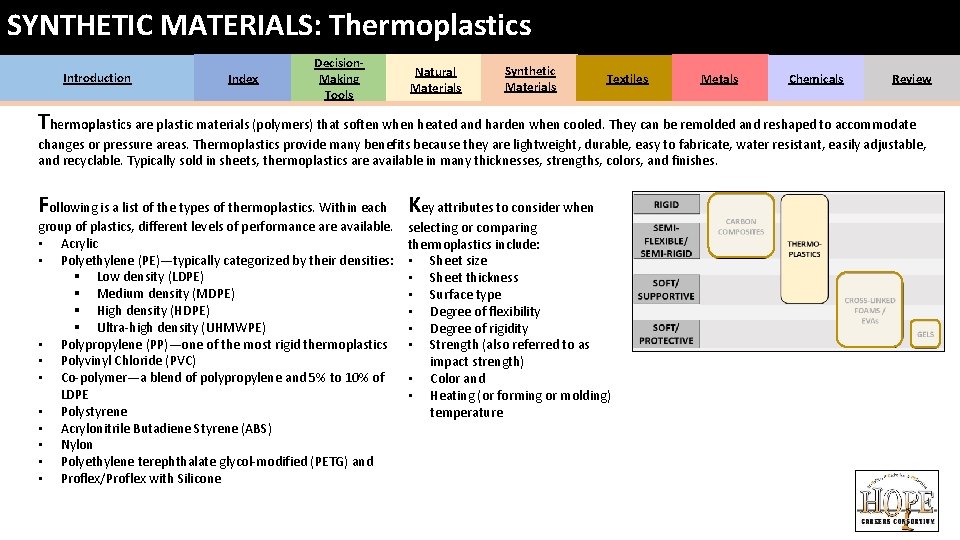
SYNTHETIC MATERIALS: Thermoplastics Introduction Index Decision. Making Tools Natural Materials Synthetic Materials Textiles Metals Chemicals Review Thermoplastics are plastic materials (polymers) that soften when heated and harden when cooled. They can be remolded and reshaped to accommodate changes or pressure areas. Thermoplastics provide many benefits because they are lightweight, durable, easy to fabricate, water resistant, easily adjustable, and recyclable. Typically sold in sheets, thermoplastics are available in many thicknesses, strengths, colors, and finishes. Following is a list of the types of thermoplastics. Within each Key attributes to consider when group of plastics, different levels of performance are available. • Acrylic • Polyethylene (PE)—typically categorized by their densities: § Low density (LDPE) § Medium density (MDPE) § High density (HDPE) § Ultra-high density (UHMWPE) • Polypropylene (PP)—one of the most rigid thermoplastics • Polyvinyl Chloride (PVC) • Co-polymer—a blend of polypropylene and 5% to 10% of LDPE • Polystyrene • Acrylonitrile Butadiene Styrene (ABS) • Nylon • Polyethylene terephthalate glycol-modified (PETG) and • Proflex/Proflex with Silicone selecting or comparing thermoplastics include: • Sheet size • Sheet thickness • Surface type • Degree of flexibility • Degree of rigidity • Strength (also referred to as impact strength) • Color and • Heating (or forming or molding) temperature
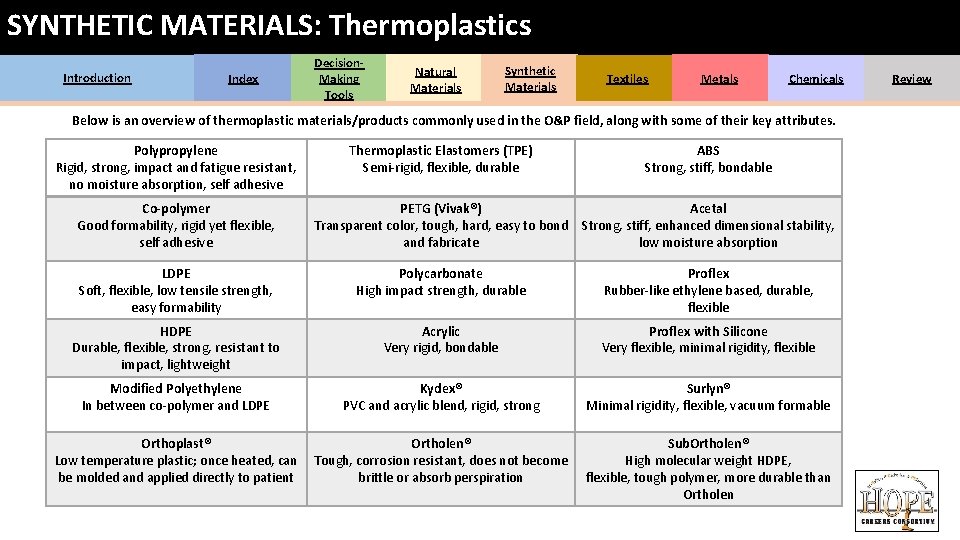
SYNTHETIC MATERIALS: Thermoplastics Introduction Index Decision. Making Tools Natural Materials Synthetic Materials Textiles Metals Chemicals Below is an overview of thermoplastic materials/products commonly used in the O&P field, along with some of their key attributes. Polypropylene Rigid, strong, impact and fatigue resistant, no moisture absorption, self adhesive Thermoplastic Elastomers (TPE) Semi-rigid, flexible, durable ABS Strong, stiff, bondable Co-polymer Good formability, rigid yet flexible, self adhesive PETG (Vivak®) Transparent color, tough, hard, easy to bond and fabricate Acetal Strong, stiff, enhanced dimensional stability, low moisture absorption LDPE Soft, flexible, low tensile strength, easy formability Polycarbonate High impact strength, durable Proflex Rubber-like ethylene based, durable, flexible HDPE Durable, flexible, strong, resistant to impact, lightweight Acrylic Very rigid, bondable Proflex with Silicone Very flexible, minimal rigidity, flexible Modified Polyethylene In between co-polymer and LDPE Kydex® PVC and acrylic blend, rigid, strong Surlyn® Minimal rigidity, flexible, vacuum formable Orthoplast® Low temperature plastic; once heated, can be molded and applied directly to patient Ortholen® Tough, corrosion resistant, does not become brittle or absorb perspiration Sub. Ortholen® High molecular weight HDPE, flexible, tough polymer, more durable than Ortholen Review
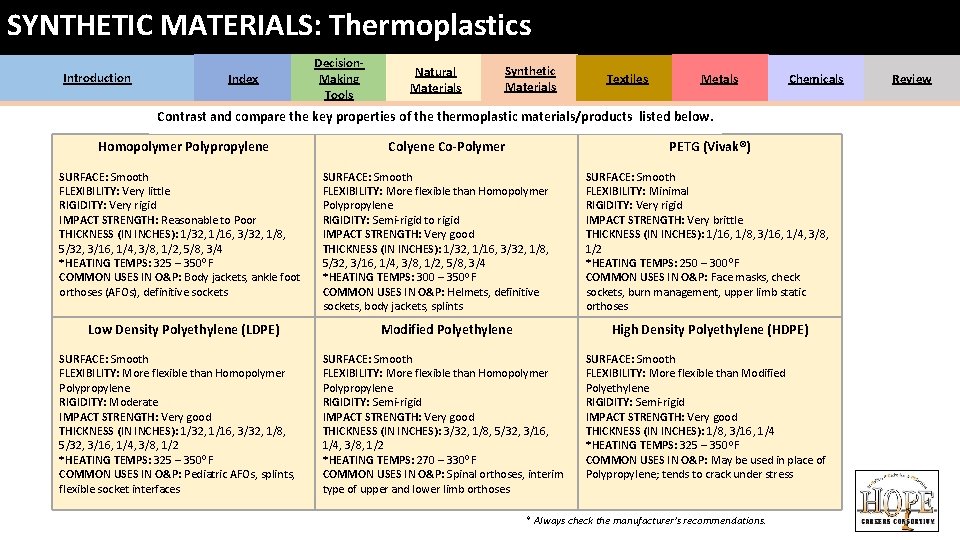
SYNTHETIC MATERIALS: Thermoplastics Introduction Index Decision. Making Tools Natural Materials Synthetic Materials Textiles Metals Chemicals Contrast and compare the key properties of thermoplastic materials/products listed below. Homopolymer Polypropylene SURFACE: Smooth FLEXIBILITY: Very little RIGIDITY: Very rigid IMPACT STRENGTH: Reasonable to Poor THICKNESS (IN INCHES): 1/32, 1/16, 3/32, 1/8, 5/32, 3/16, 1/4, 3/8, 1/2, 5/8, 3/4 *HEATING TEMPS: 325 – 350 0 F COMMON USES IN O&P: Body jackets, ankle foot orthoses (AFOs), definitive sockets Low Density Polyethylene (LDPE) SURFACE: Smooth FLEXIBILITY: More flexible than Homopolymer Polypropylene RIGIDITY: Moderate IMPACT STRENGTH: Very good THICKNESS (IN INCHES): 1/32, 1/16, 3/32, 1/8, 5/32, 3/16, 1/4, 3/8, 1/2 *HEATING TEMPS: 325 – 350 0 F COMMON USES IN O&P: Pediatric AFOs, splints, flexible socket interfaces Colyene Co-Polymer PETG (Vivak®) SURFACE: Smooth FLEXIBILITY: More flexible than Homopolymer Polypropylene RIGIDITY: Semi-rigid to rigid IMPACT STRENGTH: Very good THICKNESS (IN INCHES): 1/32, 1/16, 3/32, 1/8, 5/32, 3/16, 1/4, 3/8, 1/2, 5/8, 3/4 *HEATING TEMPS: 300 – 350 0 F COMMON USES IN O&P: Helmets, definitive sockets, body jackets, splints Modified Polyethylene SURFACE: Smooth FLEXIBILITY: Minimal RIGIDITY: Very rigid IMPACT STRENGTH: Very brittle THICKNESS (IN INCHES): 1/16, 1/8, 3/16, 1/4, 3/8, 1/2 *HEATING TEMPS: 250 – 300 0 F COMMON USES IN O&P: Face masks, check sockets, burn management, upper limb static orthoses High Density Polyethylene (HDPE) SURFACE: Smooth FLEXIBILITY: More flexible than Homopolymer Polypropylene RIGIDITY: Semi-rigid IMPACT STRENGTH: Very good THICKNESS (IN INCHES): 3/32, 1/8, 5/32, 3/16, 1/4, 3/8, 1/2 *HEATING TEMPS: 270 – 330 0 F COMMON USES IN O&P: Spinal orthoses, interim type of upper and lower limb orthoses SURFACE: Smooth FLEXIBILITY: More flexible than Modified Polyethylene RIGIDITY: Semi-rigid IMPACT STRENGTH: Very good THICKNESS (IN INCHES): 1/8, 3/16, 1/4 *HEATING TEMPS: 325 – 350 0 F COMMON USES IN O&P: May be used in place of Polypropylene; tends to crack under stress * Always check the manufacturer’s recommendations. Review
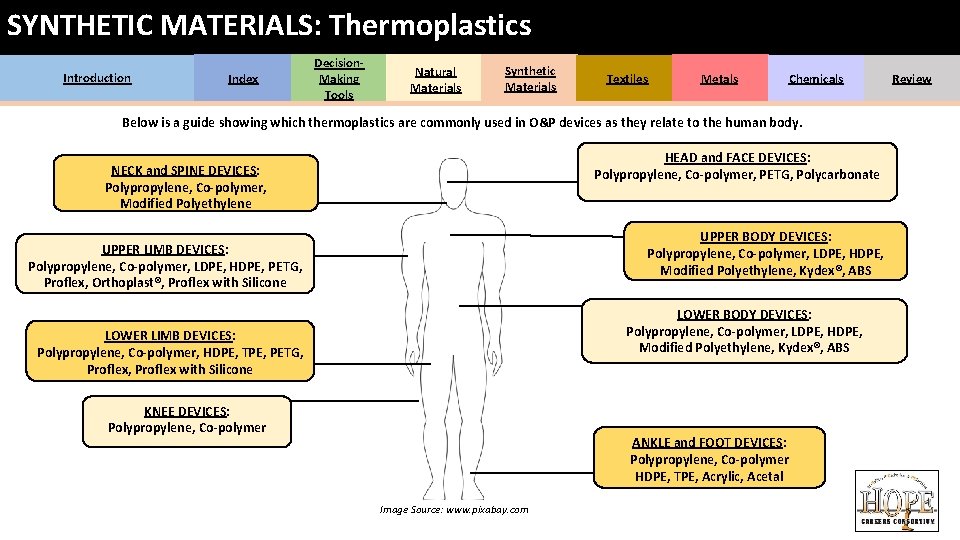
SYNTHETIC MATERIALS: Thermoplastics Introduction Index Decision. Making Tools Natural Materials Synthetic Materials Textiles Metals Chemicals Below is a guide showing which thermoplastics are commonly used in O&P devices as they relate to the human body. HEAD and FACE DEVICES: Polypropylene, Co-polymer, PETG, Polycarbonate NECK and SPINE DEVICES: Polypropylene, Co-polymer, Modified Polyethylene UPPER BODY DEVICES: Polypropylene, Co-polymer, LDPE, HDPE, Modified Polyethylene, Kydex®, ABS UPPER LIMB DEVICES: Polypropylene, Co-polymer, LDPE, HDPE, PETG, Proflex, Orthoplast®, Proflex with Silicone LOWER BODY DEVICES: Polypropylene, Co-polymer, LDPE, HDPE, Modified Polyethylene, Kydex®, ABS LOWER LIMB DEVICES: Polypropylene, Co-polymer, HDPE, TPE, PETG, Proflex with Silicone KNEE DEVICES: Polypropylene, Co-polymer ANKLE and FOOT DEVICES: Polypropylene, Co-polymer HDPE, TPE, Acrylic, Acetal Image Source: www. pixabay. com Review
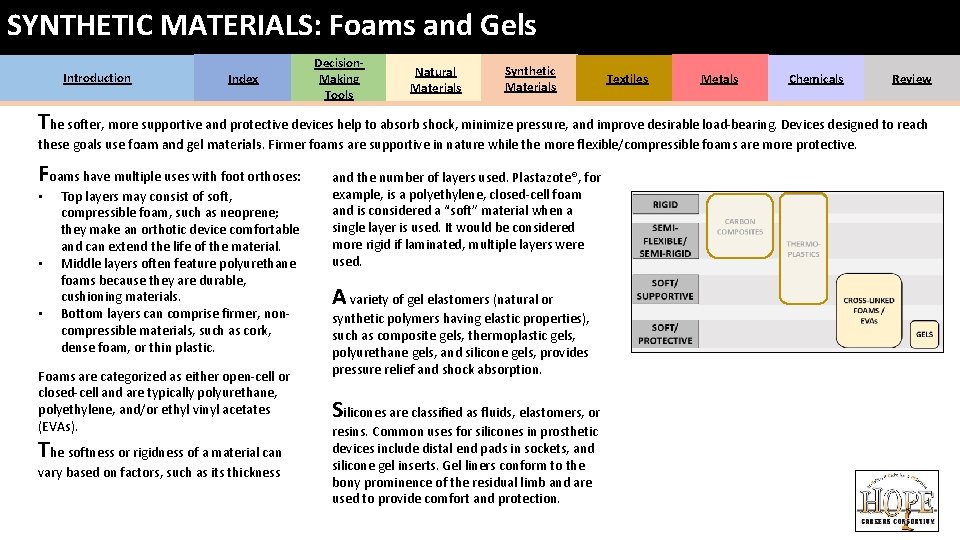
SYNTHETIC MATERIALS: Foams and Gels Introduction Index Decision. Making Tools Natural Materials Synthetic Materials Textiles Metals Chemicals Review The softer, more supportive and protective devices help to absorb shock, minimize pressure, and improve desirable load-bearing. Devices designed to reach these goals use foam and gel materials. Firmer foams are supportive in nature while the more flexible/compressible foams are more protective. Foams have multiple uses with foot orthoses: • • • Top layers may consist of soft, compressible foam, such as neoprene; they make an orthotic device comfortable and can extend the life of the material. Middle layers often feature polyurethane foams because they are durable, cushioning materials. Bottom layers can comprise firmer, noncompressible materials, such as cork, dense foam, or thin plastic. Foams are categorized as either open-cell or closed-cell and are typically polyurethane, polyethylene, and/or ethyl vinyl acetates (EVAs). The softness or rigidness of a material can vary based on factors, such as its thickness and the number of layers used. Plastazote®, for example, is a polyethylene, closed-cell foam and is considered a “soft” material when a single layer is used. It would be considered more rigid if laminated, multiple layers were used. A variety of gel elastomers (natural or synthetic polymers having elastic properties), such as composite gels, thermoplastic gels, polyurethane gels, and silicone gels, provides pressure relief and shock absorption. Silicones are classified as fluids, elastomers, or resins. Common uses for silicones in prosthetic devices include distal end pads in sockets, and silicone gel inserts. Gel liners conform to the bony prominence of the residual limb and are used to provide comfort and protection.
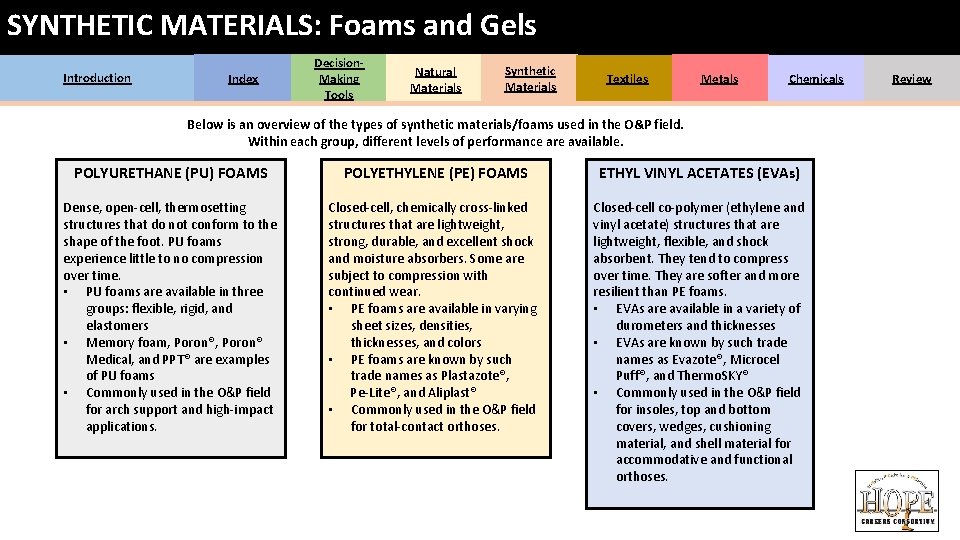
SYNTHETIC MATERIALS: Foams and Gels Introduction Index Decision. Making Tools Natural Materials Synthetic Materials Textiles Metals Chemicals Below is an overview of the types of synthetic materials/foams used in the O&P field. Within each group, different levels of performance are available. POLYURETHANE (PU) FOAMS POLYETHYLENE (PE) FOAMS ETHYL VINYL ACETATES (EVAs) Dense, open-cell, thermosetting structures that do not conform to the shape of the foot. PU foams experience little to no compression over time. • PU foams are available in three groups: flexible, rigid, and elastomers • Memory foam, Poron® Medical, and PPT® are examples of PU foams • Commonly used in the O&P field for arch support and high-impact applications. Closed-cell, chemically cross-linked structures that are lightweight, strong, durable, and excellent shock and moisture absorbers. Some are subject to compression with continued wear. • PE foams are available in varying sheet sizes, densities, thicknesses, and colors • PE foams are known by such trade names as Plastazote®, Pe-Lite®, and Aliplast® • Commonly used in the O&P field for total-contact orthoses. Closed-cell co-polymer (ethylene and vinyl acetate) structures that are lightweight, flexible, and shock absorbent. They tend to compress over time. They are softer and more resilient than PE foams. • EVAs are available in a variety of durometers and thicknesses • EVAs are known by such trade names as Evazote®, Microcel Puff®, and Thermo. SKY® • Commonly used in the O&P field for insoles, top and bottom covers, wedges, cushioning material, and shell material for accommodative and functional orthoses. Review
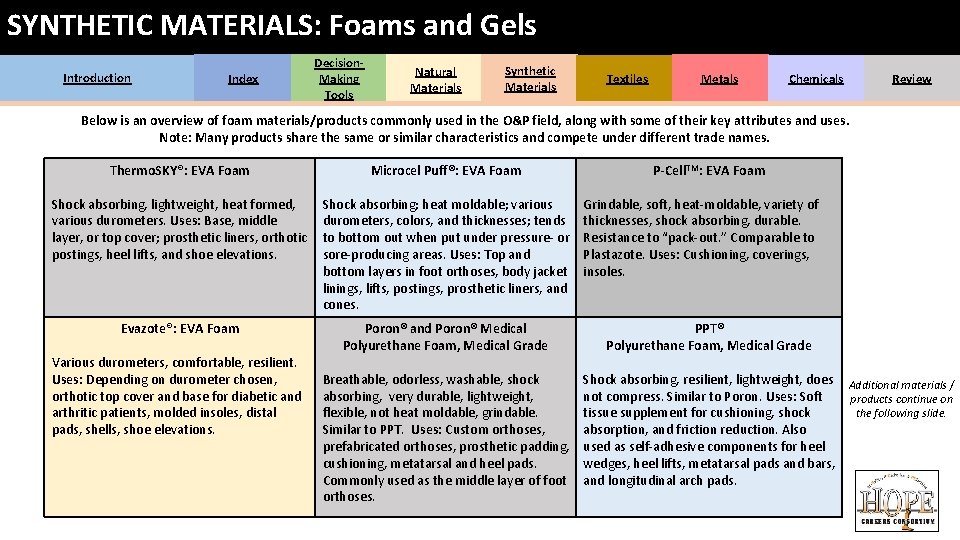
SYNTHETIC MATERIALS: Foams and Gels Introduction Index Decision. Making Tools Natural Materials Synthetic Materials Textiles Metals Chemicals Review Below is an overview of foam materials/products commonly used in the O&P field, along with some of their key attributes and uses. Note: Many products share the same or similar characteristics and compete under different trade names. Thermo. SKY®: EVA Foam Microcel Puff®: EVA Foam Shock absorbing, lightweight, heat formed, various durometers. Uses: Base, middle layer, or top cover; prosthetic liners, orthotic postings, heel lifts, and shoe elevations. Shock absorbing; heat moldable; various durometers, colors, and thicknesses; tends to bottom out when put under pressure- or sore-producing areas. Uses: Top and bottom layers in foot orthoses, body jacket linings, lifts, postings, prosthetic liners, and cones. Evazote®: EVA Foam Poron® and Poron® Medical Polyurethane Foam, Medical Grade Various durometers, comfortable, resilient. Uses: Depending on durometer chosen, orthotic top cover and base for diabetic and arthritic patients, molded insoles, distal pads, shells, shoe elevations. Breathable, odorless, washable, shock absorbing, very durable, lightweight, flexible, not heat moldable, grindable. Similar to PPT. Uses: Custom orthoses, prefabricated orthoses, prosthetic padding, cushioning, metatarsal and heel pads. Commonly used as the middle layer of foot orthoses. P-Cell. TM: EVA Foam Grindable, soft, heat-moldable, variety of thicknesses, shock absorbing, durable. Resistance to “pack-out. ” Comparable to Plastazote. Uses: Cushioning, coverings, insoles. PPT® Polyurethane Foam, Medical Grade Shock absorbing, resilient, lightweight, does Additional materials / not compress. Similar to Poron. Uses: Soft products continue on the following slide. tissue supplement for cushioning, shock absorption, and friction reduction. Also used as self-adhesive components for heel wedges, heel lifts, metatarsal pads and bars, and longitudinal arch pads.
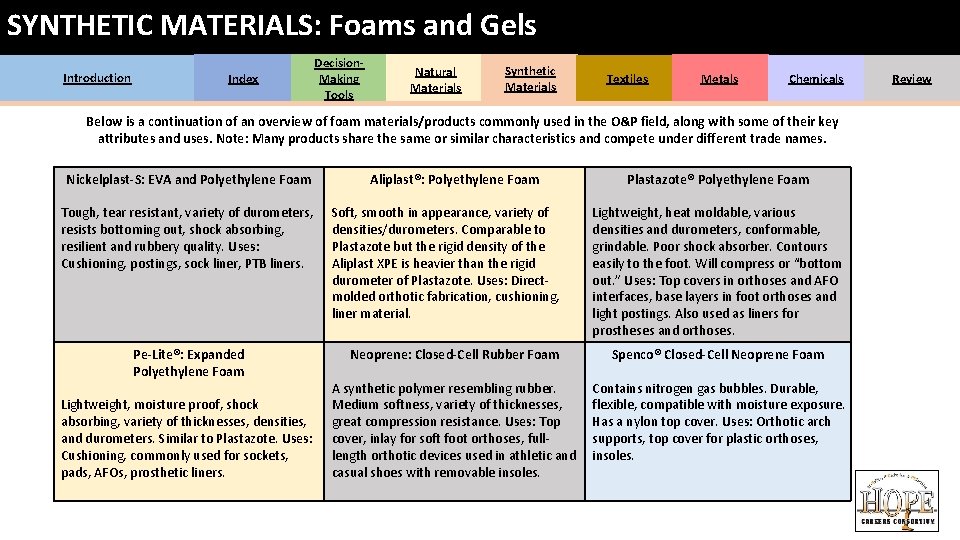
SYNTHETIC MATERIALS: Foams and Gels Introduction Index Decision. Making Tools Natural Materials Synthetic Materials Textiles Metals Chemicals Below is a continuation of an overview of foam materials/products commonly used in the O&P field, along with some of their key attributes and uses. Note: Many products share the same or similar characteristics and compete under different trade names. Nickelplast-S: EVA and Polyethylene Foam Tough, tear resistant, variety of durometers, resists bottoming out, shock absorbing, resilient and rubbery quality. Uses: Cushioning, postings, sock liner, PTB liners. Pe-Lite®: Expanded Polyethylene Foam Lightweight, moisture proof, shock absorbing, variety of thicknesses, densities, and durometers. Similar to Plastazote. Uses: Cushioning, commonly used for sockets, pads, AFOs, prosthetic liners. Aliplast®: Polyethylene Foam Soft, smooth in appearance, variety of densities/durometers. Comparable to Plastazote but the rigid density of the Aliplast XPE is heavier than the rigid durometer of Plastazote. Uses: Directmolded orthotic fabrication, cushioning, liner material. Plastazote® Polyethylene Foam Lightweight, heat moldable, various densities and durometers, conformable, grindable. Poor shock absorber. Contours easily to the foot. Will compress or “bottom out. ” Uses: Top covers in orthoses and AFO interfaces, base layers in foot orthoses and light postings. Also used as liners for prostheses and orthoses. Neoprene: Closed-Cell Rubber Foam Spenco® Closed-Cell Neoprene Foam A synthetic polymer resembling rubber. Medium softness, variety of thicknesses, great compression resistance. Uses: Top cover, inlay for soft foot orthoses, fulllength orthotic devices used in athletic and casual shoes with removable insoles. Contains nitrogen gas bubbles. Durable, flexible, compatible with moisture exposure. Has a nylon top cover. Uses: Orthotic arch supports, top cover for plastic orthoses, insoles. Review
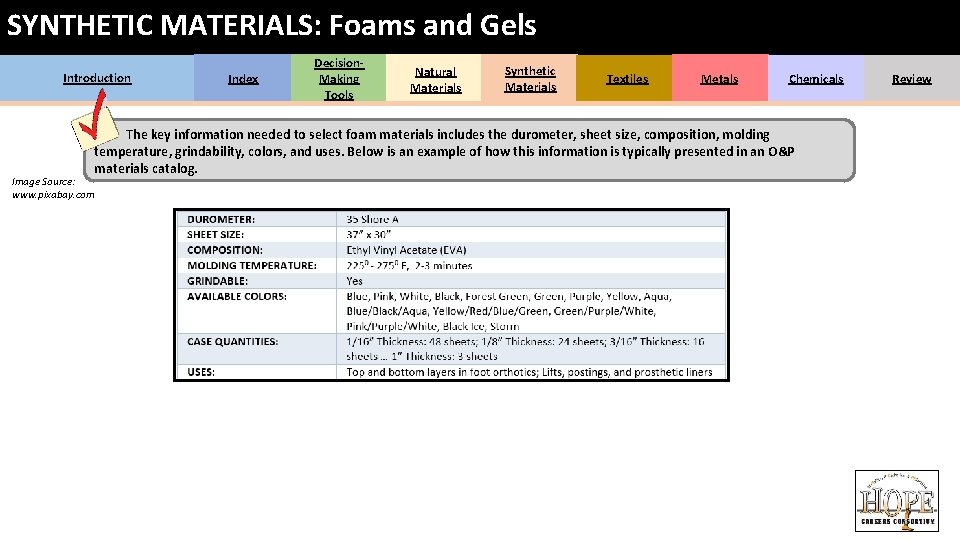
SYNTHETIC MATERIALS: Foams and Gels Introduction Index Decision. Making Tools Natural Materials Synthetic Materials Textiles Metals Chemicals The key information needed to select foam materials includes the durometer, sheet size, composition, molding temperature, grindability, colors, and uses. Below is an example of how this information is typically presented in an O&P materials catalog. Image Source: www. pixabay. com Review
SYNTHETIC MATERIALS: Review Introduction Decision. Making Tools Index Natural Materials Synthetic Materials Textiles Visit Quizlet to test your knowledge of Synthetic Materials. Click on the link below. LINK to QUIZLET: SYNTHETIC MATERIALS O&P Once on the site, click on “Test Your Knowledge: Synthetic Materials O&P. ” You will see a list of words/terms and their associated meanings. 1. 2. 3. 4. 5. Give the list a quick review. Choose any or all of the “Study” tools and “Play” tools listed at the top of the page. Test your knowledge in multiple ways, including flashcards, formal tests, spelling, and timed games. Note: With the test option, you can re-format in multiple ways and take as many times as you like. When finished, return to this presentation for more Materials information. Metals Chemicals Review
TEXTILES Introduction Index Decision. Making Tools Natural Materials Synthetic Materials TEXTILES Textiles Metals Chemicals Review
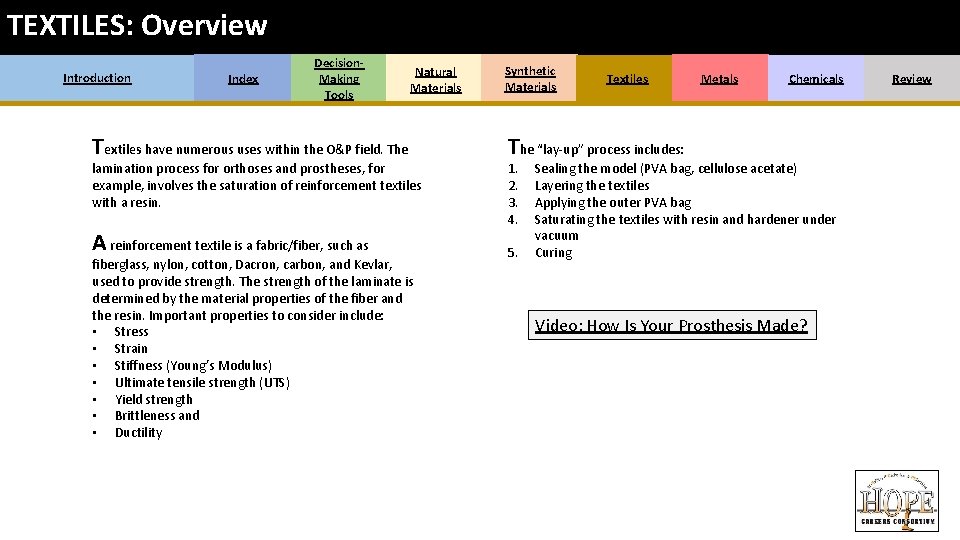
TEXTILES: Overview Introduction Index Decision. Making Tools Natural Materials Synthetic Materials Textiles have numerous uses within the O&P field. The “lay-up” process includes: A reinforcement textile is a fabric/fiber, such as 5. lamination process for orthoses and prostheses, for example, involves the saturation of reinforcement textiles with a resin. fiberglass, nylon, cotton, Dacron, carbon, and Kevlar, used to provide strength. The strength of the laminate is determined by the material properties of the fiber and the resin. Important properties to consider include: • Stress • Strain • Stiffness (Young’s Modulus) • Ultimate tensile strength (UTS) • Yield strength • Brittleness and • Ductility 1. 2. 3. 4. Metals Chemicals Sealing the model (PVA bag, cellulose acetate) Layering the textiles Applying the outer PVA bag Saturating the textiles with resin and hardener under vacuum Curing Video: How Is Your Prosthesis Made? Review
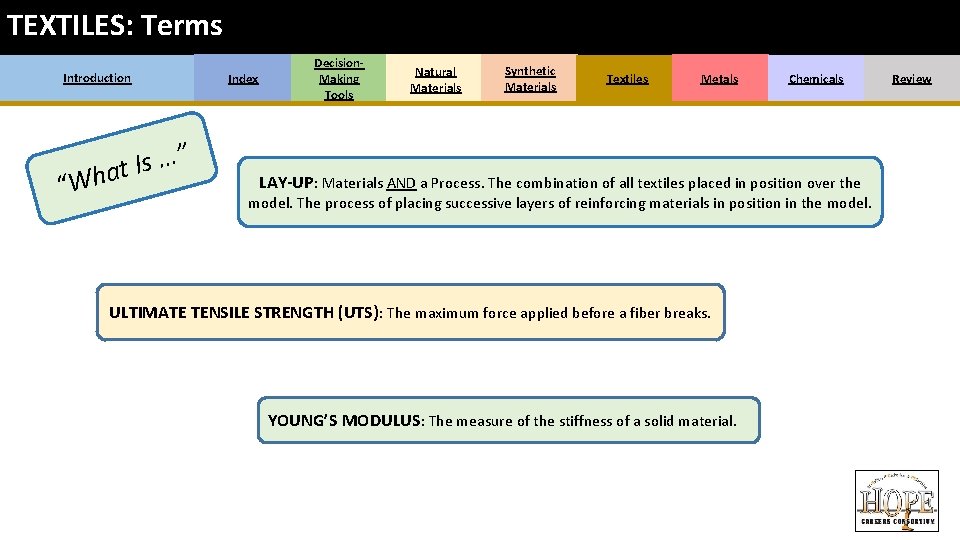
TEXTILES: Terms Introduction “W ” … s I hat Index Decision. Making Tools Natural Materials Synthetic Materials Textiles Metals Chemicals LAY-UP: Materials AND a Process. The combination of all textiles placed in position over the model. The process of placing successive layers of reinforcing materials in position in the model. ULTIMATE TENSILE STRENGTH (UTS): The maximum force applied before a fiber breaks. YOUNG’S MODULUS: The measure of the stiffness of a solid material. Review
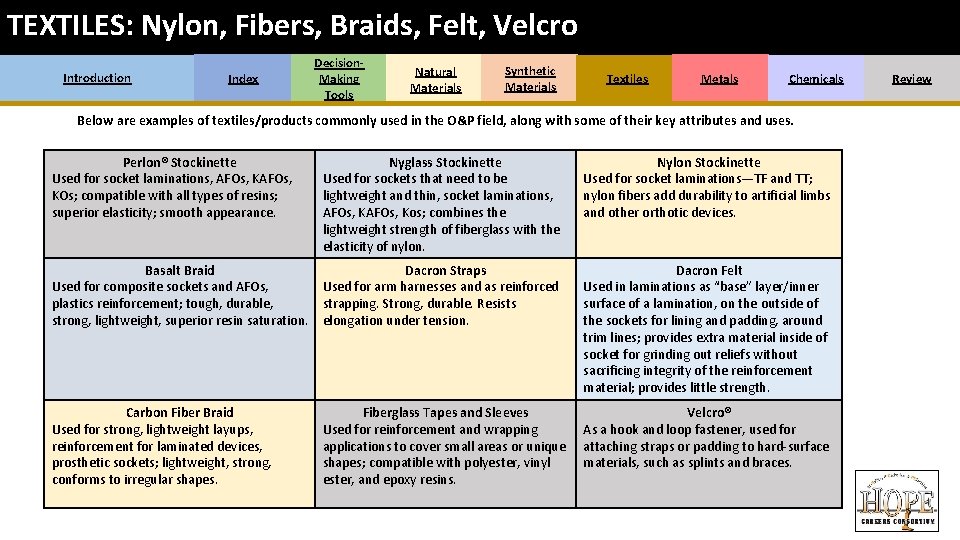
TEXTILES: Nylon, Fibers, Braids, Felt, Velcro Introduction Index Decision. Making Tools Natural Materials Synthetic Materials Textiles Metals Chemicals Below are examples of textiles/products commonly used in the O&P field, along with some of their key attributes and uses. Perlon® Stockinette Used for socket laminations, AFOs, KOs; compatible with all types of resins; superior elasticity; smooth appearance. Nyglass Stockinette Used for sockets that need to be lightweight and thin, socket laminations, AFOs, Kos; combines the lightweight strength of fiberglass with the elasticity of nylon. Nylon Stockinette Used for socket laminations—TF and TT; nylon fibers add durability to artificial limbs and other orthotic devices. Basalt Braid Dacron Straps Used for composite sockets and AFOs, Used for arm harnesses and as reinforced plastics reinforcement; tough, durable, strapping. Strong, durable. Resists strong, lightweight, superior resin saturation. elongation under tension. Dacron Felt Used in laminations as “base” layer/inner surface of a lamination, on the outside of the sockets for lining and padding, around trim lines; provides extra material inside of socket for grinding out reliefs without sacrificing integrity of the reinforcement material; provides little strength. Carbon Fiber Braid Used for strong, lightweight layups, reinforcement for laminated devices, prosthetic sockets; lightweight, strong, conforms to irregular shapes. Velcro® As a hook and loop fastener, used for attaching straps or padding to hard-surface materials, such as splints and braces. Fiberglass Tapes and Sleeves Used for reinforcement and wrapping applications to cover small areas or unique shapes; compatible with polyester, vinyl ester, and epoxy resins. Review
TEXTILES: Review Introduction Decision. Making Tools Index Natural Materials Synthetic Materials Textiles Visit Quizlet to test your knowledge of Textiles. Click on the link below. LINK to QUIZLET: TEXTILES O&P Once on the site, click on “Test Your Knowledge: Textiles O&P. ” You will see a list of words/terms and their associated meanings. 1. 2. 3. 4. 5. Give the list a quick review. Choose any or all of the “Study” tools and “Play” tools listed at the top of the page. Test your knowledge in multiple ways, including flashcards, formal tests, spelling, and timed games. Note: With the test option, you can re-format in multiple ways and take as many times as you like. When finished, return to this presentation for more Materials information. Metals Chemicals Review
METALS Introduction Index Decision. Making Tools Natural Materials Synthetic Materials METALS Textiles Metals Chemicals Review
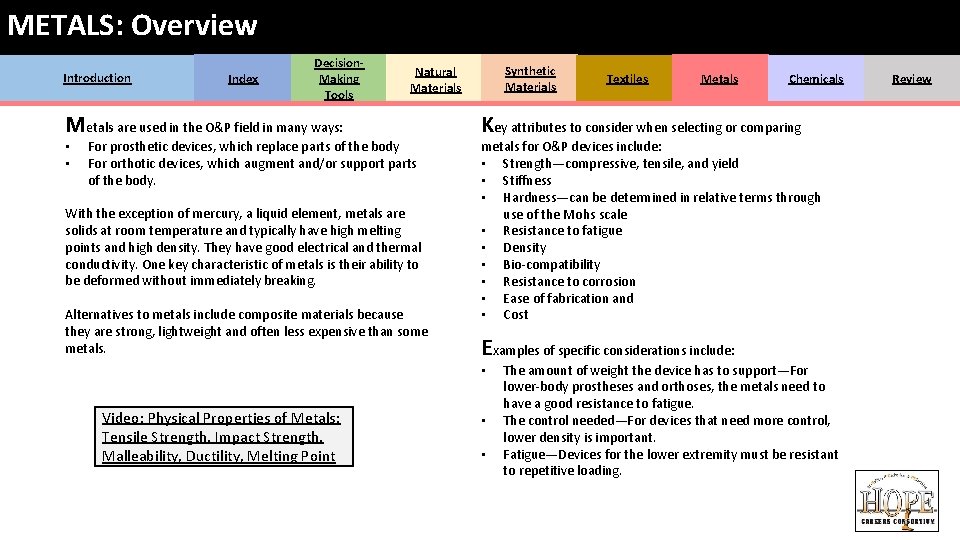
METALS: Overview Introduction Index Decision. Making Tools Metals are used in the O&P field in many ways: • • Synthetic Materials Natural Materials For prosthetic devices, which replace parts of the body For orthotic devices, which augment and/or support parts of the body. With the exception of mercury, a liquid element, metals are solids at room temperature and typically have high melting points and high density. They have good electrical and thermal conductivity. One key characteristic of metals is their ability to be deformed without immediately breaking. Alternatives to metals include composite materials because they are strong, lightweight and often less expensive than some metals. Metals Chemicals Key attributes to consider when selecting or comparing metals for O&P devices include: • Strength—compressive, tensile, and yield • Stiffness • Hardness—can be determined in relative terms through use of the Mohs scale • Resistance to fatigue • Density • Bio-compatibility • Resistance to corrosion • Ease of fabrication and • Cost Examples of specific considerations include: • Video: Physical Properties of Metals: Tensile Strength, Impact Strength, Malleability, Ductility, Melting Point Textiles • • The amount of weight the device has to support—For lower-body prostheses and orthoses, the metals need to have a good resistance to fatigue. The control needed—For devices that need more control, lower density is important. Fatigue—Devices for the lower extremity must be resistant to repetitive loading. Review
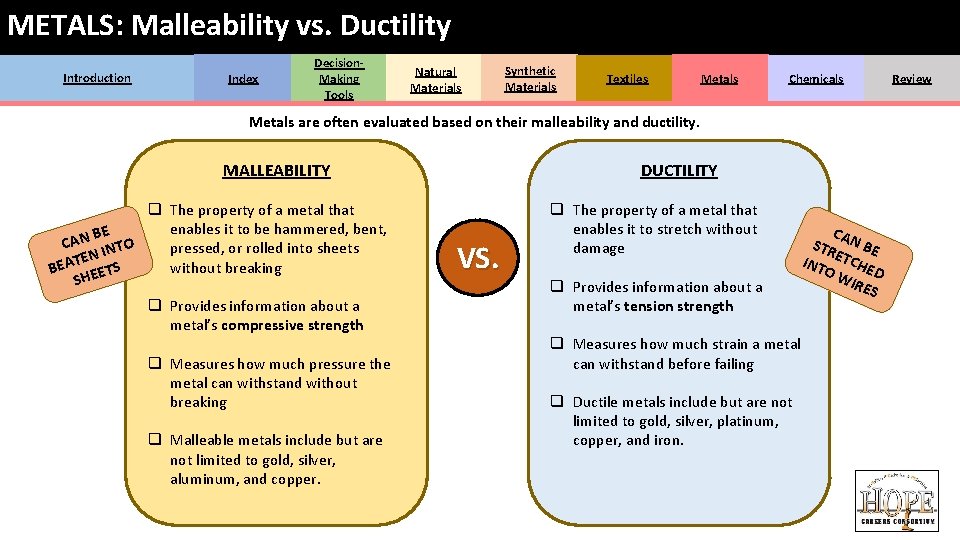
METALS: Malleability vs. Ductility Introduction Index Decision. Making Tools Natural Materials Synthetic Materials Textiles Metals Chemicals Metals are often evaluated based on their malleability and ductility. MALLEABILITY q The property of a metal that enables it to be hammered, bent, BE N A C pressed, or rolled into sheets INTO N E T without breaking BEA EETS SH q Provides information about a metal’s compressive strength q Measures how much pressure the metal can withstand without breaking q Malleable metals include but are not limited to gold, silver, aluminum, and copper. DUCTILITY VS. q The property of a metal that enables it to stretch without damage q Provides information about a metal’s tension strength q Measures how much strain a metal can withstand before failing q Ductile metals include but are not limited to gold, silver, platinum, copper, and iron. CA STR N BE INT ETCHE OW D IRE S Review
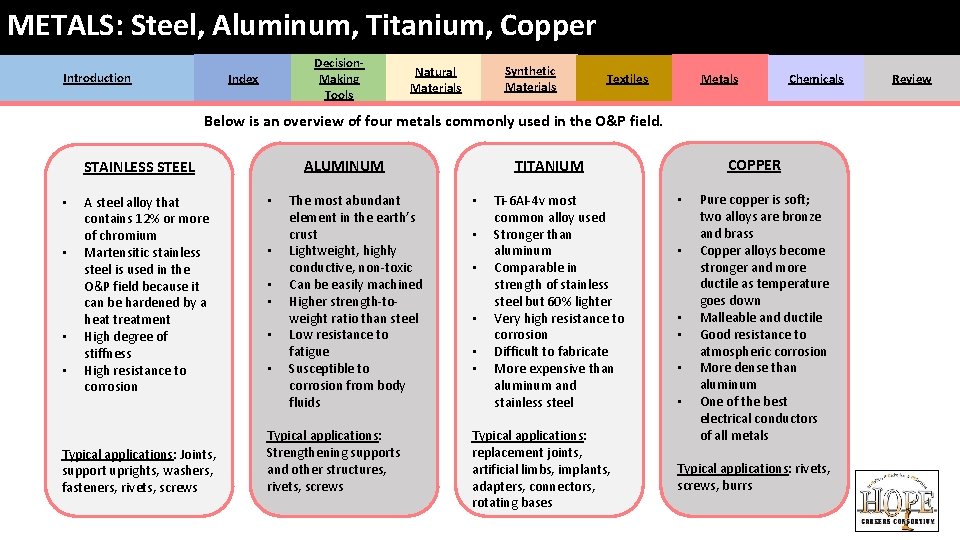
METALS: Steel, Aluminum, Titanium, Copper Introduction Decision. Making Tools Index Synthetic Materials Natural Materials Textiles Metals Chemicals Below is an overview of four metals commonly used in the O&P field. • • A steel alloy that contains 12% or more of chromium Martensitic stainless steel is used in the O&P field because it can be hardened by a heat treatment High degree of stiffness High resistance to corrosion Typical applications: Joints, support uprights, washers, fasteners, rivets, screws • • • The most abundant element in the earth’s crust Lightweight, highly conductive, non-toxic Can be easily machined Higher strength-toweight ratio than steel Low resistance to fatigue Susceptible to corrosion from body fluids Typical applications: Strengthening supports and other structures, rivets, screws COPPER TITANIUM ALUMINUM STAINLESS STEEL • • • Ti-6 AI-4 v most common alloy used Stronger than aluminum Comparable in strength of stainless steel but 60% lighter Very high resistance to corrosion Difficult to fabricate More expensive than aluminum and stainless steel Typical applications: replacement joints, artificial limbs, implants, adapters, connectors, rotating bases • • • Pure copper is soft; two alloys are bronze and brass Copper alloys become stronger and more ductile as temperature goes down Malleable and ductile Good resistance to atmospheric corrosion More dense than aluminum One of the best electrical conductors of all metals Typical applications: rivets, screws, burrs Review
METALS: Review Introduction Decision. Making Tools Index Natural Materials Synthetic Materials Textiles Visit Quizlet to test your knowledge of Metals. Click on the link below. LINK to QUIZLET: METALS O&P Once on the site, click on “Test Your Knowledge: Metals O&P. ” You will see a list of words/terms and their associated meanings. 1. 2. 3. 4. 5. Give the list a quick review. Choose any or all of the “Study” tools and “Play” tools listed at the top of the page. Test your knowledge in multiple ways, including flashcards, formal tests, spelling, and timed games. Note: With the test option, you can re-format in multiple ways and take as many times as you like. When finished, return to this presentation for more Materials information. Metals Chemicals Review
CHEMICALS Introduction Index Decision. Making Tools Natural Materials Synthetic Materials CHEMICALS Textiles Metals Chemicals Review
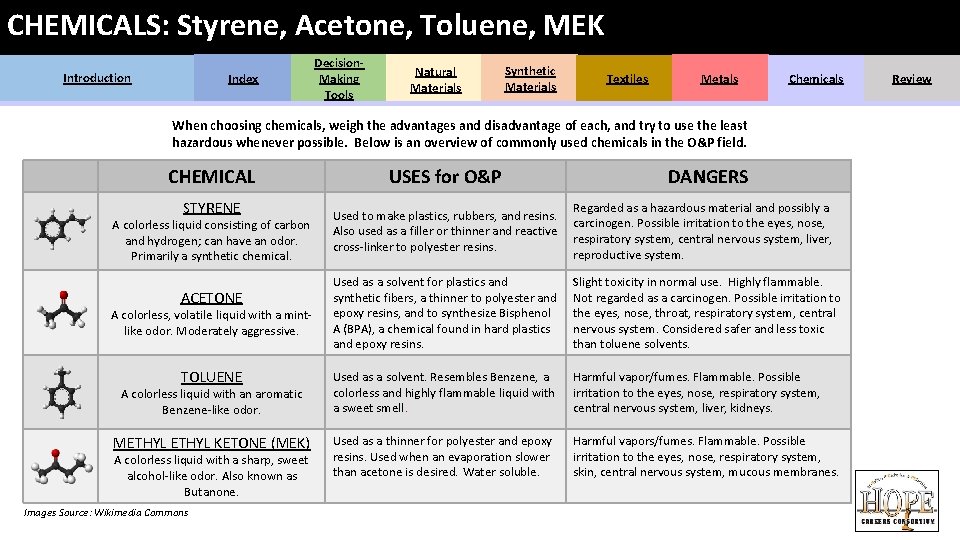
CHEMICALS: Styrene, Acetone, Toluene, MEK Introduction Index Decision. Making Tools Natural Materials Synthetic Materials Textiles Metals Chemicals When choosing chemicals, weigh the advantages and disadvantage of each, and try to use the least hazardous whenever possible. Below is an overview of commonly used chemicals in the O&P field. CHEMICAL STYRENE USES for O&P DANGERS Used to make plastics, rubbers, and resins. Also used as a filler or thinner and reactive cross-linker to polyester resins. Regarded as a hazardous material and possibly a carcinogen. Possible irritation to the eyes, nose, respiratory system, central nervous system, liver, reproductive system. Used as a solvent for plastics and synthetic fibers, a thinner to polyester and epoxy resins, and to synthesize Bisphenol A (BPA), a chemical found in hard plastics and epoxy resins. Slight toxicity in normal use. Highly flammable. Not regarded as a carcinogen. Possible irritation to the eyes, nose, throat, respiratory system, central nervous system. Considered safer and less toxic than toluene solvents. TOLUENE Used as a solvent. Resembles Benzene, a colorless and highly flammable liquid with a sweet smell. Harmful vapor/fumes. Flammable. Possible irritation to the eyes, nose, respiratory system, central nervous system, liver, kidneys. METHYL KETONE (MEK) Used as a thinner for polyester and epoxy resins. Used when an evaporation slower than acetone is desired. Water soluble. Harmful vapors/fumes. Flammable. Possible irritation to the eyes, nose, respiratory system, skin, central nervous system, mucous membranes. A colorless liquid consisting of carbon and hydrogen; can have an odor. Primarily a synthetic chemical. ACETONE A colorless, volatile liquid with a mintlike odor. Moderately aggressive. A colorless liquid with an aromatic Benzene-like odor. A colorless liquid with a sharp, sweet alcohol-like odor. Also known as Butanone. Images Source: Wikimedia Commons Review
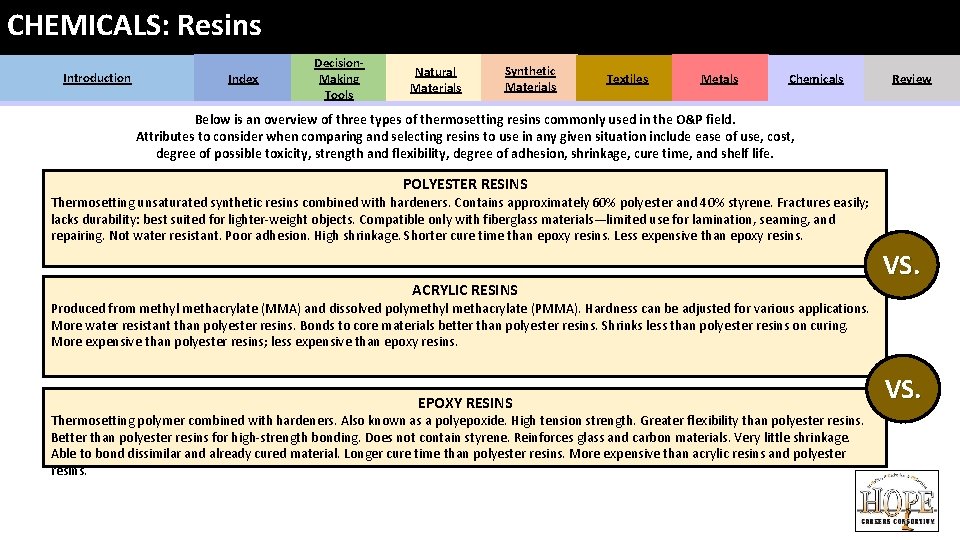
CHEMICALS: Resins Introduction Index Decision. Making Tools Natural Materials Synthetic Materials Textiles Metals Chemicals Review Below is an overview of three types of thermosetting resins commonly used in the O&P field. Attributes to consider when comparing and selecting resins to use in any given situation include ease of use, cost, degree of possible toxicity, strength and flexibility, degree of adhesion, shrinkage, cure time, and shelf life. POLYESTER RESINS Thermosetting unsaturated synthetic resins combined with hardeners. Contains approximately 60% polyester and 40% styrene. Fractures easily; lacks durability: best suited for lighter-weight objects. Compatible only with fiberglass materials—limited use for lamination, seaming, and repairing. Not water resistant. Poor adhesion. High shrinkage. Shorter cure time than epoxy resins. Less expensive than epoxy resins. ACRYLIC RESINS VS. Produced from methyl methacrylate (MMA) and dissolved polymethyl methacrylate (PMMA). Hardness can be adjusted for various applications. More water resistant than polyester resins. Bonds to core materials better than polyester resins. Shrinks less than polyester resins on curing. More expensive than polyester resins; less expensive than epoxy resins. EPOXY RESINS Thermosetting polymer combined with hardeners. Also known as a polyepoxide. High tension strength. Greater flexibility than polyester resins. Better than polyester resins for high-strength bonding. Does not contain styrene. Reinforces glass and carbon materials. Very little shrinkage. Able to bond dissimilar and already cured material. Longer cure time than polyester resins. More expensive than acrylic resins and polyester resins. VS.
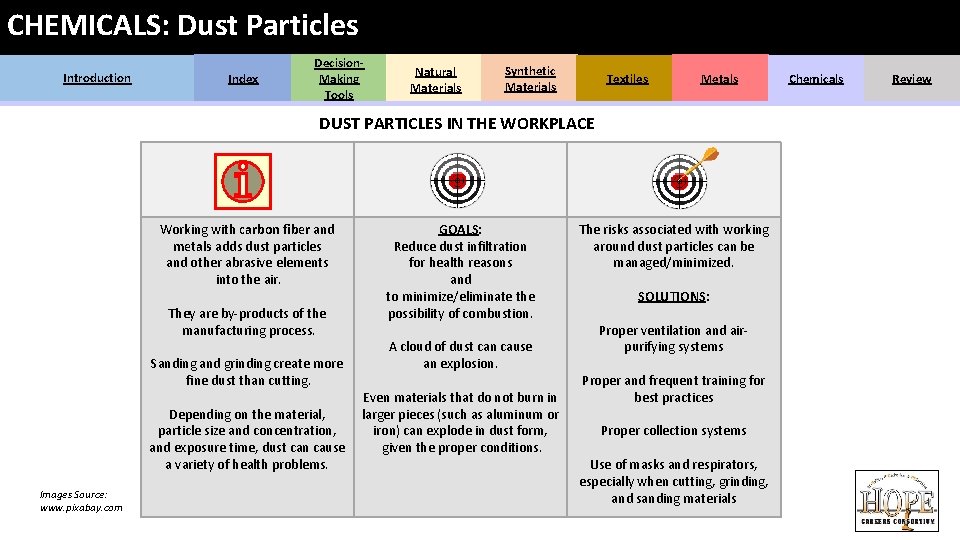
CHEMICALS: Dust Particles Introduction Index Decision. Making Tools Natural Materials Synthetic Materials Textiles Metals DUST PARTICLES IN THE WORKPLACE Working with carbon fiber and metals adds dust particles and other abrasive elements into the air. They are by-products of the manufacturing process. Sanding and grinding create more fine dust than cutting. Depending on the material, particle size and concentration, and exposure time, dust can cause a variety of health problems. Images Source: www. pixabay. com GOALS: Reduce dust infiltration for health reasons and to minimize/eliminate the possibility of combustion. A cloud of dust can cause an explosion. Even materials that do not burn in larger pieces (such as aluminum or iron) can explode in dust form, given the proper conditions. The risks associated with working around dust particles can be managed/minimized. SOLUTIONS: Proper ventilation and airpurifying systems Proper and frequent training for best practices Proper collection systems Use of masks and respirators, especially when cutting, grinding, and sanding materials Chemicals Review
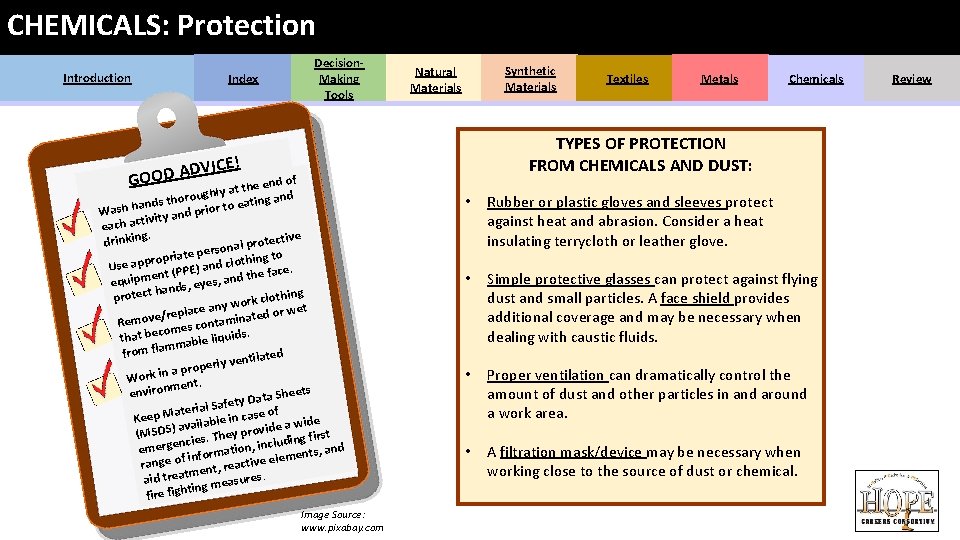
CHEMICALS: Protection Introduction Index Decision. Making Tools Synthetic Materials Natural Materials E! Image Source: www. pixabay. com Metals Chemicals TYPES OF PROTECTION FROM CHEMICALS AND DUST: DVIC A D O O G end of e h t t a y ghl s thorou r to eating and d n a h h io Was y and pr t i v i t c a each. tive drinking l protec a n o s r e p ropriate hing to Use app t (PPE) and clot. the face en equipm nds, eyes, and ha hing protect ork clot et w y n a /replace aminated or w t Remove mes con ids. o c e b t tha iqu mable l m a l f m fro ed ventilat y l r e p o a pr Work in nt. me ts environ ta Shee a D y t e f a aterial S of Keep M ailable in case e a wide av (MSDS) es. They provid ing first nci lud emerge formation, inc and ments, in e f l e o e e v g i n t ra eac tment, r res. a e r t d i a asu ting me fire figh Textiles • Rubber or plastic gloves and sleeves protect against heat and abrasion. Consider a heat insulating terrycloth or leather glove. • Simple protective glasses can protect against flying dust and small particles. A face shield provides additional coverage and may be necessary when dealing with caustic fluids. • Proper ventilation can dramatically control the amount of dust and other particles in and around a work area. • A filtration mask/device may be necessary when working close to the source of dust or chemical. Review
CHEMICALS: Review Introduction Decision. Making Tools Index Natural Materials Synthetic Materials Textiles Visit Quizlet to test your knowledge of Chemicals. Click on the link below. LINK to QUIZLET: CHEMICALS O&P Once on the site, click on “Test Your Knowledge: Chemicals O&P. ” You will see a list of words/terms and their associated meanings. 1. 2. 3. 4. 5. Give the list a quick review. Choose any or all of the “Study” tools and “Play” tools listed at the top of the page. Test your knowledge in multiple ways, including flashcards, formal tests, spelling, and timed games. Note: With the test option, you can re-format in multiple ways and take as many times as you like. When finished, return to this presentation for more Materials information. Metals Chemicals Review
REVIEW Introduction Index Decision. Making Tools Natural Materials Synthetic Materials Textiles REVIEW Use the following Review Section to test and apply your knowledge. The self-assessment included in this section features multiple-choice questions that cover subject matter from the entire presentation. 1. Read the question. 2. Click on the answer that most accurately reflects the correct response. 3. If the answer is correct, continue the self-assessment by clicking on the “RETURN TO THE QUIZ” link. Then, click on the forward arrow. 4. If the answer is incorrect, the correct answer will be provided. Continue the self-assessment by clicking on the forward arrow. 5. Use the back arrow anytime to re-visit previous questions. Metals Chemicals Review
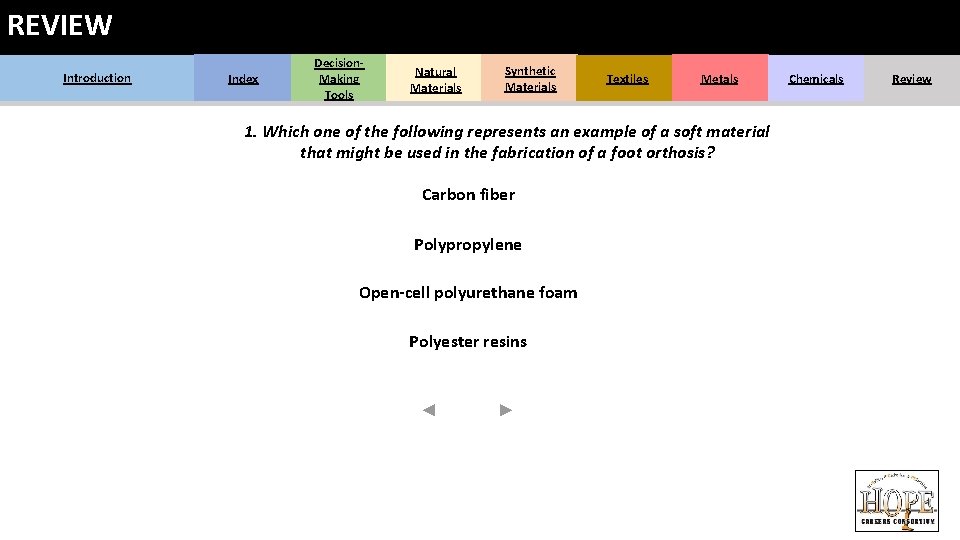
REVIEW Introduction Index Decision. Making Tools Natural Materials Synthetic Materials Textiles Metals 1. Which one of the following represents an example of a soft material that might be used in the fabrication of a foot orthosis? Carbon fiber Polypropylene Open-cell polyurethane foam Polyester resins Chemicals Review
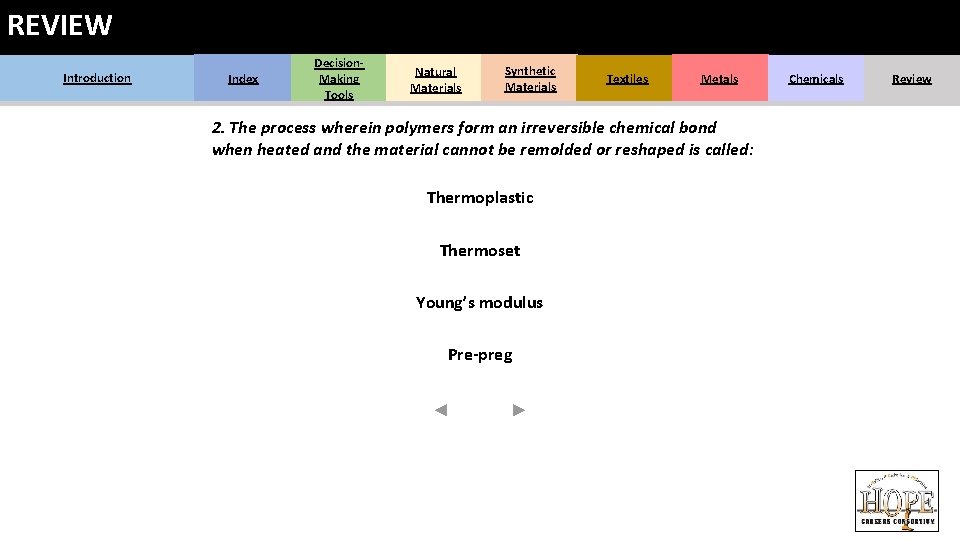
REVIEW Introduction Index Decision. Making Tools Natural Materials Synthetic Materials Textiles Metals 2. The process wherein polymers form an irreversible chemical bond when heated and the material cannot be remolded or reshaped is called: Thermoplastic Thermoset Young’s modulus Pre-preg Chemicals Review
REVIEW Introduction Index Decision. Making Tools Natural Materials Synthetic Materials Textiles 3. The property of a metal that enables it to be hammered, bent, pressed, or rolled into sheets without breaking is: Ductility Grindability Malleability Durability Metals Chemicals Review
REVIEW Introduction Index Decision. Making Tools Natural Materials Synthetic Materials Textiles 4. Plastazote, Pe-Lite, and Aliplast are examples of: Polyester resins Carbon fiber reinforced plastics Open-cell thermosetting foams Polyethylene foams Metals Chemicals Review
REVIEW Introduction Index Decision. Making Tools Natural Materials Synthetic Materials 5. Acetone and toluene are both: Chemical solvents Steel alloys Polyester resins Lamination materials Textiles Metals Chemicals Review
REVIEW Introduction Index Decision. Making Tools Natural Materials Synthetic Materials Textiles 6. Foamed thermoplastics are formed by forcing nitrogen or some other gas into the plastic during heating. They can be: Malleable or ductile Open-cell or closed-cell Natural or synthetic Dense or durable Metals Chemicals Review
REVIEW Introduction Index Decision. Making Tools Natural Materials Synthetic Materials Textiles 7. Density can be calculated: As the load divided by deformation Using the Mohs scale Using a durometer As the material’s weight per unit of volume Metals Chemicals Review
REVIEW Introduction Index Decision. Making Tools Natural Materials Synthetic Materials 8. The tool that helps determine a material’s resistance to permanent indentation is the: Mohs scale Iron Durometer Laminator Textiles Metals Chemicals Review
REVIEW Introduction Index Decision. Making Tools Natural Materials Synthetic Materials Textiles 9. The process of placing successive layers of reinforcing materials in position in the model is called: Young’s modulus Lay-up Pre-preg Thermosetting Metals Chemicals Review
REVIEW Introduction Index Decision. Making Tools Natural Materials Synthetic Materials Textiles 10. In the lamination process, reinforcement textiles are fabric / fibers used to provide: strength comfort weight tension Metals Chemicals Review
REVIEW Introduction Index Decision. Making Tools Synthetic Materials Natural Materials Textiles Metals Chemicals ATTRIBUTIONS Aliplast is a registered trademark of Alimed. Carboplast is a registered trademark of Aetrex Worldwide, Inc. Dacron is a registered trademark of Du. Pont. Elasti. Cork is a registered trademark of Acor Orthopaedic, Inc. Evazote is a registered trademark of Zotefoams, Inc. Kevlar is a registered trademark of Du. Pont. Kydex is a registered trademark of Kydex LLC. Microcel Puff is a registered trademark of Acor Orthopaedic, Inc. Multicork is a registered trademark of Acor Orthopaedic, Inc. Ortholen is a registered trademark of Teufel Orthopedic / Wilhelm Julius Teufel. Perlon is a registered trademark of Perlon-Monofil GMBH PPT is a registered trademark of Langer Biomechanics Group, Inc. P-Cell is a registered trademark of Acor Orthopaedic, Inc. Pe-Lite is a registered trademark of Fillauer, LLC. Plastazote is a registered trademark of Zotefoams, Inc. Poron is a registered trademark of Rogers Corporation. Spenco is a registered trademark of Spenco Medical Corporation. Sub. Ortholen is a registered trademark of Teufel Orthopedic. Surlyn is a registered trademark of Du. Pont. Thermo Cork is a registered trademark of Aetrex Worldwide, Inc. Thermo. SKY is a registered trademark Aetrex Worldwide, Inc. Velcro is a registered trademark of Velcro Industries B. V. VIVAK is a registered trademark of Sheffield Plastics Inc. Although the authoring institution of this educational resource has made every effort to ensure that the information presented is correct, the institution assumes no liability to any party for any loss, damage, or disruption caused by errors or omissions. Images used from Pixabay are released into the Public Domain under Creative Commons CC 0. Images used from Wikimedia Commons are released into the Public Domain by the copyright holder. Except where otherwise noted (Pixabay and Wikimedia Commons images), this work by Oklahoma State University Institute of Technology is licensed under the Creative Commons Attribution 4. 0 International License. To view a copy of this license, click on the following link: Creative Commons Licenses 4. 0. Review