
Introduction Incident Management Systems IMS The mark CDC
- Slides: 29
Introduction Incident Management Systems (IMS) The mark “CDC” is owned by the US Dept. of Health and Human Services and is used with permission. Use of this logo is not an endorsement by HHS or CDC of any particular product, service, or enterprise. cdc. gov/coronavirus
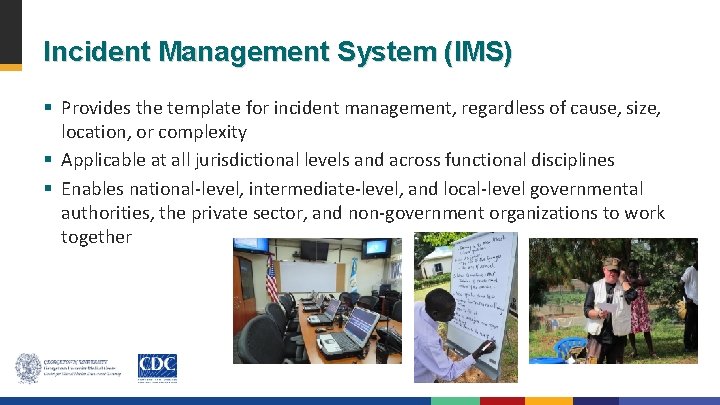
Incident Management System (IMS) § Provides the template for incident management, regardless of cause, size, location, or complexity § Applicable at all jurisdictional levels and across functional disciplines § Enables national-level, intermediate-level, and local-level governmental authorities, the private sector, and non-government organizations to work together
Benefits of an Incident Management System § § § Standardized, scalable and flexible approach Enhanced cooperation and interoperability Efficient resource coordination Comprehensive all-hazards preparedness Incorporates measurable, achievable objectives Incidents are managed at the lowest possible geographic, organizational, and jurisdictional level
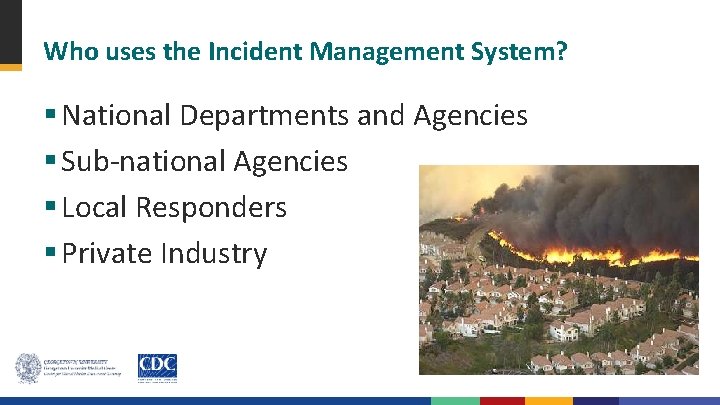
Who uses the Incident Management System? § National Departments and Agencies § Sub-national Agencies § Local Responders § Private Industry
When Should Public Health use the Incident Management System? § Communicable Disease Outbreaks: E. coli, West Nile Virus, Plague, SARS, Hepatitis, Hantavirus, Novel Coronavirus (COVID-19) § Non-Outbreak Situations: Flooding, disruption of utilities, mass immunization campaigns (flu, Hep A), community events, mass gatherings § Emergency Medical Services: Multi-patient and mass casualty events, trauma events
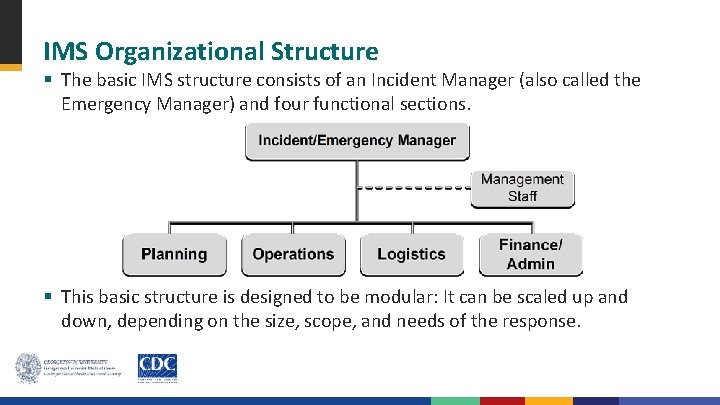
IMS Organizational Structure § The basic IMS structure consists of an Incident Manager (also called the Emergency Manager) and four functional sections. § This basic structure is designed to be modular: It can be scaled up and down, depending on the size, scope, and needs of the response.
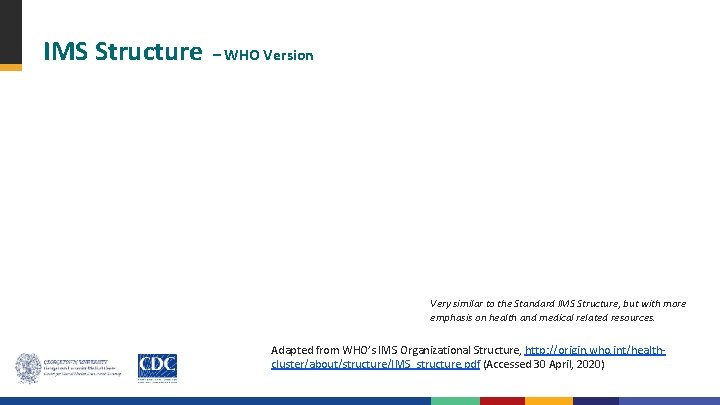
IMS Structure – WHO Version Very similar to the Standard IMS Structure, but with more emphasis on health and medical related resources. Adapted from WHO’s IMS Organizational Structure, http: //origin. who. int/healthcluster/about/structure/IMS_structure. pdf (Accessed 30 April, 2020)
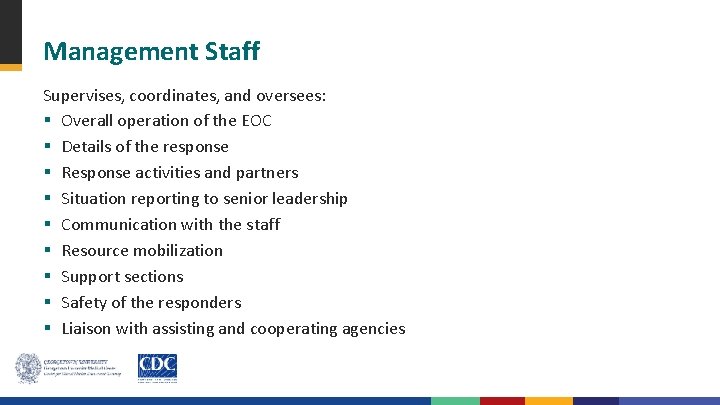
Management Staff Supervises, coordinates, and oversees: § Overall operation of the EOC § Details of the response § Response activities and partners § Situation reporting to senior leadership § Communication with the staff § Resource mobilization § Support sections § Safety of the responders § Liaison with assisting and cooperating agencies
Management Staff § § § Specific roles within the Management Staff can include: Incident Manager EOC Facility Manager Safety Officer Liaison Officer Public Communication Officer
Incident Manager (IM) § § § § Also called Emergency Manager, Director, or Coordinator In charge of the entire management section and management staff Obtains approval to activate the Incident Management System Maintains overall situational awareness of the event and all deployed resources Attends briefings and approves briefings to be presented Establishes incident priorities Approves incident objectives.
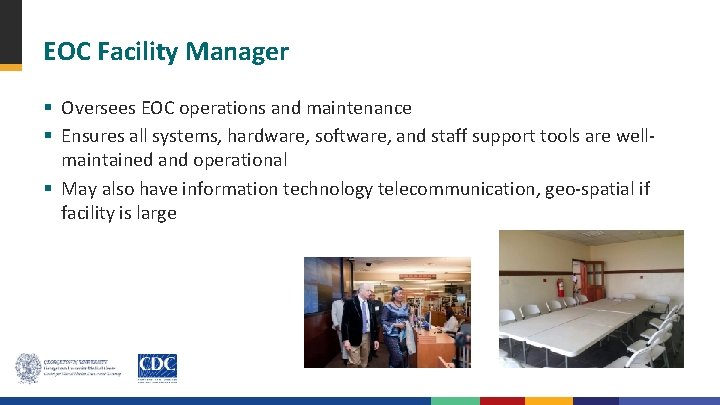
EOC Facility Manager § Oversees EOC operations and maintenance § Ensures all systems, hardware, software, and staff support tools are wellmaintained and operational § May also have information technology telecommunication, geo-spatial if facility is large
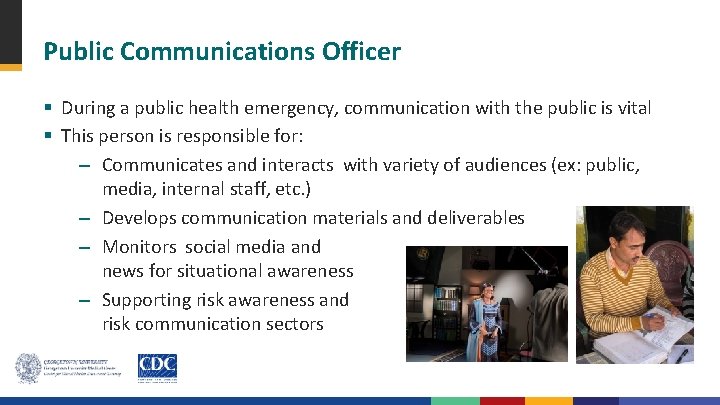
Public Communications Officer § During a public health emergency, communication with the public is vital § This person is responsible for: – Communicates and interacts with variety of audiences (ex: public, media, internal staff, etc. ) – Develops communication materials and deliverables – Monitors social media and news for situational awareness – Supporting risk awareness and risk communication sectors
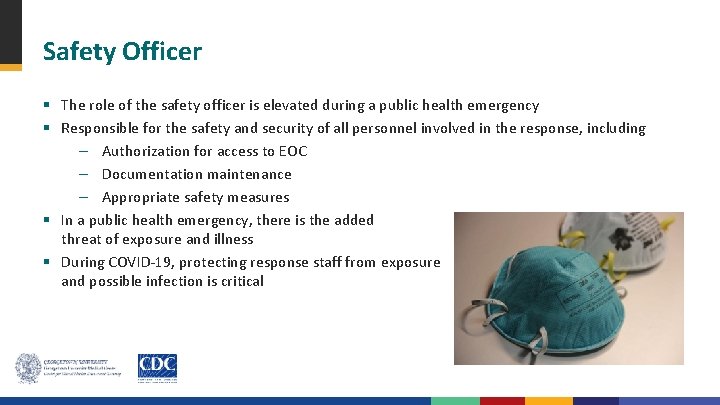
Safety Officer § The role of the safety officer is elevated during a public health emergency § Responsible for the safety and security of all personnel involved in the response, including – Authorization for access to EOC – Documentation maintenance – Appropriate safety measures § In a public health emergency, there is the added threat of exposure and illness § During COVID-19, protecting response staff from exposure and possible infection is critical
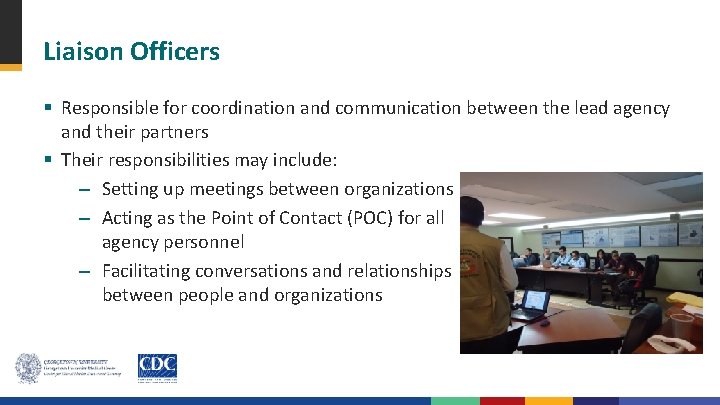
Liaison Officers § Responsible for coordination and communication between the lead agency and their partners § Their responsibilities may include: – Setting up meetings between organizations – Acting as the Point of Contact (POC) for all agency personnel – Facilitating conversations and relationships between people and organizations
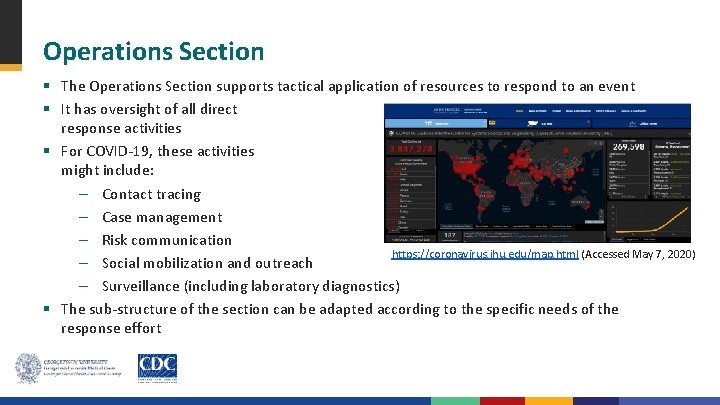
Operations Section § The Operations Section supports tactical application of resources to respond to an event § It has oversight of all direct response activities § For COVID-19, these activities might include: – Contact tracing – Case management – Risk communication https: //coronavirus. jhu. edu/map. html (Accessed May 7, 2020) – Social mobilization and outreach – Surveillance (including laboratory diagnostics) § The sub-structure of the section can be adapted according to the specific needs of the response effort
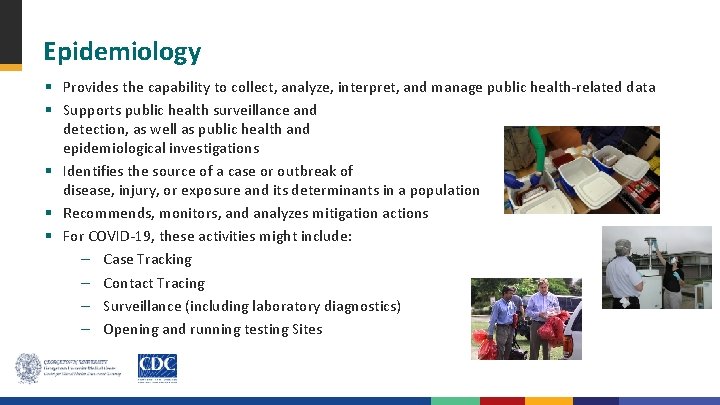
Epidemiology § Provides the capability to collect, analyze, interpret, and manage public health-related data § Supports public health surveillance and detection, as well as public health and epidemiological investigations § Identifies the source of a case or outbreak of disease, injury, or exposure and its determinants in a population § Recommends, monitors, and analyzes mitigation actions § For COVID-19, these activities might include: – Case Tracking – Contact Tracing – Surveillance (including laboratory diagnostics) – Opening and running testing Sites
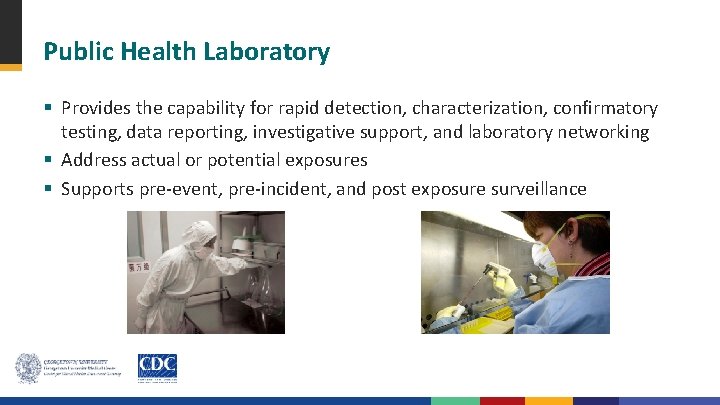
Public Health Laboratory § Provides the capability for rapid detection, characterization, confirmatory testing, data reporting, investigative support, and laboratory networking § Address actual or potential exposures § Supports pre-event, pre-incident, and post exposure surveillance
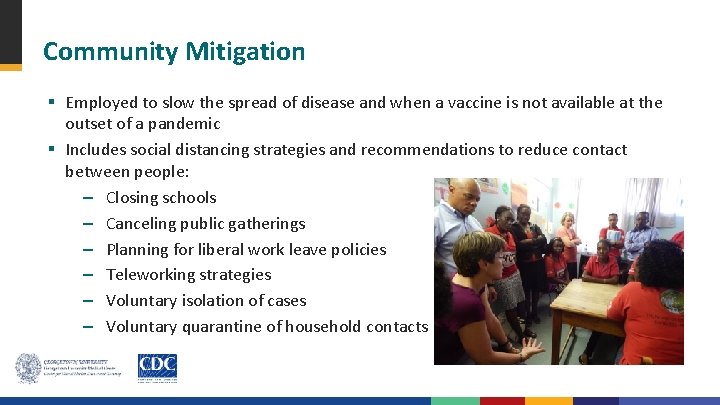
Community Mitigation § Employed to slow the spread of disease and when a vaccine is not available at the outset of a pandemic § Includes social distancing strategies and recommendations to reduce contact between people: – Closing schools – Canceling public gatherings – Planning for liberal work leave policies – Teleworking strategies – Voluntary isolation of cases – Voluntary quarantine of household contacts
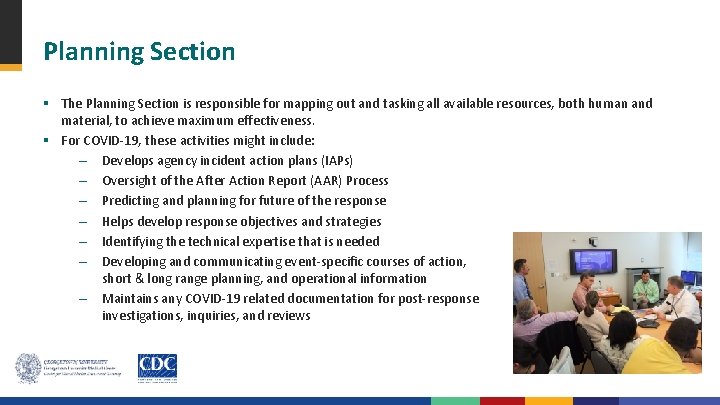
Planning Section § The Planning Section is responsible for mapping out and tasking all available resources, both human and material, to achieve maximum effectiveness. § For COVID-19, these activities might include: – Develops agency incident action plans (IAPs) – Oversight of the After Action Report (AAR) Process – Predicting and planning for future of the response – Helps develop response objectives and strategies – Identifying the technical expertise that is needed – Developing and communicating event-specific courses of action, short & long range planning, and operational information – Maintains any COVID-19 related documentation for post-response investigations, inquiries, and reviews
Incident Action Plans § An Incident Action Plan (IAP) is a document prepared during a response for each operational period. The purpose of the IAP is to: – Ensure response personnel are working toward the same goals by providing direction for actions to be taken during the operational period identified in the plan – Provide a coherent means of communicating the incident objectives for operational and support activities. This includes measurable strategic objectives for the operational period – Reduce freelancing and ensure a coordinated response
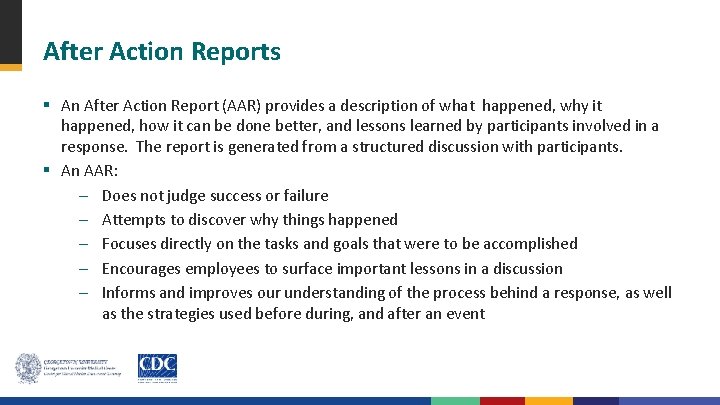
After Action Reports § An After Action Report (AAR) provides a description of what happened, why it happened, how it can be done better, and lessons learned by participants involved in a response. The report is generated from a structured discussion with participants. § An AAR: – Does not judge success or failure – Attempts to discover why things happened – Focuses directly on the tasks and goals that were to be accomplished – Encourages employees to surface important lessons in a discussion – Informs and improves our understanding of the process behind a response, as well as the strategies used before during, and after an event
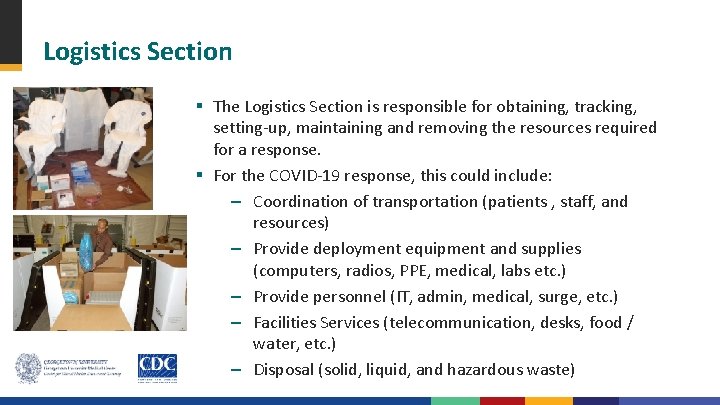
Logistics Section § The Logistics Section is responsible for obtaining, tracking, setting-up, maintaining and removing the resources required for a response. § For the COVID-19 response, this could include: – Coordination of transportation (patients , staff, and resources) – Provide deployment equipment and supplies (computers, radios, PPE, medical, labs etc. ) – Provide personnel (IT, admin, medical, surge, etc. ) – Facilities Services (telecommunication, desks, food / water, etc. ) – Disposal (solid, liquid, and hazardous waste)
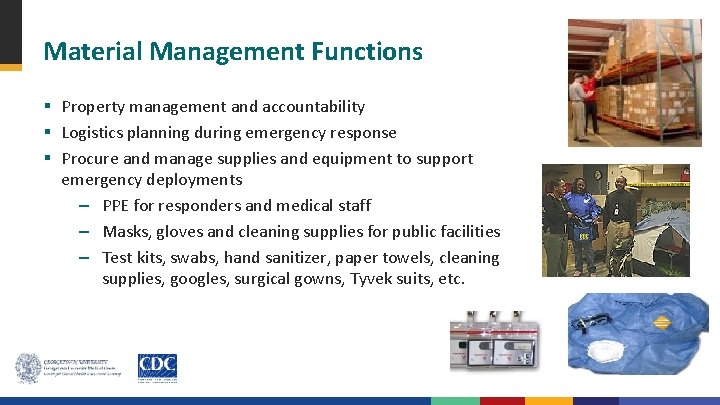
Material Management Functions § Property management and accountability § Logistics planning during emergency response § Procure and manage supplies and equipment to support emergency deployments – PPE for responders and medical staff – Masks, gloves and cleaning supplies for public facilities – Test kits, swabs, hand sanitizer, paper towels, cleaning supplies, googles, surgical gowns, Tyvek suits, etc.
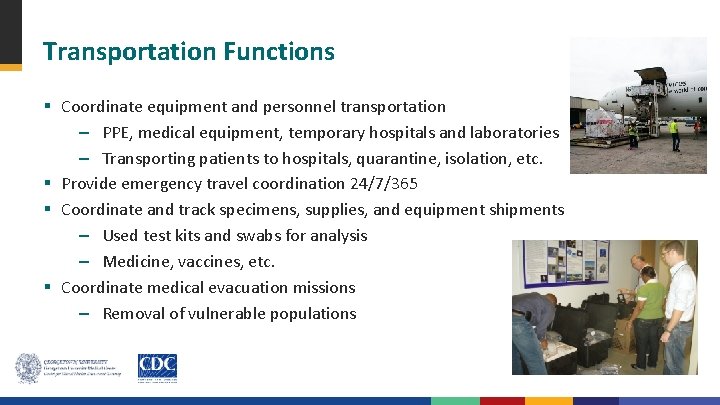
Transportation Functions § Coordinate equipment and personnel transportation – PPE, medical equipment, temporary hospitals and laboratories – Transporting patients to hospitals, quarantine, isolation, etc. § Provide emergency travel coordination 24/7/365 § Coordinate and track specimens, supplies, and equipment shipments – Used test kits and swabs for analysis – Medicine, vaccines, etc. § Coordinate medical evacuation missions – Removal of vulnerable populations
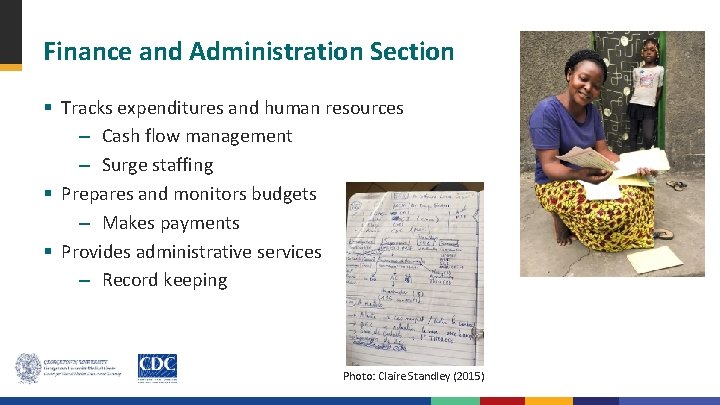
Finance and Administration Section § Tracks expenditures and human resources – Cash flow management – Surge staffing § Prepares and monitors budgets – Makes payments § Provides administrative services – Record keeping Photo: Claire Standley (2015)
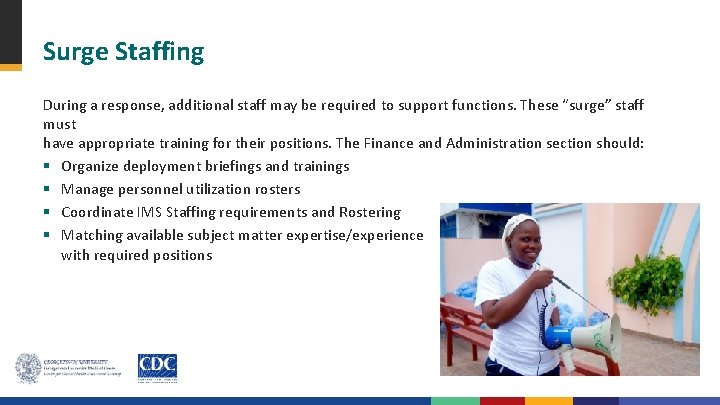
Surge Staffing During a response, additional staff may be required to support functions. These “surge” staff must have appropriate training for their positions. The Finance and Administration section should: § Organize deployment briefings and trainings § Manage personnel utilization rosters § Coordinate IMS Staffing requirements and Rostering § Matching available subject matter expertise/experience with required positions
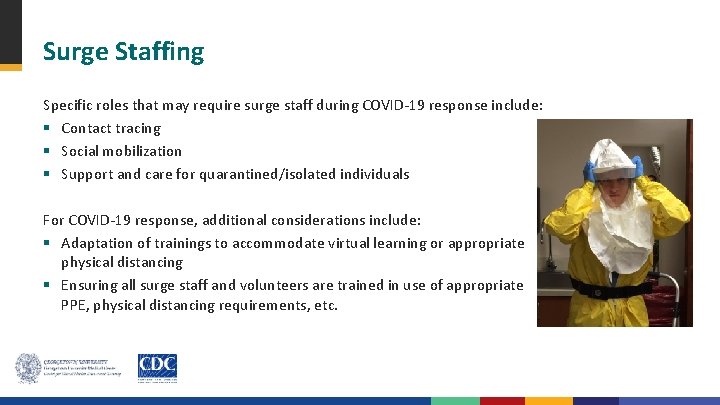
Surge Staffing Specific roles that may require surge staff during COVID-19 response include: § Contact tracing § Social mobilization § Support and care for quarantined/isolated individuals For COVID-19 response, additional considerations include: § Adaptation of trainings to accommodate virtual learning or appropriate physical distancing § Ensuring all surge staff and volunteers are trained in use of appropriate PPE, physical distancing requirements, etc.
References § WHO (2015) Framework for Public Health Emergency Operations Centres. https: //www. who. int/ihr/publications/9789241565134_eng/en/ § WHO (n. d. ) WHO’s IMS Organizational Structure. http: //origin. who. int/health-cluster/about/structure/IMS_structure. pdf § Photos retrieved from https: //phil. cdc. gov unless otherwise referenced
For more information, contact CDC 1 -800 -CDC-INFO (232 -4636) TTY: 1 -888 -232 -6348 www. cdc. gov The findings and conclusions in this report are those of the authors and do not necessarily represent the official position of the Centers for Disease Control and Prevention.