
Introduction HUMAN ANATOMY AND PHYSIOLOGY WHAT IS ANATOMY
- Slides: 12
Introduction HUMAN ANATOMY AND PHYSIOLOGY
WHAT IS ANATOMY AND PHYSIOLOGY? �Anatomy-study of the structure and shapes of body parts and their relationship to one another. �Physiology-how the body and its parts work or function.
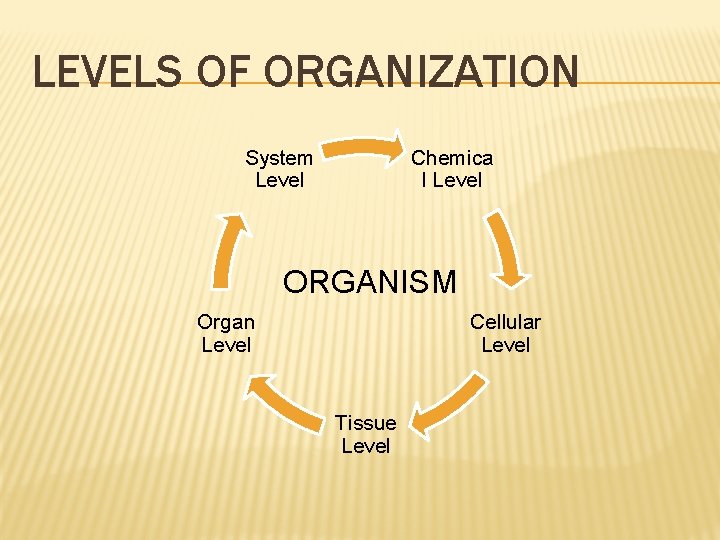
LEVELS OF ORGANIZATION System Level Chemica l Level ORGANISM Organ Level Cellular Level Tissue Level
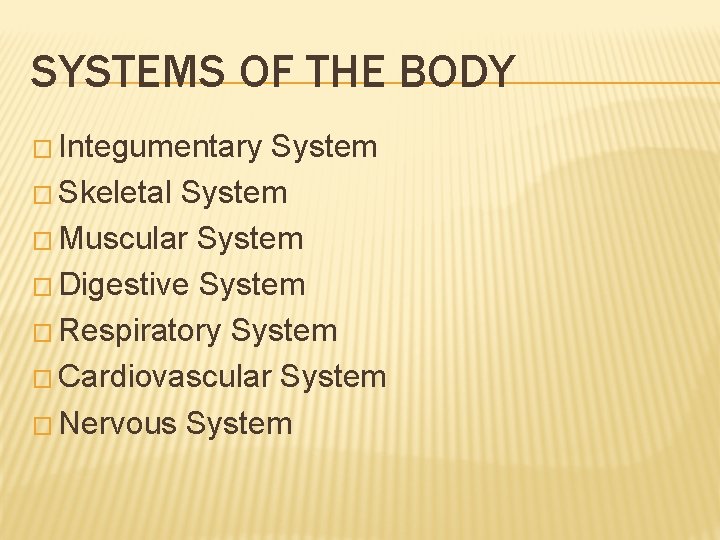
SYSTEMS OF THE BODY � Integumentary System � Skeletal System � Muscular System � Digestive System � Respiratory System � Cardiovascular System � Nervous System
� Lymphatic System � Endocrine System � Urinary System � Reproductive System
MAINTAINING LIFE � Organ system do not work in isolation; they work together to promote wellbeing of the entire body. � Every cell of the human body is surrounded by external membrane, allowing needed substances to flow inside and restricting the entry of unnecessary substance.
� Movement � Responsiveness � Digestion � Metabolism � Excretion � Reproduction � Growth or irritability
SURVIVAL NEEDS �Nutrients �Oxygen �Water �Body Temperature �Atmospheric Pressure
HOMEOSTASIS � The body’s ability to maintain relatively stable internal conditions even though the outside world is continuously changing. � The body is in equilibrium when its needs are adequately met and its functioning smoothly.
HOMEOSTATIC CONTROL MECHANISMS � This is the work of the endocrine and nervous systems. They use electrical signals to deliver the message to different parts of the body. � There are 3 components of the homeostatic mechanism: 1. Receptor-receives the stimulus 2. Control Center-analyzes the information received. 3. Effector-provides means for the control center’s response.
� The are 2 kinds of feedback in the homeostatic control mechanism: 1. Negative Feedback-most systems are negative feedback; the effect of the response is to shut off the original stimulus. 2. Positive Feedback-rare in the systems; controls the event; example is blood clotting and birth of the baby.
HOMEOSTATIC IMBALANCE � Most disease is regarded as homeostatic imbalance � As we age, our body organs becomes less efficient and our internal conditions becomes less stable. � When the body is subjected to trauma (car accident), the most vulnerable part is your abdominopelvic organs, because no bones surround this area.