
Introduction How to Use this Presentation This presentation

- Slides: 47
Introduction How to Use this Presentation This presentation contains base material for use in an instructor-led training setting. You may modify this presentation to satisfy the specific training needs of your organization. On some slides, the display text is supplemented with additional material in the slide notes. This content is licensed for modification and use in a classroom setting. You may not redistribute this material in any form. DISCLAIMER This training material presents very important, pertinent information. It should not be assumed, however, that this program satisfies every legal requirement of every state. Some states require the training be developed and delivered by an individual with specific training and experience. This training is AWARENESS LEVEL and does not authorize any person to perform work or validate their level of competency; it must be supplemented with operation and processspecific assessments and training, as well as management oversight, to assure that all training is understood and followed. Your organization must do an evaluation of all exposures and applicable codes and regulations. In addition, establish proper controls, training, and protective measures to effectively control exposures and assure compliance. This program is neither a determination that the conditions and practices of your organization are safe, nor a warranty that reliance upon this program will prevent accidents and losses or satisfy local, state, or federal regulations.
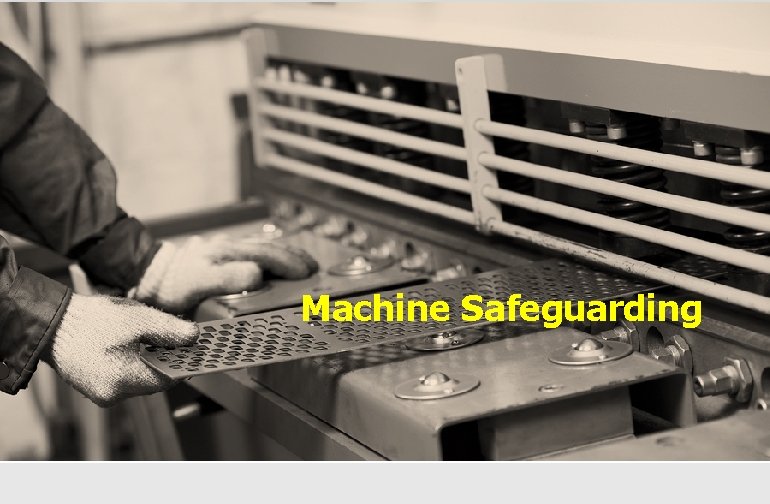
Machine Safeguarding
Introduction Learning Objectives • Understand the importance of machine safeguarding. • Know the types of motion to guard against. • Implement and use various types of machine safeguarding. • Understand additional controls to put in place. • Address the hazards associated with conveyor systems.
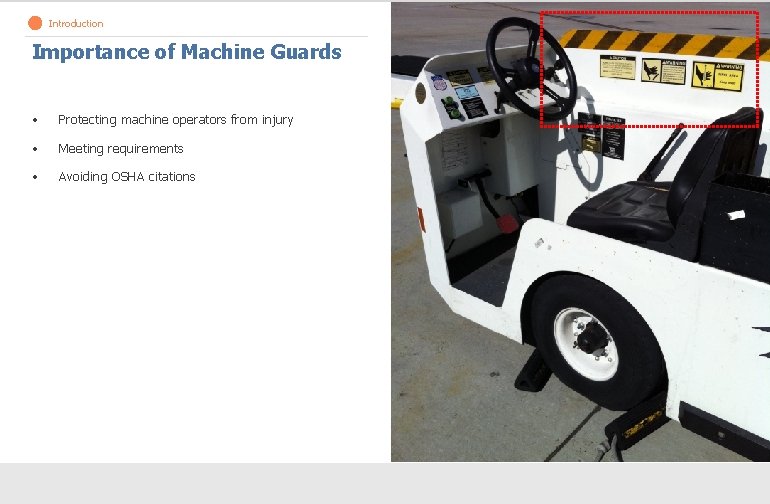
Introduction Importance of Machine Guards • Protecting machine operators from injury • Meeting requirements • Avoiding OSHA citations
Introduction Course Overview 1. Motion Hazards 2. Basics of Safeguarding 3. Guards 4. Safeguarding Devices 5. Other Controls 6. Conveyor Systems DISCLAIMER This training material presents very important, pertinent information. It should not be assumed, however, that this program satisfies every legal requirement of every state. Some states require the training be developed and delivered by an individual with specific training and experience. This training is AWARENESS LEVEL and does not authorize any person to perform work or validate their level of competency; it must be supplemented with operation and processspecific assessments and training, as well as management oversight, to assure that all training is understood and followed. Your organization must do an evaluation of all exposures and applicable codes and regulations. In addition, establish proper controls, training, and protective measures to effectively control exposures and assure compliance. This program is neither a determination that the conditions and practices of your organization are safe, nor a warranty that reliance upon this program will prevent accidents and losses or satisfy local, state, or federal regulations.
1 Motion Hazards What you need to know: • The – – – various types of motion hazards: Rotation Transverse motion In-running nip points Cutting Punching, shearing, or bending
1 Motion Hazards Rotation • Mechanisms grab loose material. • Uneven surfaces increase the hazard. • This is a “caught-in hazard. ” • Examples include the following: – Drill bit – Shafts – Flywheels The rotation of this chuck and drill presents a hazard.
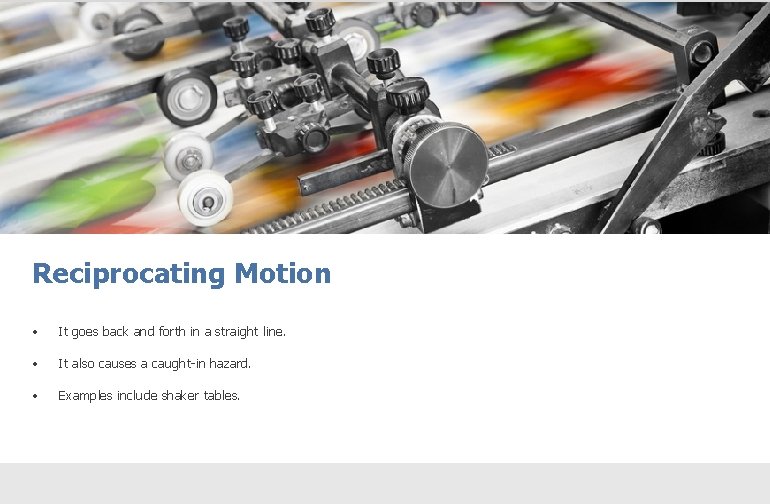
Reciprocating Motion • It goes back and forth in a straight line. • It also causes a caught-in hazard. • Examples include shaker tables.
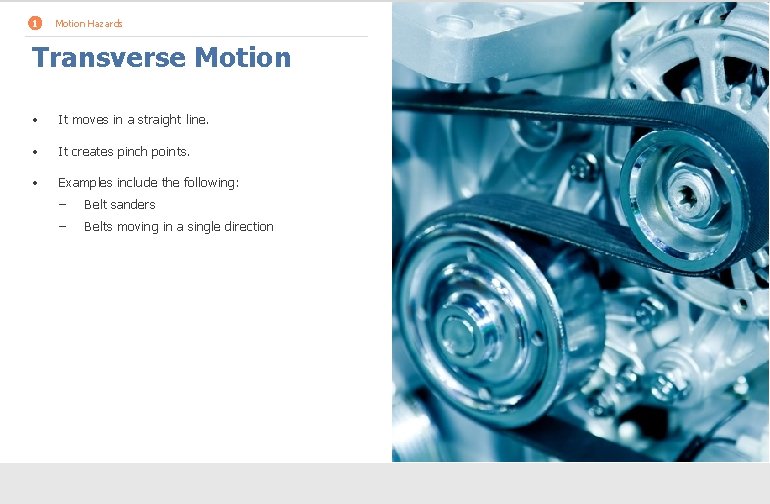
1 Motion Hazards Transverse Motion • It moves in a straight line. • It creates pinch points. • Examples include the following: ‒ Belt sanders ‒ Belts moving in a single direction
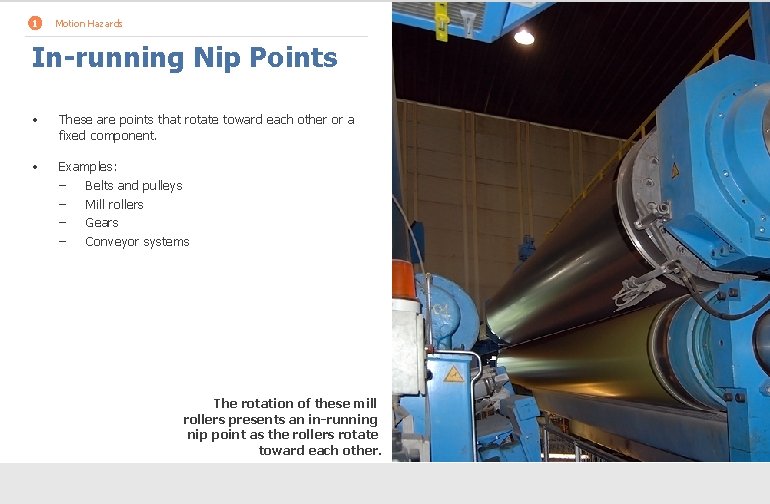
1 Motion Hazards In-running Nip Points • These are points that rotate toward each other or a fixed component. • Examples: – Belts and pulleys – Mill rollers – Gears – Conveyor systems The rotation of these mill rollers presents an in-running nip point as the rollers rotate toward each other.
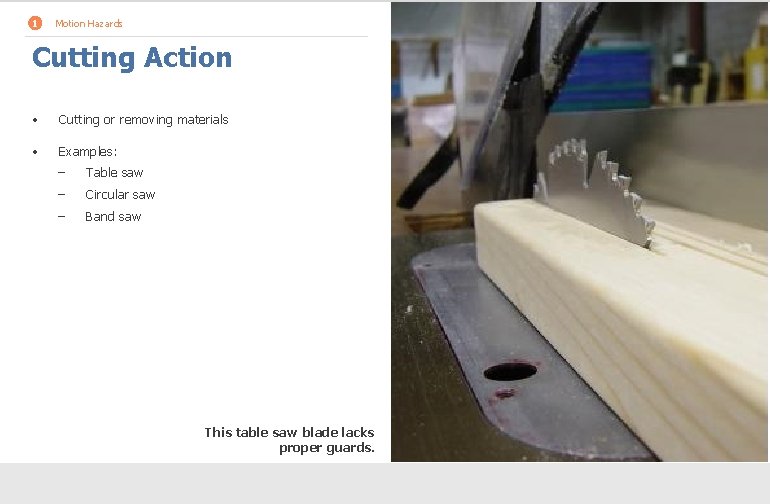
1 Motion Hazards Cutting Action • Cutting or removing materials • Examples: – Table saw – Circular saw – Band saw This table saw blade lacks proper guards.
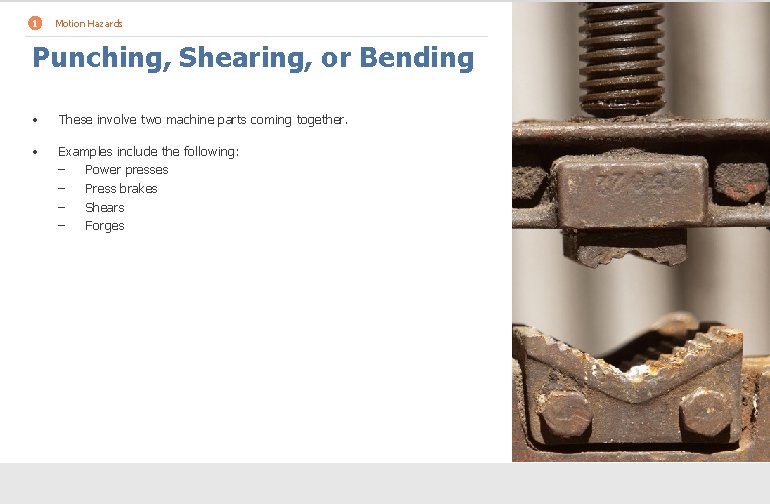
1 Motion Hazards Punching, Shearing, or Bending • These involve two machine parts coming together. • Examples include the following: – Power presses – Press brakes – Shears – Forges
2 Basics of Safeguarding What you need to know: • Machine safeguarding goals and requirements • Guard removal restrictions • Machine elements to guard: – Point of operation – Power transmission apparatus – Other moving parts • Additional Requirements • Types
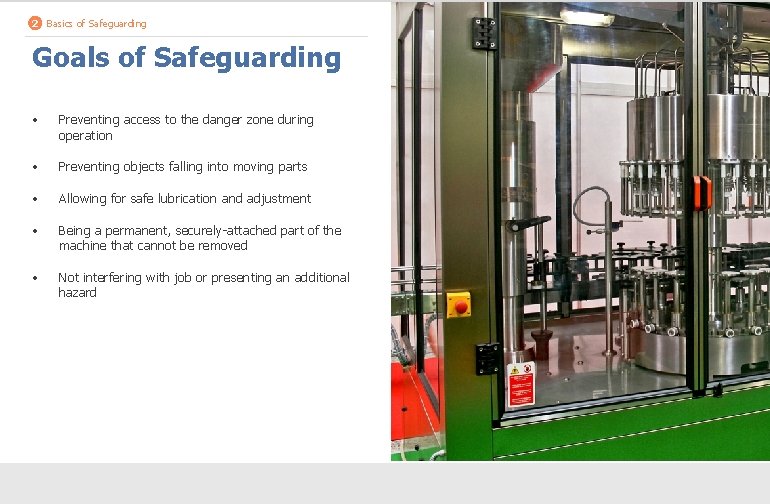
2 Basics of Safeguarding Goals of Safeguarding • Preventing access to the danger zone during operation • Preventing objects falling into moving parts • Allowing for safe lubrication and adjustment • Being a permanent, securely-attached part of the machine that cannot be removed • Not interfering with job or presenting an additional hazard
2 Basics of Safeguarding The Program Requirements: • Authorization • Documented training • Manufacturer instructions • Personal protective equipment • Lockout/tagout program • Preventive maintenance program • Inspections • Ongoing observations
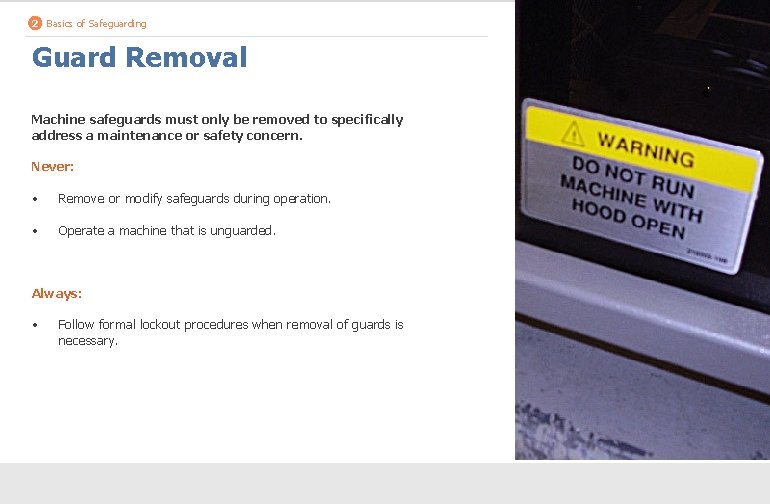
2 Basics of Safeguarding Guard Removal Machine safeguards must only be removed to specifically address a maintenance or safety concern. Never: • Remove or modify safeguards during operation. • Operate a machine that is unguarded. Always: • Follow formal lockout procedures when removal of guards is necessary.
2 Basics of Safeguarding Three Areas of Safeguarding • Points of operation • Power transmission apparatuses • Other moving parts
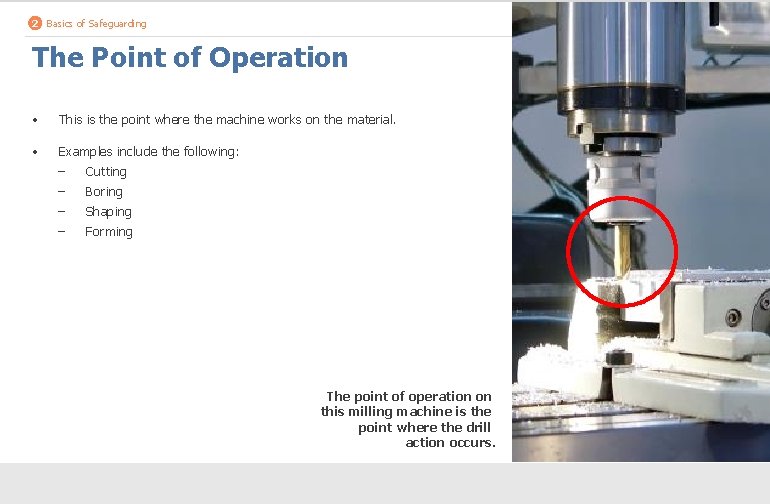
2 Basics of Safeguarding The Point of Operation • This is the point where the machine works on the material. • Examples include the following: – – Cutting Boring Shaping Forming The point of operation on this milling machine is the point where the drill action occurs.
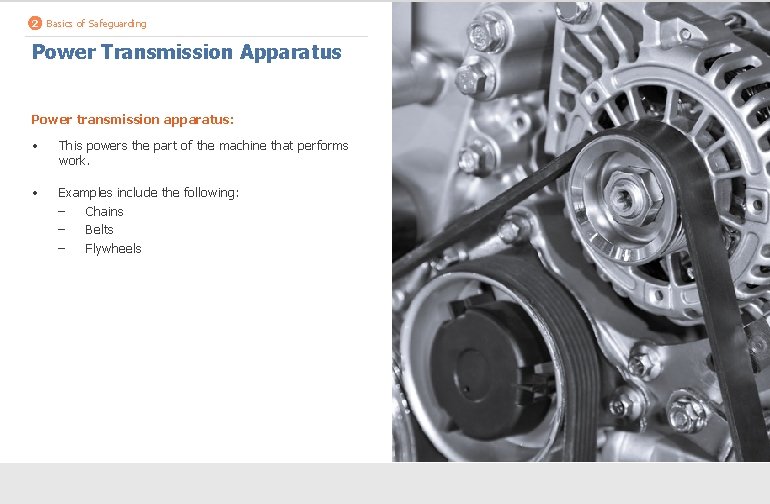
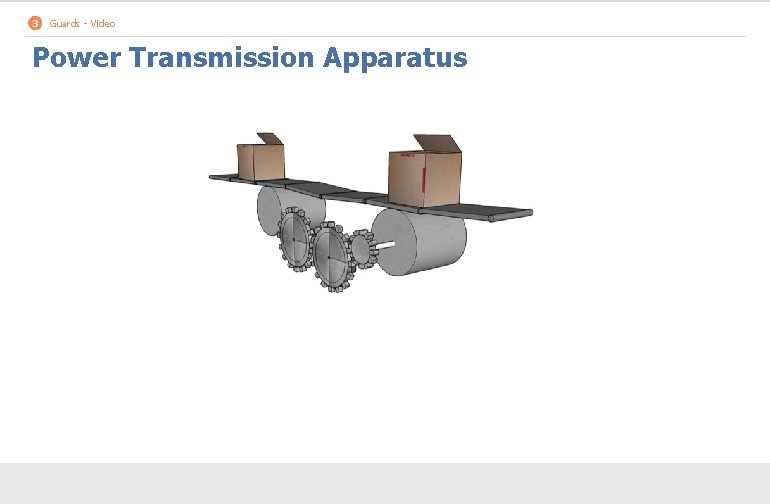
2 Basics of Safeguarding Power Transmission Apparatus Power transmission apparatus: • This powers the part of the machine that performs work. • Examples include the following: – Chains – Belts – Flywheels
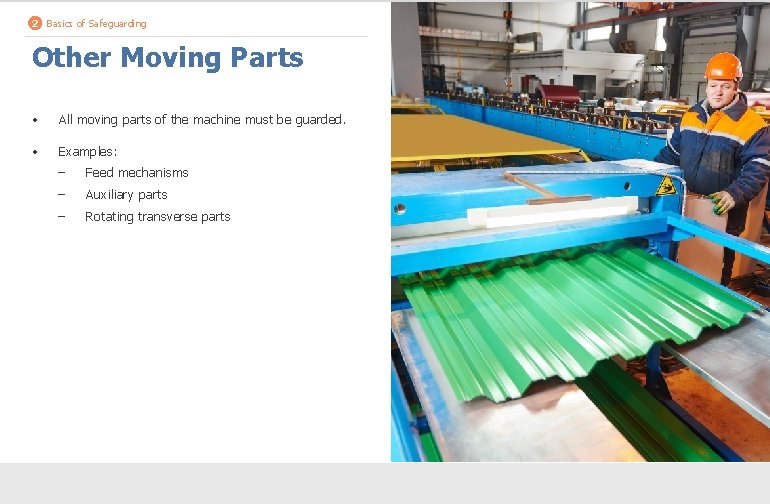
2 Basics of Safeguarding Other Moving Parts • All moving parts of the machine must be guarded. • Examples: – Feed mechanisms – Auxiliary parts – Rotating transverse parts
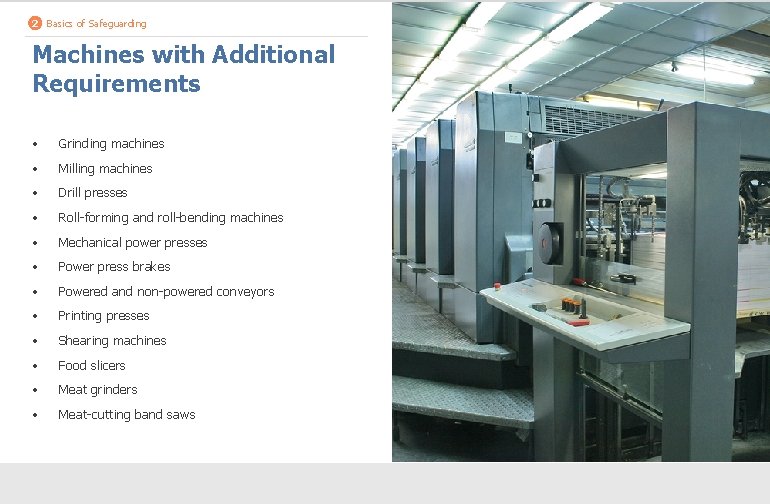
2 Basics of Safeguarding Machines with Additional Requirements • Grinding machines • Milling machines • Drill presses • Roll-forming and roll-bending machines • Mechanical power presses • Power press brakes • Powered and non-powered conveyors • Printing presses • Shearing machines • Food slicers • Meat grinders • Meat-cutting band saws
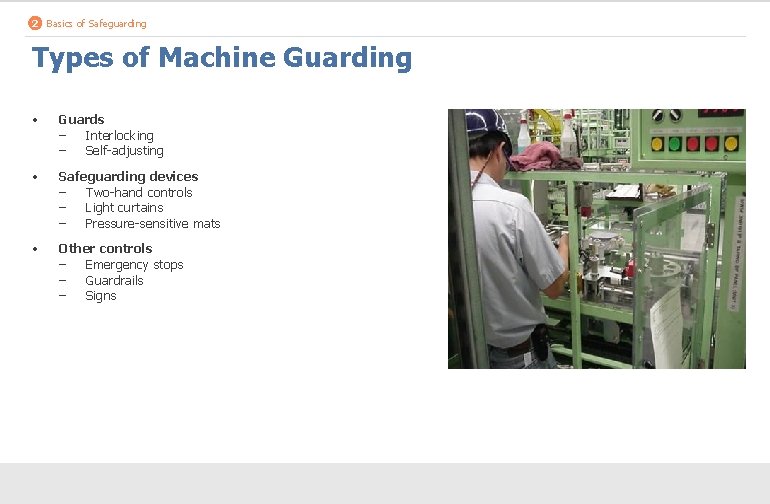
2 Basics of Safeguarding Types of Machine Guarding • Guards ‒ Interlocking ‒ Self-adjusting • Safeguarding devices ‒ Two-hand controls ‒ Light curtains ‒ Pressure-sensitive mats • Other controls ‒ Emergency stops ‒ Guardrails ‒ Signs
3 Guards What you need to know: • General design requirements of a machine guard • Common machine guard configurations
3 Guards - Video Power Transmission Apparatus
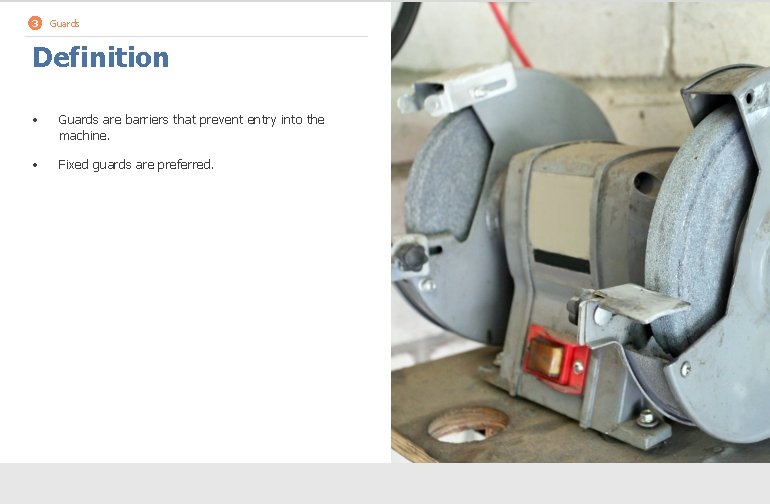
3 Guards Definition • Guards are barriers that prevent entry into the machine. • Fixed guards are preferred. Guards must be installed based on health and safety standards and manufacture requirements.
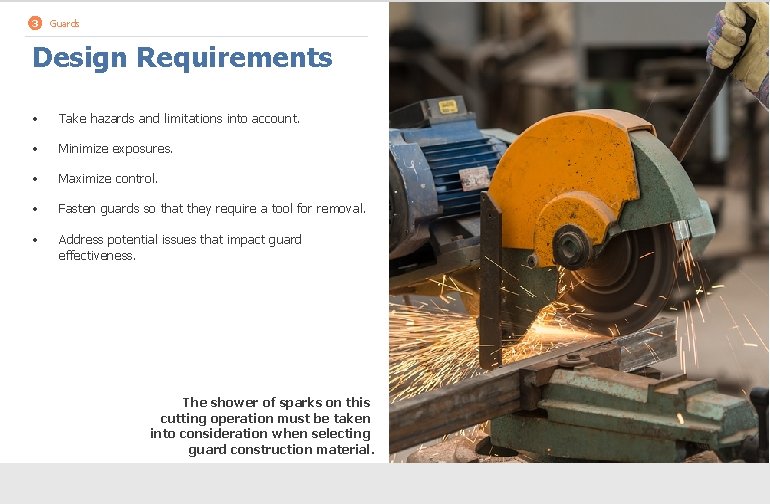
3 Guards Design Requirements • Take hazards and limitations into account. • Minimize exposures. • Maximize control. • Fasten guards so that they require a tool for removal. • Address potential issues that impact guard effectiveness. The shower of sparks on this cutting operation must be taken into consideration when selecting guard construction material.
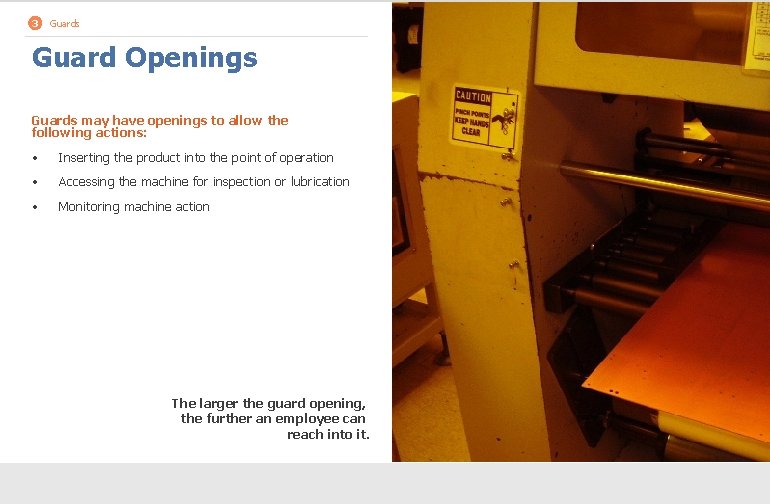
3 Guards Guard Openings Guards may have openings to allow the following actions: • Inserting the product into the point of operation • Accessing the machine for inspection or lubrication • Monitoring machine action The larger the guard opening, the further an employee can reach into it.
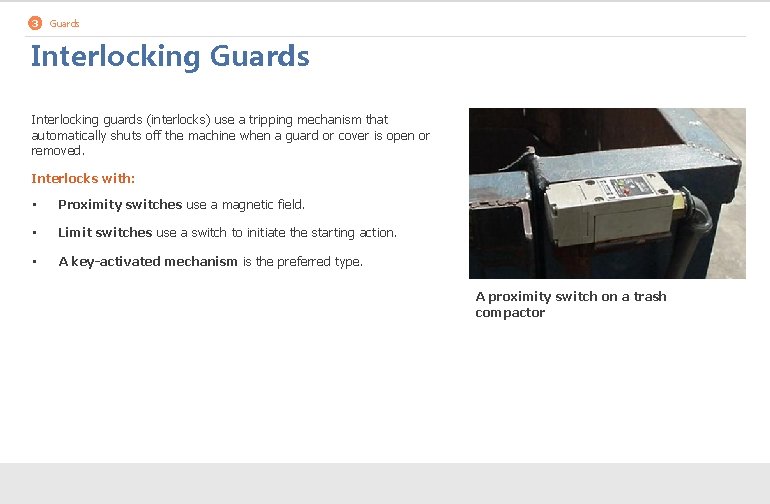
3 Guards Interlocking guards (interlocks) use a tripping mechanism that automatically shuts off the machine when a guard or cover is open or removed. Interlocks with: • Proximity switches use a magnetic field. • Limit switches use a switch to initiate the starting action. • A key-activated mechanism is the preferred type. A proximity switch on a trash compactor
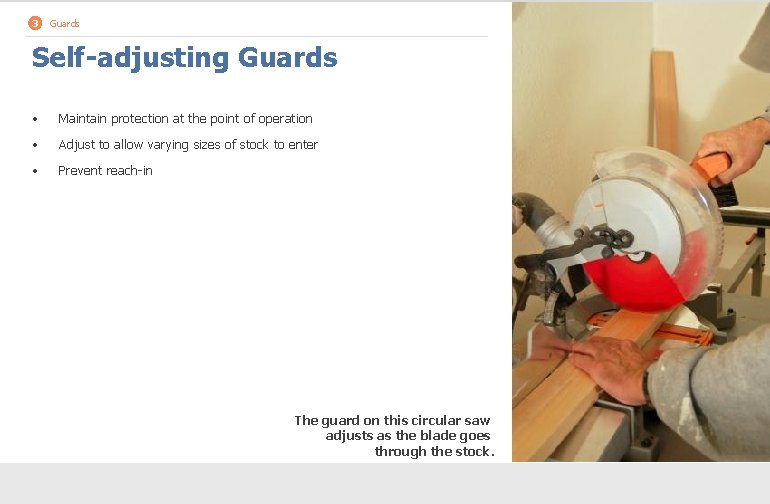
3 Guards Self-adjusting Guards • Maintain protection at the point of operation • Adjust to allow varying sizes of stock to enter • Prevent reach-in The guard on this circular saw adjusts as the blade goes through the stock.
4 Safeguarding Devices What you need to know: • The purpose of machine safeguarding devices • Safeguarding device types
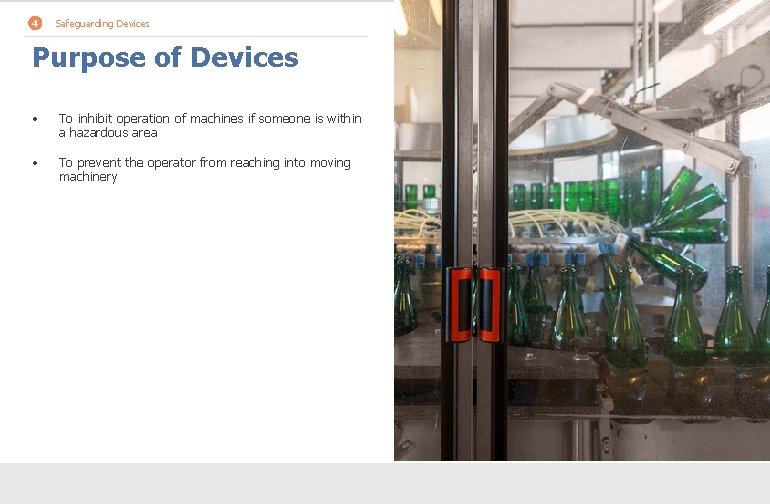
4 Safeguarding Devices Purpose of Devices • To inhibit operation of machines if someone is within a hazardous area • To prevent the operator from reaching into moving machinery
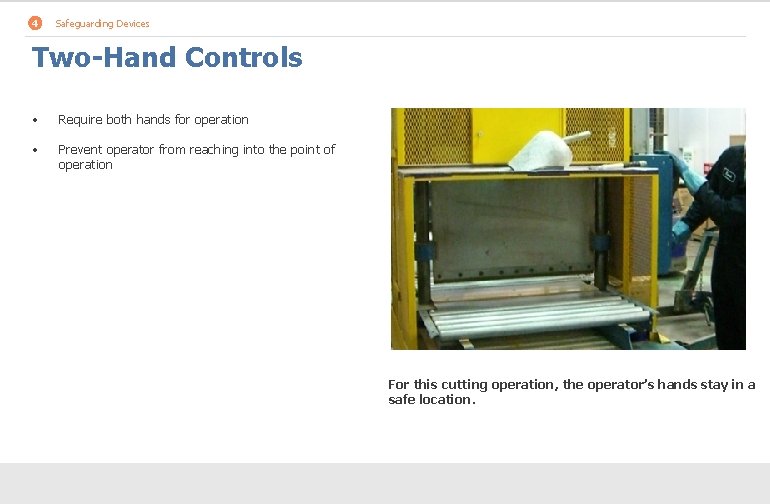
4 Safeguarding Devices Two-Hand Controls • Require both hands for operation • Prevent operator from reaching into the point of operation For this cutting operation, the operator’s hands stay in a safe location.
4 Safeguarding Devices Light Curtains They: When installing: • • Protect all cables with conduit. • Qualified personnel must make electrical connections. • Select light curtains based on size. • Stop the machine when the light field is broken. Must be capable of stopping the machine’s motion anywhere. • Must be control reliable: ‒ A single component failure will not prevent the stopping action from taking place. • Do not protect against flying objects. • Are not approved as a lockout device. • Are insufficient protection for removing jams or performing maintenance.
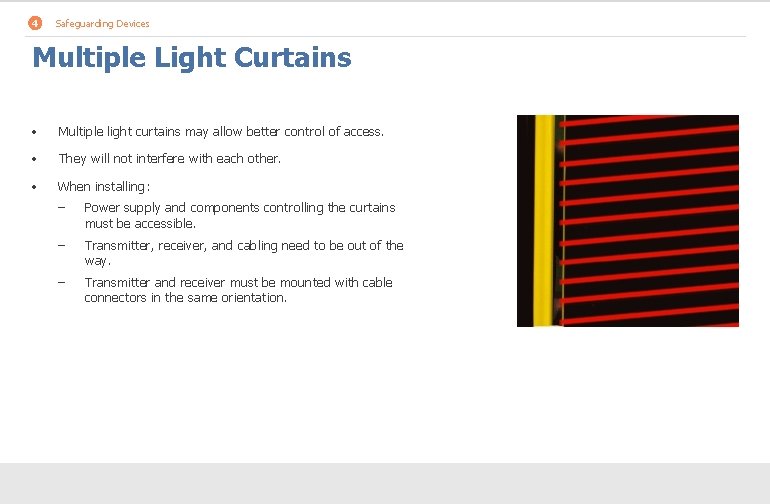
4 Safeguarding Devices Multiple Light Curtains • Multiple light curtains may allow better control of access. • They will not interfere with each other. • When installing: – Power supply and components controlling the curtains must be accessible. – Transmitter, receiver, and cabling need to be out of the way. – Transmitter and receiver must be mounted with cable connectors in the same orientation.
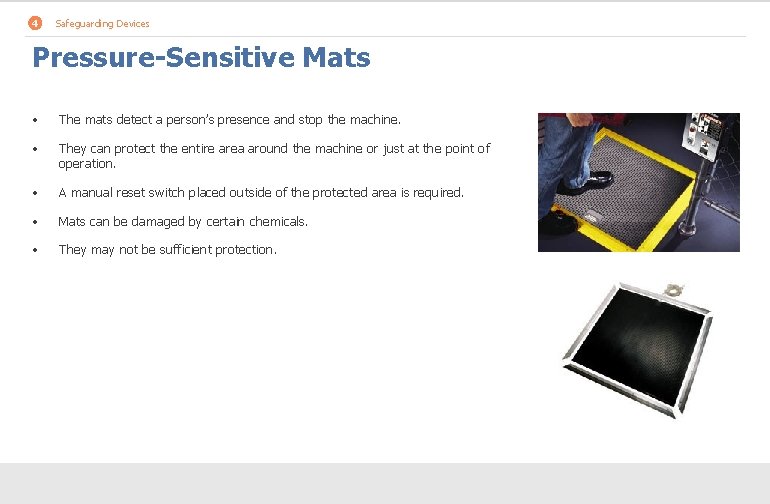
4 Safeguarding Devices Pressure-Sensitive Mats • The mats detect a person’s presence and stop the machine. • They can protect the entire area around the machine or just at the point of operation. • A manual reset switch placed outside of the protected area is required. • Mats can be damaged by certain chemicals. • They may not be sufficient protection.
5 Other Controls What you need to know: • The ‒ ‒ ‒ purpose and use of: Emergency stops (E-stops) Guardrails Signage • Safe operating procedures for employees
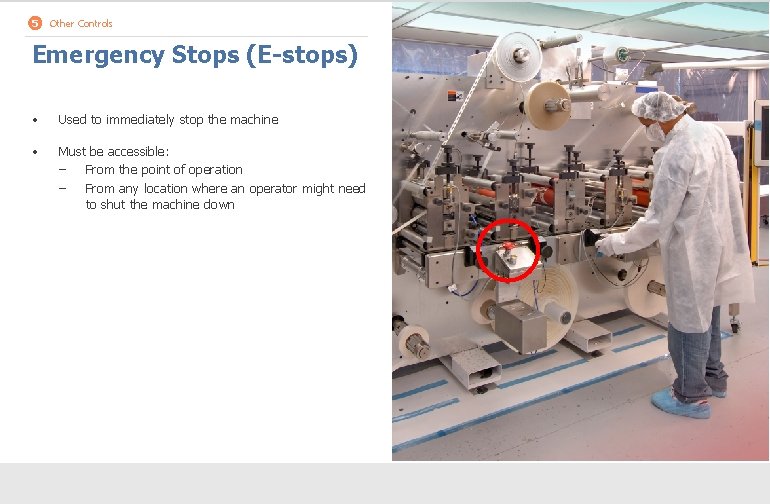
5 Other Controls Emergency Stops (E-stops) • Used to immediately stop the machine • Must be accessible: ‒ From the point of operation ‒ From any location where an operator might need to shut the machine down
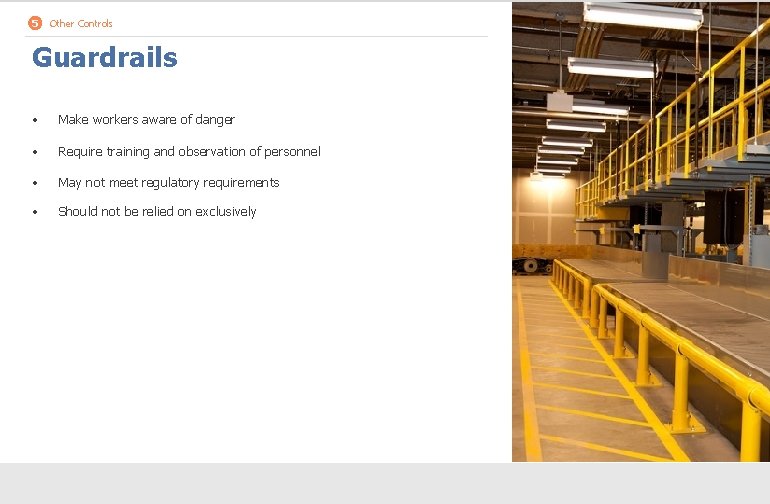
5 Other Controls Guardrails • Make workers aware of danger • Require training and observation of personnel • May not meet regulatory requirements • Should not be relied on exclusively
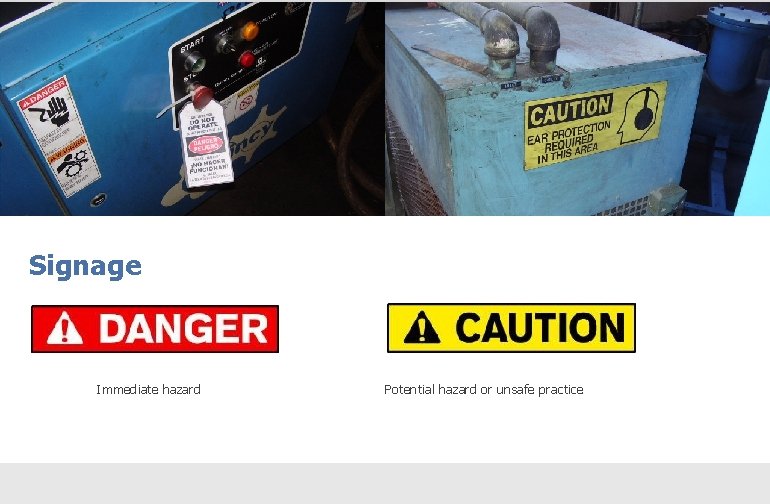
Signage Immediate hazard Potential hazard or unsafe practice
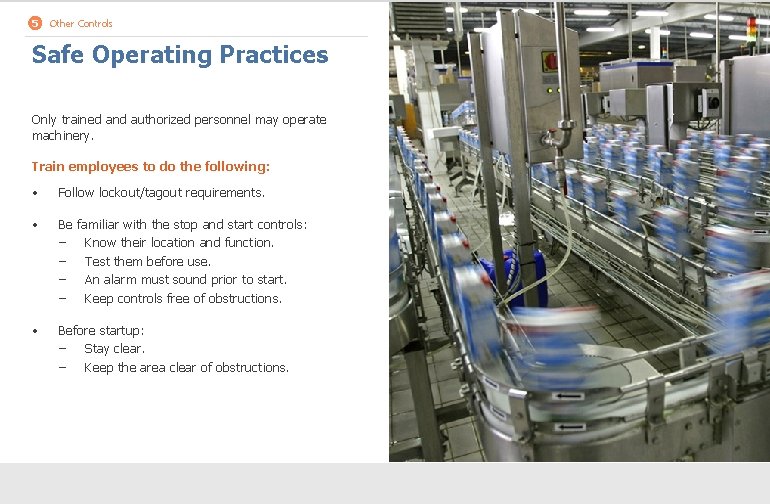
5 Other Controls Safe Operating Practices Only trained and authorized personnel may operate machinery. Train employees to do the following: • Follow lockout/tagout requirements. • Be ‒ ‒ • Before startup: ‒ Stay clear. ‒ Keep the area clear of obstructions. familiar with the stop and start controls: Know their location and function. Test them before use. An alarm must sound prior to start. Keep controls free of obstructions.
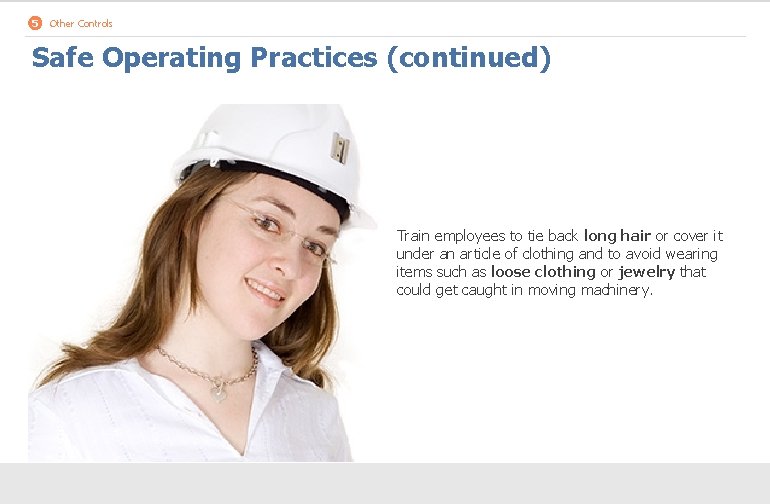
5 Other Controls Safe Operating Practices (continued) Train employees to tie back long hair or cover it under an article of clothing and to avoid wearing items such as loose clothing or jewelry that could get caught in moving machinery.
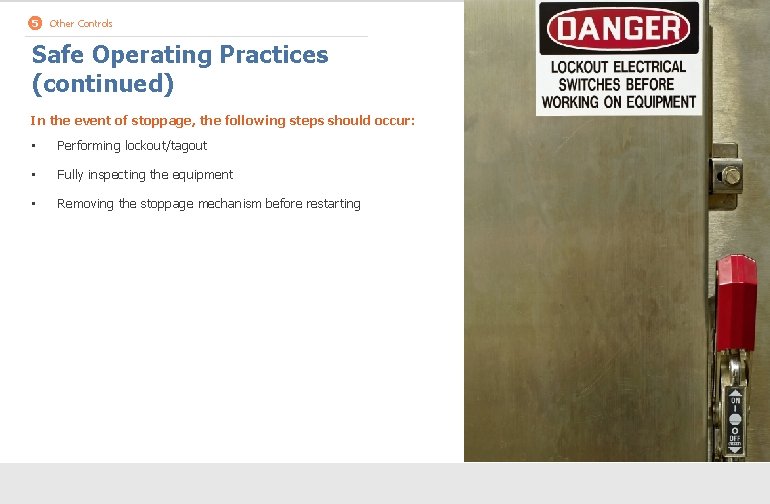
5 Other Controls Safe Operating Practices (continued) In the event of stoppage, the following steps should occur: • Performing lockout/tagout • Fully inspecting the equipment • Removing the stoppage mechanism before restarting
6 Conveyor Systems What you need to know: • Conveyor hazards • Safe operation • Guards • Maintenance
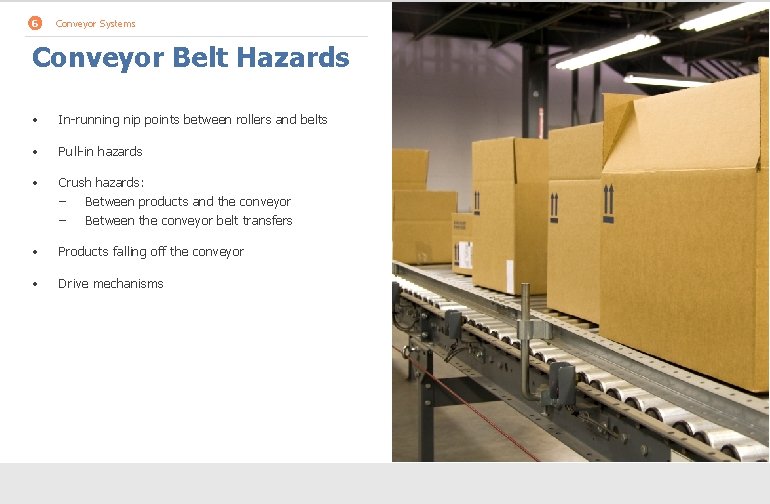
6 Conveyor Systems Conveyor Belt Hazards • In-running nip points between rollers and belts • Pull-in hazards • Crush hazards: ‒ Between products and the conveyor ‒ Between the conveyor belt transfers • Products falling off the conveyor • Drive mechanisms
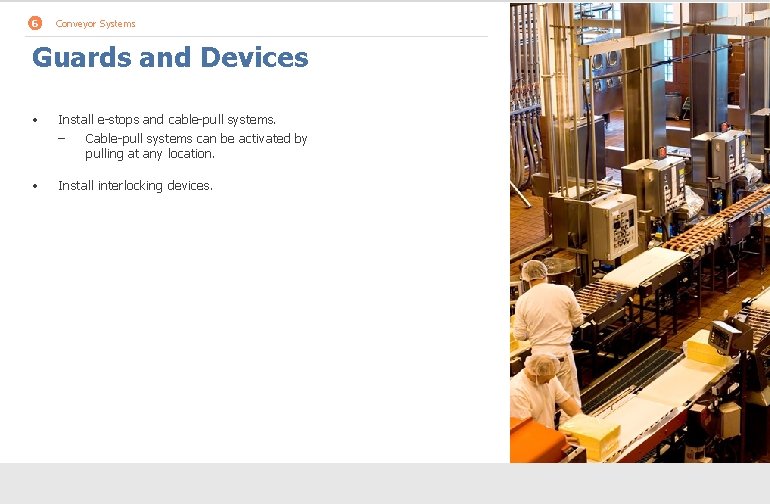
6 Conveyor Systems Guards and Devices • Install e-stops and cable-pull systems. ‒ Cable-pull systems can be activated by pulling at any location. • Install interlocking devices.
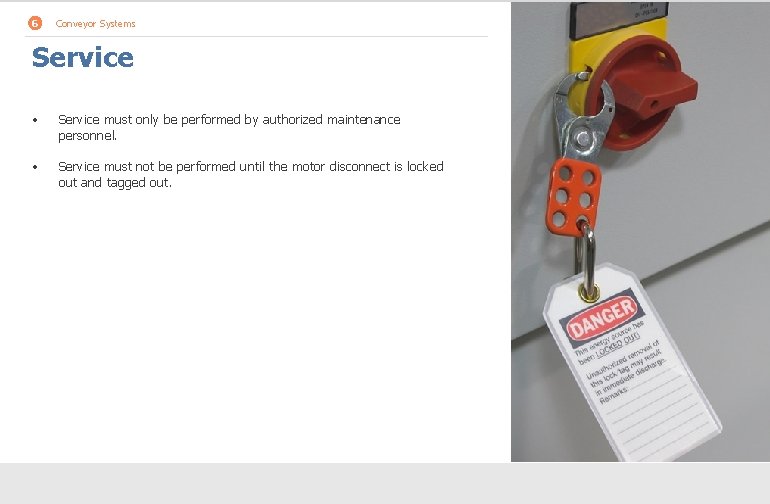
6 Conveyor Systems Service • Service must only be performed by authorized maintenance personnel. • Service must not be performed until the motor disconnect is locked out and tagged out.
Finish Summary • Determine the correct machine guards. • Never remove or modify safeguards. • Never operate an unguarded machine. • All employees must be trained. • Safeguard: ‒ The point of operation. ‒ The power transmission apparatus. ‒ All other moving parts. • Fixed guards are preferred, but other controls may be necessary.