
Introduction How has the doctrine of implied powers
- Slides: 22
Introduction • How has the doctrine of implied powers increased the powers of Congress? • The final clause of Article I, Section 8, Clause 18 of the Constitution says Congress has the power: – “To make all Laws which shall be necessary and proper for carrying into Execution the foregoing Powers, and all other Powers vested by this Constitution in the Government of the United States, or in any Department or Officer thereof. ”
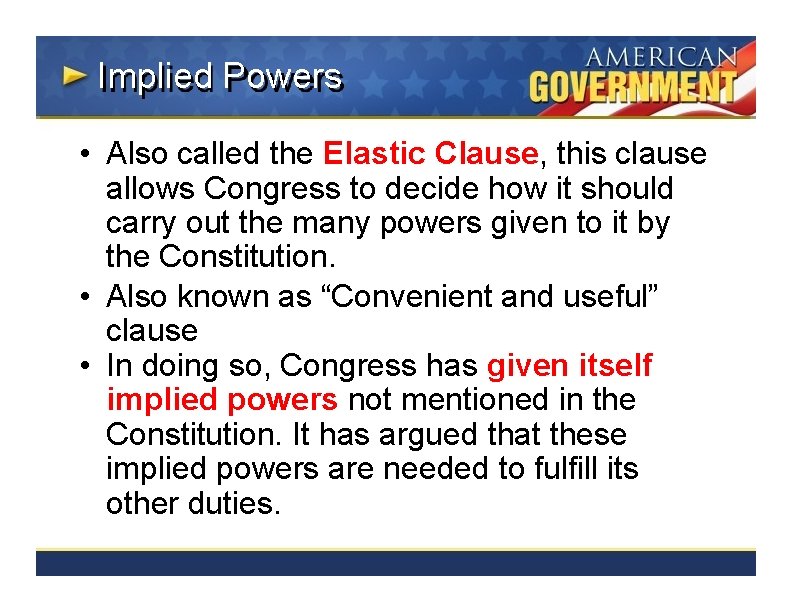
Implied Powers • Also called the Elastic Clause, this clause allows Congress to decide how it should carry out the many powers given to it by the Constitution. • Also known as “Convenient and useful” clause • In doing so, Congress has given itself implied powers not mentioned in the Constitution. It has argued that these implied powers are needed to fulfill its other duties. Copyright © Pearson Education, Inc. Chapt er 11, Sectio n 3
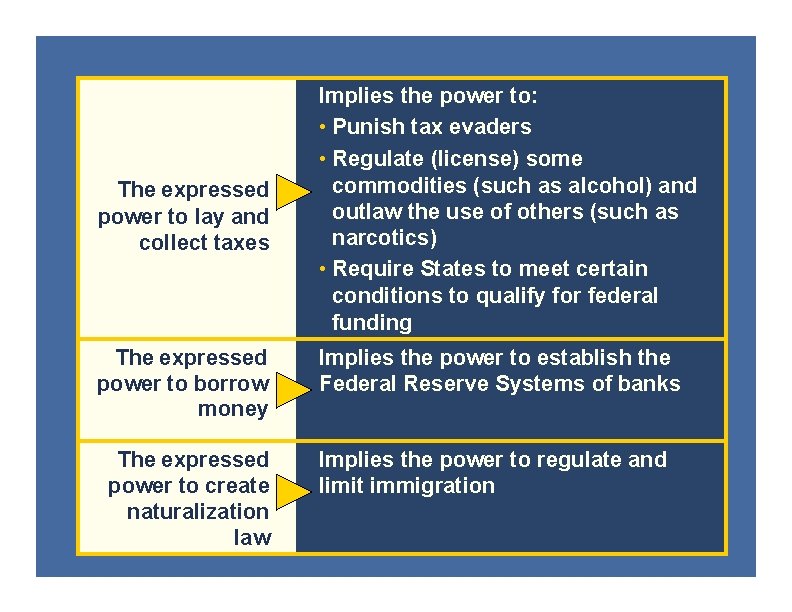
The expressed power to lay and collect taxes The expressed power to borrow money The expressed power to create naturalization law Implies the power to: • Punish tax evaders • Regulate (license) some commodities (such as alcohol) and outlaw the use of others (such as narcotics) • Require States to meet certain conditions to qualify for federal funding Implies the power to establish the Federal Reserve Systems of banks Implies the power to regulate and limit immigration
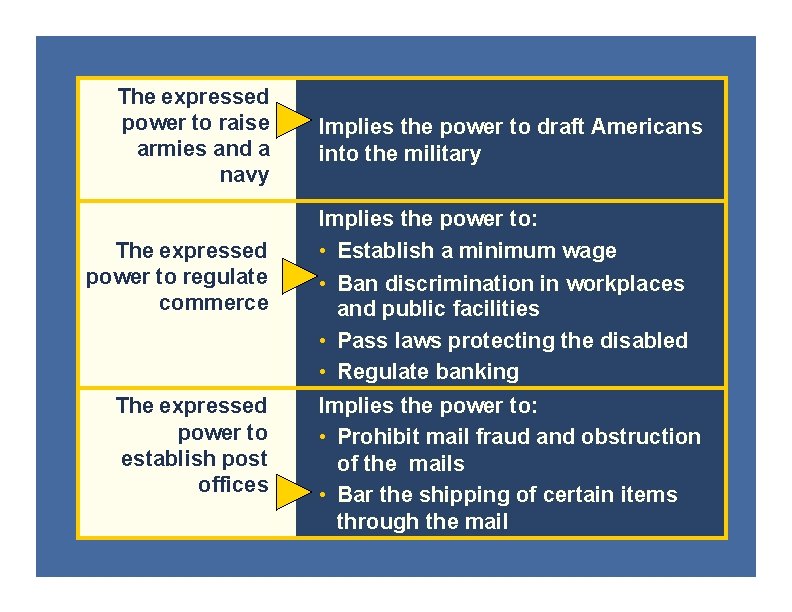
The expressed power to raise armies and a navy The expressed power to regulate commerce The expressed power to establish post offices Implies the power to draft Americans into the military Implies the power to: • Establish a minimum wage • Ban discrimination in workplaces and public facilities • Pass laws protecting the disabled • Regulate banking Implies the power to: • Prohibit mail fraud and obstruction of the mails • Bar the shipping of certain items through the mail
Necessary and Proper Clause Used • 1790 Hamilton (Secretary of Treasury) created the first national bank. • Opponents (strict constructionists/Jefferson) argued Congress didn’t have the power to create a bank – Congress only has powers expressed in Constitution and powers absolutely necessary to carry out expressed powers. • Hamilton and liberal constructionists cited Necessary & Proper Clause saying Congress has power to do anything reasonably related to exercise of expressed powers and national bank was related to execution of taxing, borrowing, commerce, and currency powers. Chapter 11, Section 3 Copyright © Pearson Education, Inc. Slide 5
Liberal Construction • Liberal constructionists took the Federalist view that the Constitution should be interpreted broadly, strengthening the national government by giving it a wide range of implied powers. Strict constructionists thought it would give federal government unlimited authority. • When Jefferson President he had to reverse his stand on this issue. Louisiana Purchase was based on implied powers. • The Supreme Court upheld the idea of implied powers in Mc. Culloch v. Maryland in 1818. (2 nd national bank and Maryland taxing bank notes • Since then, the liberal constructionist view has dominated and federal power has grown.
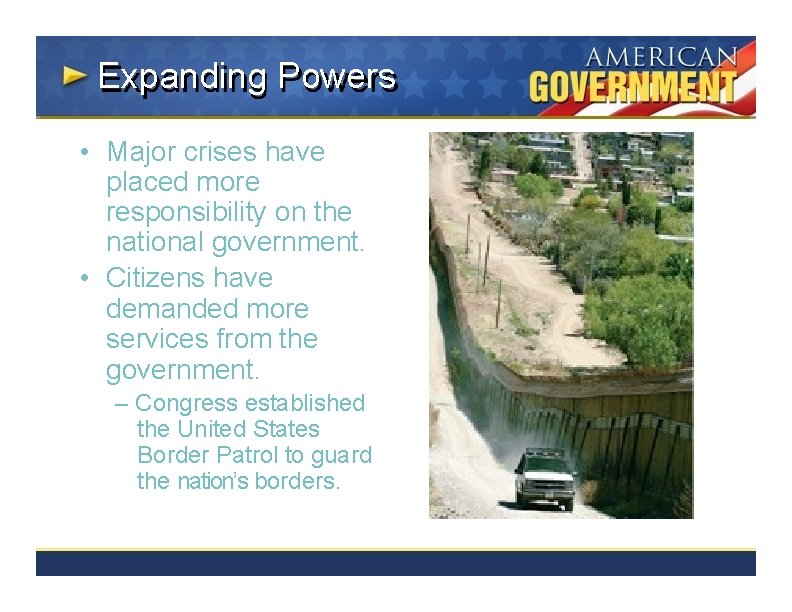
Expanding Powers • Major crises have placed more responsibility on the national government. • Citizens have demanded more services from the government. – Congress established the United States Border Patrol to guard the nationʼs borders.
Expanding Powers, cont. • Congress, the President, and the Supreme Court have all supported increased powers for the national government. • Implied powers allow the federal government to adapt to changes in society and technology that the Framers could not have anticipated. • For example, while Education is an area expressly delegated to the States, Congress has used its implied powers to make legislation affecting schools.
Congress and Education • Title III of the Civil Rights Act authorized the attorney general to issue civil suits against discriminatory school in the United States. • Title IX of the Education Amendments to the Civil Rights Act forbids gender discrimination in federally funded education programs. • The Individuals with Disabilities Education Act is designed to prevent discrimination and enable individuals with disabilities to participate fully in all aspects of education.
Implied Powers in Practice • Implied powers have most often been connected to the commerce power, the power to tax and spend, and the war powers. • Congress can levy a wide range of taxes and assign federal money to be spent on improving the general welfare through a variety of services like Social Security or Medicare.
The Commerce Power • The Commerce Clause is now defined to include the production, buying, and selling of goods as well as the transportation of people and goods. – Using implied powers derived from the Commerce Clause, Congress can regulate manufacturing, wages, food and drugs, and more. – Congress can also build interstate highways, set consumer protection laws, and protect the environment.
Introduction • What nonlegislative powers does the Constitution delegate to Congress? – Congress can propose constitutional amendments. – Congress has some rarely used electoral duties when elections must be decided or a new vice president appointed. – Congress can impeach certain federal officials. – The Senate must approve major presidential appointments and ratify official treaties. – Congress has investigatory power to investigate matters within its legislative powers
Amendments & Elections • Congress can propose constitutional amendments by a two-thirds vote of each house and has done so 33 times. • If no candidate receives a majority of electoral votes for President or Vice President, Congress chooses the winner. – The House chooses the President, voting on a stateby-state basis for one of the top three contenders. – The Senate votes for the Vice President, with individual Senators casting votes.
The Impeachment Process • The Constitution allows Congress to remove the President, Vice President, and all civil officers for treason, bribery, or high crimes and misdemeanors. – The House impeaches, or brings charges against, an official. This requires a majority vote. – The Senate then acts as a court and tries the official. Convicting an official takes a two-thirds majority.
Impeachments • To date, 17 federal officials have been impeached and seven convicted. – All those convicted were federal judges. • President Andrew Johnson was impeached in 1868 after harsh disagreements with the Republican Congress about how to carry out Reconstruction after the Civil War. The Senate found him not guilty by one vote. • Why was President Johnson impeached?
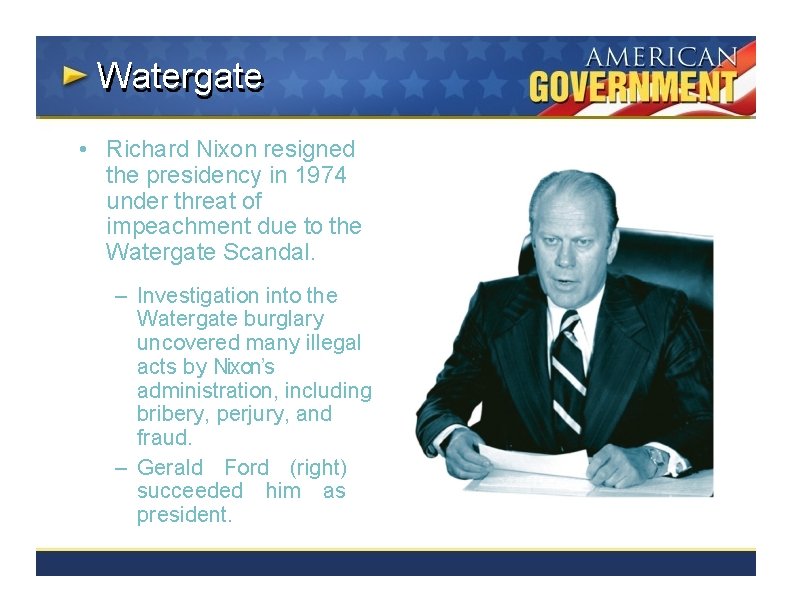
Watergate • Richard Nixon resigned the presidency in 1974 under threat of impeachment due to the Watergate Scandal. – Investigation into the Watergate burglary uncovered many illegal acts by Nixonʼs administration, including bribery, perjury, and fraud. – Gerald Ford (right) succeeded him as president.
Clintonʼs Impeachment • President Clinton was impeached by the House in 1998 but found not guilty by the Senate in 1999. – He was charged with perjury and obstruction of justice for withholding information about an inappropriate relationship with a White House intern. – Opponents of his impeachment argued that these acts did not qualify as “high crimes and misdemeanors. ”
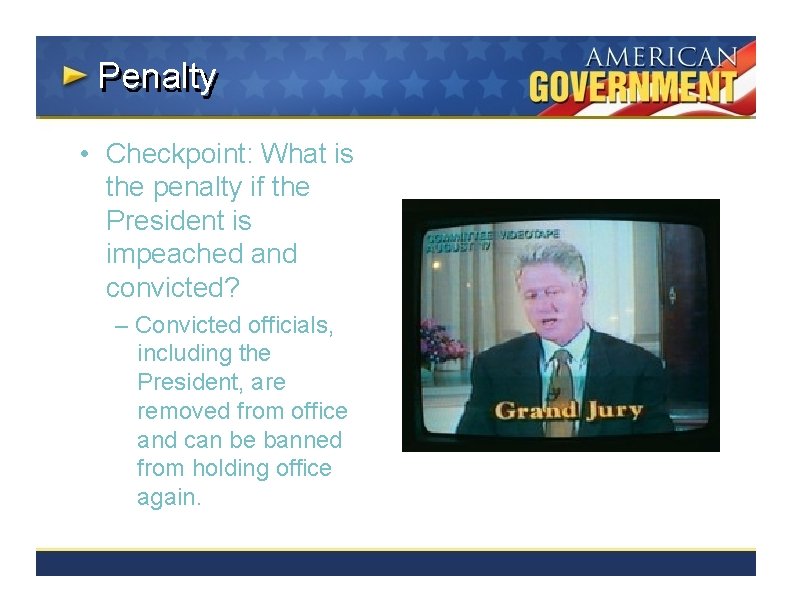
Penalty • Checkpoint: What is the penalty if the President is impeached and convicted? – Convicted officials, including the President, are removed from office and can be banned from holding office again.
Executive Powers • All major presidential appointments must be confirmed by a majority vote of the Senate. – The Senate rarely rejects a Cabinet appointment, though candidates may be withdrawn. – The custom of senatorial courtesy means the Senate will only approve appointees supported by the Senators from the appointeeʼs state who belong to the Presidentʼs party.
Congressional Influence • The Senate approves high level appointments by the President. • The President consults with Congress during the negotiation of treaties. • Presidents may need to make changes in a treaty at the behest of Congress. • Even after a treaty has been approved, Congress can repeal it.
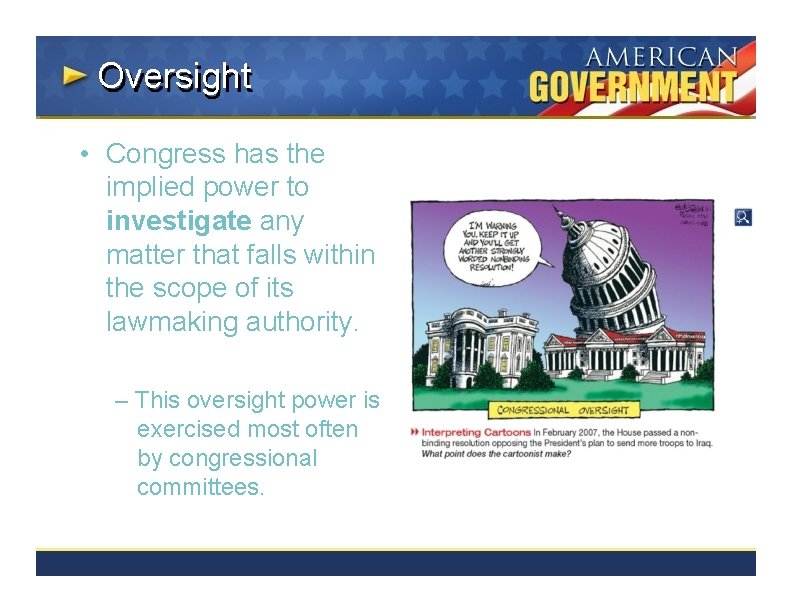
Oversight • Congress has the implied power to investigate any matter that falls within the scope of its lawmaking authority. – This oversight power is exercised most often by congressional committees.
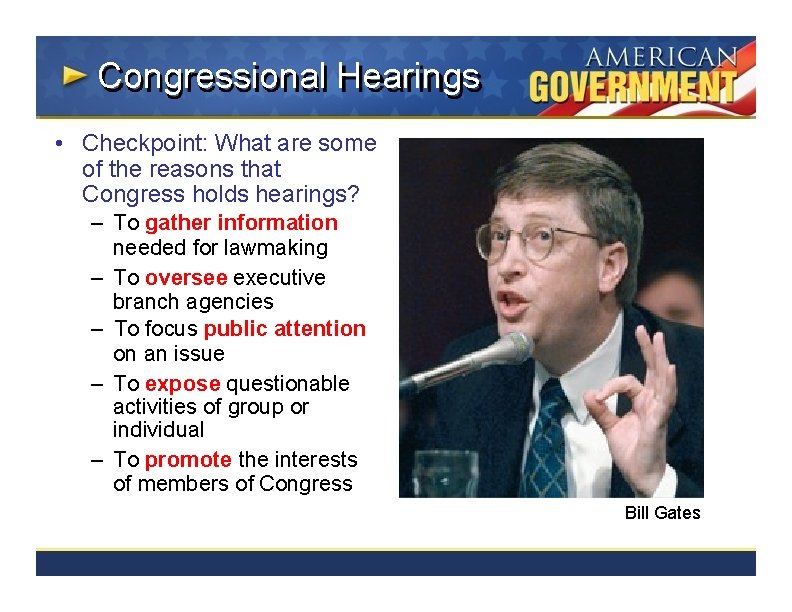
Congressional Hearings • Checkpoint: What are some of the reasons that Congress holds hearings? – To gather information needed for lawmaking – To oversee executive branch agencies – To focus public attention on an issue – To expose questionable activities of group or individual – To promote the interests of members of Congress Bill Gates