
Introduction Germanium spectroscopy Radon detection Lowlevel techniques applied
- Slides: 19
Introduction Germanium spectroscopy Radon detection Low-level techniques applied in experiments looking for rare events Mass spectrometry Grzegorz Zuzel Conclusions Max Planck Institute for Nuclear Physics, Heidelberg, Germany LAUNCH - Low-energy, Astroparticle Underground, Neutrino physics and Cosmology in Heidelberg, 21 -23. 03. 2007
1. Introduction Germanium spectroscopy Radon detection Mass spectrometry Conclusions Low-level techniques: experimental techniques which allow to investigate very low activities of natural and artificially produced radio-isotopes. • • • material screening (Ge spectroscopy, ICPMS, NA) surface screening ( , , spectroscopy) study of radioactive noble gases (emanation, diffusion) purification techniques (gases, liquids) background events rejection techniques modeling of background in experiments (Monte Carlo) Low-level techniques are “naturally” coupled with the experiments looking for rare events (detection of neutrinos, search for dark matter, search for 0ν 2 decay, search for proton decay, . . . ), where the backgrounds identification and reduction plays a key role. LAUNCH - Low-energy, Astroparticle Underground, Neutrino physics and Cosmology in Heidelberg, 21 -23. 03. 2007
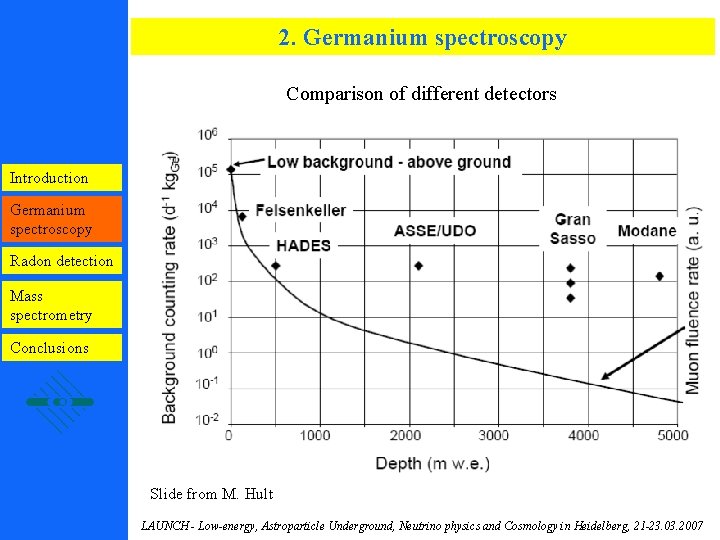
2. Germanium spectroscopy is one of the most powerful techniques to identify γ-emmiters (U/Th chain, 40 K, 60 Co, . . . ). Introduction Germanium spectroscopy • • excellent energy resolution (~ 2 ke. V) high purity detectors (low intrinsic background) Radon detection In order to reach high sensitivity it is necessary: Mass spectrometry • Conclusions reduce backgrounds originating from external sources - active/passive shielding (underground localizations) - reduction of radon in the sample chamber • • assure (reasonably) large volumes of samples assure precise calculations/measurements of detection efficiencies Highly sensitive Ge spectroscopy is a perfect tool for material screening LAUNCH - Low-energy, Astroparticle Underground, Neutrino physics and Cosmology in Heidelberg, 21 -23. 03. 2007
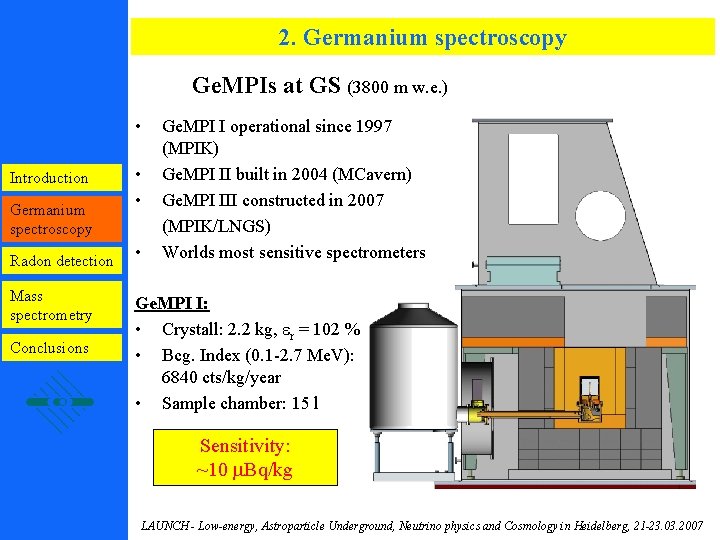
2. Germanium spectroscopy Ge. MPIs at GS (3800 m w. e. ) • Introduction Germanium spectroscopy Radon detection Mass spectrometry Conclusions • • • Ge. MPI I operational since 1997 (MPIK) Ge. MPI II built in 2004 (MCavern) Ge. MPI III constructed in 2007 (MPIK/LNGS) Worlds most sensitive spectrometers Ge. MPI I: • Crystall: 2. 2 kg, r = 102 % • Bcg. Index (0. 1 -2. 7 Me. V): 6840 cts/kg/year • Sample chamber: 15 l Sensitivity: ~10 Bq/kg LAUNCH - Low-energy, Astroparticle Underground, Neutrino physics and Cosmology in Heidelberg, 21 -23. 03. 2007
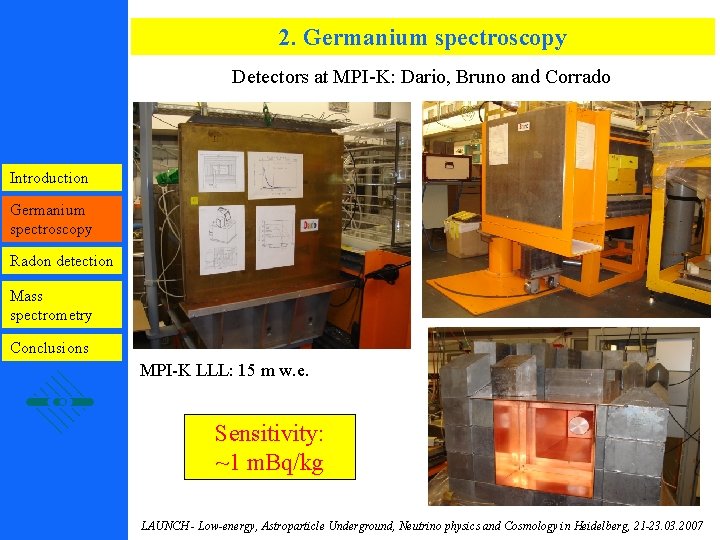
2. Germanium spectroscopy Detectors at MPI-K: Dario, Bruno and Corrado Introduction Germanium spectroscopy Radon detection Mass spectrometry Conclusions MPI-K LLL: 15 m w. e. Sensitivity: ~1 m. Bq/kg LAUNCH - Low-energy, Astroparticle Underground, Neutrino physics and Cosmology in Heidelberg, 21 -23. 03. 2007
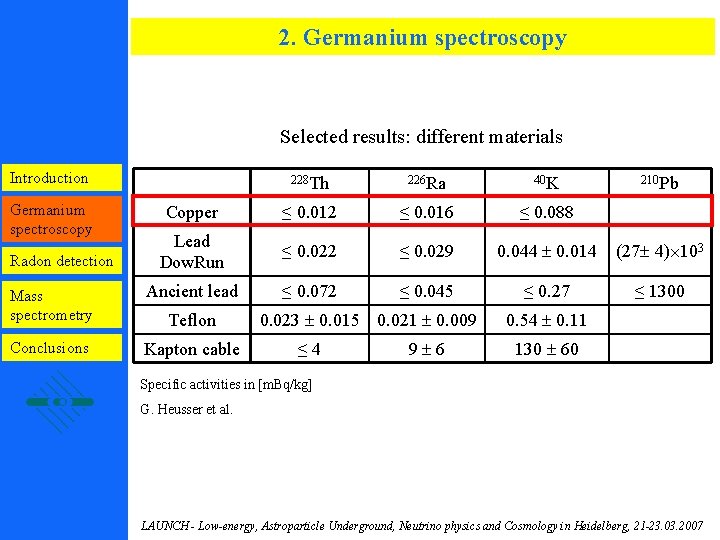
2. Germanium spectroscopy Selected results: different materials Introduction 228 Th 226 Ra 40 K Copper ≤ 0. 012 ≤ 0. 016 ≤ 0. 088 Lead Dow. Run ≤ 0. 022 ≤ 0. 029 0. 044 0. 014 (27 4) 103 Mass spectrometry Ancient lead ≤ 0. 072 ≤ 0. 045 ≤ 0. 27 ≤ 1300 Conclusions Kapton cable Germanium spectroscopy Radon detection Teflon 0. 023 0. 015 0. 021 0. 009 ≤ 4 9 6 210 Pb 0. 54 0. 11 130 60 Specific activities in [m. Bq/kg] G. Heusser et al. LAUNCH - Low-energy, Astroparticle Underground, Neutrino physics and Cosmology in Heidelberg, 21 -23. 03. 2007
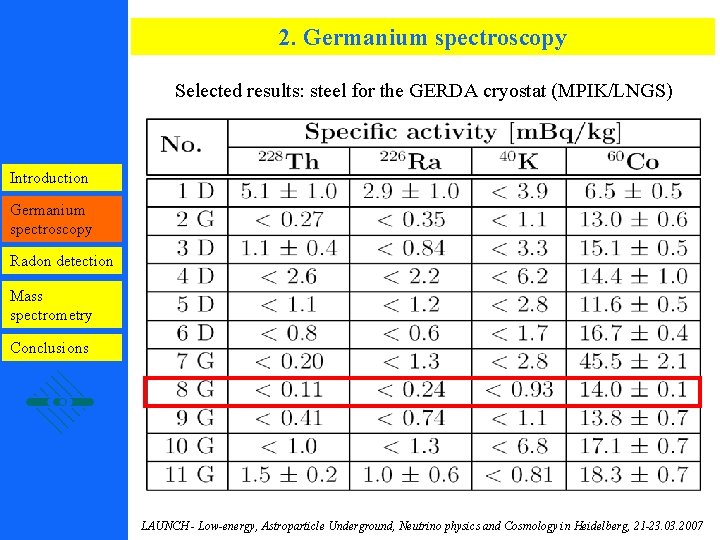
2. Germanium spectroscopy Selected results: steel for the GERDA cryostat (MPIK/LNGS) Introduction Germanium spectroscopy Radon detection Mass spectrometry Conclusions LAUNCH - Low-energy, Astroparticle Underground, Neutrino physics and Cosmology in Heidelberg, 21 -23. 03. 2007
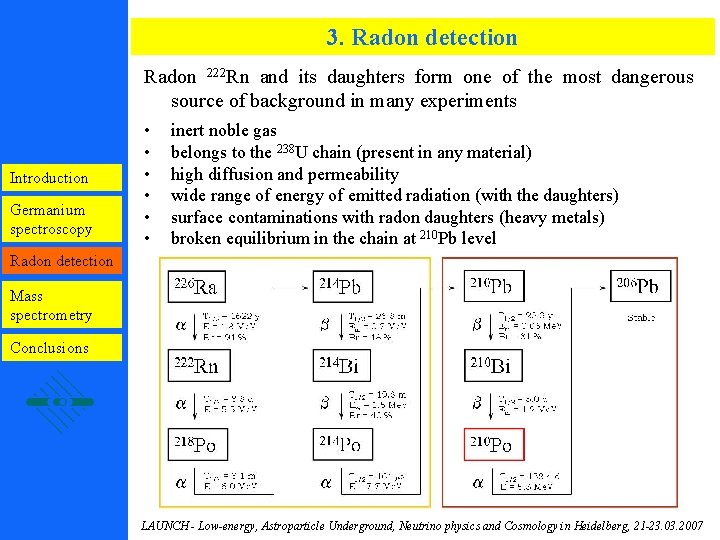
3. Radon detection Radon 222 Rn and its daughters form one of the most dangerous source of background in many experiments Introduction Germanium spectroscopy • • • inert noble gas belongs to the 238 U chain (present in any material) high diffusion and permeability wide range of energy of emitted radiation (with the daughters) surface contaminations with radon daughters (heavy metals) broken equilibrium in the chain at 210 Pb level Radon detection Mass spectrometry Conclusions LAUNCH - Low-energy, Astroparticle Underground, Neutrino physics and Cosmology in Heidelberg, 21 -23. 03. 2007
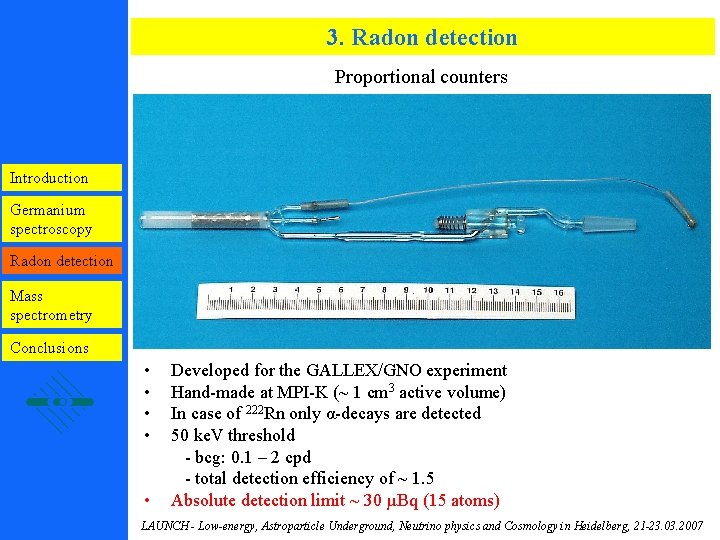
3. Radon detection Proportional counters Introduction Germanium spectroscopy Radon detection Mass spectrometry Conclusions • • • Developed for the GALLEX/GNO experiment Hand-made at MPI-K (~ 1 cm 3 active volume) In case of 222 Rn only α-decays are detected 50 ke. V threshold - bcg: 0. 1 – 2 cpd - total detection efficiency of ~ 1. 5 Absolute detection limit ~ 30 µBq (15 atoms) LAUNCH - Low-energy, Astroparticle Underground, Neutrino physics and Cosmology in Heidelberg, 21 -23. 03. 2007
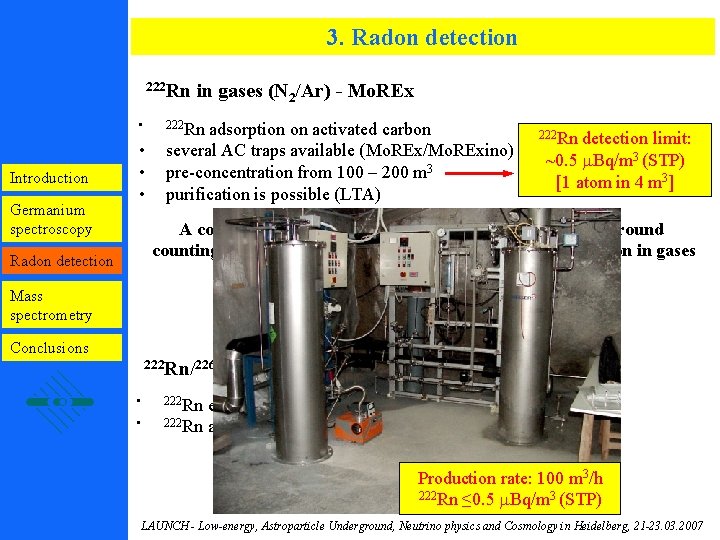
3. Radon detection 222 Rn • Introduction Germanium spectroscopy in gases (N 2/Ar) - Mo. REx 222 Rn • • • adsorption on activated carbon several AC traps available (Mo. REx/Mo. RExino) pre-concentration from 100 – 200 m 3 purification is possible (LTA) 222 Rn detection limit: ~0. 5 Bq/m 3 (STP) [1 atom in 4 m 3] A combination of 222 Rn pre-concentration and low-background counting gives the most sensitive technique for radon detection in gases Radon detection Great importance for BOREXINO, GERDA, EXO, XENON, XMASS, WARP, CLEAN, … Mass spectrometry Conclusions 222 Rn/226 Ra • • in water - STRAW 222 Rn extraction from 350 liters 222 Rn and 226 Ra measurements possible 222 Rn detection limit: ~0. 1 m. Bq/m 3 Production rate: 3100 m 3/h 226 Ra detection limit: ~0. 8 m. Bq/m 222 Rn ≤ 0. 5 Bq/m 3 (STP) LAUNCH - Low-energy, Astroparticle Underground, Neutrino physics and Cosmology in Heidelberg, 21 -23. 03. 2007
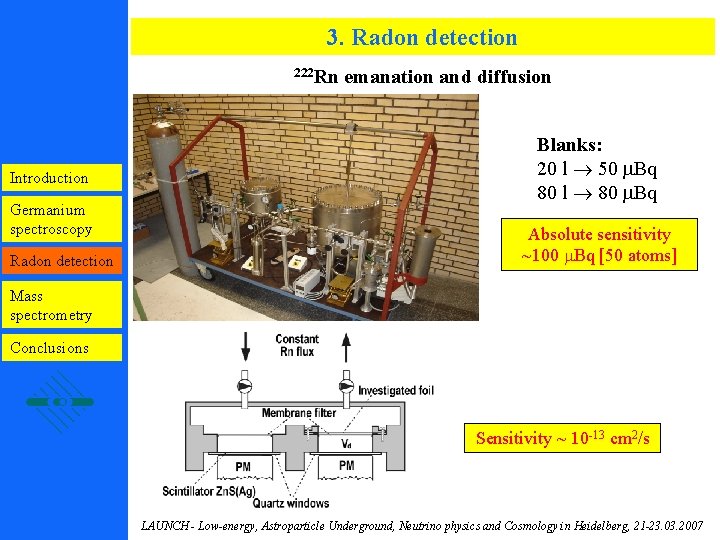
3. Radon detection 222 Rn Introduction Germanium spectroscopy Radon detection emanation and diffusion Blanks: 20 l 50 Bq 80 l 80 Bq Absolute sensitivity ~100 Bq [50 atoms] Mass spectrometry Conclusions Sensitivity ~ 10 -13 cm 2/s LAUNCH - Low-energy, Astroparticle Underground, Neutrino physics and Cosmology in Heidelberg, 21 -23. 03. 2007
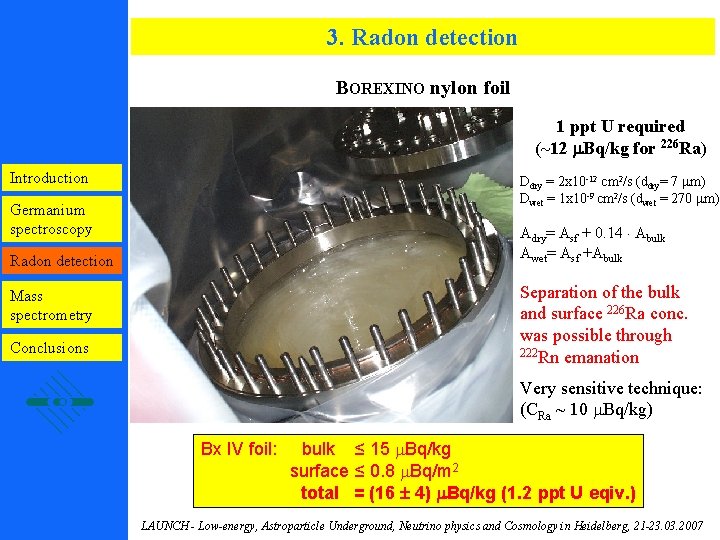
3. Radon detection BOREXINO nylon foil 1 ppt U required (~12 Bq/kg for 226 Ra) Introduction Ddry = 2 x 10 -12 cm 2/s (ddry= 7 m) Dwet = 1 x 10 -9 cm 2/s (dwet = 270 m) Germanium spectroscopy Adry= Asf + 0. 14 Abulk Awet= Asf +Abulk Radon detection Separation of the bulk and surface 226 Ra conc. was possible through 222 Rn emanation Mass spectrometry Conclusions Very sensitive technique: (CRa ~ 10 Bq/kg) Bx IV foil: bulk ≤ 15 Bq/kg surface ≤ 0. 8 Bq/m 2 total = (16 4) Bq/kg (1. 2 ppt U eqiv. ) LAUNCH - Low-energy, Astroparticle Underground, Neutrino physics and Cosmology in Heidelberg, 21 -23. 03. 2007
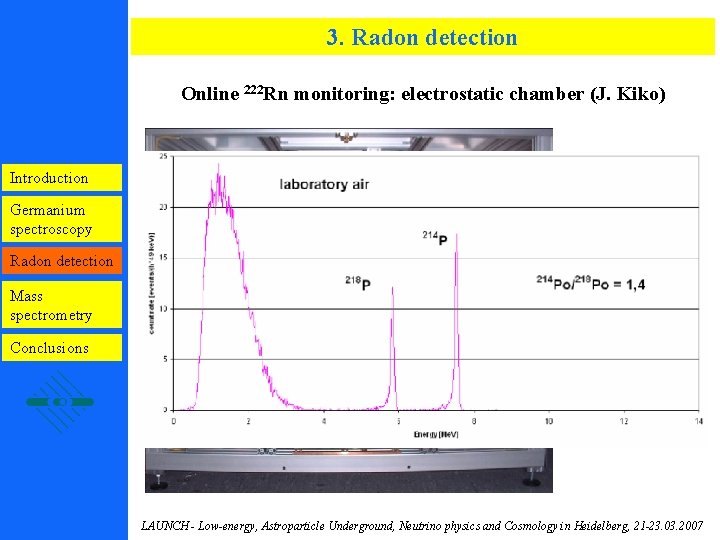
3. Radon detection Online 222 Rn monitoring: electrostatic chamber (J. Kiko) Introduction Germanium spectroscopy Radon detection Mass spectrometry Conclusions • 222 Rn monitoring in gases • Shape adopted to the electrical field • Volume: 750 l • Sensitivity goal: ~ 50 Bq/m 3 LAUNCH - Low-energy, Astroparticle Underground, Neutrino physics and Cosmology in Heidelberg, 21 -23. 03. 2007
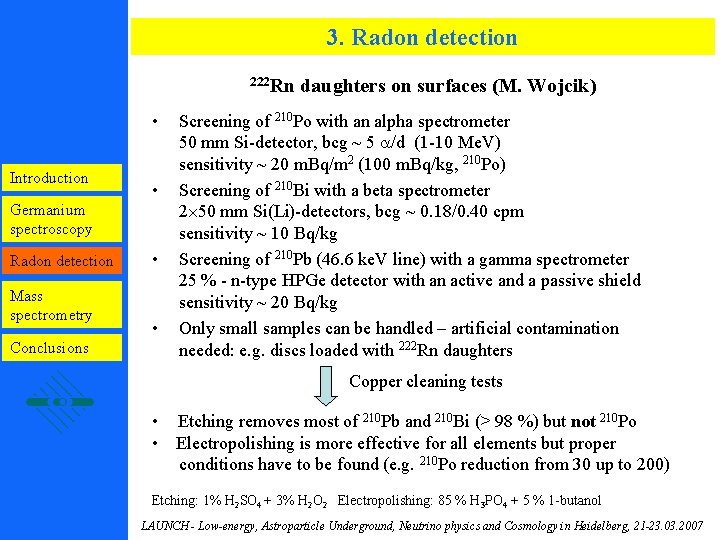
3. Radon detection 222 Rn • Introduction • Germanium spectroscopy Radon detection Mass spectrometry Conclusions • • daughters on surfaces (M. Wojcik) Screening of 210 Po with an alpha spectrometer 50 mm Si-detector, bcg ~ 5 /d (1 -10 Me. V) sensitivity ~ 20 m. Bq/m 2 (100 m. Bq/kg, 210 Po) Screening of 210 Bi with a beta spectrometer 2 50 mm Si(Li)-detectors, bcg ~ 0. 18/0. 40 cpm sensitivity ~ 10 Bq/kg Screening of 210 Pb (46. 6 ke. V line) with a gamma spectrometer 25 % - n-type HPGe detector with an active and a passive shield sensitivity ~ 20 Bq/kg Only small samples can be handled – artificial contamination needed: e. g. discs loaded with 222 Rn daughters Copper cleaning tests • Etching removes most of 210 Pb and 210 Bi (> 98 %) but not 210 Po • Electropolishing is more effective for all elements but proper conditions have to be found (e. g. 210 Po reduction from 30 up to 200) Etching: 1% H 2 SO 4 + 3% H 2 O 2 Electropolishing: 85 % H 3 PO 4 + 5 % 1 -butanol LAUNCH - Low-energy, Astroparticle Underground, Neutrino physics and Cosmology in Heidelberg, 21 -23. 03. 2007
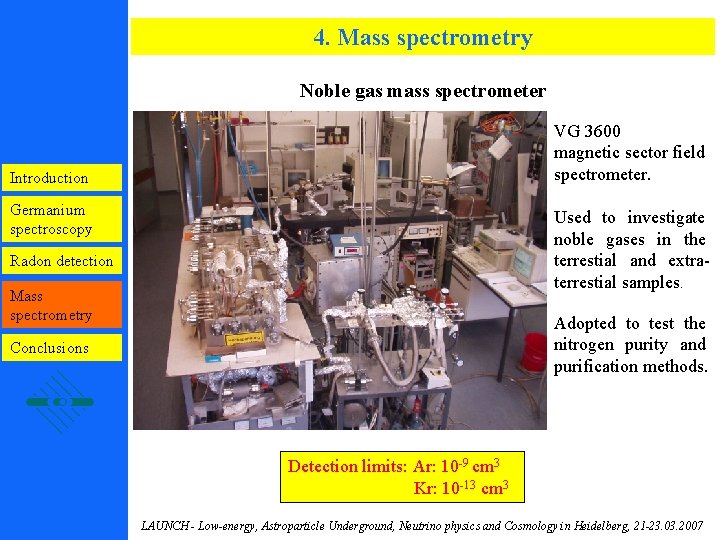
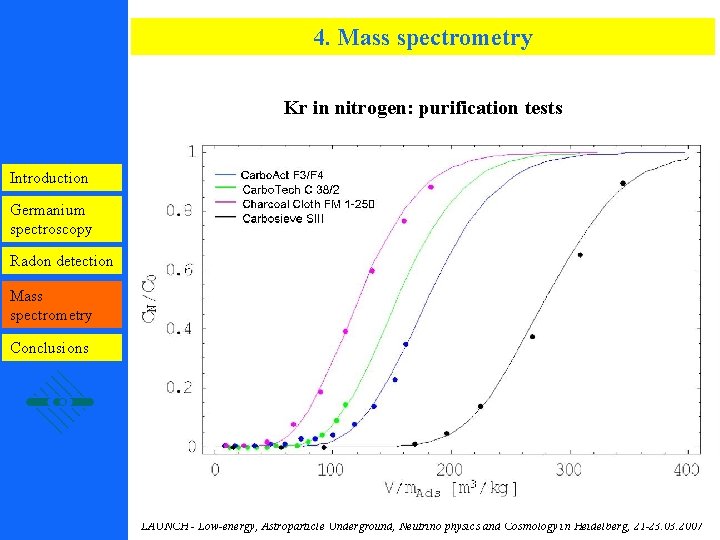
4. Mass spectrometry Noble gas mass spectrometer VG 3600 magnetic sector field spectrometer. Introduction Germanium spectroscopy Used to investigate noble gases in the terrestial and extraterrestial samples. Radon detection Mass spectrometry Adopted to test the nitrogen purity and purification methods. Conclusions Detection limits: Ar: 10 -9 cm 3 Kr: 10 -13 cm 3 LAUNCH - Low-energy, Astroparticle Underground, Neutrino physics and Cosmology in Heidelberg, 21 -23. 03. 2007
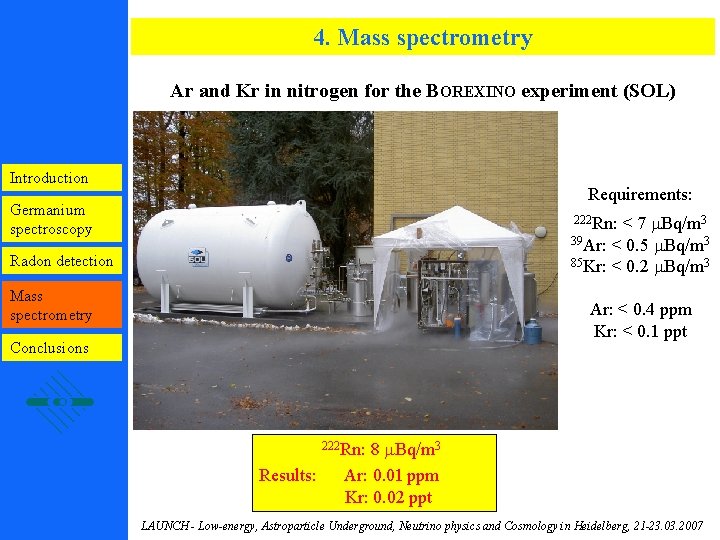
4. Mass spectrometry Ar and Kr in nitrogen for the BOREXINO experiment (SOL) Introduction Requirements: Germanium spectroscopy < 7 Bq/m 3 39 Ar: < 0. 5 Bq/m 3 85 Kr: < 0. 2 Bq/m 3 222 Rn: Radon detection Mass spectrometry Ar: < 0. 4 ppm Kr: < 0. 1 ppt Conclusions 8 Bq/m 3 Ar: 0. 01 ppm Kr: 0. 02 ppt 222 Rn: Results: LAUNCH - Low-energy, Astroparticle Underground, Neutrino physics and Cosmology in Heidelberg, 21 -23. 03. 2007
4. Mass spectrometry Kr in nitrogen: purification tests Introduction Germanium spectroscopy Radon detection Mass spectrometry Conclusions LAUNCH - Low-energy, Astroparticle Underground, Neutrino physics and Cosmology in Heidelberg, 21 -23. 03. 2007
5. Conclusions Introduction Germanium spectroscopy Radon detection Mass spectrometry Conclusions • Low-level techniques have “natural” application in experiments looking for rare events. • There is a long tradition and a lot of experience at MPI-K in this field (GALLEX/GNO, HDM, BOREXINO, GERDA). • Several detectors and experimental methods were developed allowing measurements even at a single atoms level. • Some of the developed/applied techniques are world-wide most sensitive (Ge spectroscopy, 222 Rn detection). • The ”low-level sub-group” is a part of the new division of M. Lindner. LAUNCH - Low-energy, Astroparticle Underground, Neutrino physics and Cosmology in Heidelberg, 21 -23. 03. 2007
2. Germanium spectroscopy Comparison of different detectors Introduction Germanium spectroscopy Radon detection Mass spectrometry Conclusions Slide from M. Hult LAUNCH - Low-energy, Astroparticle Underground, Neutrino physics and Cosmology in Heidelberg, 21 -23. 03. 2007