
Introduction Environmental Management System Definitions What Is an
- Slides: 18
Introduction Environmental Management System Definitions
What Is an Environmental Management System (EMS)? • EMS is the combination of people, laws, legislations, policies, procedures, reviews, and plans to help address environmental issues. • EMS is that part of an overall management system which includes: – – – – Organizational structure and responsibilities, Policies and legislations practices, Procedures, Resources, Planning activities, Awareness 2
Purpose of EMS brings together people, laws, policies, plans, review mechanisms, and procedures in order to improve and protect the environment 3
Benefits of an EMS • Helps maintain compliance • Integrate environmental programs • Reduce environmental impacts 4
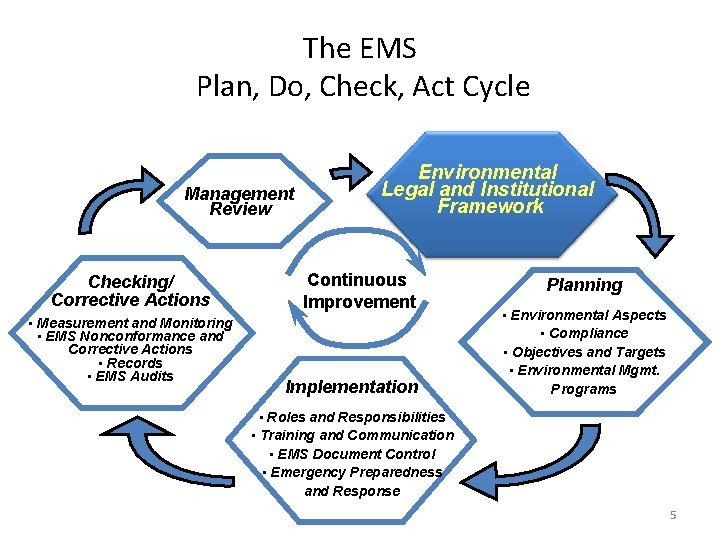
The EMS Plan, Do, Check, Act Cycle Management Review Checking/ Corrective Actions • Measurement and Monitoring • EMS Nonconformance and Corrective Actions • Records • EMS Audits Environmental Legal and Institutional Framework Continuous Improvement Implementation Planning • Environmental Aspects • Compliance • Objectives and Targets • Environmental Mgmt. Programs • Roles and Responsibilities • Training and Communication • EMS Document Control • Emergency Preparedness and Response 5
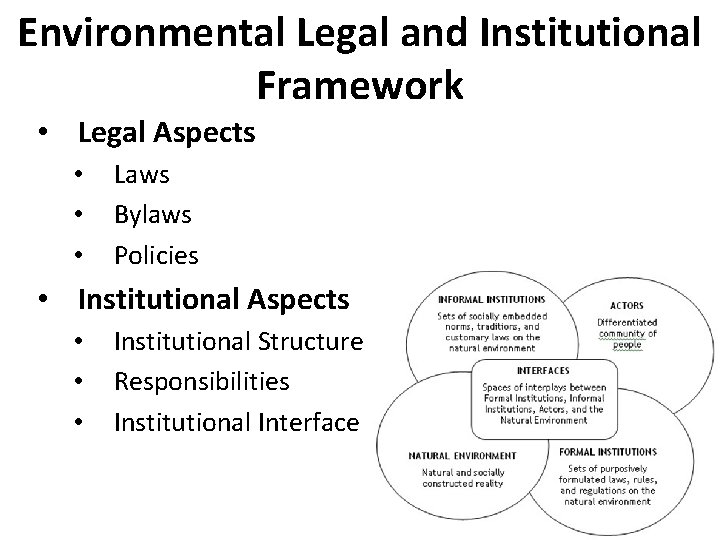
Environmental Legal and Institutional Framework • Legal Aspects • • • Laws Bylaws Policies • Institutional Aspects • • • Institutional Structure Responsibilities Institutional Interface
Types of law • The Constitution • Specialized Laws – Principles and regulations established in a community by some authority and applicable to its people, whether in the form of legislation or of custom and policies recognized and enforced by judicial decision. • Bylaws – The rules and regulations enacted by an association to provide a framework for its operation and management. 7
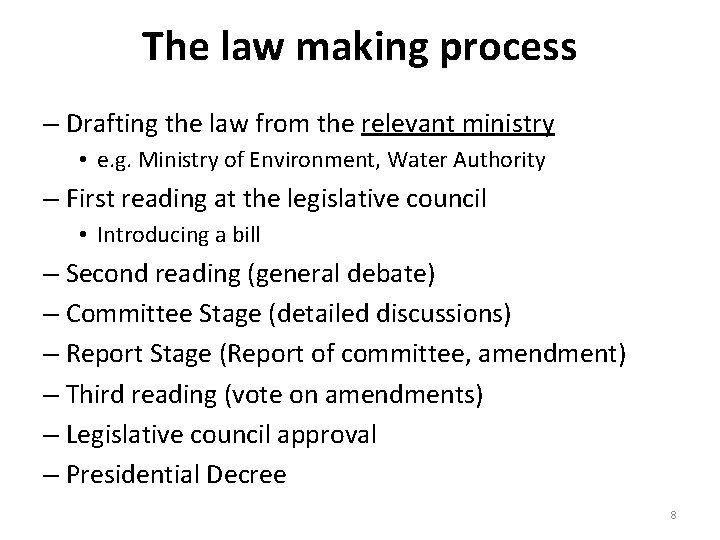
The law making process – Drafting the law from the relevant ministry • e. g. Ministry of Environment, Water Authority – First reading at the legislative council • Introducing a bill – Second reading (general debate) – Committee Stage (detailed discussions) – Report Stage (Report of committee, amendment) – Third reading (vote on amendments) – Legislative council approval – Presidential Decree 8
The objectives of the Environmental law 1. Protection of the environment against all forms and types of pollution; 2. Protection of Public health and welfare; 3. Insertion of the bases of environmental protection in social and economic development plans; and encouragement of sustainable development of vital resources in a manner that preserves the rights of future generations; 4. Protection of bio-diversity and environmentally sensitive areas, as well as improvement of environmentally harmed areas; 5. Encouragement of collection and publication of environmentrelated information to raise public awareness of environmental problems. 9
Environmental Policies • Environmental policies are rules or guidelines developed by governments to regulate behavior of individuals, corporations, and government agencies. 10
Six steps to making environmental policy 1 Identify Problems • Requires curiosity, observation, awareness 11
Six steps to making environmental policy 2 Identify Specific causes of the Problems • Involves scientific research and • Risk assessment = judging risks a problem poses to health or the environment 12
Six steps to making environmental policy 3 Get Organized • Organizations are more effective than individuals • But a motivated, informed individual can also succeed 13
Six steps to making environmental policy 4 Set Goals • Risk management = developing strategies to minimize risk • Involves social or political action 14
Six steps to making environmental policy 5 Cultivate access and influence • Lobbying • Political Support • Public acceptance 15
Six steps to making environmental policy 6 Manage Development policy • Prepare a draft policy, containing solutions • Following a law’s endorsement • Administrative agencies implement regulations • Policymakers evaluate the policy’s successes or failures • The judicial branch interprets the law 16
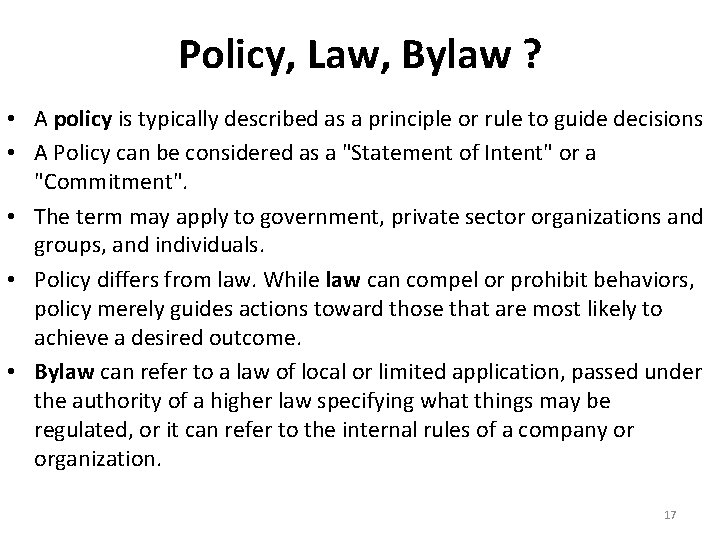
Policy, Law, Bylaw ? • A policy is typically described as a principle or rule to guide decisions • A Policy can be considered as a "Statement of Intent" or a "Commitment". • The term may apply to government, private sector organizations and groups, and individuals. • Policy differs from law. While law can compel or prohibit behaviors, policy merely guides actions toward those that are most likely to achieve a desired outcome. • Bylaw can refer to a law of local or limited application, passed under the authority of a higher law specifying what things may be regulated, or it can refer to the internal rules of a company or organization. 17
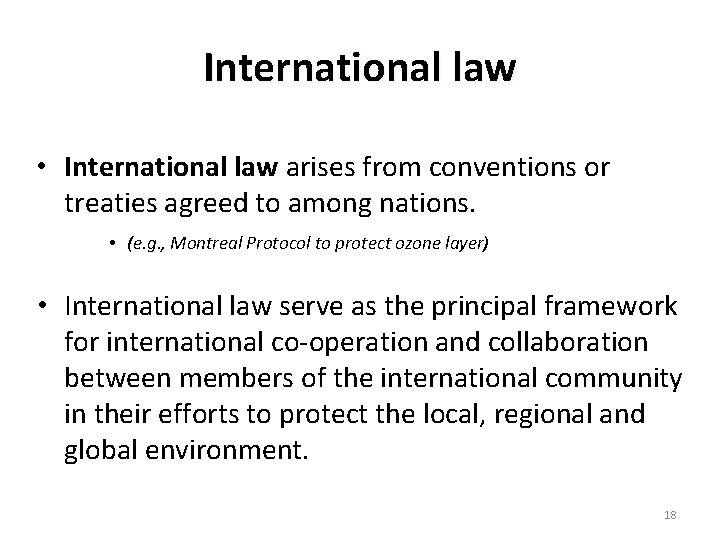
International law • International law arises from conventions or treaties agreed to among nations. • (e. g. , Montreal Protocol to protect ozone layer) • International law serve as the principal framework for international co-operation and collaboration between members of the international community in their efforts to protect the local, regional and global environment. 18