
Introduction EECS 470 Power and Architecture Many slides
- Slides: 45
Introduction EECS 470 Power and Architecture Many slides taken from Prof. David Brooks, Harvard University and modified by Mark Brehob. A couple of slides are also taken from Prof. Wenisch. Any errors are almost certainly Mark’s. Thanks to both!
Introduction Outline • Why is power a problem? • What uses power in a chip? • How can we reduce power? 2
Introduction Outline • Why is power a problem? • What uses power in a chip? • Relationship between power and performance. • How can we reduce power? 3
Why is power a problem in a μP? Introduction • Power used by the μP, vs. system power • Dissipating Heat • Melting (very bad) • Packaging (to cool $) • Heat leads to poorer performance. • Providing Energy • Battery • Cost of electricity 4
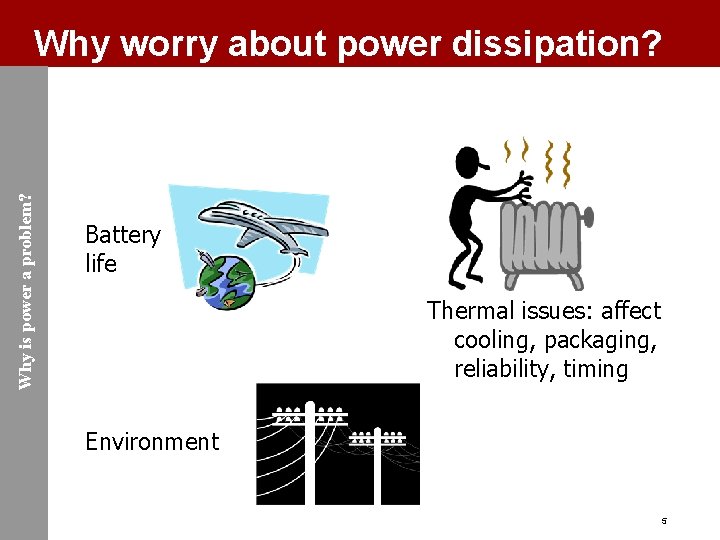
Why is power a problem? Why worry about power dissipation? Battery life Thermal issues: affect cooling, packaging, reliability, timing Environment 5
Where does power go? • Obviously desktop and servers are going to be different. • But if CPUs are a small fraction of the power, maybe we don’t care much? • Let’s take a look. • But first a few caveats – I can’t find recent studies on this – I do find that different studies can get radically different results. I’m using some fairly well-discussed numbers. 6
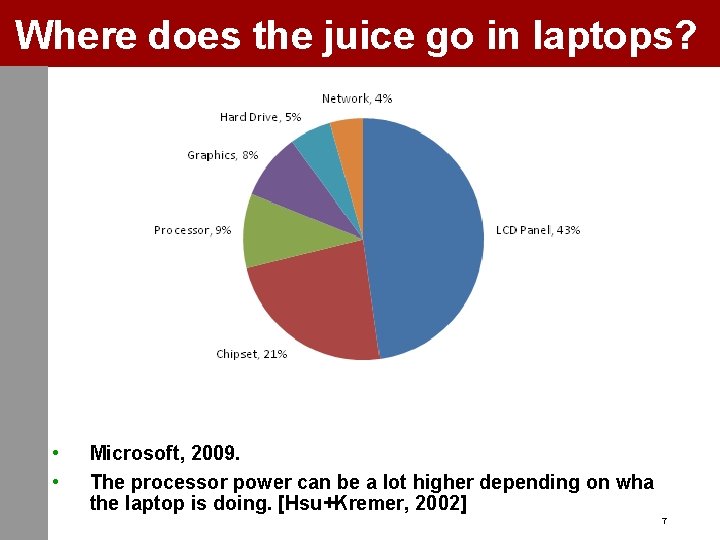
Where does the juice go in laptops? • • Microsoft, 2009. The processor power can be a lot higher depending on wha the laptop is doing. [Hsu+Kremer, 2002] 7
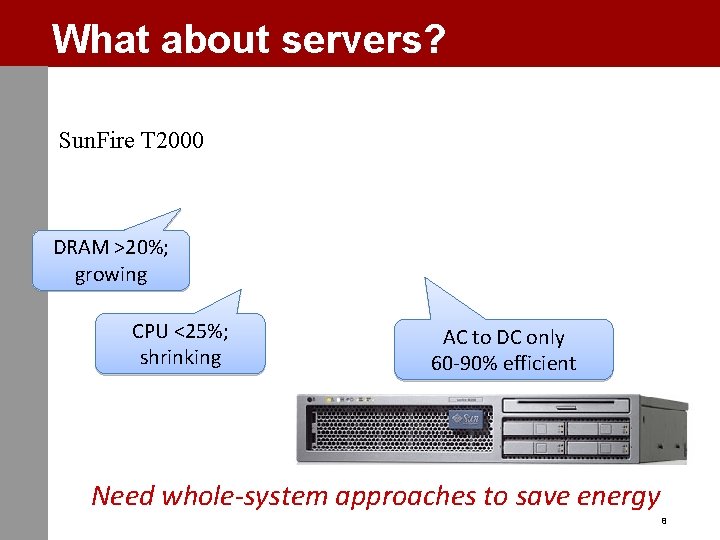
What about servers? Sun. Fire T 2000 DRAM >20%; growing CPU <25%; shrinking AC to DC only 60 -90% efficient Need whole-system approaches to save energy 8
Power usage effectiveness (PUE) A PUE of 2. 0 means that for every 2 W of power supplied to the data center, only 1 W is consumed by computing equipment. Values of around 2. 9 are pretty common 9
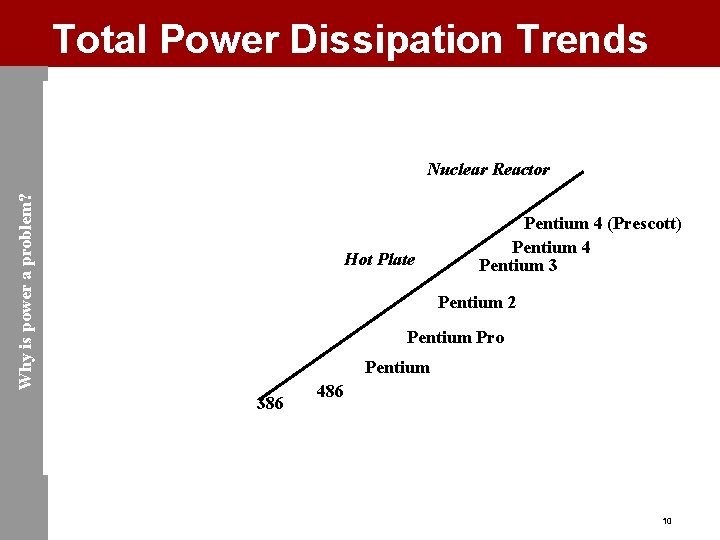
Total Power Dissipation Trends Why is power a problem? Nuclear Reactor Hot Plate Pentium 4 (Prescott) Pentium 4 Pentium 3 Pentium 2 Pentium Pro Pentium 386 486 10
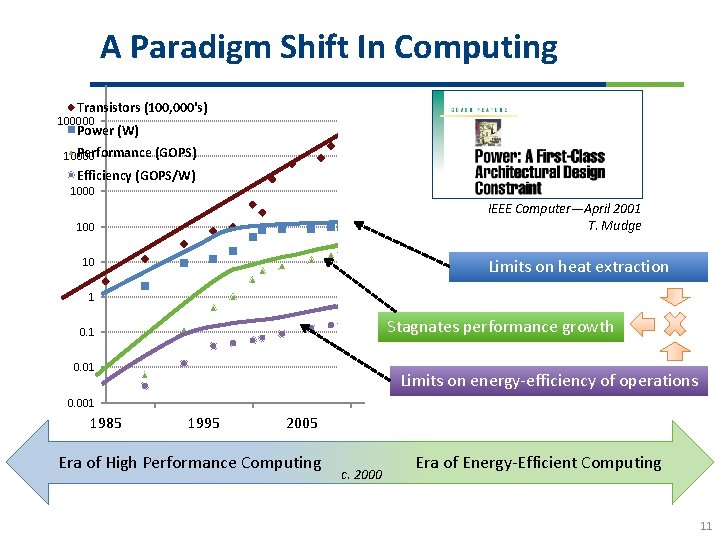
A Paradigm Shift In Computing Transistors (100, 000's) 100000 Power (W) Performance (GOPS) 10000 Efficiency (GOPS/W) 1000 IEEE Computer—April 2001 T. Mudge 100 10 Limits on heat extraction 1 Stagnates performance growth 0. 1 0. 01 Limits on energy-efficiency of operations 0. 001 1985 1995 2005 Era of High Performance Computing 2015 c. 2000 Era of Energy-Efficient Computing 11
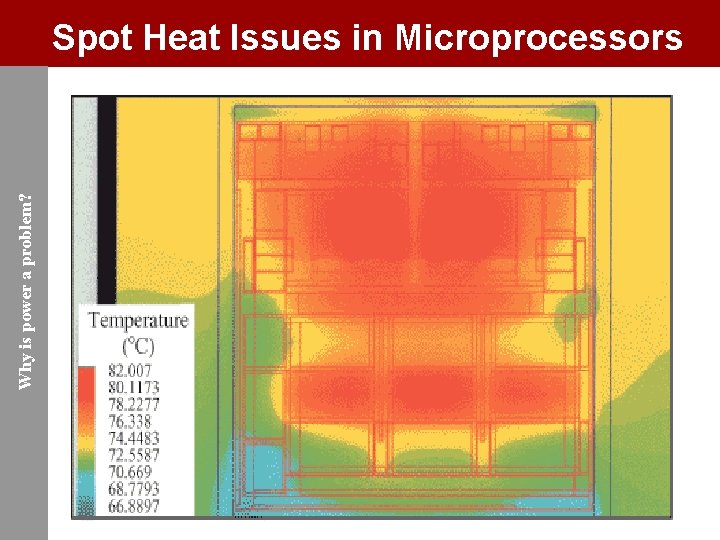
Why is power a problem? Spot Heat Issues in Microprocessors 12
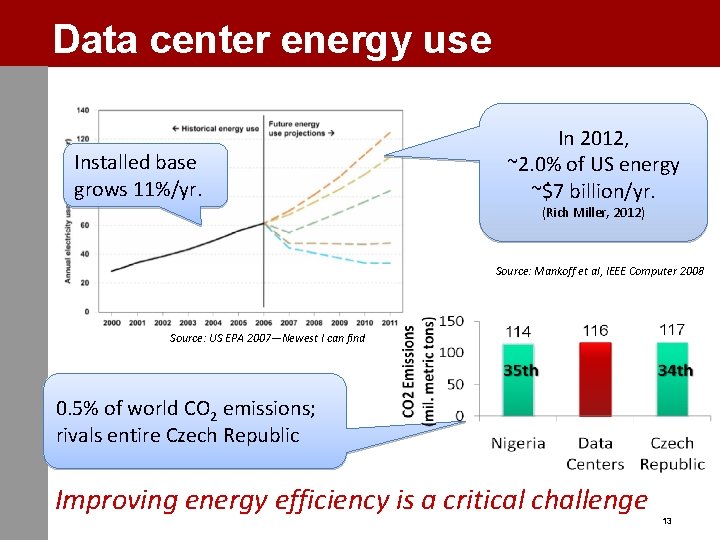
Data center energy use Installed base grows 11%/yr. In 2012, ~2. 0% of US energy ~$7 billion/yr. (Rich Miller, 2012) Source: Mankoff et al, IEEE Computer 2008 Source: US EPA 2007—Newest I can find 0. 5% of world CO 2 emissions; rivals entire Czech Republic Improving energy efficiency is a critical challenge 13
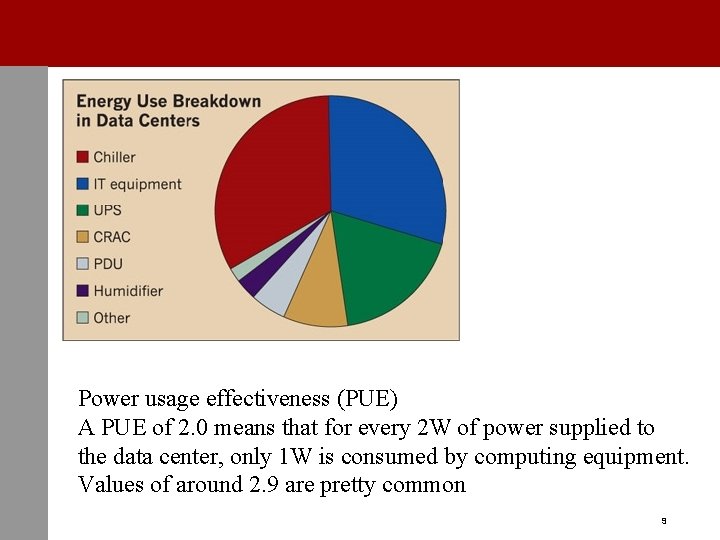
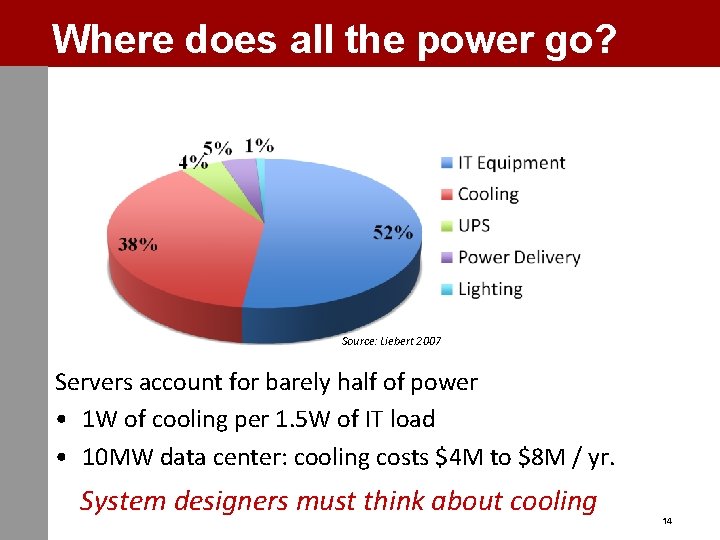
Where does all the power go? Source: Liebert 2007 Servers account for barely half of power • 1 W of cooling per 1. 5 W of IT load • 10 MW data center: cooling costs $4 M to $8 M / yr. System designers must think about cooling 14
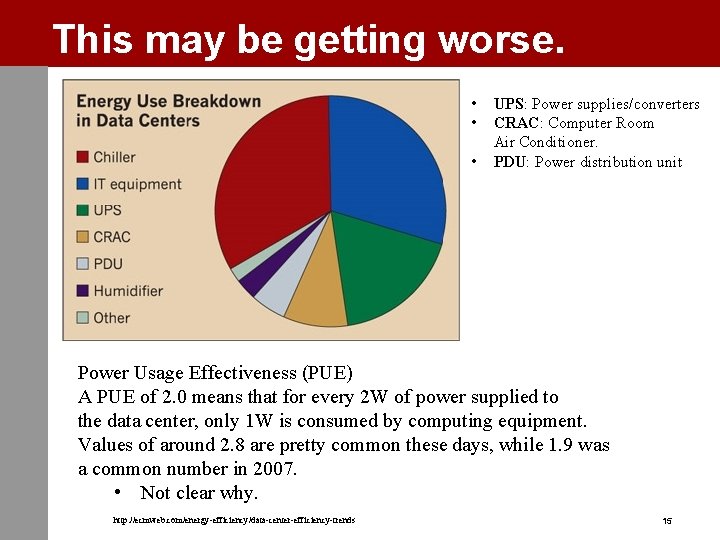
This may be getting worse. • • • UPS: Power supplies/converters CRAC: Computer Room Air Conditioner. PDU: Power distribution unit Power Usage Effectiveness (PUE) A PUE of 2. 0 means that for every 2 W of power supplied to the data center, only 1 W is consumed by computing equipment. Values of around 2. 8 are pretty common these days, while 1. 9 was a common number in 2007. • Not clear why. http: //ecmweb. com/energy-efficiency/data-center-efficiency-trends 15
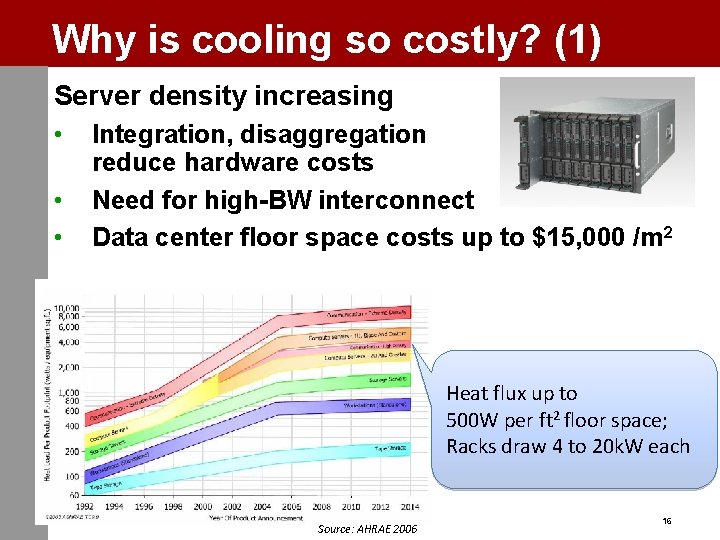
Why is cooling so costly? (1) Server density increasing • • • Integration, disaggregation reduce hardware costs Need for high-BW interconnect Data center floor space costs up to $15, 000 /m 2 Heat flux up to 500 W per ft 2 floor space; Racks draw 4 to 20 k. W each Source: AHRAE 2006 16
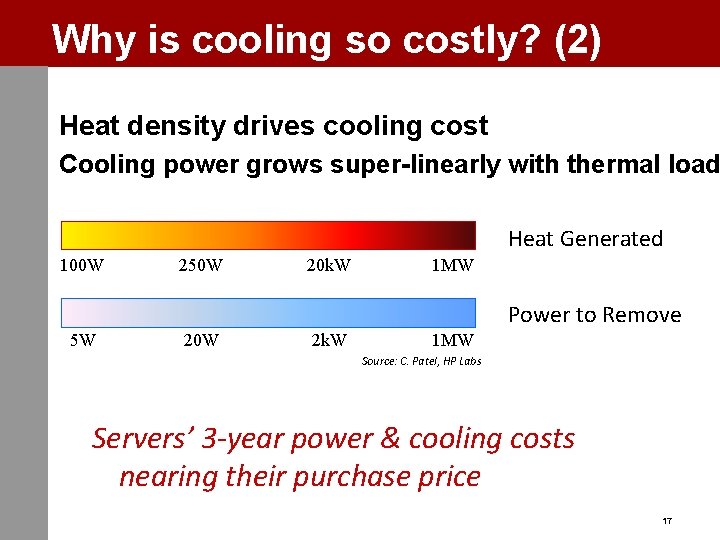
Why is cooling so costly? (2) Heat density drives cooling cost Cooling power grows super-linearly with thermal load Heat Generated 100 W 250 W 20 k. W 1 MW Power to Remove 5 W 20 W 2 k. W 1 MW Source: C. Patel, HP Labs Servers’ 3 -year power & cooling costs nearing their purchase price 17
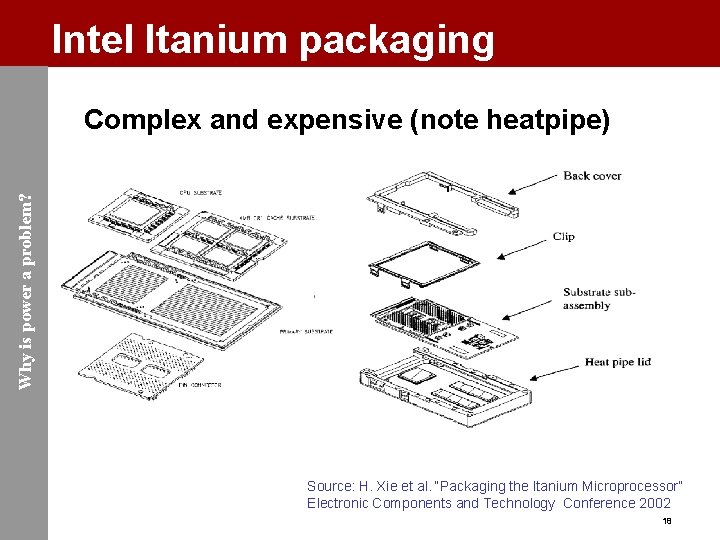
Intel Itanium packaging Why is power a problem? Complex and expensive (note heatpipe) Source: H. Xie et al. “Packaging the Itanium Microprocessor” Electronic Components and Technology Conference 2002 18
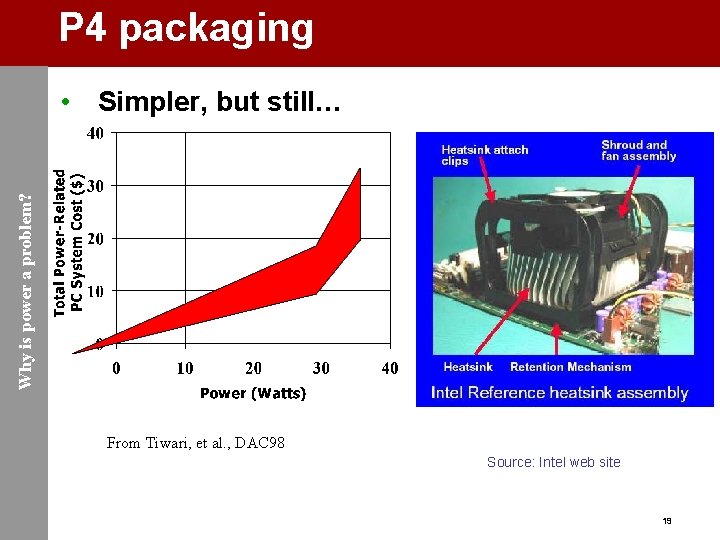
P 4 packaging Why is power a problem? • Simpler, but still… From Tiwari, et al. , DAC 98 Source: Intel web site 19
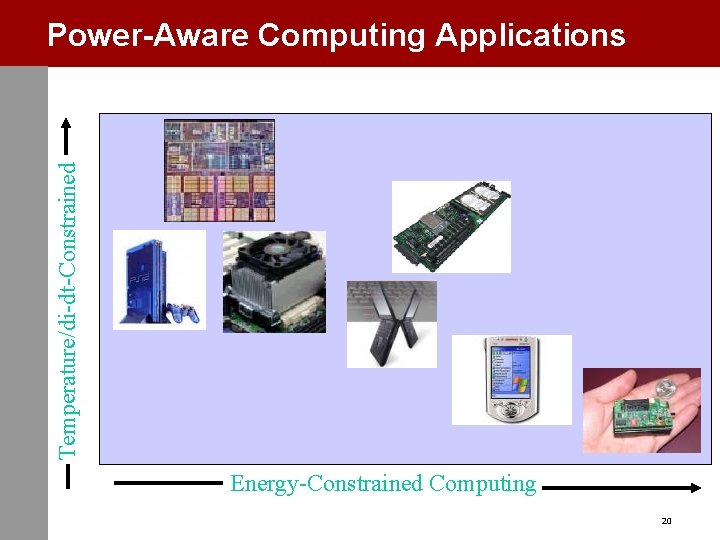
Temperature/di-dt-Constrained Power-Aware Computing Applications Energy-Constrained Computing 20
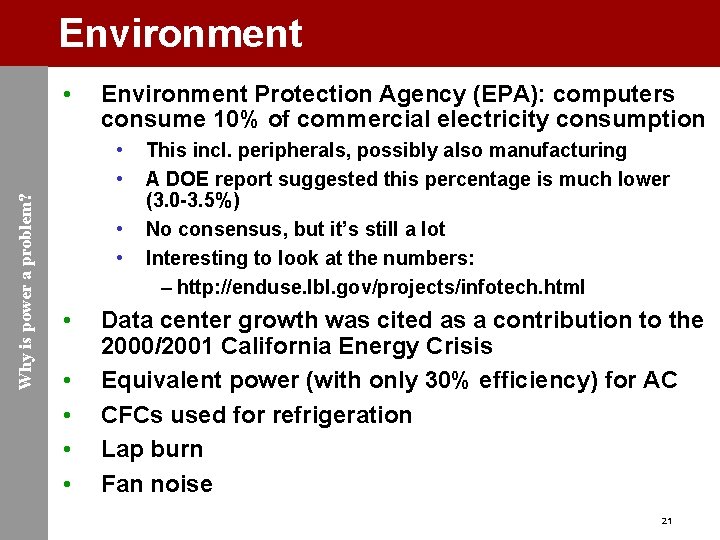
Environment • Environment Protection Agency (EPA): computers consume 10% of commercial electricity consumption Why is power a problem? • • • This incl. peripherals, possibly also manufacturing A DOE report suggested this percentage is much lower (3. 0 -3. 5%) No consensus, but it’s still a lot Interesting to look at the numbers: – http: //enduse. lbl. gov/projects/infotech. html Data center growth was cited as a contribution to the 2000/2001 California Energy Crisis Equivalent power (with only 30% efficiency) for AC CFCs used for refrigeration Lap burn Fan noise 21
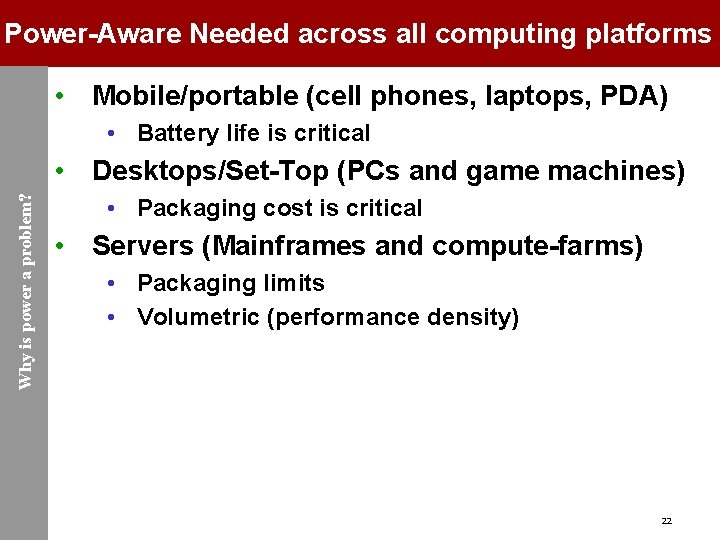
Power-Aware Needed across all computing platforms • Mobile/portable (cell phones, laptops, PDA) • Battery life is critical Why is power a problem? • Desktops/Set-Top (PCs and game machines) • Packaging cost is critical • Servers (Mainframes and compute-farms) • Packaging limits • Volumetric (performance density) 22
What uses power in a chip? 23
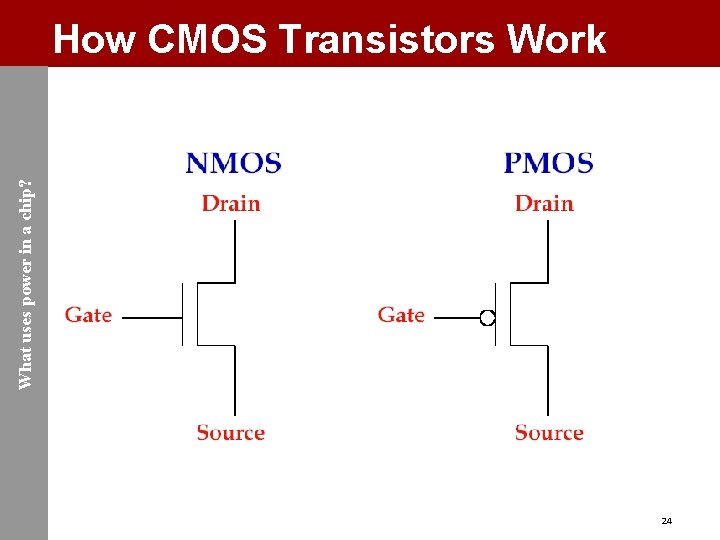
What uses power in a chip? How CMOS Transistors Work 24
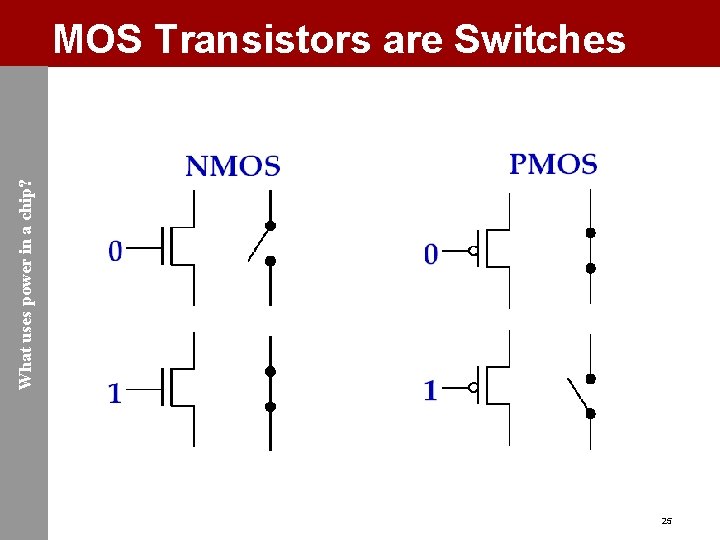
What uses power in a chip? MOS Transistors are Switches 25
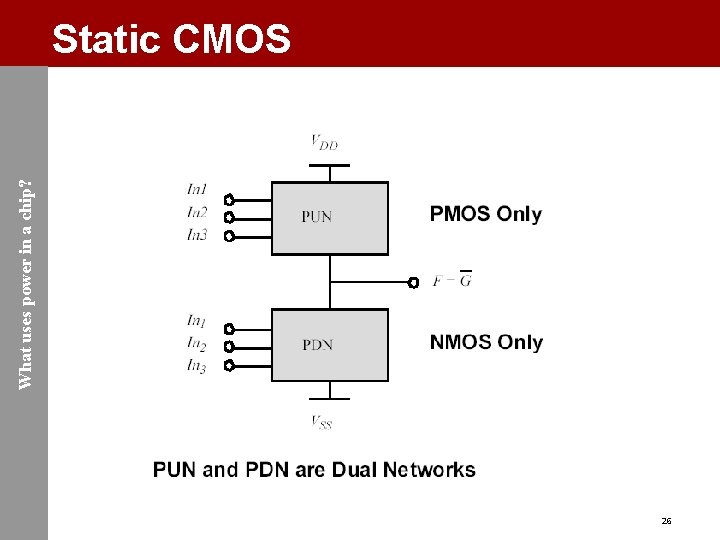
What uses power in a chip? Static CMOS 26
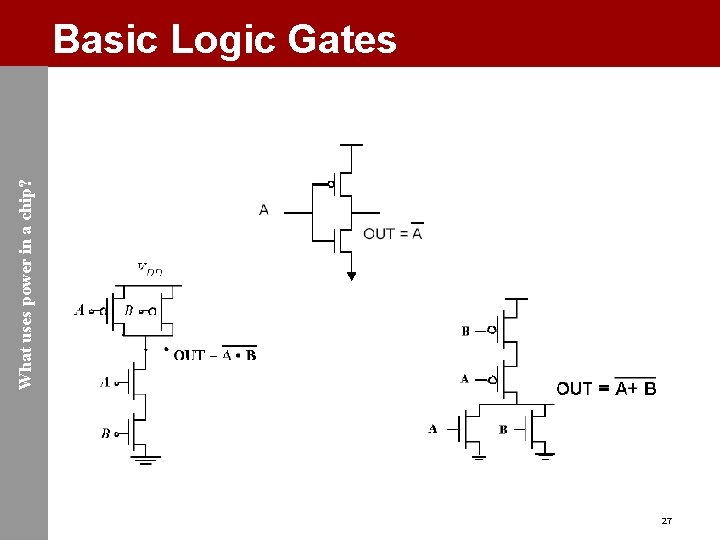
What uses power in a chip? Basic Logic Gates 27
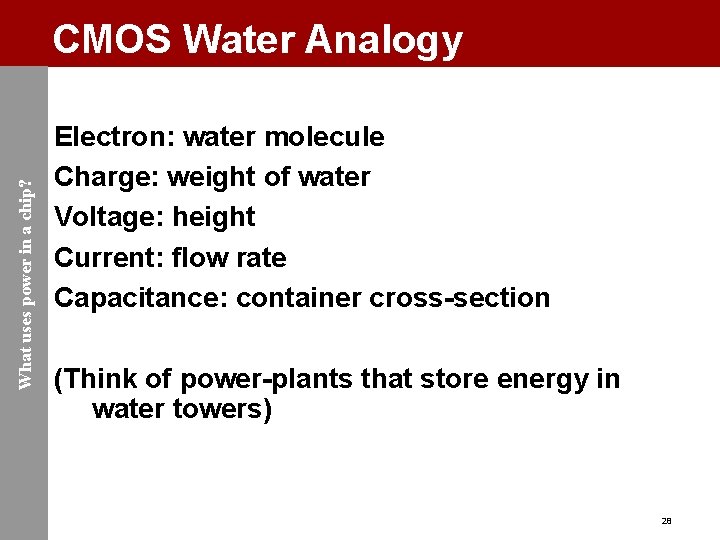
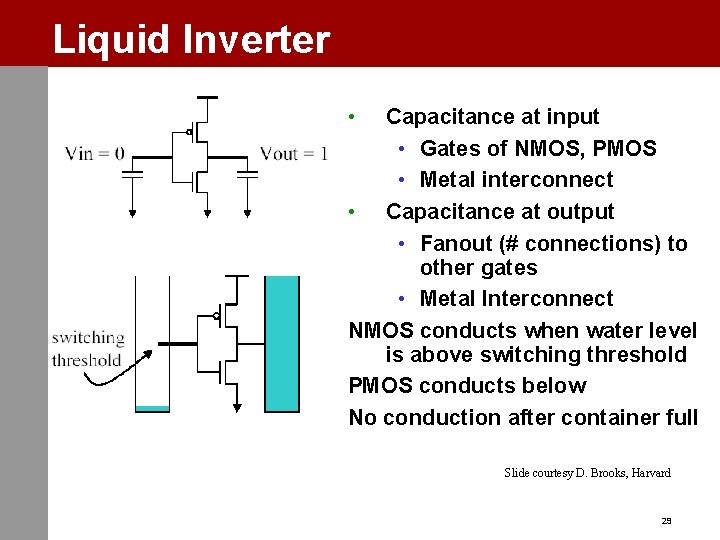
What uses power in a chip? CMOS Water Analogy Electron: water molecule Charge: weight of water Voltage: height Current: flow rate Capacitance: container cross-section (Think of power-plants that store energy in water towers) 28
Liquid Inverter • Capacitance at input • Gates of NMOS, PMOS • Metal interconnect • Capacitance at output • Fanout (# connections) to other gates • Metal Interconnect NMOS conducts when water level is above switching threshold PMOS conducts below No conduction after container full Slide courtesy D. Brooks, Harvard 29
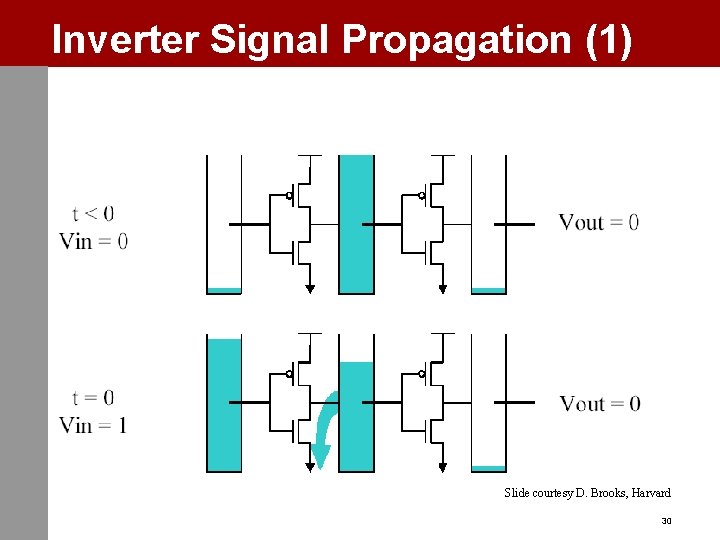
Inverter Signal Propagation (1) Slide courtesy D. Brooks, Harvard 30
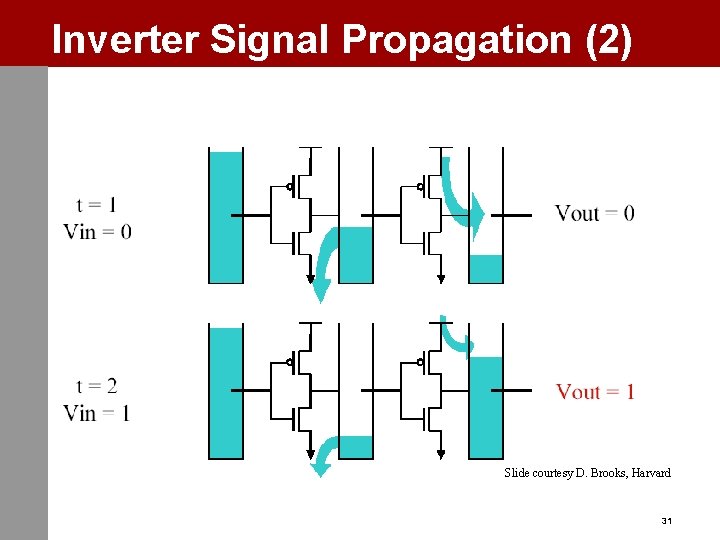
Inverter Signal Propagation (2) Slide courtesy D. Brooks, Harvard 31
Delay and Power Observations What uses power in a chip? • Load capacitance increases delay • High fanout (gates attached to output) • Interconnection • Higher current can increase speed • Increasing transistor width raises currents but also raises capacitance • Energy per switching event independent of current • Depends on amount of charge moved, not rate 32
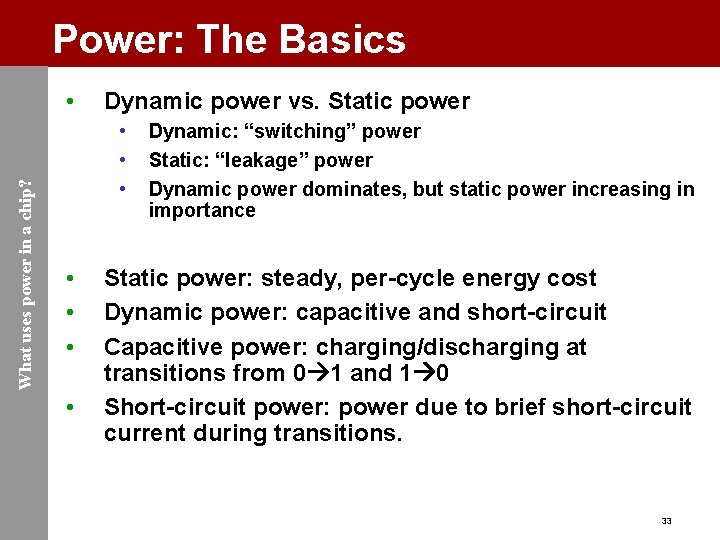
Power: The Basics What uses power in a chip? • Dynamic power vs. Static power • • Dynamic: “switching” power Static: “leakage” power Dynamic power dominates, but static power increasing in importance Static power: steady, per-cycle energy cost Dynamic power: capacitive and short-circuit Capacitive power: charging/discharging at transitions from 0 1 and 1 0 Short-circuit power: power due to brief short-circuit current during transitions. 33
What uses power in a chip? Dynamic (Capacitive) Power Dissipation • Data dependent – a function of switching activity 34
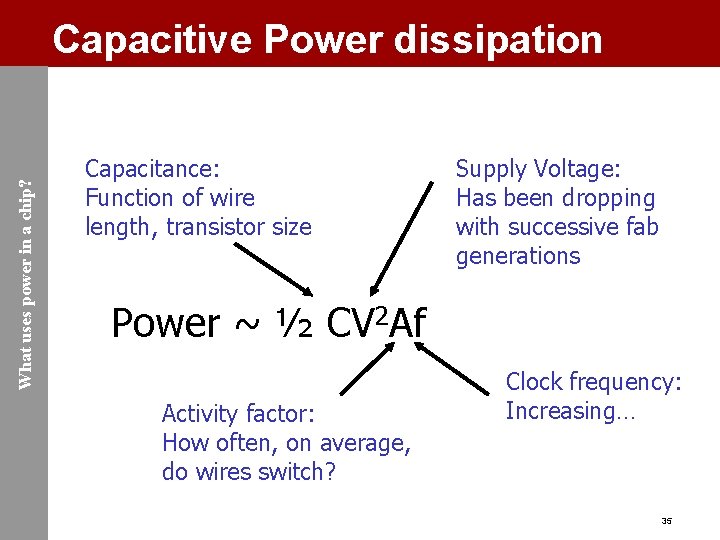
What uses power in a chip? Capacitive Power dissipation Capacitance: Function of wire length, transistor size Supply Voltage: Has been dropping with successive fab generations Power ~ ½ CV 2 Af Activity factor: How often, on average, do wires switch? Clock frequency: Increasing… 35
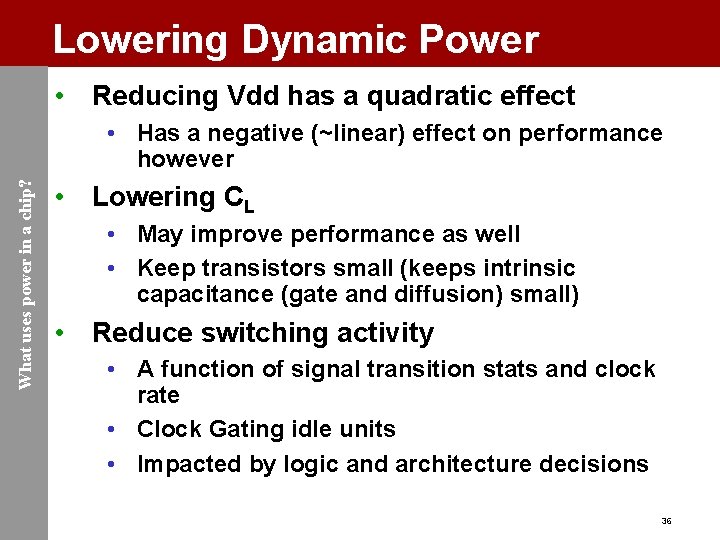
Lowering Dynamic Power • Reducing Vdd has a quadratic effect What uses power in a chip? • Has a negative (~linear) effect on performance however • Lowering CL • May improve performance as well • Keep transistors small (keeps intrinsic capacitance (gate and diffusion) small) • Reduce switching activity • A function of signal transition stats and clock rate • Clock Gating idle units • Impacted by logic and architecture decisions 36
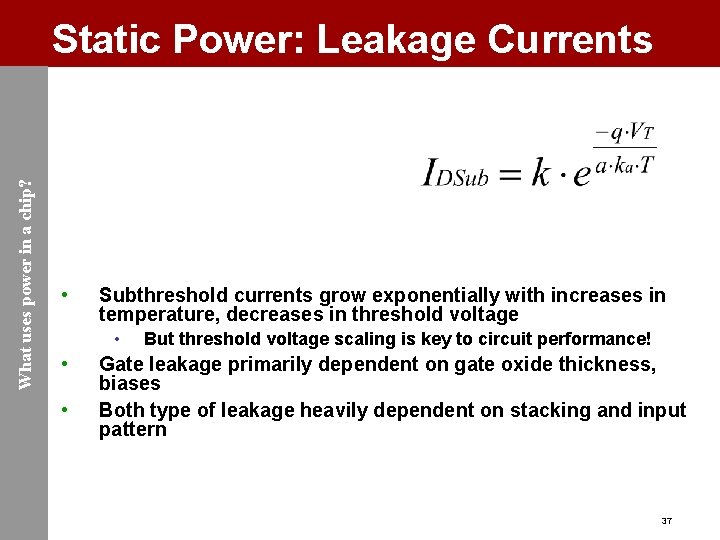
What uses power in a chip? Static Power: Leakage Currents • Subthreshold currents grow exponentially with increases in temperature, decreases in threshold voltage • • • But threshold voltage scaling is key to circuit performance! Gate leakage primarily dependent on gate oxide thickness, biases Both type of leakage heavily dependent on stacking and input pattern 37
Lowering Static Power What uses power in a chip? • Design-time Decisions • Use fewer, smaller transistors -- stack when possible to minimize contacts with Vdd/Gnd • Multithreshold process technology (multiple oxides too!) – Use “high-Vt” slow transistors whenever possible • Dynamic Techniques • Reverse-Body Bias (dynamically adjust threshold) – Low-leakage sleep mode (maintain state), e. g. XScale • Vdd-gating (Cut voltage/gnd connection to circuits) – Zero-leakage sleep mode – Lose state, overheads to enable/disable 38
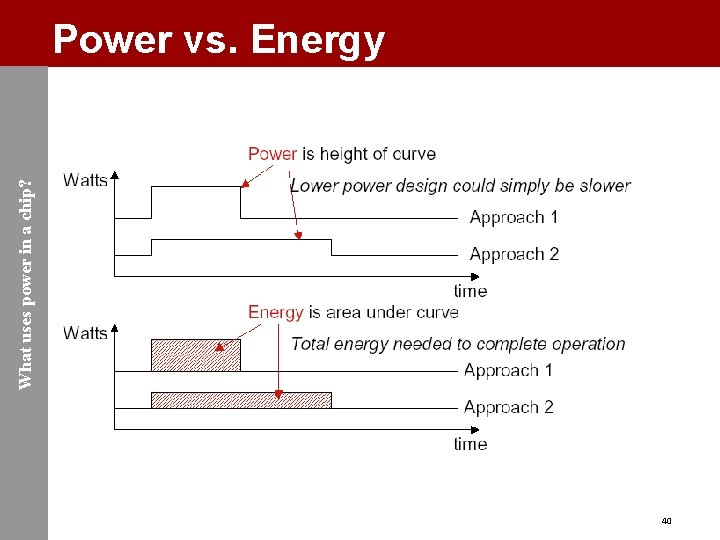
Power vs. Energy What uses power in a chip? • Power consumption in Watts • Determines battery life in hours • Sets packaging limits • Energy efficiency in joules • Rate at which energy is consumed over time • Energy = power * delay (joules = watts * seconds) • Lower energy number means less power to perform a computation at same frequency 39
What uses power in a chip? Power vs. Energy 40
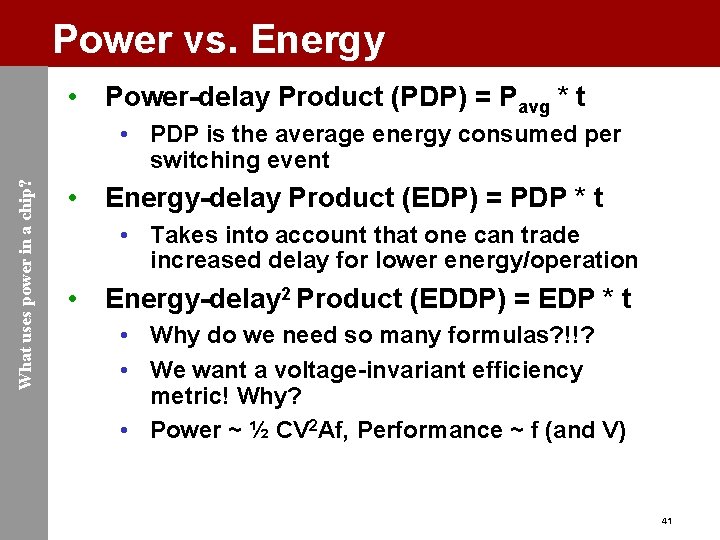
Power vs. Energy • Power-delay Product (PDP) = Pavg * t What uses power in a chip? • PDP is the average energy consumed per switching event • Energy-delay Product (EDP) = PDP * t • Takes into account that one can trade increased delay for lower energy/operation • Energy-delay 2 Product (EDDP) = EDP * t • Why do we need so many formulas? !!? • We want a voltage-invariant efficiency metric! Why? • Power ~ ½ CV 2 Af, Performance ~ f (and V) 41
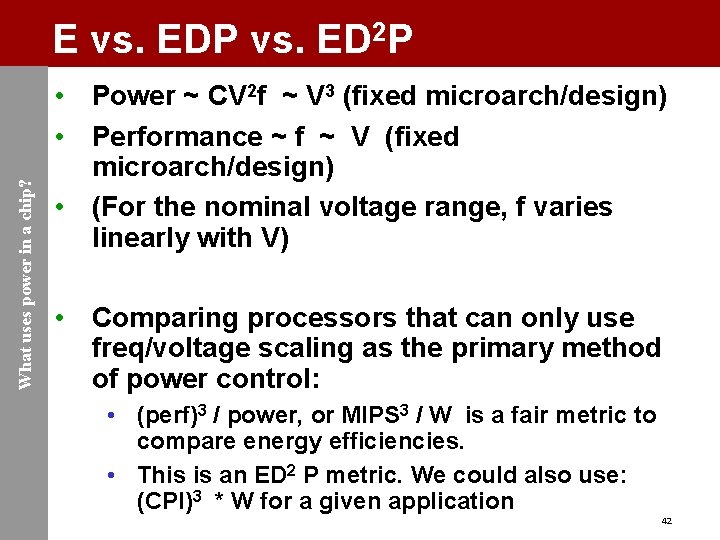
What uses power in a chip? E vs. EDP vs. ED 2 P • Power ~ CV 2 f ~ V 3 (fixed microarch/design) • Performance ~ f ~ V (fixed microarch/design) • (For the nominal voltage range, f varies linearly with V) • Comparing processors that can only use freq/voltage scaling as the primary method of power control: • (perf)3 / power, or MIPS 3 / W is a fair metric to compare energy efficiencies. • This is an ED 2 P metric. We could also use: (CPI)3 * W for a given application 42
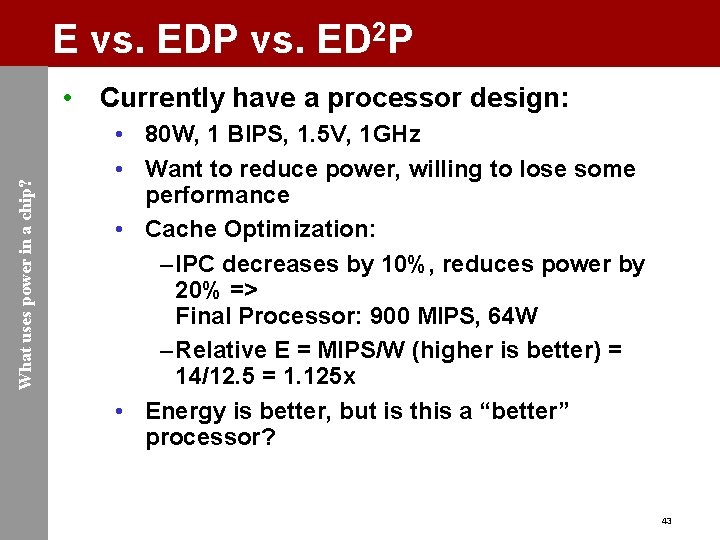
E vs. EDP vs. ED 2 P What uses power in a chip? • Currently have a processor design: • 80 W, 1 BIPS, 1. 5 V, 1 GHz • Want to reduce power, willing to lose some performance • Cache Optimization: – IPC decreases by 10%, reduces power by 20% => Final Processor: 900 MIPS, 64 W – Relative E = MIPS/W (higher is better) = 14/12. 5 = 1. 125 x • Energy is better, but is this a “better” processor? 43
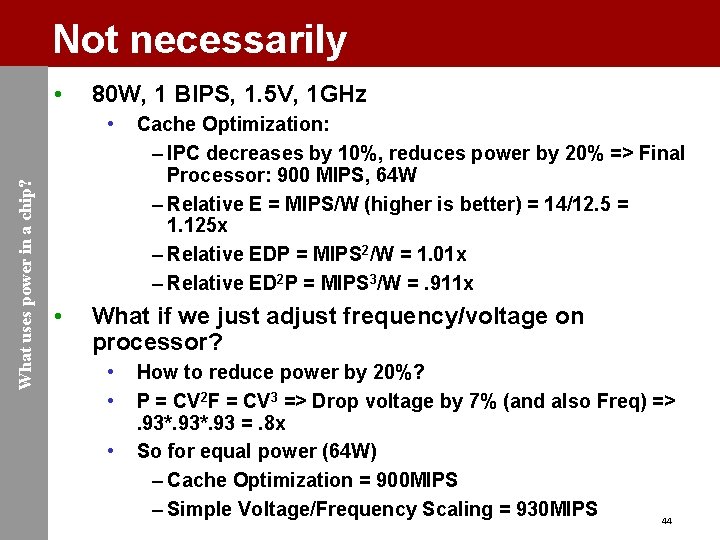
Not necessarily • 80 W, 1 BIPS, 1. 5 V, 1 GHz What uses power in a chip? • • Cache Optimization: – IPC decreases by 10%, reduces power by 20% => Final Processor: 900 MIPS, 64 W – Relative E = MIPS/W (higher is better) = 14/12. 5 = 1. 125 x – Relative EDP = MIPS 2/W = 1. 01 x – Relative ED 2 P = MIPS 3/W =. 911 x What if we just adjust frequency/voltage on processor? • • • How to reduce power by 20%? P = CV 2 F = CV 3 => Drop voltage by 7% (and also Freq) =>. 93*. 93 =. 8 x So for equal power (64 W) – Cache Optimization = 900 MIPS – Simple Voltage/Frequency Scaling = 930 MIPS 44
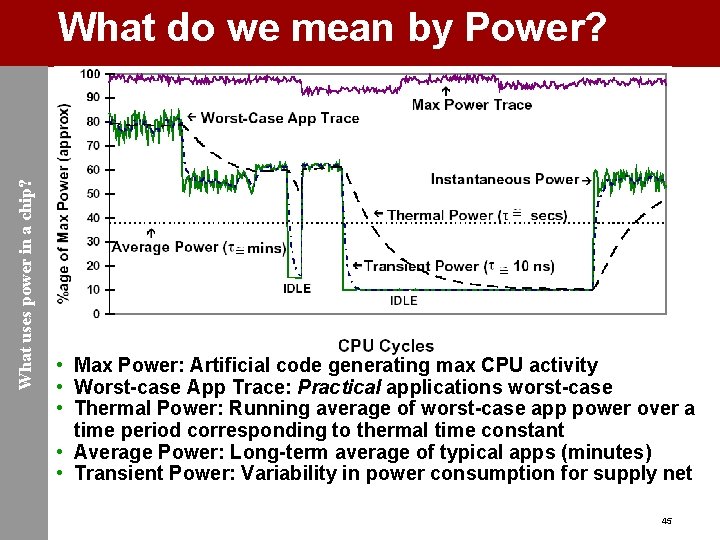
What uses power in a chip? What do we mean by Power? • Max Power: Artificial code generating max CPU activity • Worst-case App Trace: Practical applications worst-case • Thermal Power: Running average of worst-case app power over a time period corresponding to thermal time constant • Average Power: Long-term average of typical apps (minutes) • Transient Power: Variability in power consumption for supply net 45