
Introduction ECVET Objectives and Implementation in Malta Overview
Introduction ü ECVET Objectives and Implementation in Malta ü Overview of ECVET Education in Malta ü Competent Authority ü Main ECVET Providers ü Qualification Framework ü ICVET ü Use of Learning Outcomes ü Flexible Pathways for ECVET ü ECVET –ECTS ü VNFIL and RPL
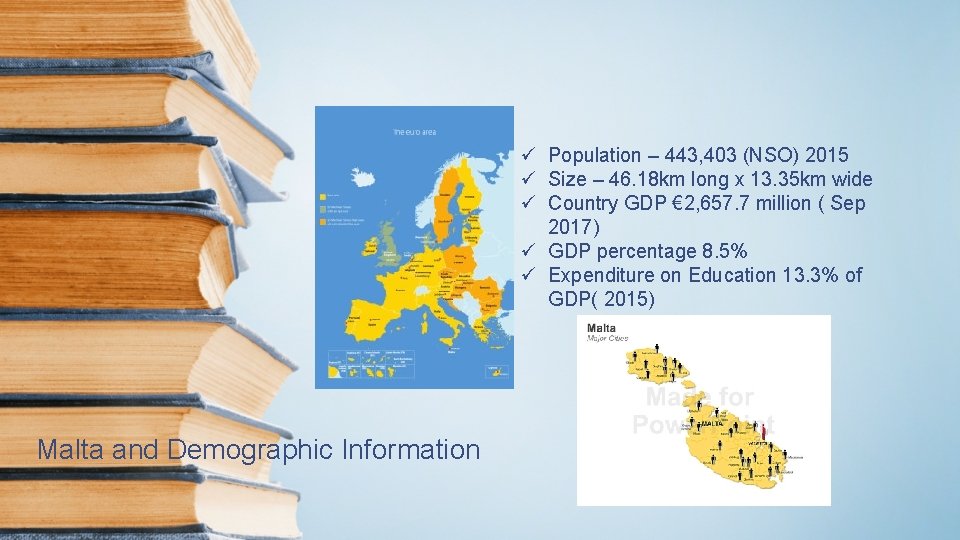
ü Population – 443, 403 (NSO) 2015 ü Size – 46. 18 km long x 13. 35 km wide ü Country GDP € 2, 657. 7 million ( Sep 2017) ü GDP percentage 8. 5% ü Expenditure on Education 13. 3% of GDP( 2015) Malta and Demographic Information
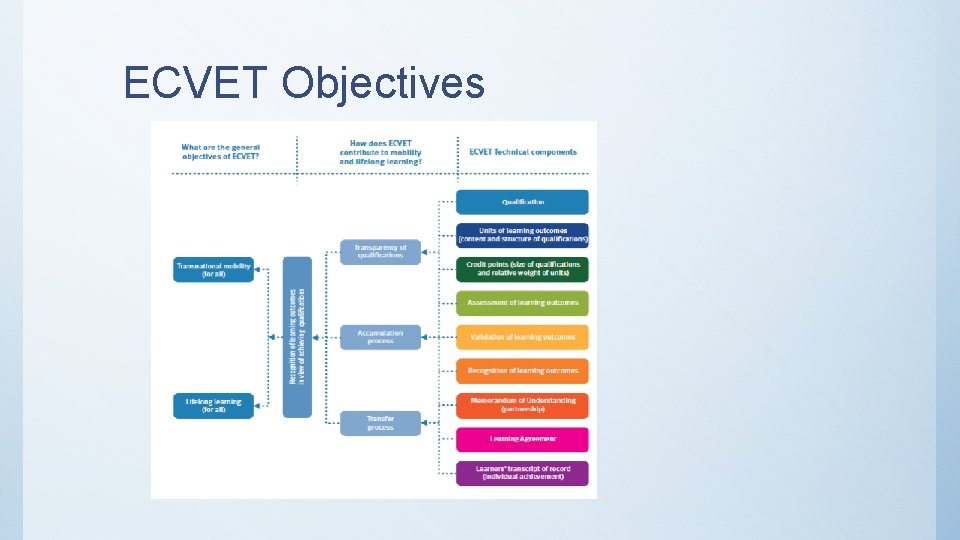
ECVET Objectives
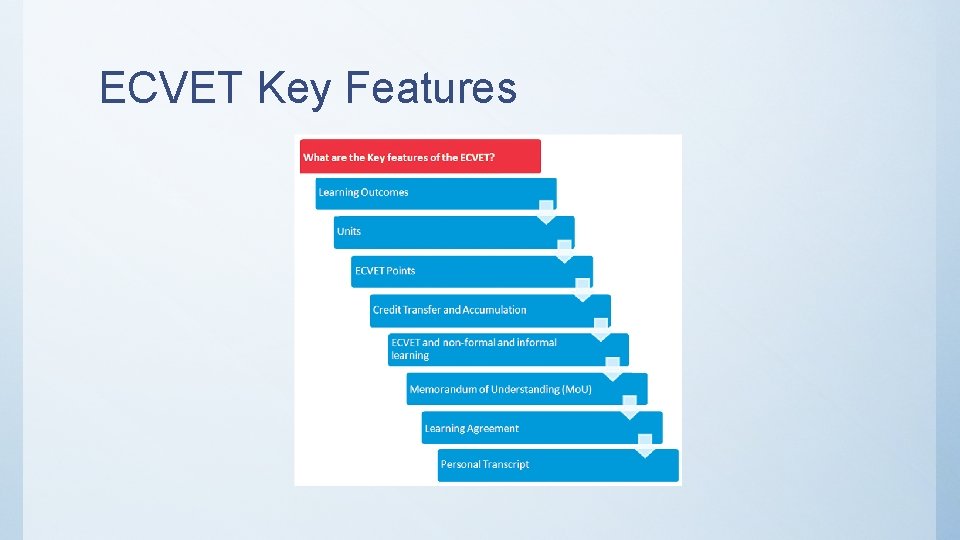
ECVET Key Features
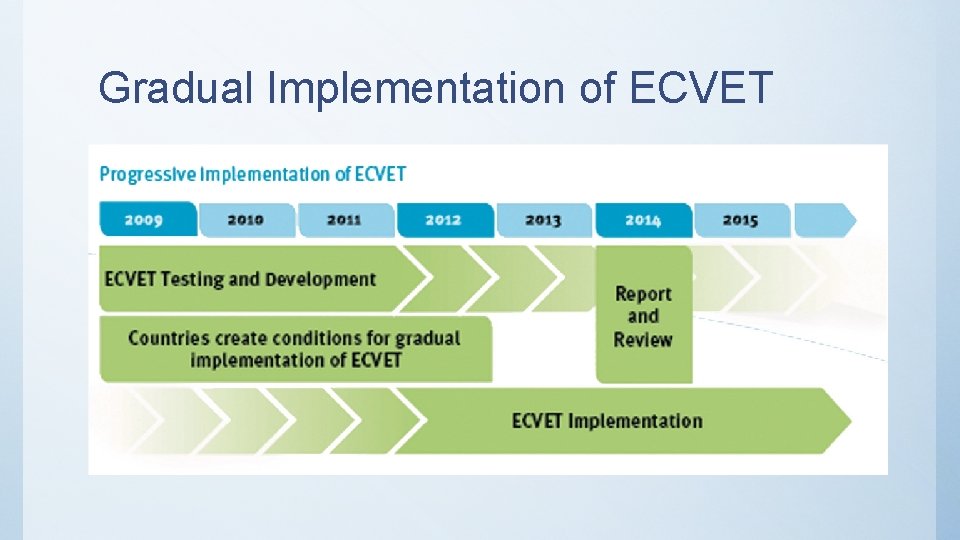
Gradual Implementation of ECVET

ECVET Initiative in Malta ü 2 year pilot project ( March 2011) ü MQF as the Leading Partners (NCFHE) ü 3 foreign partners – Italy-Slovenia. Romania ü 5 Local Partners ü Funded through Leonardo Da Vinci for LLL of EU Commission ü 30 courses were selected Level 4
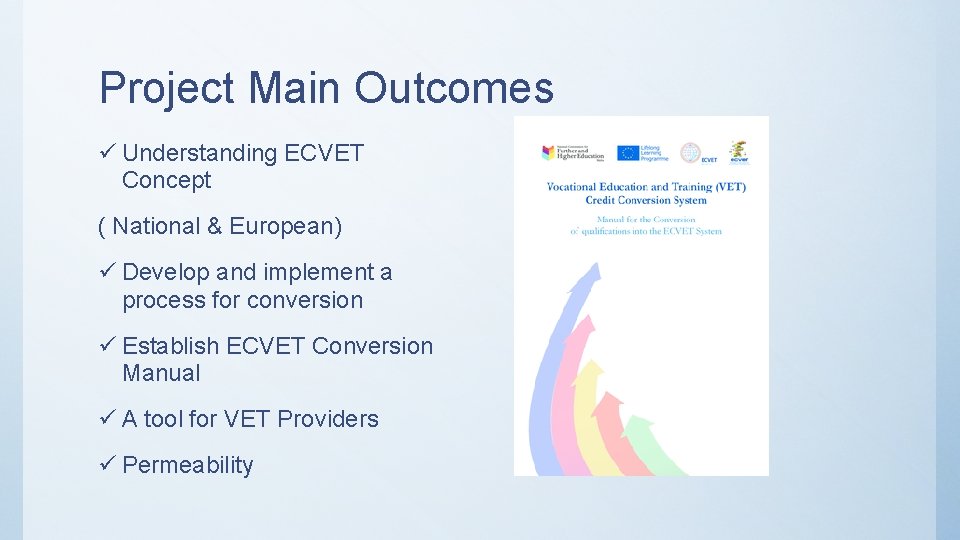
Project Main Outcomes ü Understanding ECVET Concept ( National & European) ü Develop and implement a process for conversion ü Establish ECVET Conversion Manual ü A tool for VET Providers ü Permeability
ECVET Manual ü Manual Update ( 2017) ü Divided into 5 Separate Booklets 1. Introducing ECVET 2. ECVET For Mobility and LLL 3. ECVET For Employment 4. ECVET for VET Providers ( Designing Study Programmes) 5. ECVET for VET Providers ( Getting a Programme Accredited)
GENERAL OVERVIEW OF EDUCATION IN MALTA ü Pre- school from the age of 3 -4 years ( 2 years). ü Compulsory School from the of 5 -16 ( 10 years). ü Further and Higher Education from 16 – upwards. ü Mature Students 23 upwards ü Life – long learning (no age). ü Various Part-time Courses for all ages.
Competent Authority in Malta ü MQC Set up – Legal Notice 347 (2005) ü First Referencing Report September 2008 ü Commission set up in 2012 ü Oversee quality of education programs. ü Legal Notice 295 of 2012. http: //www. justiceservices. gov. mt/Download. Document. aspx? app=lp&itemid=23720&l=1 ü Amendment Subsidiary Legislation 327. 432 , 2014 for VNFIL.
Competent Authority in Malta ü Referencing Report 4 th Revised Edition https: //ncfhe. gov. mt/en/Documents/Referencing%20 Rep ort/Referencing%20 Report%202016. pdf ü Auditing /Quality Assurance. ü IQA –EQA ü Reports by EQA are Published. ü Program and Provider Accreditation ü VNFIL https: //ncfhe. gov. mt/en/services/Pages/All%20 Services/ eqaa. aspx ü Sectoral Skills Committees Set Up
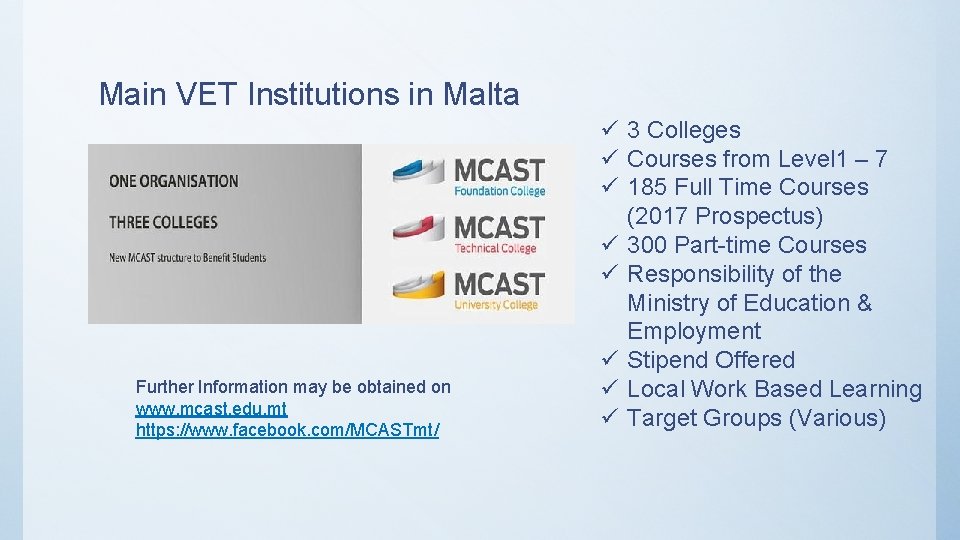
Main VET Institutions in Malta Further Information may be obtained on www. mcast. edu. mt https: //www. facebook. com/MCASTmt/ ü 3 Colleges ü Courses from Level 1 – 7 ü 185 Full Time Courses (2017 Prospectus) ü 300 Part-time Courses ü Responsibility of the Ministry of Education & Employment ü Stipend Offered ü Local Work Based Learning ü Target Groups (Various)

Main VET Institutions in Malta Further Information may be obtained on www. its. edu. mt https: //www. facebook. com/instituteoftourismstudies/ ü 1 Institute – 3 Campuses ü Courses from Level 1 – 6 ü Focused Full Time Courses/ Launching of new programs (2017 Prospectus) ü Part-time Courses ü Responsibility of the Ministry for Tourism ü Government Funded ü Stipend Offered ü Local Industrial Placements ü International Industrial Placements ü Target Groups ( Mainly Hospitality)
Life-Long Learning VET Training in Malta ü ü Job Plus (Former ETC) Adult Learning Centre Part-time Courses Responsibility of the Ministry for Education & Employment ü Target Groups- All Ages ü Main Focus – Essential Skills Further Information may be obtained on https: //www. facebook. com/Lifelonglearningmalta/ https: //lifelonglearning. gov. mt/public/frm. Courses. Category. aspx? cat=2 https: //jobsplus. gov. mt/
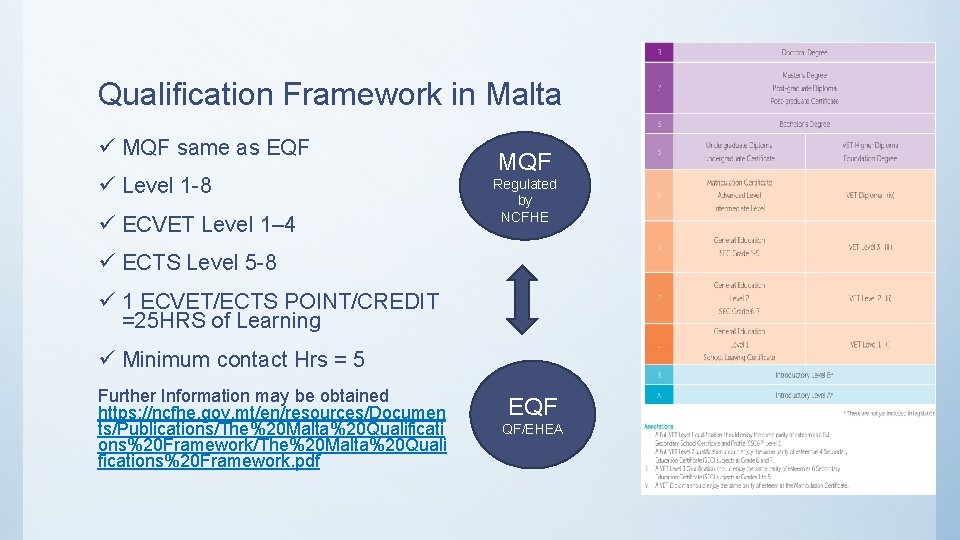
Qualification Framework in Malta ü MQF same as EQF ü Level 1 -8 ü ECVET Level 1– 4 MQF Regulated by NCFHE ü ECTS Level 5 -8 ü 1 ECVET/ECTS POINT/CREDIT =25 HRS of Learning ü Minimum contact Hrs = 5 Further Information may be obtained https: //ncfhe. gov. mt/en/resources/Documen ts/Publications/The%20 Malta%20 Qualificati ons%20 Framework/The%20 Malta%20 Quali fications%20 Framework. pdf EQF QF/EHEA
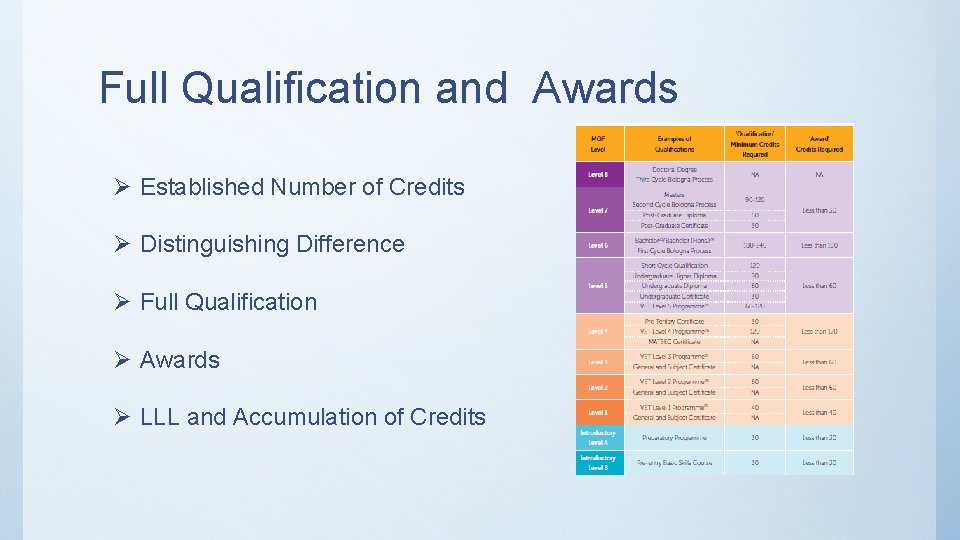
Full Qualification and Awards Ø Established Number of Credits Ø Distinguishing Difference Ø Full Qualification Ø Awards Ø LLL and Accumulation of Credits
Introduction of IVET Subjects in Secondary Schools ü ü ü ü Introduced in 2015 Based on a 3 Academic Years Agribusiness Health & Social Care Engineering Technology Information Technology Hospitality Bases on Learning Outcomes Further Information may be obtained on https: //www. um. edu. mt/__data/assets/pdf_file/0020/271271/Vocational. Subjects. pdf
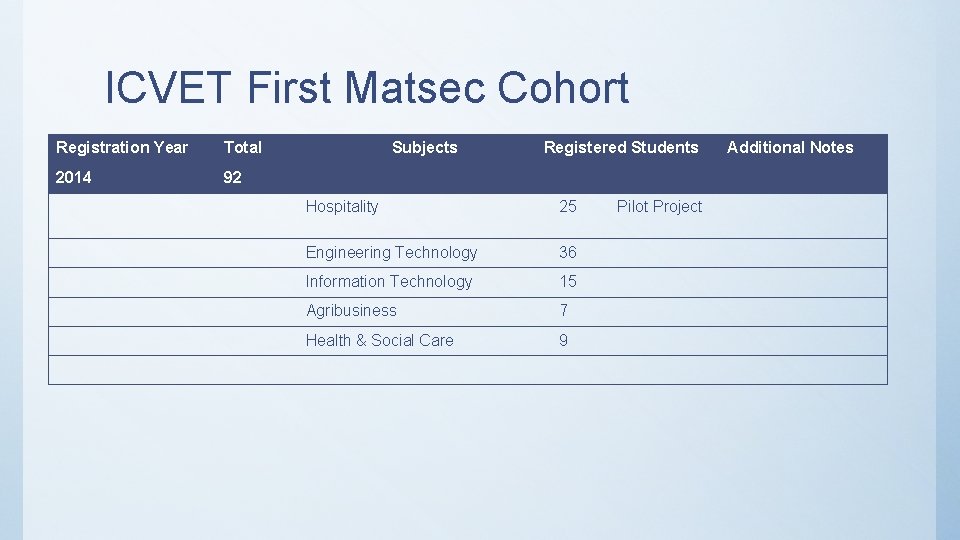
ICVET First Matsec Cohort Registration Year Total 2014 92 Subjects Registered Students Hospitality 25 Engineering Technology 36 Information Technology 15 Agribusiness 7 Health & Social Care 9 Pilot Project Additional Notes
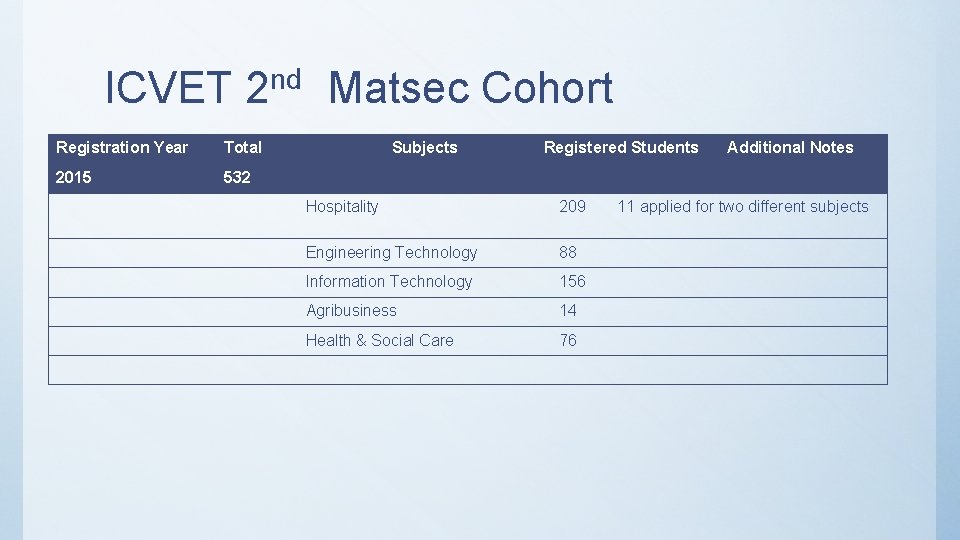
ICVET 2 nd Matsec Cohort Registration Year Total 2015 532 Subjects Registered Students Hospitality 209 Engineering Technology 88 Information Technology 156 Agribusiness 14 Health & Social Care 76 Additional Notes 11 applied for two different subjects
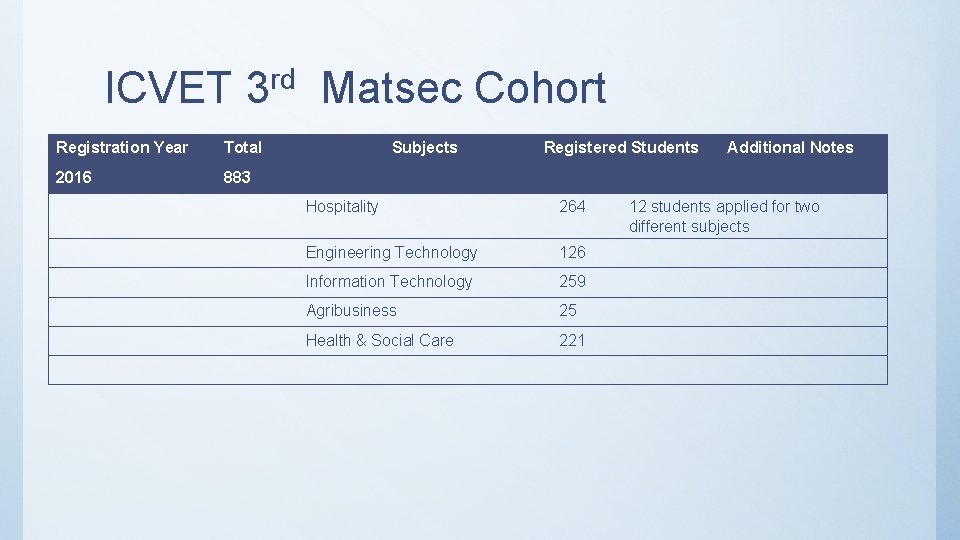
ICVET 3 rd Matsec Cohort Registration Year Total 2016 883 Subjects Registered Students Hospitality 264 Engineering Technology 126 Information Technology 259 Agribusiness 25 Health & Social Care 221 Additional Notes 12 students applied for two different subjects
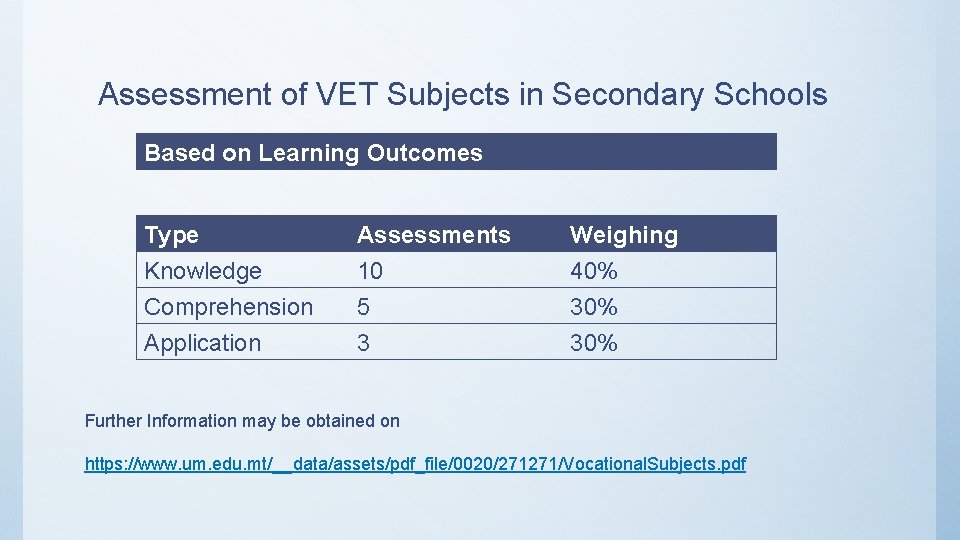
Assessment of VET Subjects in Secondary Schools Based on Learning Outcomes Type Knowledge Comprehension Application Assessments 10 5 3 Weighing 40% 30% Further Information may be obtained on https: //www. um. edu. mt/__data/assets/pdf_file/0020/271271/Vocational. Subjects. pdf

Quality Assurance and Parity of Esteem of IVET to CVET in Secondary Education ü ü ü Quality Assured External & Internal Verifications ( 2 visits per scholastic year) Leading to Level 2 or 3 (MQF) equivalent 60 ECVET Credits Grade 1 -5 = Level 3 within MQF (60 ECVET Credits) Grade 6 -7 = Level 2 within MQF (60 ECVET Credits) Leading to a Faster Track and Flexible pathway within Main VET Institutions Further Information may be obtained on https: //www. um. edu. mt/__data/assets/pdf_file/0020/271271/Vocational. Subjects. pdf
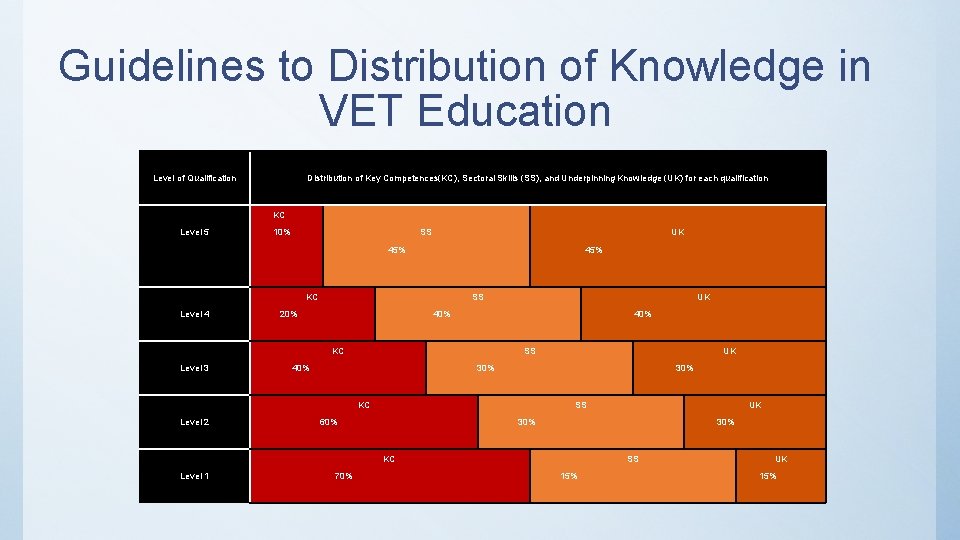
Guidelines to Distribution of Knowledge in VET Education Level of Qualification Distribution of Key Competences(KC), Sectoral Skills (SS), and Underpinning Knowledge (UK) for each qualification KC Level 5 10% SS UK 45% KC Level 4 SS 20% 40% KC Level 3 UK SS 40% 30% KC Level 2 SS 60% UK 30% KC Level 1 70% UK 30% SS 15% UK 15%
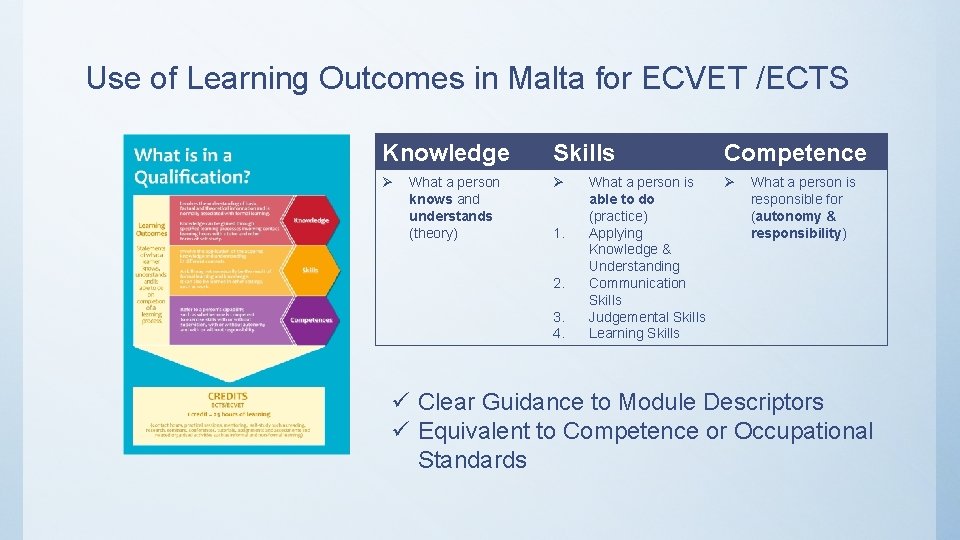
Use of Learning Outcomes in Malta for ECVET /ECTS Knowledge Skills Competence Ø Ø Ø What a person knows and understands (theory) 1. 2. 3. 4. What a person is able to do (practice) Applying Knowledge & Understanding Communication Skills Judgemental Skills Learning Skills What a person is responsible for (autonomy & responsibility) ü Clear Guidance to Module Descriptors ü Equivalent to Competence or Occupational Standards
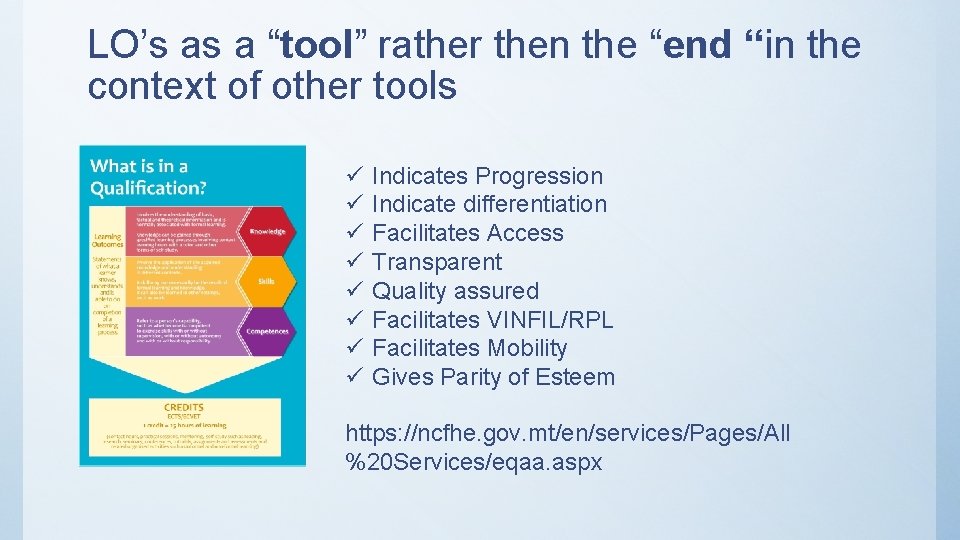
LO’s as a “tool” rather then the “end “in the context of other tools ü ü ü ü Indicates Progression Indicate differentiation Facilitates Access Transparent Quality assured Facilitates VINFIL/RPL Facilitates Mobility Gives Parity of Esteem https: //ncfhe. gov. mt/en/services/Pages/All %20 Services/eqaa. aspx

Flexible Pathways

Practical Examples of VNFIL and RPL Ø Introduction of RPL at Level 5 -6 for 3 new degree programs in VET ( ITS)- Leading to exemptions and costs reduction http: //its. edu. mt/recognition-for-prior-learning-rpl. html Ø RPL for lower levels also –leading to awards
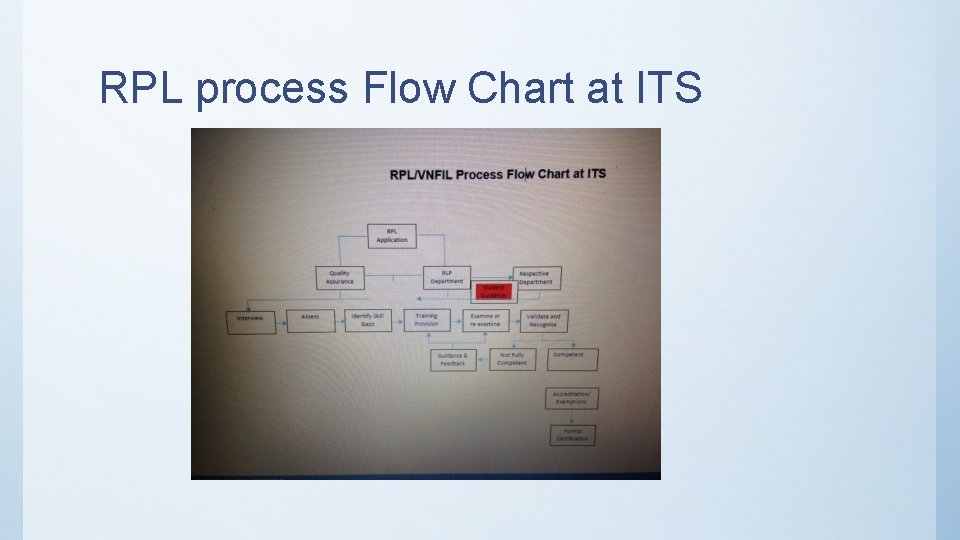
RPL process Flow Chart at ITS

RPL SIMPLY EXPLAINED

Thank You Mr Jesmond Atkins email on : jesmond. atkins@its. edu. mt
- Slides: 30