
Introduction Definitions Policy Planning Tourism Conceptual framework for
- Slides: 15
Introduction • Definitions – Policy – Planning – Tourism • Conceptual framework for understanding tourism planning and policy • Understanding is the key to improving tourism planning and policy development
Why worry about definitions? • Definitions are important because they: – clarify and give direction – provide boundaries to the subject matter – provide a common platform for understanding – clarify who’s involved and/or responsible – are embedded with ideas, principles and beliefs
What is policy? • Lets look at some definitions: – ‘Policy is what governments choose to do or not to do’ (Dye 1978) – Policy is ‘continuing work done by groups of policy actors who use available institutions to articulate and express the things they value’ (Considine 1994) – Policy is ‘the vehicle through which politicians make a difference’ (Bridgman & Davis 2004) Q. What are the ideas, values and roles embedded in these definitions?
Contemporary definitions of policy • Policy is not just about what governments do • Policy includes interactions between actors and agencies outside government • Lines of responsibility are increasingly blurred • Policy involves dialogue, debate and sharing information • Policy is a position, strategy, action or product adopted by government arising from dialogues by actors and agencies inside and outside government about values, ideas and interests.
Seven characteristics of policy 1. Involves government 2. Is a stated intention or commitment 3. Involves hypothesising about future causes and consequences 4. Is an action that brings about intervention or an allocation/redistribution of resources 5. Is an organisational practice 6. Is about choices that governments and policy collaborators make 7. Involves mediating values and interests
What is planning? • Is a basic human activity to achieve a predetermined set of goals • Is concerned with the future • Involves identifying alternatives, and • Involves anticipating change • Involves developing a strategic vision • Involves choosing the best/most appropriate course of action • Is value-laden and political
What is tourism? • Definitions of tourism are diverse • Definitions often driven by the need to collect data • Defining tourism from different perspectives shapes policy direction and content: – Tourism as temporary leisure and recreation (may exclude other VFR, business and others) – Tourism as travel decisions and behaviour – Tourism as the sum of relationships between tourists, tourism industry, community, government and NGOs • Dominant view is that tourism is an industry and network of businesses and this shapes government policy and tourism administration
Defining tourism for planning and policy • We know that tourism involves: – A collection of government, businesses, activities and processes – Involves the production and consumption of tourism products and resources – Overlaps and intersects with the daily lives of local communities – Involves the production and consumption of tourism experiences – Produces a range of intended and unintended consequences that need to be managed • Tourism policy and planning needs to address all these aspects and not just focus on economic/industrial dimensions of tourism
Defining tourism for planning and policy Q. What might limit governments in developing tourism planning and policy that deals with all these dimensions?
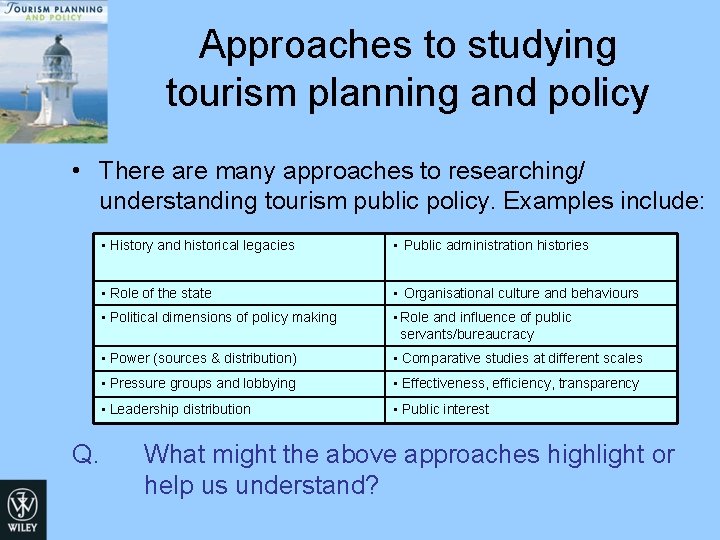
Approaches to studying tourism planning and policy • There are many approaches to researching/ understanding tourism public policy. Examples include: Q. • History and historical legacies • Public administration histories • Role of the state • Organisational culture and behaviours • Political dimensions of policy making • Role and influence of public servants/bureaucracy • Power (sources & distribution) • Comparative studies at different scales • Pressure groups and lobbying • Effectiveness, efficiency, transparency • Leadership distribution • Public interest What might the above approaches highlight or help us understand?
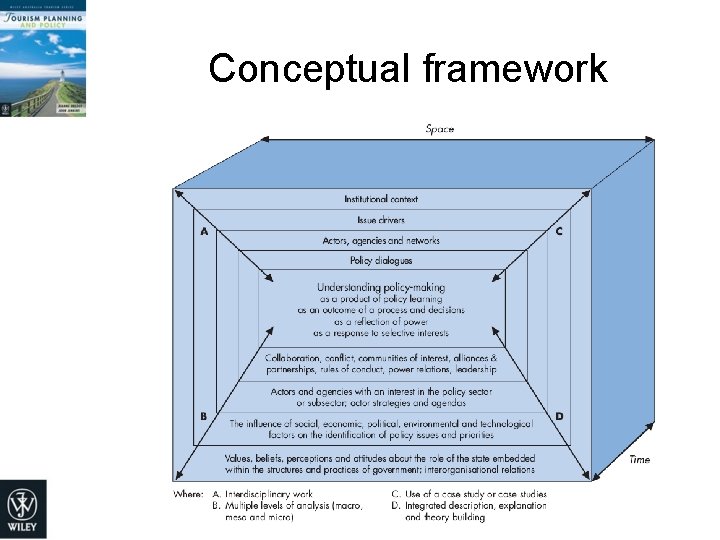
A social constructionist approach • Planning and policy are dynamic, socially constructed activities that involve a range of actors and agencies • Developing an understanding of policy must include an appreciation of: – Space (what is happening at different scales) – Time (what has happened in the past and what is likely in the future; awareness of the present) – The institutional context (the structures and processes through which governments operate and collaborate) – Issue drivers (internal and external drivers of change) – Actors and agencies (government and non-government) – Characteristics of policy dialogues and exchanges
Conceptual framework
Conclusions • The importance of definitions in framing policy content, direction and administration • Definitions and conceptions of policy have changed. These changes have significantly affected policy and planning theory and practice. • Social constructionist approach to studying tourism planning and policy and their key dimensions