
INTRODUCTION DEFINITION Apocalypse is a genre of revelatory




- Slides: 11
INTRODUCTION
DEFINITION “Apocalypse” is a genre of revelatory literature with a narrative framework, in which a revelation is mediated by an otherworldly being to a human recipient, disclosing a transcendent reality which is both temporal, insofar as it envisages eschatological salvation, and spatial insofar as it involves another, supernatural world. —Adela Yarbro Collins, “The Early Christian Apocalypses, ” Semeia 14 (1979), 62.
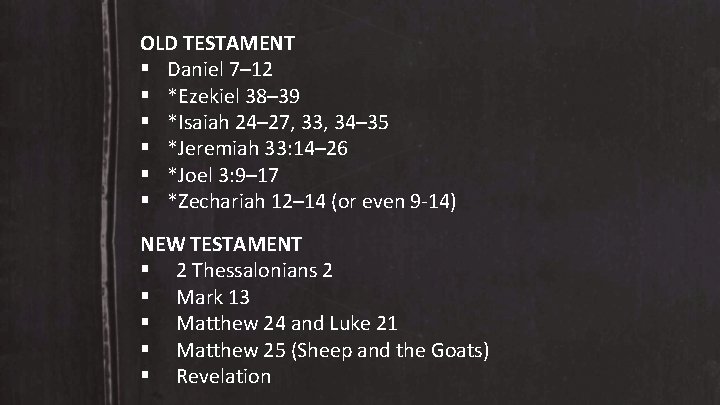
OLD TESTAMENT Daniel 7– 12 *Ezekiel 38– 39 *Isaiah 24– 27, 33, 34– 35 *Jeremiah 33: 14– 26 *Joel 3: 9– 17 *Zechariah 12– 14 (or even 9 -14) NEW TESTAMENT 2 Thessalonians 2 Mark 13 Matthew 24 and Luke 21 Matthew 25 (Sheep and the Goats) Revelation
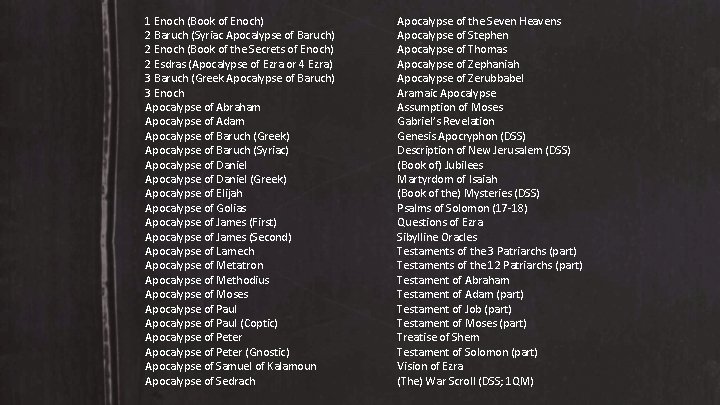
1 Enoch (Book of Enoch) 2 Baruch (Syriac Apocalypse of Baruch) 2 Enoch (Book of the Secrets of Enoch) 2 Esdras (Apocalypse of Ezra or 4 Ezra) 3 Baruch (Greek Apocalypse of Baruch) 3 Enoch Apocalypse of Abraham Apocalypse of Adam Apocalypse of Baruch (Greek) Apocalypse of Baruch (Syriac) Apocalypse of Daniel (Greek) Apocalypse of Elijah Apocalypse of Golias Apocalypse of James (First) Apocalypse of James (Second) Apocalypse of Lamech Apocalypse of Metatron Apocalypse of Methodius Apocalypse of Moses Apocalypse of Paul (Coptic) Apocalypse of Peter (Gnostic) Apocalypse of Samuel of Kalamoun Apocalypse of Sedrach Apocalypse of the Seven Heavens Apocalypse of Stephen Apocalypse of Thomas Apocalypse of Zephaniah Apocalypse of Zerubbabel Aramaic Apocalypse Assumption of Moses Gabriel’s Revelation Genesis Apocryphon (DSS) Description of New Jerusalem (DSS) (Book of) Jubilees Martyrdom of Isaiah (Book of the) Mysteries (DSS) Psalms of Solomon (17 -18) Questions of Ezra Sibylline Oracles Testaments of the 3 Patriarchs (part) Testaments of the 12 Patriarchs (part) Testament of Abraham Testament of Adam (part) Testament of Job (part) Testament of Moses (part) Treatise of Shem Testament of Solomon (part) Vision of Ezra (The) War Scroll (DSS; 1 QM)
DEFINITION “Apocalypse” is a genre of revelatory literature with a narrative framework, in which a revelation is mediated by an otherworldly being to a human recipient, disclosing a transcendent reality which is both temporal, insofar as it envisages eschatological salvation, and spatial insofar as it involves another, supernatural world. —Adela Yarbro Collins, “The Early Christian Apocalypses, ” Semeia 14 (1979), 62.
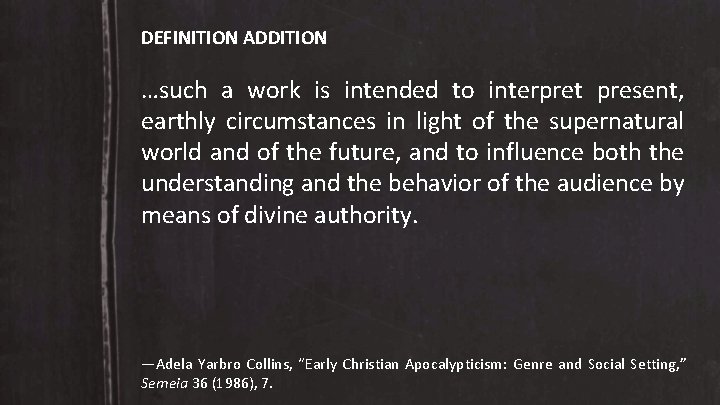
DEFINITION ADDITION …such a work is intended to interpret present, earthly circumstances in light of the supernatural world and of the future, and to influence both the understanding and the behavior of the audience by means of divine authority. —Adela Yarbro Collins, “Early Christian Apocalypticism: Genre and Social Setting, ” Semeia 36 (1986), 7.
DEFINITION ADDITION …intended for a group in crisis with the purpose of exhortation and/or consolation by means of divine authority. —David Hellholm, “The Problem of Apocalyptic Genre and the Apocalypse of John” Semeia 36 (1986), 27.
STRUCTURE
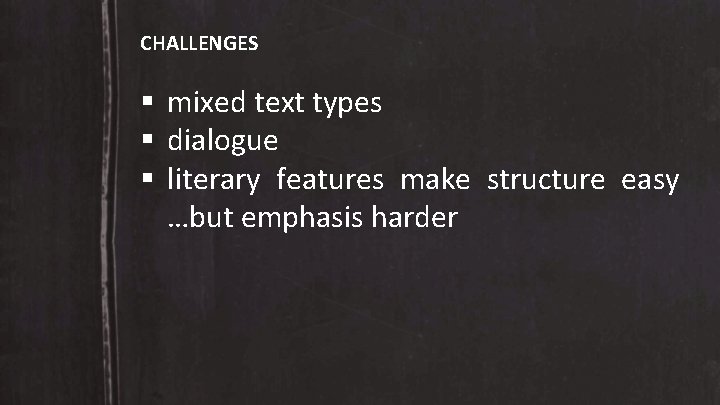
CHALLENGES mixed text types dialogue literary features make structure easy …but emphasis harder
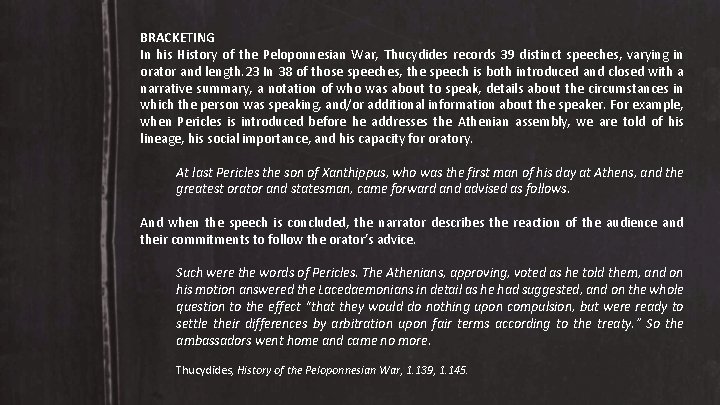
BRACKETING In his History of the Peloponnesian War, Thucydides records 39 distinct speeches, varying in orator and length. 23 In 38 of those speeches, the speech is both introduced and closed with a narrative summary, a notation of who was about to speak, details about the circumstances in which the person was speaking, and/or additional information about the speaker. For example, when Pericles is introduced before he addresses the Athenian assembly, we are told of his lineage, his social importance, and his capacity for oratory. At last Pericles the son of Xanthippus, who was the first man of his day at Athens, and the greatest orator and statesman, came forward and advised as follows. And when the speech is concluded, the narrator describes the reaction of the audience and their commitments to follow the orator’s advice. Such were the words of Pericles. The Athenians, approving, voted as he told them, and on his motion answered the Lacedaemonians in detail as he had suggested, and on the whole question to the effect “that they would do nothing upon compulsion, but were ready to settle their differences by arbitration upon fair terms according to the treaty. ” So the ambassadors went home and came no more. Thucydides, History of the Peloponnesian War, 1. 139, 1. 145.