
Introduction CONT ENT Clinical drug development Regulatory bodies
• Introduction CONT ENT: • Clinical drug development • Regulatory bodies • Schedule Y • ICH E 6(R 1) guidelines • ICMR guidelines • Inclusion and exclusion criteria • Clinical Trial Registry • Contents of protocol • Comparison study between USFDA and CDSCO
CLINICAL TRIALS: ICMR ( Indian Council of Medical Research ) : A clinical trial is any research/study that prospectively assigns human participants or groups of humans to one or more health-related intervention(s) to evaluate the effects on health outcomes. The intervention could be drugs, vaccines, biosimilars, biologics, Phytopharmaceuticals, radiopharmaceuticals, diagnostic agents, public health interventions, socio-behavioural interventions, technologies, devices, surgical techniques or interventions involving traditional systems of medicine, etc. Clinical trials are usually well-controlled studies. They use a design that allows comparison of participants treated with an investigational product (IP)/any intervention to a control population (receiving placebo or an active comparator), so that the effect of the IP/intervention can be determined and differentiated from effects of other influences, such as spontaneous change, placebo effect, concomitant treatment/intervention or observer expectations.
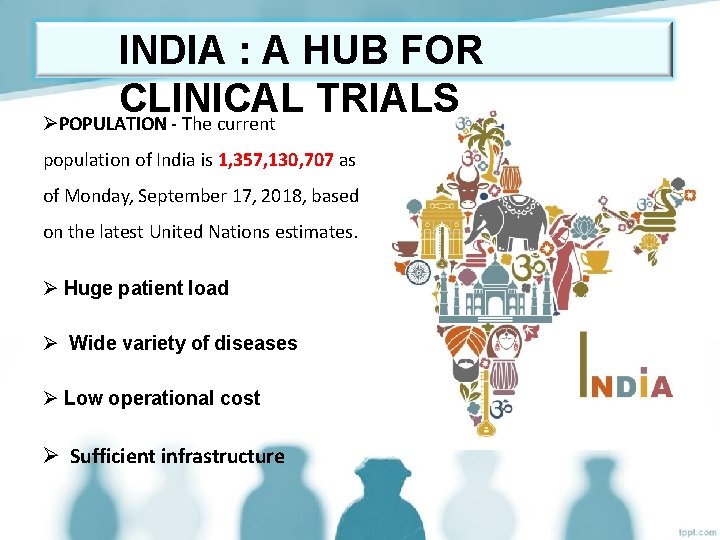
INDIA : A HUB FOR CLINICAL TRIALS POPULATION - The current population of India is 1, 357, 130, 707 as of Monday, September 17, 2018, based on the latest United Nations estimates. Huge patient load Wide variety of diseases Low operational cost Sufficient infrastructure

CLINICAL DRUG DEVELOPMENT Preclinical PHASE: data IND filing IND approval Phase 1 Phase 2 Phase 3 NDA filed NDA approval Marketing permission Phase 4 CLINICAL STUDY
REGULATORY BOADIES :
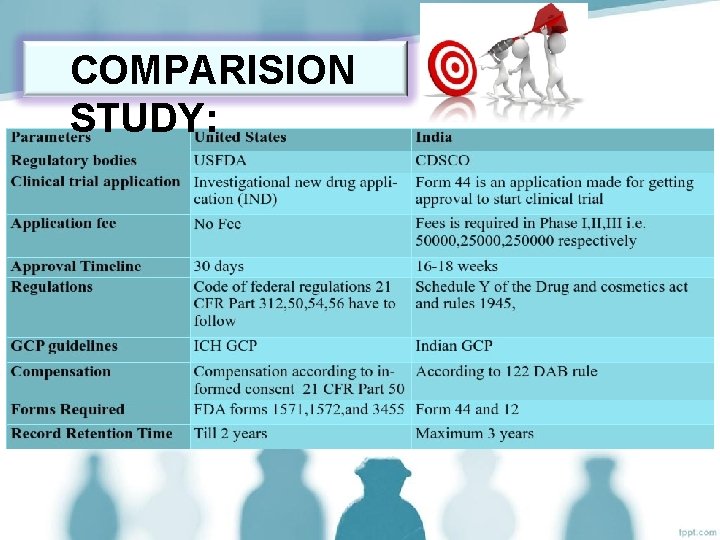
CENTRAL DRUG STANDARD CONTROL ORGANISATION (CDSCO) The Central Drugs Standard Control Organization (CDSCO), headed by the Drug Controller General of India (DCGI), lays down the regulations for the conduct of clinical trials in India. Main objective is to standardize clinical research and to assure safety, efficacy, quality of drugs, cosmetics and medical devices. It is essential that now all clinical trials conducted in India should as per the International conference of Harmonization-Good Clinical Practices Guidelines (ICH-GCP) for clinical trials and follow the recently amended Schedule Y of the Drugs and Cosmetics Act.
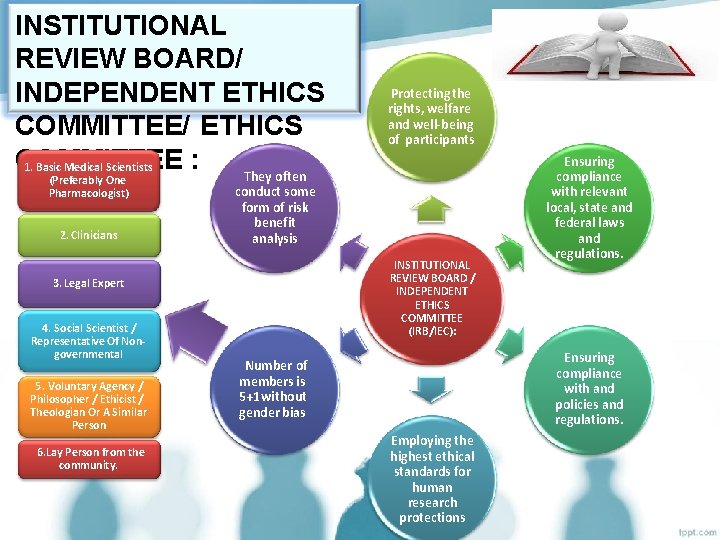
INSTITUTIONAL REVIEW BOARD/ INDEPENDENT ETHICS COMMITTEE/ ETHICS COMMITTEE : 1. Basic Medical Scientists They often (Preferably One Pharmacologist) 2. Clinicians conduct some form of risk benefit analysis INSTITUTIONAL REVIEW BOARD / INDEPENDENT ETHICS COMMITTEE (IRB/IEC): 3. Legal Expert 4. Social Scientist / Representative Of Nongovernmental 5. Voluntary Agency / Philosopher / Ethicist / Theologian Or A Similar Person 6. Lay Person from the community. Protecting the rights, welfare and well-being of participants Ensuring compliance with relevant local, state and federal laws and regulations. Ensuring compliance with and policies and regulations. Number of members is 5+1 without gender bias Employing the highest ethical standards for human research protections
CLINICAL TRIAL PROTOCOL:
2. SCHEDU Clinical Trial: LE Y : 1. Approval for clinical trial • • • Clinical trial on a new drug shall be initiated only after the permission has been granted by the Licensing Authority, and the approval obtained from the respective ethics committee. All trial Investigator(s) should possess appropriate qualifications, training and experience and should have access to such investigational and treatment facilities as are relevant to the proposed trial protocol. Protocol amendments if become necessary before initiation or during the course of a clinical trial, all such amendments should be notified to the Licensing Authority in writing along with the approval by the ethics committee. 2. Responsibilities of Sponsor • Sponsor is responsible for implementing and maintaining quality assurance systems to ensure that the clinical trial is conducted and data generated, documented and reported in compliance with the protocol and Good Clinical Practice (GCP). • Sponsors are required to submit a status report on the clinical trial to the Licensing Authority at the prescribed periodicity. • In case of studies prematurely discontinued for any reason including lack of commercial interest in pursuing the new drug application, a summary report should be submitted within 3 months.
• • SCHEDU LE Y : In case of injury or death occurring to the clinical trial subject, the sponsor shall make payment for medical management of the subject and also provide financial compensation for the clinical trial related injury or death. The sponsor (whether a pharmaceutical company or an institution) shall submit details of compensation provided or paid for clinical trial related injury or death, to the licensing authority within thirty days of the receipt of the order of the licensing authority. 3. Responsibilities of the investigator(s): • Responsible to conduct the trial according to the protocol and the GCP guidelines • Investigator should ensure that adequate medical care is provided to the participant • • • for any adverse events. Investigator(s) shall report all serious and unexpected adverse events. The investigator shall provide information to the clinical trial subject through informed consent process He shall also inform the subject or his/her nominees(s) of their rights to contact the sponsor for conduct of the clinical trial for the purpose of making claims in the case of trial related injury or death
SCHEDU 4. Informed consent: LE Y : • The investigator must provide information about the study verbally as well as using a • • • patient information sheet, in a language that is non-technical and understandable by the study subject. The subject’s consent must be obtained in writing using an ‘informed consent form 'which have been approved by the ethics committee and furnished to the licensing authority. Where a subject is not able to give informed consent , the same may be obtained from a legally acceptable representative. If the subject or his/her legally acceptable representative is unable to read/write – an impartial witness should be present during the entire informed consent process who must append his/her signatures to the consent form. 5. Responsibilities of the ethics committee: • The ethics committee should exercise particular care to protect the rights, safety and well • • • being of all vulnerable subjects participating in the study. Ethics committee(s) should make, the periodic study progress reports and audit reports furnished by the sponsor and/or by visiting the study sites. In case an ethics committee revokes its approval accorded to a trial protocol, it must record the reasons for doing so. In case of serious adverse event occurring to the clinical trial subject, the ethics committee shall forward its report on the serious adverse event, after due analysis, along with its opinion on the financial compensation, if any, to be paid by the sponsor or his representative
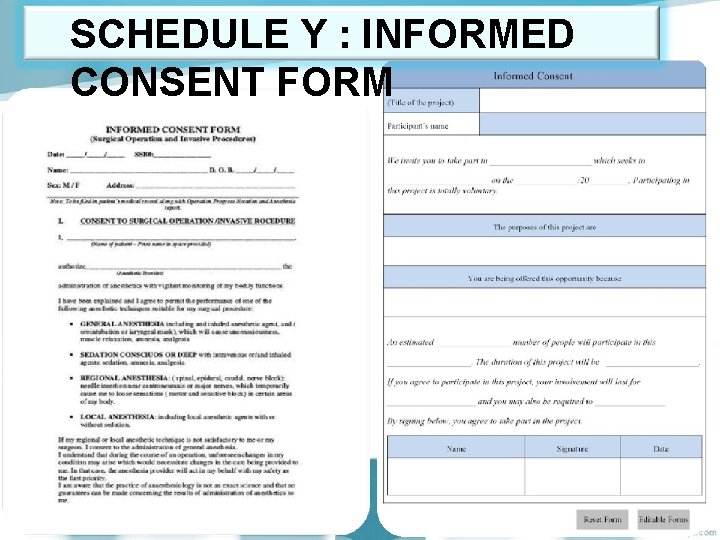
SCHEDULE Y : INFORMED CONSENT FORM
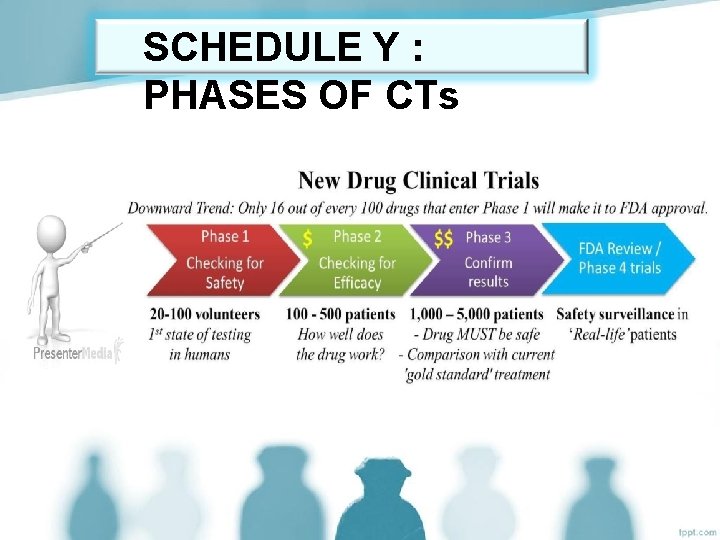
SCHEDULE Y : PHASES OF CTs
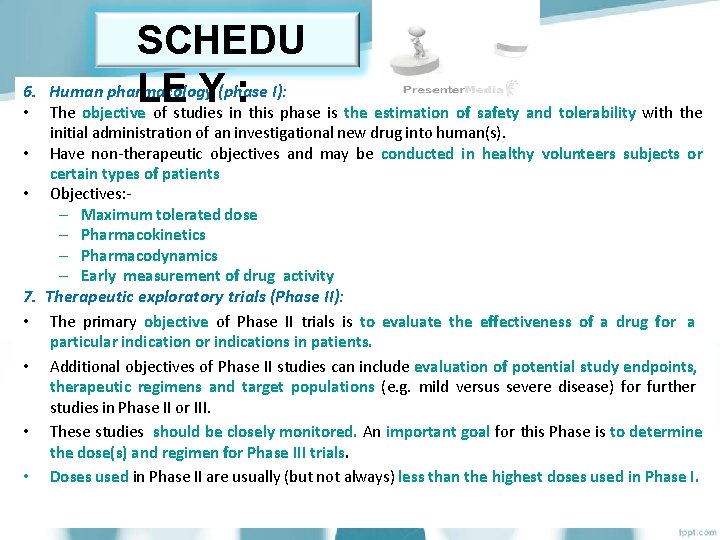
6. • • • SCHEDU Human pharmacology (phase I): LE Y : The objective of studies in this phase is the estimation of safety and tolerability with the initial administration of an investigational new drug into human(s). Have non-therapeutic objectives and may be conducted in healthy volunteers subjects or certain types of patients Objectives: – Maximum tolerated dose – Pharmacokinetics – Pharmacodynamics – Early measurement of drug activity 7. Therapeutic exploratory trials (Phase II): • The primary objective of Phase II trials is to evaluate the effectiveness of a drug for a • • • particular indication or indications in patients. Additional objectives of Phase II studies can include evaluation of potential study endpoints, therapeutic regimens and target populations (e. g. mild versus severe disease) for further studies in Phase II or III. These studies should be closely monitored. An important goal for this Phase is to determine the dose(s) and regimen for Phase III trials. Doses used in Phase II are usually (but not always) less than the highest doses used in Phase I.
SCHEDU LE Y : 8. Therapeutic confirmatory trials (phase III): • • Phase III studies have primary objective of demonstration or confirmation of therapeutic benefit(s). Phase III may also further explore the dose-response relationships (relationships among dose, drug concentration in blood and clinical response), use of the drug in wider populations, in different stages of disease, or the safety and efficacy of the drug in combination with other drug(s). 9. Post Marketing Trials (Phase IV): • Post Marketing trials are studies performed after drug approval and related to the approved indication(s).
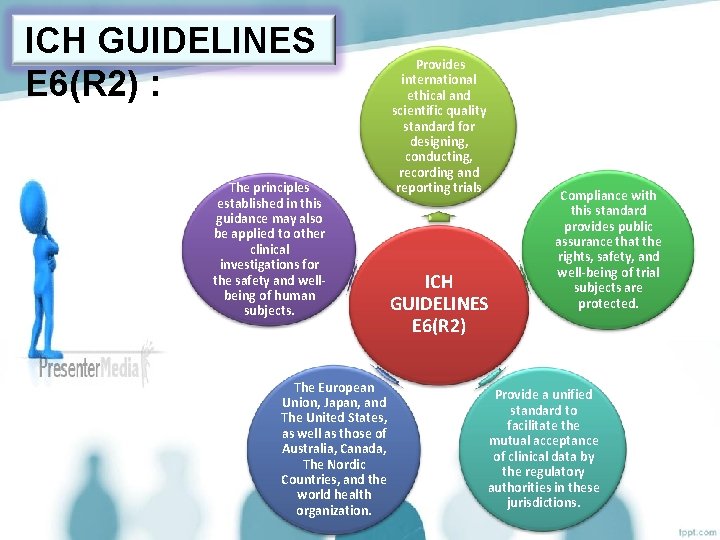
ICH GUIDELINES E 6(R 2) : The principles established in this guidance may also be applied to other clinical investigations for the safety and wellbeing of human subjects. The European Union, Japan, and The United States, as well as those of Australia, Canada, The Nordic Countries, and the world health organization. Provides international ethical and scientific quality standard for designing, conducting, recording and reporting trials ICH GUIDELINES E 6(R 2) Compliance with this standard provides public assurance that the rights, safety, and well-being of trial subjects are protected. Provide a unified standard to facilitate the mutual acceptance of clinical data by the regulatory authorities in these jurisdictions.
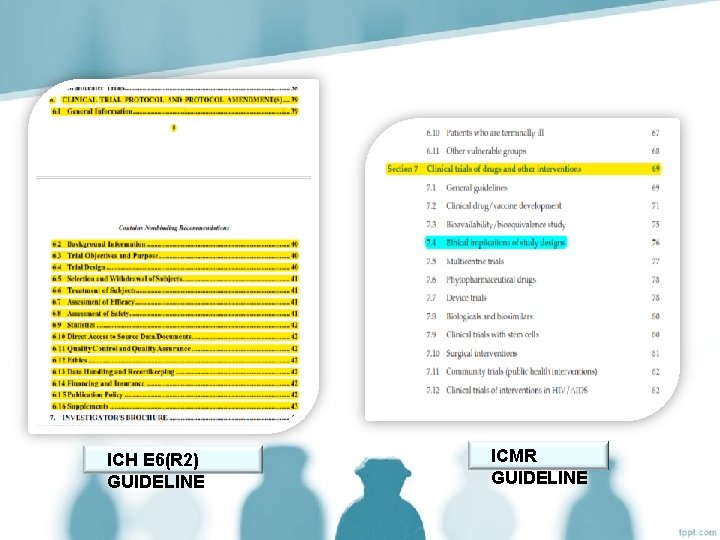
ICH GUIDELINES E 6(R 2) : 6. CLINICAL TRIAL PROTOCOL AND PROTOCOL AMENDMENT(S) 1. Protocol title, protocol identifying number, and date. Any amendment(s) should also bear the amendment number(s) and date(s). 2. Name and address of the sponsor and monitor (if other than the sponsor). 3. Name and title of the person(s) authorized to sign the protocol and the protocol amendment(s) for the sponsor. 4. Name, title, address, and telephone number(s) of the sponsor's medical expert (or dentist when appropriate) for the trial. 5. Name and title of the investigator(s) who is (are) responsible for conducting the trial, and the address and telephone number(s) of the trial site(s). 6. Name, title, address, and telephone number(s) of the qualified physician (or dentist, if applicable), who is responsible for all trial-site related medical 7. Name(s) and address(es) of the clinical laboratory(ies) and other medical and/or technical department(s) and/or institutions involved in the trial.
2. 1. 2. ICH GUIDELINES Background Information E 6(R 2) : Name and description of the investigational product(s). A summary of findings from nonclinical studies that potentially have clinical significance and from clinical trials that are relevant to the trial. 3. Summary of the known and potential risks and benefits, if any, to human subjects. 4. Description of and justification for the route of administration, dosage regimen, and treatment period(s). 5. A statement that the trial will be conducted in compliance with the protocol, GCP, and the applicable regulatory requirement(s). 6. Description of the population to be studied. 7. References to literature and data that are relevant to the trial and that provide background for the trial. 6. 3 Trial Objectives and Purpose A detailed description of the objectives and the purpose of the trial.
ICH GUIDELINES 4. Trial Design E 6(R 2) : The scientific integrity of the trial and the credibility of the data from the trial depend substantially on the trial design. A description of the trial design should include: 1. A specific statement of the primary endpoints and the secondary endpoints, if any, to be measured during the trial. 2. A description of the type/design of trial to be conducted (e. g. , double-blind, placebo-controlled, parallel design) and a schematic diagram of trial design, procedures, and stages. 3. A description of the measures taken to minimize/avoid bias, including: (a) Randomization (b) Blinding. 4. A description of the trial treatment(s) and the dosage and dosage regimen of the investigational product(s). Also include a description of the dosage form, packaging, and labeling of the investigational product(s). 5. The expected duration of subject participation, and a description of the sequence and duration of all trial periods, including follow-up, if any. 6. A description of the "stopping rules" or "discontinuation criteria" for individual subjects, parts of trial, and entire trial.
ICH GUIDELINES 7. Accountability procedures for the investigational product(s), including the placebo(s) E 6(R 2) : and comparator(s), if any. 8. Maintenance of trial treatment randomization codes and procedures for breaking codes. 9. The identification of any data to be recorded directly on the CRFs (i. e. , no prior written or electronic record of data), and to be considered to be source data. 5. Selection and Withdrawal of Subjects 1. Subject inclusion criteria. 2. Subject exclusion criteria. 3. Subject withdrawal criteria (i. e. , terminating investigational product treatment/trial treatment) and procedures specifying: (a) When and how to withdraw subjects from the trial/investigational product Treatment (b) The type and timing of the data to be collected for withdrawn subjects (c) Whether and how subjects are to be replaced (d)The follow-up for subjects withdrawn from investigational product treatment/trial treatment.
ICH GUIDELINES 6. Treatment of Subjects E 6(R 2) : 1. The treatment(s) to be administered, including the name(s) of all the product(s), the dose(s), the dosing schedule(s), the route/mode(s) of administration, and the treatment period(s), including the follow-up period(s) for subjects for each investigational product treatment/trial treatment group/arm of the trial. 2. Medication(s)/treatment(s) permitted (including rescue medication) and not permitted before and/or during the trial. 3. Procedures for monitoring subject compliance. 7. Assessment of Efficacy 1. Specification of the efficacy parameters. 2. Methods and timing for assessing, recording, and analyzing efficacy parameters. 8. Assessment of Safety 1. Specification of safety parameters. 2. The methods and timing for assessing, recording, and analyzing safety parameters. 3. Procedures for eliciting reports of and for recording and reporting adverse event and intercurrent illnesses. 4. The type and duration of the follow-up of subjects after adverse events.
9. 1. ICH GUIDELINES Statistics E 6(R 2) : A description of the statistical methods to be employed, including timing of any planned interim analysis(ses). 2. The number of subjects planned to be enrolled. In multicenter trials, the numbers of enrolled subjects projected for each trial site should be specified. Reason for choice of sample size, including reflections on (or calculations of) the power of the trial and clinical justification. 3. The level of significance to be used. 4. Criteria for the termination of the trial. 5. Procedure for accounting for missing, unused, and spurious data. 6. Procedures for reporting any deviation(s) from the original statistical plan (any deviation(s) from the original statistical plan should be described and justified in protocol and/or in the final report, as appropriate). 7. The selection of subjects to be included in the analyses (e. g. , all randomized subjects, all dosed subjects, all eligible subjects, evaluable subjects).
10. ICH GUIDELINES : Direct Access. E 6(R 2) to Source Data/Documents The sponsor should ensure that it is specified in the protocol or other written agreement that the investigator(s)/institution(s) will permit trial-related monitoring, audits, IRB/IEC review, and regulatory inspection(s), providing direct access to source data/documents. 11. Quality Control and Quality Assurance 12. Ethics Description of ethical considerations relating to the trial. 13. Data Handling and Record keeping 14. Financing and Insurance Financing and insurance if not addressed in a separate agreement. 15. Publication Policy Publication policy, if not addressed in a separate agreement. 16. Supplements (NOTE: Since the protocol and the clinical trial/study report are closely related, further relevant information can be found in the ICH Guidance for Structure and Content of Clinical Study Reports. )
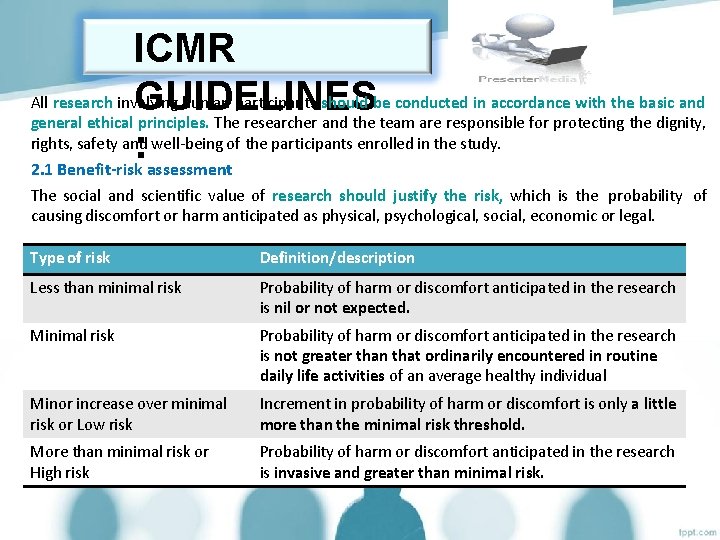
ICMR All research involving human participants should be conducted in accordance with the basic and GUIDELINES general ethical principles. The researcher and the team are responsible for protecting the dignity, rights, safety and well-being of the participants enrolled in the study. : 2. 1 Benefit-risk assessment The social and scientific value of research should justify the risk, which is the probability of causing discomfort or harm anticipated as physical, psychological, social, economic or legal. Type of risk Definition/description Less than minimal risk Probability of harm or discomfort anticipated in the research is nil or not expected. Minimal risk Probability of harm or discomfort anticipated in the research is not greater than that ordinarily encountered in routine daily life activities of an average healthy individual Minor increase over minimal risk or Low risk Increment in probability of harm or discomfort is only a little more than the minimal risk threshold. More than minimal risk or High risk Probability of harm or discomfort anticipated in the research is invasive and greater than minimal risk.
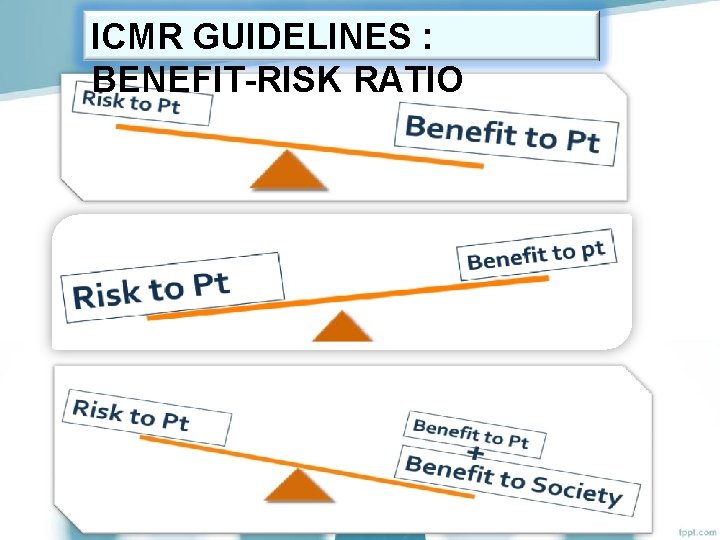
ICMR GUIDELINES : BENEFIT-RISK RATIO
ICMR GUIDELINES 2. 2 Informed consent process : • Informed consent protects the individual’s autonomy to freely choose whether or not to participate in the research. • Informed consent should explain medical terminology in simple terms and be in a language that the participant understands. • In certain circumstances audio/audio-visual recording of the informed consent process may be required, for example in certain clinical trials as notified by CDSCO. 2. 3 Privacy and confidentiality • Privacy is the right of an individual to control or influence the information that can be collected and stored and by whom and to whom that information may be disclosed or shared. • Confidentiality is the obligation of the researcher/research team/organization to the participant to safeguard the entrusted information. • It includes the obligation to protect information from unauthorized access, use, disclosure, modification, loss or theft. 2. 4 Distributive justice • Research should not lead to social, racial or ethnic inequalities.
ICMR 2. 5 Payment for participation GUIDELINES • Travel related expenses, for inconvenience incurred, time spent and other incidental expenses : • Not be made to pay for any expenses incurred beyond routine clinical care • If there are provisions, participants may also receive additional medical services at no cost. • EC must review and approve the payments (in cash or kind or both) and free services and the processes involved, and also determine that this does not amount to undue Inducement. 2. 6 Compensation for research-related harm • Research participants who suffer direct physical, psychological, social, legal or economic Harm as a result of their participation are entitled, after due assessment, to financial Or other assistance to compensate them equitably for any temporary or permanent Impairment or disability. • In case of death, participant’s dependents are entitled to financial compensation. • The researcher is responsible for reporting all to the EC within 24 hours of Knowledge. • The institution should create in-built mechanism to be able to provide for Compensation, such as a corpus fund in the institution.
ICMR 2. 7 Ancillary. GUIDELINES care • Participants may be offered free medical care for non-research-related conditions or : incidental findings if these occur during the course of participation in the research, provided such compensation does not amount to undue inducement as determined by the EC. 2. 8 Conflict of interest • Conflict of interest (COI) is a set of conditions where professional judgment concerning a primary interest such as participants welfare or the validity of research tends to be unduly influenced by a secondary interest, financial or non-financial (personal, academic or political). • If COI is inherent in the research, it is important to declare this at the outset and establish appropriate mechanisms to manage it.
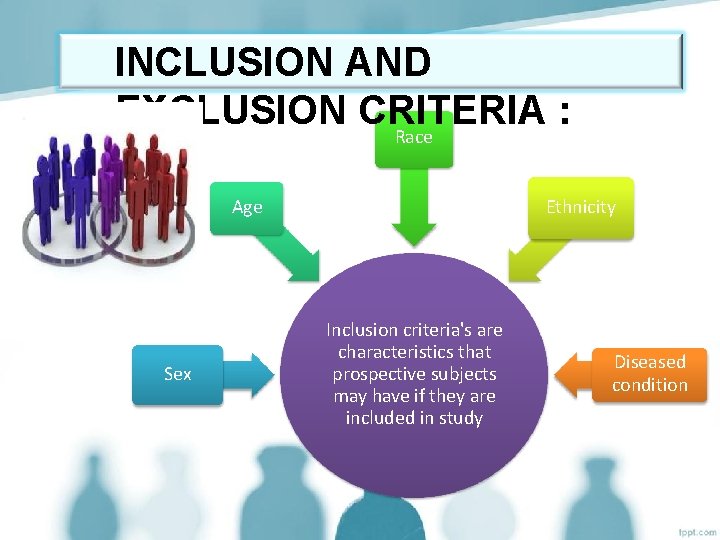
INCLUSION AND EXCLUSION CRITERIA : Race Age Sex Ethnicity Inclusion criteria's are characteristics that prospective subjects may have if they are included in study Diseased condition
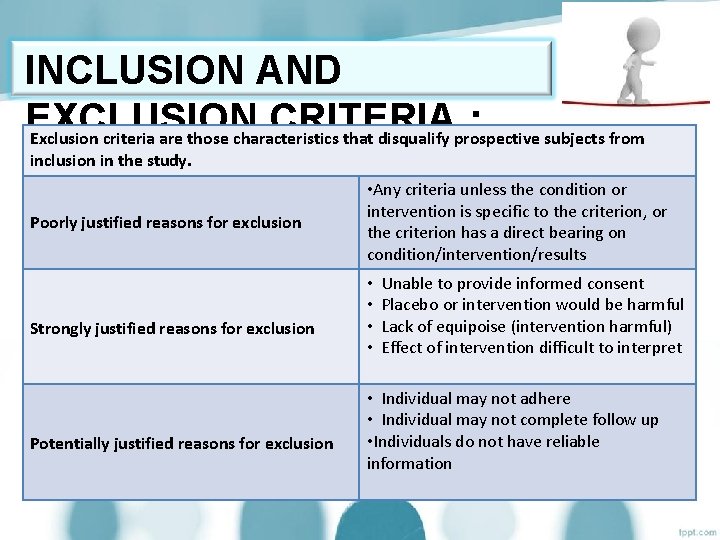
INCLUSION AND EXCLUSION CRITERIA : Exclusion criteria are those characteristics that disqualify prospective subjects from inclusion in the study. Poorly justified reasons for exclusion Strongly justified reasons for exclusion Potentially justified reasons for exclusion • Any criteria unless the condition or intervention is specific to the criterion, or the criterion has a direct bearing on condition/intervention/results • • Unable to provide informed consent Placebo or intervention would be harmful Lack of equipoise (intervention harmful) Effect of intervention difficult to interpret • Individual may not adhere • Individual may not complete follow up • Individuals do not have reliable information
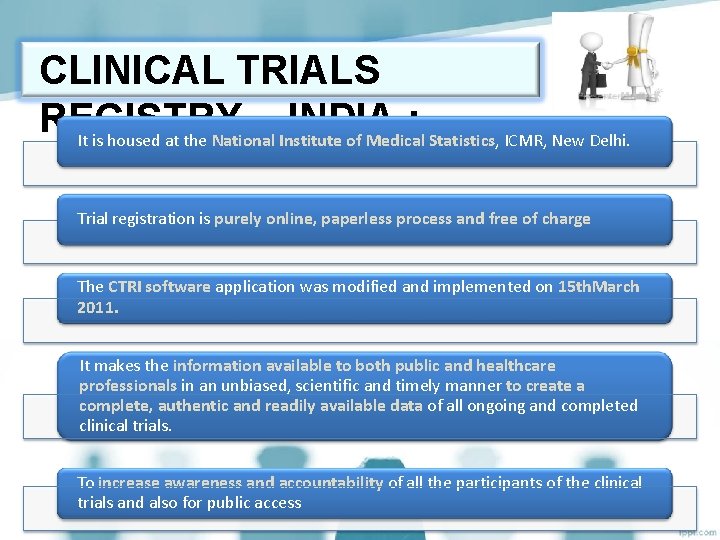
CLINICAL TRIALS REGISTRY – INDIA : It is housed at the National Institute of Medical Statistics, ICMR, New Delhi. Trial registration is purely online, paperless process and free of charge The CTRI software application was modified and implemented on 15 th. March 2011. It makes the information available to both public and healthcare professionals in an unbiased, scientific and timely manner to create a complete, authentic and readily available data of all ongoing and completed clinical trials. To increase awareness and accountability of all the participants of the clinical trials and also for public access
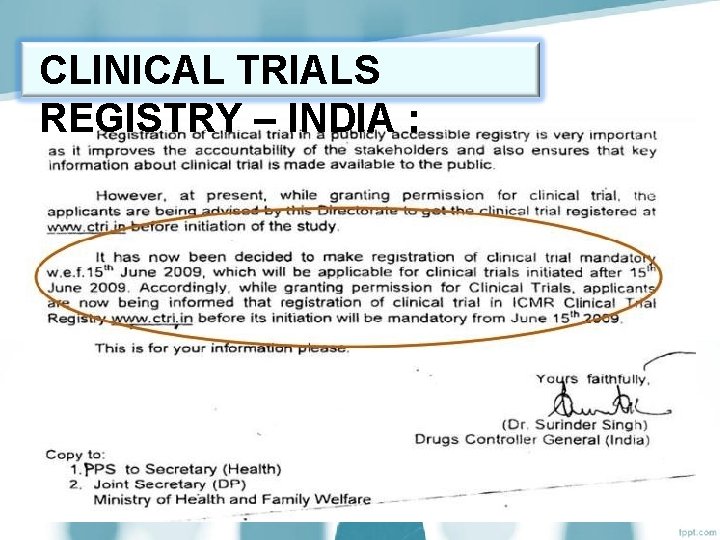
CLINICAL TRIALS REGISTRY – INDIA :
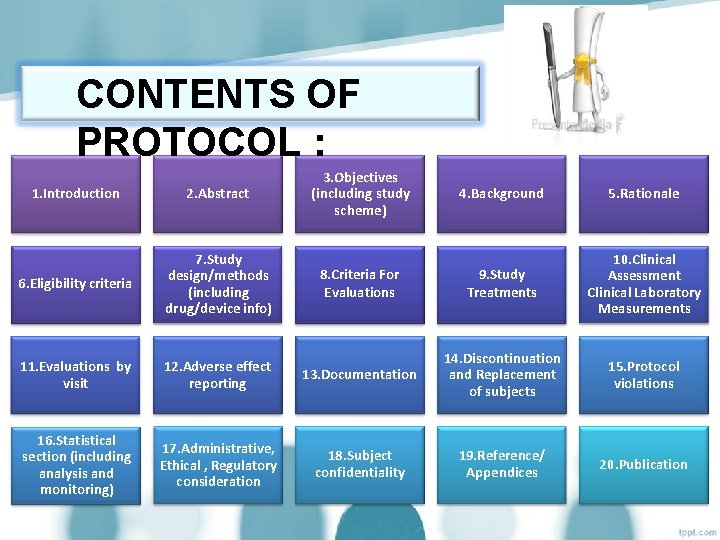
CONTENTS OF PROTOCOL : 1. Introduction 2. Abstract 6. Eligibility criteria 7. Study design/methods (including drug/device info) 11. Evaluations by visit 16. Statistical section (including analysis and monitoring) 3. Objectives (including study scheme) 4. Background 5. Rationale 8. Criteria For Evaluations 9. Study Treatments 10. Clinical Assessment Clinical Laboratory Measurements 12. Adverse effect reporting 13. Documentation 14. Discontinuation and Replacement of subjects 15. Protocol violations 17. Administrative, Ethical , Regulatory consideration 18. Subject confidentiality 19. Reference/ Appendices 20. Publication
PROTOCOL FORMAT :
INVESTIGATOR’S BROCHURE :
ICH E 6(R 2) GUIDELINE ICMR GUIDELINE
ICH E 6(R 2) GUIDELINE ICMR GUIDELINE
COMPARISION STUDY:
REFERE NCES : • ICH GUIDELINES E 6(R 2) ; Good Clinical Practice: Integrated addendum to ICH E 6(R 1) : clinical trial protocol and protocol amendment(s) U. S. Department of Health and Human Services , Food and Drug Administration , Center for Drug Evaluation and Research (CDER), Center for Biologics Evaluation and Research (CBER) , March 2018 • D&C ACT; SCHEDULE Y; Requirements and guidelines for permission to import and / or manufacture of new drugs for sale or to undertake clinical trials, May 28, 2017 • NATIONAL ETHICAL GUIDELINES FOR BIOMEDICAL AND HEALTH RESEARCH INVOLVING HUMAN PARTICIPANTS, Published by-Director-General ; INDIAN COUNCIL OF MEDICAL RESEARCH 2017 • UNDERSTANDING CLINICAL TRIALS , ICT Booklet 1 ST Edition, UK Clinical Research Collaboration
• REFERE INJURY AND DEATH IN: CLINICAL TRIALS AND COMPENSATION: RULE 122 NCES DAB, Ravindra. B. Ghooi 013 Oct-Dec; 4(4): 199– 203. • REGULATORY PROCESS AND ETHICS FOR CLINICAL TRIALS IN INDIA(CDSCO) L EVANGELINE, NVN Mounica, V Sharmila Reddy, MV Ngabhushanam, D Nagarjuna Reddy and Brahmaiah Bonthagarala, The Pharma Innovation Journal 2017; 6(4): 165 -169 • A PROSPECTIVE RANDOMISED, OPEN, MULTICENTRE, PHASE III STUDY TO ASSESS DIFFERENT DURATIONS OF ANASTROZOLE THERAPY AFTER 2 TO 3 YEARS TAMOXIFEN AS ADJUVANT THERAPY IN POSTMENOPAUSAL WOMEN WITH BREAST CANCER, Protocol templet, 2016 • REGULATIONS GOVERNING CLINICAL TRIALS IN INDIA, EUROPE AND USA- A COMPARATIVE STUDY Agarwal Pooja*, Priyanka B International Journal of Drug Regulatory Affairs; 2017, 5(1), 30 -39 • COMPARATIVE STUDY OF THE REGULATORY GUIDELINES FOR CLINICAL TRIALS IN THE UNITED STATES AND INDIA Vijay Kumar, Shruti Chopra, March, 2016

- Slides: 42