
Introduction COMPSCI 453 Computer Networks Professor Jim Kurose

- Slides: 12
Introduction COMPSCI 453 Computer Networks Professor Jim Kurose College of Information and Computer Sciences University of Massachusetts § Overview. What is the Internet? What is a protocol? § Network edge Computer Networking: A Top. Down Approach § Network core § Performance: loss, delay, throughput § Layering, encapsulation, service models § Security § History Class textbook: (8 th ed. ) J. F. Kurose, K. W. Ross Pearson, 2020 http: //gaia. cs. umass. edu/kurose_ross
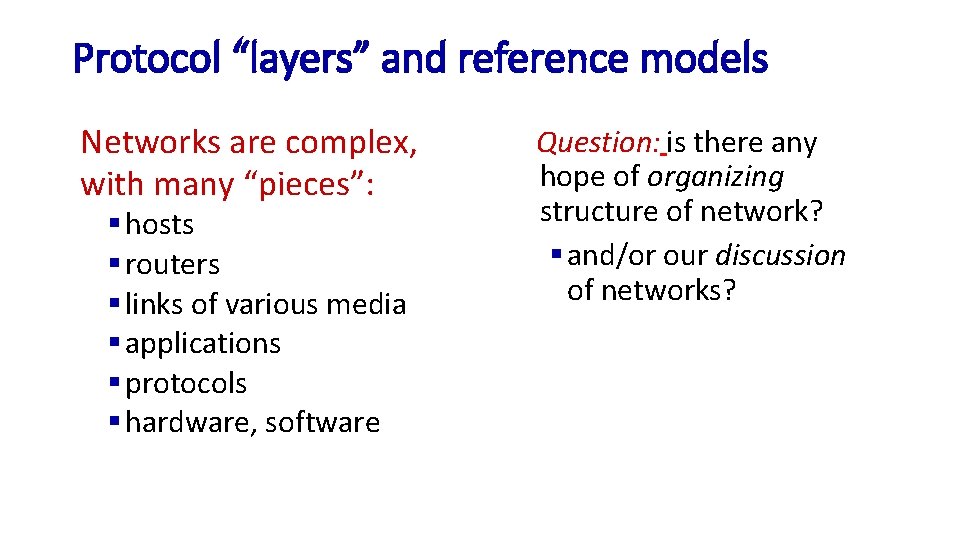
Protocol “layers” and reference models Networks are complex, with many “pieces”: § hosts § routers § links of various media § applications § protocols § hardware, software Question: is there any hope of organizing structure of network? § and/or our discussion of networks?
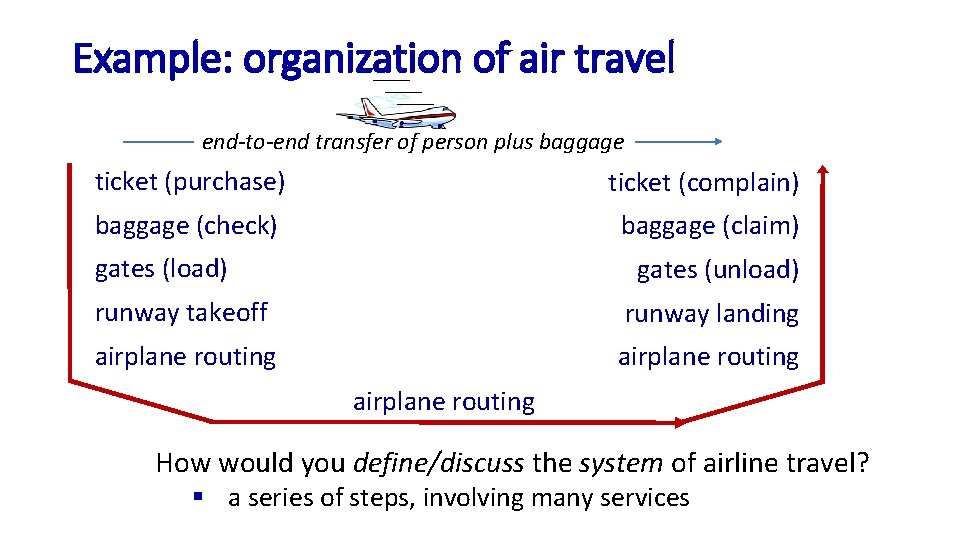
Example: organization of air travel end-to-end transfer of person plus baggage ticket (purchase) ticket (complain) baggage (check) baggage (claim) gates (load) gates (unload) runway takeoff runway landing airplane routing How would you define/discuss the system of airline travel? § a series of steps, involving many services
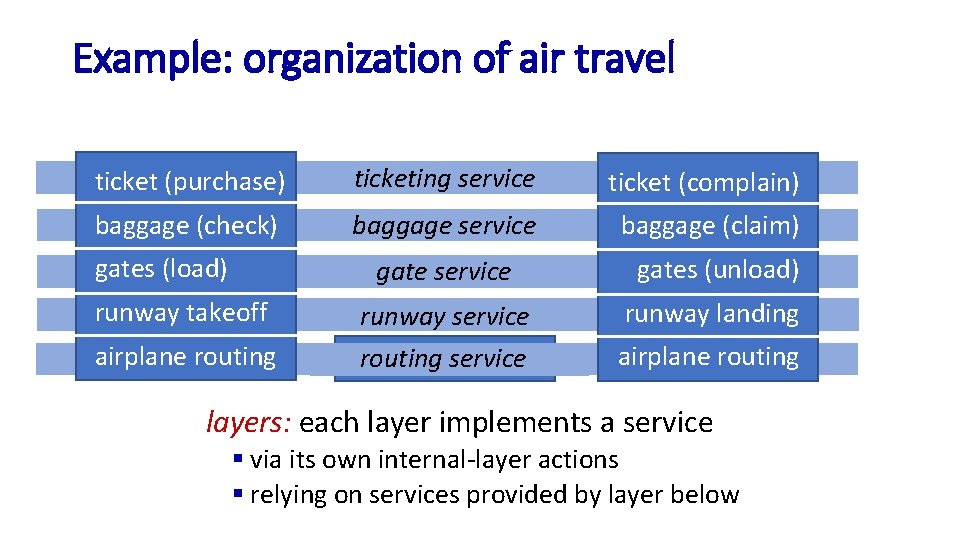
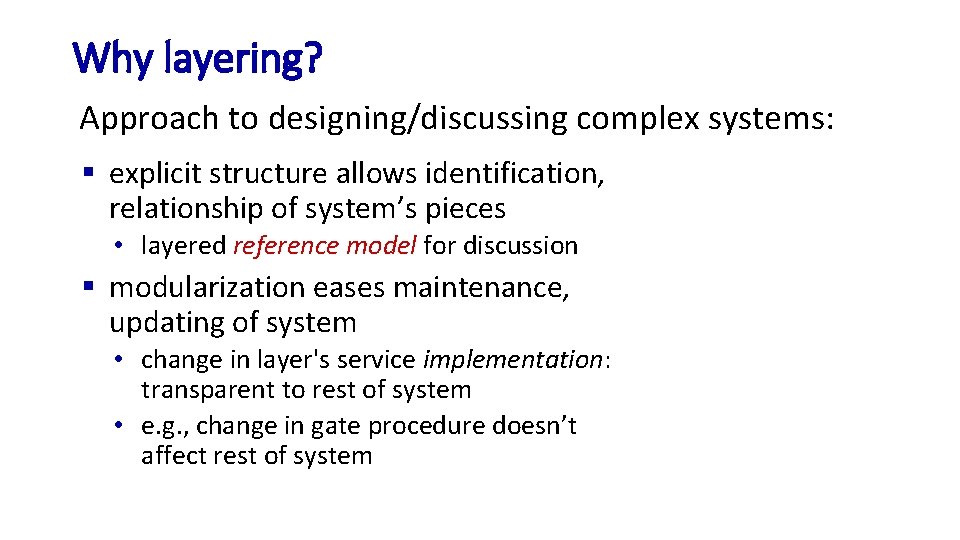
Example: organization of air travel ticket (purchase) ticketing service ticket (complain) baggage (check) baggage service baggage (claim) gate service gates (unload) runway takeoff runway service runway landing airplane routing service airplane routing gates (load) layers: each layer implements a service § via its own internal-layer actions § relying on services provided by layer below
Why layering? Approach to designing/discussing complex systems: § explicit structure allows identification, relationship of system’s pieces • layered reference model for discussion § modularization eases maintenance, updating of system • change in layer's service implementation: transparent to rest of system • e. g. , change in gate procedure doesn’t affect rest of system
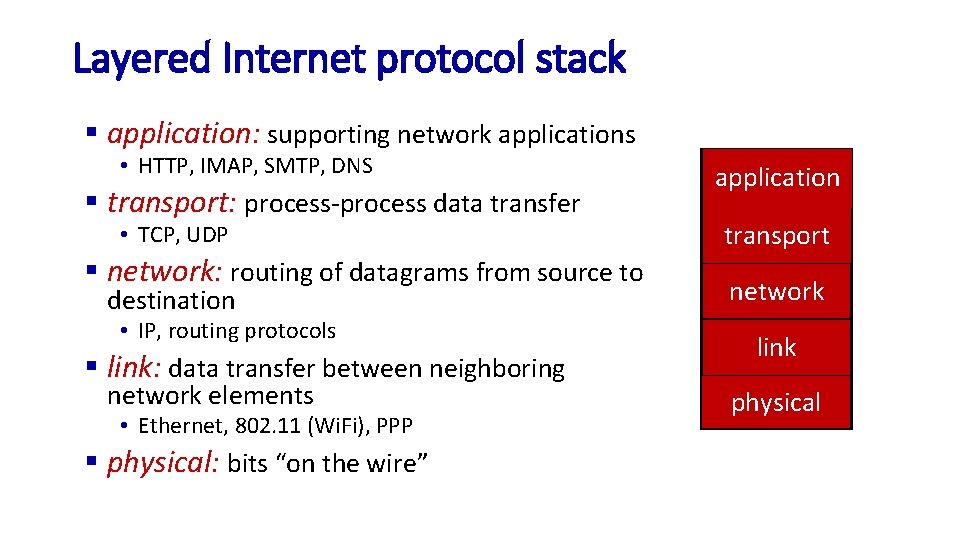
Layered Internet protocol stack § application: supporting network applications • HTTP, IMAP, SMTP, DNS § transport: process-process data transfer • TCP, UDP § network: routing of datagrams from source to destination • IP, routing protocols § link: data transfer between neighboring network elements • Ethernet, 802. 11 (Wi. Fi), PPP § physical: bits “on the wire” application transport network link physical
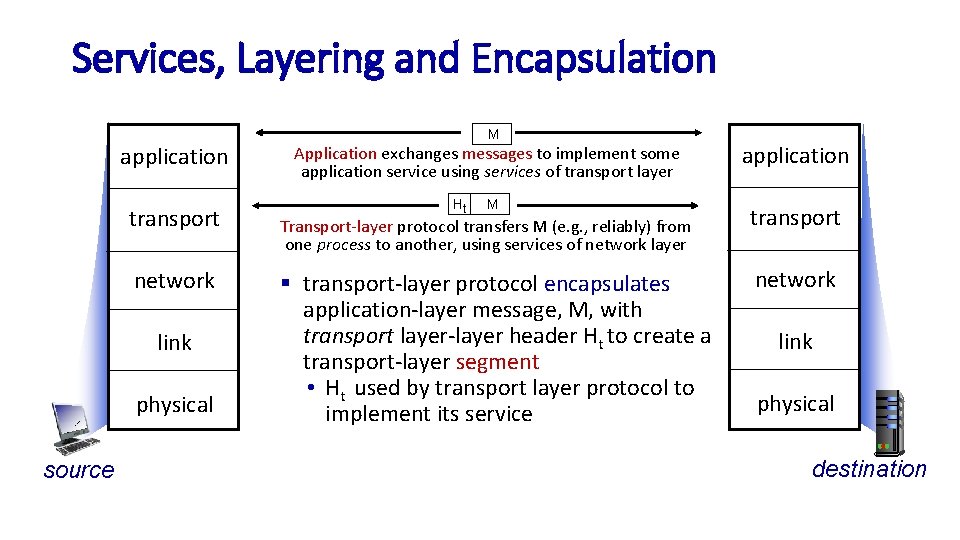
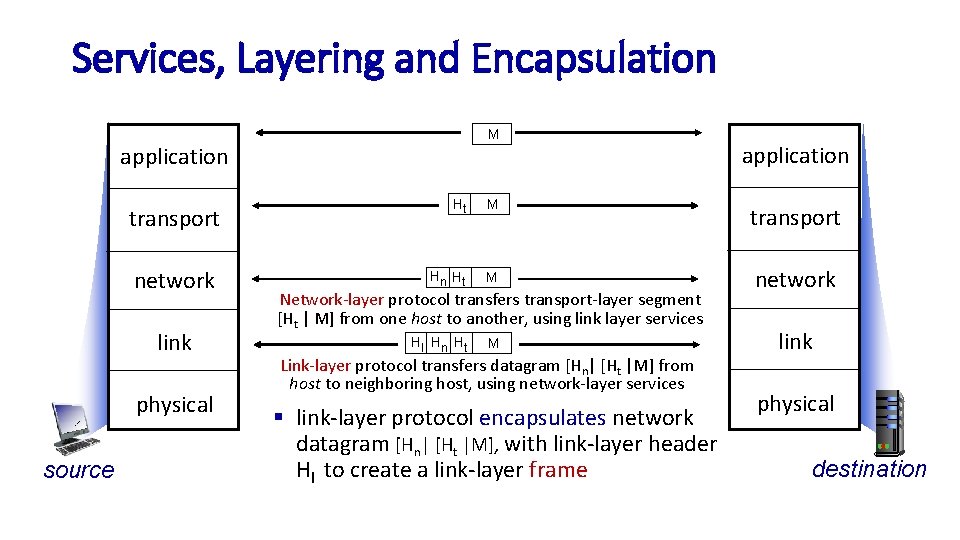
Services, Layering and Encapsulation application transport network link physical source M Application exchanges messages to implement some application service using services of transport layer Ht M Transport-layer protocol transfers M (e. g. , reliably) from one process to another, using services of network layer § transport-layer protocol encapsulates application-layer message, M, with transport layer-layer header Ht to create a transport-layer segment • Ht used by transport layer protocol to implement its service application transport network link physical destination
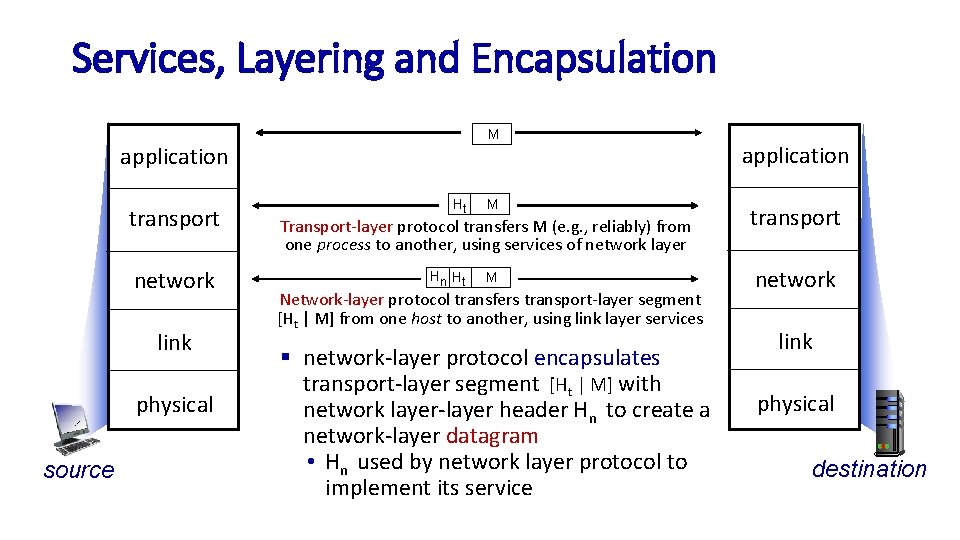
Services, Layering and Encapsulation M application transport network link physical source Ht M Hn Ht M Transport-layer protocol transfers M (e. g. , reliably) from one process to another, using services of network layer Network-layer protocol transfers transport-layer segment [Ht | M] from one host to another, using link layer services § network-layer protocol encapsulates transport-layer segment [Ht | M] with network layer-layer header Hn to create a network-layer datagram • Hn used by network layer protocol to implement its service application transport network link physical destination
Services, Layering and Encapsulation M application transport network link physical source application Ht M transport Hn Ht M network Hl Hn Ht M Network-layer protocol transfers transport-layer segment [Ht | M] from one host to another, using link layer services Link-layer protocol transfers datagram [Hn| [Ht |M] from host to neighboring host, using network-layer services § link-layer protocol encapsulates network datagram [Hn| [Ht |M], with link-layer header Hl to create a link-layer frame link physical destination
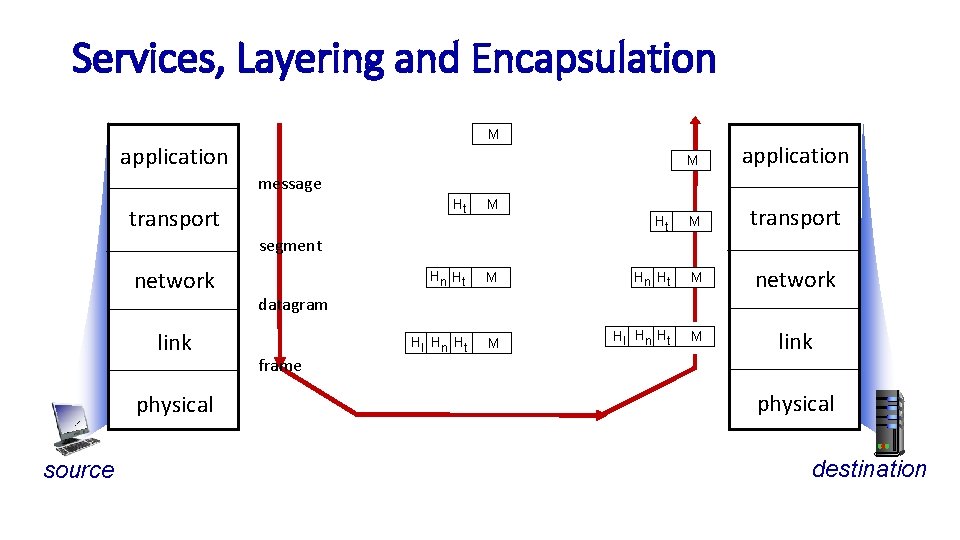
Services, Layering and Encapsulation M application Ht M transport message transport Ht M Hn Ht M network Hl Hn Ht M link segment network link physical source datagram frame physical destination
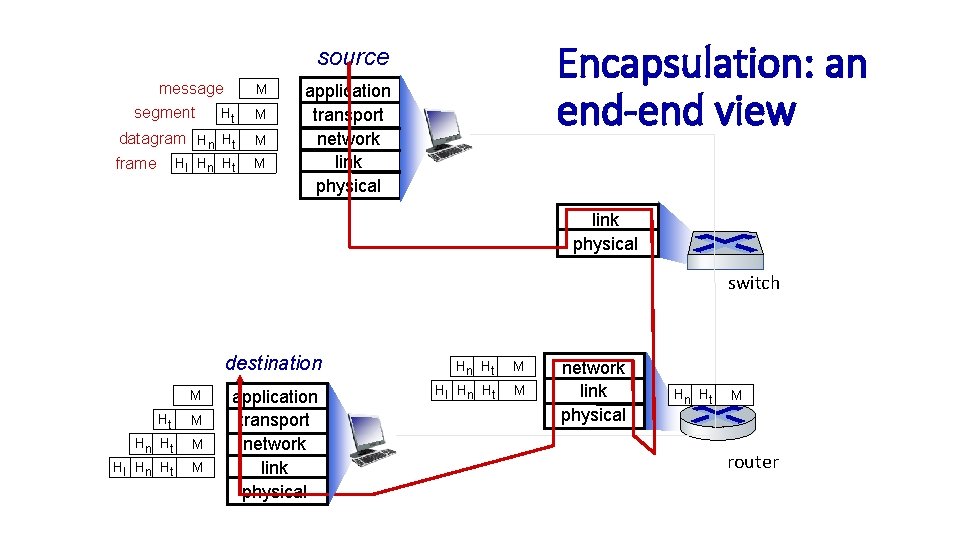
Encapsulation: an end-end view source message segment Ht M datagram Hn Ht M frame M Hl Hn Ht M application transport network link physical switch destination M Ht M Hn Ht Hl Hn Ht M M application transport network link physical Hn Ht Hl Hn Ht M M network link physical Hn Ht M router
Introduction COMPSCI 453 Computer Networks Professor Jim Kurose College of Information and Computer Sciences University of Massachusetts § Overview. What is the Internet? What is a protocol? § Network edge § Network core § Performance: loss, delay, throughput § Protocol layers, service models § Security § History Class textbook: Computer Networking: A Top. Down Approach (8 th ed. ) J. F. Kurose, K. W. Ross Pearson, 2020 http: //gaia. cs. umass. edu/kurose_ross Video: 2020, J. F. Kurose, All Rights Reserved Powerpoint: 1996 -2020, J. F. Kurose, K. W. Ross, All Rights Reserved