
Introduction Circuit Elements Ohms Law KCL Basic Electrical
Introduction; Circuit Elements; Ohm's Law; KCL
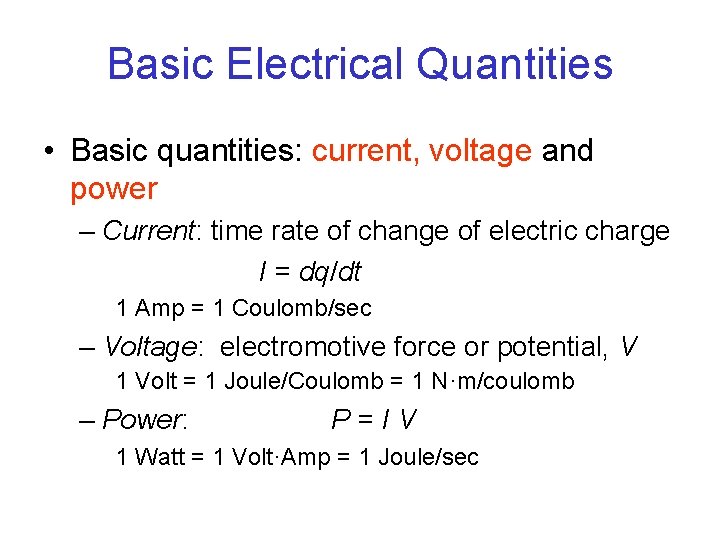
Basic Electrical Quantities • Basic quantities: current, voltage and power – Current: time rate of change of electric charge I = dq/dt 1 Amp = 1 Coulomb/sec – Voltage: electromotive force or potential, V 1 Volt = 1 Joule/Coulomb = 1 N·m/coulomb – Power: P=IV 1 Watt = 1 Volt·Amp = 1 Joule/sec
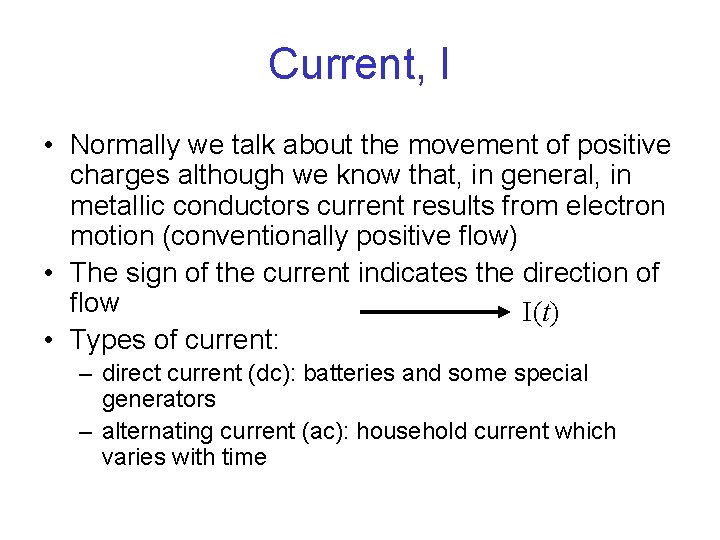
Current, I • Normally we talk about the movement of positive charges although we know that, in general, in metallic conductors current results from electron motion (conventionally positive flow) • The sign of the current indicates the direction of flow I(t) • Types of current: – direct current (dc): batteries and some special generators – alternating current (ac): household current which varies with time
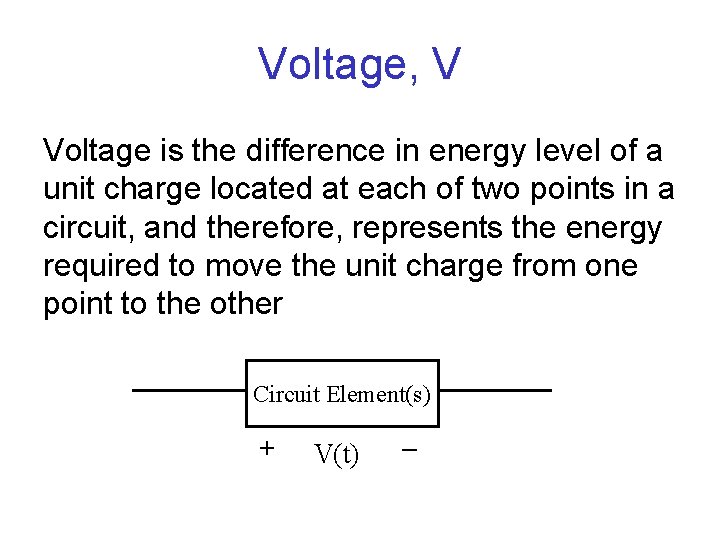
Voltage, V Voltage is the difference in energy level of a unit charge located at each of two points in a circuit, and therefore, represents the energy required to move the unit charge from one point to the other Circuit Element(s) + V(t) –

Default Sign Convention • Passive sign convention : current should enter the positive voltage terminal I + Circuit Element – • Consequence for P = I V – Positive (+) Power: element absorbs power – Negative (-) Power: element supplies power Lect 1 EEE 202
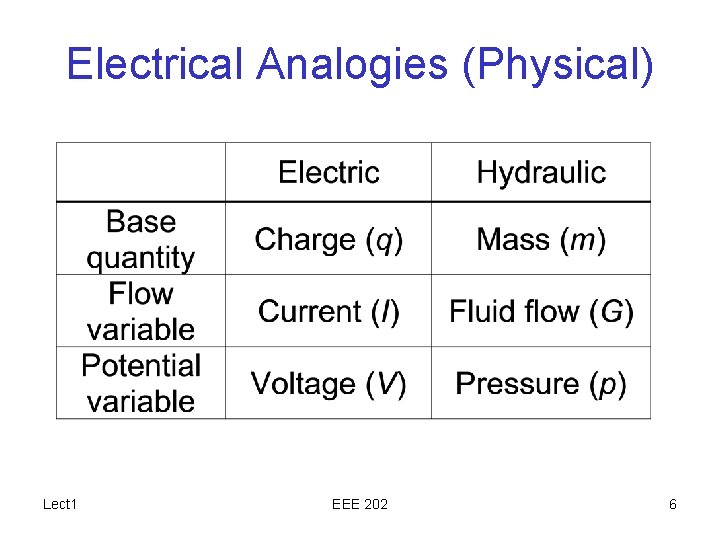
Electrical Analogies (Physical) Lect 1 EEE 202 6

Active vs. Passive Elements • Active elements can generate energy – Voltage and current sources – Batteries • Passive elements cannot generate energy – Resistors – Capacitors and Inductors (but CAN store energy)
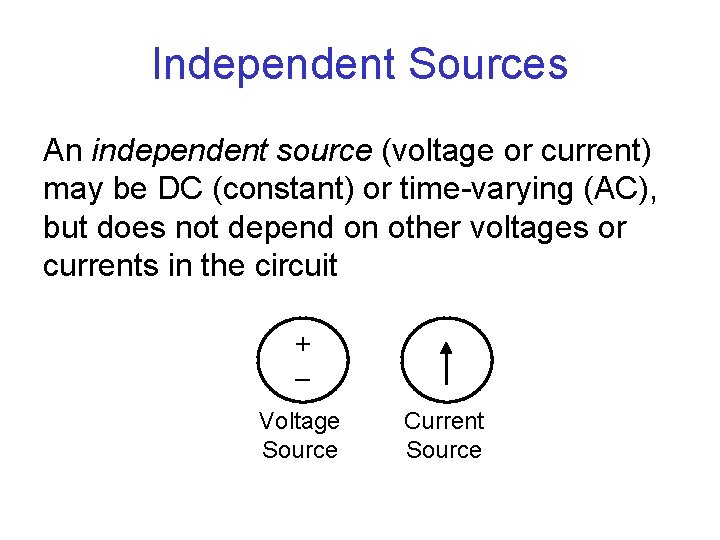
Independent Sources An independent source (voltage or current) may be DC (constant) or time-varying (AC), but does not depend on other voltages or currents in the circuit + – Voltage Source Current Source
Resistors • A resistor is a circuit element that dissipates electrical energy (usually as heat) • Real-world devices that are modeled by resistors: incandescent light bulbs, heating elements (stoves, heaters, etc. ), long wires • Resistance is measured in Ohms (Ω)
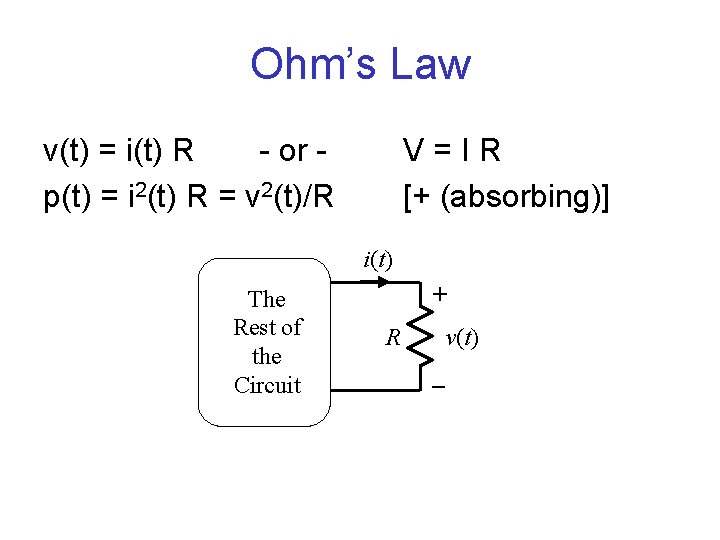
Ohm’s Law v(t) = i(t) R - or p(t) = i 2(t) R = v 2(t)/R V=IR [+ (absorbing)] i(t) The Rest of the Circuit + R v(t) –
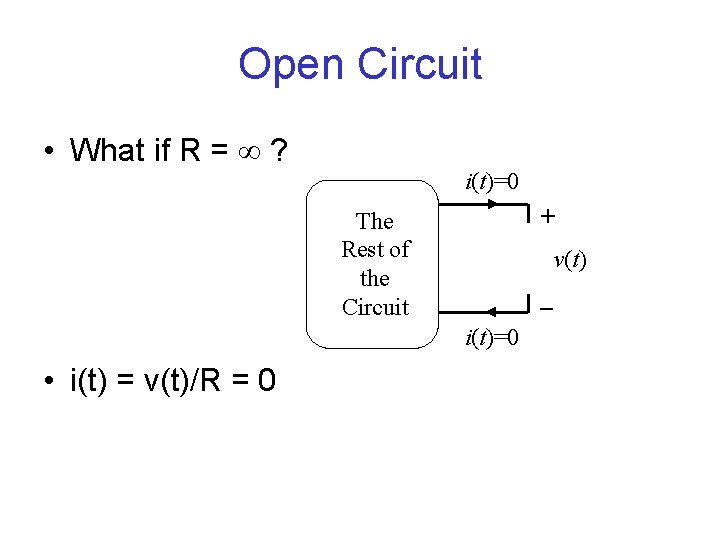
Open Circuit • What if R = ? i(t)=0 + The Rest of the Circuit v(t) – i(t)=0 • i(t) = v(t)/R = 0
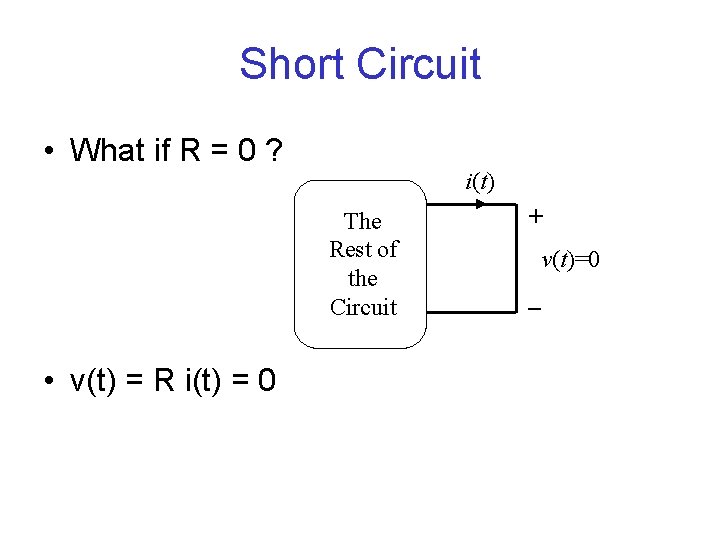
Short Circuit • What if R = 0 ? i(t) The Rest of the Circuit • v(t) = R i(t) = 0 + v(t)=0 –
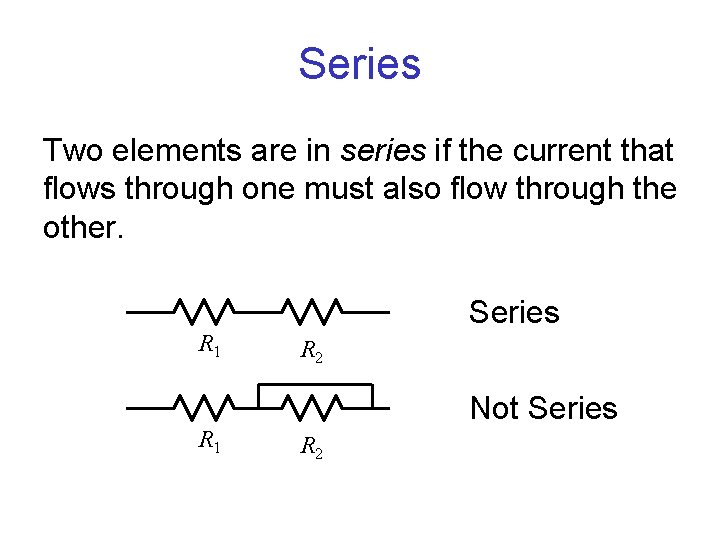
Series Two elements are in series if the current that flows through one must also flow through the other. R 1 Series R 2 Not Series R 2
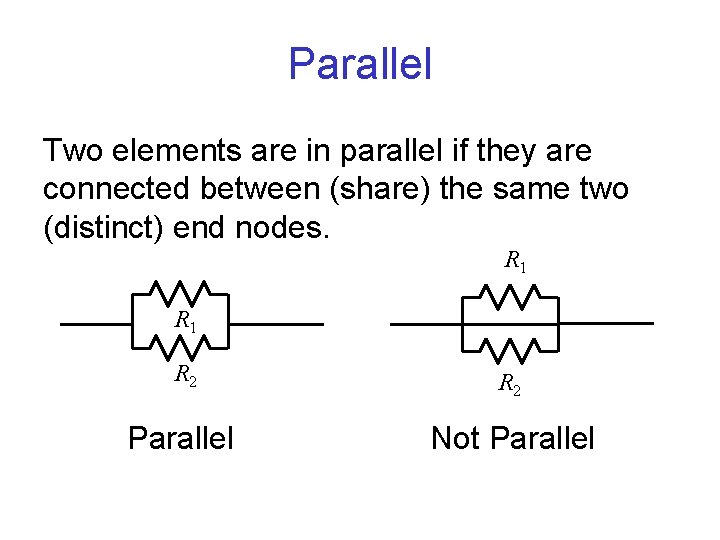
Parallel Two elements are in parallel if they are connected between (share) the same two (distinct) end nodes. R 1 R 2 Parallel Not Parallel
Kirchhoff’s Laws • Kirchhoff’s Current Law (KCL) – sum of all currents entering a node is zero – sum of currents entering node is equal to sum of currents leaving node • Kirchhoff’s Voltage Law (KVL) – sum of voltages around any loop in a circuit is zero
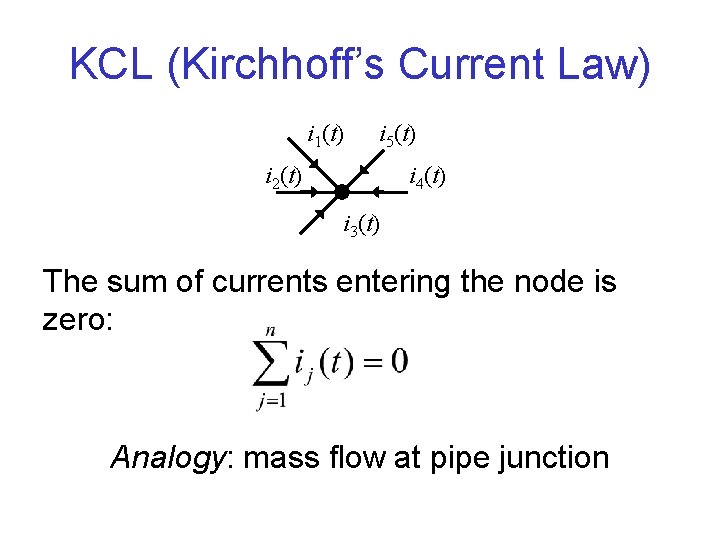
KCL (Kirchhoff’s Current Law) i 1(t) i 5(t) i 2(t) i 4(t) i 3(t) The sum of currents entering the node is zero: Analogy: mass flow at pipe junction
- Slides: 16