
Introduction Chapter 4 Programmable and Steering Logic 4
Introduction Chapter # 4: Programmable and Steering Logic 4 -1
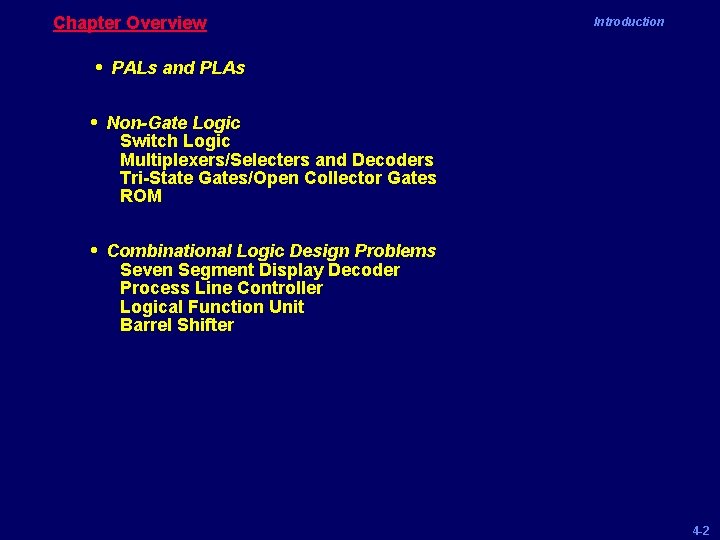
Chapter Overview Introduction • PALs and PLAs • Non-Gate Logic Switch Logic Multiplexers/Selecters and Decoders Tri-State Gates/Open Collector Gates ROM • Combinational Logic Design Problems Seven Segment Display Decoder Process Line Controller Logical Function Unit Barrel Shifter 4 -2
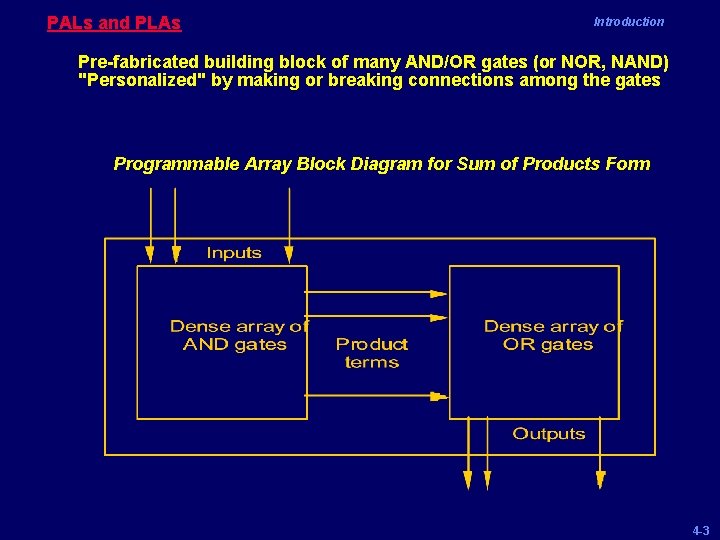
PALs and PLAs Introduction Pre-fabricated building block of many AND/OR gates (or NOR, NAND) "Personalized" by making or breaking connections among the gates Programmable Array Block Diagram for Sum of Products Form 4 -3
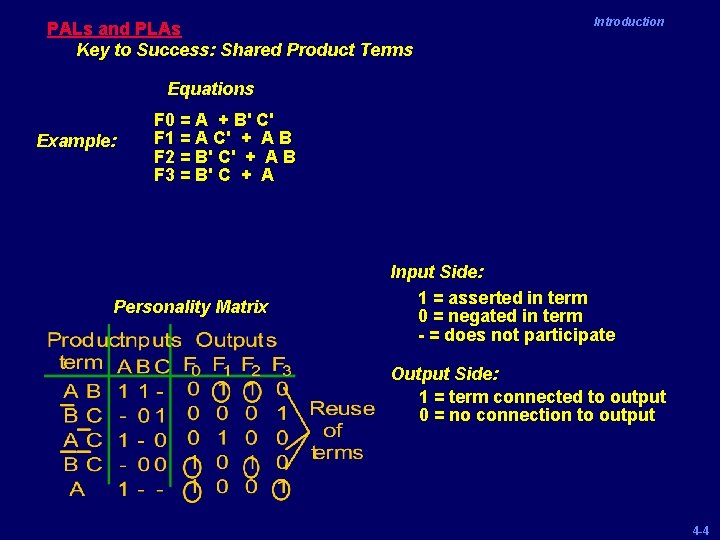
PALs and PLAs Key to Success: Shared Product Terms Introduction Equations Example: F 0 = A + B' C' F 1 = A C' + A B F 2 = B' C' + A B F 3 = B' C + A Personality Matrix Input Side: 1 = asserted in term 0 = negated in term - = does not participate Output Side: 1 = term connected to output 0 = no connection to output 4 -4
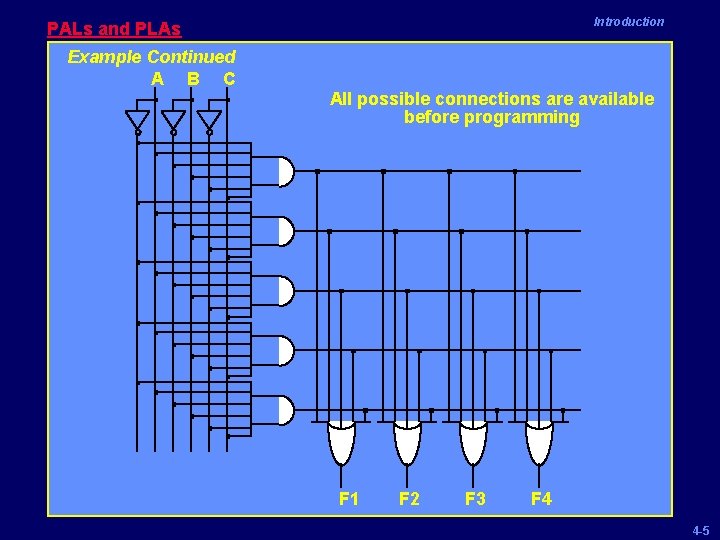
Introduction PALs and PLAs Example Continued A B C All possible connections are available before programming F 1 F 2 F 3 F 4 4 -5
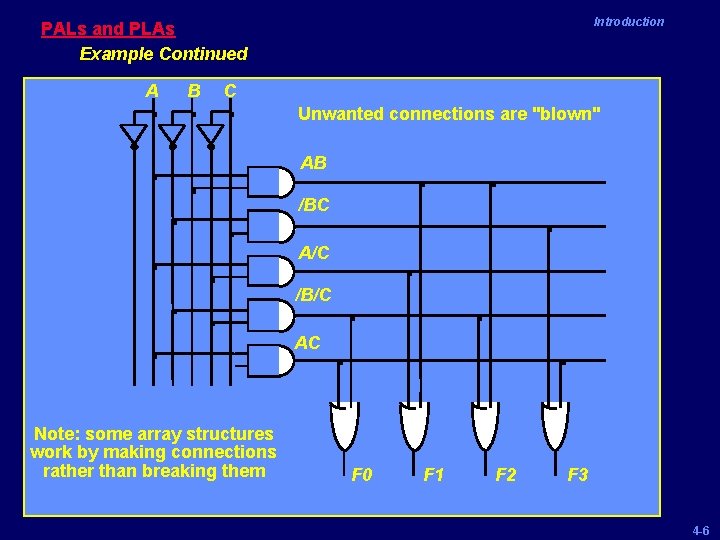
Introduction PALs and PLAs Example Continued A B C Unwanted connections are "blown" AB /BC A/C /B/C AC Note: some array structures work by making connections rather than breaking them F 0 F 1 F 2 F 3 4 -6
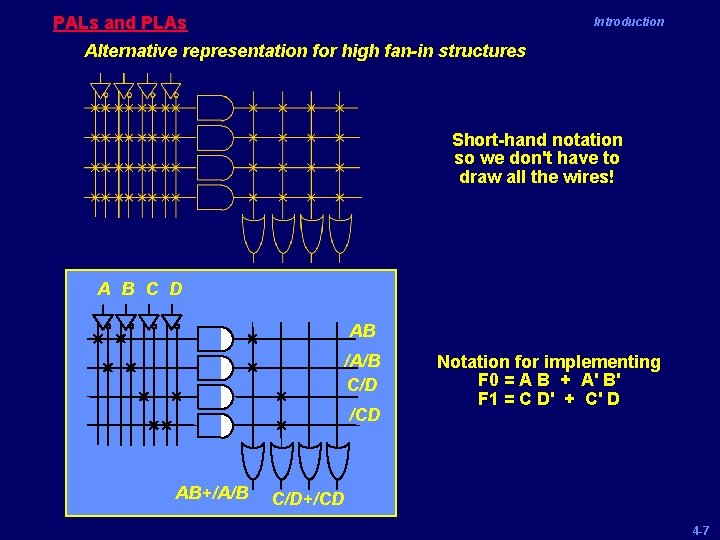
PALs and PLAs Introduction Alternative representation for high fan-in structures Short-hand notation so we don't have to draw all the wires! A B C D AB /A/B C/D /CD AB+/A/B Notation for implementing F 0 = A B + A' B' F 1 = C D' + C' D C/D+/CD 4 -7
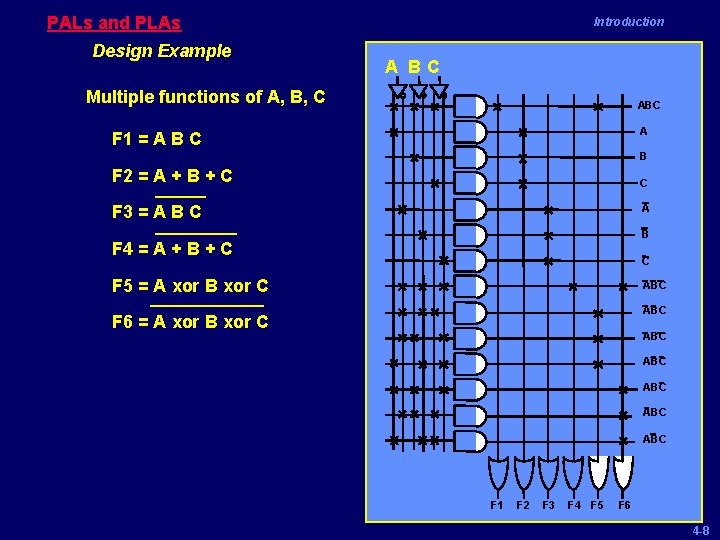
PALs and PLAs Design Example Introduction A BC Multiple functions of A, B, C ABC A F 1 = A B C B F 2 = A + B + C C F 3 = A B C A B F 4 = A + B + C C F 5 = A xor B xor C ABC F 6 = A xor B xor C ABC ABC ABC F 1 F 2 F 3 F 4 F 5 F 6 4 -8
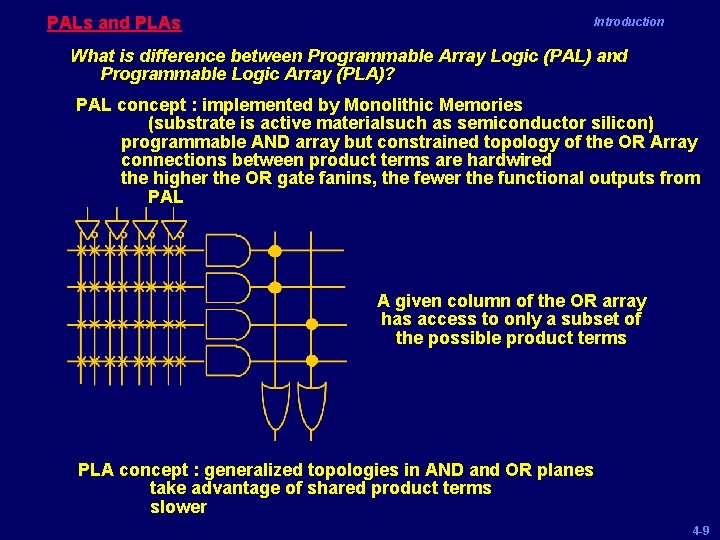
PALs and PLAs Introduction What is difference between Programmable Array Logic (PAL) and Programmable Logic Array (PLA)? PAL concept : implemented by Monolithic Memories (substrate is active materialsuch as semiconductor silicon) programmable AND array but constrained topology of the OR Array connections between product terms are hardwired the higher the OR gate fanins, the fewer the functional outputs from PAL A given column of the OR array has access to only a subset of the possible product terms PLA concept : generalized topologies in AND and OR planes take advantage of shared product terms slower 4 -9
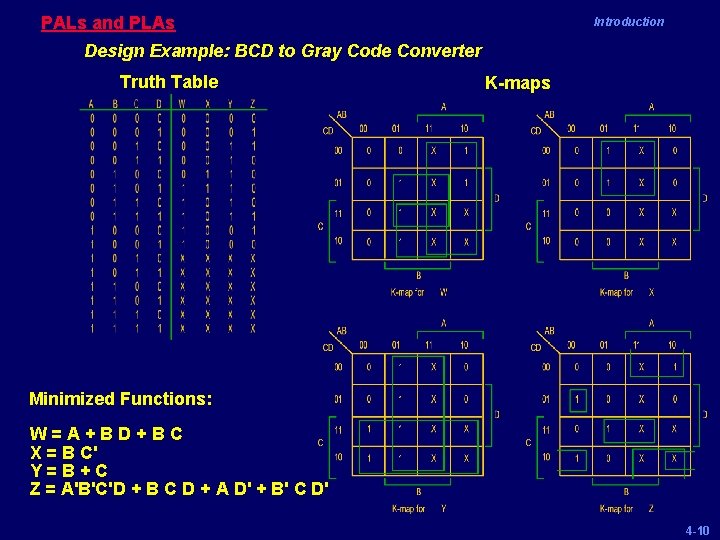
PALs and PLAs Introduction Design Example: BCD to Gray Code Converter Truth Table K-maps Minimized Functions: W=A+BD+BC X = B C' Y=B+C Z = A'B'C'D + B C D + A D' + B' C D' 4 -10
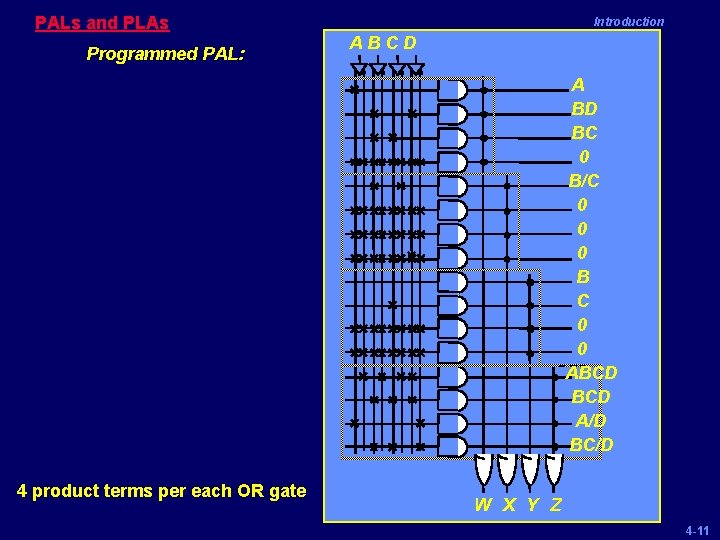
PALs and PLAs Programmed PAL: Introduction ABCD A BD BC 0 B/C 0 0 0 B C 0 0 ABCD A/D BC/D 4 product terms per each OR gate W X Y Z 4 -11
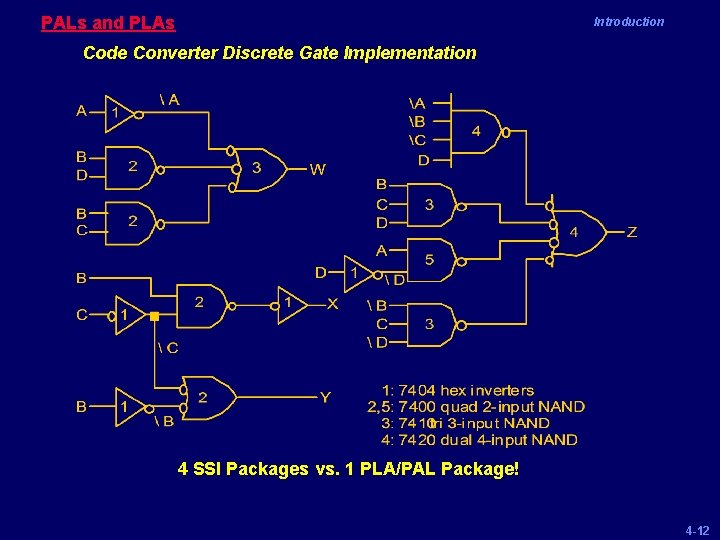
PALs and PLAs Introduction Code Converter Discrete Gate Implementation 4 SSI Packages vs. 1 PLA/PAL Package! 4 -12
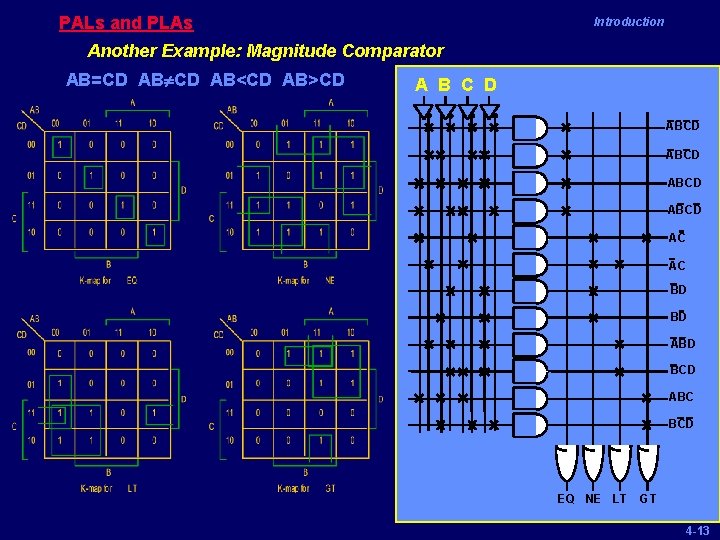
PALs and PLAs Introduction Another Example: Magnitude Comparator AB=CD AB¹CD AB<CD AB>CD A B C D ABCD AC AC BD BD ABD BCD ABC BCD EQ NE LT GT 4 -13
Non-Gate Logic Introduction AND-OR-Invert PAL/PLA Generalized Building Blocks Beyond Simple Gates Kinds of "Non-gate logic": • switching circuits built from CMOS transmission gates • multiplexer/selecter functions • decoders • tri-state and open collector gates • read-only memories 4 -14
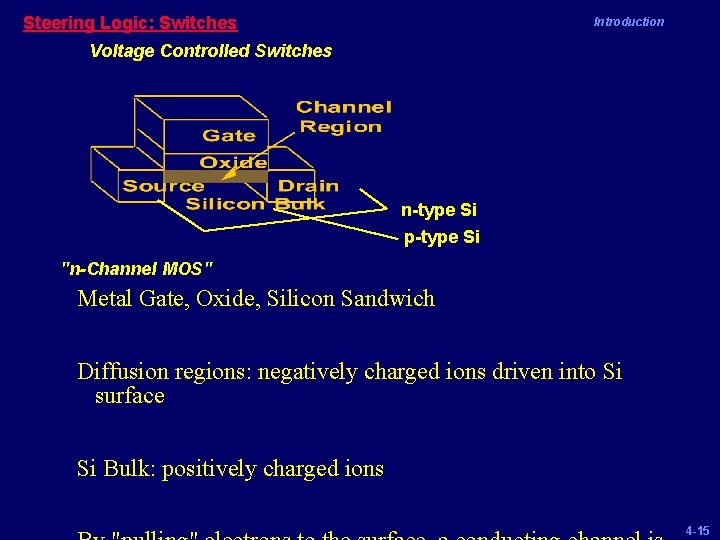
Steering Logic: Switches Introduction Voltage Controlled Switches n-type Si p-type Si "n-Channel MOS" Metal Gate, Oxide, Silicon Sandwich Diffusion regions: negatively charged ions driven into Si surface Si Bulk: positively charged ions 4 -15
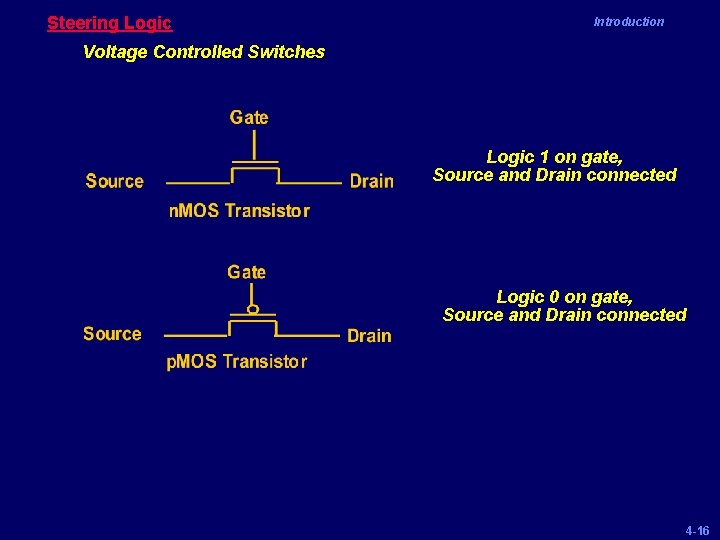
Steering Logic Introduction Voltage Controlled Switches Logic 1 on gate, Source and Drain connected Logic 0 on gate, Source and Drain connected 4 -16
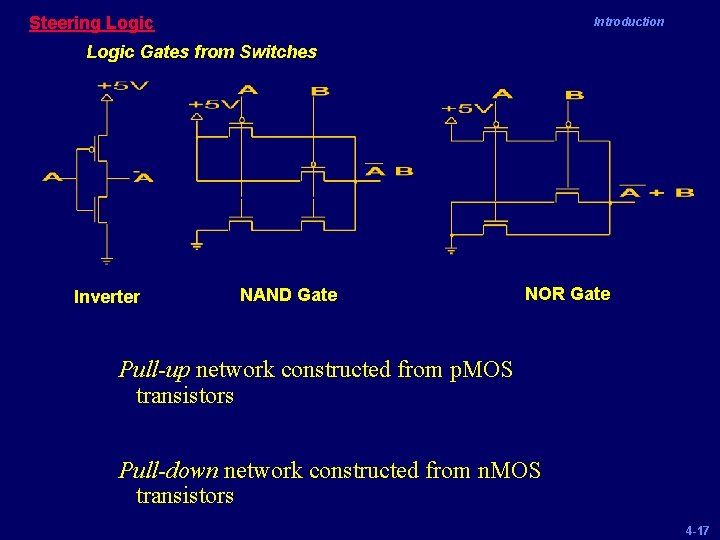
Steering Logic Introduction Logic Gates from Switches Inverter NAND Gate NOR Gate Pull-up network constructed from p. MOS transistors Pull-down network constructed from n. MOS transistors 4 -17
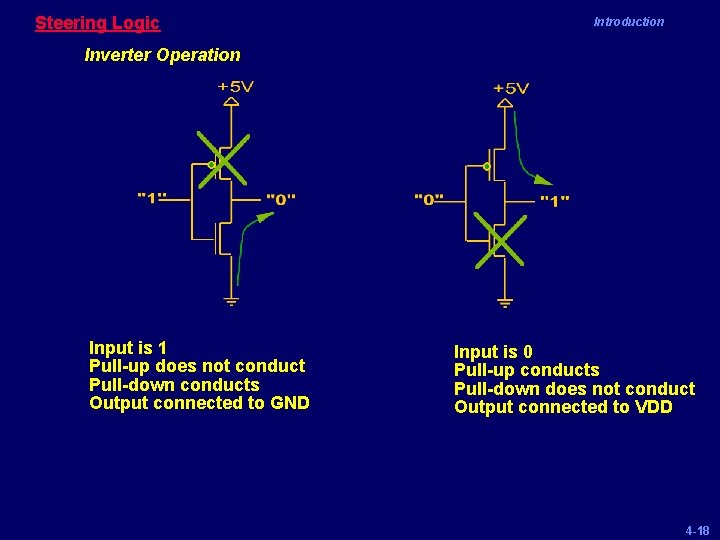
Steering Logic Introduction Inverter Operation Input is 1 Pull-up does not conduct Pull-down conducts Output connected to GND Input is 0 Pull-up conducts Pull-down does not conduct Output connected to VDD 4 -18
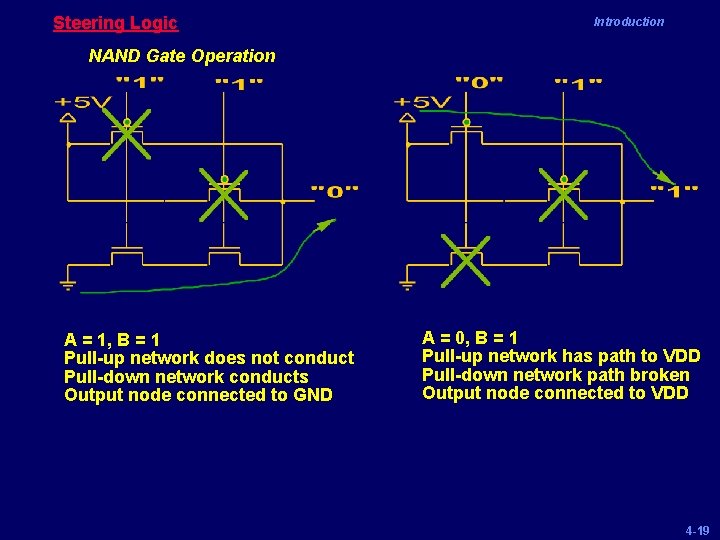
Steering Logic Introduction NAND Gate Operation A = 1, B = 1 Pull-up network does not conduct Pull-down network conducts Output node connected to GND A = 0, B = 1 Pull-up network has path to VDD Pull-down network path broken Output node connected to VDD 4 -19
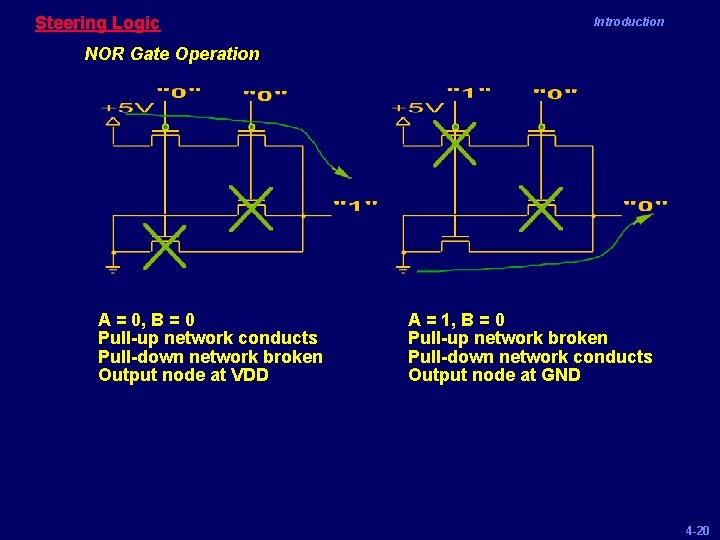
Steering Logic Introduction NOR Gate Operation A = 0, B = 0 Pull-up network conducts Pull-down network broken Output node at VDD A = 1, B = 0 Pull-up network broken Pull-down network conducts Output node at GND 4 -20
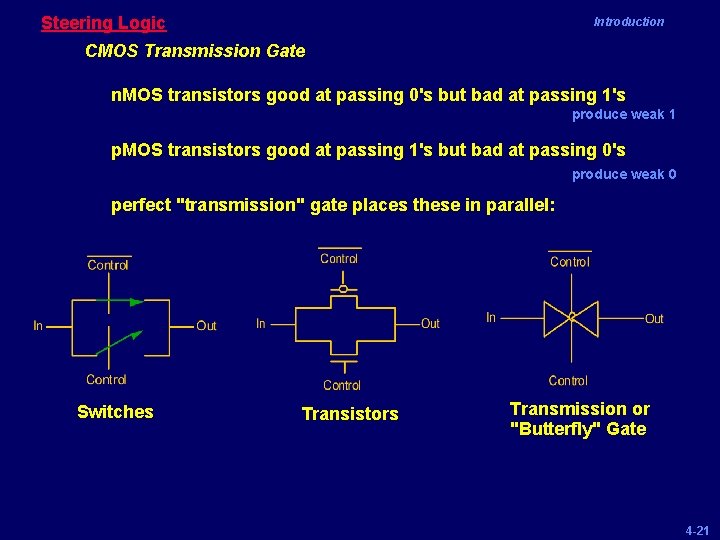
Steering Logic Introduction CMOS Transmission Gate n. MOS transistors good at passing 0's but bad at passing 1's produce weak 1 p. MOS transistors good at passing 1's but bad at passing 0's produce weak 0 perfect "transmission" gate places these in parallel: Switches Transistors Transmission or "Butterfly" Gate 4 -21
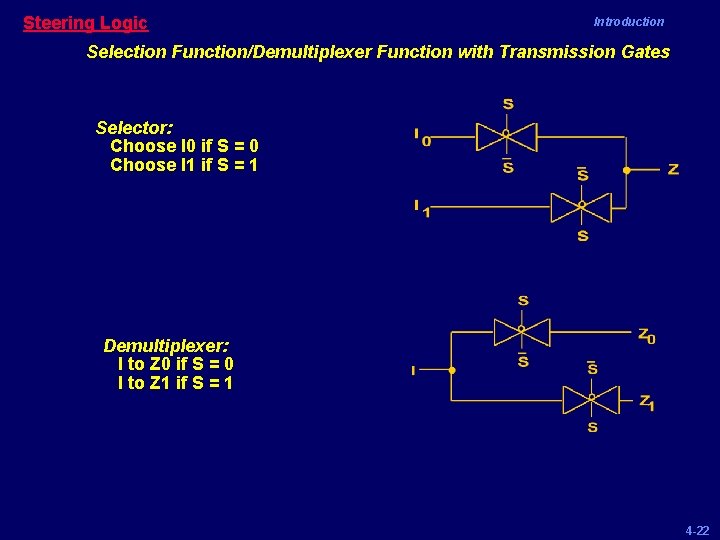
Steering Logic Introduction Selection Function/Demultiplexer Function with Transmission Gates Selector: Choose I 0 if S = 0 Choose I 1 if S = 1 Demultiplexer: I to Z 0 if S = 0 I to Z 1 if S = 1 4 -22
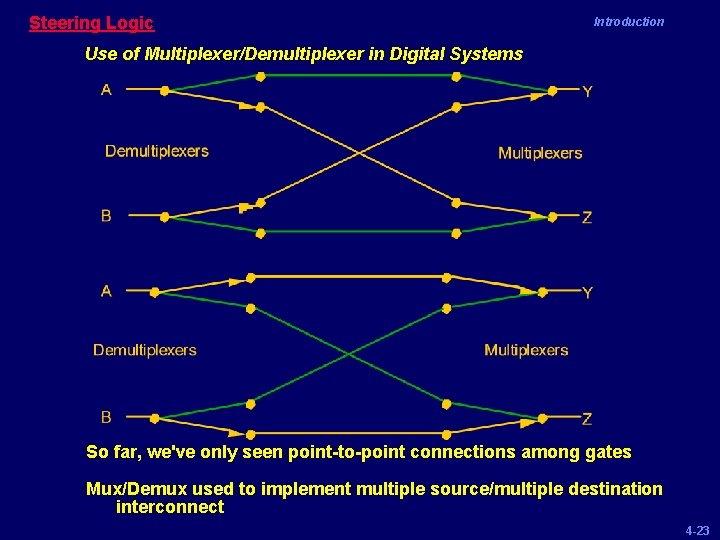
Steering Logic Introduction Use of Multiplexer/Demultiplexer in Digital Systems So far, we've only seen point-to-point connections among gates Mux/Demux used to implement multiple source/multiple destination interconnect 4 -23
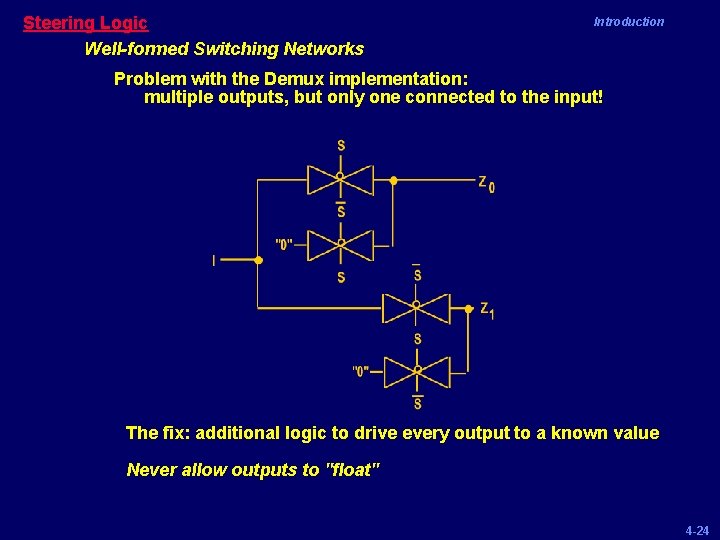
Steering Logic Well-formed Switching Networks Introduction Problem with the Demux implementation: multiple outputs, but only one connected to the input! The fix: additional logic to drive every output to a known value Never allow outputs to "float" 4 -24
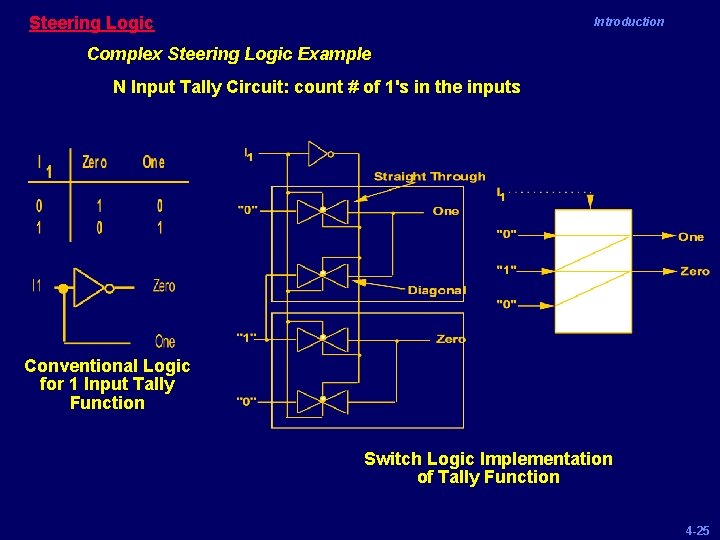
Steering Logic Introduction Complex Steering Logic Example N Input Tally Circuit: count # of 1's in the inputs Conventional Logic for 1 Input Tally Function Switch Logic Implementation of Tally Function 4 -25
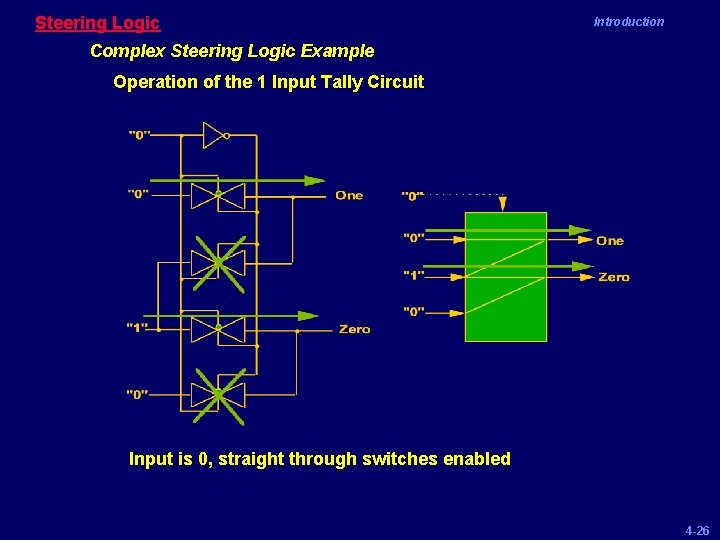
Steering Logic Introduction Complex Steering Logic Example Operation of the 1 Input Tally Circuit Input is 0, straight through switches enabled 4 -26
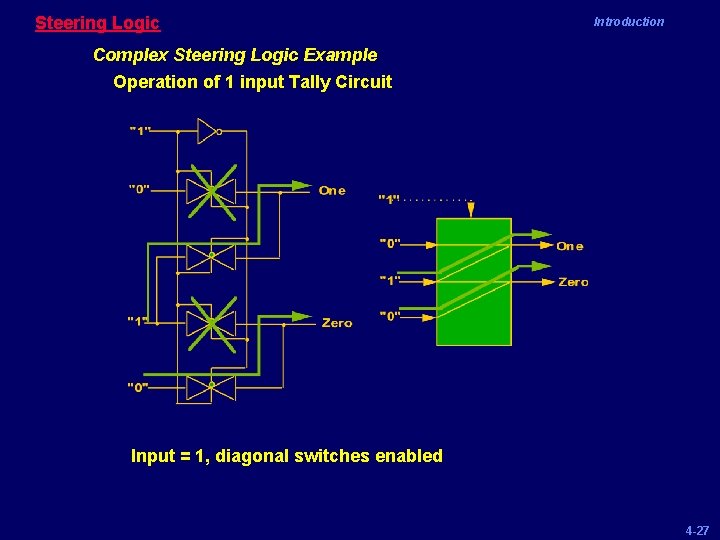
Steering Logic Introduction Complex Steering Logic Example Operation of 1 input Tally Circuit Input = 1, diagonal switches enabled 4 -27
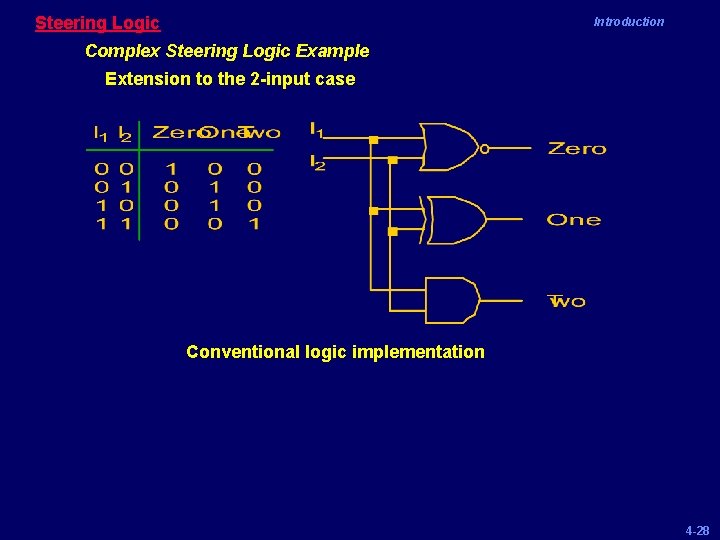
Steering Logic Introduction Complex Steering Logic Example Extension to the 2 -input case Conventional logic implementation 4 -28
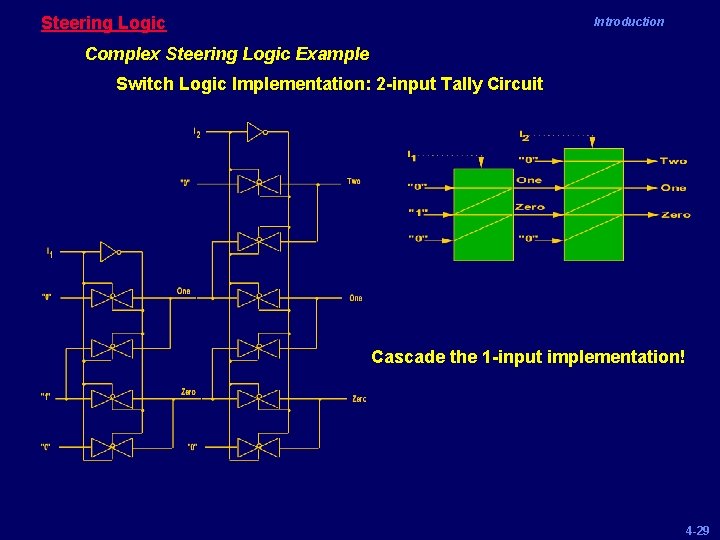
Steering Logic Introduction Complex Steering Logic Example Switch Logic Implementation: 2 -input Tally Circuit Cascade the 1 -input implementation! 4 -29
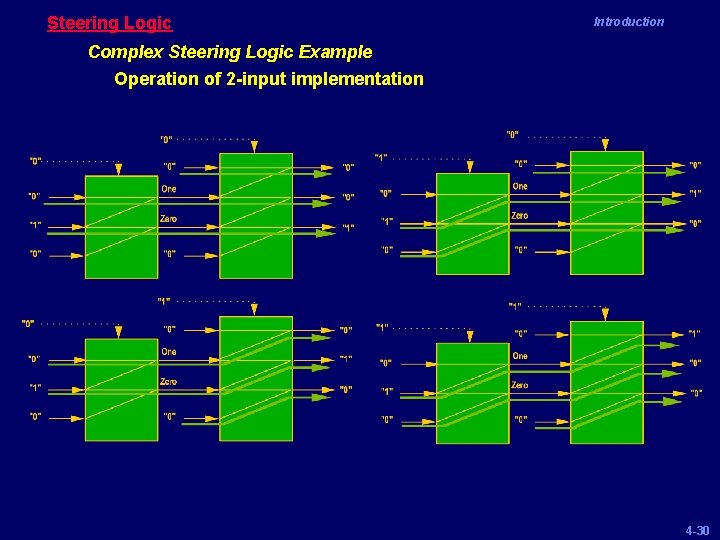
Steering Logic Introduction Complex Steering Logic Example Operation of 2 -input implementation 4 -30
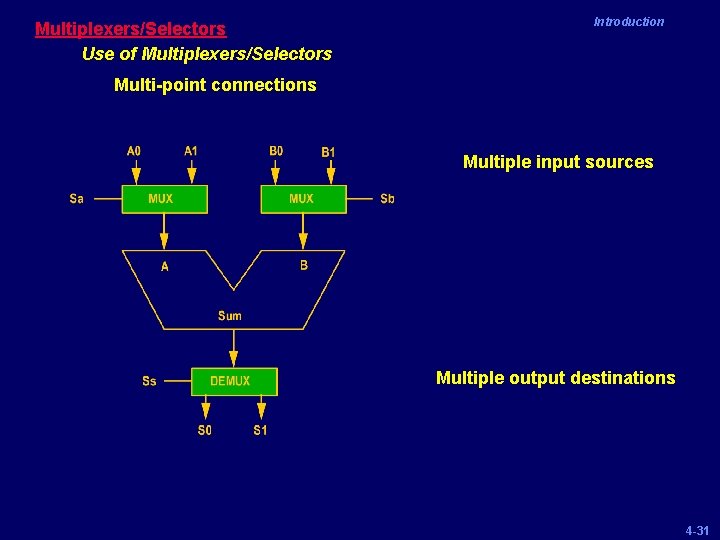
Multiplexers/Selectors Use of Multiplexers/Selectors Introduction Multi-point connections Multiple input sources Multiple output destinations 4 -31
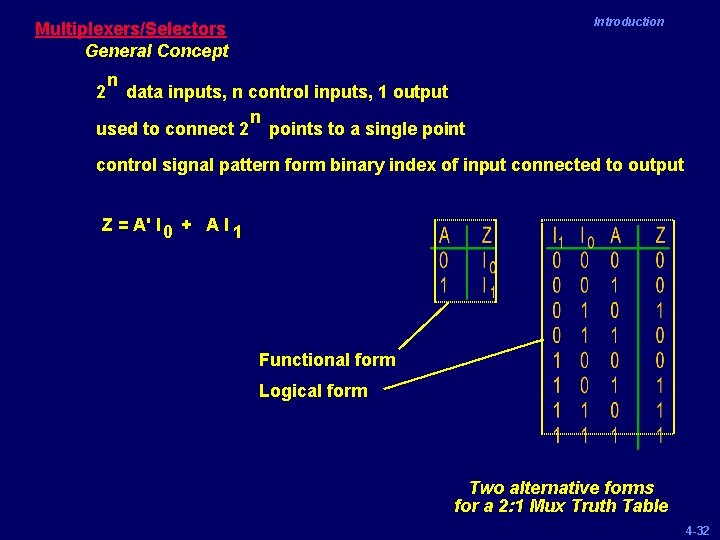
Introduction Multiplexers/Selectors General Concept 2 n data inputs, n control inputs, 1 output n used to connect 2 points to a single point control signal pattern form binary index of input connected to output Z = A' I 0 + A I 1 Functional form Logical form Two alternative forms for a 2: 1 Mux Truth Table 4 -32
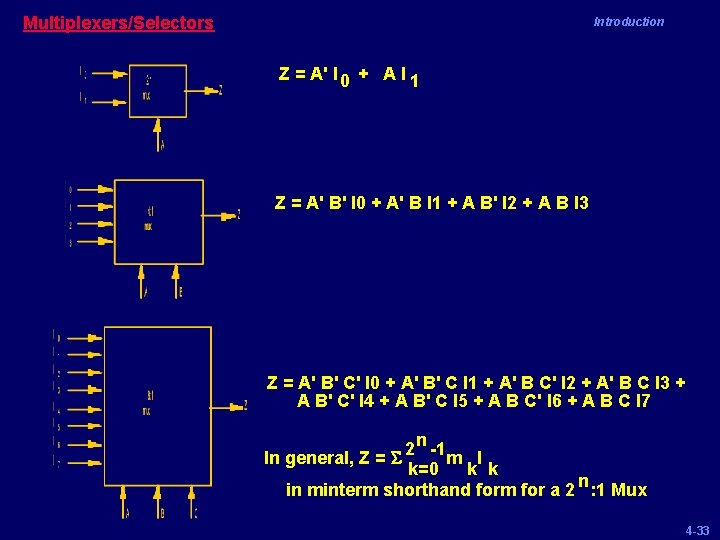
Multiplexers/Selectors Introduction Z = A' I 0 + A I 1 Z = A' B' I 0 + A' B I 1 + A B' I 2 + A B I 3 Z = A' B' C' I 0 + A' B' C I 1 + A' B C' I 2 + A' B C I 3 + A B' C' I 4 + A B' C I 5 + A B C' I 6 + A B C I 7 n -1 2 In general, Z = S m I k=0 k k in minterm shorthand form for a 2 n : 1 Mux 4 -33
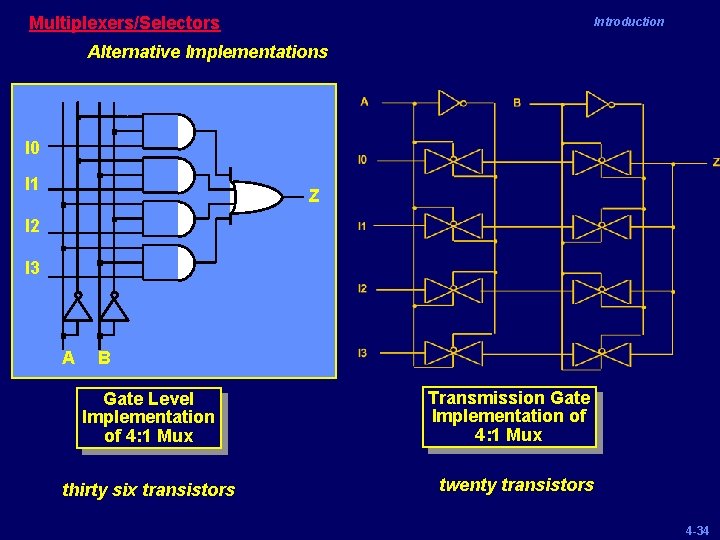
Multiplexers/Selectors Introduction Alternative Implementations I 0 I 1 Z I 2 I 3 A B Gate Level Implementation of 4: 1 Mux thirty six transistors Transmission Gate Implementation of 4: 1 Mux twenty transistors 4 -34
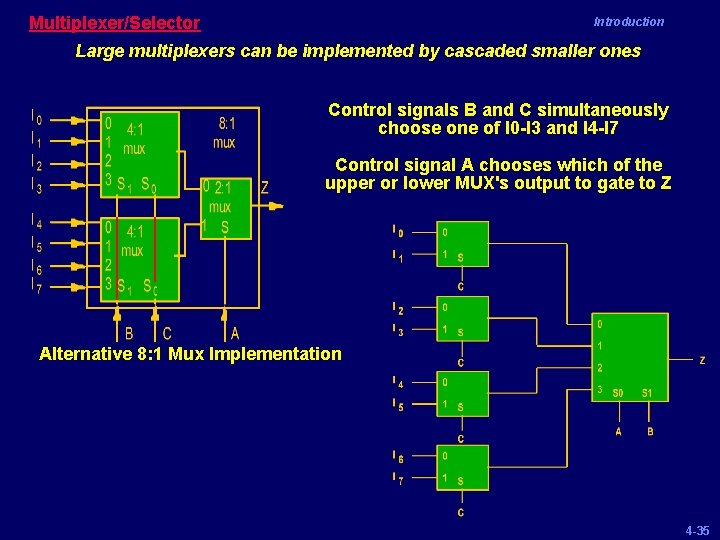
Multiplexer/Selector Introduction Large multiplexers can be implemented by cascaded smaller ones Control signals B and C simultaneously choose one of I 0 -I 3 and I 4 -I 7 Control signal A chooses which of the upper or lower MUX's output to gate to Z Alternative 8: 1 Mux Implementation 4 -35
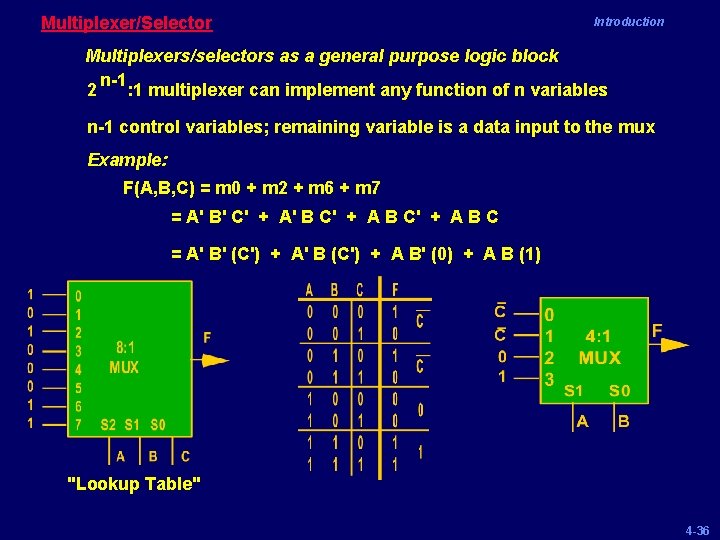
Multiplexer/Selector Introduction Multiplexers/selectors as a general purpose logic block n-1 2 : 1 multiplexer can implement any function of n variables n-1 control variables; remaining variable is a data input to the mux Example: F(A, B, C) = m 0 + m 2 + m 6 + m 7 = A' B' C' + A' B C' + A B C = A' B' (C') + A' B (C') + A B' (0) + A B (1) "Lookup Table" 4 -36
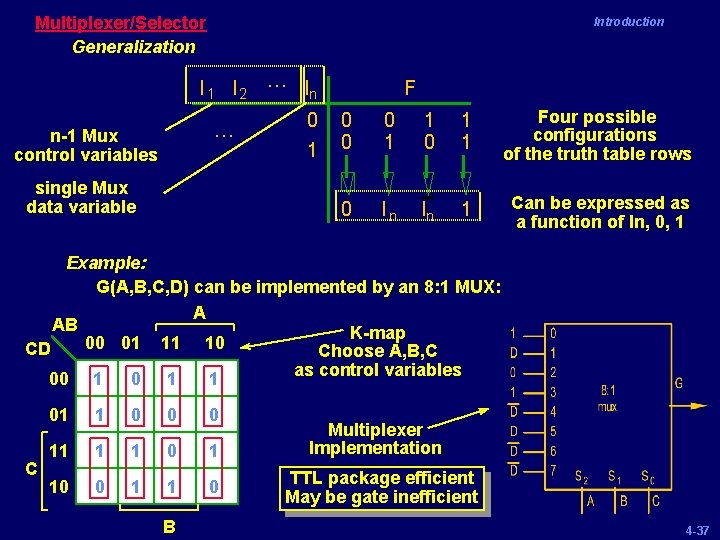
Multiplexer/Selector Generalization Introduction I 1 I 2 … In … n-1 Mux control variables single Mux data variable 0 1 F 0 0 0 1 1 Four possible configurations of the truth table rows 0 In In 1 Can be expressed as a function of In, 0, 1 Example: G(A, B, C, D) can be implemented by an 8: 1 MUX: A AB K-map 00 01 11 10 CD Choose A, B, C as control variables 00 1 1 C 01 1 0 0 0 11 1 1 0 1 10 0 1 1 0 B Multiplexer Implementation TTL package efficient May be gate inefficient 4 -37
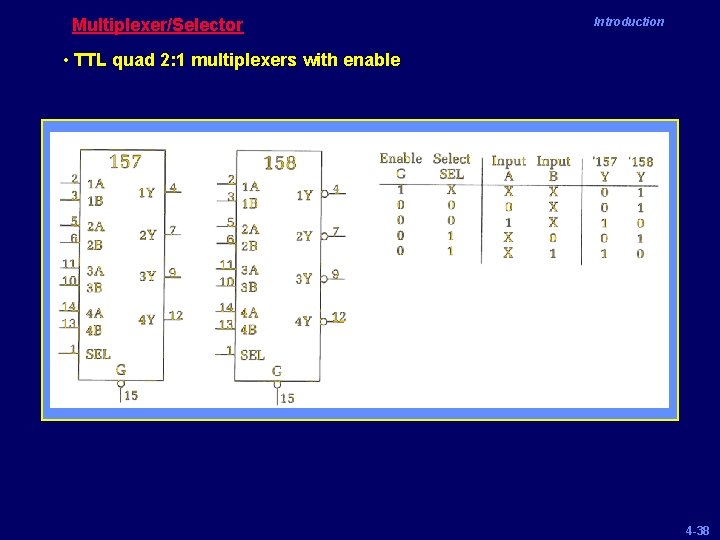
Multiplexer/Selector Introduction • TTL quad 2: 1 multiplexers with enable 4 -38
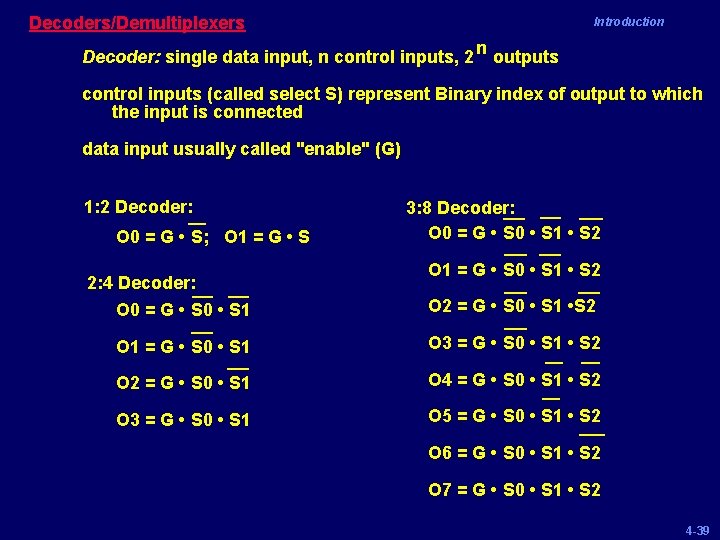
Decoders/Demultiplexers Introduction Decoder: single data input, n control inputs, 2 n outputs control inputs (called select S) represent Binary index of output to which the input is connected data input usually called "enable" (G) 1: 2 Decoder: O 0 = G • S; O 1 = G • S 2: 4 Decoder: O 0 = G • S 0 • S 1 3: 8 Decoder: O 0 = G • S 0 • S 1 • S 2 O 1 = G • S 0 • S 1 • S 2 O 2 = G • S 0 • S 1 • S 2 O 1 = G • S 0 • S 1 O 3 = G • S 0 • S 1 • S 2 O 2 = G • S 0 • S 1 O 4 = G • S 0 • S 1 • S 2 O 3 = G • S 0 • S 1 O 5 = G • S 0 • S 1 • S 2 O 6 = G • S 0 • S 1 • S 2 O 7 = G • S 0 • S 1 • S 2 4 -39
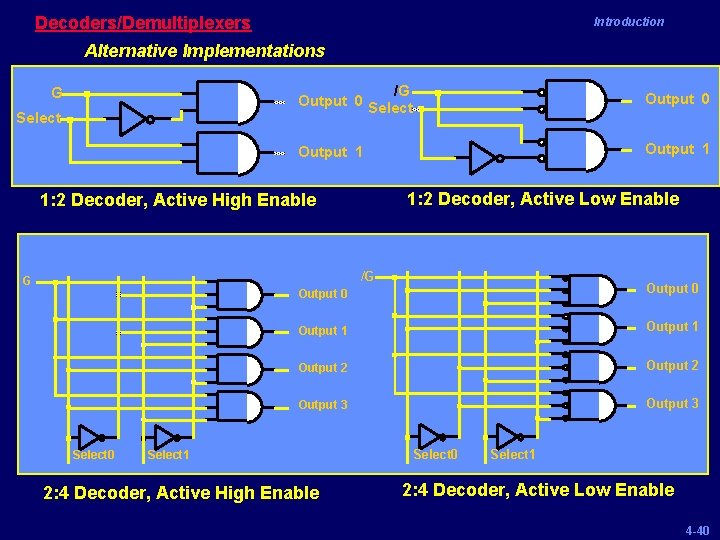
Decoders/Demultiplexers Introduction Alternative Implementations G Select /G Output 0 Select Output 0 Output 1 1: 2 Decoder, Active Low Enable 1: 2 Decoder, Active High Enable /G G Select 0 Output 1 Output 2 Output 3 Select 1 2: 4 Decoder, Active High Enable Select 0 Select 1 2: 4 Decoder, Active Low Enable 4 -40

Decoders/Demultiplexers Switch Logic Implementations Introduction Naive, Incorrect Implementation All outputs not driven at all times Correct 1: 2 Decoder Implementation 4 -41
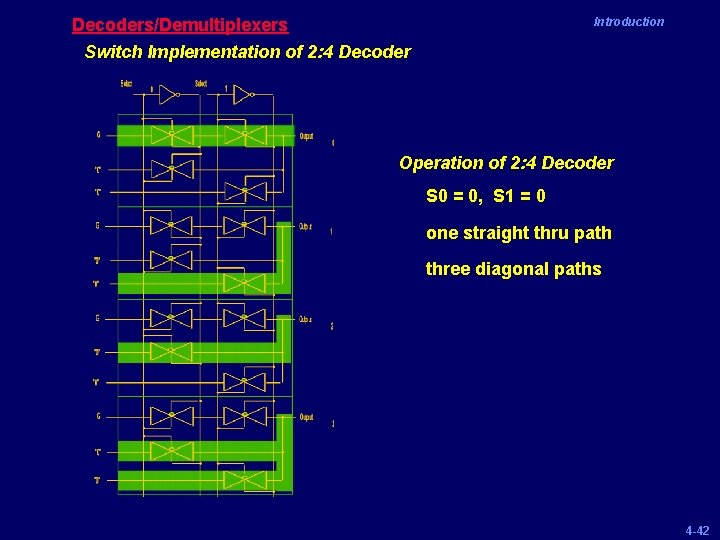
Decoders/Demultiplexers Switch Implementation of 2: 4 Decoder Introduction Operation of 2: 4 Decoder S 0 = 0, S 1 = 0 one straight thru path three diagonal paths 4 -42
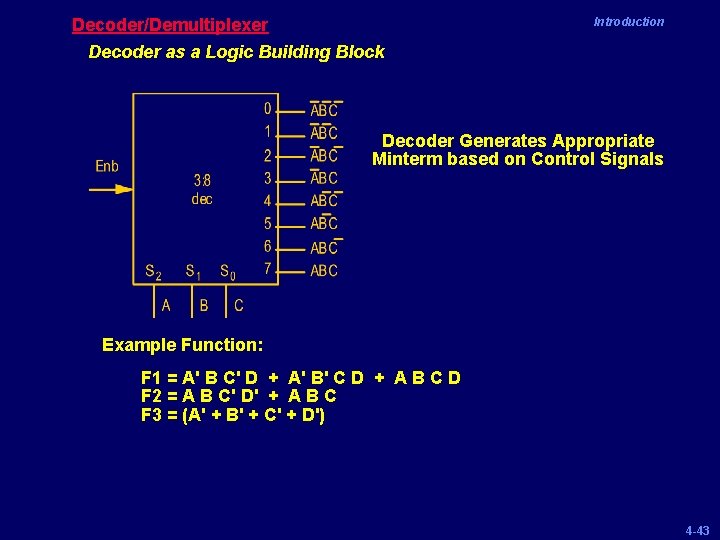
Decoder/Demultiplexer Decoder as a Logic Building Block Introduction Decoder Generates Appropriate Minterm based on Control Signals Example Function: F 1 = A' B C' D + A' B' C D + A B C D F 2 = A B C' D' + A B C F 3 = (A' + B' + C' + D') 4 -43
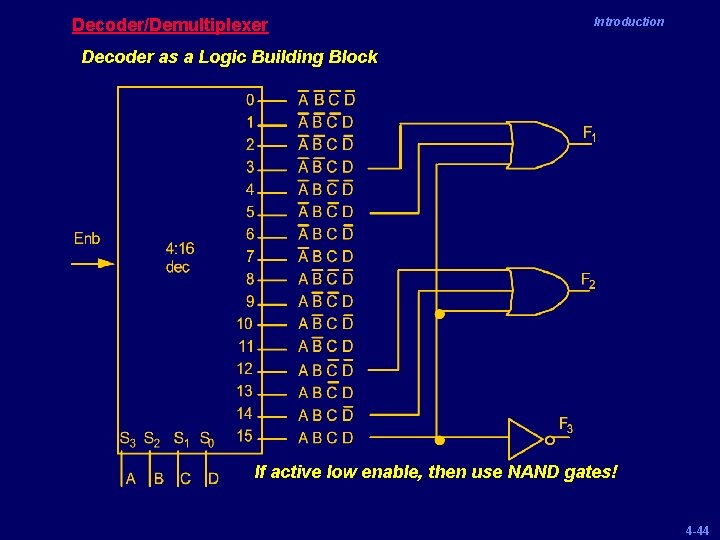
Decoder/Demultiplexer Introduction Decoder as a Logic Building Block If active low enable, then use NAND gates! 4 -44
- Slides: 44