
Introduction Chapter 1 What is finance Finance is

- Slides: 16
Introduction Chapter 1
What is finance? Finance is the study and practice of making investments. An investment is anything that requires forgoing present consumption in exchange for hopefully higher future consumption. Investments can be: � Short-term � Long-term
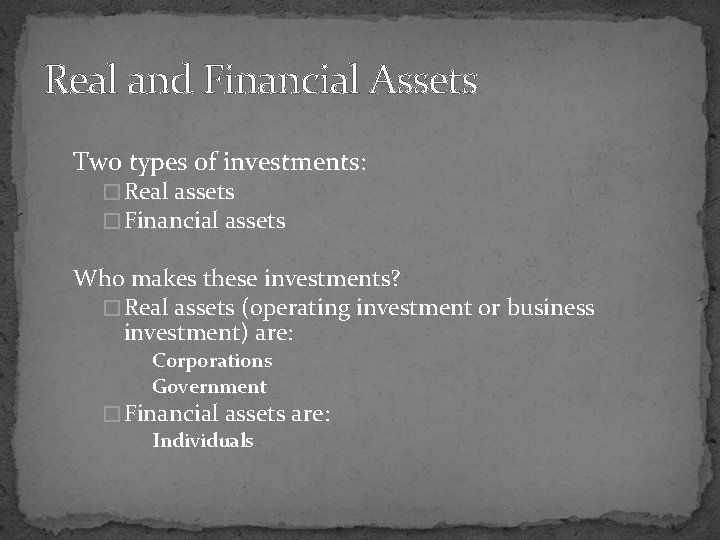
Real and Financial Assets Two types of investments: � Real assets � Financial assets Who makes these investments? � Real assets (operating investment or business investment) are: ü Corporations ü Government � Financial assets are: ü Individuals
Four Fundamental Questions What are the tree or four principal questions associated with any investments? Retrospective 1 2 3 4 Prospective
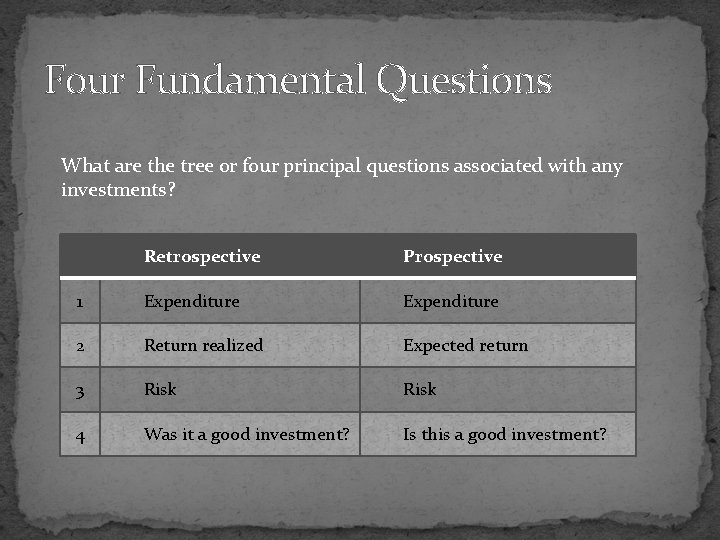
Four Fundamental Questions What are the tree or four principal questions associated with any investments? Retrospective Prospective 1 Expenditure 2 Return realized Expected return 3 Risk 4 Was it a good investment? Is this a good investment?
Real Asset: an asset that has two defining characteristics: a) Is not created by legal contract between specific individuals b) Some operation is required to produce a return Examples:
Financial Asset - a legal contract between specific individuals whereby one party promises to make future payments to the other (typically in exchange for immediate cash). Payments are often contingent. For a financial asset, no operation is generally required to receive a return. Examples: 1) Mortgage 2) Common share
Financial Asset The individual who makes the promised future payments is called: � seller of the FA � writer of the FA � issuer of the FA � short position The individual who receives the payment is called: � owner of the FA � holder of the FA � investor � long position
The Corporate Organizational Form Why corporations are so successful in terms of business activity compared to alternatives (sole proprietorship, partnerships)? • Legal identity of a corporation • Limited liability for shareholders • Tax advantages (deferral) • Separation of ownership (shareholders) and control (management) • Unlimited life
The Corporate Organizational Form Disadvantages of the corporate organizational form? � Shareholders are not entitled to private corporate information � Agency problem Solution for the Principal-Agent problem: � Managerial compensation plan (bonuses, stock options) that ties managers and shareholders interests together � Managerial labor market
The Objectives of Corporate Business Activity The Canadian Business Corporation Act describes the duties of directors of corporations as “managing the business and affairs of a corporation. ” This directive is often interpreted with-respect-to financial management to the maximization of shareholders’ wealth. Wealth is the amount receivable from an asset upon actual or hypothetical sale. Therefore, an interpretation of objective of firms in their operation is maximization of the sale price of a firm upon hypothetical sale (for a private corporation) or maximization of share-price of a public corporation.
Measuring Wealth Creation The increment to corporate/shareholders’ wealth from an investment by a firm is often represented as the Net-Present. Value of the investment. Value of an investment = Net present value (NPV) = = Discounted cash flow analysis (DCF) Three fundamental inputs to any NPV problem: � Timing of cash flows � Amount of predicted cash flows � Discounted factor/opportunity cost The opportunity cost is the rate-of-return that financial asset holder could earn on financial assets that have risk approximately the same as the investment considered.
NPV example Business investment: Invest $300, 000 now to generate $70, 000 per annum indefinitely starting in 1 year. Opportunity cost: rate of return for shareholders 7% per annum. 4 Questions: � � Expenditure Risk – Return – Is this a good investment? Internal Rate of Return (IRR) – hypothetical discount rate that makes NPV equal to zero.
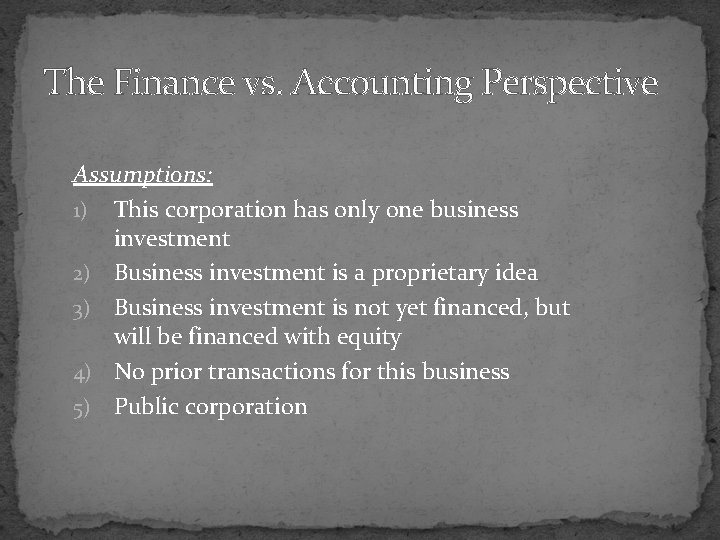
The Finance vs. Accounting Perspective Assumptions: 1) This corporation has only one business investment 2) Business investment is a proprietary idea 3) Business investment is not yet financed, but will be financed with equity 4) No prior transactions for this business 5) Public corporation
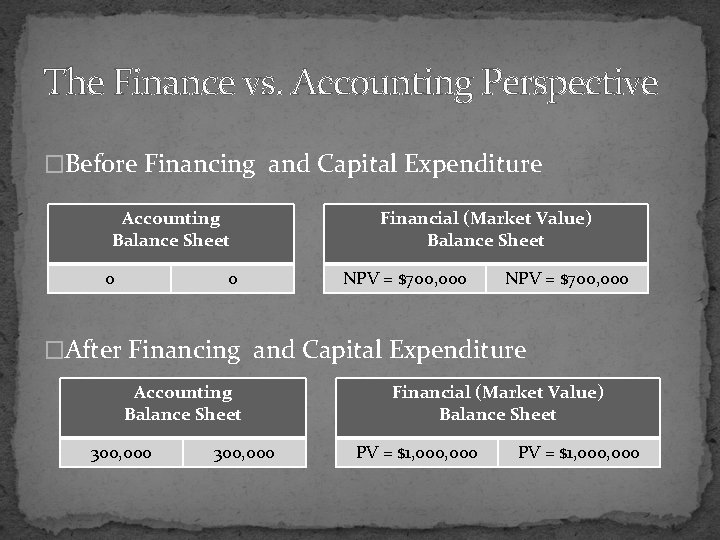
The Finance vs. Accounting Perspective �Before Financing and Capital Expenditure Accounting Balance Sheet 0 0 Financial (Market Value) Balance Sheet NPV = $700, 000 �After Financing and Capital Expenditure Accounting Balance Sheet 300, 000 Financial (Market Value) Balance Sheet PV = $1, 000, 000
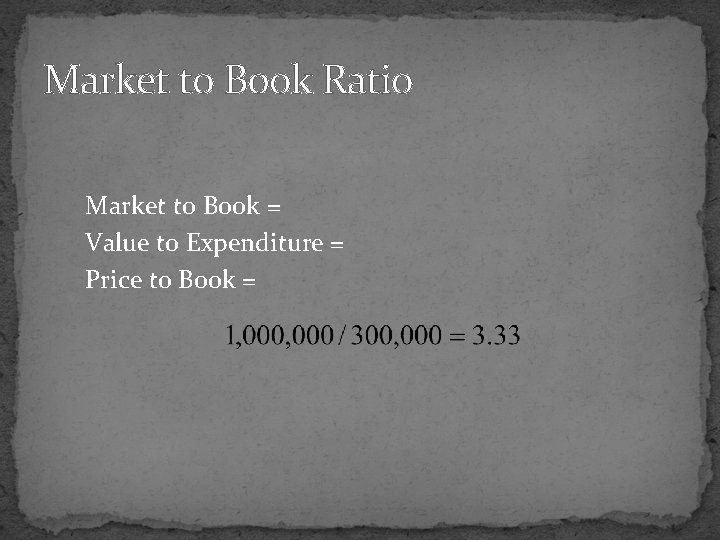
Market to Book Ratio Market to Book = Value to Expenditure = Price to Book =