
Introduction Chapter 1 Definition Globalization or globalisation is
Introduction Chapter 1
Definition ¥Globalization (or globalisation) is a term used to describe the changes in societies and the world economy that are the result of dramatically increased international trade and cultural exchange. In specifically economic contexts, it is often understood to refer almost exclusively to the effects of trade, particularly trade liberalization or "free trade“.

¥Economic globalization — there are four aspects to economic globalization, referring to four different flows across boundaries, namely flows of goods/services, i. e. 'free trade' (or at least freer trade), flows of people (migration), of capital and of technology.
Definitions ¥WHAT: The process of the economy becoming worldwide, more integrated and highly interdependent. ¥WHY: 1. Political: unification & socialization of global community; PTA, reduction of trade barriers, collapse of communism, controls reduced 2. Technology: advancement in comm. & transportation 3. Market: rise of East Asia 4. Cost and 5. Competition: privatization

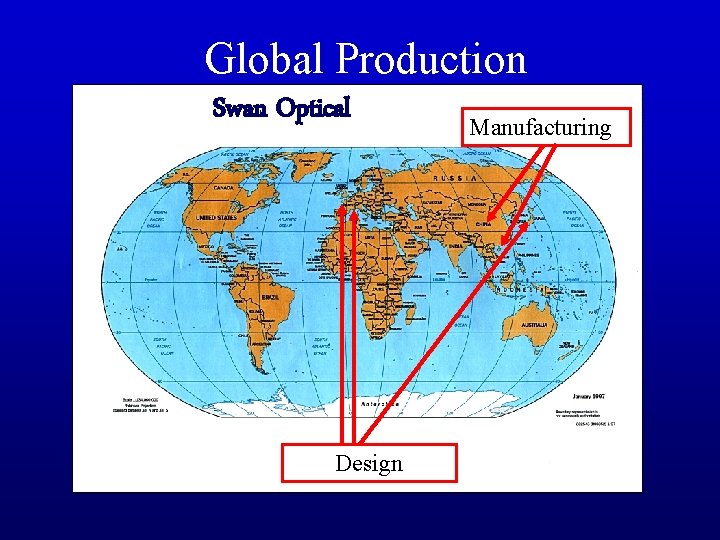
Components of globalizations ¥The globalization of markets. ¥The globalization of production.
Globalization of Markets
Global Production Swan Optical Design Manufacturing
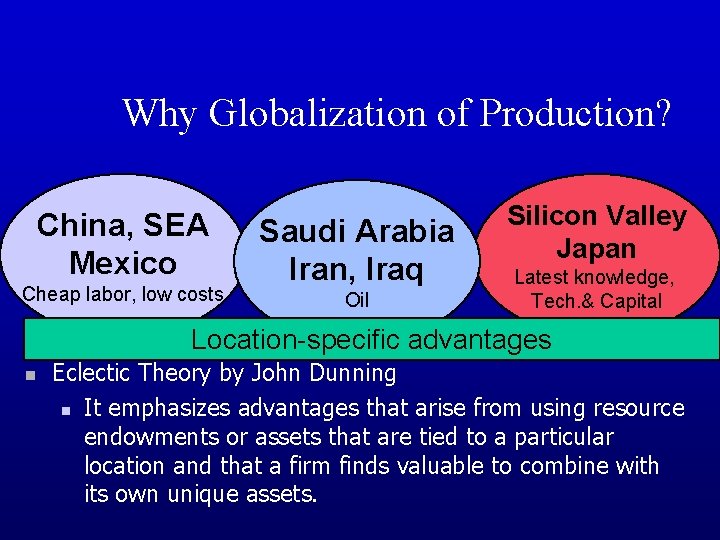
Why Globalization of Production? China, SEA Mexico Cheap labor, low costs Saudi Arabia Iran, Iraq Oil Silicon Valley Japan Latest knowledge, Tech. & Capital Location-specific advantages n Eclectic Theory by John Dunning n It emphasizes advantages that arise from using resource endowments or assets that are tied to a particular location and that a firm finds valuable to combine with its own unique assets.
Globalization - Pro ¥Lower prices for goods and services. ¥Economic growth stimulation. ¥Increase in consumer income. ¥Creates jobs. ¤Countries specialize in production of goods and services that are produced most efficiently.
Globalization - Con ¥Destroys manufacturing jobs in wealthy, advanced countries. ¥Wage rates of unskilled workers in advanced countries declines. ¥Companies move to countries with fewer labor and environment regulations. ¥Loss of sovereignty.
Foreign Direct Investment ¥FDI occurs when a firm invests directly in facilities to produce and/or market a product in a foreign country. ¥FDI is not the investment by individuals, firms or public bodies in foreign financial instruments.
What is FDI? ¥A company buying a firm in a different country. ¥A firm creating a ‘greenfield’ operation in a different country. ¥A firm creating a subsidiary in a different country. ¥Also: ¤The firm has significant control of its foreign operation. ¤Firm can affect managerial decisions of the foreign operation.
MNCs, MNEs and TNCs ¥A multinational corporation (MNC) or multinational enterprise (MNE) or transnational corporation (TNC) is one that spans multiple nations; these corporations are often very large. Such companies have offices, factories or branch plants in different countries. They usually have a centralised head office where they coordinate global management.
¥Very large multinationals have budgets that exceed those of many countries. Countries often offer incentive to MNC, such as tax breaks or lax environmental standards, in order to attract MNC into their country. They can be seen as a power in global politics. ¥Multinationals often make use of subcontractors to produce certain goods for them. ¥The first multinational, appearing in 1602, was the Dutch East India Company.
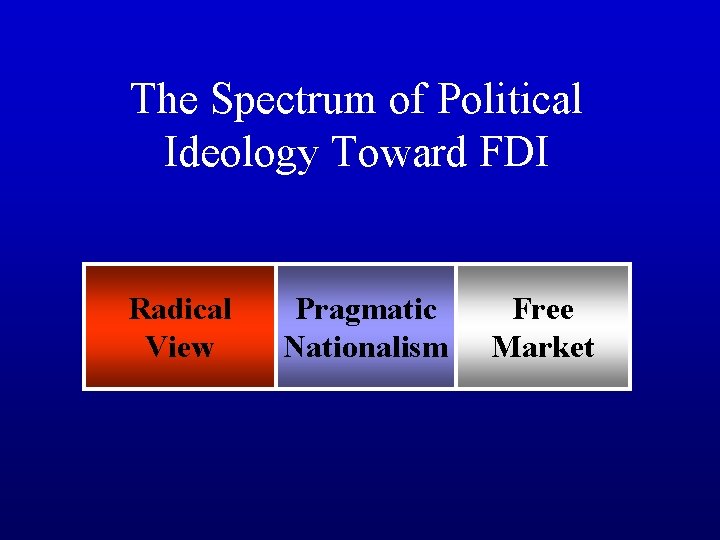
The Spectrum of Political Ideology Toward FDI Radical View Pragmatic Nationalism Free Market
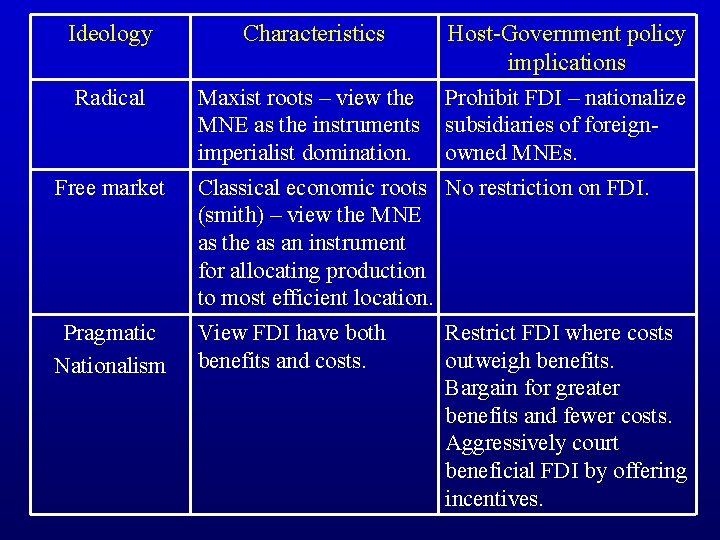
Ideology Radical Free market Pragmatic Nationalism Characteristics Host-Government policy implications Maxist roots – view the Prohibit FDI – nationalize MNE as the instruments subsidiaries of foreignimperialist domination. owned MNEs. Classical economic roots No restriction on FDI. (smith) – view the MNE as the as an instrument for allocating production to most efficient location. View FDI have both Restrict FDI where costs benefits and costs. outweigh benefits. Bargain for greater benefits and fewer costs. Aggressively court beneficial FDI by offering incentives.
Radical View ¥Marxist view is that MNE’s enslave less developed countries. ¤Instrument of domination not development. ¥Popular from WWII to the 1980 s. ¤Practiced by Eastern Europe, India, China, 3 rd World Countries. ¥Ended with the collapse of Communism. ¤Bad performance by those countries vs those with freer market approach
Free Market View ¥Sees FDI as way to disperse production and flow of goods and services in the most efficient manner. ¤Supported by Smith and Ricardo and ‘market imperfection’ explanations of FDI. ¥However, all countries impose some restrictions on FDI.
Pragmatic View ¥Lies some where between radical and free market view. ¥Government should maximize national benefits and minimize costs of FDI.
Why FDI? . . . more in theory ¥Bypass protectionist pressures/trade barriers ¥Globalization of the world’s economy ¥Proximity to major customers ¥Transportation costs ¥Following competitors – Oligopoly ¥Product life cycle (Market saturation) ¥Location specific advantage ¥Exchange rate
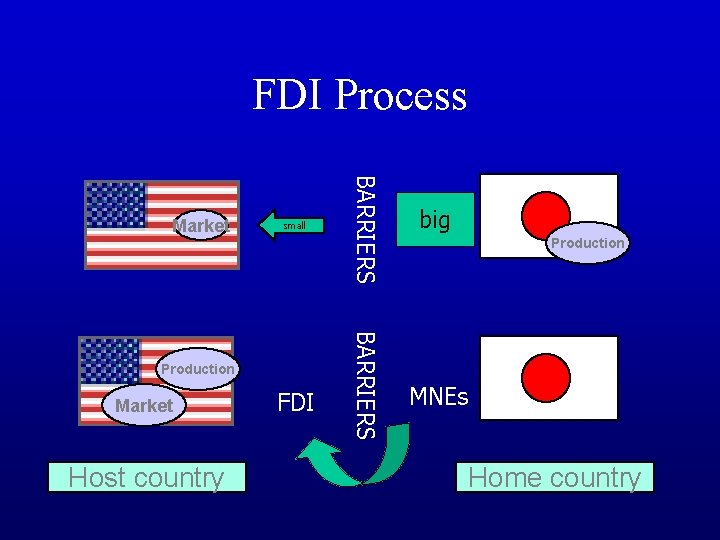
FDI Process Production Market Host country FDI big BARRIERS small BARRIERS Market MNEs Production Home country
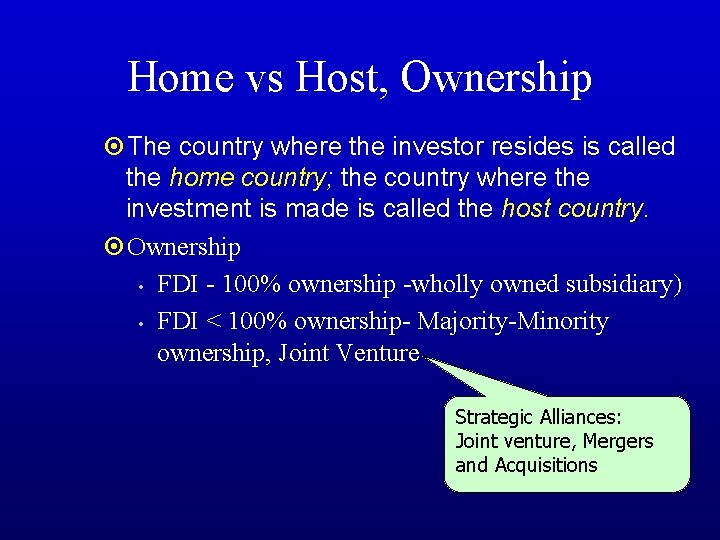
Home vs Host, Ownership ¤The country where the investor resides is called the home country; the country where the investment is made is called the host country. ¤Ownership • FDI - 100% ownership -wholly owned subsidiary) • FDI < 100% ownership- Majority-Minority ownership, Joint Venture Strategic Alliances: Joint venture, Mergers and Acquisitions
Mode of Entry ¥Purchase existing assets in a foreign country. ¥Make new investment in property, plant & equipment in a foreign country. ¥Participate in a joint venture with a local partner in a foreign country.
FDI Outflows 1982 -1998
Growth of FDI, World Trade and World Output
Why is FDI Growing More Rapidly Than WT or WO? ¥Can circumvent future trade barriers. ¥World political and economic change. ¤Democratization of markets. ¥Globalization of world markets.
FDI Inflows 1991 - 1997
Two Forms of FDI ¥Horizontal Direct Investment ¥Vertical Direct Investment
Horizontal Direct Investment ¥FDI in the same industry abroad as company operates at home.
HDI, When and Why? ¥Transportation too costly? ¥Most cited: Market Imperfections (Internalization Theory). ¤Impediments to the free flow of products between nations. ¥Follow the lead of a competitor - strategic rivalry. ¥Location specific advantages (natural resources).
Vertical Direct Investment ¥Backward - investments into industry that provides inputs into a firm’s domestic production (typically extractive industries). ¥Forward - investment in an industry that utilizes the outputs from a firm’s domestic production (typically sales and distribution).
VDI, When and Why? ¥Market power? ¤create entry barriers. ¤erode entry barriers. ¥Market imperfections. ¤impediment to the sale of know-how. ¤Investments in specialized assets.
Benefits of FDI to Host Countries ¥Resource-transfer effects. ¥Employment effect. ¥Balance-of-payments effect. ¥Economic growth.
Resource-Transfer Effects ¥Capital. ¥Technology. ¥Management.

Employment Effects ¥Brings jobs that otherwise would not be created. ¤Direct: Hiring host-country citizens. ¤Indirect: • Jobs created by local suppliers. • Jobs created by increased spending by employees of the multi-national enterprise. ¥Questions remain on whether net jobs gained.
Balance-of-Payments Effects ¥Host country benefits from initial capital inflow when MNE establishes business. ¤Host country records current account debit on repatriated earnings of MNE. ¥Host country benefits if FDI substitutes for imports of goods and services. ¥Host country benefits when MNE uses its foreign subsidiary to export to other countries.
Economic Growth ¥Increased: ¤productivity growth, ¤product and process innovation, ¤and greater economic growth, Stemming from increased competition of MNE’s investments.
Host Country Problems With FDI ¥Drives out local competitors. ¥Can prevent the development of ‘local’ competitors. ¥Profits brought home ‘hurts’ (debit) a host’s capital account. ¥Parts imported for assembly hurt trade balance. ¥Can affect sovereignty and national defense.
Home Country FDI Benefits ¥Improves balance of payments for inward flow of foreign earnings. ¥Creates a demand for exports. ¤Export demand can create jobs. ¥Increased knowledge from operating in a foreign environment. ¥Benefits the consumer through lower prices. ¥Frees up employees and resources for higher value activities.
Home Country Problems with FDI ¥Negative effect on Balance of Payments ¤Initial capital outflow. ¤MNE uses foreign subsidiary sell back to home market. ¤MNE uses foreign subsidiary a substitute for direct exports. ¥Potential loss of jobs. to as
How Do Countries Encourage FDI? ¥Risk insurance. (Home) ¥Elimination of double taxation. (Home) ¥Tax incentives. (Host) ¥Low interest rates. (Host) ¥Stable government and stable policies.
How Do Countries Discourage FDI? ¥Limit capital outflows. (Home) ¥Manipulate tax code to encourage domestic investment. (Home) ¥Political restrictions on investing in certain countries. (Home) ¥Ownership restraints. (Host) ¥Performance requirements. (Host)
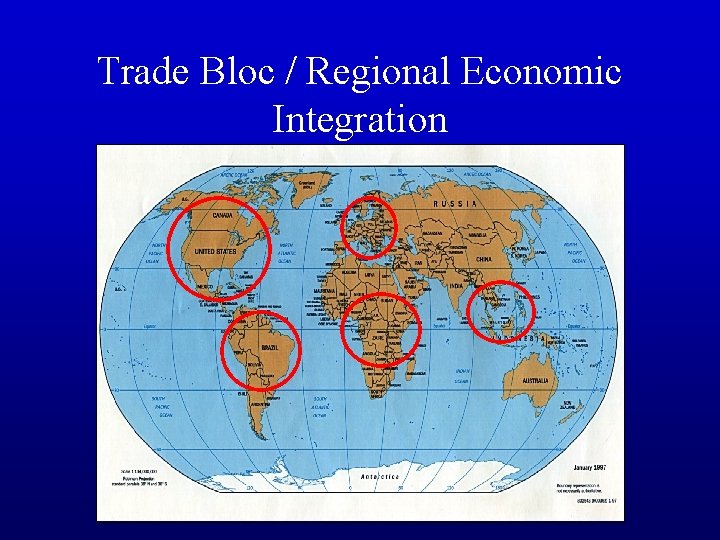
Trade Bloc / Regional Economic Integration
Regional Economic Integration ¥Agreements among countries in a geographic region to reduce, and ultimately remove, tariff and nontariff barriers to the free flow of goods, services and factors of production among each other.
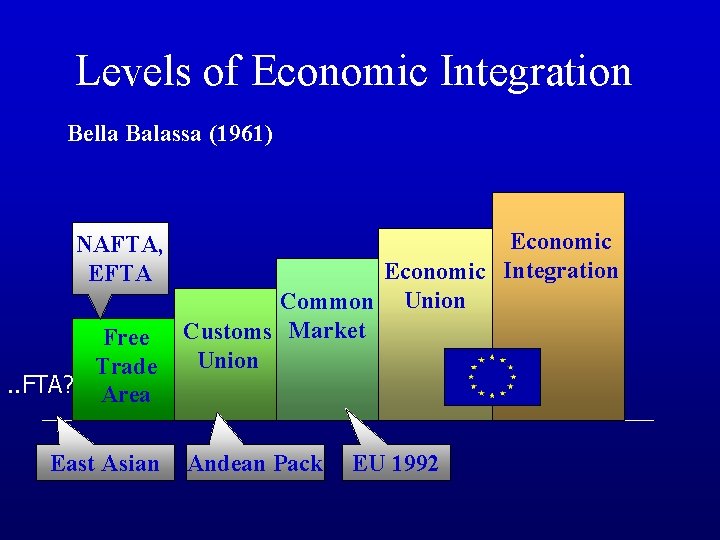
Levels of Economic Integration Bella Balassa (1961) NAFTA, EFTA Free Trade. . FTA? Area East Asian Economic Integration Common Union Customs Market Union Andean Pack EU 1992
Preferential Trading Area ¥This is a trading bloc which gives preferential access to certain products from certain countries. This is done by reducing tariffs, but does not abolish them completely. ¥An example of a preferential trading area is one formed by the EU and the ACP countries.
Free Trade Area ¥A free trade area is a designate group of countries that have agreed to eliminate tariffs, quotas and preferences on most goods between them. Unlike a customs union, members of a free trade area do not have the same policies with respect to nonmembers. ¥AFTA, NAFTA, FTAA & etc.
Custom Union ¥A customs union is a free trade zone with a Common External Tariff. Purposes for establishing a customs union normally include increasing economic efficiency and establishing closer political and cultural ties between the member countries. ¥EU-Turkey Customs Union & Southern African Customs Union.
Common Market ¥A common market is a customs union with common policies on product regulation, and freedom of movement of all the factors of production (goods, services, capital and labour). ¥European Community (EC) & European Economic Area (EEA).
Economic Union ¥An economic union is a single market with a common currency. It is to be distinguished from a mere currency union (e. g. the Latin Monetary Union in the 1800 s), which does not involve a single market.
Complete Economic Integration ¥This is the final stage of economic intergration. Nations embark on the harmonisation of economic policies, and tends to be the development of a supranational state, making decisions on behalf of member governments. ¥An example of this is the UK, where there is full intergration between England, Scotland, Wales, and Northern Ireland.
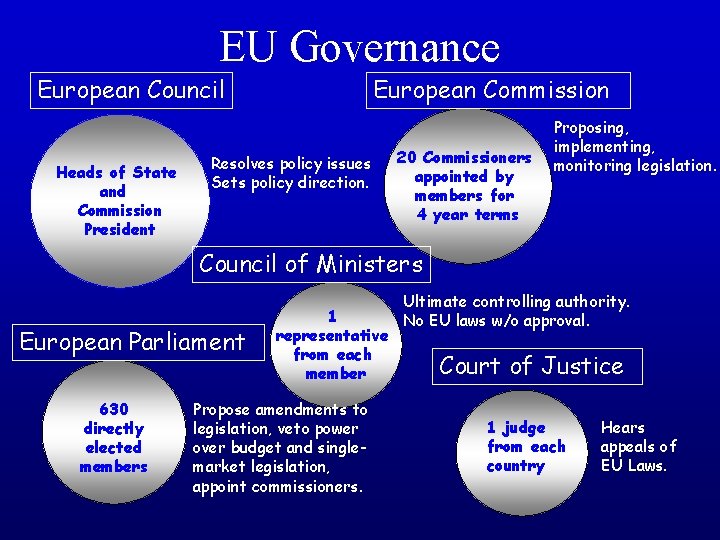
EU Governance European Council Heads of State and Commission President European Commission Resolves policy issues Sets policy direction. 20 Commissioners appointed by members for 4 year terms Proposing, implementing, monitoring legislation. Council of Ministers European Parliament 630 directly elected members 1 representative from each member Propose amendments to legislation, veto power over budget and singlemarket legislation, appoint commissioners. Ultimate controlling authority. No EU laws w/o approval. Court of Justice 1 judge from each country Hears appeals of EU Laws.
North American Free Trade Agreement ¥Became law: January 1, 1994 ¥Over 15 year period: ¤tariffs reduced (99% of goods traded) ¤NTBs reduced ¤investment opportunities increased ¥Protects intellectual property ¥Applies national environmental standards ¥Special treatment for many industries
ANCOM: Andean Pact ¥Bolivia, Colombia, Ecuador, Peru, Venezuela ¥Cartagana Agreement, 1969. One of oldest still in existence ¥Population: 97 mm (14% of hemisphere) ¥GNP: $122. 6 billion ¥Changed from FTA to customs union in 1992
The Mercosur Accord ¥ 1988: Argentina, Brazil. 1990: Paraguay, Uruguay ¥ 1995: Agreed to move toward a full customs union. ¥Population: 209 mm (27% of hemisphere) ¥GNP: $656. 6 billion (8% of hemisphere) ¥Trade doubled in first 3 years
Association of Southeast Asian Nations ¥Created in 1967 ¥ 400 million citizens ¥Economic, political and social cooperation ¥Brunei, Indonesia, Malaysia, the Philippines, Singapore, Thailand, Laos, Cambodia, Myanmar and Vietnam.
Impediments to Regional Integration ¥Groups within countries may be hurt. ¥Potential loss of sovereignty and control over domestic issues. ¥Debate: ¤Integration is trade creation? ¤Integration is trade diversion?
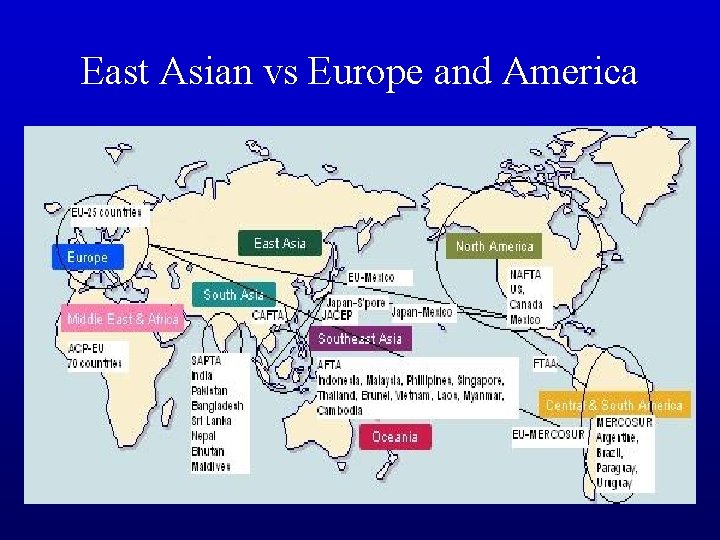
East Asian vs Europe and America
Chapter 3 Asian Financial Crisis
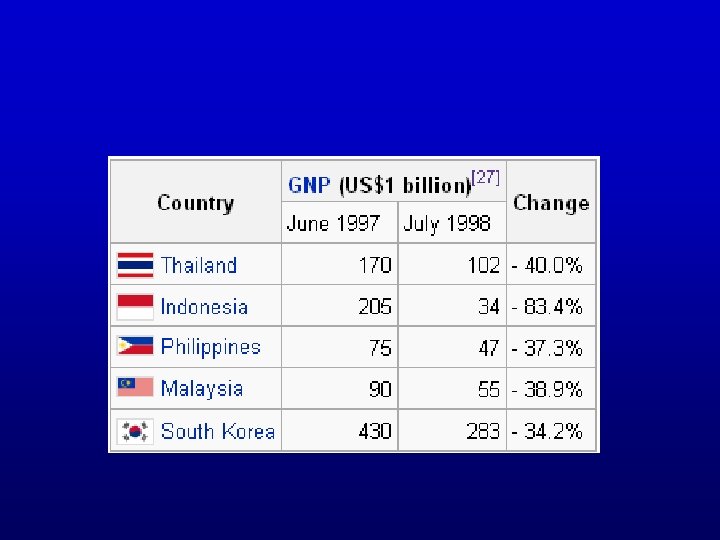
Overview ¥July 1997. ¥Started in Thailand – ¤Burden external debt. ¤May 1997, Baht hit by massive speculative attack - no devaluate the Baht. ¤Float the baht, cutting its peg to the US$.
Why? ¥The Investment Boom ¥Excess Capacity ¥The Debt Boom
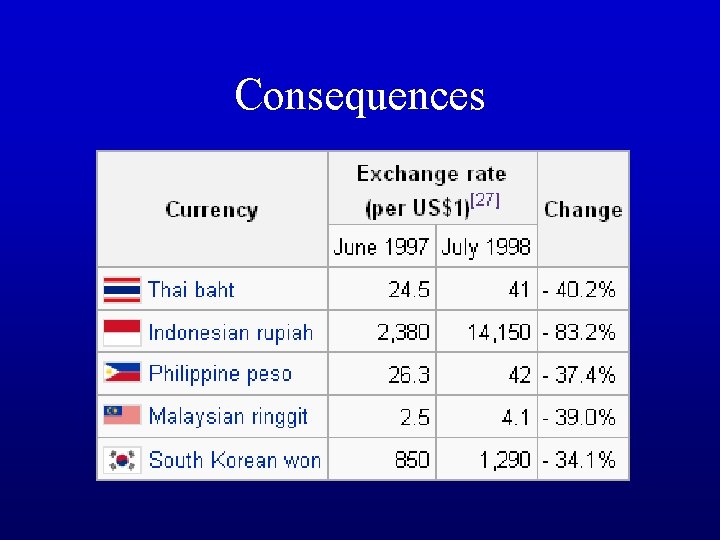
Consequences
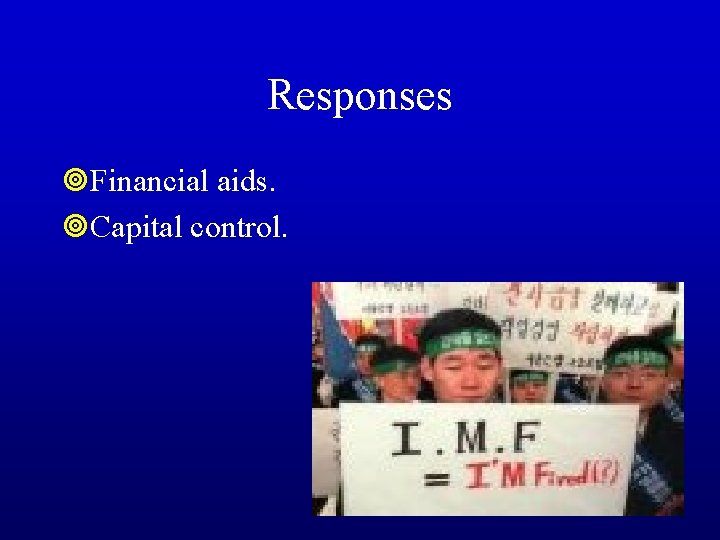
Responses ¥Financial aids. ¥Capital control.
- Slides: 66