
Introduction Chapter 1 1 Risk vs Return l

- Slides: 17
Introduction Chapter 1 1
Risk vs Return l l There is a trade off between risk and expected return The higher the risk, the higher the expected return 2
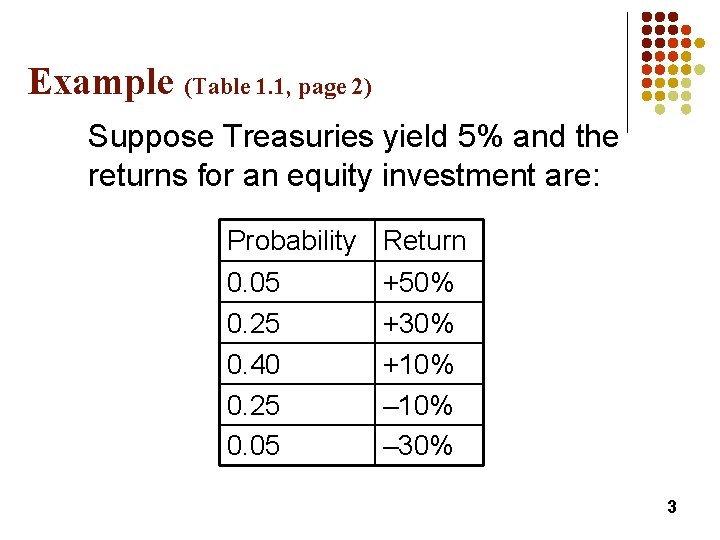
Example (Table 1. 1, page 2) Suppose Treasuries yield 5% and the returns for an equity investment are: Probability 0. 05 0. 25 0. 40 0. 25 0. 05 Return +50% +30% +10% – 30% 3
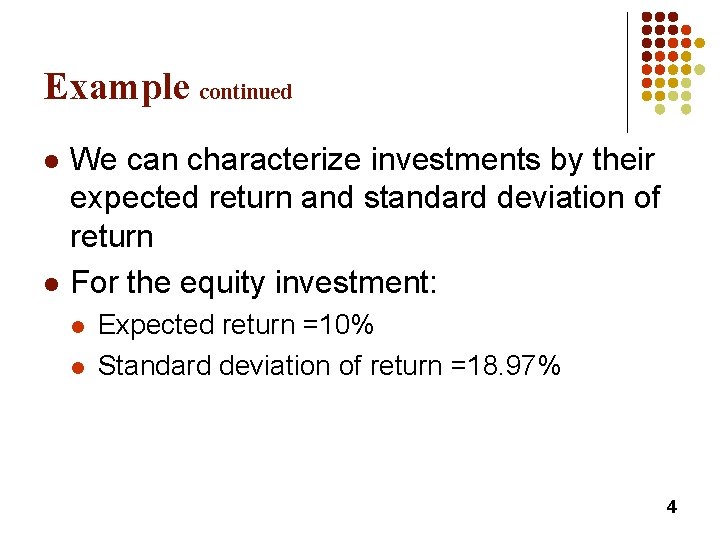
Example continued l l We can characterize investments by their expected return and standard deviation of return For the equity investment: l l Expected return =10% Standard deviation of return =18. 97% 4
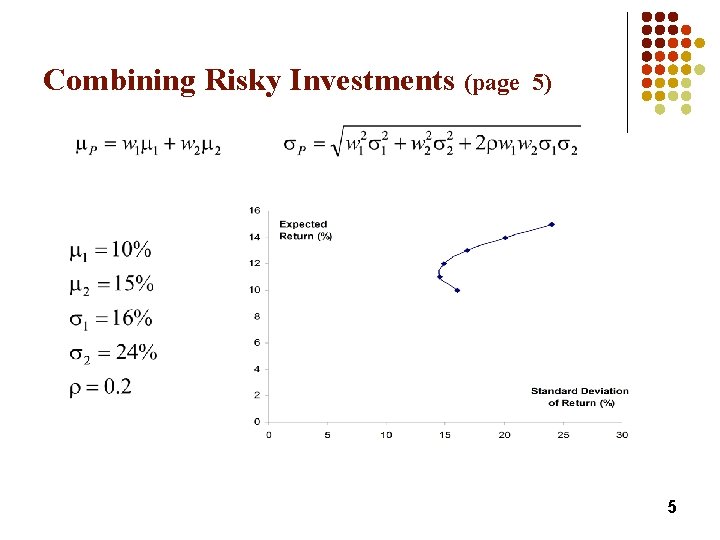
Combining Risky Investments (page 5) 5
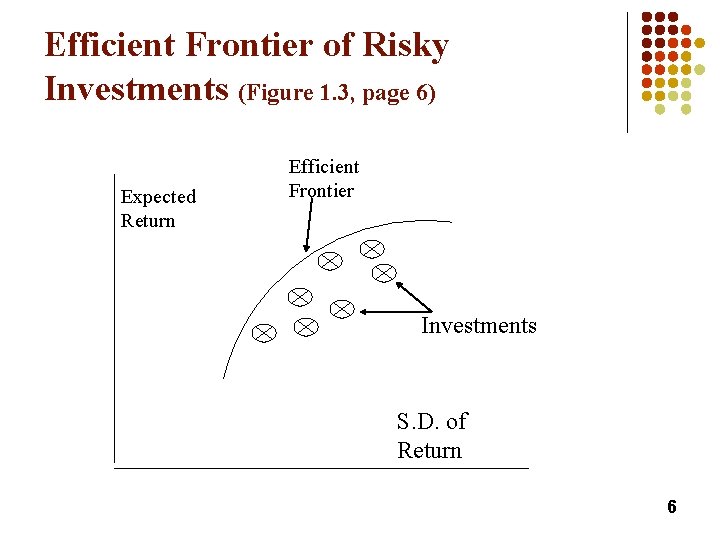
Efficient Frontier of Risky Investments (Figure 1. 3, page 6) Expected Return Efficient Frontier Investments S. D. of Return 6
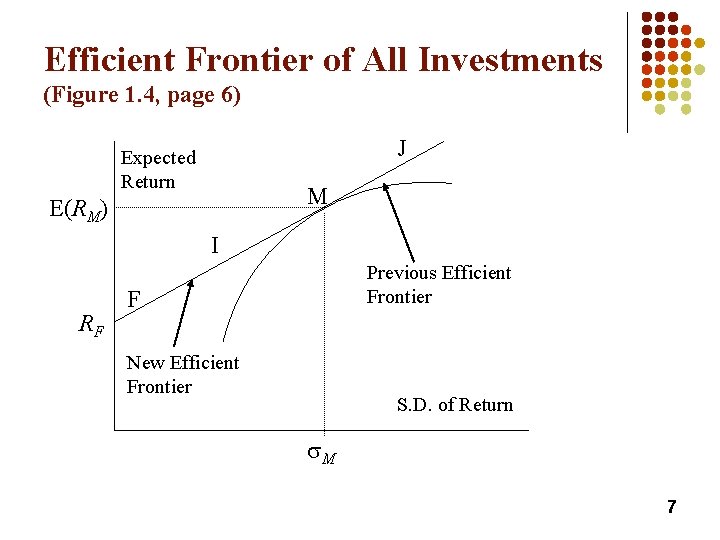
Efficient Frontier of All Investments (Figure 1. 4, page 6) J Expected Return M E(RM) I RF Previous Efficient Frontier F New Efficient Frontier S. D. of Return s. M 7
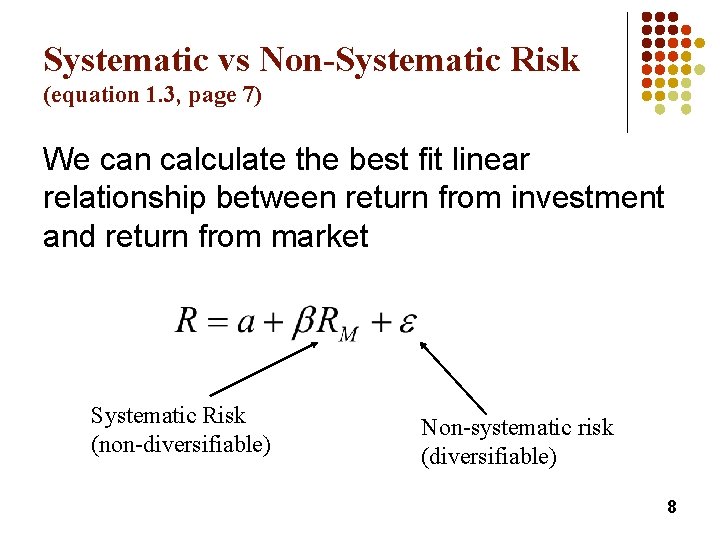
Systematic vs Non-Systematic Risk (equation 1. 3, page 7) We can calculate the best fit linear relationship between return from investment and return from market Systematic Risk (non-diversifiable) Non-systematic risk (diversifiable) 8
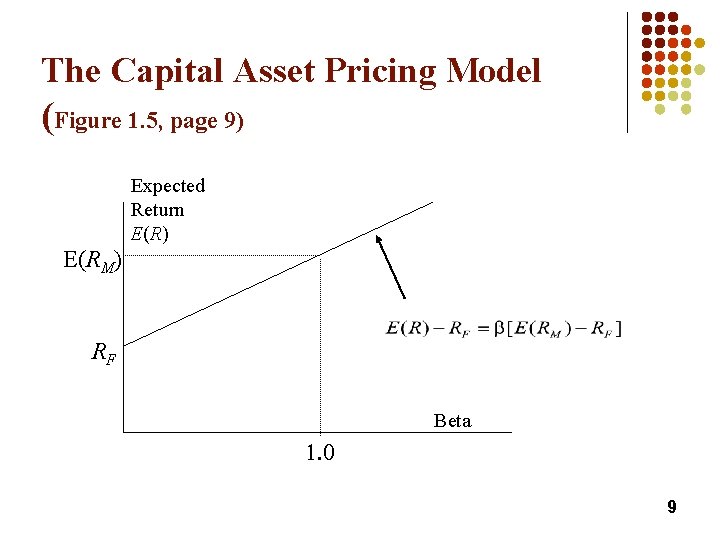
The Capital Asset Pricing Model (Figure 1. 5, page 9) Expected Return E(R) E(RM) RF Beta 1. 0 9
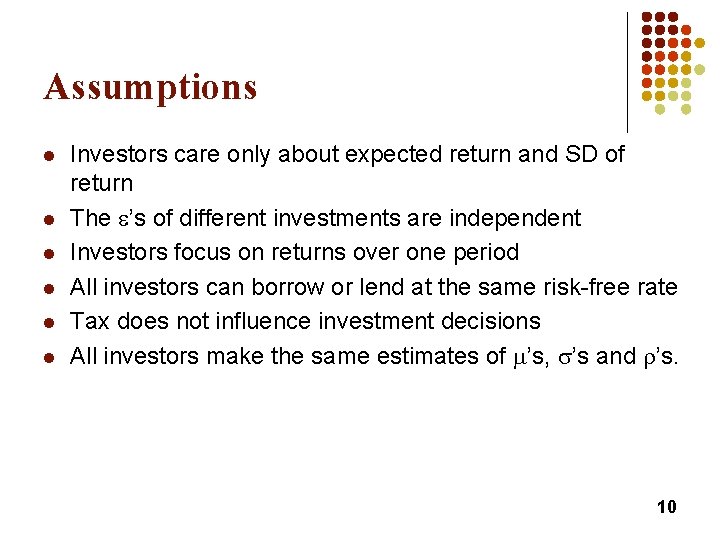
Assumptions l l l Investors care only about expected return and SD of return The e’s of different investments are independent Investors focus on returns over one period All investors can borrow or lend at the same risk-free rate Tax does not influence investment decisions All investors make the same estimates of m’s, s’s and r’s. 10
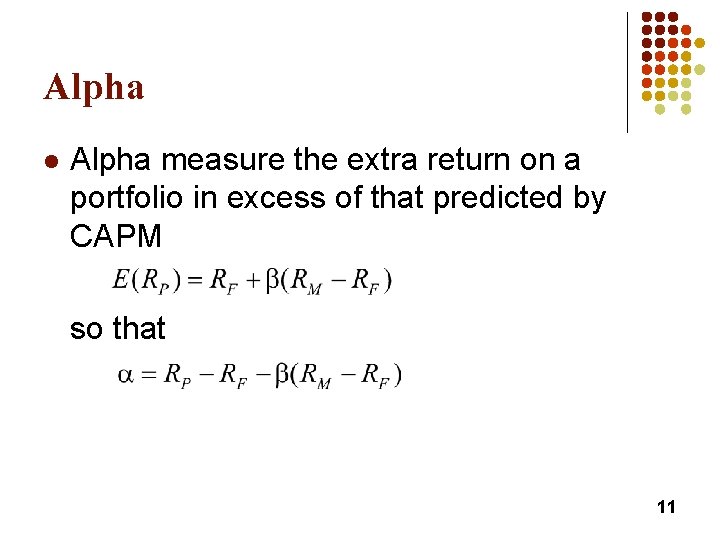
Alpha l Alpha measure the extra return on a portfolio in excess of that predicted by CAPM so that 11
Arbitrage Pricing Theory l l l Returns depend on several factors We can form portfolios to eliminate the dependence on the factors This leads to result that expected return is linearly dependent on the realization of the factors 12
Risk vs Return for Companies l l If shareholders care only about systematic risk, should the same be true of company managers? In practice companies are concerned about total risk Earnings stability and company survival are important managerial objectives “Bankruptcy costs” arguments show that managers are acting in the best interests of shareholders when they consider total risk 13
What Are Bankruptcy Costs? (Business Snapshot 1. 1, page 15) l l l Lost sales (There is a reluctance to buy from a bankrupt company. ) Key employees leave Legal and accounting costs 14
Approaches to Bank Risk Management l l l Risk aggregation: aims to get rid of nonsystematic risks with diversification Risk decomposition: tackles risks one by one In practice banks use both approaches 15
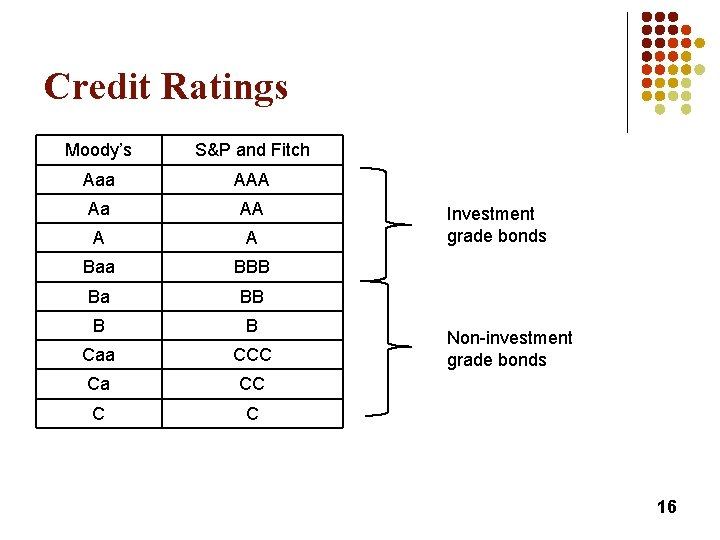
Credit Ratings Moody’s S&P and Fitch Aaa AAA Aa AA A A Baa BBB Ba BB B B Caa CCC Ca CC C C Investment grade bonds Non-investment grade bonds 16
Subdivisions l l l Moody’s divides Aa into Aa 1, Aa 2, Aa 3. S&P and Fitch divide AA into AA+, AA, and AA− Other rating categories are subdivided similarly except AAA (Aaa) and the two lowest categories. 17