
Introduction Chapter 1 1 Prelude Some theories that


- Slides: 51
Introduction Chapter 1 1
Prelude • Some theories that arise in a special field, because of their deep insight and analytical power, become the foundation of much broader fields. • Newtonian mechanics, initially developed to understand the movements of several planets, eventually exert dominant influence over physics, biology, economics and finance.
• General equilibrium theory is theoretical foundation of the mainstream economics. • Originated by Leon Walras in 1870 s, it was inspired by Newtonian mechanics.
General background • Financial engineering is often regarded as a technical and narrow field • But derivative securities have played increasingly prominent roles in the financial market. • The ideas originated from derivative theories have become more and more important in corporate finance and investment theory.
• The following quote from Fischer Black, the main founder of financial engineering, may give us an impression on the potential scope of theory.
Quote from Fischer Black • I like the beauty and symmetry in Mr. Treynor’s equilibrium models so much that I started designing them myself. I worked on models in several areas: • Monetary theory • Business cycles • Options and warrants • For 20 years, I have been struggling to show people the beauty in these models to pass on knowledge I received from Mr. Treynor. • • In monetary theory --- theory of how money is related to economic activity --- I am still struggling. In business cycle theory --- theory of fluctuation in the economy -- I am still struggling. In options and warrants, though, people see the beauty. (p. 93)
• Fischer Black and the Revolutionary Idea of Finance by Perry Mehrling • Why Mehrling, a monetary economist, wrote a biography of Black, whose main recognized contributions are in financial derivatives? • He found Black’s idea is very important to many different areas in economics.
• Since the seminal work of Black and Scholes, the option theory, starting as a “derivative” theory on shares and other securities, has been applied to many different areas.
• In this course, we will show that the option theory that Black and others pioneered has much broader impacts. • Develop a general theory of economics inspired by the option theory • Present a new monetary theory and business cycle theory by extending the ideas of Fischer Black.
• The theory of financial engineering will become the foundation of finance, economics, and biology. The Black. Scholes based theory will fundamentally change the way we understand the world, which has been dominated by the Newtonian theory for several hundred years.
Why? • Newtonian mechanics is about individual particles. • Many particle problems are discussed and resolved in thermodynamics • Black-Scholes equation, the fundamental equation in financial engineering, is a thermodynamic equation, or inverse thermodynamics equation • We will get to the details later.
The Nature of Derivatives A derivative is an instrument whose value depends on the values of other more basic underlying variables. Or A derivative is an instrument whose value is a function the values of other more basic underlying variables
Examples of Derivatives • • Forward Contracts Futures Contracts Swaps Options
Futures contracts • Suppose that in October 2017 a company took a long position in ten contracts on June 2018 crude oil futures. It closed out its position in February 2018. The futures price (per barrel) was 44. 32 when it entered into the contract, 62. 18 when it closed out its position. One contract was for the delivery of 1, 000 barrels. What is the company’s total profit? If the margin of one contract is 3100 USD, what is the rate of return on this investment?
Solution • • The profit is (62. 18 -44. 32)*1000*10 = 178600 dollars The total margin is 3100*10 = 31000 dollars The rate of return is 178600/31000 = 5. 76 = 576% Note that we don’t need to minus one in calculation as margin is not a cost.
Derivative use and financial crisis • Mortgage backed securities: Complex derivatives difficult to value – Prepayment risk: Usually occur at low interest rate environment, when rate of return for reinvestment is low. – Default risk: The probability of default. Are credit rating companies, such as Moody’s and S&P reliable? – Regulation risk: Will governments bail out the mortgage securities?
• MBS enables the dramatic increase of mortgage businesses for financial institutions. • It increases the building of houses. • This is an example how financial instruments affect real economic activities.
Derivative use and financial crisis • CDS (Credit Default Swap) – Measured by the spread from risk free bonds – Provide a natural tool to bet on bond yields – AIG CDS bailout and payments • • Goldman Sachs: 12. 9 billion Societe Generale; 11. 9 billion Deutsche Bank: 11. 8 billion http: //www. reuters. com/article/2009/03/18/us-aiggoldmansachs-sb-id. USTRE 52 H 0 B 520090318 – The large positions show that these banks were confident about the impending collapse of the mortgage market and take advantages of it.
CDS example • A bank enters into a credit default swap with a highly rated insurance company. The notional amount of the swap is $50 million. The 10 -year swap is based on a 10 -year loan to XYZ Corp. The size of the protection payment is 3. 00% per year. •
• How much does the bank pay the insurance company for each year the swap is in place? – If XYZ does not suffer a credit event, how much does the insurance company pay the bank over the 10 -year life of the swap? – Assume that XYZ goes bankrupt before the swap matures and the recovery value on the underlying loan is 40%. How much does the insurance company owe the bank?
– An investor observed the weakness of XYZ and bought the same CDS from the insurance company with the notional value of 100 million. After paying CDS premium for one year, XYZ goes bankrupt, with the recovery rate on the loan of 40%. How much does the insurance company pay this investor? What is the rate of return for this investor?
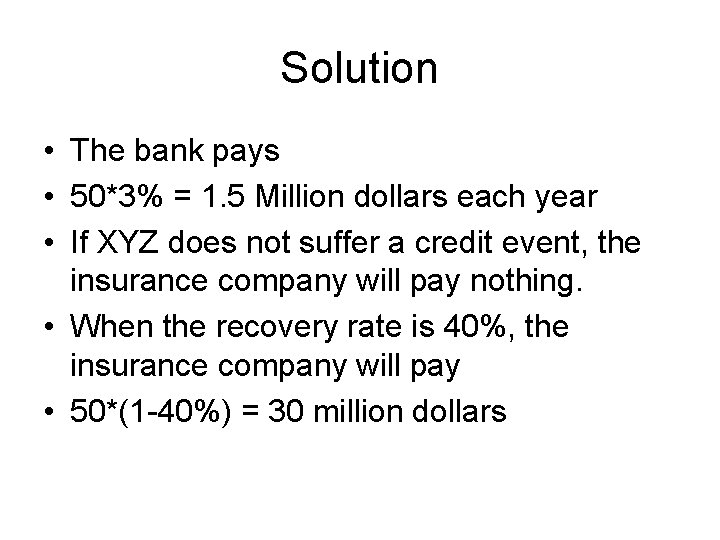
Solution • The bank pays • 50*3% = 1. 5 Million dollars each year • If XYZ does not suffer a credit event, the insurance company will pay nothing. • When the recovery rate is 40%, the insurance company will pay • 50*(1 -40%) = 30 million dollars
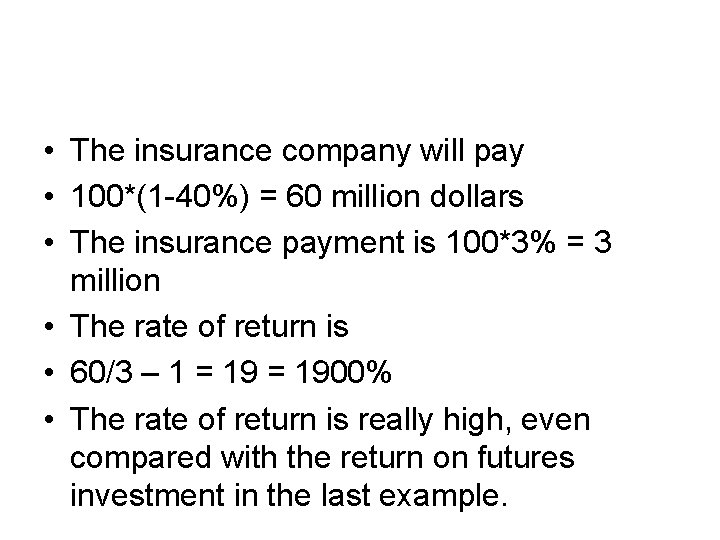
• The insurance company will pay • 100*(1 -40%) = 60 million dollars • The insurance payment is 100*3% = 3 million • The rate of return is • 60/3 – 1 = 1900% • The rate of return is really high, even compared with the return on futures investment in the last example.
Discussion • The story of Michael Burry from The Big Short by Michael Lewis • Michael Burry tried to find a financial instrument to short against the mortgage bond market. CDS on mortgage bonds were created to satisfy the need.
Notes about Michael Burry. • His son was diagnosed with autism. He realized he himself has autism as well. Yet his lack of contact with others made him very independent in making assessment of the world. • Should we consider autism a disease?
The advantages of derivative trading • Derivative securities are very flexible. They can be designed to take advantages of any scenarios.
What can we get out of this • Historically, destructive forces precede constructive forces • Guns precede internal combustion engines • Nuclear bombs precede nuclear reactors • Oxygen as a poison precedes oxygen as an energy source • How about derivative securities? • One purpose of this course is to develop theories that can be used constructively to understand broad economic activities.
Derivatives in a broader sense • Insurance policy function of age, job, health condition, amount to insure – GEICO • Share price function of assets, revenue, profit, interest rate, competitors, pension liability – Jack Treynor, one of the earliest to point out the importance of pension liability
Derivatives in a broader sense (Continued) • Bank loans – Change of value of mortgaged assets. – Maturity of loans • The ability to value different businesses in a unified framework eased the integration of different types of financial institutions – Citigroup • Travelers • Salomon Brothers • Citi. Bank
Derivatives in a broader sense (Continued • Profit of a ski resort – Snow condition, general economic condition • Value of production investment – Influenced by fixed cost investment, discount rate, level of uncertainty duration of projects, market size and competition. • Total economic activities – Influenced by central bank interest rate, tax rates, regulatory policies, education policies, lifespan of residents, population size, level of uncertainty and competition.
• Choice of education – Amount of state subsidy – Salary upon graduation and growth rate – Stability of career – Length of working years – Retirement benefit – Availability and interest rate of student loans
History of Derivative markets • Metal coins – Content of precious metal – Value of metal coins – Gradual debasing of metal coins • Paper currency: Song dynasty – In Sichuan Province of China lacking bronze, iron was used to make coins, which was very heavy – Paper money start to circulate – Trust is the key to paper currency
History of Derivative markets (Continued) • Modern paper currency – 1945 Brenton Wood system – 35 USD equals 1 ounce of gold • Today’s gold price? – Breakdown at 1970, when Nixon closed the exchange window. – Is it feasible to return to the gold standard? • Quantitative easing, asset inflation and redistribution of wealth
History of Derivative markets (Continued) • Rice futures in Japan – Speculation in spot and futures market – The inherent instability of a small market, Japan as an island nation. – The impacts of islands to the world history, England, Japan, pacific islands. • Chicago – Farmers and merchants • OTC markets
Derivatives Markets • Exchange traded – Traditionally exchanges have used the open-outcry system, but increasingly they are switching to electronic trading – Contracts are standard there is virtually no credit risk – Example of default: HKFE in October, 1987
Derivatives Markets (Continued) • Over-the-counter (OTC) – A computer- and telephone-linked network of dealers at financial institutions, corporations, and fund managers – Contracts can be non-standard – credit risk, especially during crises • In 1998, US federal reserve organized rescue of LTCM, helping it unwind many contracts • In 2008, US government bailed out many contracts, such as AIG’s CDS contracts. • Discussion: If federal reserve didn’t rescue LTCM in 1998, will 2008 financial crisis occur at the same magnitude? – Much bigger than exchange based market
Ways Derivatives are Used • To hedge risks – Commodity producers and large commodity consumers, such as airliners – Pro and con of hedging – Some of the largest losses are due to hedging. How? Mismatach of maturity and other properties
Some examples • A German oil supply company signed fixed price contracts with many clients. To hedge risk, it long futures contracts. Later oil prices dropped, which generates massive margin call. But oil supply contracts are long term, which do not provide immediate large cash inflows. What happened next? • The company closed the futures contract at huge loss. Then it exposed huge risk of the rise of oil prices. So it canceled all the hugely valuable long term oil supply contracts with its clients, free of charge. • Reason behind this failure: Conflict between the management of Deutsche Bank, the majority owner, and management of the oil supply company
Some examples (Continued) • In 2008, at the peak of oil price, many Chinese airlines bought massive oil futures. At that time, it was widely circulated that Chinese companies bought over 90% of the oil futures world wide. – Results: Many Chinese airlines posted record loss in 2009 • Goldcorp http: //www. goldcorp. com/ – It used to hedge all its gold production. As gold prices rise relentlessly, its profit was flat. In the end, it closed all its short positions in gold futures at huge cost. – In its company slide show: 100% unhedged gold production • New consensus: In most cases, more harm than benefit in hedging
A numerical example • An oil supply company signed fixed price contracts with many clients. The current spot price of oil is 40 dollar per barrel. The oil supply company will sell 50 dollar per barrel to its clients. To hedge risk, it long 10, 000 futures contracts. Each contract represent 1000 barrel of oil. Soon after, oil prices dropped to 30 dollar per barrel. What is the loss from the futures contract? The loss generates massive margin call. But oil supply contracts are long term, which do not provide immediate large cash inflows.
Ways Derivatives are Used (Continued) • To speculate (take a view on the future direction of the market) – To gain leverage or utilize information more precisely. For example, how one can make money in a stable market? • To lock in an arbitrage profit – E. g. Arbitrage between index components and index futures – For many years, Morgan Stanley was the dominant player in the index arbitrage market.
Ways Derivatives are Used (Continued) • To change the nature of a liability or asset – Most deposits, as short term deposits, are floating rate liability. Most mortgages are fixed rate assets. – Interest rate swap to reduce mortgage risk in banks
Discussion • If you need to get a mortgage, which type you will choose, floating rate or fixed rate – Note: In floating rate mortgages, monthly payments can actually be fixed. What is floating is the payment period. • If you are a bank employee, which type of mortgage you will recommend to your customer: floating or fixed rate?
Ways Derivatives are Used (Continued) • To bypass regulations and laws – Forward contract: Influence share prices without violating legal requirements. It is very helpful in M&A. – CDS: Insurance contract without regulatory constraints. This is how AIG can put up large positions in CDS. – Discussion: A bank can put up a CDS against a client’s position. Can a physician buy life insurance policies on his patients. – Striped bonds: Reduce tax liability
Information advantage and trading strategies • Derivative securities provide endless possibilities in trading strategies. With so many possibilities, one might expect sophisticated strategies would guarantee high rate of return. To answer this question, we will turn to a general result derived from information theory, which is called Kelly formula. From Kelly formula, when you do not have information advantage, no trading strategy will provide return higher than a passive benchmark.
• Indeed, more active trading will only lower your expected rate of return. Derivative trading can only leverage your information advantage, but cannot substitute information advantage. This is why insiders often prefer to use derivatives as trading vehicles, which are cheap and offer high leverages. This is also why derivatives markets are great places to discover new information.
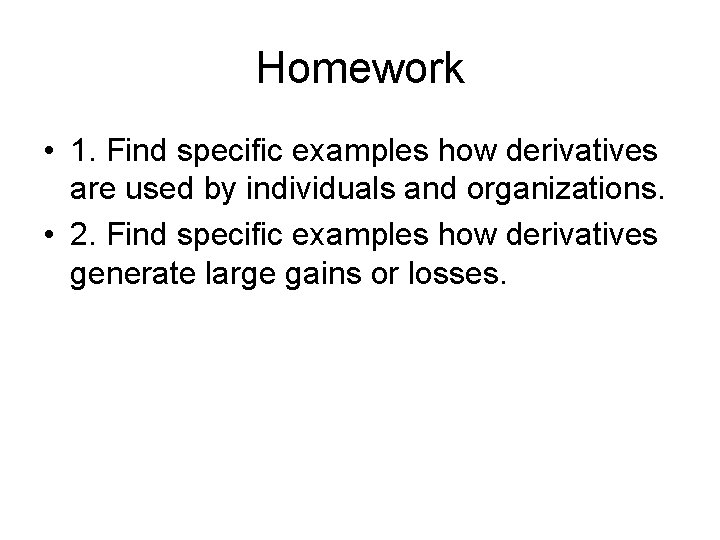
Homework • 1. Find specific examples how derivatives are used by individuals and organizations. • 2. Find specific examples how derivatives generate large gains or losses.
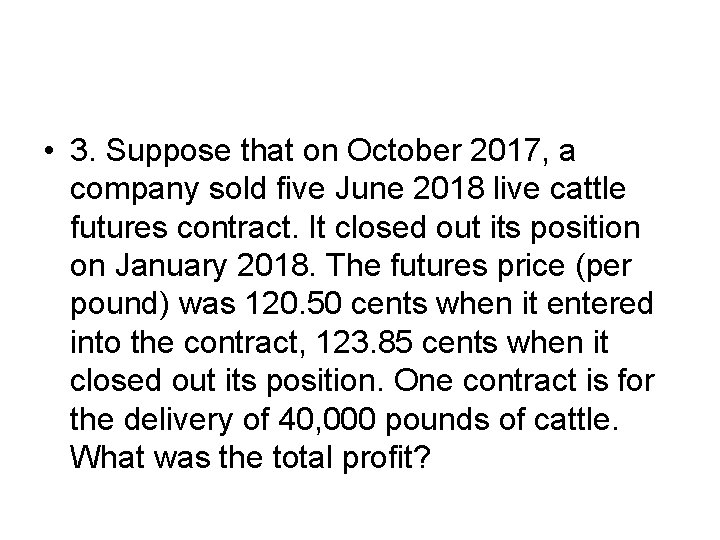
• 3. Suppose that on October 2017, a company sold five June 2018 live cattle futures contract. It closed out its position on January 2018. The futures price (per pound) was 120. 50 cents when it entered into the contract, 123. 85 cents when it closed out its position. One contract is for the delivery of 40, 000 pounds of cattle. What was the total profit?
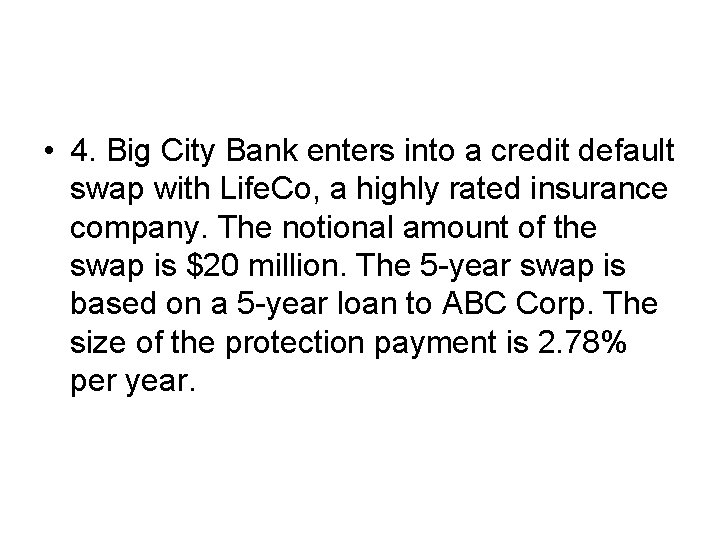
• 4. Big City Bank enters into a credit default swap with Life. Co, a highly rated insurance company. The notional amount of the swap is $20 million. The 5 -year swap is based on a 5 -year loan to ABC Corp. The size of the protection payment is 2. 78% per year.
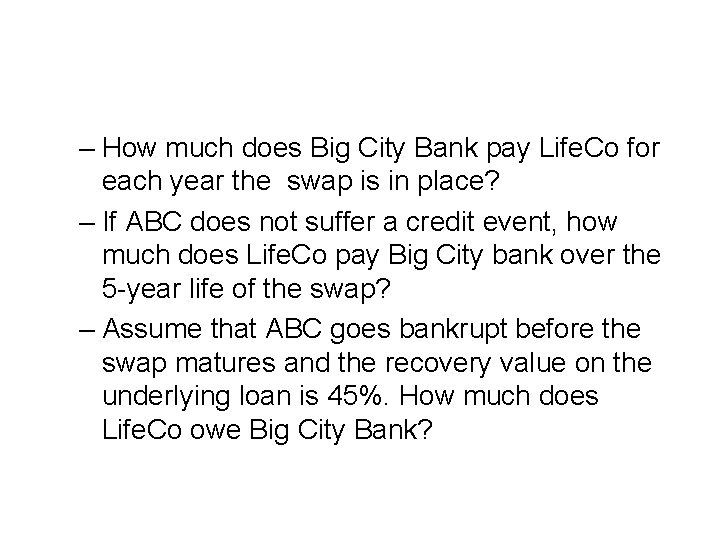
– How much does Big City Bank pay Life. Co for each year the swap is in place? – If ABC does not suffer a credit event, how much does Life. Co pay Big City bank over the 5 -year life of the swap? – Assume that ABC goes bankrupt before the swap matures and the recovery value on the underlying loan is 45%. How much does Life. Co owe Big City Bank?
• An investor observed the weakness of ABC and bought the same CDS from Life. Co with the notional value of 100 million. After paying CDS premium for one year, ABC goes bankrupt. The recovery value on the underlying loan is 45%. How much does Life. Co pay this investor? What is the rate of return for this investor?