
Introduction BUSINESS MODEL DEVELOPMENT TOOLKIT INTRODUCTION By completing
Introduction BUSINESS MODEL DEVELOPMENT TOOLKIT
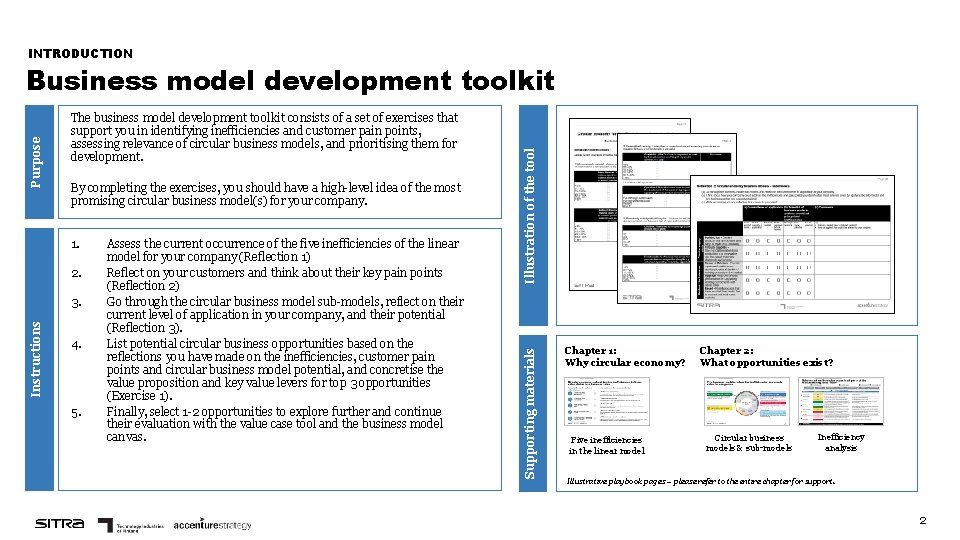
INTRODUCTION By completing the exercises, you should have a high-level idea of the most promising circular business model(s) for your company. 1. 2. Instructions 3. 4. 5. Assess the current occurrence of the five inefficiencies of the linear model for your company (Reflection 1) Reflect on your customers and think about their key pain points (Reflection 2) Go through the circular business model sub-models, reflect on their current level of application in your company, and their potential (Reflection 3). List potential circular business opportunities based on the reflections you have made on the inefficiencies, customer pain points and circular business model potential, and concretise the value proposition and key value levers for top 3 opportunities (Exercise 1). Finally, select 1 -2 opportunities to explore further and continue their evaluation with the value case tool and the business model canvas. Illustration of the tool The business model development toolkit consists of a set of exercises that support you in identifying inefficiencies and customer pain points, assessing relevance of circular business models, and prioritising them for development. Supporting materials Purpose Business model development toolkit Chapter 1: Why circular economy? Five inefficiencies in the linear model Chapter 2: What opportunities exist? Circular business models & sub-models Inefficiency analysis Illustrative playbook pages – please refer to the entire chapter for support. 2

Tool BUSINESS MODEL DEVELOPMENT TOOLKIT
TOOL Business model development toolkit Tool Access the business model development toolkit by double-clicking on the icon below. 4
- Slides: 4