
Introduction and Overview Definitions The general design process



- Slides: 24
Introduction and Overview† Ø Definitions. Ø The general design process. Ø A context for design: the waterfall model; reviews and documents. Ø Some size factors. Ø Quality and productivity factors. _____ †Material from: David Budgen (course text), and Richard Fairley, Software Engineering Concepts, Mc. Graw-Hill. CS 646: Software Design and Architectures
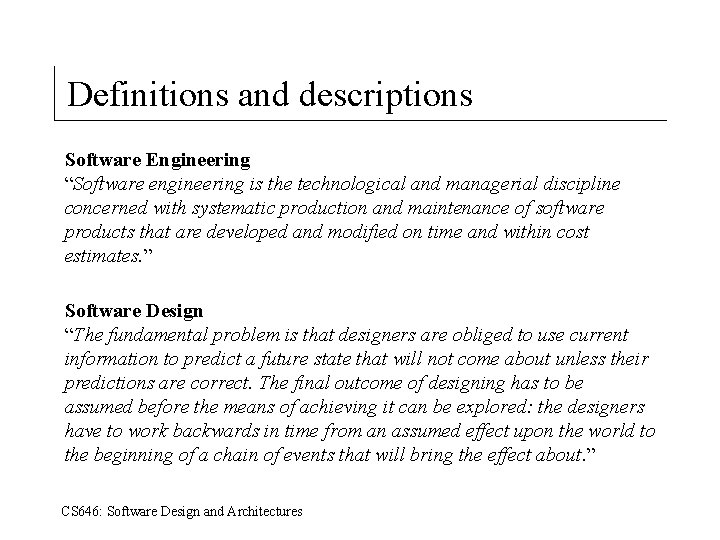
Definitions and descriptions Software Engineering “Software engineering is the technological and managerial discipline concerned with systematic production and maintenance of software products that are developed and modified on time and within cost estimates. ” Software Design “The fundamental problem is that designers are obliged to use current information to predict a future state that will not come about unless their predictions are correct. The final outcome of designing has to be assumed before the means of achieving it can be explored: the designers have to work backwards in time from an assumed effect upon the world to the beginning of a chain of events that will bring the effect about. ” CS 646: Software Design and Architectures
The general design process (scientific analysis) initial observations conduct experiments predictions from theory devise experiments to test theory more systematic observations construct theory (model) experimental observations conduct experiments new predictions experimental observations derive scientific principles CS 646: Software Design and Architectures
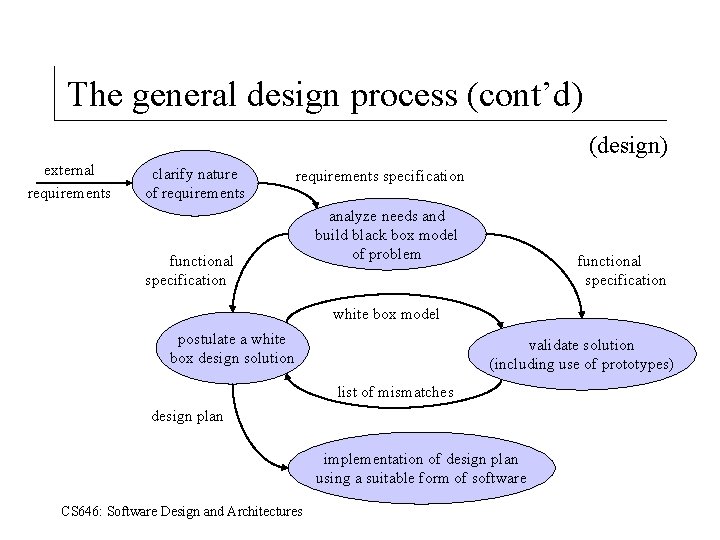
The general design process (cont’d) (design) external requirements clarify nature of requirements specification functional specification analyze needs and build black box model of problem functional specification white box model postulate a white box design solution validate solution (including use of prototypes) list of mismatches design plan implementation of design plan using a suitable form of software CS 646: Software Design and Architectures
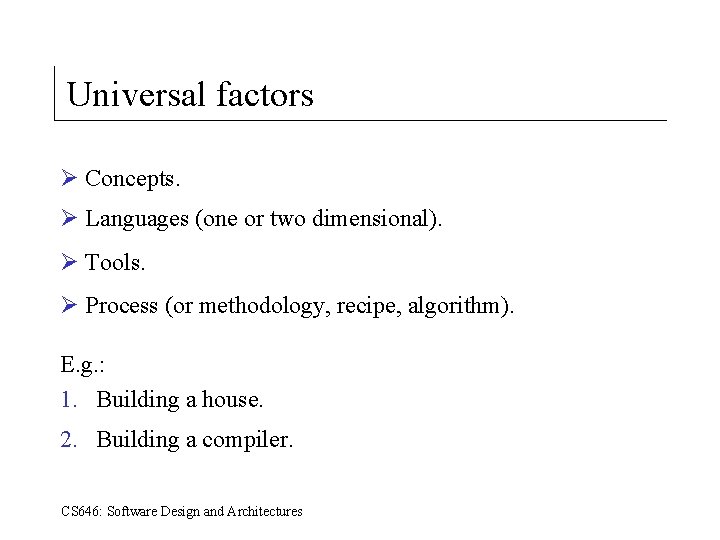
Universal factors Ø Concepts. Ø Languages (one or two dimensional). Ø Tools. Ø Process (or methodology, recipe, algorithm). E. g. : 1. Building a house. 2. Building a compiler. CS 646: Software Design and Architectures
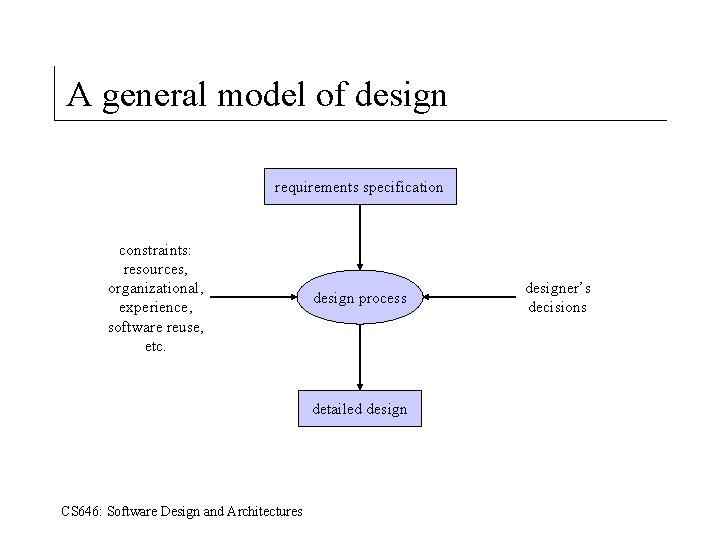
A general model of design requirements specification constraints: resources, organizational, experience, software reuse, etc. design process detailed design CS 646: Software Design and Architectures designer’s decisions
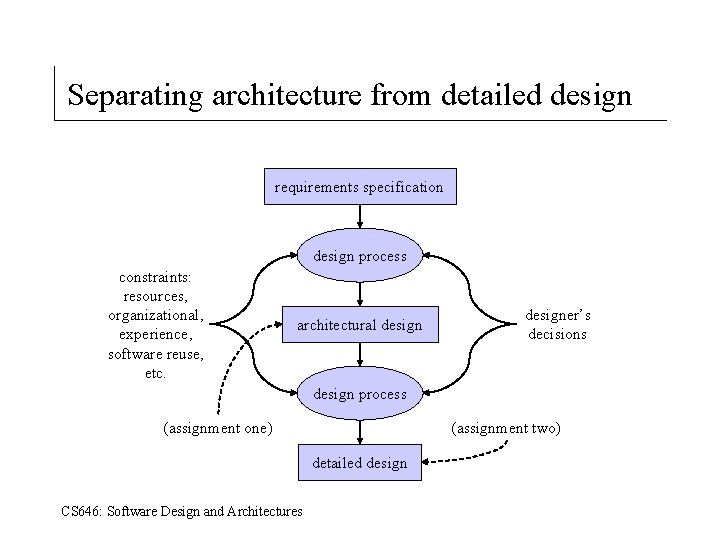
Separating architecture from detailed design requirements specification design process constraints: resources, organizational, experience, software reuse, etc. architectural designer’s decisions design process (assignment one) (assignment two) detailed design CS 646: Software Design and Architectures
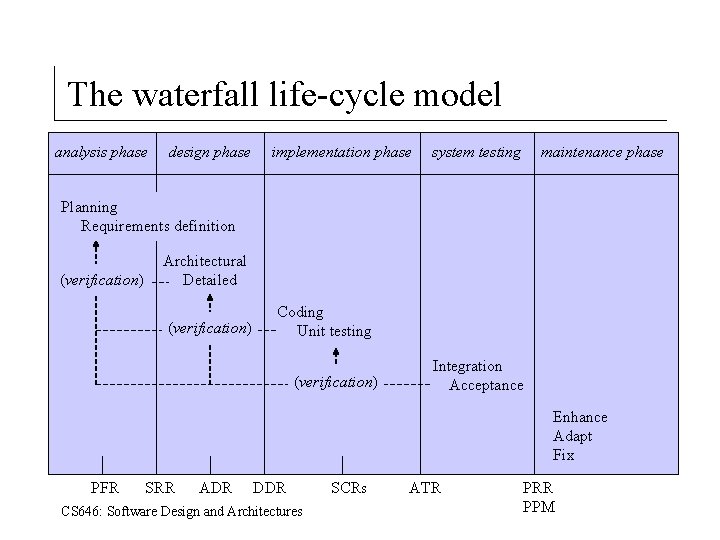
The waterfall life-cycle model analysis phase design phase implementation phase system testing maintenance phase Planning Requirements definition (verification) Architectural Detailed (verification) Coding Unit testing (verification) Integration Acceptance Enhance Adapt Fix PFR SRR ADR DDR CS 646: Software Design and Architectures SCRs ATR PRR PPM
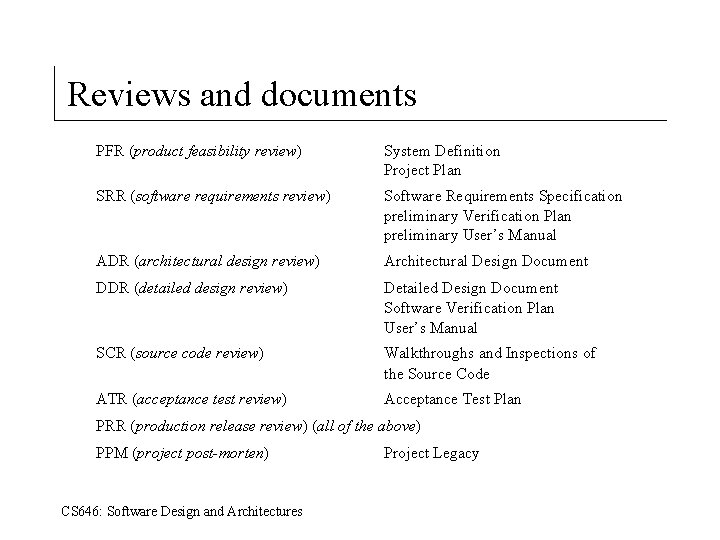
Reviews and documents PFR (product feasibility review) System Definition Project Plan SRR (software requirements review) Software Requirements Specification preliminary Verification Plan preliminary User’s Manual ADR (architectural design review) Architectural Design Document DDR (detailed design review) Detailed Design Document Software Verification Plan User’s Manual SCR (source code review) Walkthroughs and Inspections of the Source Code ATR (acceptance test review) Acceptance Test Plan PRR (production release review) (all of the above) PPM (project post-morten) CS 646: Software Design and Architectures Project Legacy
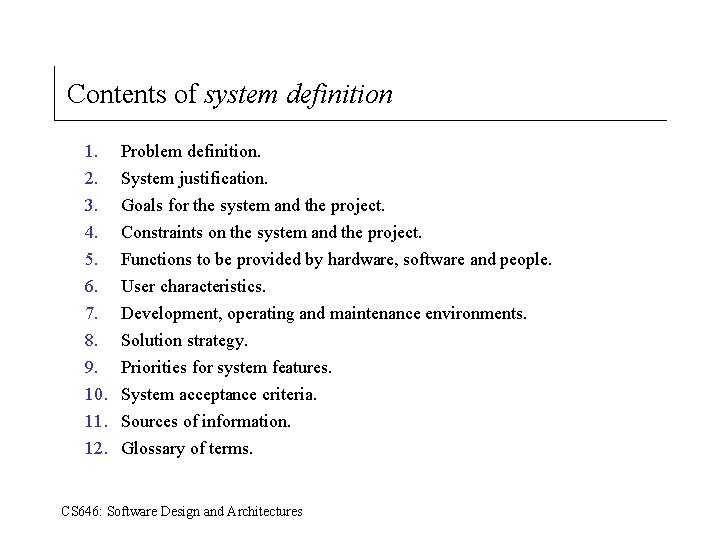
Contents of system definition 1. 2. 3. 4. 5. 6. 7. 8. 9. 10. 11. 12. Problem definition. System justification. Goals for the system and the project. Constraints on the system and the project. Functions to be provided by hardware, software and people. User characteristics. Development, operating and maintenance environments. Solution strategy. Priorities for system features. System acceptance criteria. Sources of information. Glossary of terms. CS 646: Software Design and Architectures
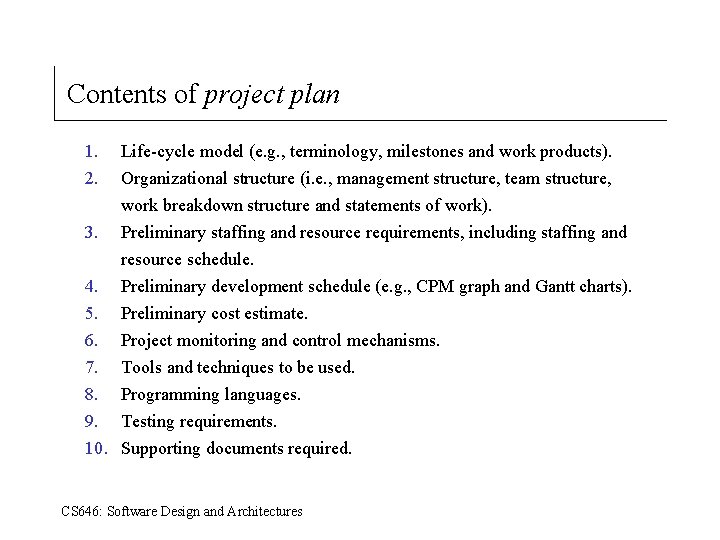
Contents of project plan 1. 2. 3. Life-cycle model (e. g. , terminology, milestones and work products). Organizational structure (i. e. , management structure, team structure, work breakdown structure and statements of work). Preliminary staffing and resource requirements, including staffing and resource schedule. 4. Preliminary development schedule (e. g. , CPM graph and Gantt charts). 5. Preliminary cost estimate. 6. Project monitoring and control mechanisms. 7. Tools and techniques to be used. 8. Programming languages. 9. Testing requirements. 10. Supporting documents required. CS 646: Software Design and Architectures
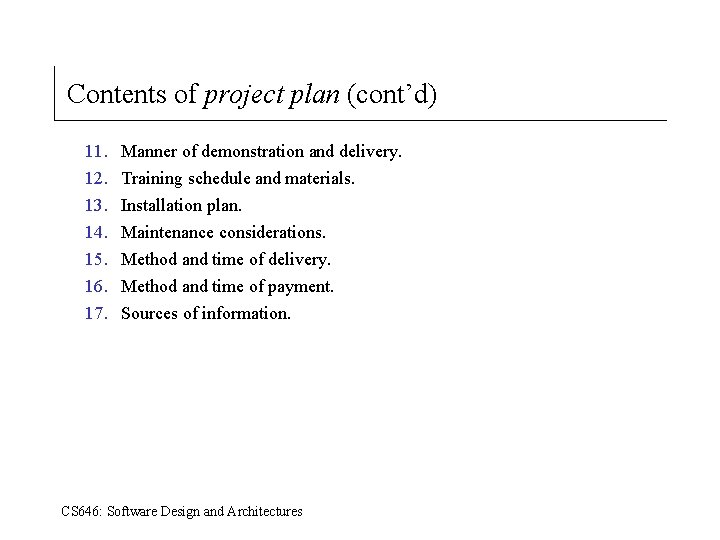
Contents of project plan (cont’d) 11. 12. 13. 14. 15. 16. 17. Manner of demonstration and delivery. Training schedule and materials. Installation plan. Maintenance considerations. Method and time of delivery. Method and time of payment. Sources of information. CS 646: Software Design and Architectures
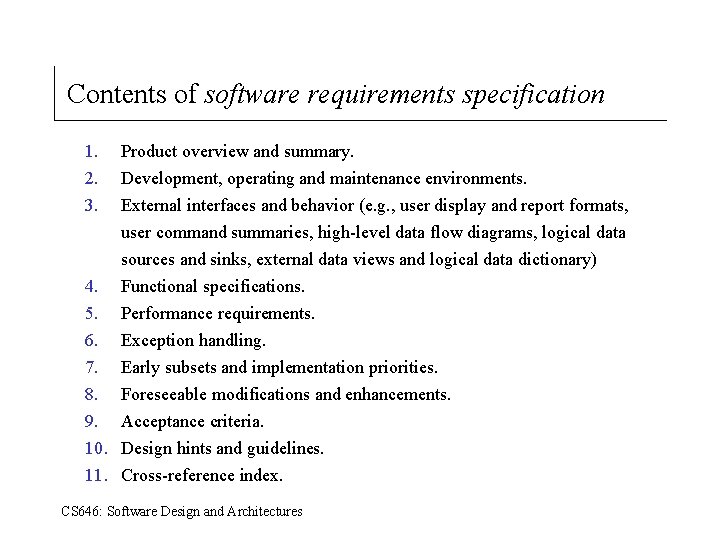
Contents of software requirements specification 1. 2. 3. Product overview and summary. Development, operating and maintenance environments. External interfaces and behavior (e. g. , user display and report formats, user command summaries, high-level data flow diagrams, logical data sources and sinks, external data views and logical data dictionary) 4. Functional specifications. 5. Performance requirements. 6. Exception handling. 7. Early subsets and implementation priorities. 8. Foreseeable modifications and enhancements. 9. Acceptance criteria. 10. Design hints and guidelines. 11. Cross-reference index. CS 646: Software Design and Architectures
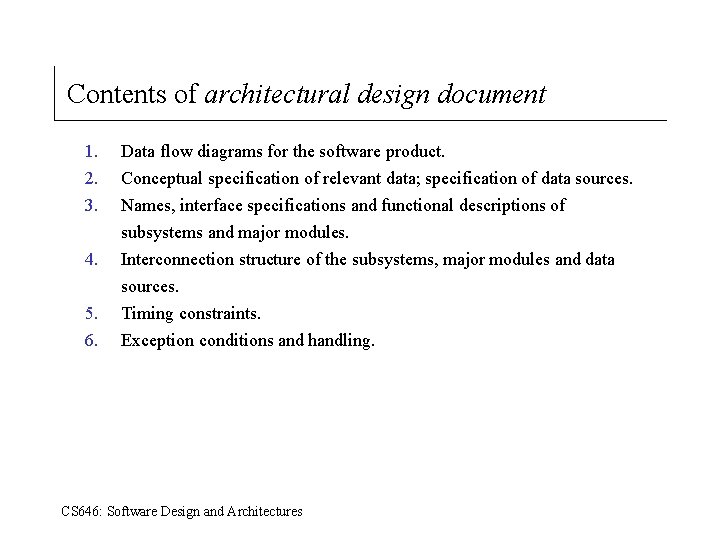
Contents of architectural design document 1. 2. 3. Data flow diagrams for the software product. Conceptual specification of relevant data; specification of data sources. Names, interface specifications and functional descriptions of subsystems and major modules. 4. Interconnection structure of the subsystems, major modules and data sources. Timing constraints. Exception conditions and handling. 5. 6. CS 646: Software Design and Architectures
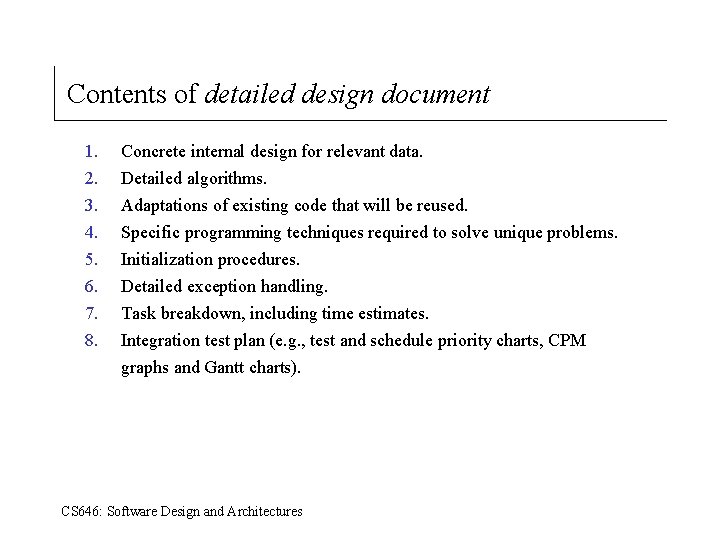
Contents of detailed design document 1. 2. 3. 4. 5. 6. 7. 8. Concrete internal design for relevant data. Detailed algorithms. Adaptations of existing code that will be reused. Specific programming techniques required to solve unique problems. Initialization procedures. Detailed exception handling. Task breakdown, including time estimates. Integration test plan (e. g. , test and schedule priority charts, CPM graphs and Gantt charts). CS 646: Software Design and Architectures
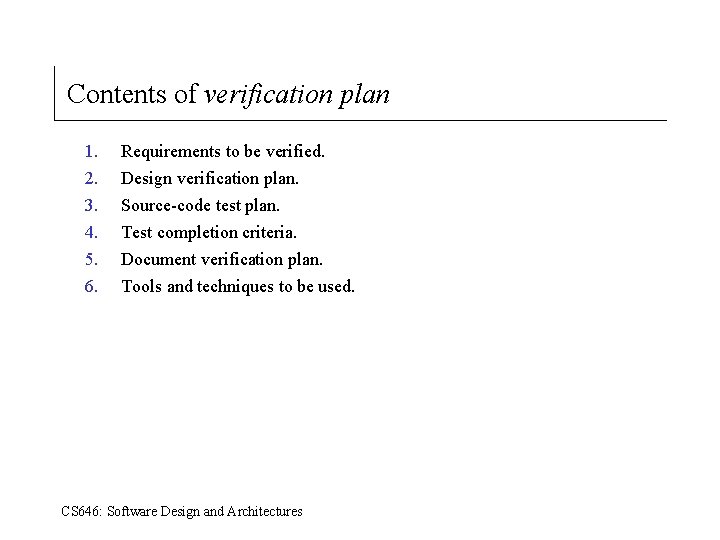
Contents of verification plan 1. 2. 3. 4. 5. 6. Requirements to be verified. Design verification plan. Source-code test plan. Test completion criteria. Document verification plan. Tools and techniques to be used. CS 646: Software Design and Architectures
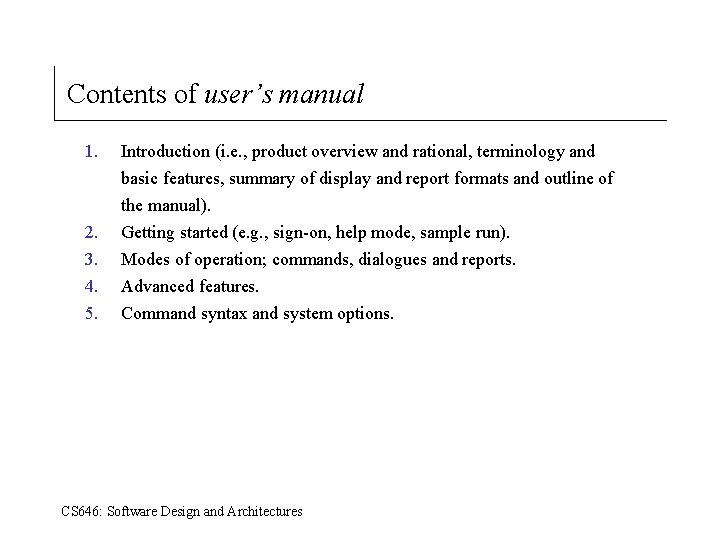
Contents of user’s manual 1. 2. 3. 4. 5. Introduction (i. e. , product overview and rational, terminology and basic features, summary of display and report formats and outline of the manual). Getting started (e. g. , sign-on, help mode, sample run). Modes of operation; commands, dialogues and reports. Advanced features. Command syntax and system options. CS 646: Software Design and Architectures
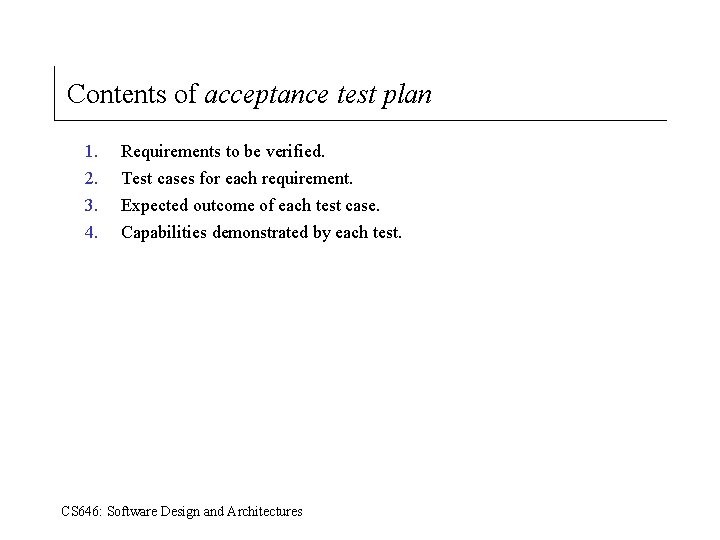
Contents of acceptance test plan 1. 2. 3. 4. Requirements to be verified. Test cases for each requirement. Expected outcome of each test case. Capabilities demonstrated by each test. CS 646: Software Design and Architectures
Contents of project legacy 1. 2. 3. 4. 5. 6. 7. 8. Project description. Initial expectations. Current status of the project. Remaining areas of concern. Activities/time log. Technical lessons learned. Managerial lessons learned. Recommendations for future projects. CS 646: Software Design and Architectures
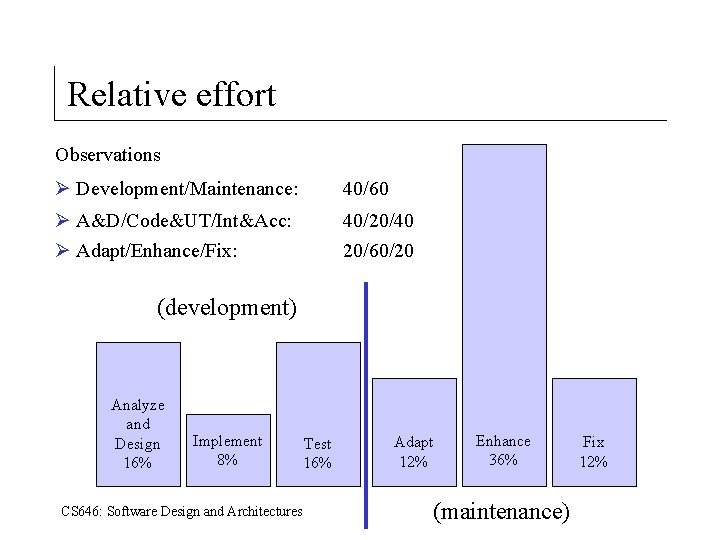
Relative effort Observations Ø Development/Maintenance: 40/60 Ø A&D/Code&UT/Int&Acc: Ø Adapt/Enhance/Fix: 40/20/40 20/60/20 (development) Analyze and Design 16% Implement 8% CS 646: Software Design and Architectures Test 16% Adapt 12% Enhance 36% (maintenance) Fix 12%
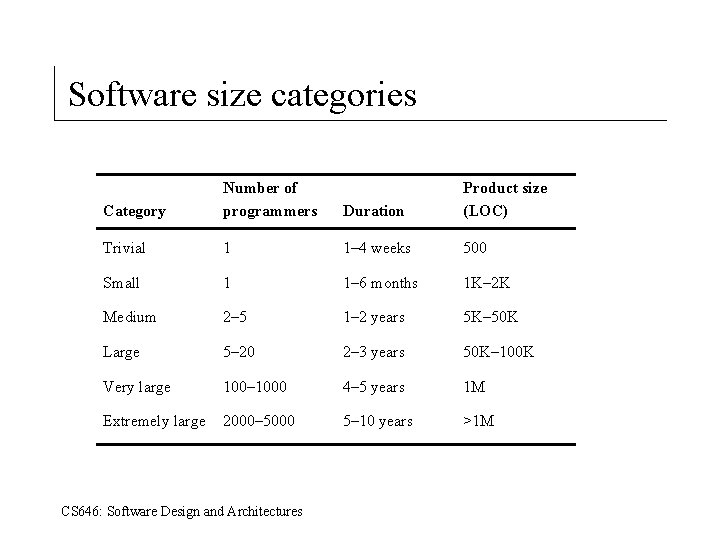
Software size categories Category Number of programmers Duration Product size (LOC) Trivial 1 1– 4 weeks 500 Small 1 1– 6 months 1 K– 2 K Medium 2– 5 1– 2 years 5 K– 50 K Large 5– 20 2– 3 years 50 K– 100 K Very large 100– 1000 4– 5 years 1 M Extremely large 2000– 5000 5– 10 years >1 M CS 646: Software Design and Architectures
How programmers spend their time† Ø Writing programs: 13% Ø Reading programs and manuals: 16% Ø Job communication: 32% Ø Personal: 13% Ø Miscellaneous: 15% Ø Training: 6% Ø Mail: 5% _____ †Bell Labs Study (1964, 70 programmers) CS 646: Software Design and Architectures
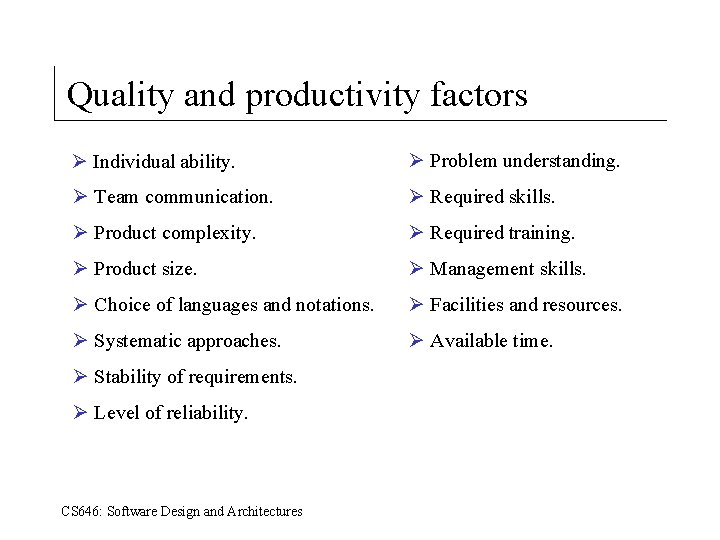
Quality and productivity factors Ø Individual ability. Ø Problem understanding. Ø Team communication. Ø Required skills. Ø Product complexity. Ø Required training. Ø Product size. Ø Management skills. Ø Choice of languages and notations. Ø Facilities and resources. Ø Systematic approaches. Ø Available time. Ø Stability of requirements. Ø Level of reliability. CS 646: Software Design and Architectures
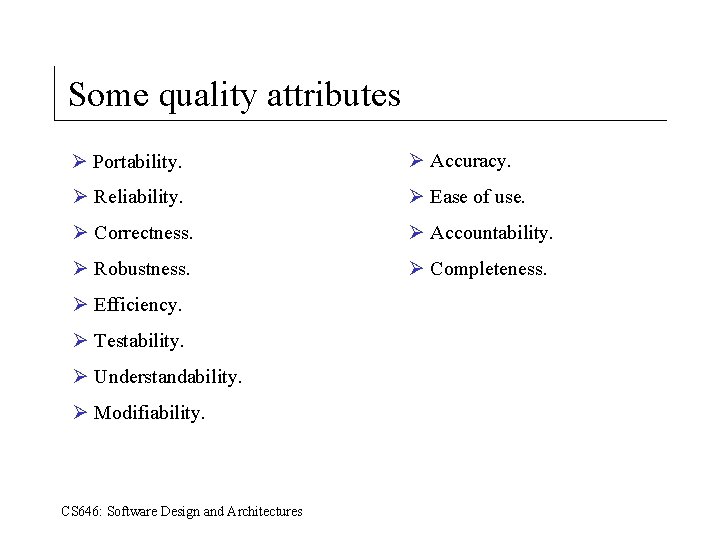
Some quality attributes Ø Portability. Ø Accuracy. Ø Reliability. Ø Ease of use. Ø Correctness. Ø Accountability. Ø Robustness. Ø Completeness. Ø Efficiency. Ø Testability. Ø Understandability. Ø Modifiability. CS 646: Software Design and Architectures