
Introduction Acquiring Knowledge and the Scientific Method Chapter


- Slides: 23
Introduction, Acquiring Knowledge, and the Scientific Method Chapter 1 Dusana Rybarova Psyc 290 B May 15 2006
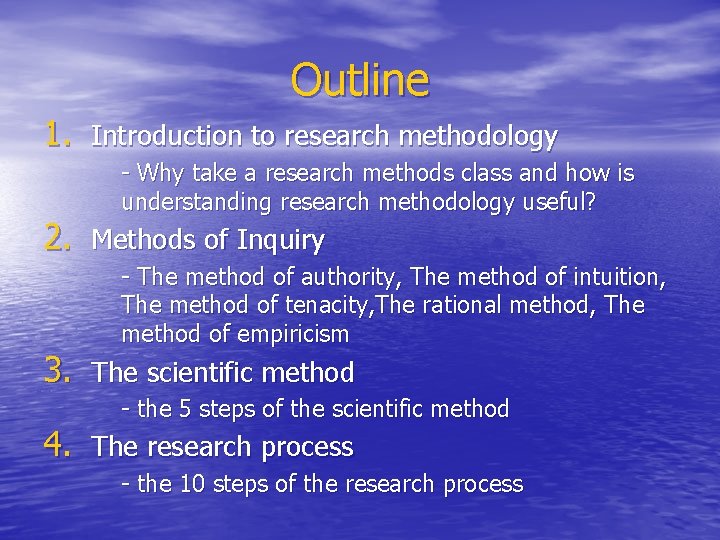
Outline 1. Introduction to research methodology - Why take a research methods class and how is understanding research methodology useful? 2. Methods of Inquiry - The method of authority, The method of intuition, The method of tenacity, The rational method, The method of empiricism 3. The scientific method - the 5 steps of the scientific method 4. The research process - the 10 steps of the research process
1. Introduction to research methodology • How is understanding research methodology useful? – Psychology is a science • this means that psychologists and behavioral scientists in general use the methods of science to gather and interpret information • science provides a carefully developed system for answering questions so that the answers we get are as accurate, objective and complete as possible
1. Introduction to research methodology (cont. ) • How is understanding research methodology useful? – Conducting a study • one might object that you do not plan to conduct any studies in the future • each student in this class has to develop a research outline following the 10 steps of research process • to keep up to date in your profession, you will probably need to read and understand the most recent research publications
1. Introduction to research methodology (cont. ) • How is understanding research methodology useful? – Reading and Evaluating Other People’s Studies • this class will help you critically evaluate the research presented in journal articles • you will be able to determine to what extent the evidence supports conclusions
1. Introduction to research methodology (cont. ) • How is understanding research methodology useful? – Understanding brief descriptions of studies • there are basic principles that every scientific study follows and knowing about these principles will help you to better understand the meaning of abbreviated descriptions of studies that you will find in your textbooks for other classes
1. Introduction to research methodology (cont. ) • How is understanding research methodology useful? – Making decisions in our daily lives • you must understand appreciate the role and capabilities of science and experimentation so that you can evaluate and act on research results • e. g. ads for weight-loss programs • this class will help you make educated decisions about the research claims you encounter in everyday life
1. Introduction to research methodology (cont. ) • How is understanding research methodology useful? – Being a better thinker • science is a logical and objective method of critical thinking • this class may help you to evaluate evidence in a more sophisticated way and make a more objective decisions in everyday life
2. Methods of Inquiry • methods of inquiry are ways in which a person can know things or discover answers to questions
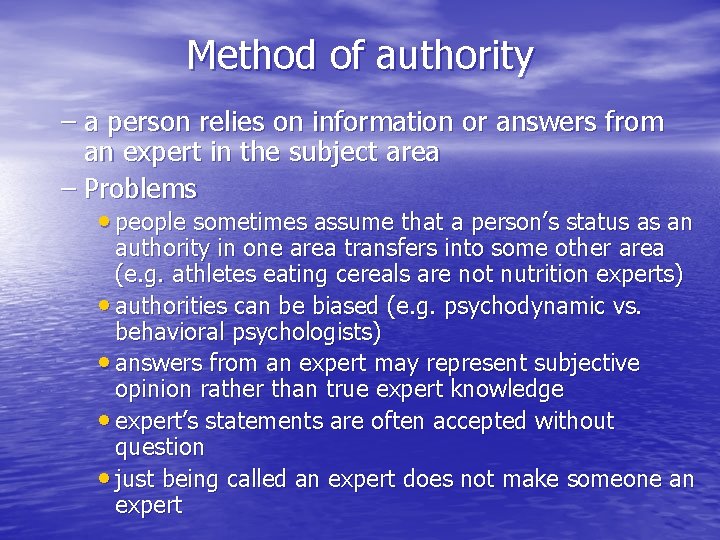
Method of authority – a person relies on information or answers from an expert in the subject area – Problems • people sometimes assume that a person’s status as an authority in one area transfers into some other area (e. g. athletes eating cereals are not nutrition experts) • authorities can be biased (e. g. psychodynamic vs. behavioral psychologists) • answers from an expert may represent subjective opinion rather than true expert knowledge • expert’s statements are often accepted without question • just being called an expert does not make someone an expert
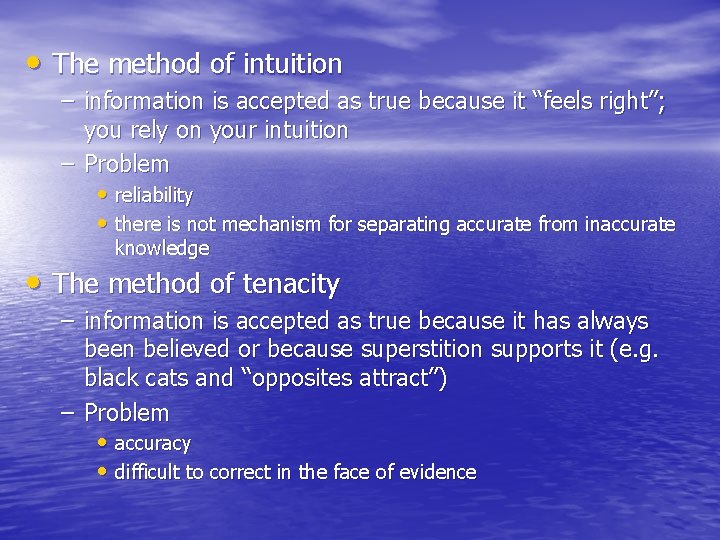
• The method of intuition – information is accepted as true because it “feels right”; you rely on your intuition – Problem • reliability • there is not mechanism for separating accurate from inaccurate knowledge • The method of tenacity – information is accepted as true because it has always been believed or because superstition supports it (e. g. black cats and “opposites attract”) – Problem • accuracy • difficult to correct in the face of evidence
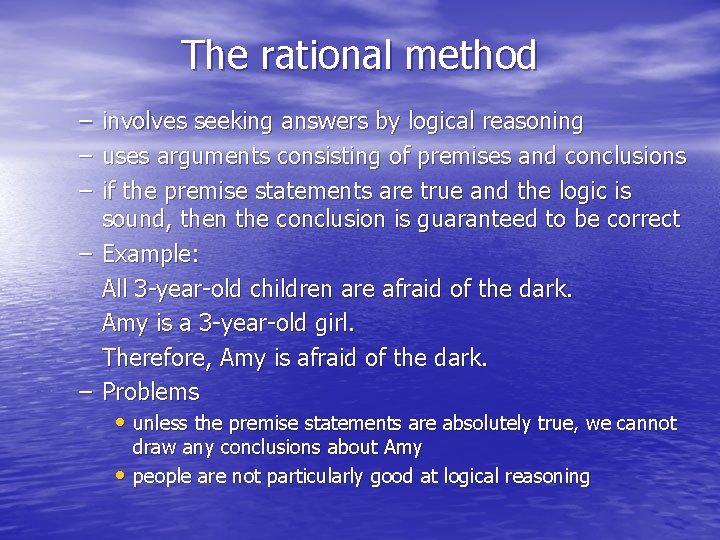
The rational method – involves seeking answers by logical reasoning – uses arguments consisting of premises and conclusions – if the premise statements are true and the logic is sound, then the conclusion is guaranteed to be correct – Example: All 3 -year-old children are afraid of the dark. Amy is a 3 -year-old girl. Therefore, Amy is afraid of the dark. – Problems • unless the premise statements are absolutely true, we cannot draw any conclusions about Amy • people are not particularly good at logical reasoning
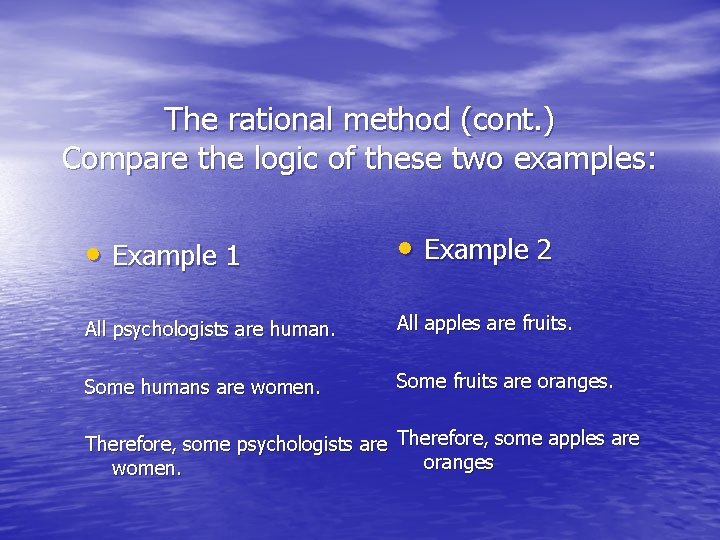
The rational method (cont. ) Compare the logic of these two examples: • Example 1 • Example 2 All psychologists are human. All apples are fruits. Some humans are women. Some fruits are oranges. Therefore, some psychologists are Therefore, some apples are oranges women.
Method of empiricism – uses observation or direct sensory experience to obtain knowledge – Problems • we can not necessarily believe everything we see (e. g. illusions) • misinterpretation of observation • your perceptions can be drastically altered by prior knowledge, expectations, feelings and beliefs • Can be dangerous
3. The scientific method • the scientific method is an approach to acquiring knowledge that contains many elements of the methods previously discussed • it tries to avoid pitfalls of any individual method used by itself
The steps of scientific method – Step 1: Observe Behavior or Other Phenomena • often based on informal observations • often based on inductive reasoning: using a relatively small set of specific observations to form general statement – Step 2: Form a Tentative Answer or Explanation (Hypothesis) • hypothesis is a possible explanation that is intended to be tested and critically evaluated – Step 3: Use the hypothesis to generate a testable prediction • more specific and concrete version of the original hypothesis – Step 4: Evaluate the prediction by making systematic, planned observation • this involves research / data collection
The steps of scientific method – Step 5: Use the observations to support, refute, or refine the original hypothesis • compare the actual results of step 4 with the prediction made in step 3 • based on the results decide whether the original hypothesis was true, false or can not be refuted or confirmed based on the obtained data • decide on further aspects of the hypothesis to be tested (this step can serve as step 1 of another cycle of scientific inquiry)
Other elements of the scientific method – science is empirical • it involves structured or systematic observation – science is public • scientific method makes observations available for evaluation by others (especially other scientists) by publishing them in scientific journals • other scientists should be able to repeat the same step-by-step process that led to the observations • replication – repetition of observation, allows verification of findings – science is objective • minimizes the influence of experimenter bias – the influence of researcher’s biases and beliefs on the outcome of the study
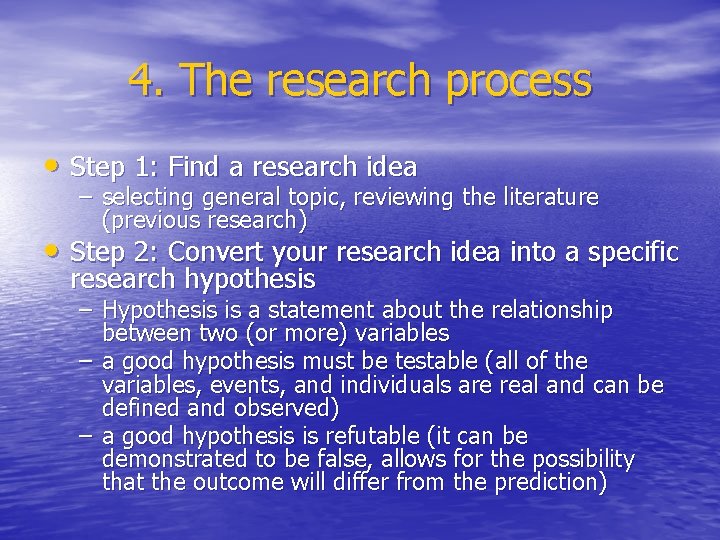
4. The research process • Step 1: Find a research idea – selecting general topic, reviewing the literature (previous research) • Step 2: Convert your research idea into a specific research hypothesis – Hypothesis is a statement about the relationship between two (or more) variables – a good hypothesis must be testable (all of the variables, events, and individuals are real and can be defined and observed) – a good hypothesis is refutable (it can be demonstrated to be false, allows for the possibility that the outcome will differ from the prediction)
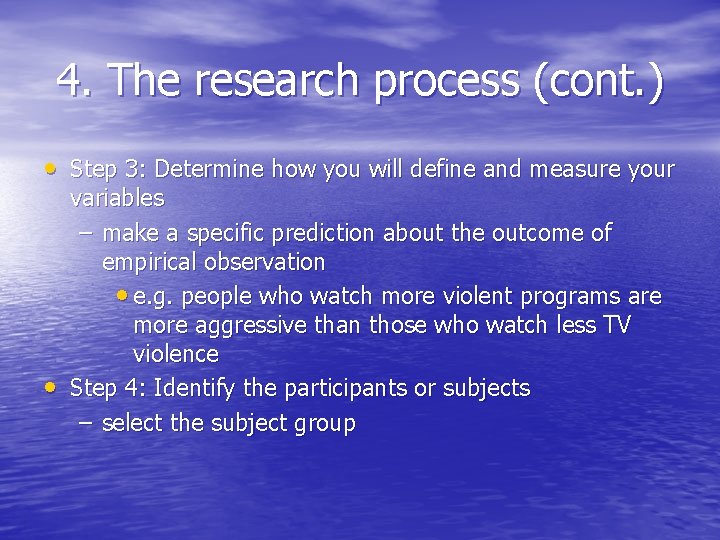
4. The research process (cont. ) • Step 3: Determine how you will define and measure your • variables – make a specific prediction about the outcome of empirical observation • e. g. people who watch more violent programs are more aggressive than those who watch less TV violence Step 4: Identify the participants or subjects – select the subject group
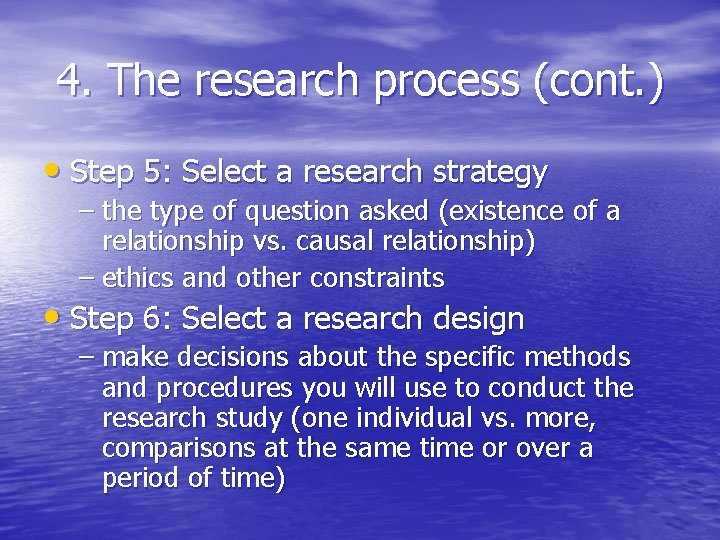
4. The research process (cont. ) • Step 5: Select a research strategy – the type of question asked (existence of a relationship vs. causal relationship) – ethics and other constraints • Step 6: Select a research design – make decisions about the specific methods and procedures you will use to conduct the research study (one individual vs. more, comparisons at the same time or over a period of time)
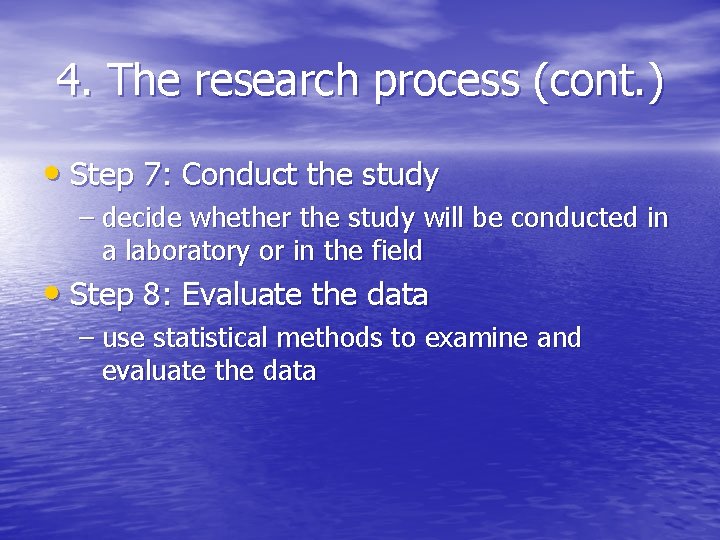
4. The research process (cont. ) • Step 7: Conduct the study – decide whether the study will be conducted in a laboratory or in the field • Step 8: Evaluate the data – use statistical methods to examine and evaluate the data
4. The research process (cont. ) • Step 9: Report the results – describe what was done and how the findings were interpreted • Step 10: Refine or reformulate your research idea – test the boundaries of the results – refine the original research