
Introduction 1 Introduction to Beagle 2 Professor Mark
Introduction 1 Introduction to Beagle 2 Professor Mark Sims Space Research Centre University of Leicester On Behalf of the Beagle 2 Consortium Some information contained within this presentation is Confidential & Proprietary to the Beagle 2 Consortium It may not be copied whole or in part except with prior written permission from the Beagle 2 Mission Manager and Dr. Judith Pillinger (Open University)
Introduction Beagle 2 Project 2 Timeline: Proposal 1998 l Build Phase 1999 -2003 l Mission Operations June 2003 to August 2004 including search and internal investigation l Mission: l l l Part of ESA’s Mars Express Mission First UK European Mars Lander World-leading Science Astrobiology and Geochemistry UK built and led International Participation to Build and Science
Introduction Beagle 2 Science 3 Unique Objectives (in 2003): Detection of extinct and/or extant life (detection of organics*) l Analysis of subsurface material and regime l First attempt at in-situ radiometric dating of rocks on another planet* *Recently achieved by NASA’s Curiosity Mission l Science Programme: l l l Geochemical, mineralogical and petrological analysis of selected rocks and “soils” Chemical and physical analysis of the atmosphere Local geomorphological classification of the landing site Measurement of dynamic environmental processes Astronomical observations of the Sun, bright stars and Phobos and Deimos

Introduction 4 Beagle 2 Engineering Beagle 2 Specification: Mass – 72. 7 kg (~9 kg for instruments) l Lander 33. 2 kg, Entry Descent and Landing System 35. 6 kg, Mars Express Interfaces 4. 88 kg l Power - Battery (Lithium Ion, ~200 Wh); Solar arrays (Ga. As, 4 off) l Thermal - Non RHU design; Solar Collector l Operations - 180 Sols (primary); contact ~1 day (Odyssey) or <4 days (MEX)) l Parachute, Airbag Based Entry, Descent and Landing (EDL) System l Aspects: l l l Innovative Design Small High payload fraction Highly integrated No redundancy Deployable instrument capability (via Robotic Arm) 0. 66 m
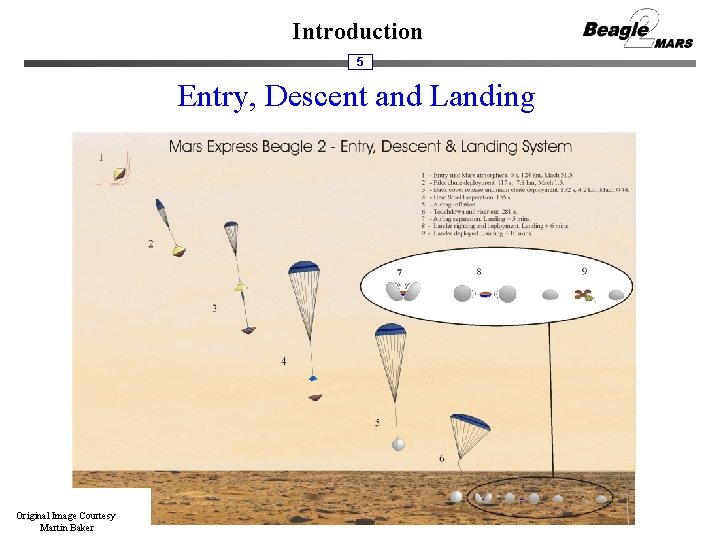
Introduction 5 Entry, Descent and Landing Original Image Courtesy Martin Baker
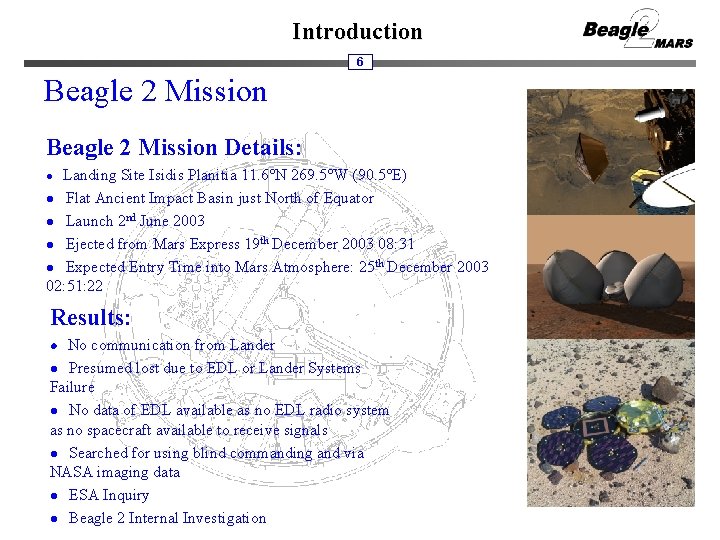
Introduction 6 Beagle 2 Mission Details: Landing Site Isidis Planitia 11. 6°N 269. 5°W (90. 5°E) l Flat Ancient Impact Basin just North of Equator l Launch 2 nd June 2003 l Ejected from Mars Express 19 th December 2003 08: 31 l Expected Entry Time into Mars Atmosphere: 25 th December 2003 02: 51: 22 l Results: No communication from Lander l Presumed lost due to EDL or Lander Systems Failure l No data of EDL available as no EDL radio system as no spacecraft available to receive signals l Searched for using blind commanding and via NASA imaging data l ESA Inquiry l Beagle 2 Internal Investigation l
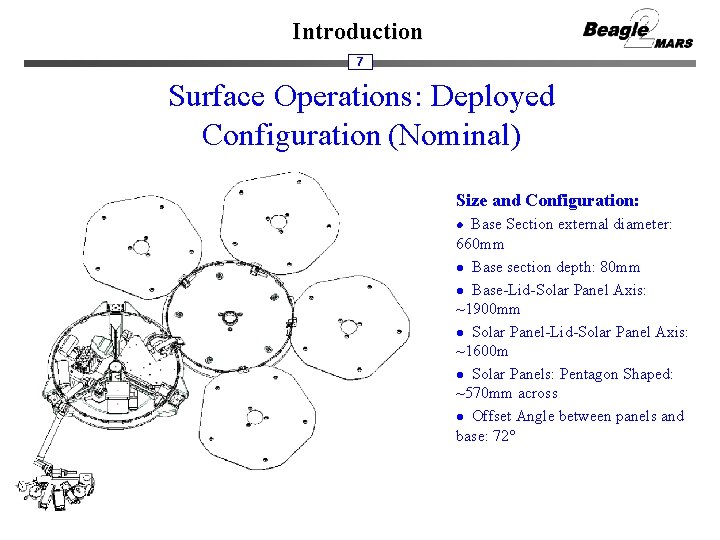
Introduction 7 Surface Operations: Deployed Configuration (Nominal) Size and Configuration: Base Section external diameter: 660 mm l Base section depth: 80 mm l Base-Lid-Solar Panel Axis: ~1900 mm l Solar Panel-Lid-Solar Panel Axis: ~1600 m l Solar Panels: Pentagon Shaped: ~570 mm across l Offset Angle between panels and base: 72° l
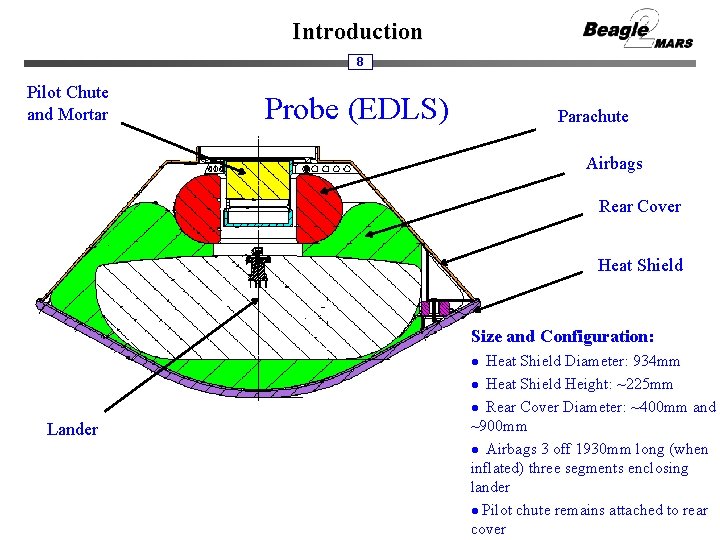
Introduction 8 Pilot Chute and Mortar Probe (EDLS) Parachute Airbags Rear Cover Heat Shield Size and Configuration: Heat Shield Diameter: 934 mm l Heat Shield Height: ~225 mm l Rear Cover Diameter: ~400 mm and ~900 mm l Airbags 3 off 1930 mm long (when inflated) three segments enclosing lander l Pilot chute remains attached to rear cover l Lander
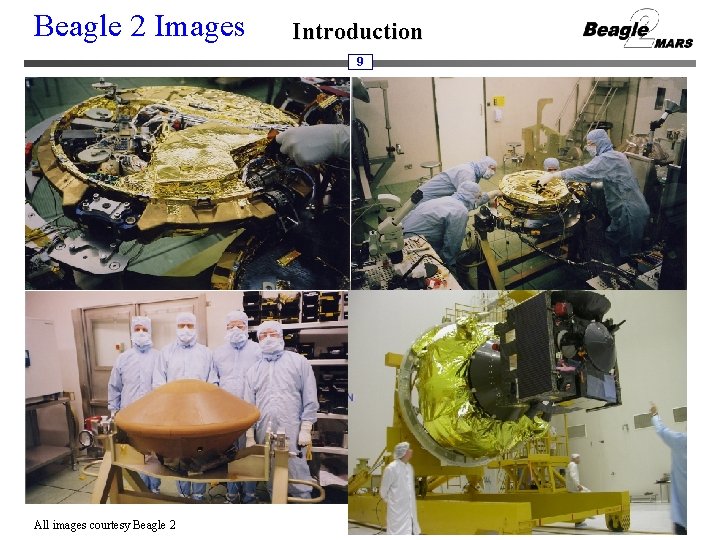
Beagle 2 Images Introduction 9 All images courtesy Beagle 2

Beagle 2 Images Introduction 10 Picture of Beagle 2 being ejected from Mars Express 19 th December 2003 Images courtesy ESA
- Slides: 10