
Introducing Upthrust fluid flow What is the force
- Slides: 16
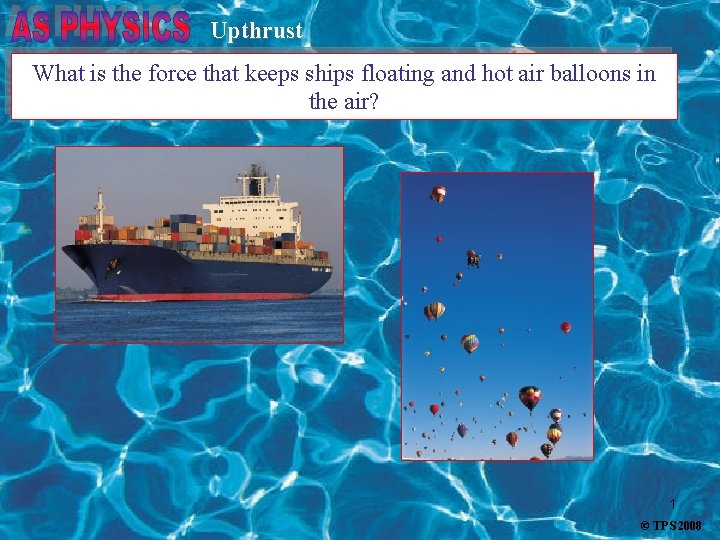
Introducing Upthrust fluid flow What is the force that keeps ships floating and hot air balloons in the air? 1 © TPS 2008
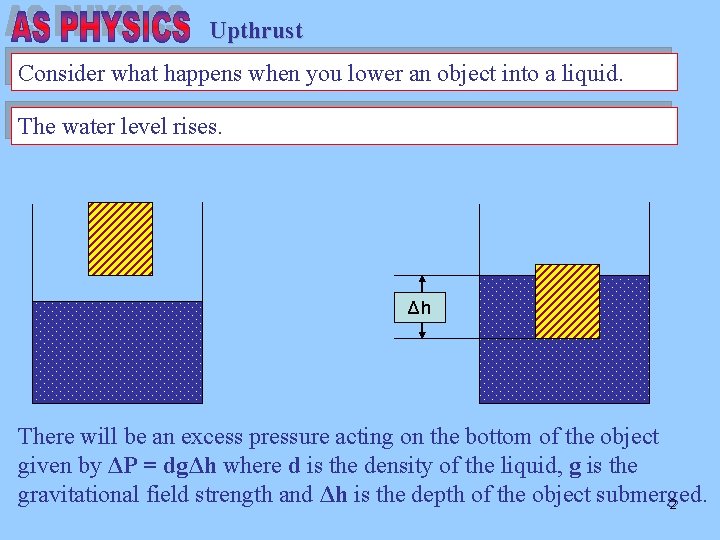
Upthrust Consider what happens when you lower an object into a liquid. The water level rises. Δh There will be an excess pressure acting on the bottom of the object given by ΔP = dgΔh where d is the density of the liquid, g is the gravitational field strength and Δh is the depth of the object submerged. 2
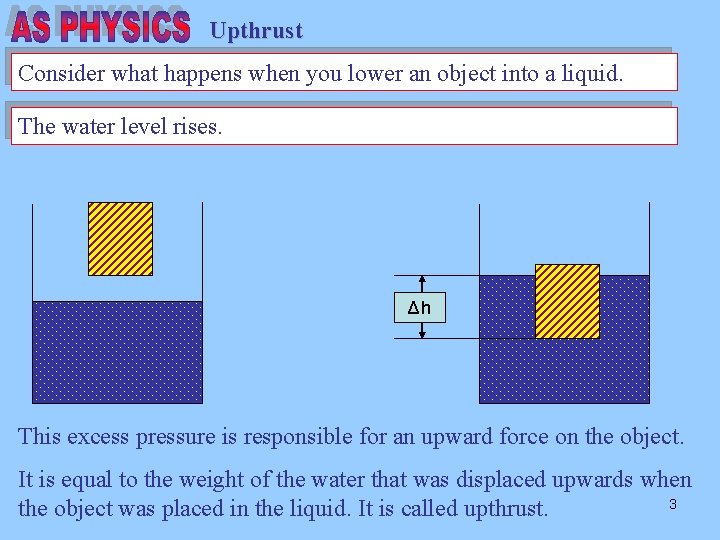
Upthrust Consider what happens when you lower an object into a liquid. The water level rises. Δh This excess pressure is responsible for an upward force on the object. It is equal to the weight of the water that was displaced upwards when 3 the object was placed in the liquid. It is called upthrust.
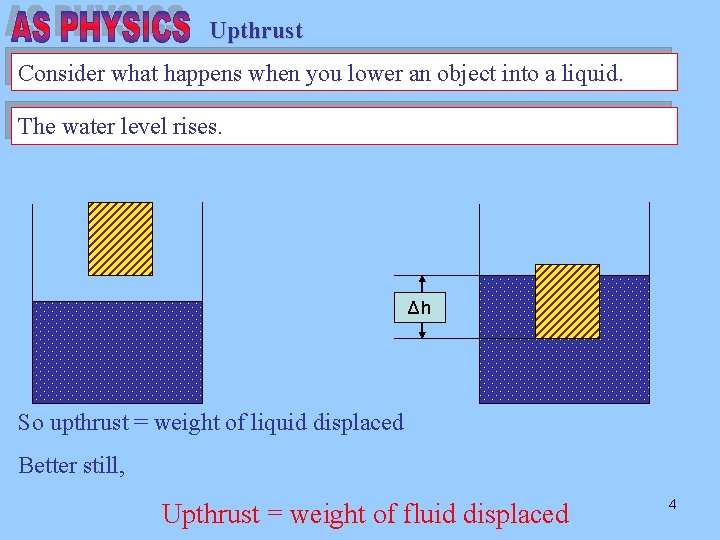
Upthrust Consider what happens when you lower an object into a liquid. The water level rises. Δh So upthrust = weight of liquid displaced Better still, Upthrust = weight of fluid displaced 4
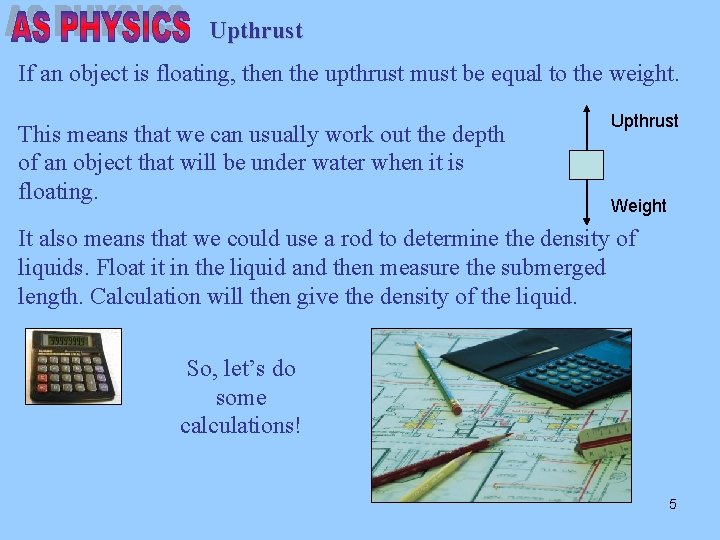
Upthrust If an object is floating, then the upthrust must be equal to the weight. This means that we can usually work out the depth of an object that will be under water when it is floating. Upthrust Weight It also means that we could use a rod to determine the density of liquids. Float it in the liquid and then measure the submerged length. Calculation will then give the density of the liquid. So, let’s do some calculations! 5
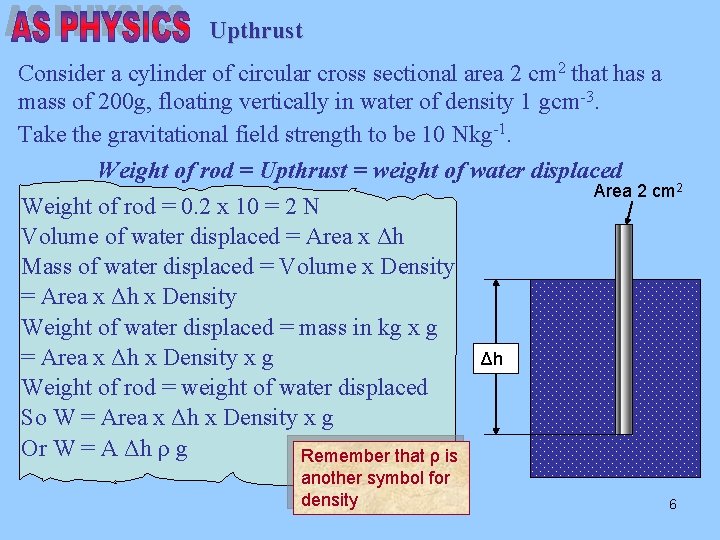
Upthrust Consider a cylinder of circular cross sectional area 2 cm 2 that has a mass of 200 g, floating vertically in water of density 1 gcm-3. Take the gravitational field strength to be 10 Nkg-1. Weight of rod = Upthrust = weight of water displaced Area 2 cm 2 Weight of rod = 0. 2 x 10 = 2 N Volume of water displaced = Area x Δh Mass of water displaced = Volume x Density = Area x Δh x Density Weight of water displaced = mass in kg x g = Area x Δh x Density x g Δh Weight of rod = weight of water displaced So W = Area x Δh x Density x g Or W = A Δh ρ g Remember that ρ is another symbol for density 6
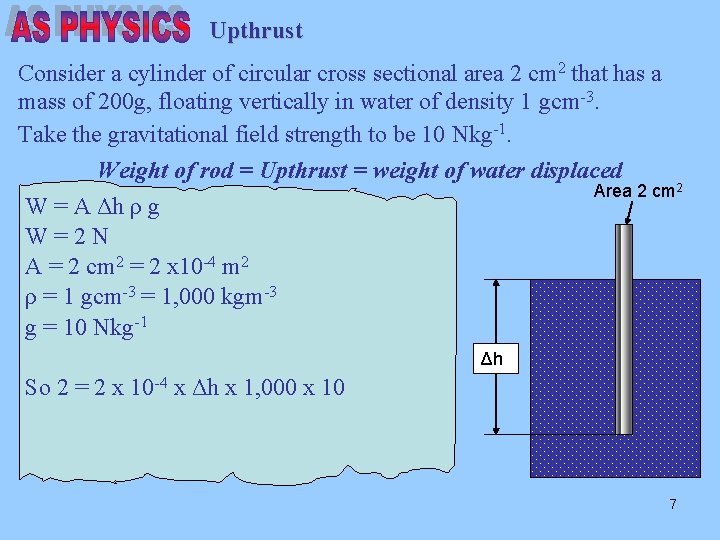
Upthrust Consider a cylinder of circular cross sectional area 2 cm 2 that has a mass of 200 g, floating vertically in water of density 1 gcm-3. Take the gravitational field strength to be 10 Nkg-1. Weight of rod = Upthrust = weight of water displaced Area 2 cm 2 W = A Δh ρ g W=2 N A = 2 cm 2 = 2 x 10 -4 m 2 ρ = 1 gcm-3 = 1, 000 kgm-3 g = 10 Nkg-1 Δh So 2 = 2 x 10 -4 x Δh x 1, 000 x 10 7
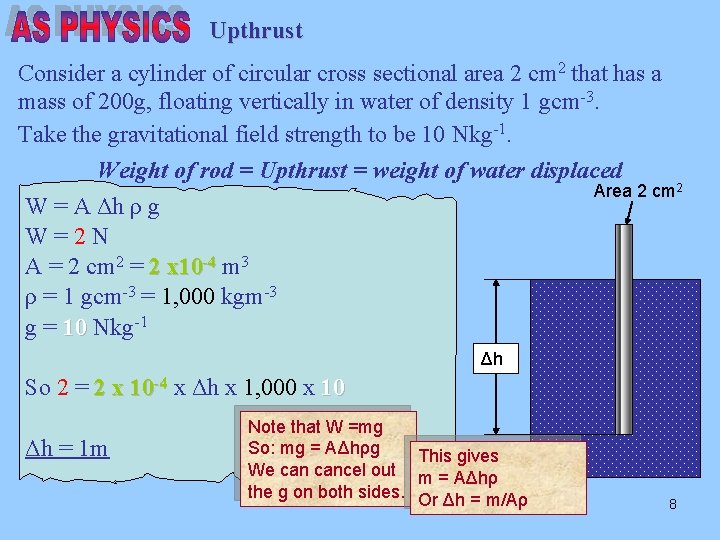
Upthrust Consider a cylinder of circular cross sectional area 2 cm 2 that has a mass of 200 g, floating vertically in water of density 1 gcm-3. Take the gravitational field strength to be 10 Nkg-1. Weight of rod = Upthrust = weight of water displaced Area 2 cm 2 W = A Δh ρ g W=2 N A = 2 cm 2 = 2 x 10 -4 m 3 ρ = 1 gcm-3 = 1, 000 kgm-3 g = 10 Nkg-1 Δh So 2 = 2 x 10 -4 x Δh x 1, 000 x 10 Δh = 1 m Note that W =mg So: mg = AΔhρg This gives We cancel out m = AΔhρ the g on both sides. Or Δh = m/Aρ 8
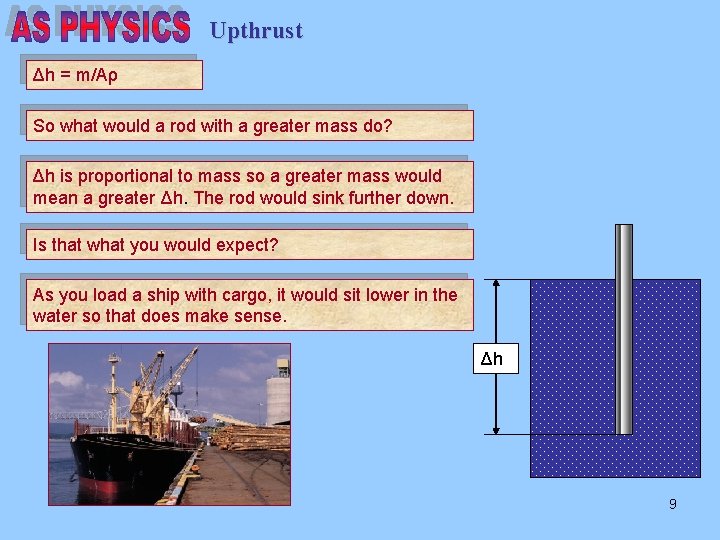
Upthrust Δh = m/Aρ So what would a rod with a greater mass do? Δh is proportional to mass so a greater mass would mean a greater Δh. The rod would sink further down. Is that what you would expect? As you load a ship with cargo, it would sit lower in the water so that does make sense. Δh 9
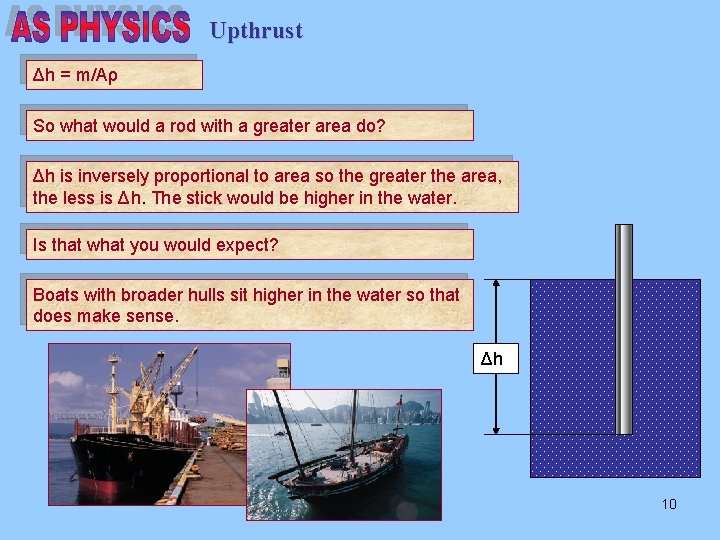
Upthrust Δh = m/Aρ So what would a rod with a greater area do? Δh is inversely proportional to area so the greater the area, the less is Δh. The stick would be higher in the water. Is that what you would expect? Boats with broader hulls sit higher in the water so that does make sense. Δh 10
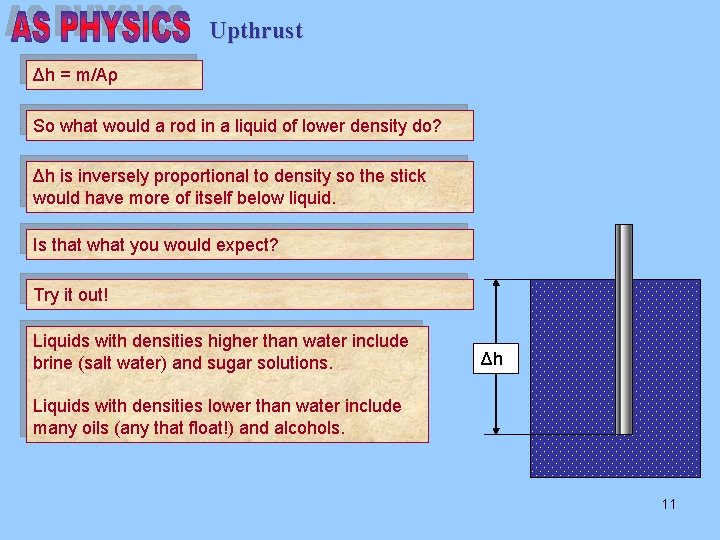
Upthrust Δh = m/Aρ So what would a rod in a liquid of lower density do? Δh is inversely proportional to density so the stick would have more of itself below liquid. Is that what you would expect? Try it out! Liquids with densities higher than water include brine (salt water) and sugar solutions. Δh Liquids with densities lower than water include many oils (any that float!) and alcohols. 11
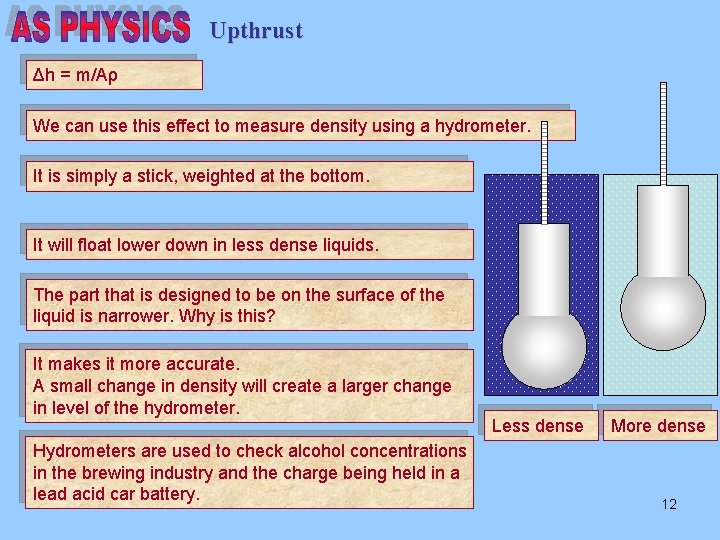
Upthrust Δh = m/Aρ We can use this effect to measure density using a hydrometer. It is simply a stick, weighted at the bottom. It will float lower down in less dense liquids. The part that is designed to be on the surface of the liquid is narrower. Why is this? It makes it more accurate. A small change in density will create a larger change in level of the hydrometer. Hydrometers are used to check alcohol concentrations in the brewing industry and the charge being held in a lead acid car battery. Less dense More dense 12
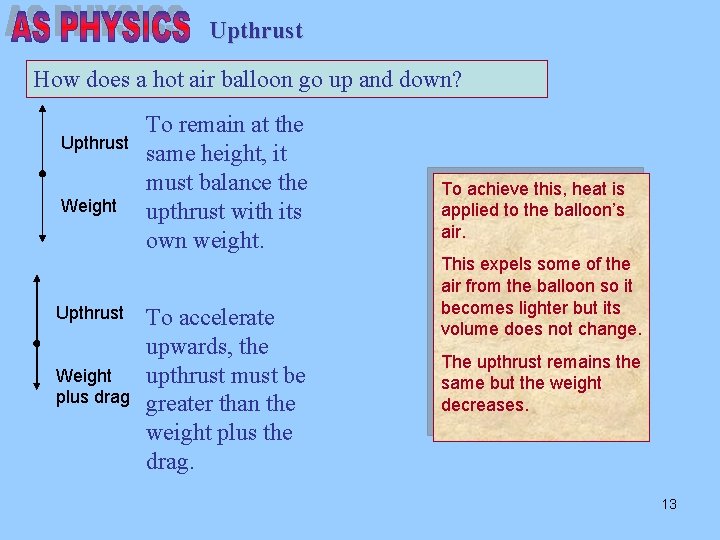
Upthrust How does a hot air balloon go up and down? Upthrust Weight plus drag To remain at the same height, it must balance the upthrust with its own weight. To accelerate upwards, the upthrust must be greater than the weight plus the drag. To achieve this, heat is applied to the balloon’s air. This expels some of the air from the balloon so it becomes lighter but its volume does not change. The upthrust remains the same but the weight decreases. 13
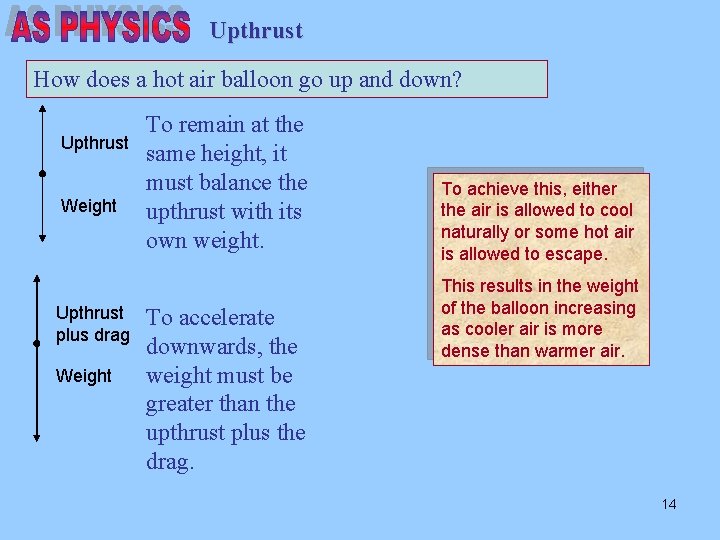
Upthrust How does a hot air balloon go up and down? Upthrust Weight Upthrust plus drag Weight To remain at the same height, it must balance the upthrust with its own weight. To accelerate downwards, the weight must be greater than the upthrust plus the drag. To achieve this, either the air is allowed to cool naturally or some hot air is allowed to escape. This results in the weight of the balloon increasing as cooler air is more dense than warmer air. 14
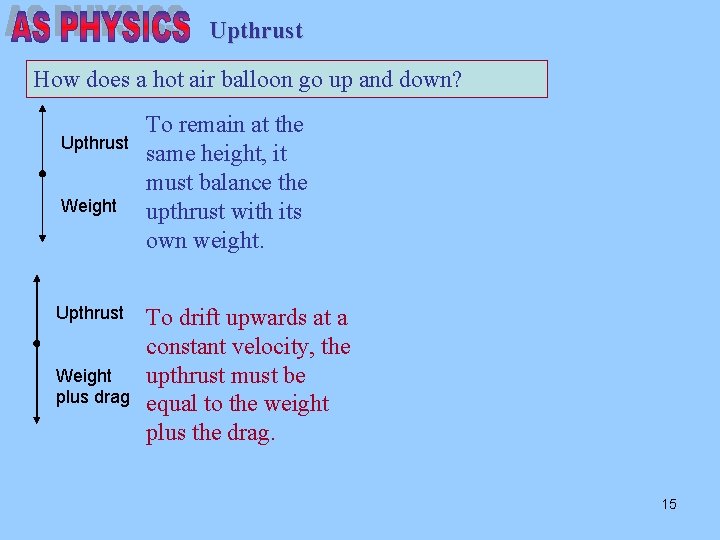
Upthrust How does a hot air balloon go up and down? Upthrust Weight plus drag To remain at the same height, it must balance the upthrust with its own weight. To drift upwards at a constant velocity, the upthrust must be equal to the weight plus the drag. 15
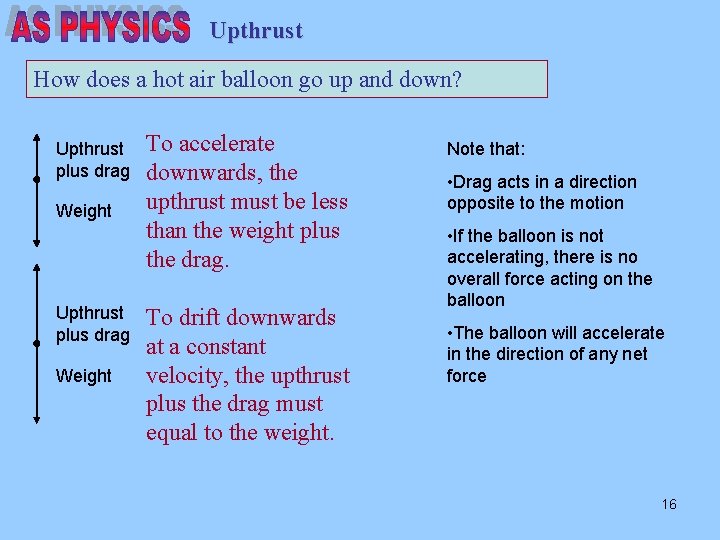
Upthrust How does a hot air balloon go up and down? Upthrust plus drag Weight To accelerate downwards, the upthrust must be less than the weight plus the drag. To drift downwards at a constant velocity, the upthrust plus the drag must equal to the weight. Note that: • Drag acts in a direction opposite to the motion • If the balloon is not accelerating, there is no overall force acting on the balloon • The balloon will accelerate in the direction of any net force 16