
Introducing the Wechsler Individual Achievement Test Third UK
- Slides: 31
Introducing the Wechsler Individual Achievement Test – Third. UK Edition for Teachers WIAT-IIIUK - T Prepared and presented by Dr Pauline M Cogan
Elements of WIAT-IIIUK - T KIT 1. Examiner’s Manual 2. Stimulus Book for q Early Reading Skills q Reading Comprehension 3. Word Card 4. Oral Reading Fluency Booklet 5. WIAT-III UK – T Record Forms 6. Flashdrive
General 1. WIAT-III UK – T Follows on from the successful application of WIAT-II-T by specialist teachers in, particularly in providing evidence for access arrangements. WIAT-III UK – T provides q New and updated subtests q New normative date WIAT-III UK – T provides q Measures of reading & spelling achievements (5 subtests) are required for individuals aged 4 years 0 months to 25 years 11 months
WIAT-IIIUK – T Examiner’s Manual This explains how to: q Administer the test q Score q Interpret the WIAT-III UK – T It includes: q Scoring rules q Scoring examples q Normative tables q Interpretative tables } Manual scoring
WIAT-IIIUK – T Examiner’s Manual q Once familiar with the administration procedures, the examiner will not need to use the manual during the testing session. q The examiner will need to refer to the scoring rules and examples provided in the manual to assist in scoring student responses after testing is completed.
WIAT-IIIUK – T Examiner’s Manual Chapter 1 q Introduction q Information on using the test v v The Manual Content & Structure Application of the WIAT-III – T (e. g. eligibility for RACE etc) General Qualifications for e. g. RACE q User qualifications q User responsibilities
WIAT-IIIUK – T Examiner’s Manual User Qualifications – Individuals who have q Relevant SEN qualifications q Training in the use of individually administered assessment instruments q User qualifications should be congruent with criteria specified for the organisation to which they plan to submit their results.
WIAT-IIIUK – T User Qualifications – Examiners should have training in q q q q Fundamental principles of assessment procedures Ability to establish/maintain rapport Elicit optimum performance Follow standardised administration procedures Understand psychometric statistics Score and interpret tests Maintain test security ONLY individuals who have received professional training in educational or psychological assessment should interpret the results of the WIAT-III UK - T
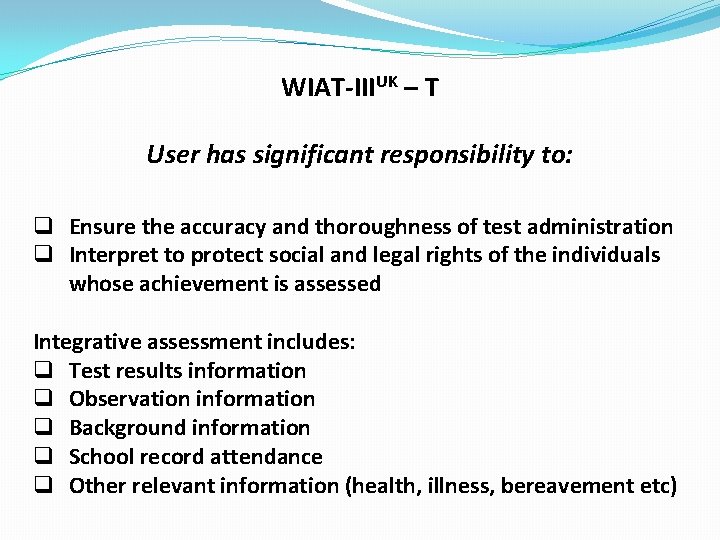
WIAT-IIIUK – T User has significant responsibility to: q Ensure the accuracy and thoroughness of test administration q Interpret to protect social and legal rights of the individuals whose achievement is assessed Integrative assessment includes: q Test results information q Observation information q Background information q School record attendance q Other relevant information (health, illness, bereavement etc)
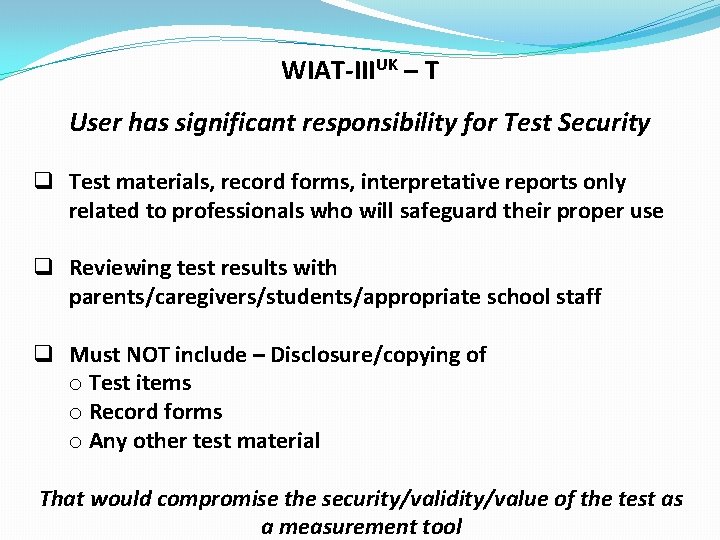
WIAT-IIIUK – T User has significant responsibility for Test Security q Test materials, record forms, interpretative reports only related to professionals who will safeguard their proper use q Reviewing test results with parents/caregivers/students/appropriate school staff q Must NOT include – Disclosure/copying of o Test items o Record forms o Any other test material That would compromise the security/validity/value of the test as a measurement tool
Structure of WIAT-IIIUK – T q 5 Subtests q Flexible approach (1 subtest, a few or all 5 can be administered)
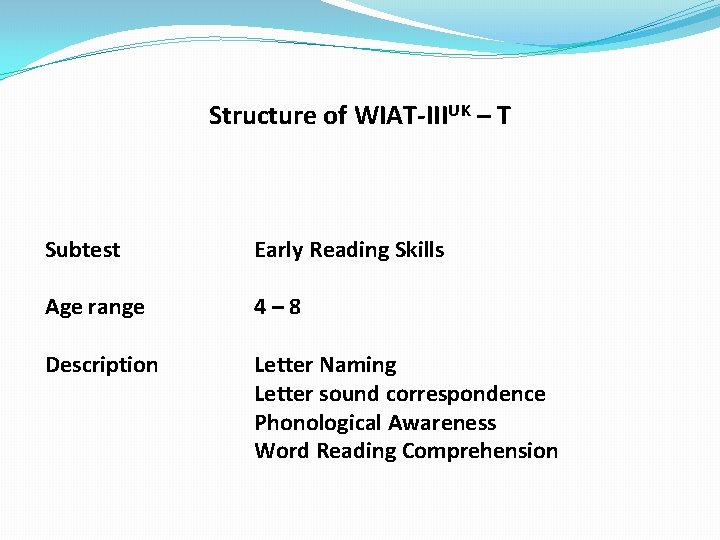
Structure of WIAT-IIIUK – T Subtest Early Reading Skills Age range 4– 8 Description Letter Naming Letter sound correspondence Phonological Awareness Word Reading Comprehension
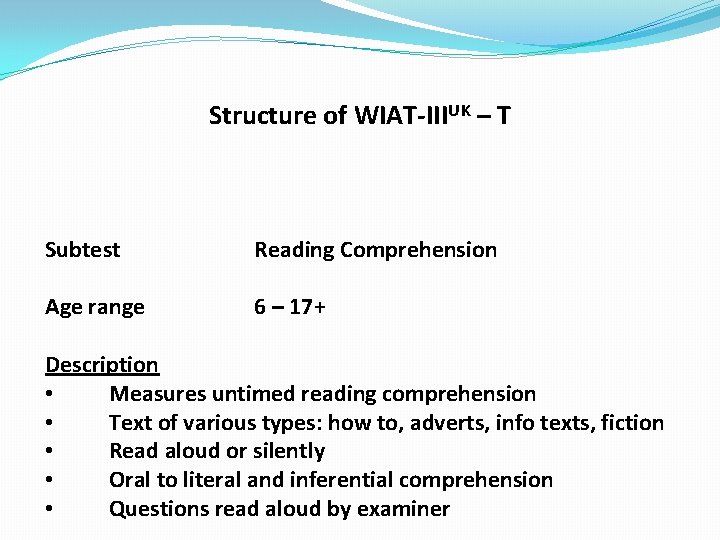
Structure of WIAT-IIIUK – T Subtest Reading Comprehension Age range 6 – 17+ Description • Measures untimed reading comprehension • Text of various types: how to, adverts, info texts, fiction • Read aloud or silently • Oral to literal and inferential comprehension • Questions read aloud by examiner
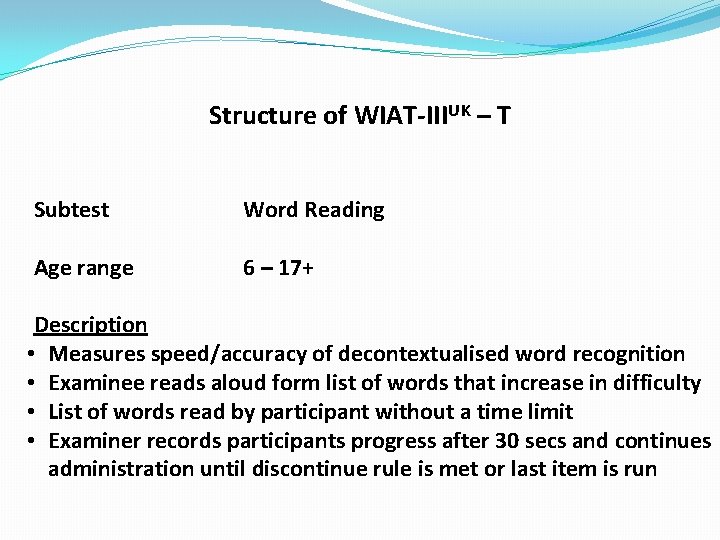
Structure of WIAT-IIIUK – T Subtest Word Reading Age range 6 – 17+ Description • Measures speed/accuracy of decontextualised word recognition • Examinee reads aloud form list of words that increase in difficulty • List of words read by participant without a time limit • Examiner records participants progress after 30 secs and continues administration until discontinue rule is met or last item is run
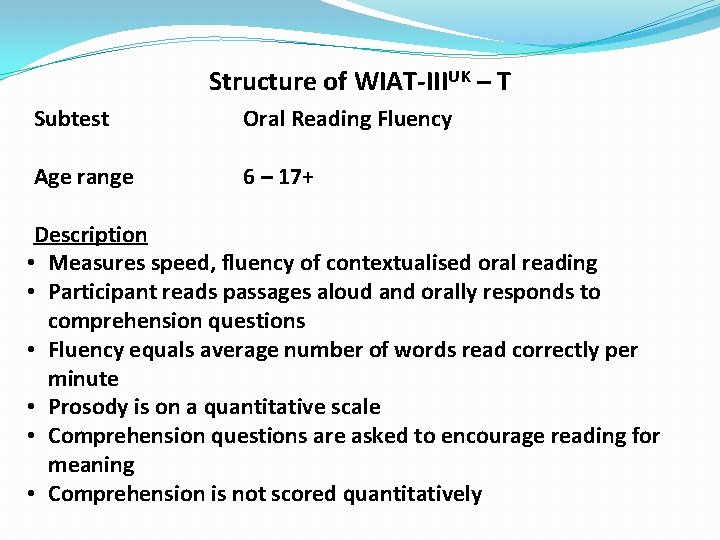
Structure of WIAT-IIIUK – T Subtest Oral Reading Fluency Age range 6 – 17+ Description • Measures speed, fluency of contextualised oral reading • Participant reads passages aloud and orally responds to comprehension questions • Fluency equals average number of words read correctly per minute • Prosody is on a quantitative scale • Comprehension questions are asked to encourage reading for meaning • Comprehension is not scored quantitatively
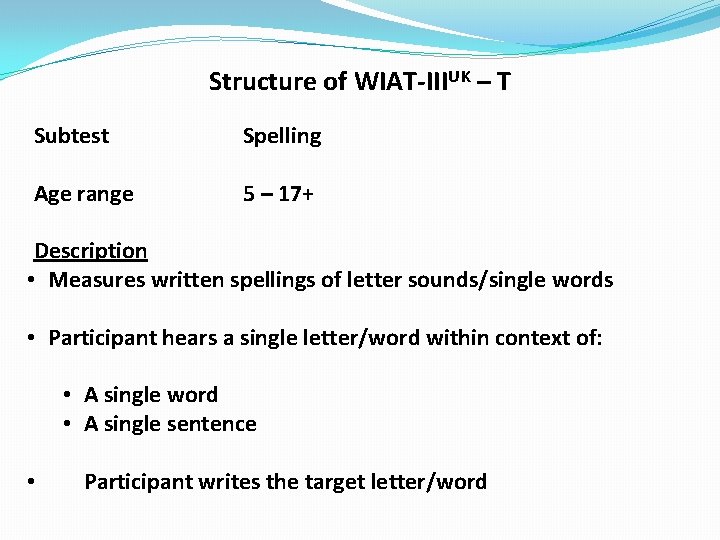
Structure of WIAT-IIIUK – T Subtest Spelling Age range 5 – 17+ Description • Measures written spellings of letter sounds/single words • Participant hears a single letter/word within context of: • A single word • A single sentence • Participant writes the target letter/word
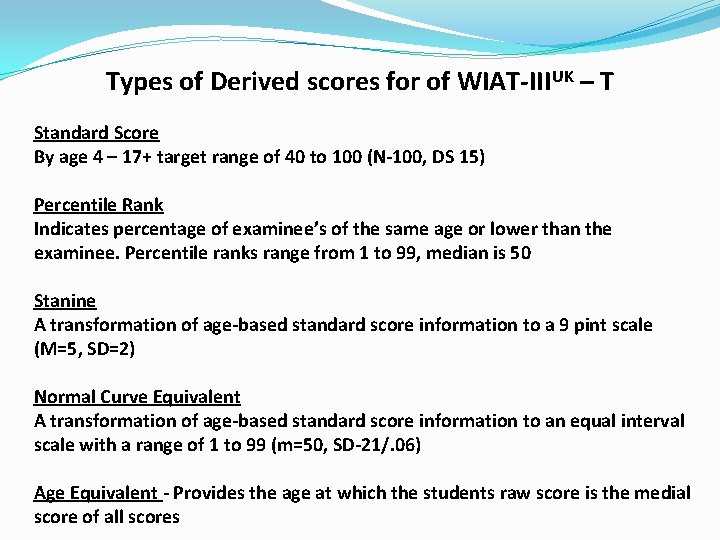
Types of Derived scores for of WIAT-IIIUK – T Standard Score By age 4 – 17+ target range of 40 to 100 (N-100, DS 15) Percentile Rank Indicates percentage of examinee’s of the same age or lower than the examinee. Percentile ranks range from 1 to 99, median is 50 Stanine A transformation of age-based standard score information to a 9 pint scale (M=5, SD=2) Normal Curve Equivalent A transformation of age-based standard score information to an equal interval scale with a range of 1 to 99 (m=50, SD-21/. 06) Age Equivalent - Provides the age at which the students raw score is the medial score of all scores
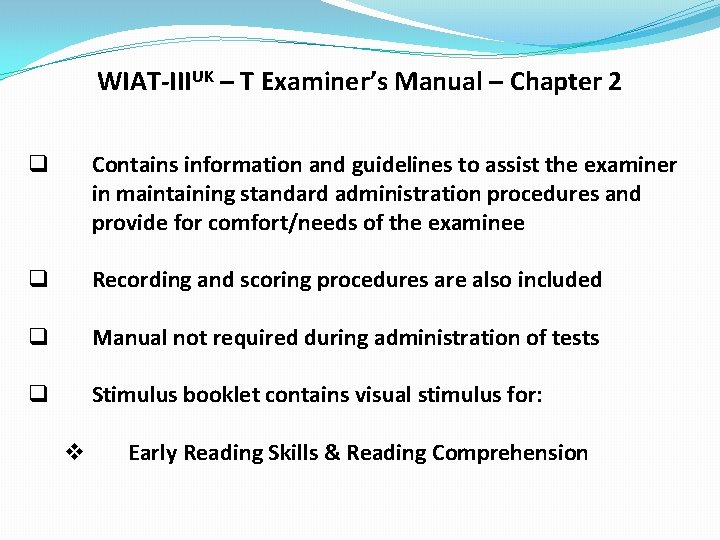
WIAT-IIIUK – T Examiner’s Manual – Chapter 2 q Contains information and guidelines to assist the examiner in maintaining standard administration procedures and provide for comfort/needs of the examinee q Recording and scoring procedures are also included q Manual not required during administration of tests q Stimulus booklet contains visual stimulus for: v Early Reading Skills & Reading Comprehension
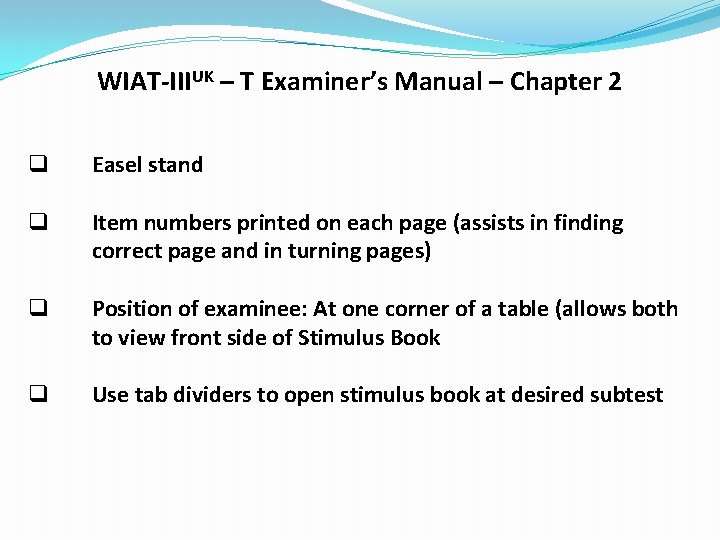
WIAT-IIIUK – T Examiner’s Manual – Chapter 2 q Easel stand q Item numbers printed on each page (assists in finding correct page and in turning pages) q Position of examinee: At one corner of a table (allows both to view front side of Stimulus Book q Use tab dividers to open stimulus book at desired subtest
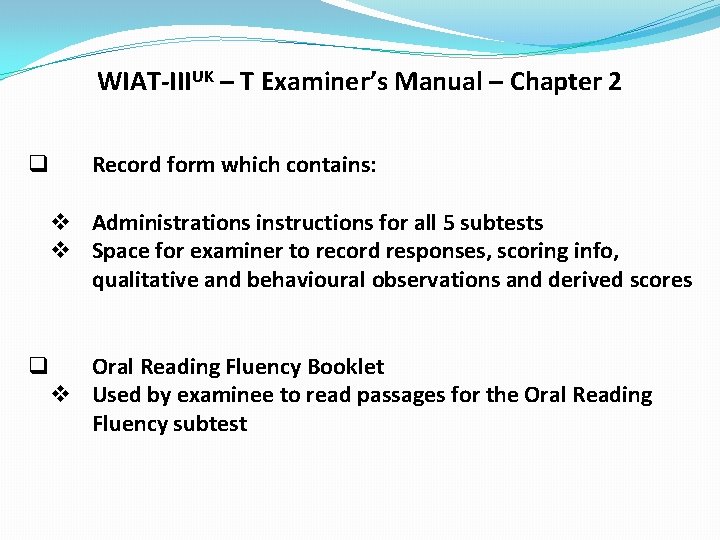
WIAT-IIIUK – T Examiner’s Manual – Chapter 2 q Record form which contains: v Administrations instructions for all 5 subtests v Space for examiner to record responses, scoring info, qualitative and behavioural observations and derived scores q Oral Reading Fluency Booklet v Used by examinee to read passages for the Oral Reading Fluency subtest
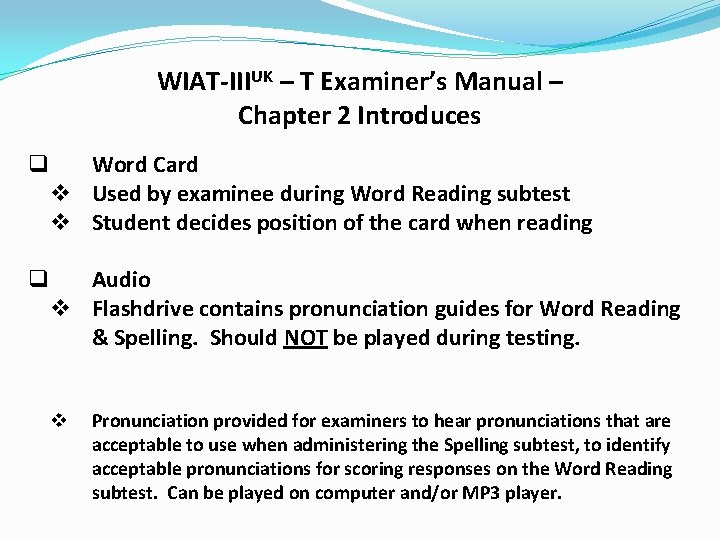
WIAT-IIIUK – T Examiner’s Manual – Chapter 2 Introduces q Word Card v Used by examinee during Word Reading subtest v Student decides position of the card when reading q Audio v Flashdrive contains pronunciation guides for Word Reading & Spelling. Should NOT be played during testing. v Pronunciation provided for examiners to hear pronunciations that are acceptable to use when administering the Spelling subtest, to identify acceptable pronunciations for scoring responses on the Word Reading subtest. Can be played on computer and/or MP 3 player.
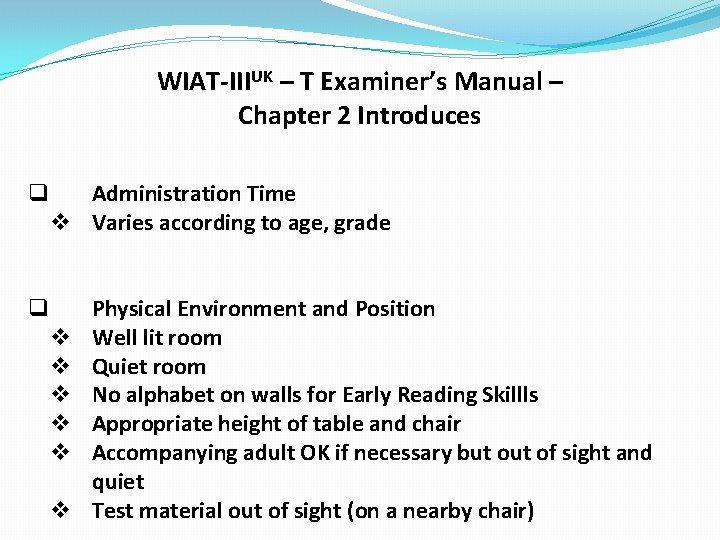
WIAT-IIIUK – T Examiner’s Manual – Chapter 2 Introduces q Administration Time v Varies according to age, grade Physical Environment and Position Well lit room Quiet room No alphabet on walls for Early Reading Skillls Appropriate height of table and chair Accompanying adult OK if necessary but of sight and quiet v Test material out of sight (on a nearby chair) q v v v
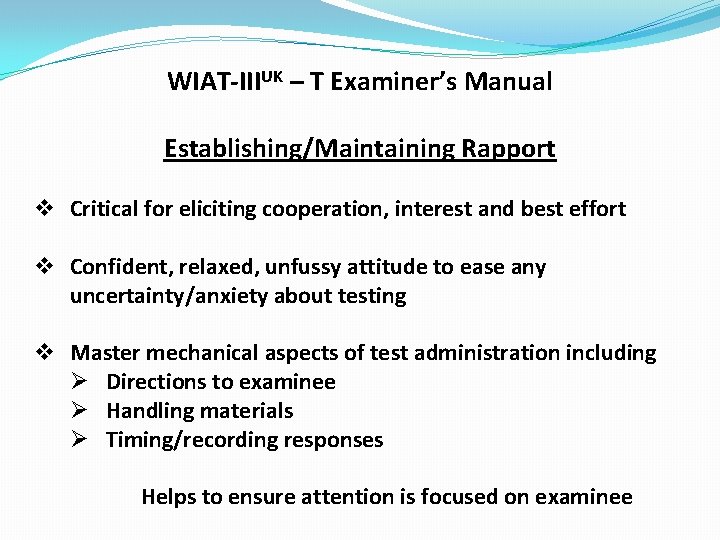
WIAT-IIIUK – T Examiner’s Manual Establishing/Maintaining Rapport v Critical for eliciting cooperation, interest and best effort v Confident, relaxed, unfussy attitude to ease any uncertainty/anxiety about testing v Master mechanical aspects of test administration including Ø Directions to examinee Ø Handling materials Ø Timing/recording responses Helps to ensure attention is focused on examinee
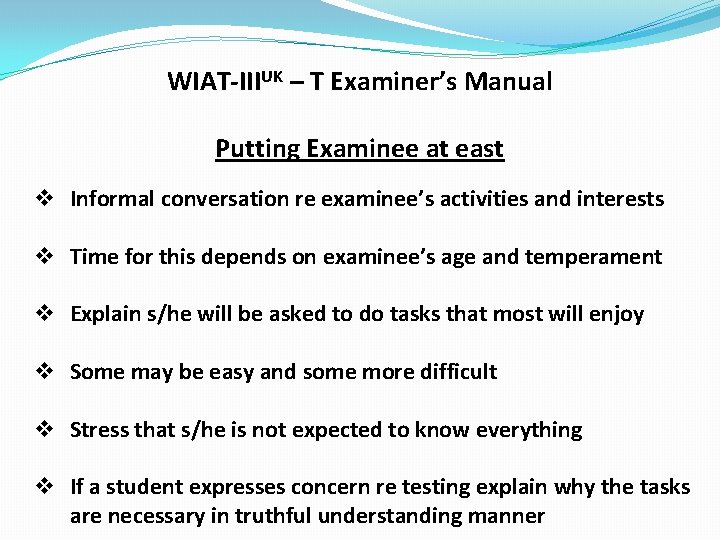
WIAT-IIIUK – T Examiner’s Manual Putting Examinee at east v Informal conversation re examinee’s activities and interests v Time for this depends on examinee’s age and temperament v Explain s/he will be asked to do tasks that most will enjoy v Some may be easy and some more difficult v Stress that s/he is not expected to know everything v If a student expresses concern re testing explain why the tasks are necessary in truthful understanding manner
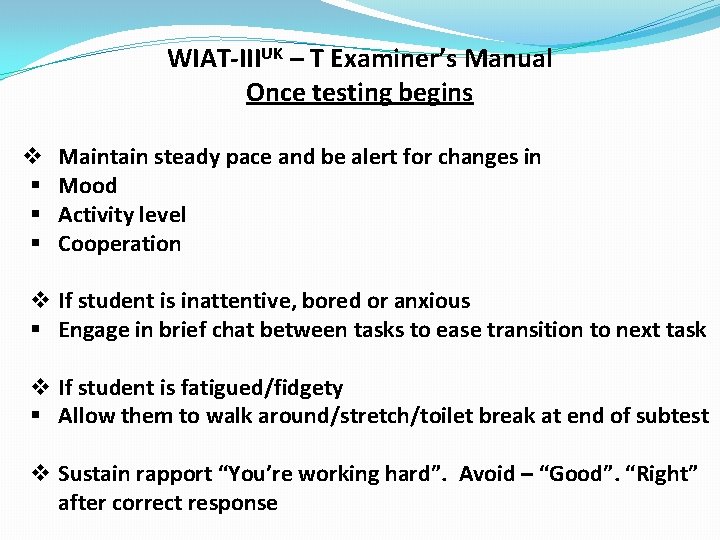
WIAT-IIIUK – T Examiner’s Manual Once testing begins v § § § Maintain steady pace and be alert for changes in Mood Activity level Cooperation v If student is inattentive, bored or anxious § Engage in brief chat between tasks to ease transition to next task v If student is fatigued/fidgety § Allow them to walk around/stretch/toilet break at end of subtest v Sustain rapport “You’re working hard”. Avoid – “Good”. “Right” after correct response
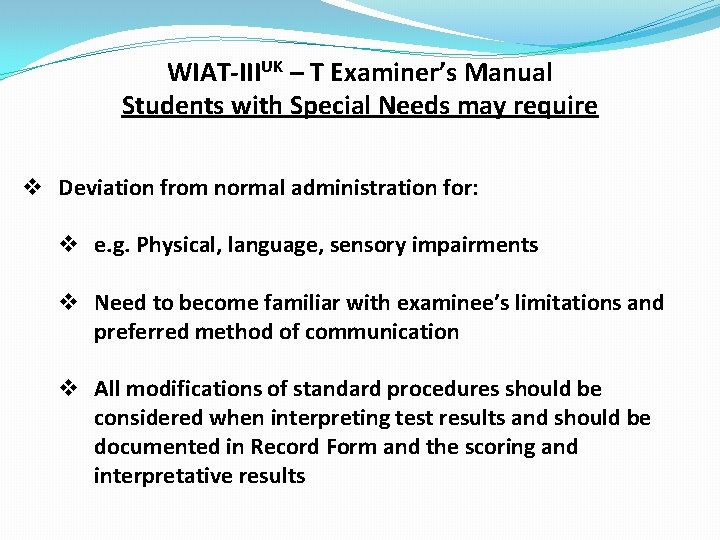
WIAT-IIIUK – T Examiner’s Manual Students with Special Needs may require v Deviation from normal administration for: v e. g. Physical, language, sensory impairments v Need to become familiar with examinee’s limitations and preferred method of communication v All modifications of standard procedures should be considered when interpreting test results and should be documented in Record Form and the scoring and interpretative results
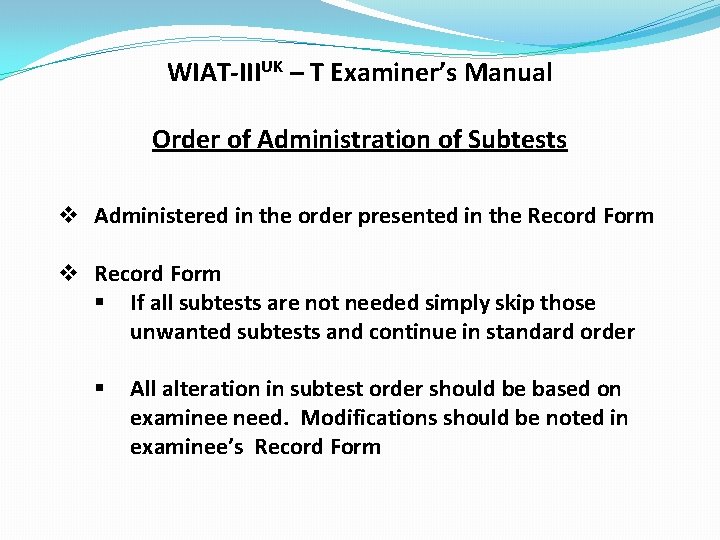
WIAT-IIIUK – T Examiner’s Manual Order of Administration of Subtests v Administered in the order presented in the Record Form v Record Form § If all subtests are not needed simply skip those unwanted subtests and continue in standard order § All alteration in subtest order should be based on examinee need. Modifications should be noted in examinee’s Record Form
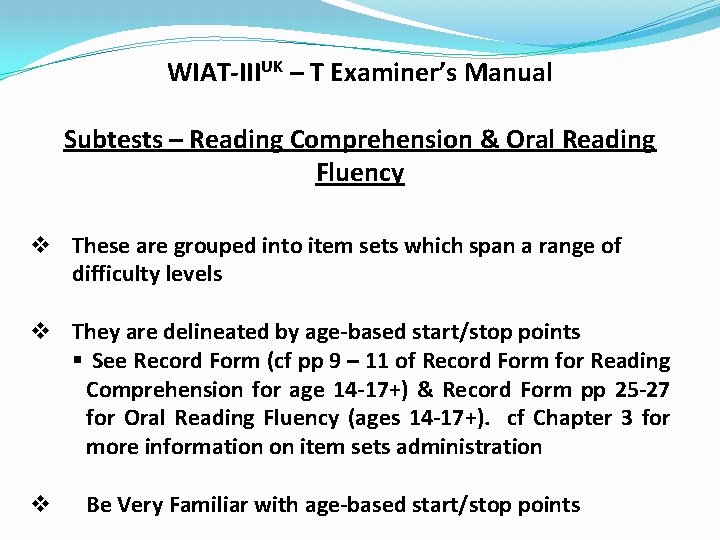
WIAT-IIIUK – T Examiner’s Manual Subtests – Reading Comprehension & Oral Reading Fluency v These are grouped into item sets which span a range of difficulty levels v They are delineated by age-based start/stop points § See Record Form (cf pp 9 – 11 of Record Form for Reading Comprehension for age 14 -17+) & Record Form pp 25 -27 for Oral Reading Fluency (ages 14 -17+). cf Chapter 3 for more information on item sets administration v Be Very Familiar with age-based start/stop points
WIAT-IIIUK – T Examiner’s Manual ü Be Familiar with Symbols for: v v Start Points Reverse Rules Discontinue Rule Stop Points ü These are incorporated in the subtests to shorten testing time and to avoid examinee frustration, fatigue or boredom
WIAT-IIIUK – T Examiner’s Manual ü Start Points – this is determined by examinee’s age ü Reverse Rules – You must familiarise yourself with relevant subtest Reverse Rules ü Recording and Scoring – You must familiarise yourself with Recording and Scoring relevant subtests
Acknowledgement Many thanks to ETC Consult for providing me with this test kit to facilitate the preparation of the presentation today.