
Introducing the Specifications of the Metro Ethernet Forum
- Slides: 13
Introducing the Specifications of the Metro Ethernet Forum 1
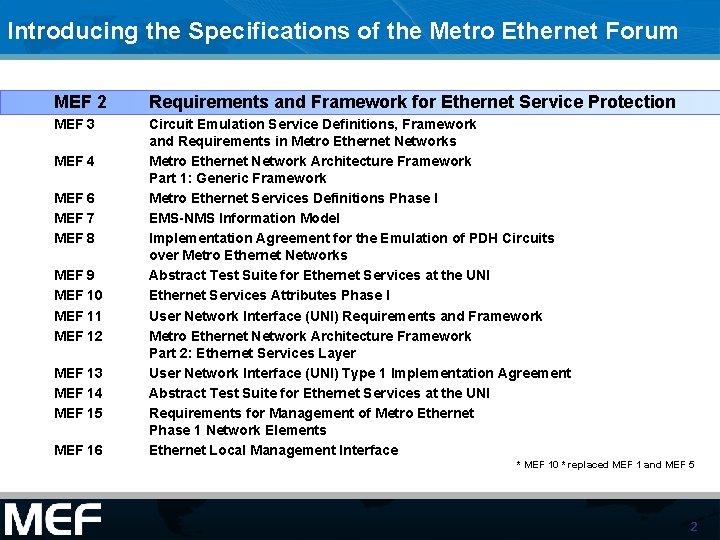
Introducing the Specifications of the Metro Ethernet Forum MEF 2 Requirements and Framework for Ethernet Service Protection MEF 3 Circuit Emulation Service Definitions, Framework and Requirements in Metro Ethernet Networks Metro Ethernet Network Architecture Framework Part 1: Generic Framework Metro Ethernet Services Definitions Phase I EMS-NMS Information Model Implementation Agreement for the Emulation of PDH Circuits over Metro Ethernet Networks Abstract Test Suite for Ethernet Services at the UNI Ethernet Services Attributes Phase I User Network Interface (UNI) Requirements and Framework Metro Ethernet Network Architecture Framework Part 2: Ethernet Services Layer User Network Interface (UNI) Type 1 Implementation Agreement Abstract Test Suite for Ethernet Services at the UNI Requirements for Management of Metro Ethernet Phase 1 Network Elements Ethernet Local Management Interface MEF 4 MEF 6 MEF 7 MEF 8 MEF 9 MEF 10 MEF 11 MEF 12 MEF 13 MEF 14 MEF 15 MEF 16 * MEF 10 * replaced MEF 1 and MEF 5 2
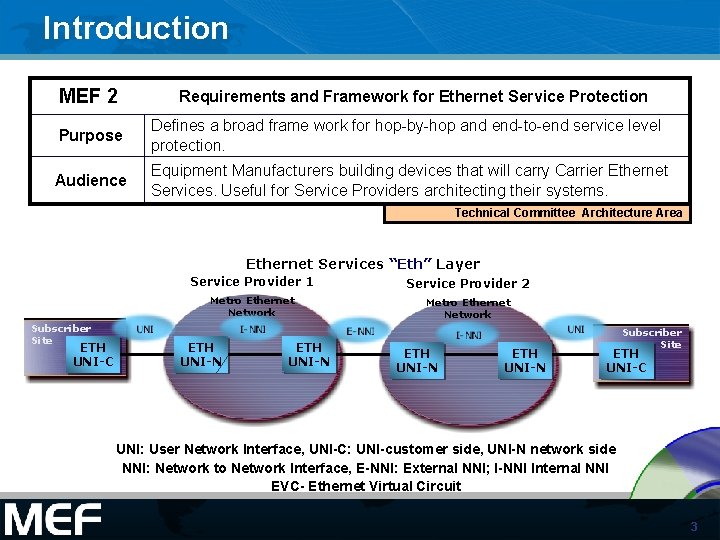
Introduction MEF 2 Requirements and Framework for Ethernet Service Protection Purpose Defines a broad frame work for hop-by-hop and end-to-end service level protection. Audience Equipment Manufacturers building devices that will carry Carrier Ethernet Services. Useful for Service Providers architecting their systems. Technical Committee Architecture Area Ethernet Services “Eth” Layer Subscriber Site ETH UNI-C Service Provider 1 Service Provider 2 Metro Ethernet Network ETH UNI-N Subscriber Site ETH UNI-C UNI: User Network Interface, UNI-C: UNI-customer side, UNI-N network side NNI: Network to Network Interface, E-NNI: External NNI; I-NNI Internal NNI EVC- Ethernet Virtual Circuit 3
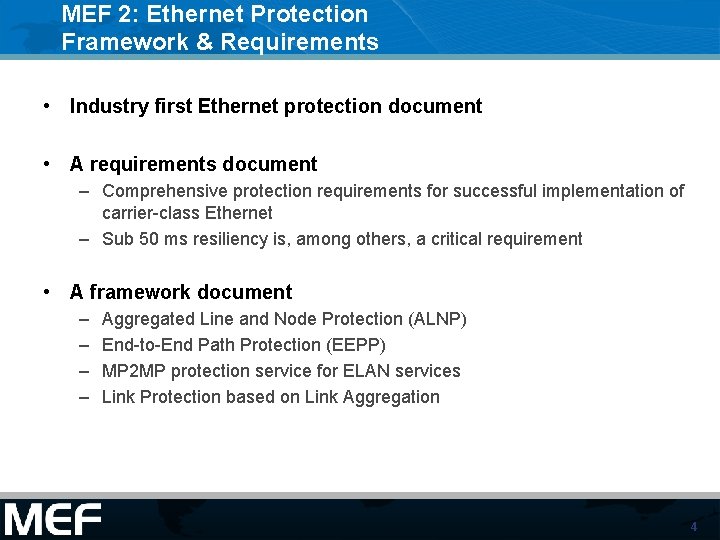
MEF 2: Ethernet Protection Framework & Requirements • Industry first Ethernet protection document • A requirements document – Comprehensive protection requirements for successful implementation of carrier-class Ethernet – Sub 50 ms resiliency is, among others, a critical requirement • A framework document – – Aggregated Line and Node Protection (ALNP) End-to-End Path Protection (EEPP) MP 2 MP protection service for ELAN services Link Protection based on Link Aggregation 4
MEF Protection Framework • MEF 2 Defines a broad frame work for hop by hop and end to end service level protection – It defines a standardized list of terms to enable SLAs to be well defined around protection events – It allows the MEN to leverage any underlying transport layer protection type if it can enable end to end service protection 5
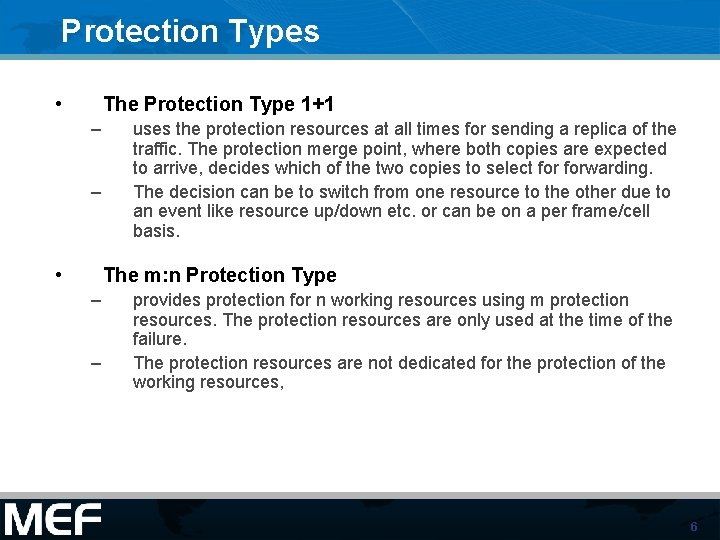
Protection Types • The Protection Type 1+1 – – • uses the protection resources at all times for sending a replica of the traffic. The protection merge point, where both copies are expected to arrive, decides which of the two copies to select forwarding. The decision can be to switch from one resource to the other due to an event like resource up/down etc. or can be on a per frame/cell basis. The m: n Protection Type – – provides protection for n working resources using m protection resources. The protection resources are only used at the time of the failure. The protection resources are not dedicated for the protection of the working resources, 6
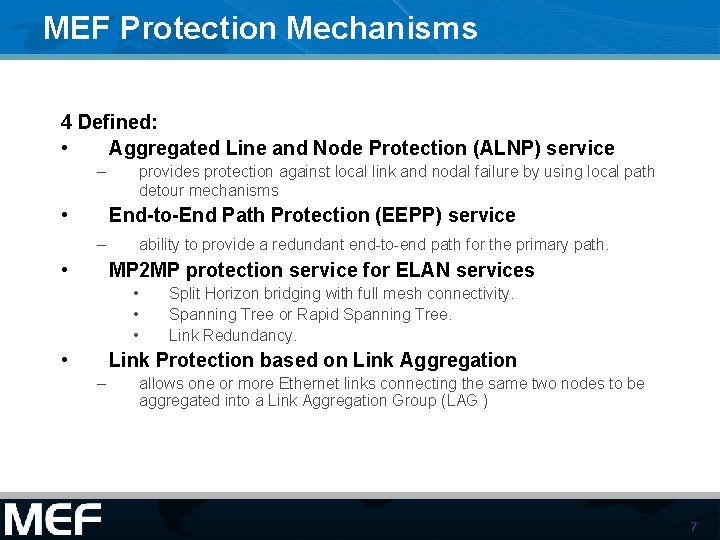
MEF Protection Mechanisms 4 Defined: • Aggregated Line and Node Protection (ALNP) service – • provides protection against local link and nodal failure by using local path detour mechanisms End-to-End Path Protection (EEPP) service – • ability to provide a redundant end-to-end path for the primary path. MP 2 MP protection service for ELAN services • • Split Horizon bridging with full mesh connectivity. Spanning Tree or Rapid Spanning Tree. Link Redundancy. Link Protection based on Link Aggregation – allows one or more Ethernet links connecting the same two nodes to be aggregated into a Link Aggregation Group (LAG ) 7
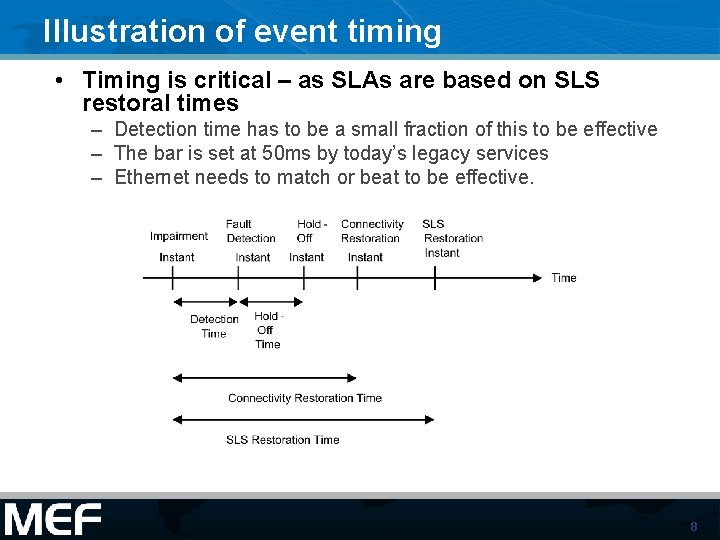
Illustration of event timing • Timing is critical – as SLAs are based on SLS restoral times – Detection time has to be a small fraction of this to be effective – The bar is set at 50 ms by today’s legacy services – Ethernet needs to match or beat to be effective. 8
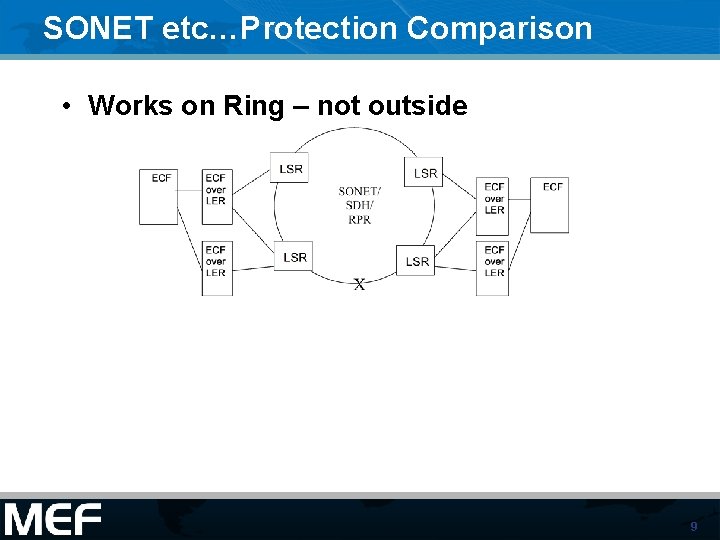
SONET etc…Protection Comparison • Works on Ring – not outside 9
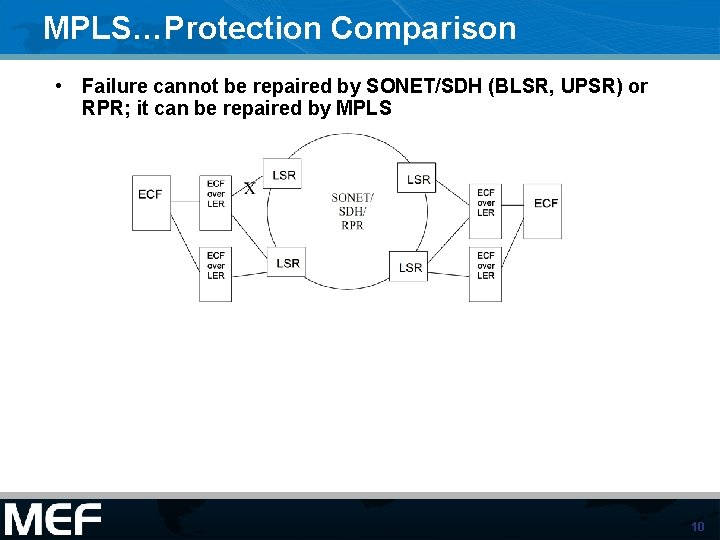
MPLS…Protection Comparison • Failure cannot be repaired by SONET/SDH (BLSR, UPSR) or RPR; it can be repaired by MPLS 10
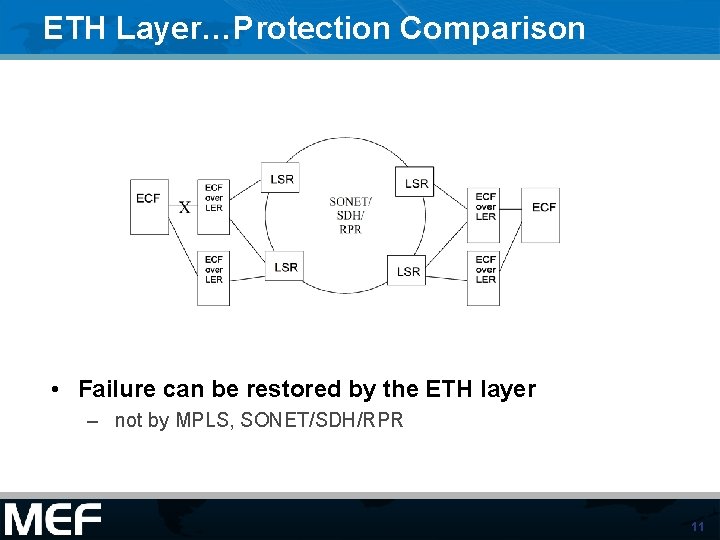
ETH Layer…Protection Comparison • Failure can be restored by the ETH layer – not by MPLS, SONET/SDH/RPR 11
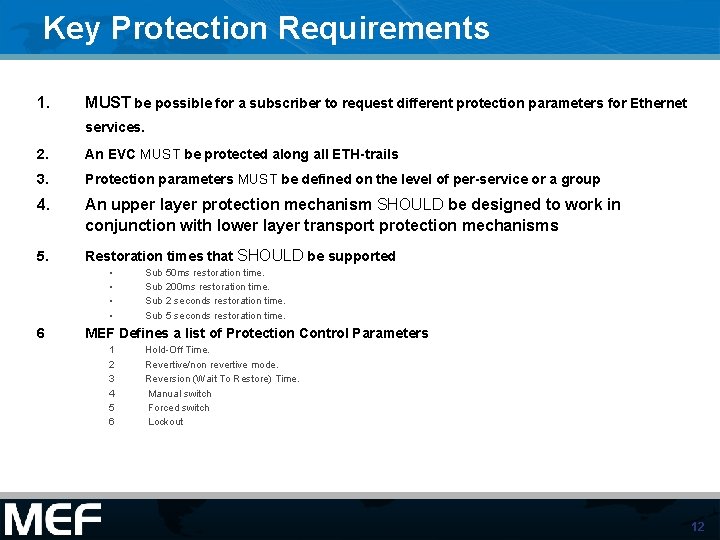
Key Protection Requirements 1. MUST be possible for a subscriber to request different protection parameters for Ethernet services. 2. An EVC MUST be protected along all ETH-trails 3. Protection parameters MUST be defined on the level of per-service or a group 4. An upper layer protection mechanism SHOULD be designed to work in conjunction with lower layer transport protection mechanisms 5. Restoration times that SHOULD be supported • • 6 Sub 50 ms restoration time. Sub 200 ms restoration time. Sub 2 seconds restoration time. Sub 5 seconds restoration time. MEF Defines a list of Protection Control Parameters 1 2 3 4 5 6 Hold-Off Time. Revertive/non revertive mode. Reversion (Wait To Restore) Time. Manual switch Forced switch Lockout 12
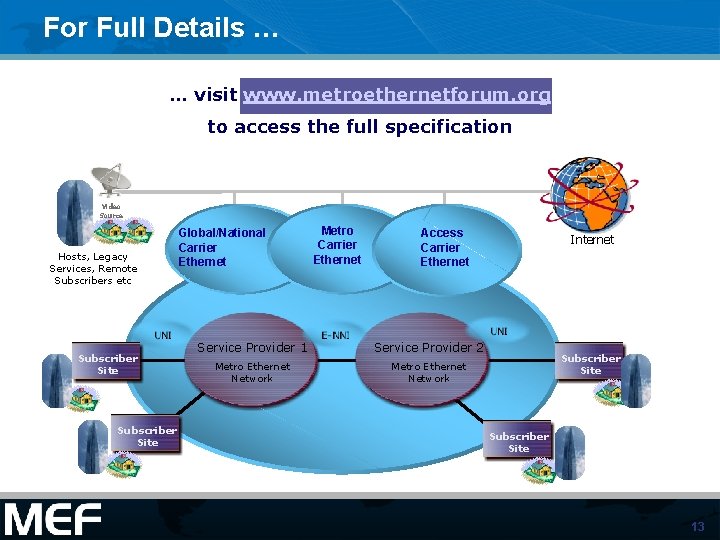
For Full Details … … visit www. metroethernetforum. org to access the full specification Video Source Hosts, Legacy Services, Remote Subscribers etc Subscriber Site Global/National Carrier Ethernet Metro Carrier Ethernet Access Carrier Ethernet Service Provider 1 Service Provider 2 Metro Ethernet Network Internet Subscriber Site 13