
Introducing the Specifications of the MEF 54 Ethernet

- Slides: 33
Introducing the Specifications of the MEF 54: Ethernet Interconnection Point (EIP): An ENNI Implementation Agreement April 2016
MEF Reference Presentations • Intention – These MEF reference presentations are intended to give general overviews of the MEF work and have been approved by the MEF Marketing Committee – Further details on the topic are to be found in related specifications, technical overviews, white papers in the MEF public site Information Center: http: //www. mef. net/carrier-ethernet/technical-specifications 2
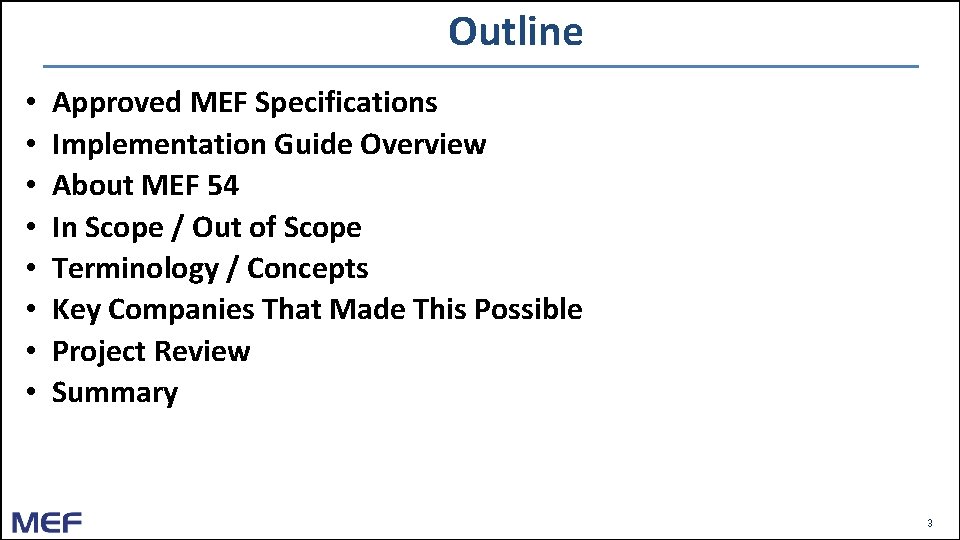
Outline • • Approved MEF Specifications Implementation Guide Overview About MEF 54 In Scope / Out of Scope Terminology / Concepts Key Companies That Made This Possible Project Review Summary 3
Approved MEF Specifications* Specification Description MEF 2 Requirements and Framework for Ethernet Service Protection MEF 3 Circuit Emulation Service Definitions, Framework and Requirements in Metro Ethernet Networks MEF 4 Metro Ethernet Network Architecture Framework Part 1: Generic Framework MEF 6. 2 EVC Ethernet Services Definitions Phase 3 MEF 7. 2 Carrier Ethernet Information Model MEF 8 Implementation Agreement for the Emulation of PDH Circuits over Metro Ethernet Networks MEF 9 Abstract Test Suite for Ethernet Services at the UNI MEF 10. 3 Ethernet Services Attributes Phase 3 MEF 11 User Network Interface (UNI) Requirements and Framework MEF 12. 2 Carrier Ethernet Network Architecture Framework Part 2: Ethernet Services Layer MEF 13 User Network Interface (UNI) Type 1 Implementation Agreement MEF 14 Abstract Test Suite for Traffic Management Phase 1 MEF 15 Requirements for Management of Metro Ethernet Phase 1 Network Elements MEF 16 Ethernet Local Management Interface MEF 17 Service OAM Framework and Requirements *Current at time of publication. See MEF web site for official current list, minor updates and superseded work (such as MEF 1 and MEF 5) 4
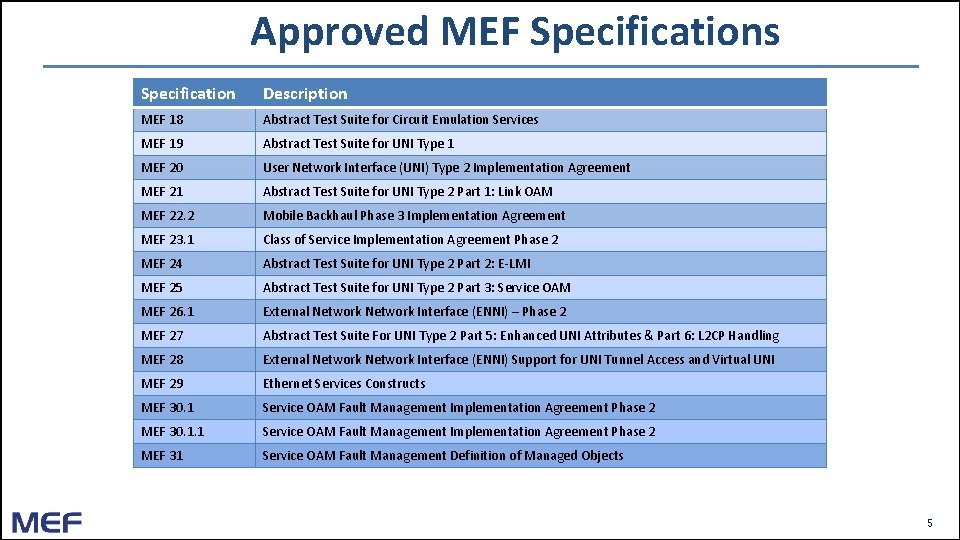
Approved MEF Specifications Specification Description MEF 18 Abstract Test Suite for Circuit Emulation Services MEF 19 Abstract Test Suite for UNI Type 1 MEF 20 User Network Interface (UNI) Type 2 Implementation Agreement MEF 21 Abstract Test Suite for UNI Type 2 Part 1: Link OAM MEF 22. 2 Mobile Backhaul Phase 3 Implementation Agreement MEF 23. 1 Class of Service Implementation Agreement Phase 2 MEF 24 Abstract Test Suite for UNI Type 2 Part 2: E-LMI MEF 25 Abstract Test Suite for UNI Type 2 Part 3: Service OAM MEF 26. 1 External Network Interface (ENNI) – Phase 2 MEF 27 Abstract Test Suite For UNI Type 2 Part 5: Enhanced UNI Attributes & Part 6: L 2 CP Handling MEF 28 External Network Interface (ENNI) Support for UNI Tunnel Access and Virtual UNI MEF 29 Ethernet Services Constructs MEF 30. 1 Service OAM Fault Management Implementation Agreement Phase 2 MEF 30. 1. 1 Service OAM Fault Management Implementation Agreement Phase 2 MEF 31 Service OAM Fault Management Definition of Managed Objects 5
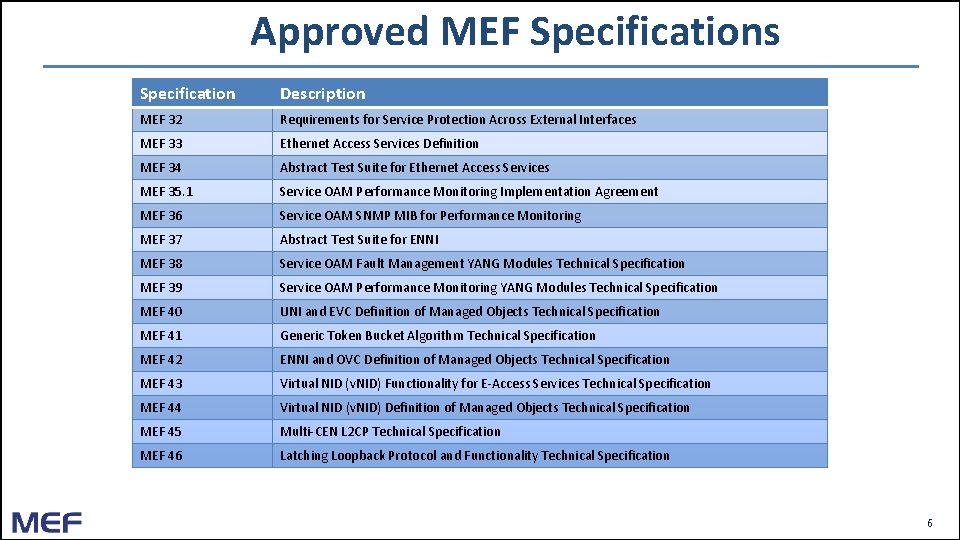
Approved MEF Specifications Specification Description MEF 32 Requirements for Service Protection Across External Interfaces MEF 33 Ethernet Access Services Definition MEF 34 Abstract Test Suite for Ethernet Access Services MEF 35. 1 Service OAM Performance Monitoring Implementation Agreement MEF 36 Service OAM SNMP MIB for Performance Monitoring MEF 37 Abstract Test Suite for ENNI MEF 38 Service OAM Fault Management YANG Modules Technical Specification MEF 39 Service OAM Performance Monitoring YANG Modules Technical Specification MEF 40 UNI and EVC Definition of Managed Objects Technical Specification MEF 41 Generic Token Bucket Algorithm Technical Specification MEF 42 ENNI and OVC Definition of Managed Objects Technical Specification MEF 43 Virtual NID (v. NID) Functionality for E-Access Services Technical Specification MEF 44 Virtual NID (v. NID) Definition of Managed Objects Technical Specification MEF 45 Multi-CEN L 2 CP Technical Specification MEF 46 Latching Loopback Protocol and Functionality Technical Specification 6
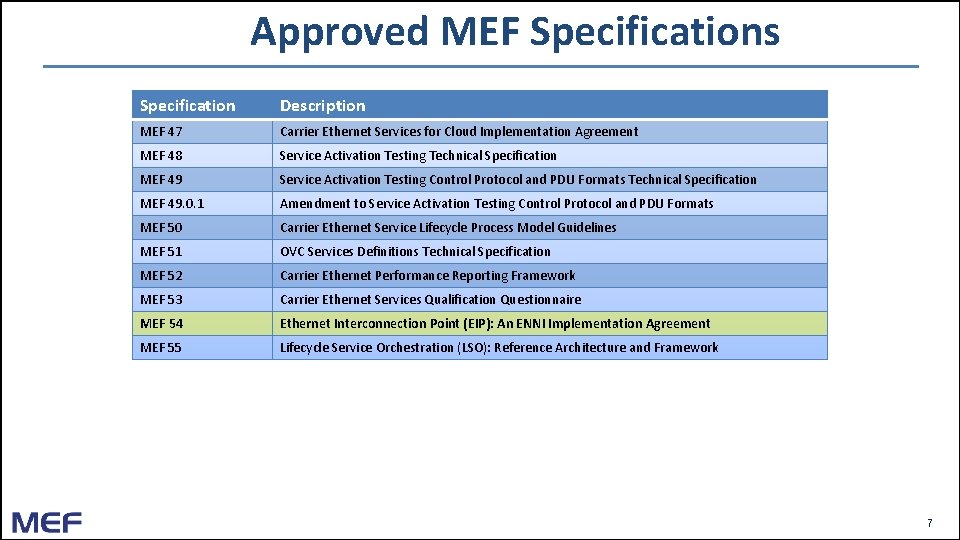
Approved MEF Specifications Specification Description MEF 47 Carrier Ethernet Services for Cloud Implementation Agreement MEF 48 Service Activation Testing Technical Specification MEF 49 Service Activation Testing Control Protocol and PDU Formats Technical Specification MEF 49. 0. 1 Amendment to Service Activation Testing Control Protocol and PDU Formats MEF 50 Carrier Ethernet Service Lifecycle Process Model Guidelines MEF 51 OVC Services Definitions Technical Specification MEF 52 Carrier Ethernet Performance Reporting Framework MEF 53 Carrier Ethernet Services Qualification Questionnaire MEF 54 Ethernet Interconnection Point (EIP): An ENNI Implementation Agreement MEF 55 Lifecycle Service Orchestration (LSO): Reference Architecture and Framework 7
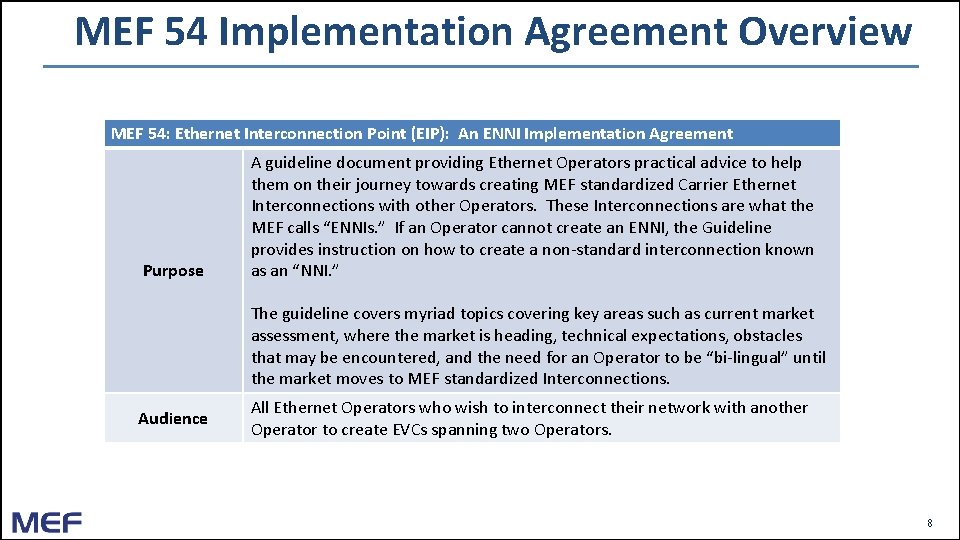
MEF 54 Implementation Agreement Overview MEF 54: Ethernet Interconnection Point (EIP): An ENNI Implementation Agreement Purpose A guideline document providing Ethernet Operators practical advice to help them on their journey towards creating MEF standardized Carrier Ethernet Interconnections with other Operators. These Interconnections are what the MEF calls “ENNIs. ” If an Operator cannot create an ENNI, the Guideline provides instruction on how to create a non-standard interconnection known as an “NNI. ” The guideline covers myriad topics covering key areas such as current market assessment, where the market is heading, technical expectations, obstacles that may be encountered, and the need for an Operator to be “bi-lingual” until the market moves to MEF standardized Interconnections. Audience All Ethernet Operators who wish to interconnect their network with another Operator to create EVCs spanning two Operators. 8
Overview of MEF 54 Ethernet Interconnection Point (EIP): An ENNI Implementation Agreement
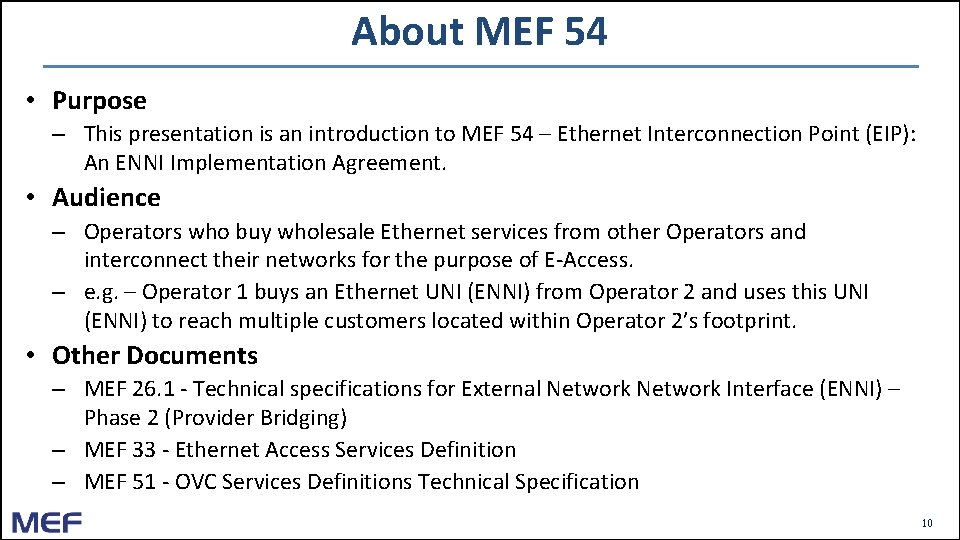
About MEF 54 • Purpose – This presentation is an introduction to MEF 54 – Ethernet Interconnection Point (EIP): An ENNI Implementation Agreement. • Audience – Operators who buy wholesale Ethernet services from other Operators and interconnect their networks for the purpose of E-Access. – e. g. – Operator 1 buys an Ethernet UNI (ENNI) from Operator 2 and uses this UNI (ENNI) to reach multiple customers located within Operator 2’s footprint. • Other Documents – MEF 26. 1 - Technical specifications for External Network Interface (ENNI) – Phase 2 (Provider Bridging) – MEF 33 - Ethernet Access Services Definition – MEF 51 - OVC Services Definitions Technical Specification 10
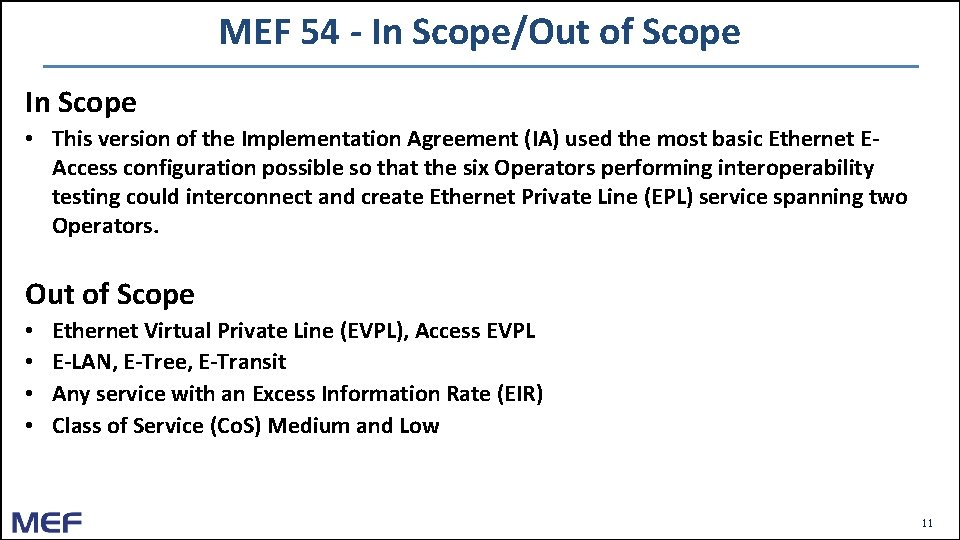
MEF 54 - In Scope/Out of Scope In Scope • This version of the Implementation Agreement (IA) used the most basic Ethernet EAccess configuration possible so that the six Operators performing interoperability testing could interconnect and create Ethernet Private Line (EPL) service spanning two Operators. Out of Scope • • Ethernet Virtual Private Line (EVPL), Access EVPL E-LAN, E-Tree, E-Transit Any service with an Excess Information Rate (EIR) Class of Service (Co. S) Medium and Low 11
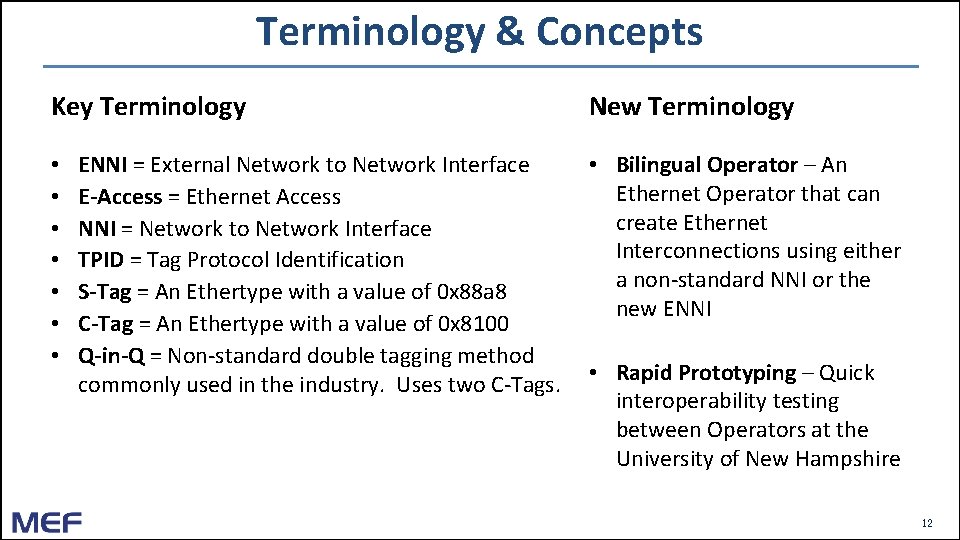
Terminology & Concepts Key Terminology • • ENNI = External Network to Network Interface E-Access = Ethernet Access NNI = Network to Network Interface TPID = Tag Protocol Identification S-Tag = An Ethertype with a value of 0 x 88 a 8 C-Tag = An Ethertype with a value of 0 x 8100 Q-in-Q = Non-standard double tagging method commonly used in the industry. Uses two C-Tags. New Terminology • Bilingual Operator – An Ethernet Operator that can create Ethernet Interconnections using either a non-standard NNI or the new ENNI • Rapid Prototyping – Quick interoperability testing between Operators at the University of New Hampshire 12
Key Companies That Made This Possible • This project relied heavily upon the six Operators who donated time, talent, and a spirit of mutual respect and cooperation to moving the industry forward (AT&T, Frontier, Century. Link, Tele. Pacific, Verizon, Windstream) – Thank you! • This Project relied heavily upon the testing (rapid prototyping) conducted at the University of New Hampshire’s Interoperability Lab – Thank you! • This project relied heavily upon the equipment vendors who donated time and equipment to facilitate the testing at UNH Lab (Accedian, Alcatel. Lucent, Canoga Perkins, Ciena, Cisco, Juniper, RAD) – Thank you! • This project relied heavily upon Veryx technologies to measure performance between Operators during testing – Thank you! 13
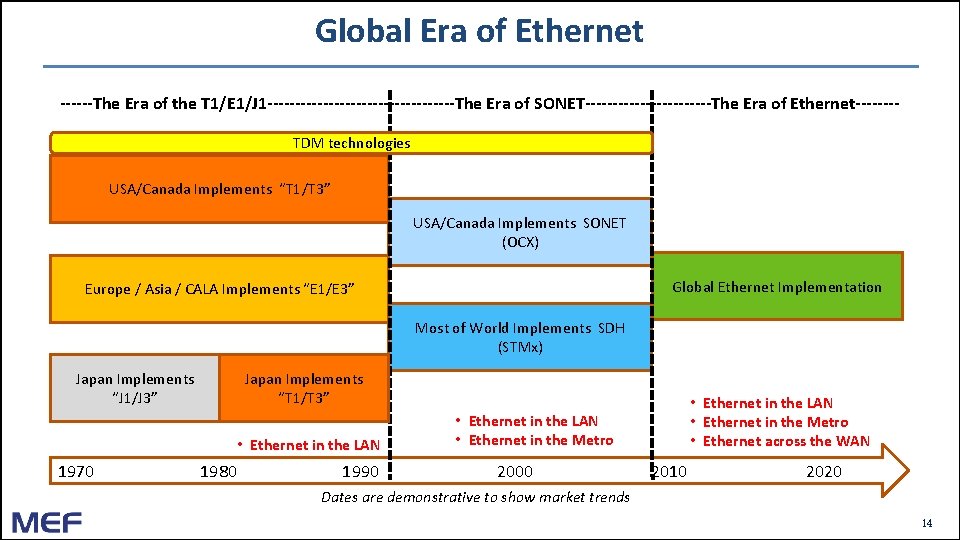
Global Era of Ethernet ------The Era of the T 1/E 1/J 1 -----------------The Era of SONET------------The Era of Ethernet---- TDM technologies USA/Canada Implements “T 1/T 3” USA/Canada Implements SONET (OCX) Global Ethernet Implementation Europe / Asia / CALA Implements “E 1/E 3” Most of World Implements SDH (STMx) Japan Implements “J 1/J 3” Japan Implements “T 1/T 3” • Ethernet in the LAN • Ethernet in the Metro • Ethernet across the WAN 1970 1980 1990 2000 2010 2020 Dates are demonstrative to show market trends 14
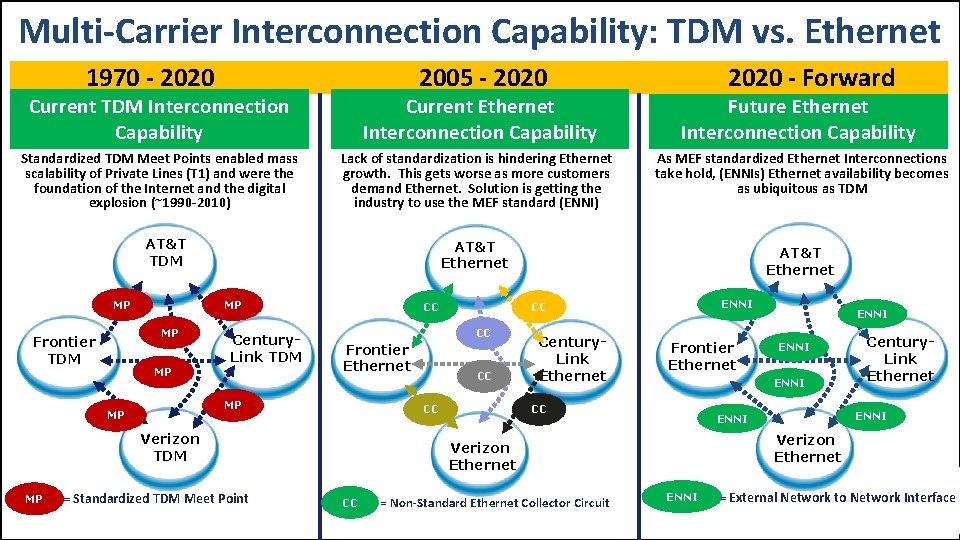
Multi-Carrier Interconnection Capability: TDM vs. Ethernet 1970 - 2020 2005 - 2020 2020 - Forward Future Ethernet Interconnection Capability Current TDM Interconnection Capability Current Ethernet Interconnection Capability Standardized TDM Meet Points enabled mass scalability of Private Lines (T 1) and were the foundation of the Internet and the digital explosion (~1990 -2010) Lack of standardization is hindering Ethernet growth. This gets worse as more customers demand Ethernet. Solution is getting the industry to use the MEF standard (ENNI) As MEF standardized Ethernet Interconnections take hold, (ENNIs) Ethernet availability becomes as ubiquitous as TDM AT&T Ethernet AT&T TDM MP MP MP Frontier TDM Century. Link TDM MP CC CC Frontier Ethernet MP MP MP = Standardized TDM Meet Point CC CC Verizon TDM ENNI CC Century. Link Ethernet Frontier Ethernet CC = Non-Standard Ethernet Collector Circuit ENNI Century. Link Ethernet ENNI Verizon Ethernet CC ENNI = External Network to Network Interface
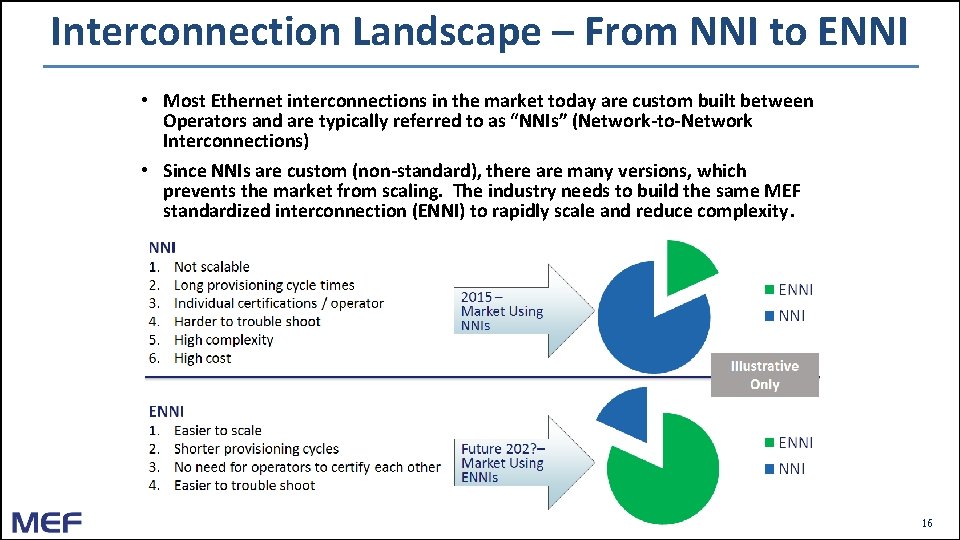
Interconnection Landscape – From NNI to ENNI • Most Ethernet interconnections in the market today are custom built between Operators and are typically referred to as “NNIs” (Network-to-Network Interconnections) • Since NNIs are custom (non-standard), there are many versions, which prevents the market from scaling. The industry needs to build the same MEF standardized interconnection (ENNI) to rapidly scale and reduce complexity. 16
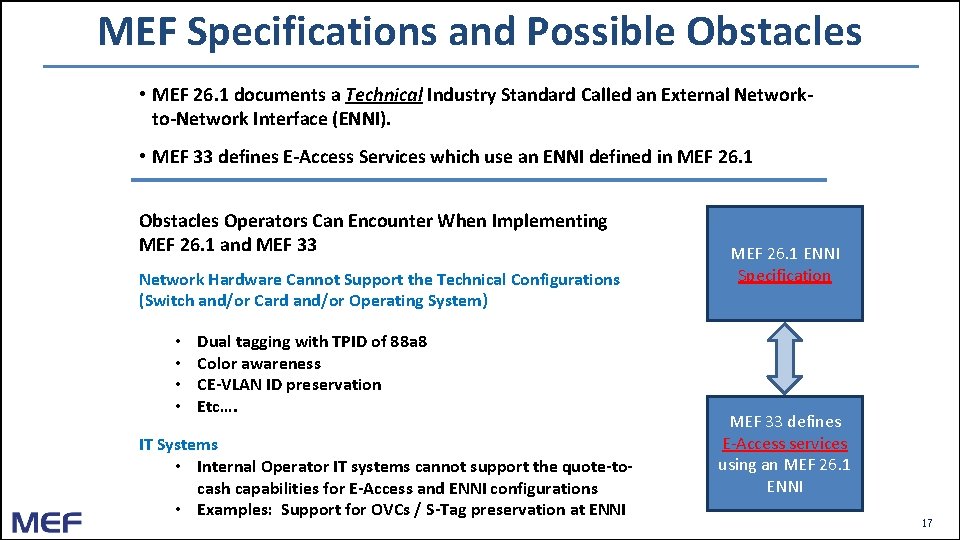
MEF Specifications and Possible Obstacles • MEF 26. 1 documents a Technical Industry Standard Called an External Networkto-Network Interface (ENNI). • MEF 33 defines E-Access Services which use an ENNI defined in MEF 26. 1 Obstacles Operators Can Encounter When Implementing MEF 26. 1 and MEF 33 Network Hardware Cannot Support the Technical Configurations (Switch and/or Card and/or Operating System) • • Dual tagging with TPID of 88 a 8 Color awareness CE-VLAN ID preservation Etc…. IT Systems • Internal Operator IT systems cannot support the quote-tocash capabilities for E-Access and ENNI configurations • Examples: Support for OVCs / S-Tag preservation at ENNI MEF 26. 1 ENNI Specification MEF 33 defines E-Access services using an MEF 26. 1 ENNI 17
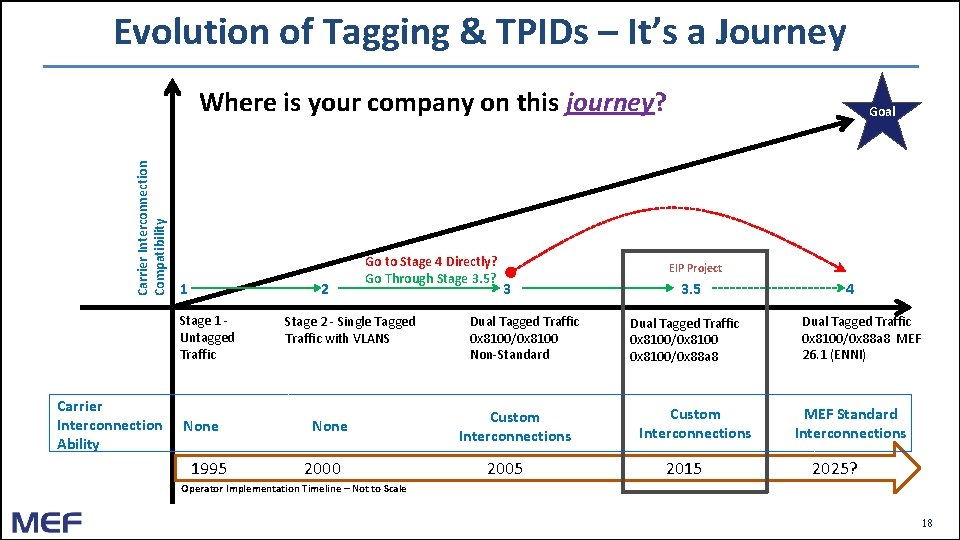
Evolution of Tagging & TPIDs – It’s a Journey Carrier Interconnection Compatibility Where is your company on this journey? Go to Stage 4 Directly? Go Through Stage 3. 5? EIP Project 1 2 3. 5 4 Stage 1 - Untagged Traffic Carrier Interconnection Ability Goal None Stage 2 - Single Tagged Traffic with VLANS None Dual Tagged Traffic 0 x 8100/0 x 8100 Non-Standard Custom Interconnections Dual Tagged Traffic 0 x 8100/0 x 8100/0 x 88 a 8 Custom Interconnections Dual Tagged Traffic 0 x 8100/0 x 88 a 8 MEF 26. 1 (ENNI) MEF Standard Interconnections EIP Project 1995 2000 2005 2015 2025? Operator Implementation Timeline – Not to Scale 18
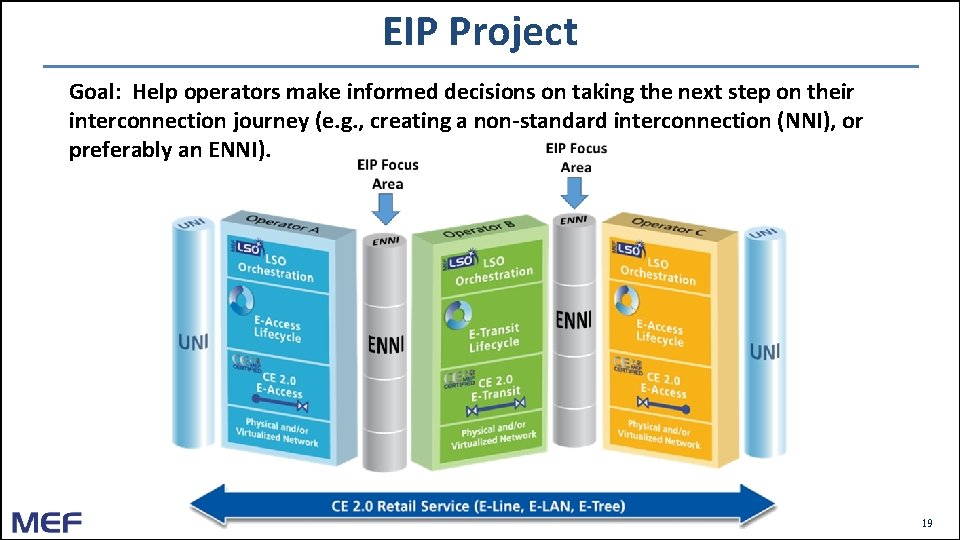
EIP Project Goal: Help operators make informed decisions on taking the next step on their interconnection journey (e. g. , creating a non-standard interconnection (NNI), or preferably an ENNI). 19
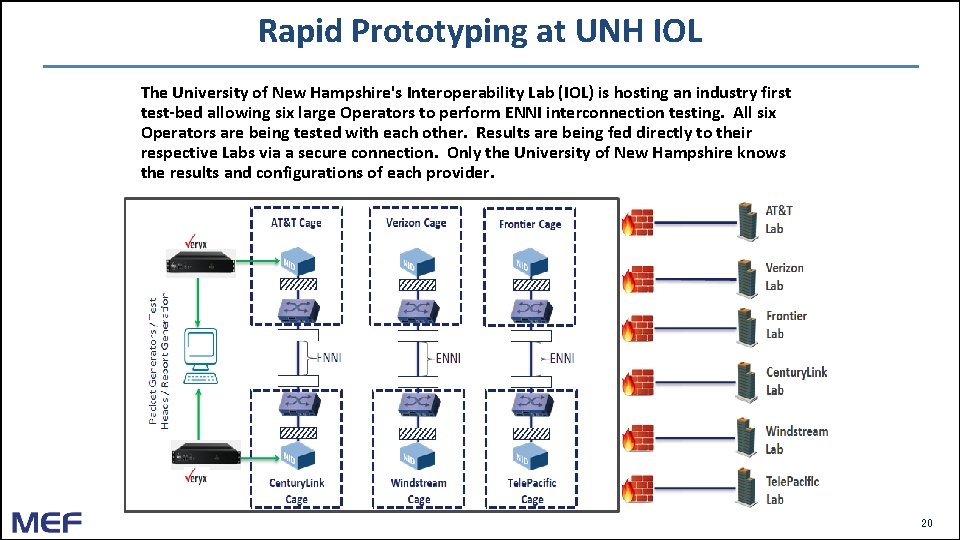
Rapid Prototyping at UNH IOL The University of New Hampshire's Interoperability Lab (IOL) is hosting an industry first test-bed allowing six large Operators to perform ENNI interconnection testing. All six Operators are being tested with each other. Results are being fed directly to their respective Labs via a secure connection. Only the University of New Hampshire knows the results and configurations of each provider. 20
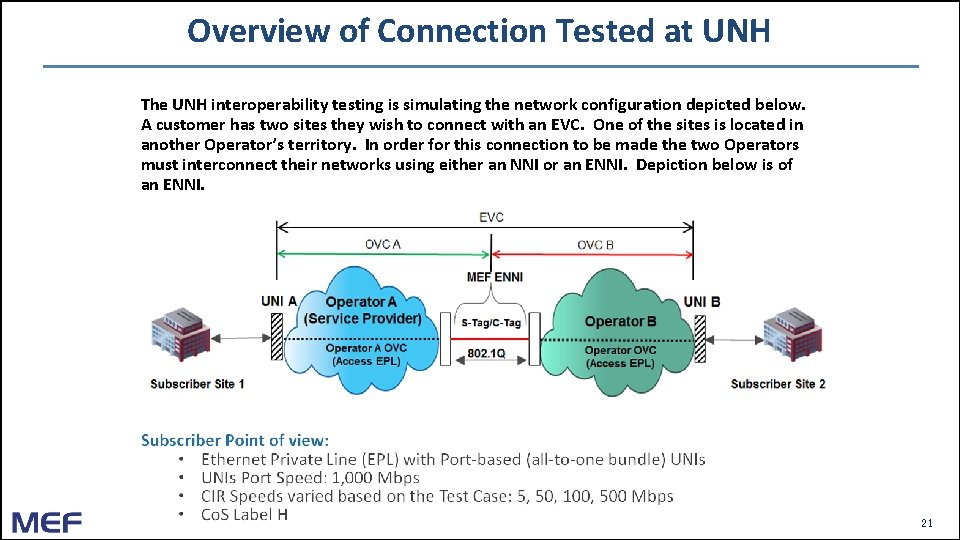
Overview of Connection Tested at UNH The UNH interoperability testing is simulating the network configuration depicted below. A customer has two sites they wish to connect with an EVC. One of the sites is located in another Operator’s territory. In order for this connection to be made the two Operators must interconnect their networks using either an NNI or an ENNI. Depiction below is of an ENNI. 21
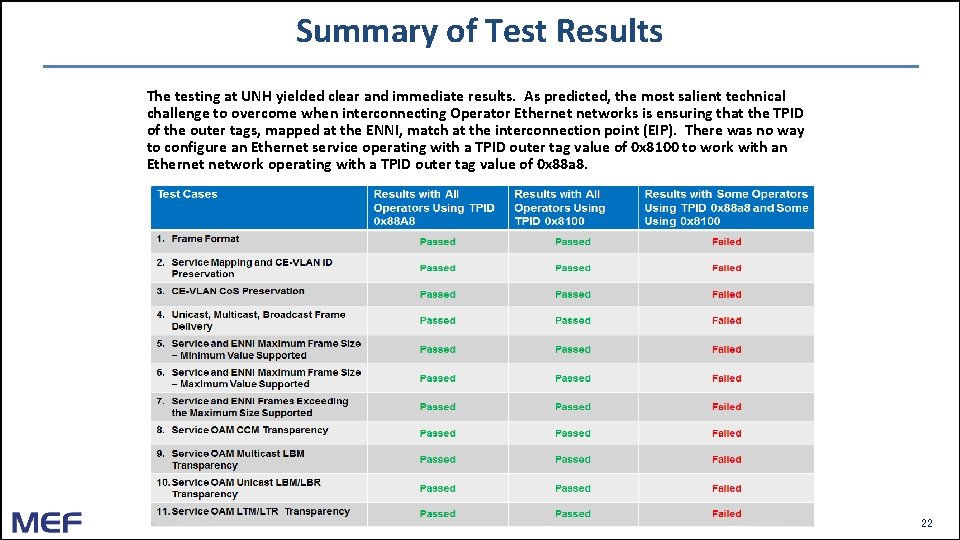
Summary of Test Results The testing at UNH yielded clear and immediate results. As predicted, the most salient technical challenge to overcome when interconnecting Operator Ethernet networks is ensuring that the TPID of the outer tags, mapped at the ENNI, match at the interconnection point (EIP). There was no way to configure an Ethernet service operating with a TPID outer tag value of 0 x 8100 to work with an Ethernet network operating with a TPID outer tag value of 0 x 88 a 8. 22
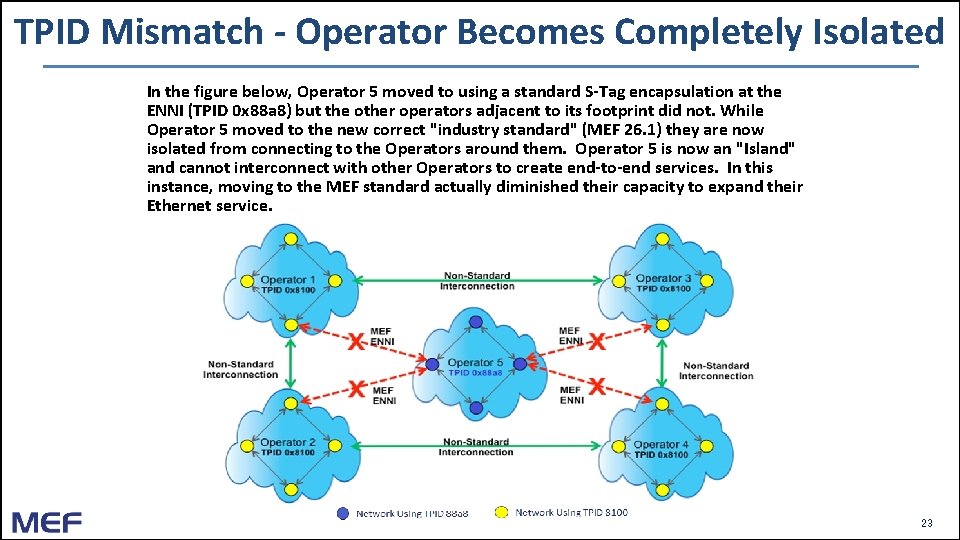
TPID Mismatch - Operator Becomes Completely Isolated In the figure below, Operator 5 moved to using a standard S-Tag encapsulation at the ENNI (TPID 0 x 88 a 8) but the other operators adjacent to its footprint did not. While Operator 5 moved to the new correct "industry standard" (MEF 26. 1) they are now isolated from connecting to the Operators around them. Operator 5 is now an "Island" and cannot interconnect with other Operators to create end-to-end services. In this instance, moving to the MEF standard actually diminished their capacity to expand their Ethernet service. 23
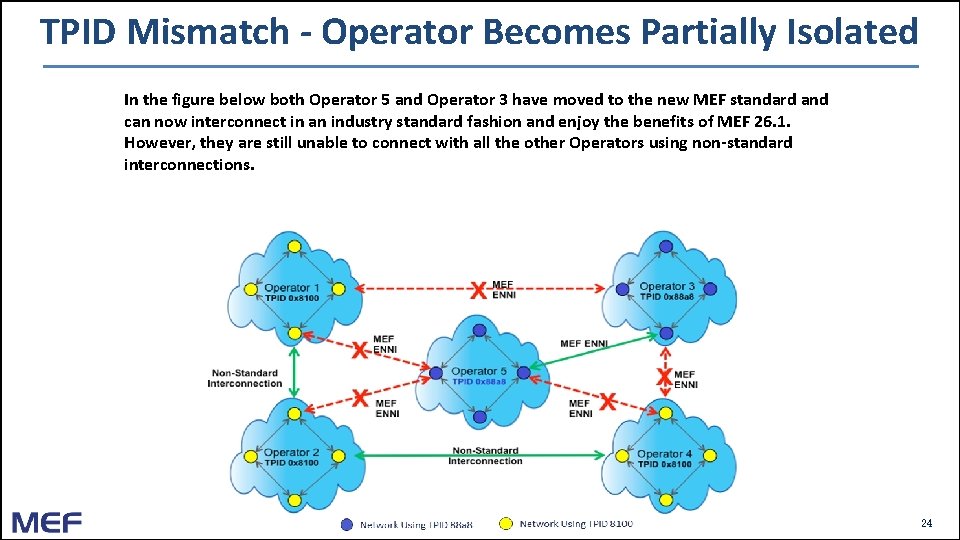
TPID Mismatch - Operator Becomes Partially Isolated In the figure below both Operator 5 and Operator 3 have moved to the new MEF standard and can now interconnect in an industry standard fashion and enjoy the benefits of MEF 26. 1. However, they are still unable to connect with all the other Operators using non-standard interconnections. 24
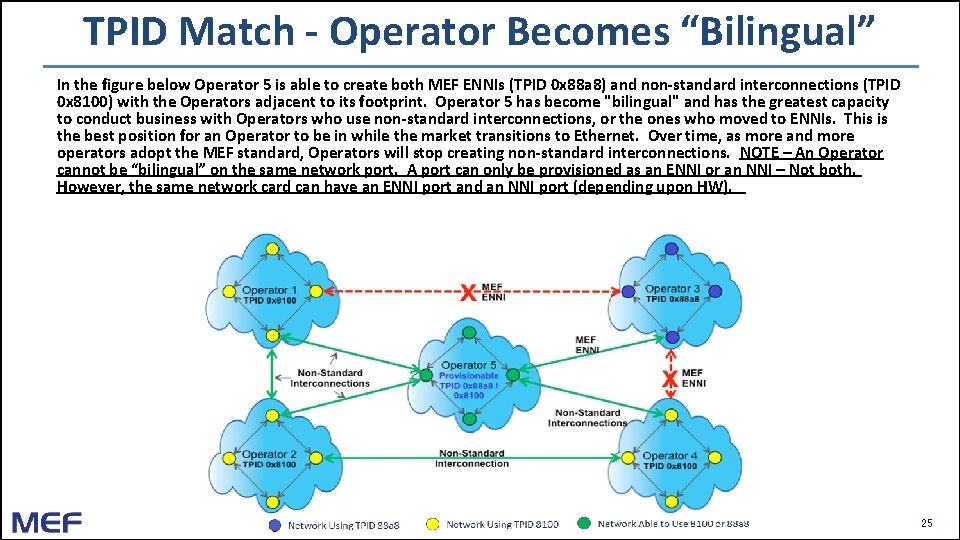
TPID Match - Operator Becomes “Bilingual” In the figure below Operator 5 is able to create both MEF ENNIs (TPID 0 x 88 a 8) and non-standard interconnections (TPID 0 x 8100) with the Operators adjacent to its footprint. Operator 5 has become "bilingual" and has the greatest capacity to conduct business with Operators who use non-standard interconnections, or the ones who moved to ENNIs. This is the best position for an Operator to be in while the market transitions to Ethernet. Over time, as more and more operators adopt the MEF standard, Operators will stop creating non-standard interconnections. NOTE – An Operator cannot be “bilingual” on the same network port. A port can only be provisioned as an ENNI or an NNI – Not both. However, the same network card can have an ENNI port and an NNI port (depending upon HW). 25
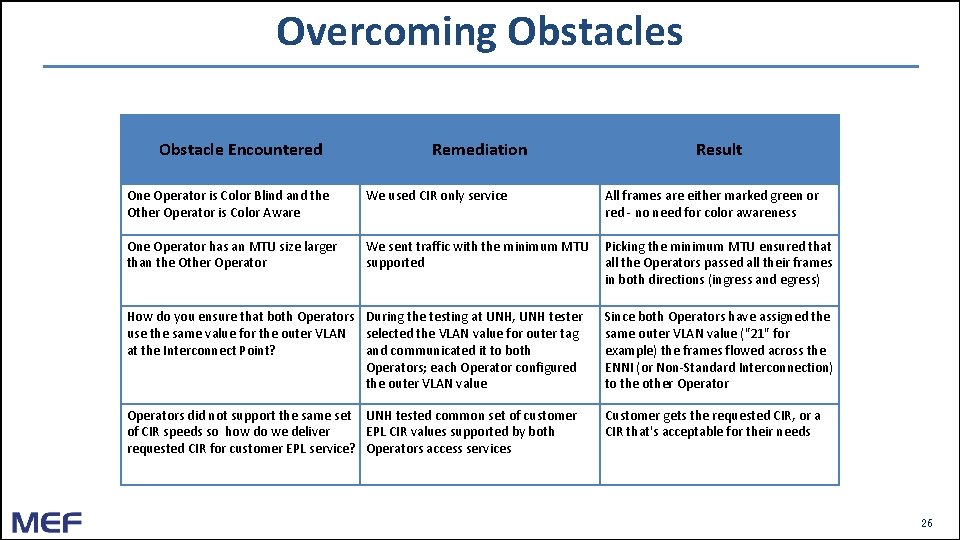
Overcoming Obstacles Obstacle Encountered Remediation Result One Operator is Color Blind and the Other Operator is Color Aware We used CIR only service All frames are either marked green or red - no need for color awareness One Operator has an MTU size larger than the Other Operator We sent traffic with the minimum MTU Picking the minimum MTU ensured that supported all the Operators passed all their frames in both directions (ingress and egress) How do you ensure that both Operators During the testing at UNH, UNH tester use the same value for the outer VLAN selected the VLAN value for outer tag at the Interconnect Point? and communicated it to both Operators; each Operator configured the outer VLAN value Since both Operators have assigned the same outer VLAN value ("21" for example) the frames flowed across the ENNI (or Non-Standard Interconnection) to the other Operators did not support the same set UNH tested common set of customer of CIR speeds so how do we deliver EPL CIR values supported by both requested CIR for customer EPL service? Operators access services Customer gets the requested CIR, or a CIR that's acceptable for their needs 26
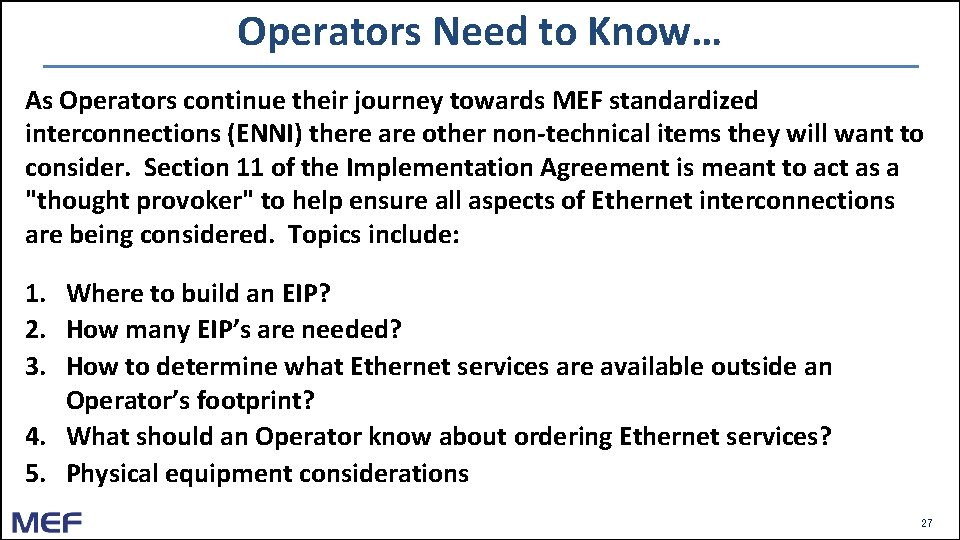
Operators Need to Know… As Operators continue their journey towards MEF standardized interconnections (ENNI) there are other non-technical items they will want to consider. Section 11 of the Implementation Agreement is meant to act as a "thought provoker" to help ensure all aspects of Ethernet interconnections are being considered. Topics include: 1. Where to build an EIP? 2. How many EIP’s are needed? 3. How to determine what Ethernet services are available outside an Operator’s footprint? 4. What should an Operator know about ordering Ethernet services? 5. Physical equipment considerations 27
Summary MEF 5 X - EIP
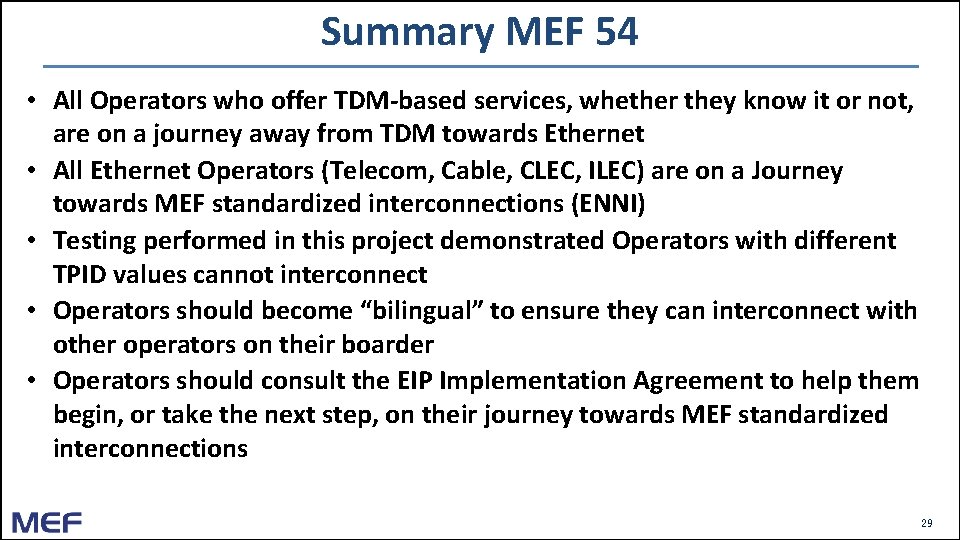
Summary MEF 54 • All Operators who offer TDM-based services, whether they know it or not, are on a journey away from TDM towards Ethernet • All Ethernet Operators (Telecom, Cable, CLEC, ILEC) are on a Journey towards MEF standardized interconnections (ENNI) • Testing performed in this project demonstrated Operators with different TPID values cannot interconnect • Operators should become “bilingual” to ensure they can interconnect with other operators on their boarder • Operators should consult the EIP Implementation Agreement to help them begin, or take the next step, on their journey towards MEF standardized interconnections 29
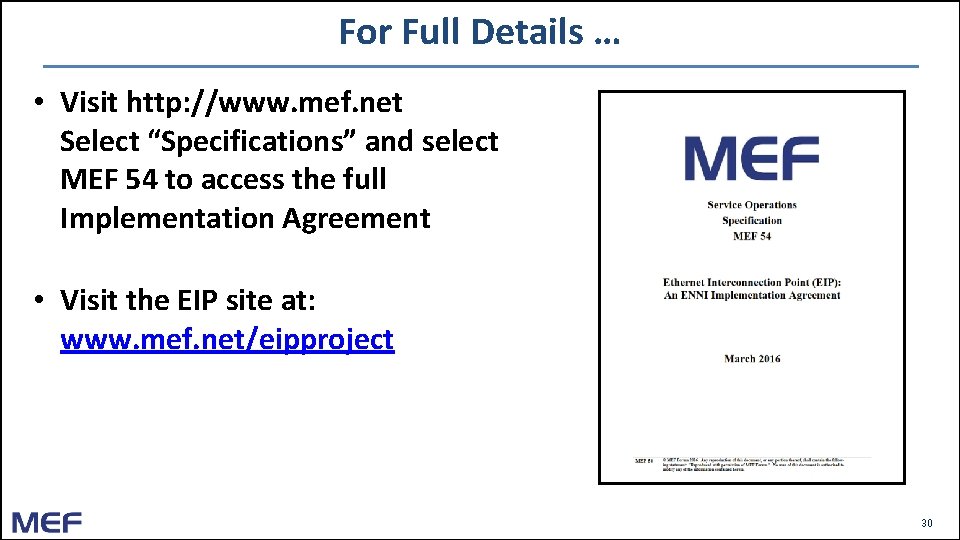
For Full Details … • Visit http: //www. mef. net Select “Specifications” and select MEF 54 to access the full Implementation Agreement • Visit the EIP site at: www. mef. net/eipproject 30
How to Perform ENNI Testing and Certification • Operators who wish to perform their own Interoperability testing – whether using TPID 0 x 88 a 8 (ENNI) or 0 x 8100 (NNI) are encouraged to contact the University of New Hampshire’s Interoperability Lab. Visit: https: //www. iol. unh. edu/ • Operators who are ready to create, or can already create, an industry standard ENNI using TPID 0 x 88 a 8 as per MEF 26. 1 should get MEF certified for “MEF 33 E-Access services. ” They will then appear on MEF’s “Certification Registry. ” Doing so allows other Operators, who boarder their network, to understand where the Operator is on its interconnection journey. It also allows retail customers with large RFPs to view an Operator’s capabilities. Visit: https: //www. mef. net/certification/services-certification-overview 31
Related Documents • MEF 26. 1 - External Network Interface (ENNI) – Phase 2 • MEF 33 - Ethernet Access Services Definition • MEF 51 - OVC Services Definitions Technical Specification 32
Accelerating Worldwide Adoption of Carrier-class Ethernet Networks and Services MEF. net