
Introducing the Peterborough Exemplar An introduction for professionals
Introducing the Peterborough Exemplar An introduction for professionals Aug 2020

Community Mental Health Exemplar Project Wherever you live in Peterborough, you will have access to the mental health support that you need when you need it
Our aim is to provide a sustainable, person-centred system of mental health care for Peterborough, which delivers better access to a broader range of care options, reduced demand for high level interventions, greater service efficiency, and improved patient experience and outcomes. We believe this will ensure people with serious mental illness are better supported overall.
Keys to success We have built a Program Theory Model to evaluate our work. Key to our desired outcome that people with serious mental illness are better supported overall are two things: • The Primary Care Mental Health Service (PCMHS) and Primary Care Networks (PCNs) build trust relationships • People access the support that is right for them at the right time
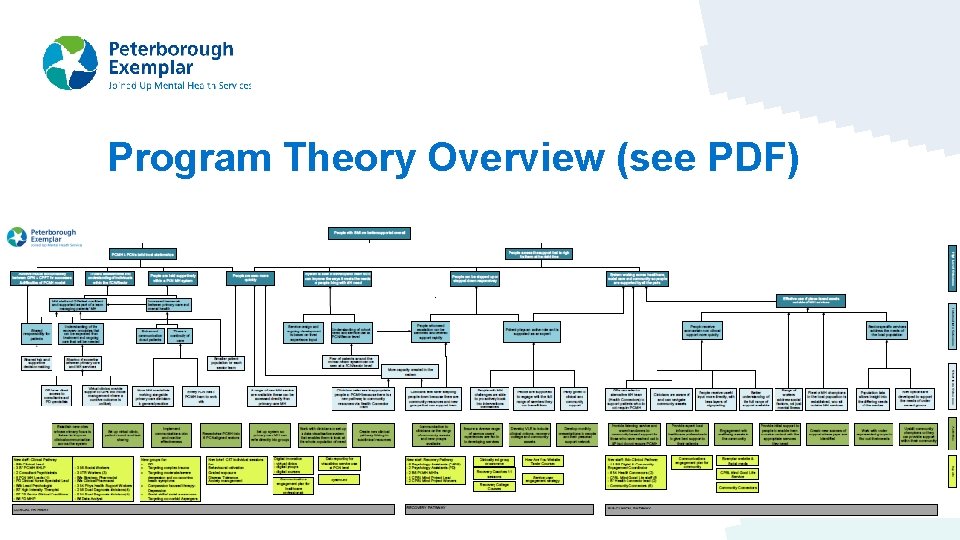
Program Theory Overview (see PDF)
The Peterborough Exemplar is a two-year, NHS England-funded pilot that will transform the way in which mental health support is provided to the people of Peterborough. This is an exciting opportunity to take a holistic approach to mental health provision and ‘join the dots’ between NHS, local authority, third sector services and our diverse communities; providing a range of specialist treatments, self-help and wellbeing options that are easy to access and focus on both the needs and strengths of each individual.
Why we need the exemplar Service users say it better than we ever could: ‘I feel I am being bounced around the services. I was told by my psychiatrist that I had PD and then I was discharged and told my medication would be reviewed in 4 years… I have been told by CPFT that I am not unwell enough to hit their threshold and I actually came off my medication hoping to become ill enough to get help’
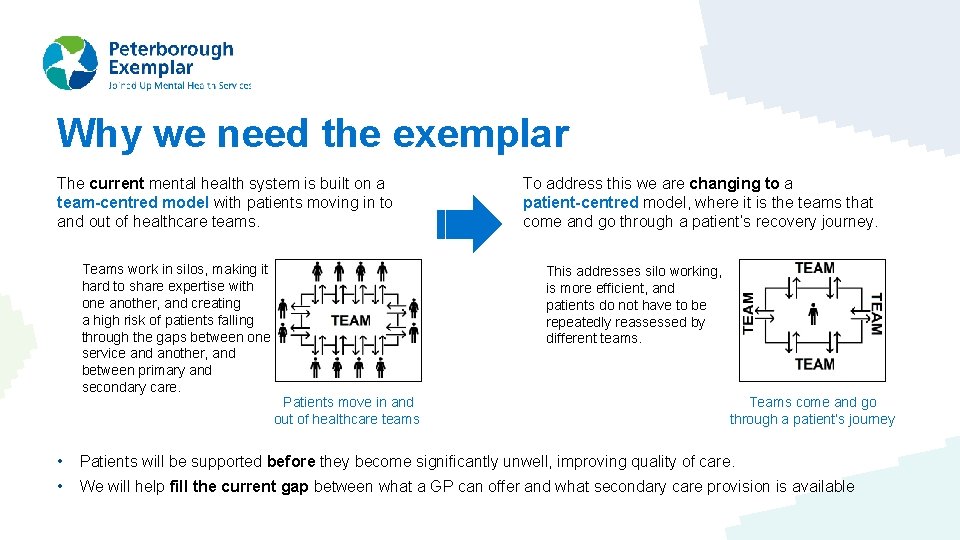
Why we need the exemplar The current mental health system is built on a team-centred model with patients moving in to and out of healthcare teams. Teams work in silos, making it hard to share expertise with one another, and creating a high risk of patients falling through the gaps between one service and another, and between primary and secondary care. To address this we are changing to a patient-centred model, where it is the teams that come and go through a patient’s recovery journey. This addresses silo working, is more efficient, and patients do not have to be repeatedly reassessed by different teams. Patients move in and out of healthcare teams Teams come and go through a patient’s journey • Patients will be supported before they become significantly unwell, improving quality of care. • We will help fill the current gap between what a GP can offer and what secondary care provision is available
Why we need the exemplar The Peterborough population is very diverse and some community groups are under-represented in the current service structure; there are no services meeting their mental health needs. A more holistic, community-asset-based model of mental health care is essential to reaching those with both mildmoderate mental health challenges and severe mental illness in these groups.

Clinical Pathway: Primary Care Mental Health Service
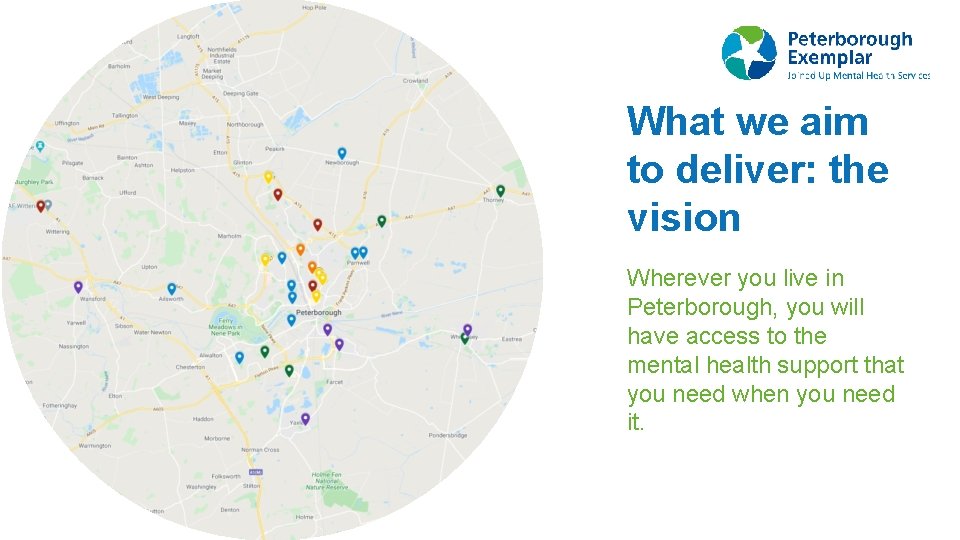
What we aim to deliver: the vision Wherever you live in Peterborough, you will have access to the mental health support that you need when you need it.
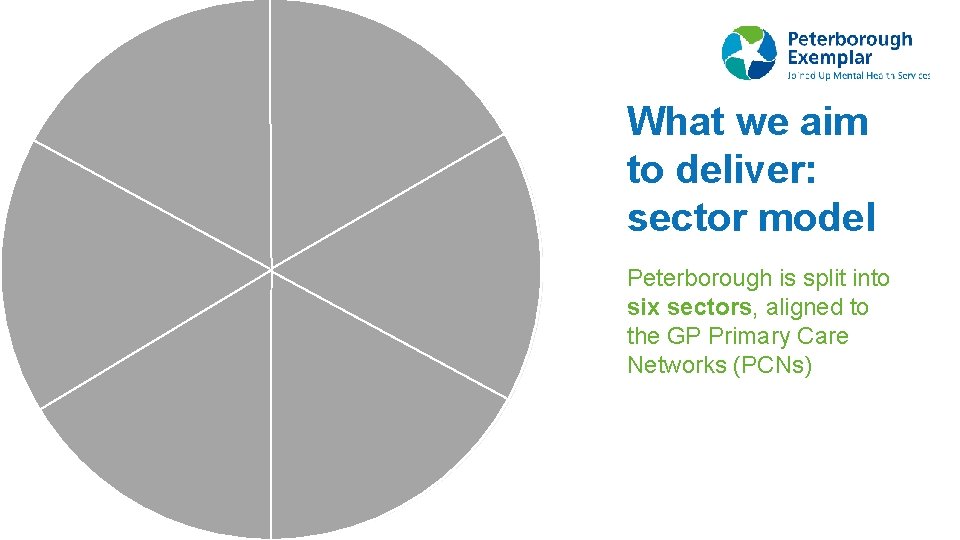
What we aim to deliver: sector model Peterborough is split into six sectors, aligned to the GP Primary Care Networks (PCNs)
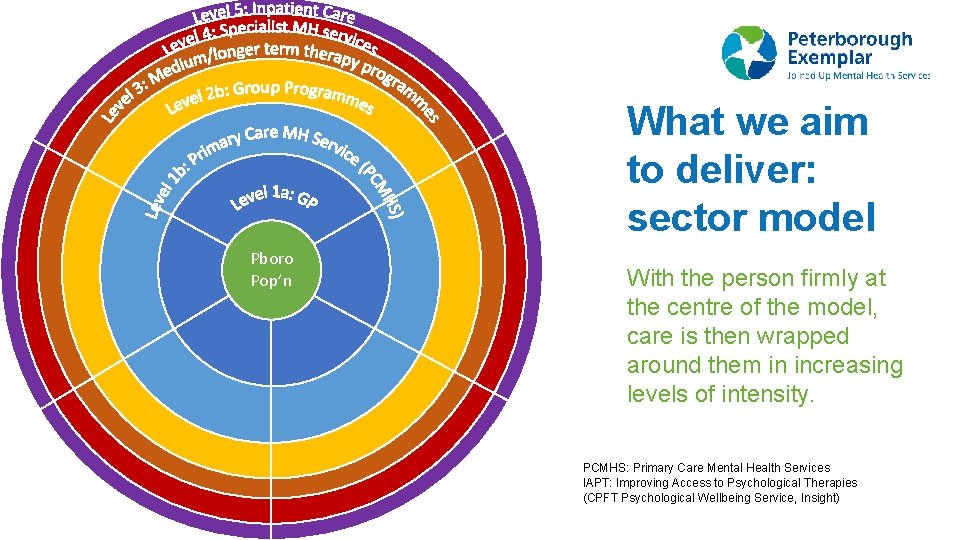
What we aim to deliver: sector model Pboro Pop’n With the person firmly at the centre of the model, care is then wrapped around them in increasing levels of intensity. PCMHS: Primary Care Mental Health Services IAPT: Improving Access to Psychological Therapies (CPFT Psychological Wellbeing Service, Insight)
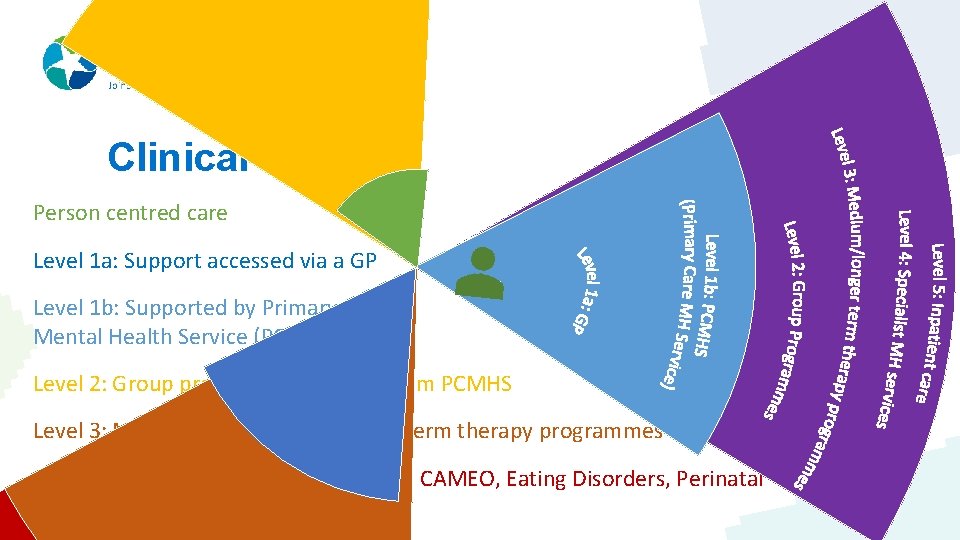
Clinical Pathway Person centred care Level 1 a: Support accessed via a GP Level 1 b: Supported by Primary Care Mental Health Service (PCMHS) Level 2: Group programmes directly from PCMHS Level 3: More intense medium-longer term therapy programmes Level 4: Specialist services: PALT, PDCS, CAMEO, Eating Disorders, Perinatal Level 5: Inpatient care: Oak Wards
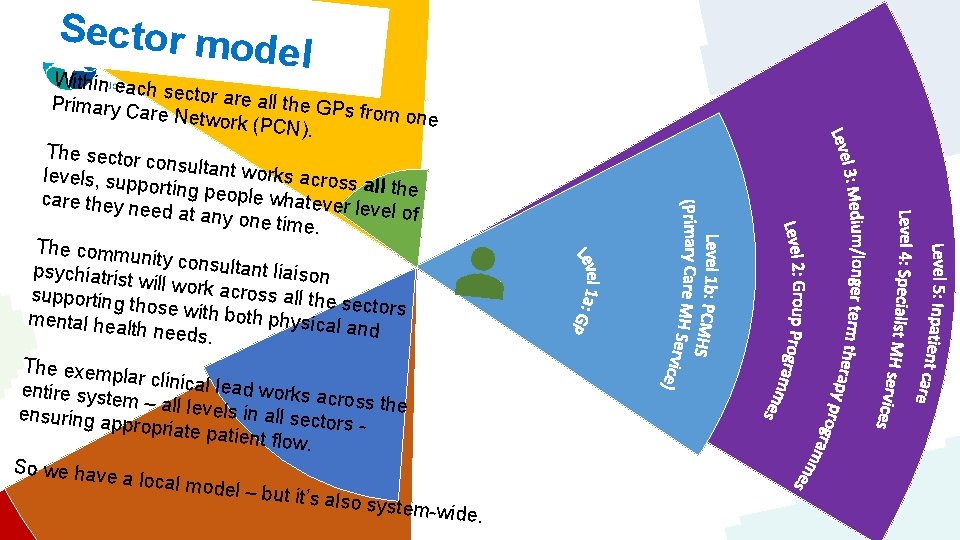
Sector mo del Within each sector are a ll the GPs f Primary Ca rom one re Network (PCN). The sector con levels, supp sultant works across a ll the orting peop le whateve care they n r level of eed at any one time. The commu nity consult ant liaison psychiatrist will work ac ross all the supporting sectors those with b o t h physical a mental hea lth needs. nd The exemp lar clinical le ad works a entire syste cross the m – all leve ls in ensuring ap all sectors propriate p atient flow. So we have a local mod el – but it’s also system -wide.
GP Mental Health Leads An investment in a Mental Health Lead for each Primary Care Network allows mutual accountability to be achieved between the PCNs and CPFT’s Primary Care Mental Health Service (PCMHS). Any difficulties between GPs and PCMHS sector teams can be identified and responded to.
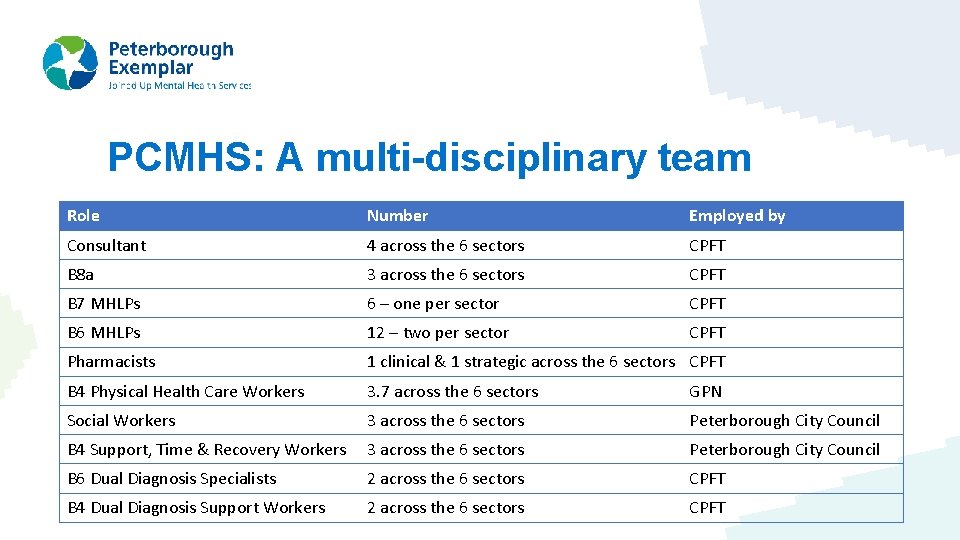
PCMHS: A multi-disciplinary team Role Number Employed by Consultant 4 across the 6 sectors CPFT B 8 a 3 across the 6 sectors CPFT B 7 MHLPs 6 – one per sector CPFT B 6 MHLPs 12 – two per sector CPFT Pharmacists 1 clinical & 1 strategic across the 6 sectors CPFT B 4 Physical Health Care Workers 3. 7 across the 6 sectors GPN Social Workers 3 across the 6 sectors Peterborough City Council B 4 Support, Time & Recovery Workers 3 across the 6 sectors Peterborough City Council B 6 Dual Diagnosis Specialists 2 across the 6 sectors CPFT B 4 Dual Diagnosis Support Workers 2 across the 6 sectors CPFT
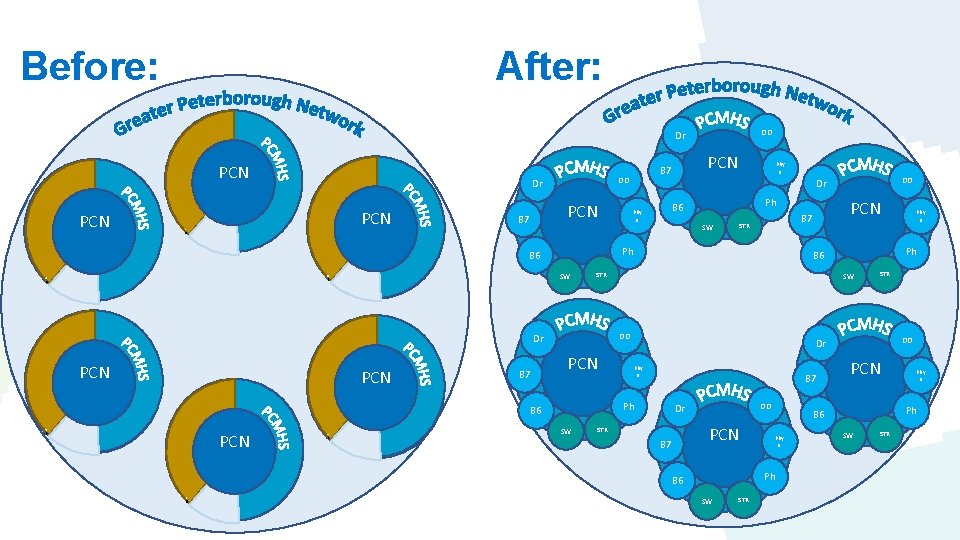
Before: After: DD Dr PCN PCN DD Dr PCN B 7 SW STR SW SW STR DD Dr Phy s B 7 DD Dr PCN STR B 7 Ph B 6 SW STR PCN Phy s Ph B 6 PCN SW PCN B 7 DD PCN B 7 Ph B 6 Phy s DD Dr STR Dr PCN Phy s Ph B 6 PCN PCN B 7 SW STR
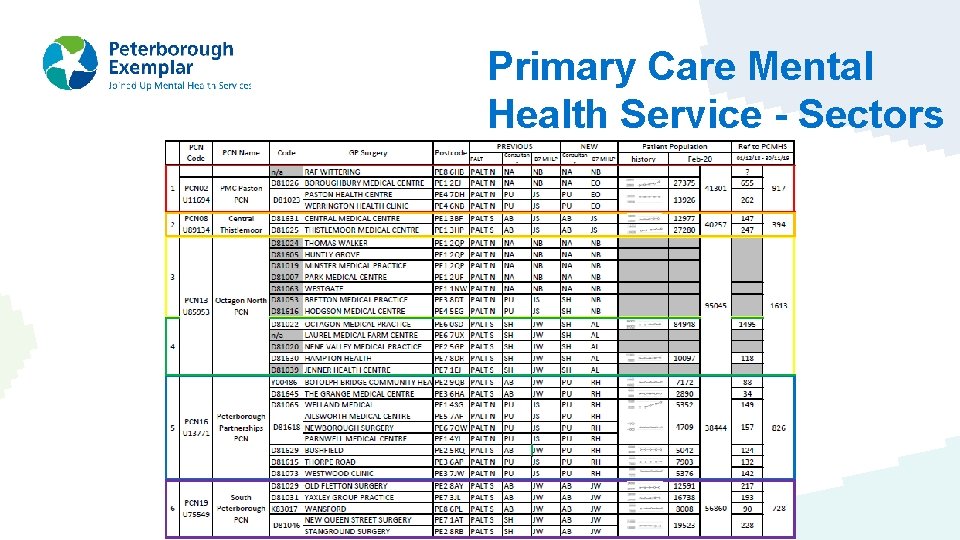
Primary Care Mental Health Service - Sectors

Clinical Pathway: Personality Disorder
Personality Disorder Group Program A new group program for those identifying with traits of Personality Disorder is being provided by CPFT’s Personality Disorder Community Service (PDCS) and CPSL Mind. ‘Is This For Me’ is a preliminary group program of two sessions, followed by a 15 week group program. No referral to secondary care is needed. This group is accessed directly by referral from PCMHS.
Personality Disorder support across wider system We have added two Clinical Nurse Specialist Leads to the Personality Disorder Community Service to support professionals in primary care and secondary care mental health services who are supporting people with personality disorder traits. • One role supports the PD Core Group, providing advice and liaison to all secondary care mental health teams to give the best possible care for service users within their teams who have personality disorder. • One role provides advice, guidance and teaching to clinicians in primary care and the Primary Care Mental Health Service (PCMHS)

Clinical Pathway: Psychology
CAPs (Clinical Associate Psychologists) Group Programme Five group programmes are being offered to address gaps in current provision: • • • ASD (adapted DBT) ACT for chronic health conditions Trauma stabilisation group Schema therapy Compassion focussed therapy
CAPs (Clinical Associate Psychologists) Brief Psychological Interventions Brief Psychological Intervention (BPI) programmes are being offered by the Clinical Associate Psychology team • • anxiety management and graded exposure behavioural activation emotional regulation coping with voices

Clinical Pathway: Dual Diagnosis Outreach Team
Dual Diagnosis Outreach Team This new team, made up of 2 B 6 nurses and 2 B 4 support workers aims to redress inequality of access to mental health support for SMI patients in Peterborough • Peterborough has statistically higher rates of homelessness and does not have an outreach team (there is one in Cambridge) • COVID 19 has increased the likelihood of greater numbers of homeless people in Peterborough • We can capitalize on both the trust and engagement work done during COVID through housing the homeless in hotels

Recovery Pathway
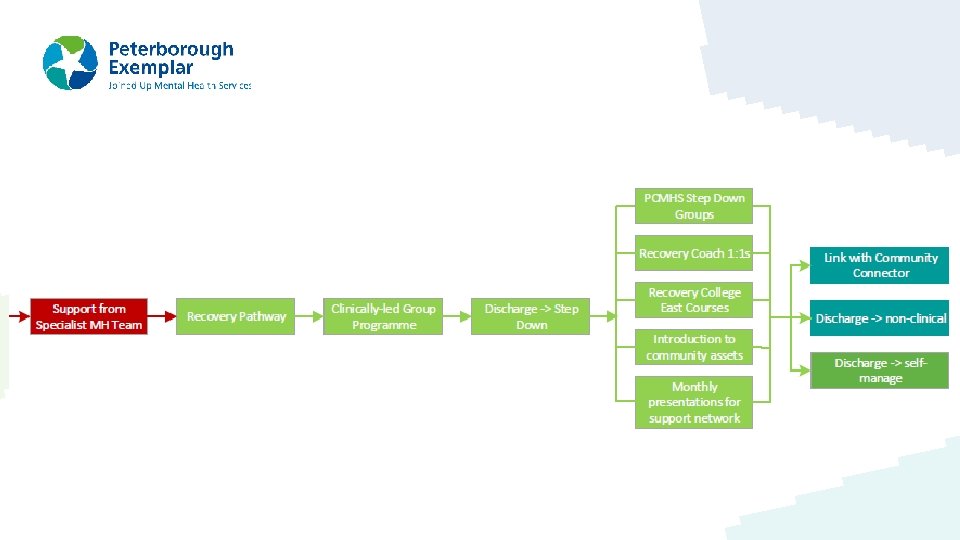
Recovery Pathway A clinically led group programme for those still held on a secondary care caseload, transitioning to a step-down group run by PCMHS after discharge, alongside one-to-one recovery coach sessions and courses at the Recovery College come together in the recovery pathway to support those being stepped down from secondary care teams. • It is acknowledged that service users experience a “cliff-edge” as support is withdrawn, which needs addressing. • This pathway supports those who have been in secondary care transitioning over to community-based assets • It is also known clinicians are reluctant to discharge people due to the lack of support, so this pathway is also intended to create capacity in

Sub-Clinical Pathway: Health Connectors
Health Connector Team A new referral option for GPs is to be created for those experiencing moderate-severe mental health challenges who need support but do not need to be referred to the Primary Care Mental Health Service for clinical intervention. The health connectors will be a bi-lingual team who connect people to community-based assets, working alongside the Think Communities community connector volunteers. The team sits as a bridge between health and social support for those with moderate-severe mental health challenges.
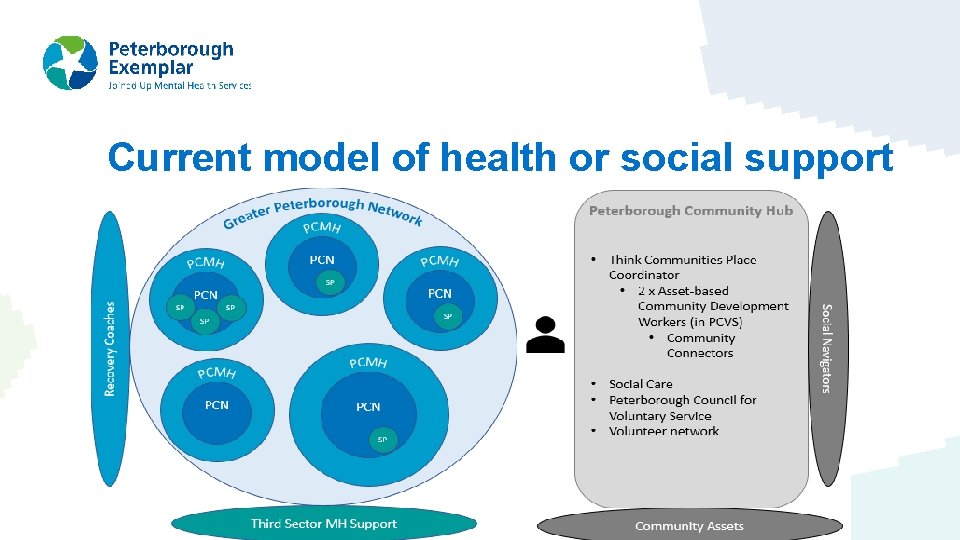
Current model of health or social support
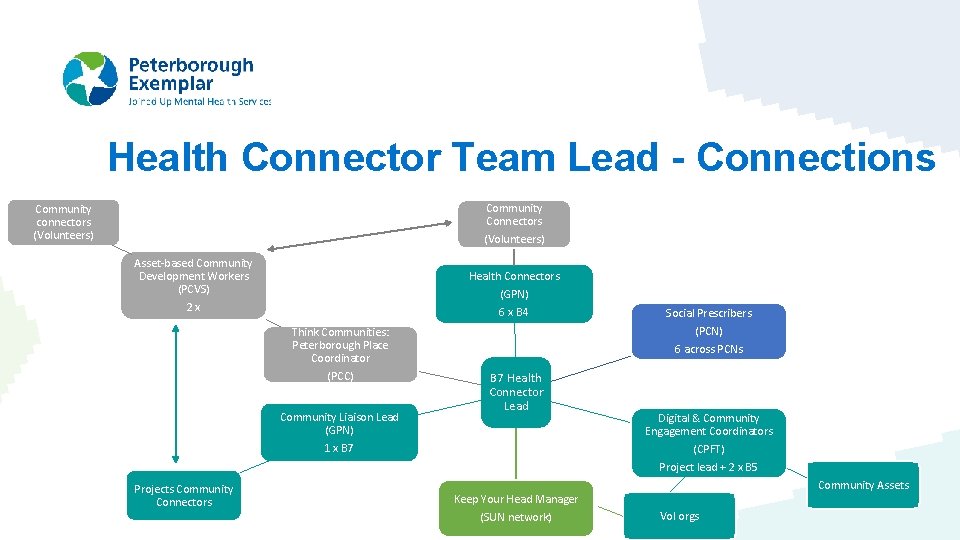
Health Connector Team Lead - Connections Community Connectors Community connectors (Volunteers) Asset-based Community Development Workers (PCVS) 2 x Health Connectors (GPN) 6 x B 4 Think Communities: Peterborough Place Coordinator (PCC) Community Liaison Lead (GPN) 1 x B 7 Projects Community Connectors B 7 Health Connector Lead Keep Your Head Manager (SUN network) Social Prescribers (PCN) 6 across PCNs Digital & Community Engagement Coordinators (CPFT) Project lead + 2 x B 5 Community Assets Vol orgs

Sub-Clinical Pathway: How Are You Peterborough Website & Social Media
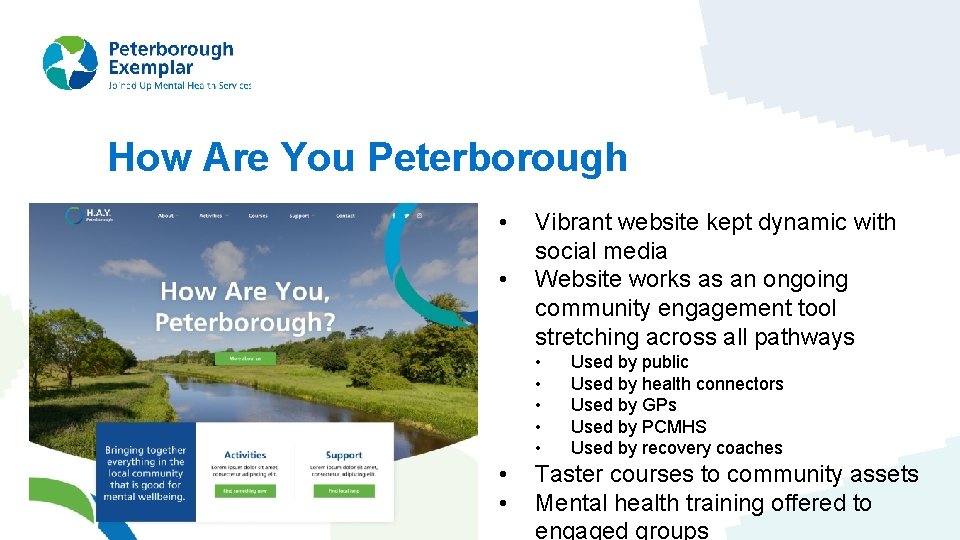
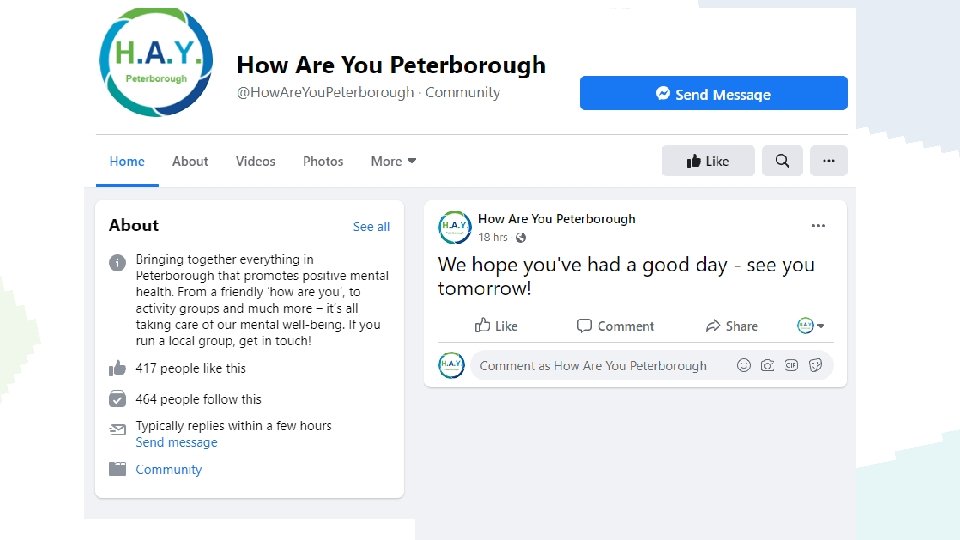
How Are You Peterborough • • Vibrant website kept dynamic with social media Website works as an ongoing community engagement tool stretching across all pathways • • Used by public Used by health connectors Used by GPs Used by PCMHS Used by recovery coaches Taster courses to community assets Mental health training offered to engaged groups

Sub-Clinical Pathway: CPSL Mind Good Life Service
Community support for Rural Peterborough • Exemplar is investing in CPSL Mind’s Good Life Service to bring this service to the 5 most rural communities in Peterborough (2 facilitators, 1 lead) • Public health reports and local feedback indicate that a lack of local resources, poor transport and poverty increases the likelihood of mental ill health • It also proposes to offer grants for grass roots initiatives to promote wellbeing, via a £ 50, 000 investment in the Good Life Fund. • Support at grass roots level and from the Good Life investment aims to reduce the numbers of people in rural areas requiring pharmacological and psychological interventions.

Sub-Clinical Pathway: Communities Wellbeing Investment
Peterborough Communities Wellbeing Investment • Aims to address inequality of access to mental health support for minority ethnic groups in Peterborough, who constitute 40% of the population • The grant aims to increase grass roots mental health support that is culturally sensitive • CPSL Mind work with the community groups to co-produce a mental health training package for the community projects to increase awareness of mental health problems and pathways of support • The Community Engagement lead role is to oversee the project, embed changes in mental health pathways at PCN and PCMHS level to ensure that they are responsive to culturally diverse need • Liaise with the Community Hub, the Volunteer Centre and PVCS to better integrate NHS services with Local authority services.
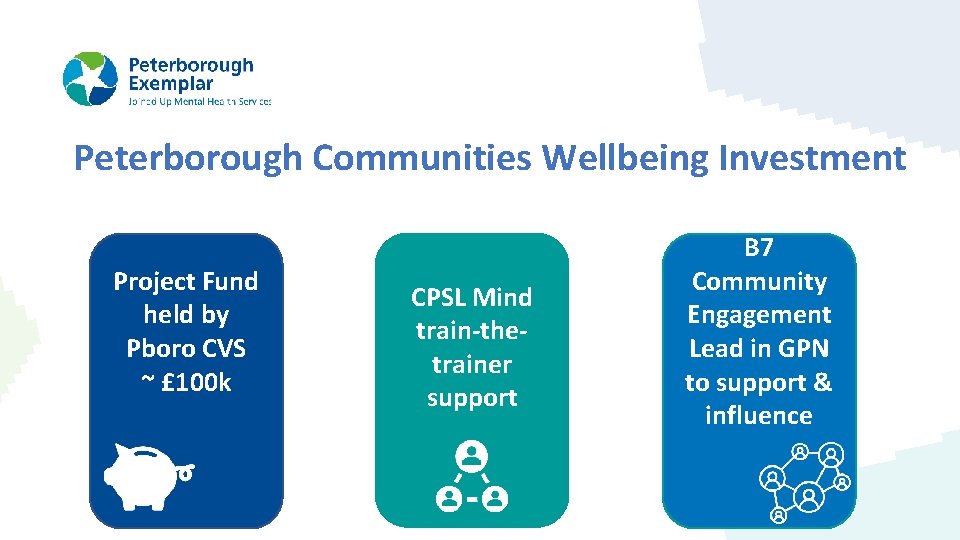
Peterborough Communities Wellbeing Investment Project Fund held by Pboro CVS ~ £ 100 k CPSL Mind train-thetrainer support B 7 Community Engagement Lead in GPN to support & influence
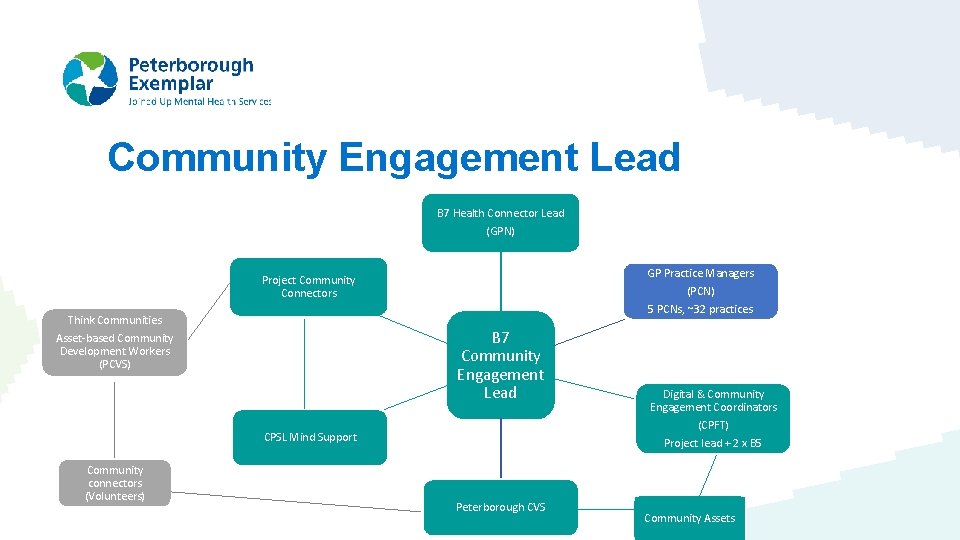
Community Engagement Lead B 7 Health Connector Lead (GPN) GP Practice Managers (PCN) 5 PCNs, ~32 practices Project Community Connectors Think Communities Asset-based Community Development Workers (PCVS) B 7 Community Engagement Lead (CPFT) Project lead + 2 x B 5 CPSL Mind Support Community connectors (Volunteers) Digital & Community Engagement Coordinators Peterborough CVS Community Assets

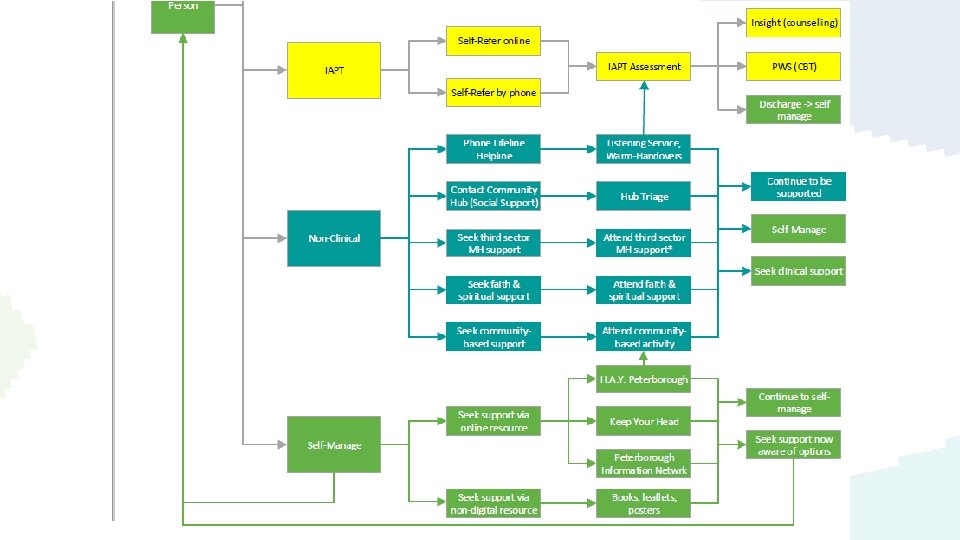
Exemplar System: Summary from perspective of someone seeking support (Please separate PDF files for clearer images)
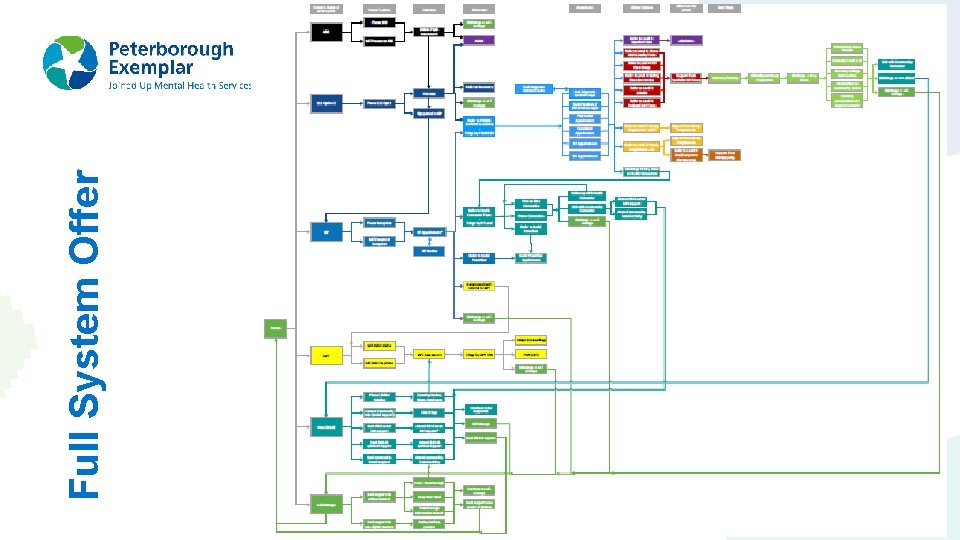
Full System Offer
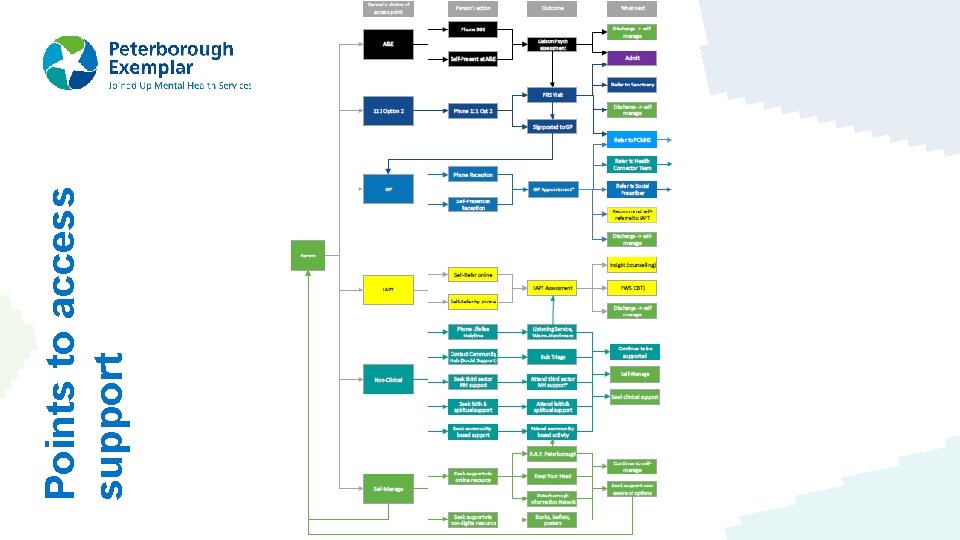
Points to access support
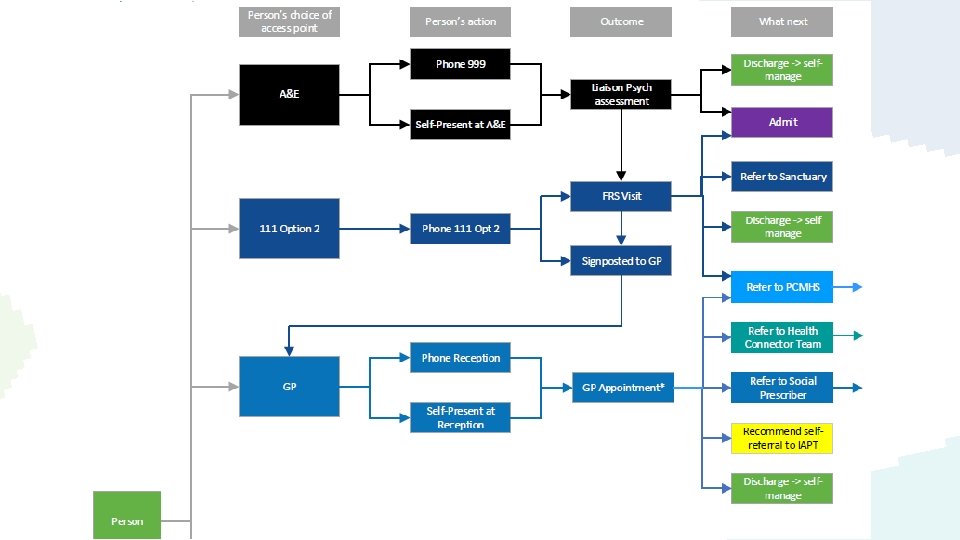
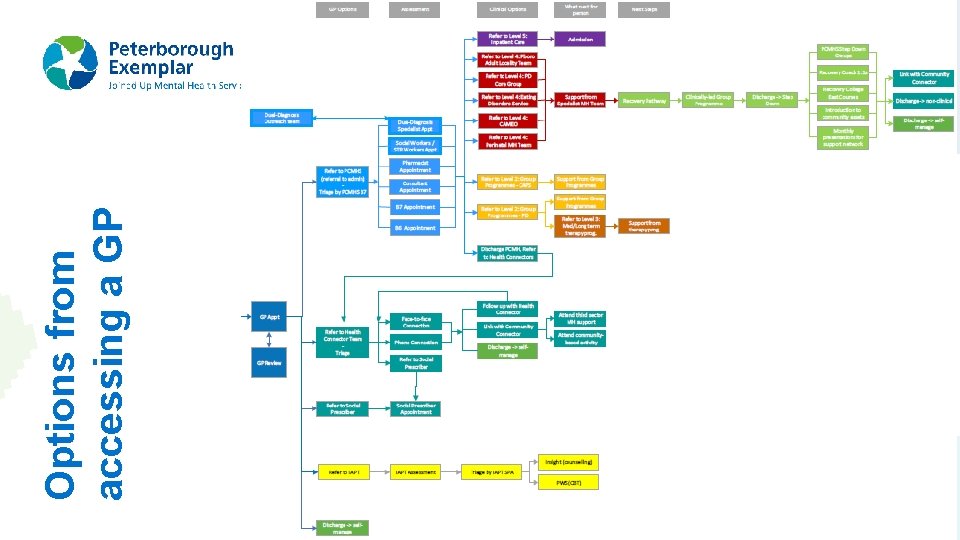
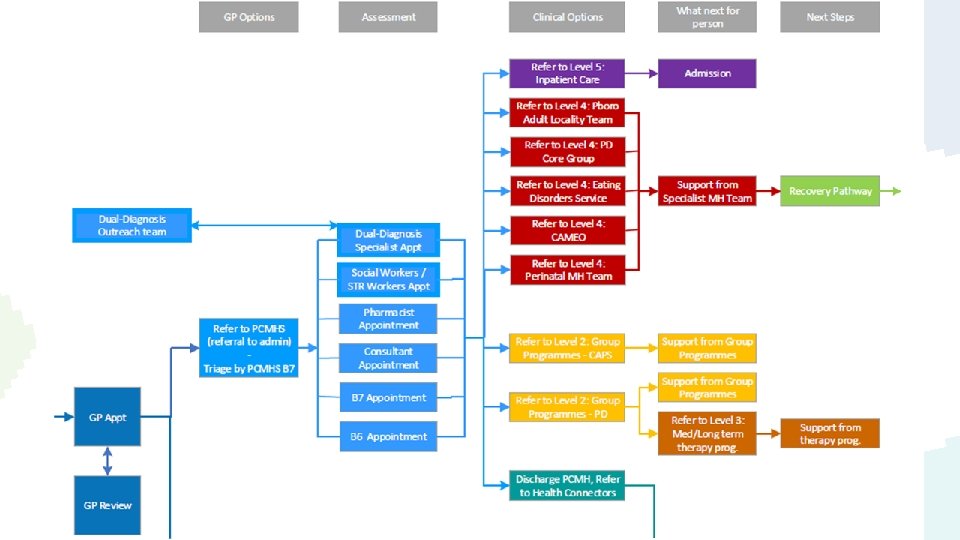
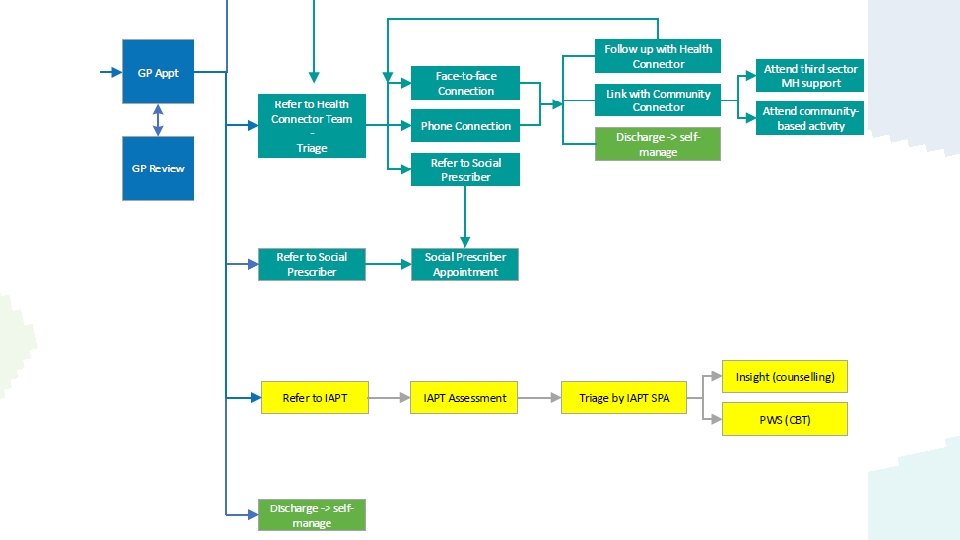
Options from accessing a GP
Find out more Email: Pboro. MHExemplar@cpft. nhs. uk Twitter: @Pboro. MHExemplar Facebook: @How. Are. You. Peterborough Website: COMING SOON
- Slides: 52