
Introducing the Library of Congress Classification LCCS Training
Introducing the Library of Congress Classification LCCS Training Sessions OSU July 2007
History l l l LC Classification schedules developed 18981910 Emphasized LC’s collection strengths: social sciences (political science, law, history) Originally, little emphasis on humanities, religion & philosophy
History (cont. ) l l l In early years, schedules revised periodically Today, schedules are revised continuously (see Weekly Lists) Some schedules only recently published: – – KBR, history of canon law, 2001 KBU, law of the Roman Catholic Church, 2001 KBM, Jewish law, 2002 KBP, Islamic law, 2002
Characteristics l l l Enumerative - every topic explicitly listed No synthetic features 3½ shelf feet long!
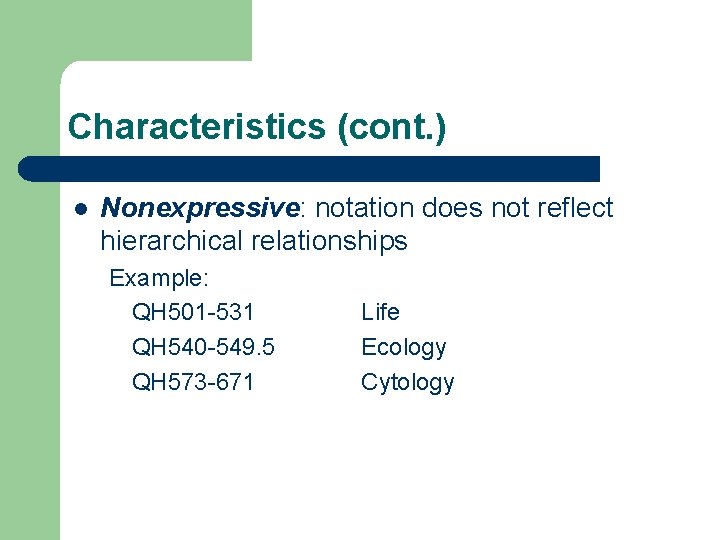
Characteristics (cont. ) l Nonexpressive: notation does not reflect hierarchical relationships Example: QH 501 -531 QH 540 -549. 5 QH 573 -671 Life Ecology Cytology
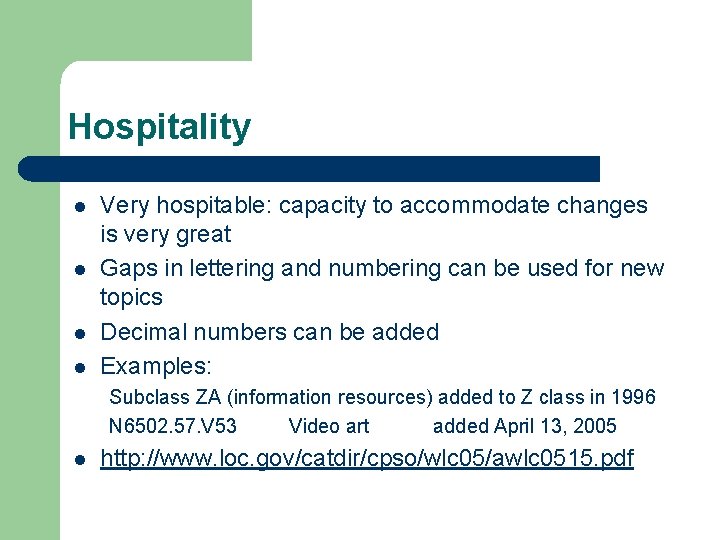
Hospitality l l Very hospitable: capacity to accommodate changes is very great Gaps in lettering and numbering can be used for new topics Decimal numbers can be added Examples: Subclass ZA (information resources) added to Z class in 1996 N 6502. 57. V 53 Video art added April 13, 2005 l http: //www. loc. gov/catdir/cpso/wlc 05/awlc 0515. pdf
Classification Tools l l l l Library of Congress Classification Schedules Classification Web (also includes Library of Congress Subject Headings) Subject Cataloging Manual: Classification Subject Cataloging Manual: Shelflisting Cataloger’s Desktop on the Web Cataloging Calculator Library of Congress Filing Rules
Classification Guidelines l l F 10, General Principles of Classification (SCM: Classification) Eight principles – some obvious, some peculiar to LCCS
“Class works according to their subject matter” l l l Must determine their subject matter first Not classed according to size or date of receipt Generally not classed according to format – with exceptions
Classing by Form l “Class a work by its specific subject, not by its form under a broader topic” Example: Class a journal on sanitation in – RA 567 (Sanitation. Waste disposal. Sewage disposal – General works) Not in the broader class RA 565. A 1 (Environmental health -- Periodicals. Societies. Serials)
Classing by Form (cont. ) l l Within a given topical area, class by subject, ignoring form unless form captions have been established under the subject. Most common form caption: Periodicals. Societies. Serials
Classing by Place l If choosing between classing by specific subject and classing by place, prefer classification by the subject Example: Penguins of Antarctica QL 696. S 473 Spheniscidae (Penguins) Not QL 695. 2 Birds of Antarctica
Classing by Place (cont. ) Exceptions: l Class by place if there are contrary instructions l Class by place if precedent (the shelflist) clearly indicates otherwise
Specificity l l Use the most specific number available. Use a broader number only if no specific number is available and it is not feasible to establish one.

Multiple subjects l Where several subjects are discussed in a work, choose the classification number: according to instructions printed in the schedules Example: A popular work (i. e. , not scientific) on domesticated mammals could be classed with popular works on mammals or works on domesticated animals QL 706 Mammals -- Popular works For popular works on domestic animals see SF 41 –
Multiple subjects (cont. ) l Where several subjects are discussed in a work, choose the classification number: – – – according to dominant subject (as represented by the first subject heading on the record) that matches the first subject mentioned in the work being cataloged for a broader subject if the work deals with several subjects that, taken together, constitute a major part of a larger subject
Multiple Classes l In problematic cases where several numbers appear satisfactory, class according to – – the intent of the author, or where it appears that the work would be most usefully located
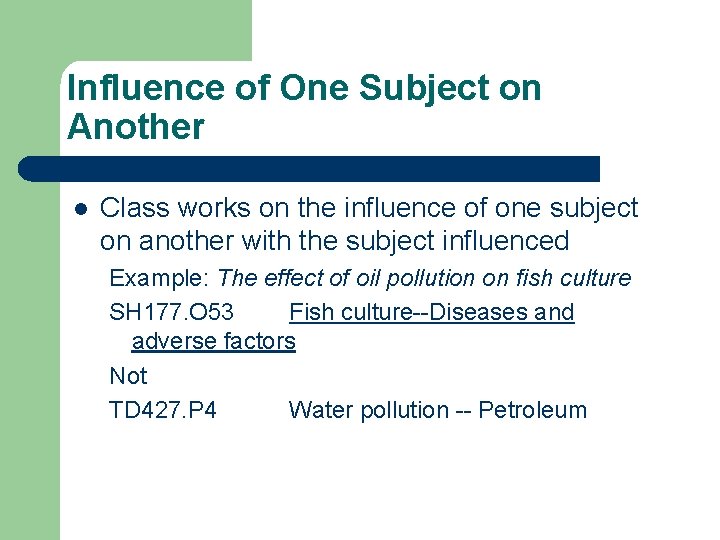
Influence of One Subject on Another l Class works on the influence of one subject on another with the subject influenced Example: The effect of oil pollution on fish culture SH 177. O 53 Fish culture--Diseases and adverse factors Not TD 427. P 4 Water pollution -- Petroleum
- Slides: 18