
Introducing the Grid Project Impacts Quantification Web Calculator

Introducing the Grid Project Impacts Quantification Web Calculator 28 August 2018 Presented by: Pacific Northwest National Laboratory (Karen Studarus) PNNL-SA-137754 gridpiq. pnnl. gov
“If Only I Could Quickly and Easily…” • Ask many “what if? ” questions about my system • Screen grid projects • Visualize grid time series • Compare assumptions • Sanity check results • Check for knock-on benefits or unintended consequences • Document benefits of my project or product • Leverage many data sources in one place
Introducing the Grid Project Impact Quantification Tool (Grid. PIQ) • Screening tool for grid projects – various technologies (e. g. energy storage, PV) and impacts (e. g. inter-hour ramping, emissions, peak power) • Publically available right now – gridpiq. pnnl. gov • Transparent methodologies and data sources • Built in online instructions and explanation of methodology • Intuitive user interface
How does it work? • User inputs a few simple things to see results in seconds • For example: Technology type, efficiency, size, location • Completely customizable • Change parameters to 1. explore assumptions, 2. compare scenarios, or 3. tune the results to your specific location for maximum applicability • User cautioned when boundaries of the Grid. PIQ model are pushed • We’ll show two examples today: • New control scheme on a distribution feeder • Energy Storage
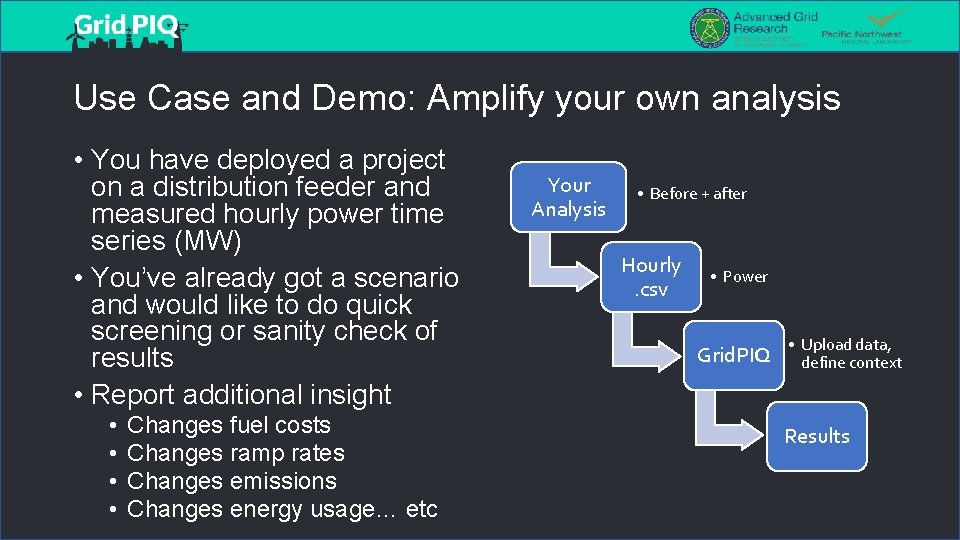
Use Case and Demo: Amplify your own analysis • You have deployed a project on a distribution feeder and measured hourly power time series (MW) • You’ve already got a scenario and would like to do quick screening or sanity check of results • Report additional insight • • Changes fuel costs Changes ramp rates Changes emissions Changes energy usage… etc Your Analysis • Before + after Hourly. csv • Power Grid. PIQ • Upload data, define context Results
Use Case and Demo: Energy Storage • Characteristics you input: • Battery size, • location characteristics, • dispatch objective • Expect Insight about how the battery changes the system’s: • • • Net Load Profile (MW) Energy consumption Peak Power Ramping requirement from other generators Carbon footprint Etc. • Now let me step you through…

Overview of Available Technologies
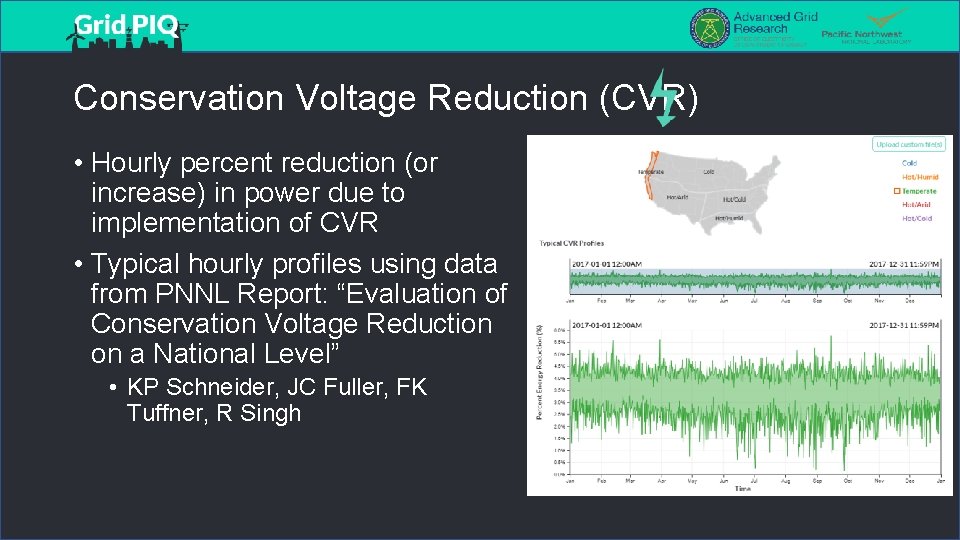
Conservation Voltage Reduction (CVR) • Hourly percent reduction (or increase) in power due to implementation of CVR • Typical hourly profiles using data from PNNL Report: “Evaluation of Conservation Voltage Reduction on a National Level” • KP Schneider, JC Fuller, FK Tuffner, R Singh
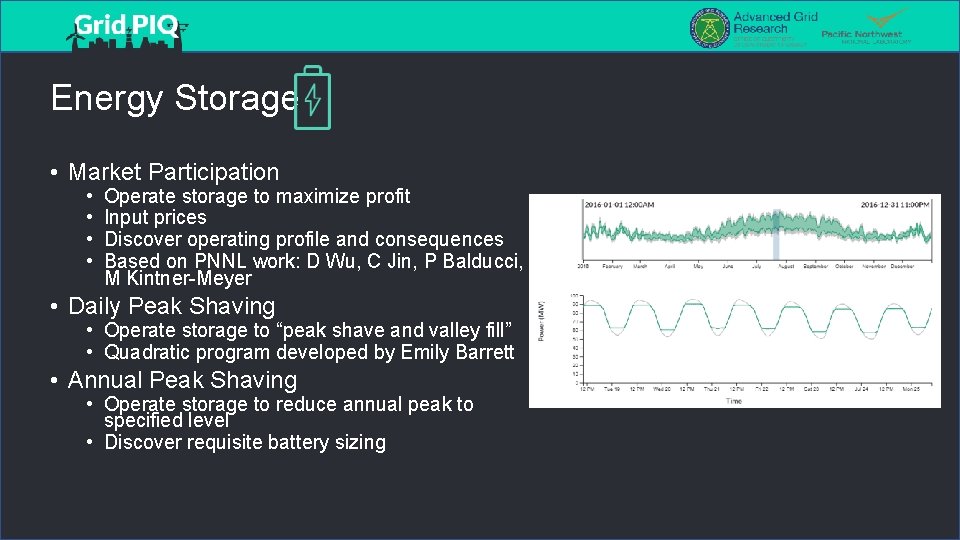
Energy Storage • Market Participation • • Operate storage to maximize profit Input prices Discover operating profile and consequences Based on PNNL work: D Wu, C Jin, P Balducci, M Kintner-Meyer • Daily Peak Shaving • Operate storage to “peak shave and valley fill” • Quadratic program developed by Emily Barrett • Annual Peak Shaving • Operate storage to reduce annual peak to specified level • Discover requisite battery sizing
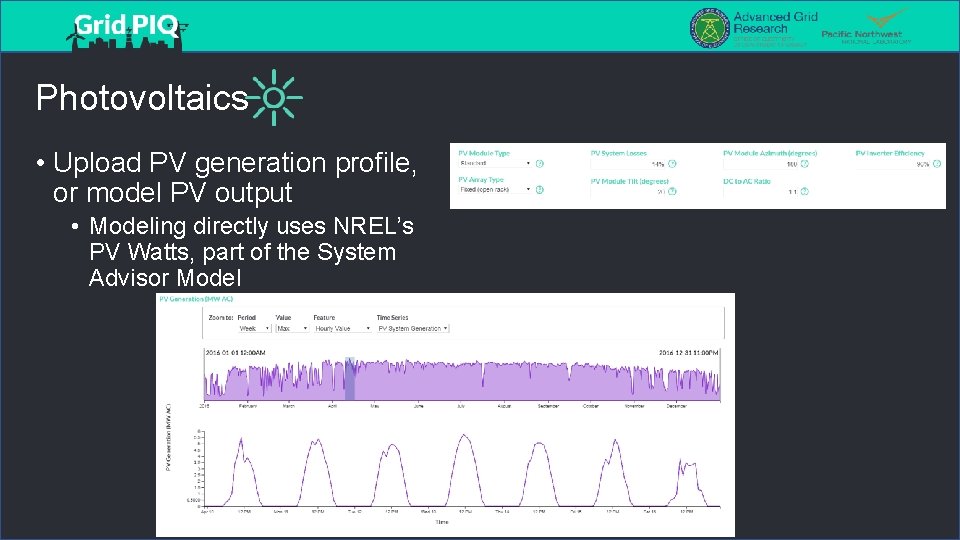
Photovoltaics • Upload PV generation profile, or model PV output • Modeling directly uses NREL’s PV Watts, part of the System Advisor Model
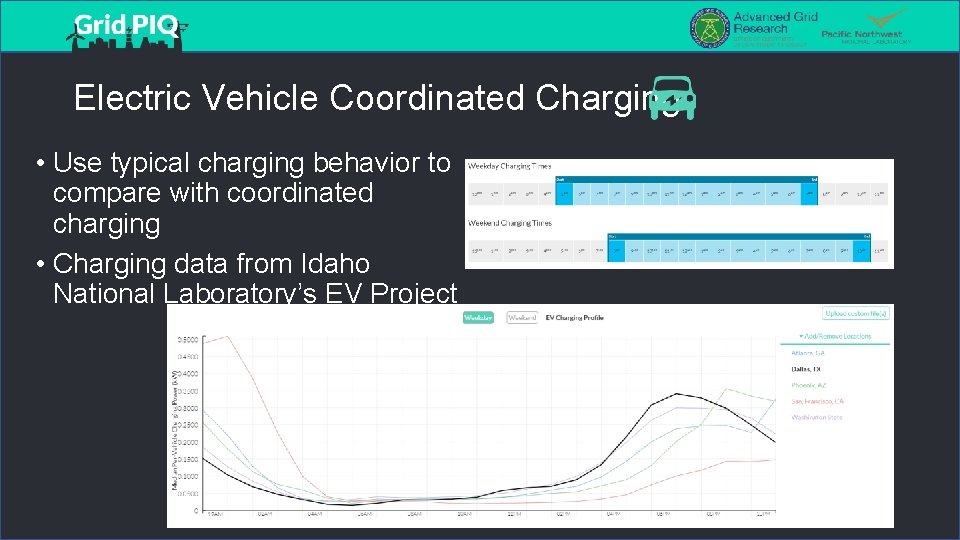
Electric Vehicle Coordinated Charging • Use typical charging behavior to compare with coordinated charging • Charging data from Idaho National Laboratory’s EV Project
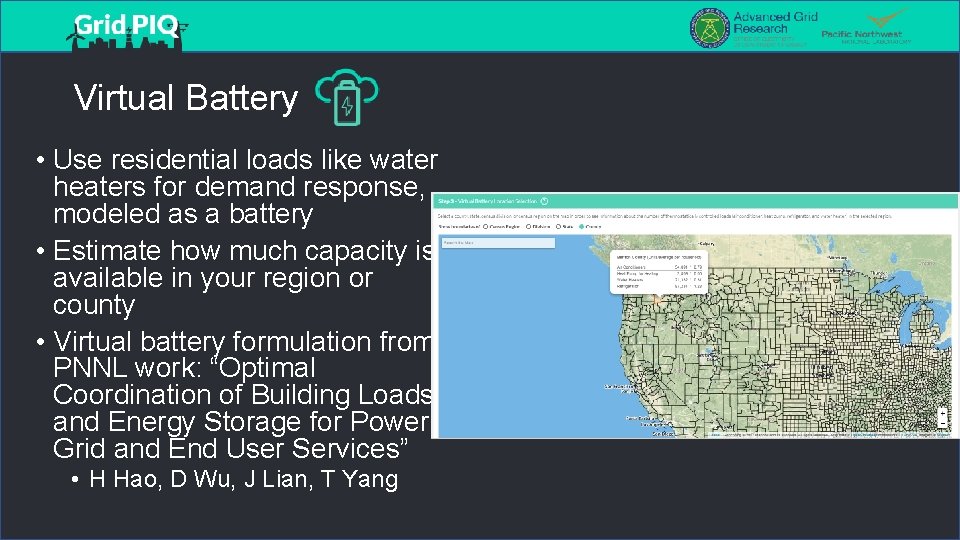
Virtual Battery • Use residential loads like water heaters for demand response, modeled as a battery • Estimate how much capacity is available in your region or county • Virtual battery formulation from PNNL work: “Optimal Coordination of Building Loads and Energy Storage for Power Grid and End User Services” • H Hao, D Wu, J Lian, T Yang

What’s Next?
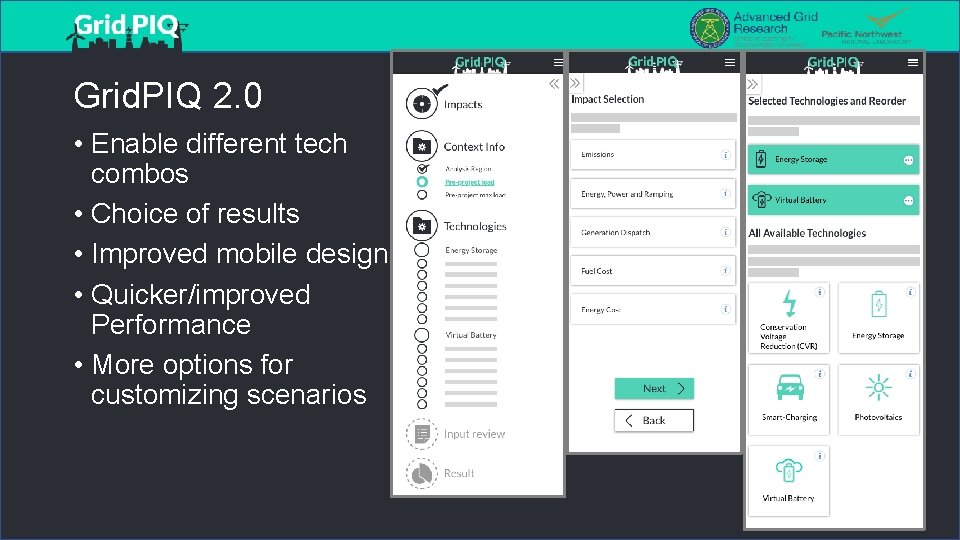
Grid. PIQ 2. 0 • Enable different tech combos • Choice of results • Improved mobile design • Quicker/improved Performance • More options for customizing scenarios
Get involved! • Contact us if you’d like to join the Grid. PIQ Steering Committee. Meet once a year to influence future development of the project, check progress, and make sure Grid. PIQ meets your needs • Use the calculator: Grid. PIQ. pnnl. gov • Partner for analysis • Incorporate your methodology or tool with Grid. PIQ • News about this and other Advanced Grid Research on Smart. Grid. gov • gridpiq@pnnl. gov, 206 -528 -3487
- Slides: 15