
Introducing the BRAIN and Spinal Cord Any questions
Introducing the BRAIN and Spinal Cord
Any questions for a scientist? Ask your parents to email us! sarah. gundy@nuigalway. ie Unit 5 A: Keeping Healthy
What Do We Want to Know? What is Parkinson’s disease? What is a neuron? How does the brain send messages to the body?
Parkinson’s Disease Michael J. Fox is a famous actor who now has Parkinson’s disease Watch a video of Michael J. Fox Listen as he describes what it is like living with Parkinson’s disease Video can be accessed at: https: //www. youtube. com/watch? v=ECk. PVTZlf. P 8
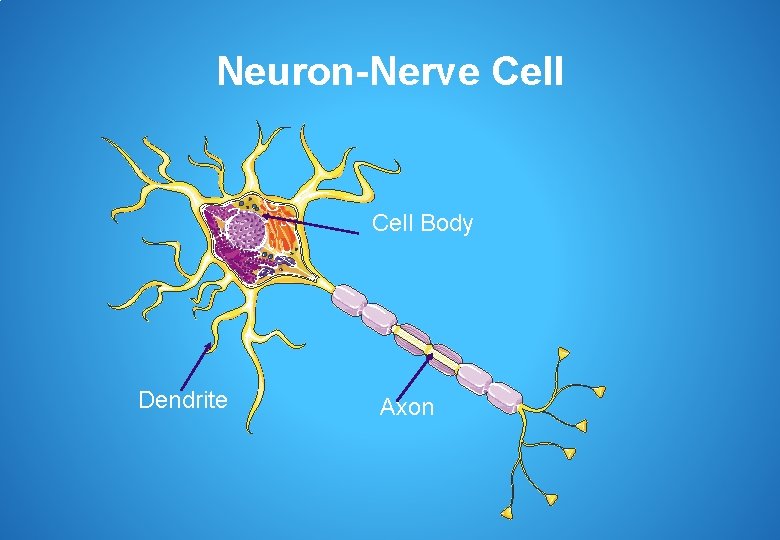
Neuron-Nerve Cell Body Dendrite Axon

Neuron 1 The region where two neurons meet is called the synapse The synapse is a gap between the neurons that the message must jump across Chemicals, called neurotransmitters, carry the messages across the gaps Neuro. Synapse transmitters Dopamine is a type of neurotransmitter in the brain Neuron 2
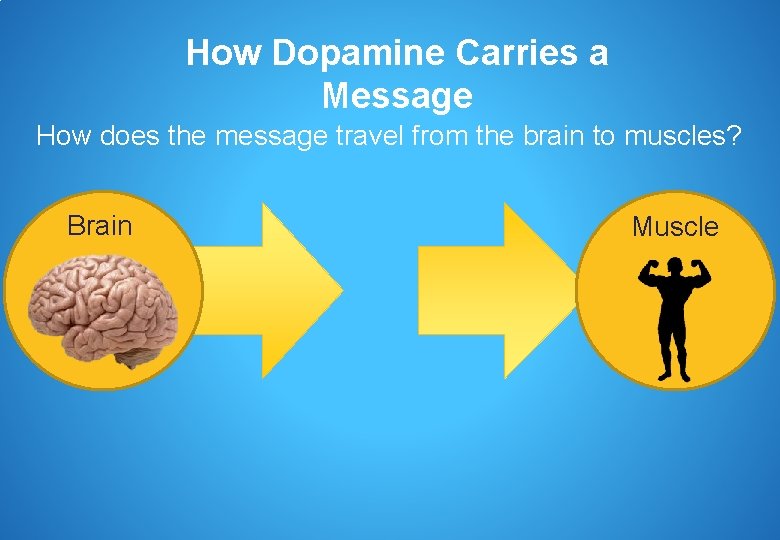
How Dopamine Carries a Message How does the message travel from the brain to muscles? Brain Muscle
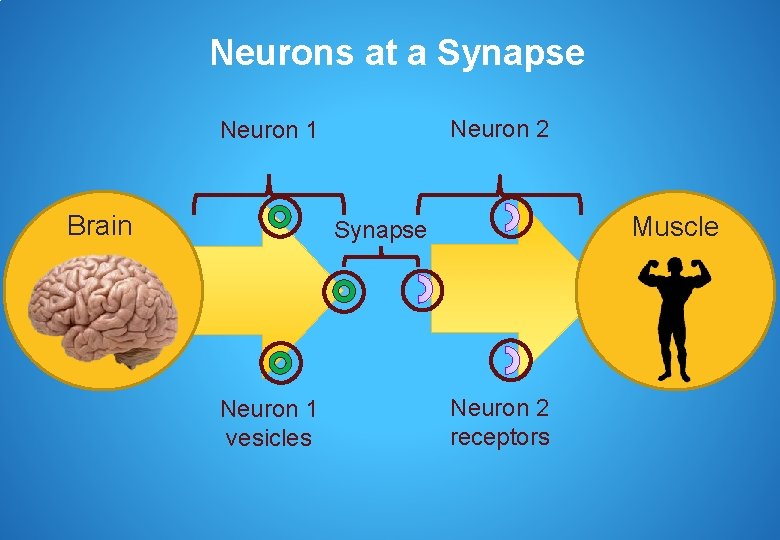
Neurons at a Synapse Neuron 2 Neuron 1 Brain Muscle Synapse Neuron 1 vesicles Neuron 2 receptors
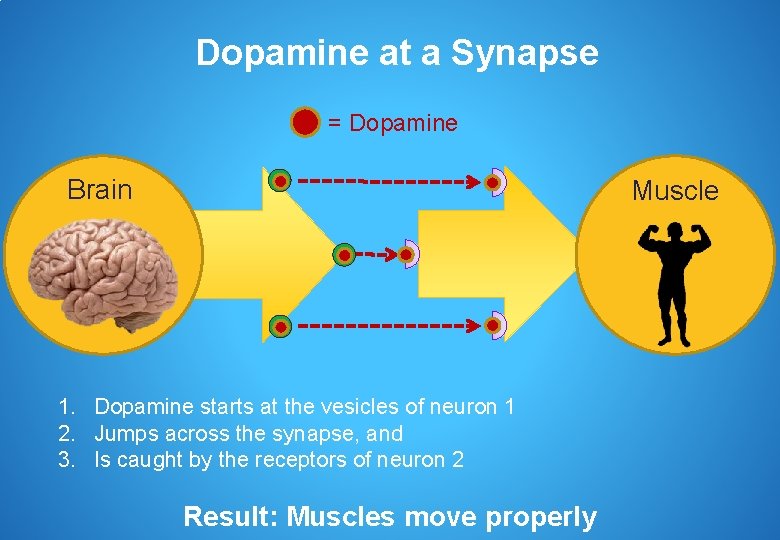
Dopamine at a Synapse = Dopamine Brain Muscle 1. Dopamine starts at the vesicles of neuron 1 2. Jumps across the synapse, and 3. Is caught by the receptors of neuron 2 Result: Muscles move properly
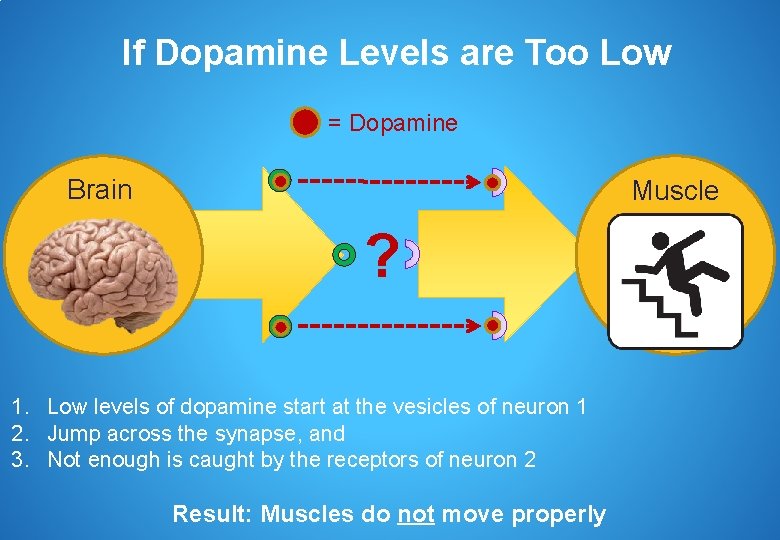
If Dopamine Levels are Too Low = Dopamine Brain Muscle ? 1. Low levels of dopamine start at the vesicles of neuron 1 2. Jump across the synapse, and 3. Not enough is caught by the receptors of neuron 2 Result: Muscles do not move properly
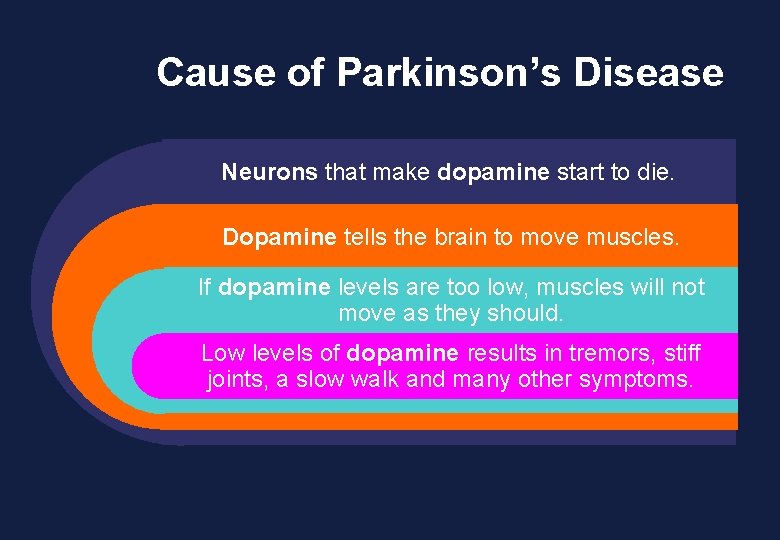
Cause of Parkinson’s Disease Neurons that make dopamine start to die. Dopamine tells the brain to move muscles. If dopamine levels are too low, muscles will not move as they should. Low levels of dopamine results in tremors, stiff joints, a slow walk and many other symptoms.

Substantia Nigra Dopamine is released by a structure in the brain called the substantia nigra. In Parkinson’s disease, neurons in the substantia nigra are damaged which causes too little dopamine to be released. substantia nigra
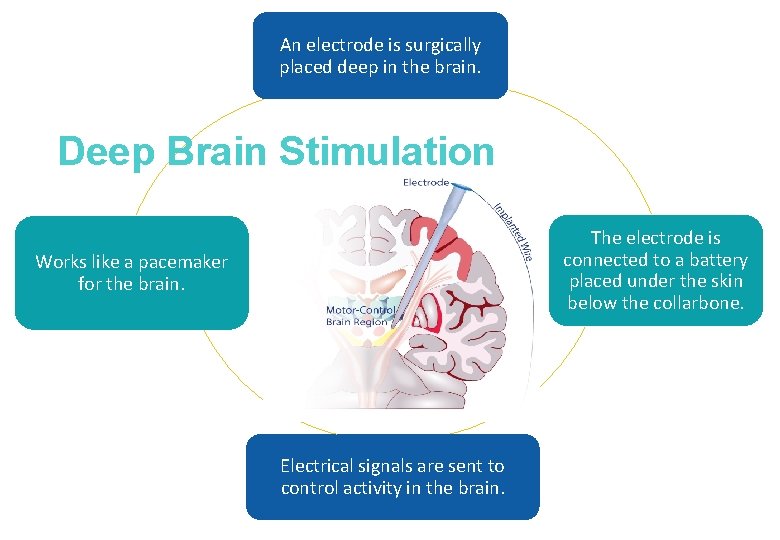
An electrode is surgically placed deep in the brain. Deep Brain Stimulation The electrode is connected to a battery placed under the skin below the collarbone. Works like a pacemaker for the brain. Electrical signals are sent to control activity in the brain.
Activity: Designing a Medical Device Design and build a medical device to go deep in the brain for deep brain stimulation Steps: 1. Plan 2. Build 3. Test 4. Questio n
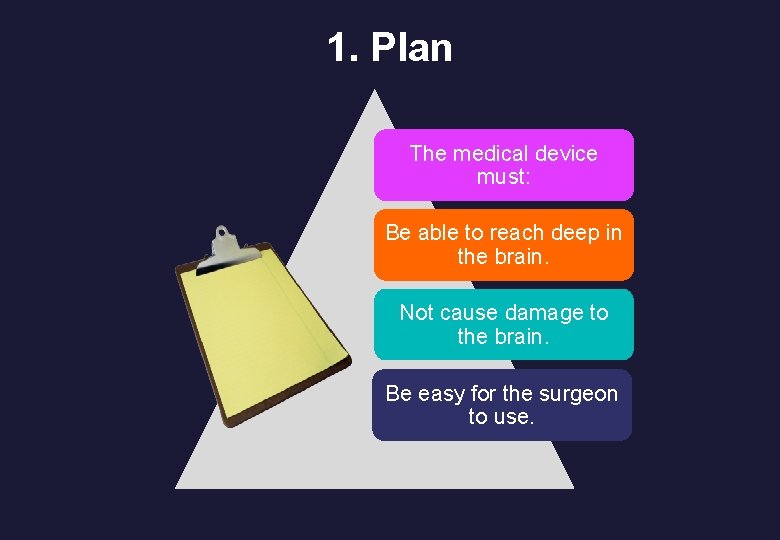
1. Plan The medical device must: Be able to reach deep in the brain. Not cause damage to the brain. Be easy for the surgeon to use.
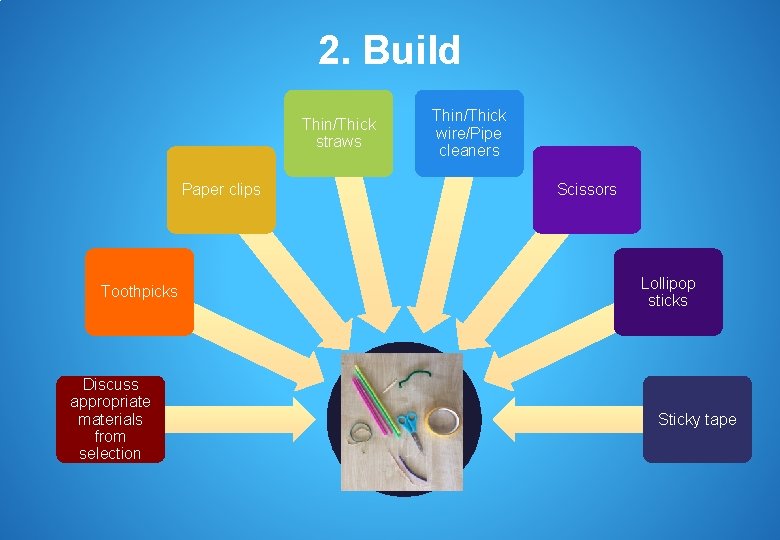
2. Build Thin/Thick straws Paper clips Toothpicks Discuss appropriate materials from selection Thin/Thick wire/Pipe cleaners Scissors Lollipop sticks Sticky tape
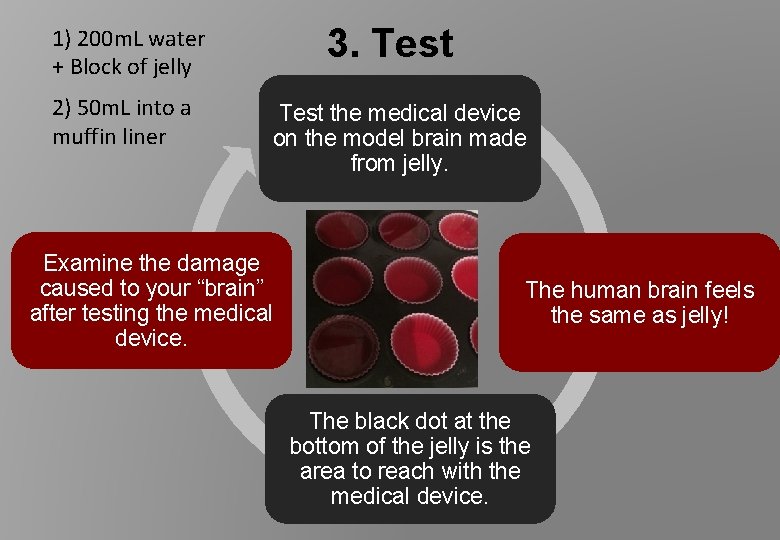
3. Test 1) 200 m. L water + Block of jelly 2) 50 m. L into a muffin liner Test the medical device on the model brain made from jelly. Examine the damage caused to your “brain” after testing the medical device. The human brain feels the same as jelly! The black dot at the bottom of the jelly is the area to reach with the medical device.
4. Question Do you think you fixed your brain? Why or why not? If you were doing the activity again, what would you do differently?
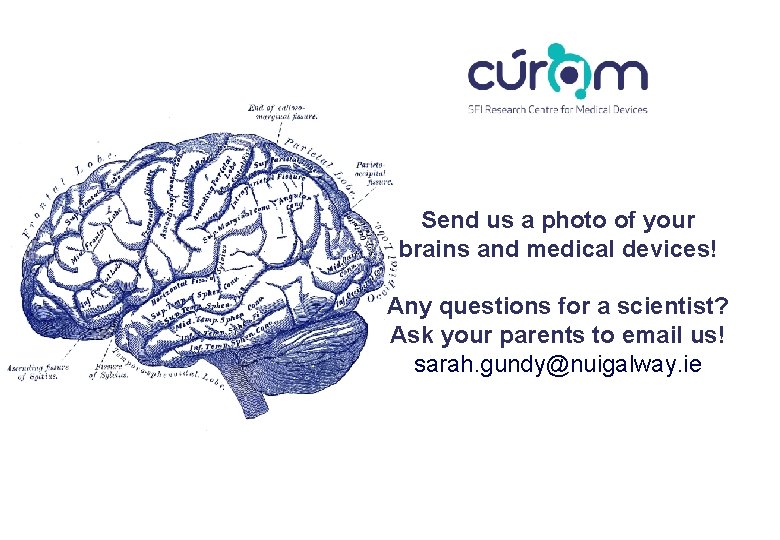
Send us a photo of your brains and medical devices! Any questions for a scientist? Ask your parents to email us! sarah. gundy@nuigalway. ie Unit 5 A: Keeping Healthy
References: 1. www. flickr. com 2. www. pixabay. com 3. smart. servier. com 4. commons. wikimedia. org 5. Gray’s Anatomy Acknowledgements: Sincere thanks to all of the researchers who gave lectures and generously gave their time throughout the course. Thanks also to all the participating teachers who very kindly shared ideas and resources.
This publication has emanated from research conducted with the financial support of Science Foundation Ireland (SFI) and is co-funded under the European Regional Development Fund under Grant Number 13/RC/2073. This project has been funded by the European Union Seventh Framework Programme under Marie Curie Initial Training Networks (FP 7 -PEOPLE-2012 -ITN) and Grant Agreement Number 317304 (Angio. Mat. Train). This project has also been funded by the European Union Horizon 2020 Programme (H 2020 -MSCAITN-2015) under the Marie Skłodowska-Curie Innovative Training Networks and Grant Agreement Numbers 676408 (Brain. Mat. Train) and 676338 (Tendon Therapy Train).
- Slides: 21