
Introducing SEAMCAT Spectrum Engineering Advanced Monte Carlo Analysis


- Slides: 34
Introducing SEAMCAT Spectrum Engineering Advanced Monte Carlo Analysis Tool José Carrascosa SEAMCAT Project Manager jose. carrascosa@eco. cept. org European Communications Office 28 July 2016
Presentation outline (1/4) Part 1 - Introduction to SEAMCAT • • • Why SEAMCAT? What is SEAMCAT? The Monte Carlo method Schematic compatibility scenario Software overview
Presentation outline (2/4) Part 2 - SEAMCAT development • SEAMCAT development: – Context – History – Objectives
Presentation outline (3/4) Part 3 - SEAMCAT 5 features • How SEAMCAT 5 responds to the main development objectives: – Flexibility – Reliability – Computation speed – User-friendliness – Recognition
Presentation outline (4/4) Part 4 - Summary • SEAMCAT in brief • Where can I download SEAMCAT ? • Where can I find documentation?
Part 1 - Introduction to SEAMCAT
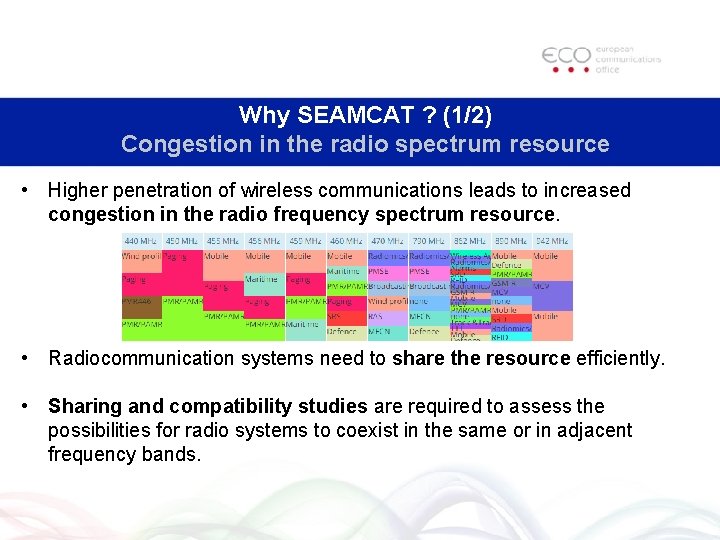
Why SEAMCAT ? (1/2) Congestion in the radio spectrum resource • Higher penetration of wireless communications leads to increased congestion in the radio frequency spectrum resource. • Radiocommunication systems need to share the resource efficiently. • Sharing and compatibility studies are required to assess the possibilities for radio systems to coexist in the same or in adjacent frequency bands.
Why SEAMCAT ? (2/2) Need for tools that lead to effective radio spectrum use • Classic analytical methods, like the Minimum Coupling Loss method, tend to be pessimistic overestimating the interference conditions between wireless systems. • Realistic modelling of complex compatibility scenarios is needed • Monte Carlo simulations lead to more efficient use of the radio spectrum as they are able to simulate close-to-reality co -existence scenarios.
What is SEAMCAT? (1/2) Spectrum Engineering Advanced Monte Carlo Analysis Tool • Open Source software tool • Free of cost • Based on the Monte Carlo simulation method for statistical modelling of interference scenarios between radio communication systems
What is SEAMCAT? (2/2) • SEAMCAT is intended for: – Co-existence studies between radio communication systems operating in the same or adjacent frequency bands – Simulation of systems operating mainly under terrestrial services (some scenarios involving satellite systems are also possible) – Quantification of the probability of interference (probability that one system is interfered by one or more other systems) • It is not designed for network planning purposes
Brief introduction to the Monte Carlo method (1/2 ) • The Monte Carlo method is based on a set of computational algorithms that allow using randomness to solve problems that might be difficult to solve using a deterministic approach • It allows solving problems that have a probabilistic interpretation and are very useful for simulating systems which involve many variable parameters
Brief introduction to the Monte Carlo method (2/2 ) • In the Monte Carlo method, parameters that vary can be defined as random variables with a given distribution. • The basic principle is the random sampling of these distributions at each simulation run (i. e. simulation event) in order to perform a given calculation. • Results of calculations obtained at each event can then be averaged across the total number of events. • The number of events required to produce a statistically representative result depends on the number of random variables included in a given scenario.
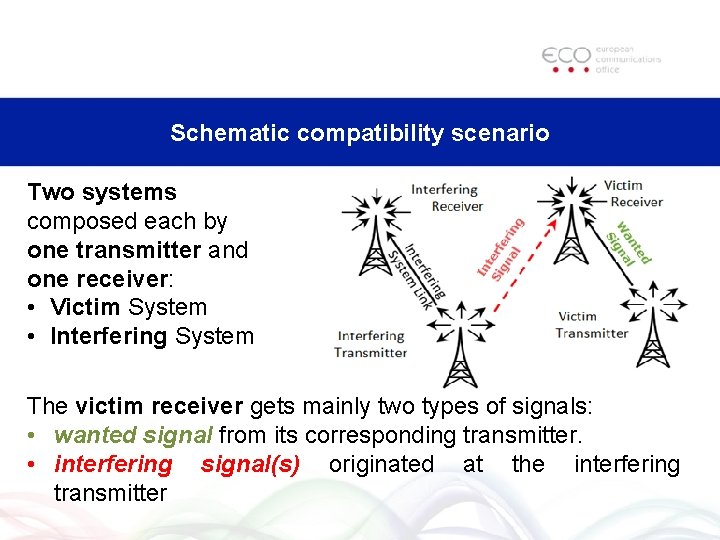
Schematic compatibility scenario Two systems composed each by one transmitter and one receiver: • Victim System • Interfering System The victim receiver gets mainly two types of signals: • wanted signal from its corresponding transmitter. • interfering signal(s) originated at the interfering transmitter
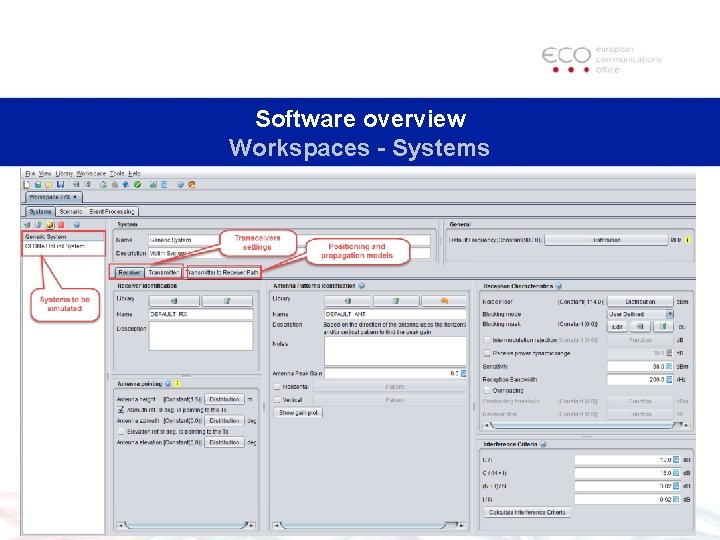
Software overview Workspaces - Systems
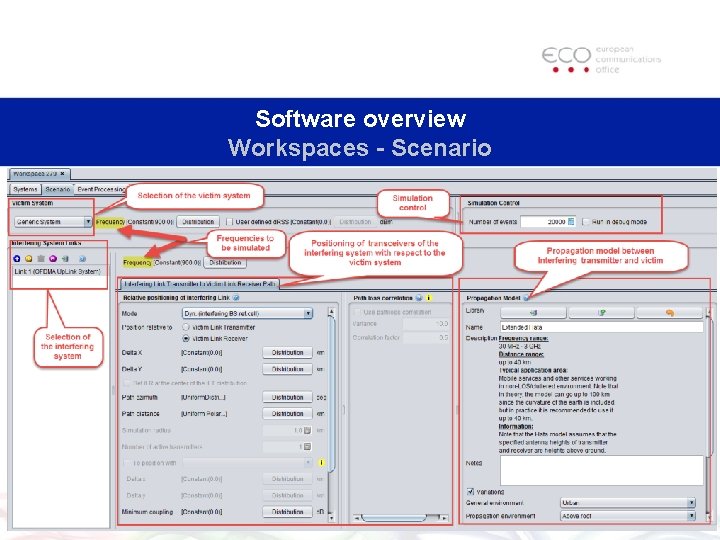
Software overview Workspaces - Scenario
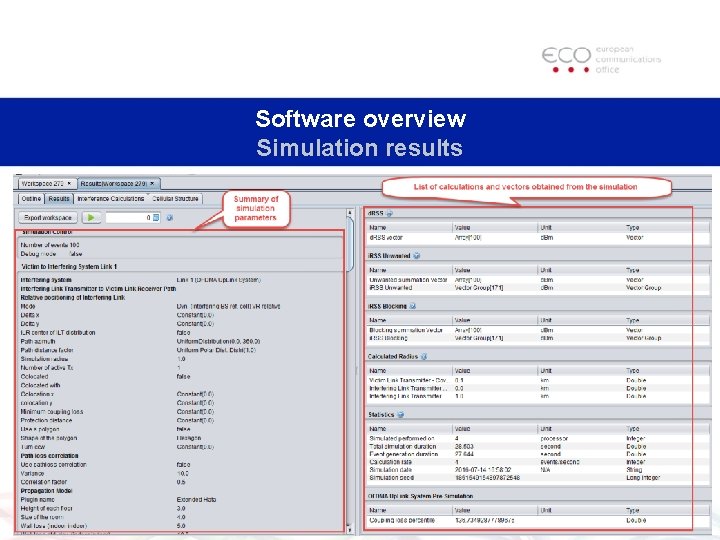
Software overview Simulation results
Part 2 - SEAMCAT development
SEAMCAT development (1/3) : Context SEAMCAT is developed within the European Conference of Postal and Telecommunications Administrations (CEPT). The CEPT brings together the postal and telecommunications regulatory authorities of 48 European countries. The European Communications Office (ECO), based in Copenhagen, Denmark, is the permanent office supporting the CEPT. SEAMCAT development is managed by the ECO in close cooperation with CEPT administrations, industry and academia.
SEAMCAT development (2/3) History • First specified in the late 1990’s and gradually developed ever since • Recent versions: • 4. 1. 0 (October 2013) • 5. 0. 0 (January 2016) • 5. 0. 1 (April 2016) • Version 5. 1. 0 is expected to be released in Autumn 2016
SEAMCAT development Objectives To produce a platform for assessing the compatibility among various wireless communication systems in a realistic manner that is: • Flexible • Reliable • Fast • User-friendly • Recognised
Part 3 - SEAMCAT 5 features
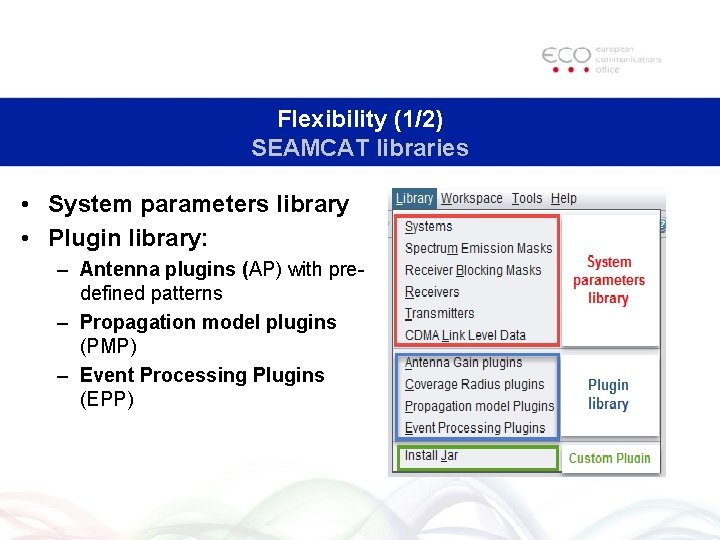
Flexibility (1/2) SEAMCAT libraries • System parameters library • Plugin library: – Antenna plugins (AP) with predefined patterns – Propagation model plugins (PMP) – Event Processing Plugins (EPP)
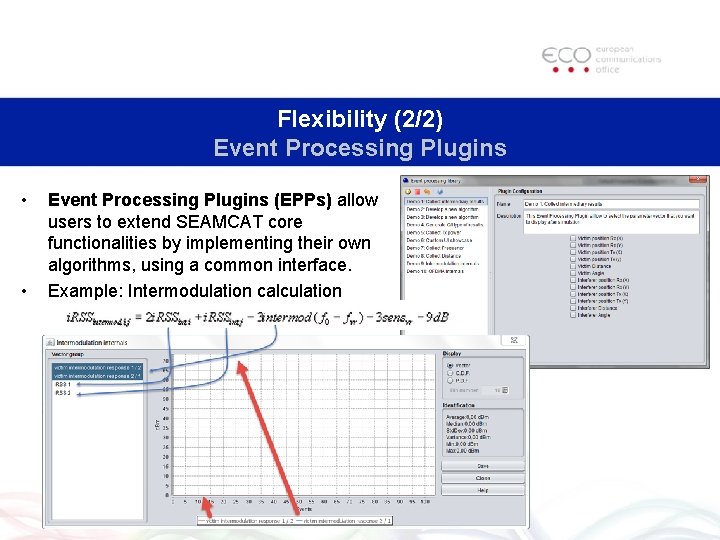
Flexibility (2/2) Event Processing Plugins • • Event Processing Plugins (EPPs) allow users to extend SEAMCAT core functionalities by implementing their own algorithms, using a common interface. Example: Intermodulation calculation
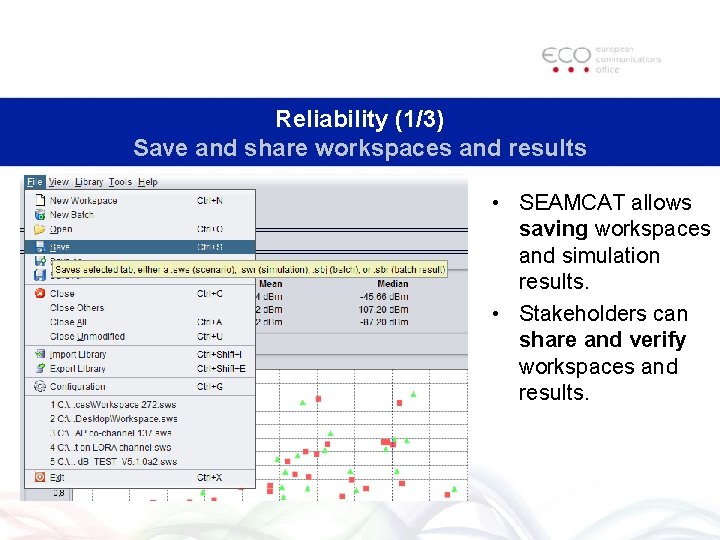
Reliability (1/3) Save and share workspaces and results • SEAMCAT allows saving workspaces and simulation results. • Stakeholders can share and verify workspaces and results.
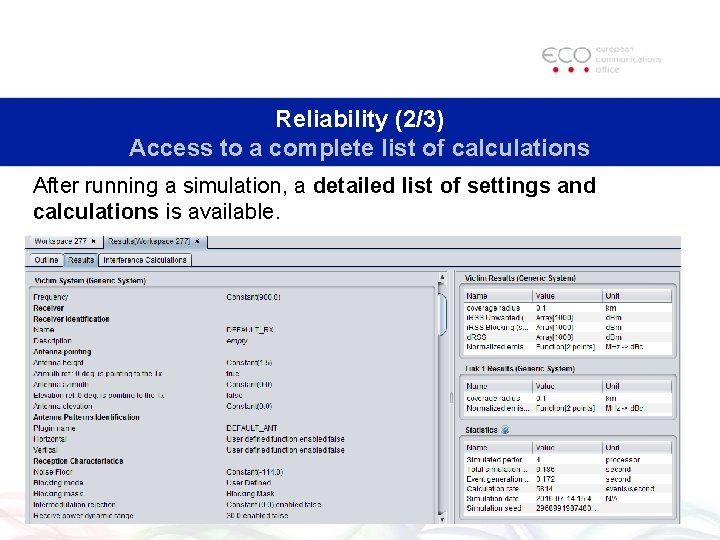
Reliability (2/3) Access to a complete list of calculations After running a simulation, a detailed list of settings and calculations is available.
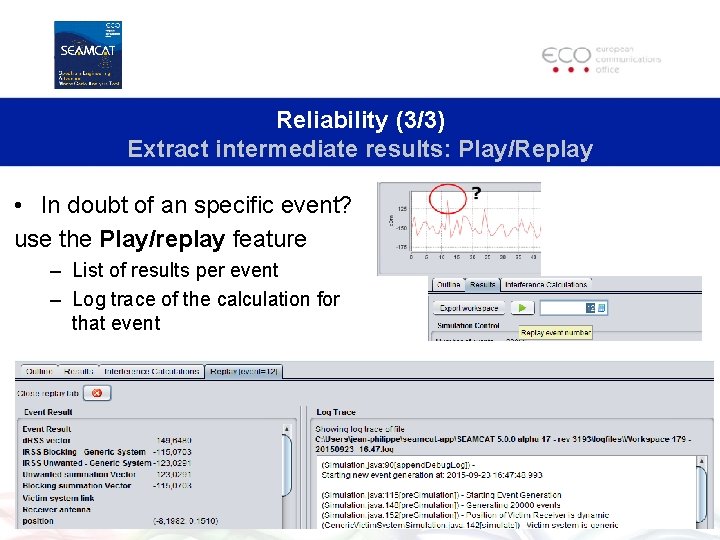
Reliability (3/3) Extract intermediate results: Play/Replay • In doubt of an specific event? use the Play/replay feature – List of results per event – Log trace of the calculation for that event
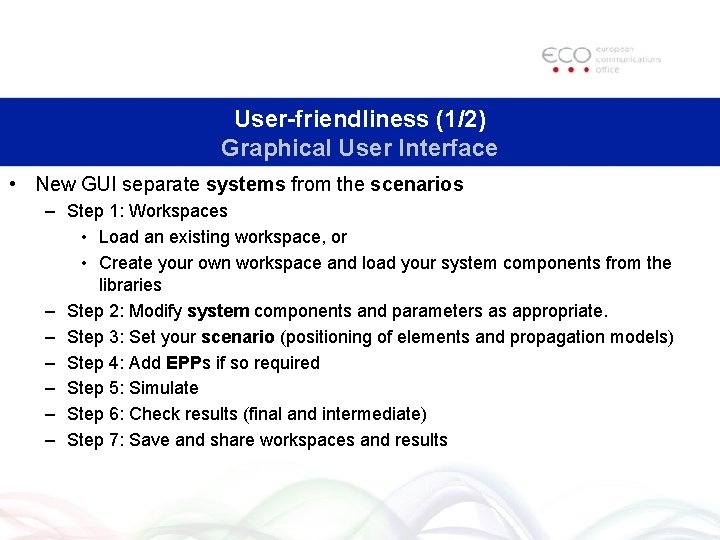
User-friendliness (1/2) Graphical User Interface • New GUI separate systems from the scenarios – Step 1: Workspaces • Load an existing workspace, or • Create your own workspace and load your system components from the libraries – Step 2: Modify system components and parameters as appropriate. – Step 3: Set your scenario (positioning of elements and propagation models) – Step 4: Add EPPs if so required – Step 5: Simulate – Step 6: Check results (final and intermediate) – Step 7: Save and share workspaces and results
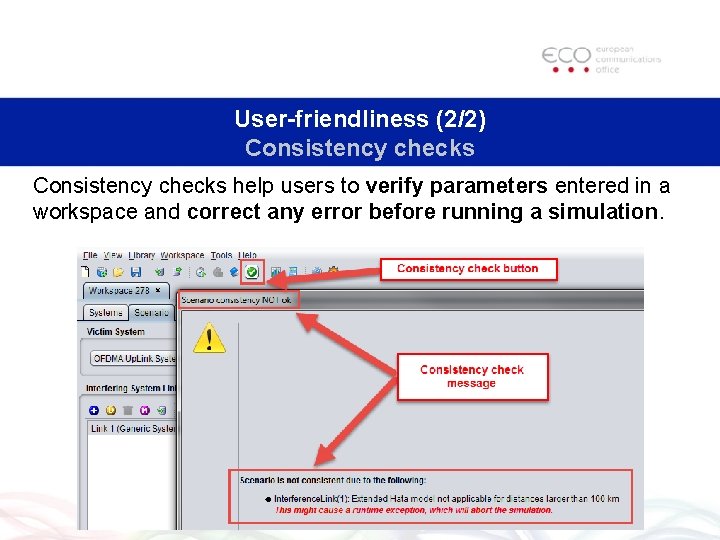
User-friendliness (2/2) Consistency checks help users to verify parameters entered in a workspace and correct any error before running a simulation.
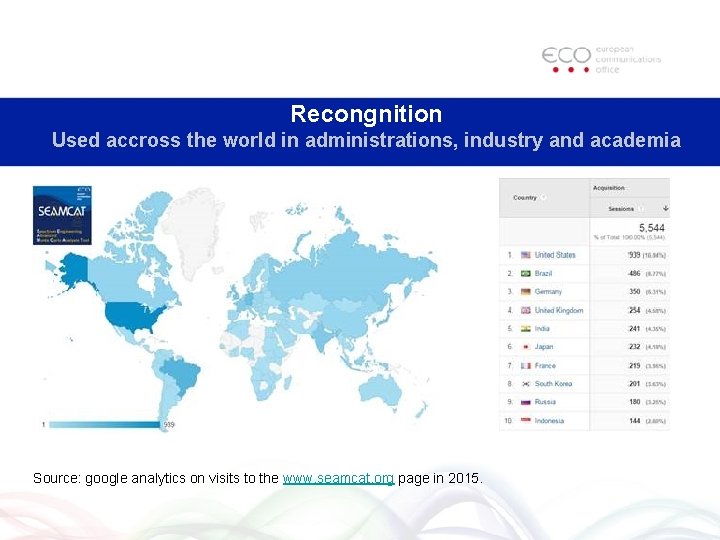
Recongnition Used accross the world in administrations, industry and academia Source: google analytics on visits to the www. seamcat. org page in 2015.
Part 4 - Summary
SEAMCAT in brief • Realistic tool for modelling complex compatibility scenarios between wireless systems, thanks to the power of the Monte Carlo method. • Flexible, thanks to libraries for system parameters and plugins. • Reliable, thanks to the possibility of saving and sharing workspaces and full simulation results, accessing a complete list of calculations and extracting intermediate results. • Faster, thanks to parallel processing. • User-friendly, thanks to recent GUI improvements, the addition of consistency checks for workspace parameters, and updates to the available documentation • Recognised by administrations, industry and academia across the World
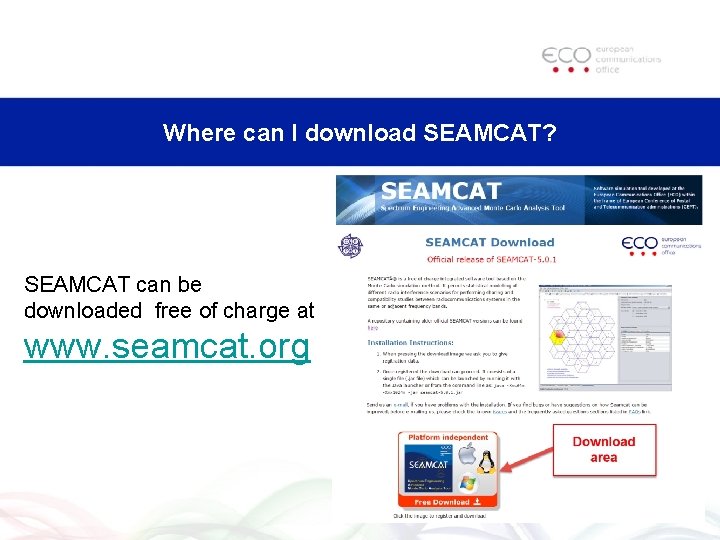
Where can I download SEAMCAT? SEAMCAT can be downloaded free of charge at www. seamcat. org
Where can I find documentation ? SEAMCAT Handbook - over 400 pages of documentation • The latest official version of the SEAMCAT handbook was approved end of April 2016. • It can be downloaded here: http: //www. cept. org/ecc/grou ps/ecc/wgse/stg/client/introduction/
Thank you ! Any questions? José Carrascosa - SEAMCAT Project Manager jose. carrascosa@eco. cept. org