
Introducing Science of Information Into a CS Upper
- Slides: 14
+ Introducing Science of Information Into a CS Upper Level Class Willamette University Computer Science Department Haiyan Cheng
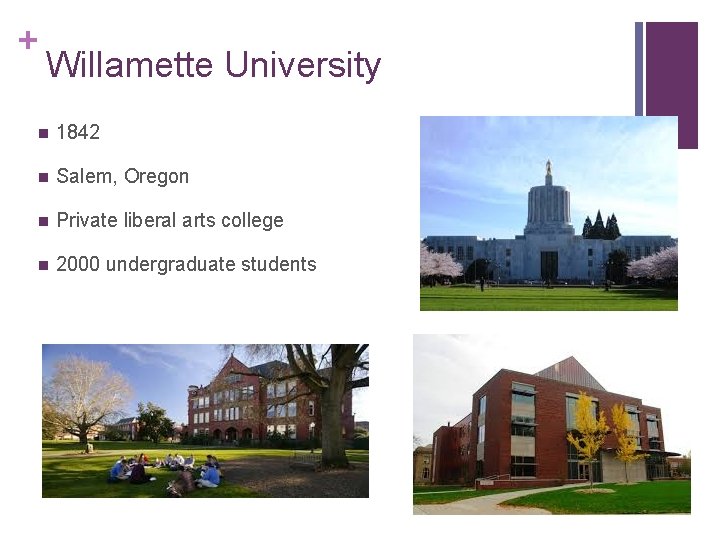
+ Willamette University n 1842 n Salem, Oregon n Private liberal arts college n 2000 undergraduate students
+ Computer Science Department n Four faculty members n Typically graduates 6 -8 CS majors per year n Teaches Quantitative Analysis (QA) courses to non-majors to satisfy General Education Requirements. n Lacking upper level electives courses. n New courses: Problem solving with Matlab, Computational Science and Applications.
+ My Involvement In the CSo. I n Attended the workshop at Purdue university at summer 2013 n Introduced the module to the CS-435 Computational Science and Application class n Two weeks theoretical contents: Science of information, Computational Science n Goals: n Introduce the concept of science of information n Make students aware the applications of science of information in various fields
+ Learning Outcomes n Understand Science of Information and its broader applications in different fields. n Understand the main issues in problem solving n Implement algorithms with Matlab to solve practical problems. n Improve proficiency in abstract thinking and independent problem solving
+ Existing Course Contents n Project oriented n Six projects n Learn subject knowledge and problem solving with Matlab n Course Deliverables: n Pop quiz n Lab projects n Final group projects
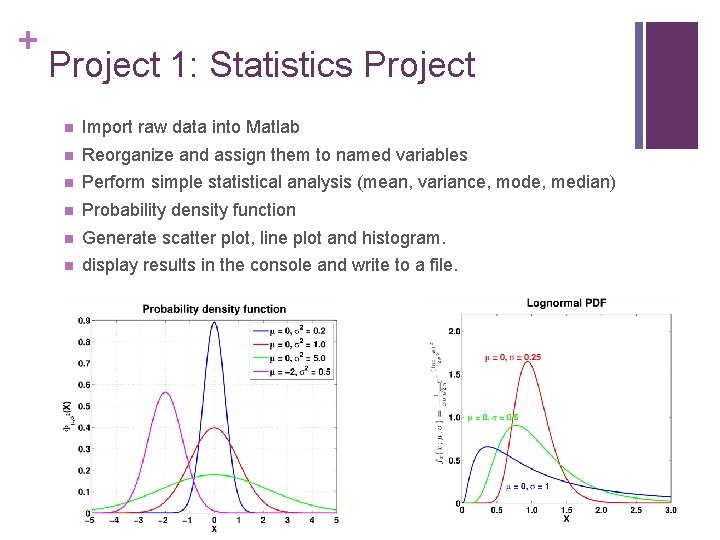
+ Project 1: Statistics Project n Import raw data into Matlab n Reorganize and assign them to named variables n Perform simple statistical analysis (mean, variance, mode, median) n Probability density function n Generate scatter plot, line plot and histogram. n display results in the console and write to a file.
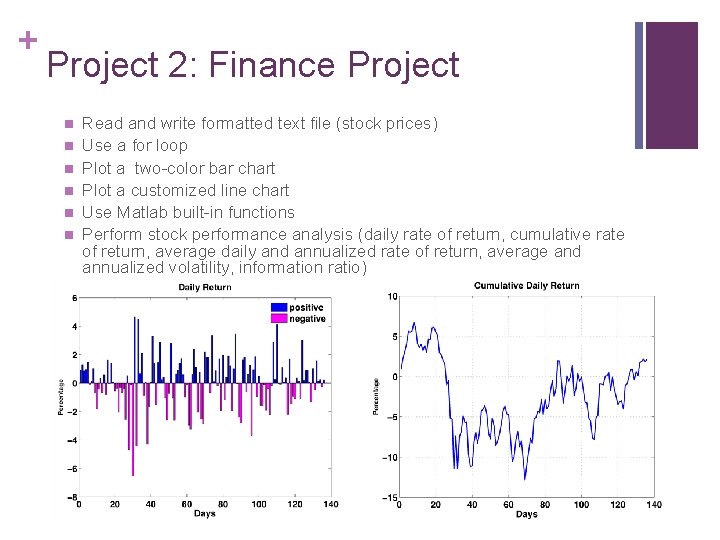
+ Project 2: Finance Project n n n Read and write formatted text file (stock prices) Use a for loop Plot a two-color bar chart Plot a customized line chart Use Matlab built-in functions Perform stock performance analysis (daily rate of return, cumulative rate of return, average daily and annualized rate of return, average and annualized volatility, information ratio)
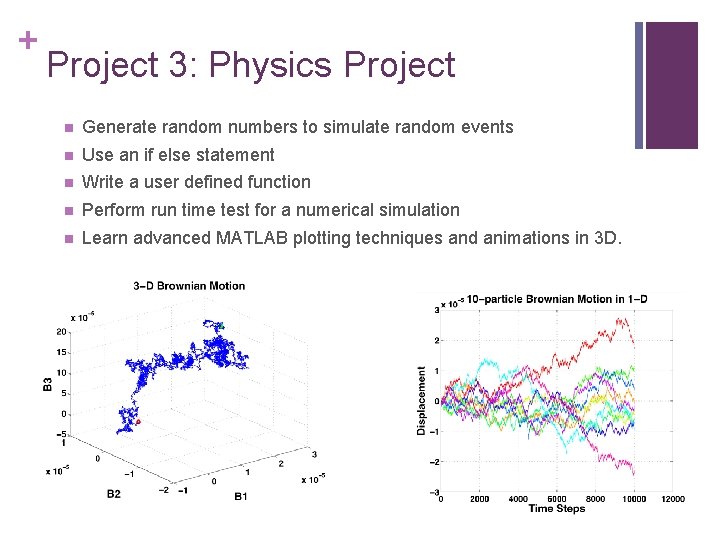
+ Project 3: Physics Project n Generate random numbers to simulate random events n Use an if else statement n Write a user defined function n Perform run time test for a numerical simulation n Learn advanced MATLAB plotting techniques and animations in 3 D.
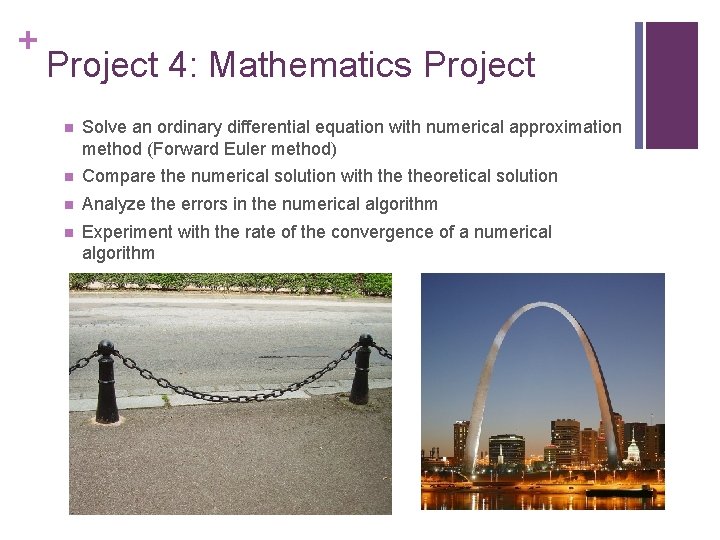
+ Project 4: Mathematics Project n Solve an ordinary differential equation with numerical approximation method (Forward Euler method) n Compare the numerical solution with theoretical solution n Analyze the errors in the numerical algorithm n Experiment with the rate of the convergence of a numerical algorithm
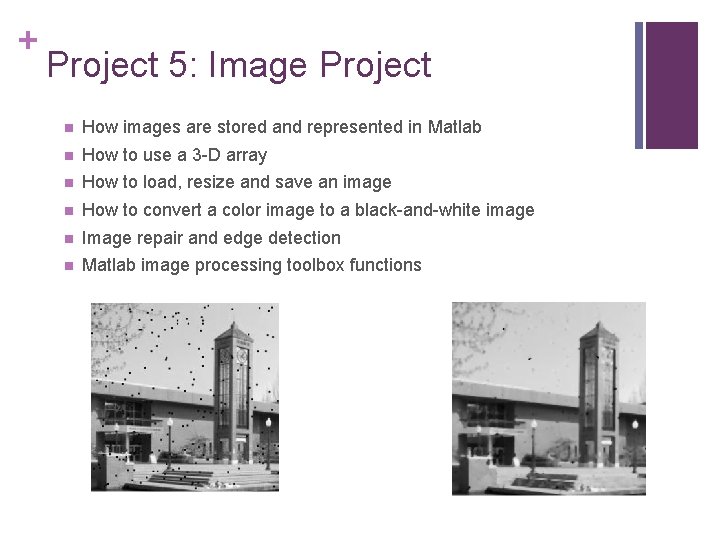
+ Project 5: Image Project n How images are stored and represented in Matlab n How to use a 3 -D array n How to load, resize and save an image n How to convert a color image to a black-and-white image n Image repair and edge detection n Matlab image processing toolbox functions
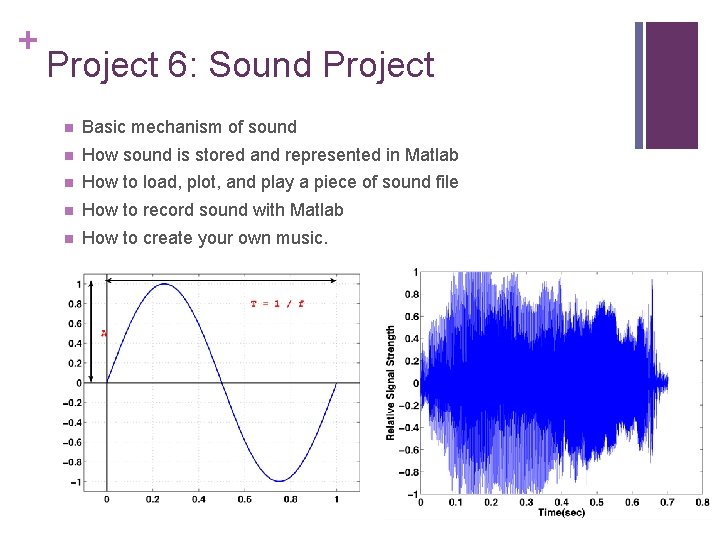
+ Project 6: Sound Project n Basic mechanism of sound n How sound is stored and represented in Matlab n How to load, plot, and play a piece of sound file n How to record sound with Matlab n How to create your own music.
+ Science of Information Module n First two weeks: Introduction to Science of information and Computational science n Require students to read and discuss implications of information and how does that affect our life. n Used Deepak Kumar’s course material (slides) for information introduction based on the book: Information: A very short introduction
+ Ideas and Plans n Can’t offer a full-fledged Science of Information course n Integrate into the current independent study course. n Test run: n First half of the semester: use existing modules to learn the subject (optionally, develop a course ware that can be used in the future. ) n Second half: work on information related projects